Installation | Tradition and Celebration across the Jewish Calendar
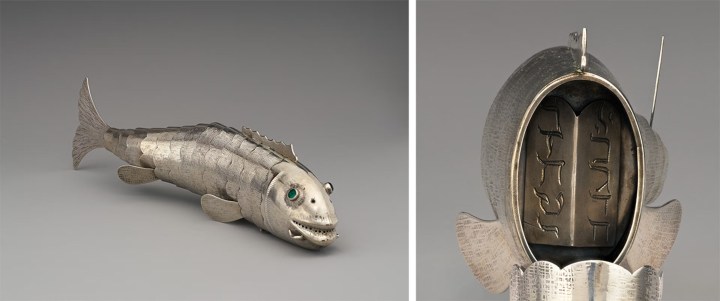
Fish-form Spice Container (Besamim), 1813, Vienna, silver, foil-backed glass, 8 × 34 × 7.6 cm, 450g
(New York: The Metropolitan Museum of Art, New York, 2025.104)
◊ ◊ ◊ ◊ ◊
Riva Arnold describes the seven works in this installation from The Met’s Department of European Sculpture and Decorative Arts:
Tradition and Celebration across the Jewish Calendar
The Metropolitan Museum of Art, New York, on view until 3 March 2026
Tucked within the galleries of the Department of European Sculpture and Decorative Arts (ESDA) is a special display of new acquisitions and objects that have never been on view before. The seven works in this temporary installation are part of a rotating exhibit of case studies organized by the department’s curators, fellows, and researchers. The current selection—on view until March 3, 2026—highlights craftsmanship, materials, and community celebrations from the Jewish populations of Austria, Italy, France, and the Netherlands between the sixteenth and nineteenth centuries.
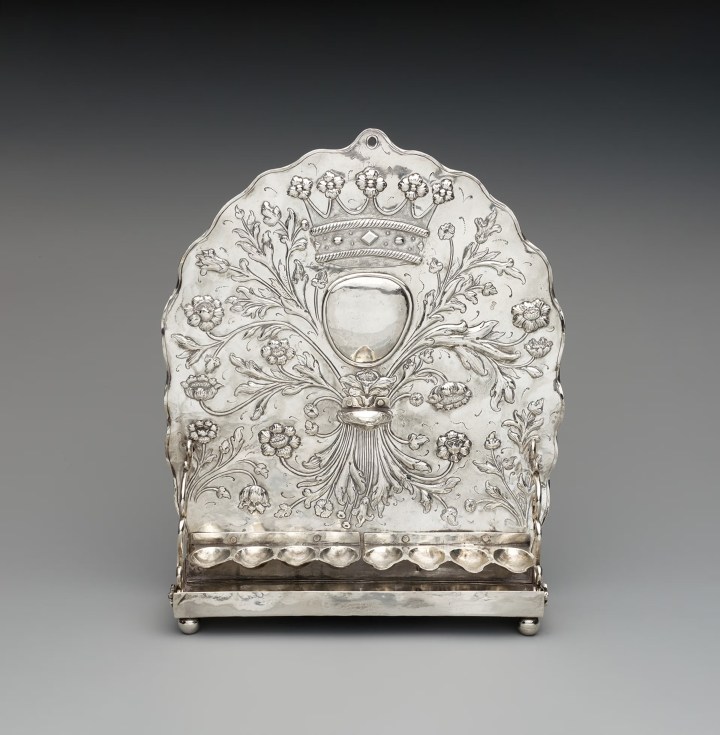
Johannes van der Lely, Hanukkah Lamp, 1706, Leeuwarden, silver, 31 × 26 cm (New York: The Metropolitan Museum of Art, 2025.585).
For over a decade, ESDA has been acquiring Judaica objects connected to Jewish life, culture, and religion. The selected items represent universal themes related to special days in the Jewish calendar, which follows a lunisolar cycle. This means that the days and months are based on the cycles of the moon, with each day beginning at sunset;[1] a leap month is added every few years to ensure that holidays are observed in their correct season. For example, Rosh Hashanah, associated with the new year, is celebrated in the fall, and Passover, associated with renewal, is in the spring.
Joyful holiday traditions and domestic milestones, such as the birth of a new baby or a wedding, kept communities together despite societal upheaval and economic fluctuations. Judaica produced in the Rococo or Baroque periods displayed extravagant decorative motifs typical of that era, with outstanding craftsmanship that evidences a material culture spanning metalwork, porcelain, leather, and enamel. . .
The full essay is available here»
Call for Papers | Imagining Britain
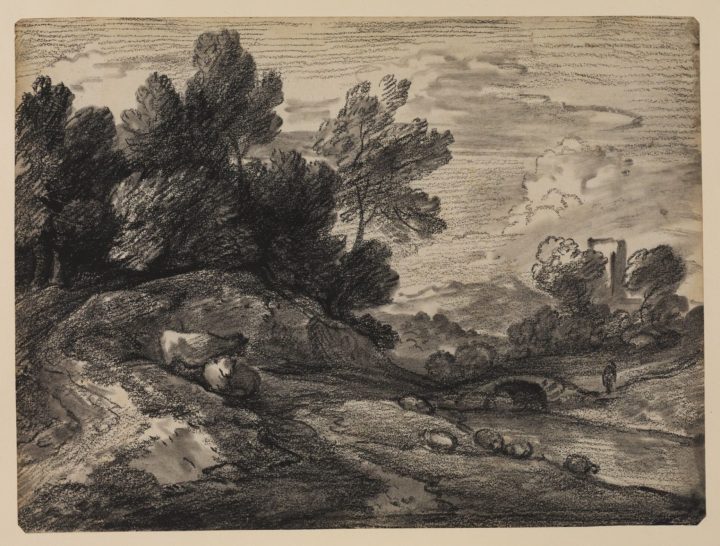
Thomas Gainsborough, Landscape with Sheep and Cattle on the Bank of a Stream, 1780–84, synthetic black chalk with stumping on wove paper, all four corners cut (London: Courtauld Gallery, Robert Clermont Witt, bequest, 1952).
◊ ◊ ◊ ◊ ◊
From The Courtauld:
Imagining Britain: Postgraduate and Early Career Research in British and Irish Art
The Courtauld Institute of Art, London, 9 June 2026
Organized by Claire Ó Nualláin and Clara Shaw
Proposals due by 9 March 2026
In recent decades, a significant aspect of British art studies has involved reflection on the nature and boundaries of the field itself, debated critically and curatorially.
A decade on from the inaugural provocation of British Art Studies volume I, published in November 2015, in which art historians responded to the statement, “There’s No Such Thing as British Art,” the expansion of the field’s geographic and intellectual perspectives has opened new research avenues. Increasingly, scholars have recognised the possibilities afforded to the study of British art when it is brought into dialogue with the arts of regions which have hitherto been marginalised in its discussion, including Ireland and former colonial territories. This introspection has instigated a reexamination of British collections, with major rehangs including at Tate Britain and the Yale Center for British Art, encouraging fresh perspectives on canonical works of art and the emergence of lesser-known artists and histories from the archive. In 2025, the Courtauld Institute of Art announced the opening of the Manton Centre for British Art, a major new initiative in the field providing new contexts in which to explore the definition, scope, and even relevance of the concept of ‘British’ art.
In light of these exciting developments in the study of British and Irish art, we wish to announce a call for papers from postgraduate and early career researchers responding to the theme Imagining Britain. This student-led symposium aims to provide an interdisciplinary, cross-period forum for fruitful discussions interrogating the role of visual and material culture in reinforcing, challenging and complicating the notion of ‘British.’
We welcome proposals for fifteen to twenty-minute papers exploring any aspect of the visual histories of Britain and Ireland from medieval to the present day that address issues including, but not limited to:
• Reflections on the historiography of British and Irish art, and the influence of major collectors and institutions in constructing its canon
• Histories of state or monarchical deployment of art and material culture to construct or shape national identity
• Case studies of the role of art and visual culture in responding to questions of British identity, particularly from underrepresented perspectives
• Longue durée analysis of the development of British art
• Analyses of canonical works of British art from post-colonial and post-Imperial perspectives
Please send paper proposals (250–400 words) and a full CV to Claire Ó Nualláin c2400367@courtauld.ac.uk and Clara Shaw c2101718@courtauld.ac.uk. The deadline for applications is Monday, 9 March. Applicants will be informed about decisions by early April. Successful applicants will be encouraged, where possible, to use institutional funding they have available for travel and accommodation, as only minimal funding from the Courtauld will be available and this will be reserved for early career candidates and those without institutional support.
Supported by the CHASE Doctoral Training Partnership.










leave a comment