Exhibition | Seeds of Exchange
Now on view at the Garden Museum:
Seeds of Exchange: Canton and London in the 1700s
Garden Museum, London, 11 February — 10 May 2026
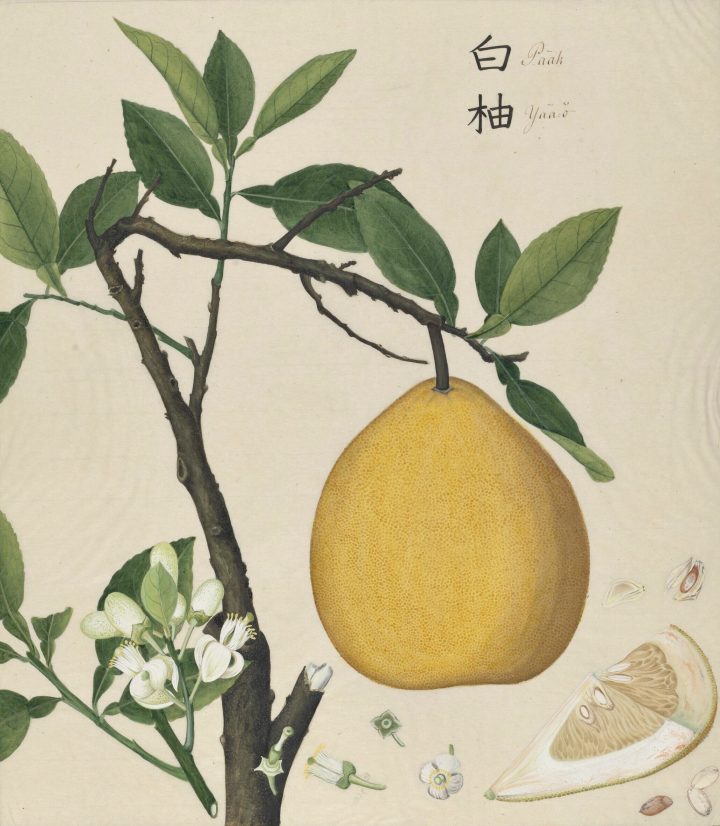
Mak Sau (Mauk-Sow-U) 麥秀, Citrus Maxima, 1771 (Upperville, VA: Oak Spring Garden Foundation).
Discover the relationship between John Bradby Blake (1745–1773), an English botanist who worked as a supercargo for the East India Company in the 1770s, his Chinese interlocutor Whang At Tong 黃遏東, and Mak Sau 麥秀, the botanical artist Bradby Blake commissioned to document plants native to Canton.
The exhibition explores the exchange of botanical knowledge shared between Canton (now Guangzhou) and London between 1766 and 1773, displaying a collection of Chinese botanical art and research for the first time in Britain since it was commissioned 235 years ago. Featuring 30 botanical paintings by the artist Mak Sau together with herbals, maps, models, a portrait of Whang At Tong by Sir Joshua Reynolds (1723–1792), and watercolours and drawings of Canton from the V&A, Seeds of Exchange tells the story of a little-known international botanical collaboration.
Bradby Blake worked in Canton in the late 1760s until his death in 1773, during which time he commissioned more than 150 botanical paintings of Chinese plants, the makings of an unfinished ‘Compleat Chinensis’. In his garden in Canton, he grew local plants such as Camellia japonica, Kumquat (Citrus japonica), and tangerines from seeds and cuttings, documenting and recording information about seed germination and growing conditions and sending seeds and plants to England. The exhibition brings together Bradby Blake’s archive of Chinese herbals and research material, reuniting the botanical paintings they inspired for the first time in 235 years.
The exhibition is produced in collaboration with the Oak Spring Garden Foundation in Virginia, where Bradby Blake’s archive is now held.
New Book | The China Question
From Cambridge UP:
Ho-fung Hung, The China Question: Eight Centuries of Fantasy and Fear (Cambridge: Cambridge University Press, 2026), 336 pages, ISBN: 978-1009559775, £30 / $40.
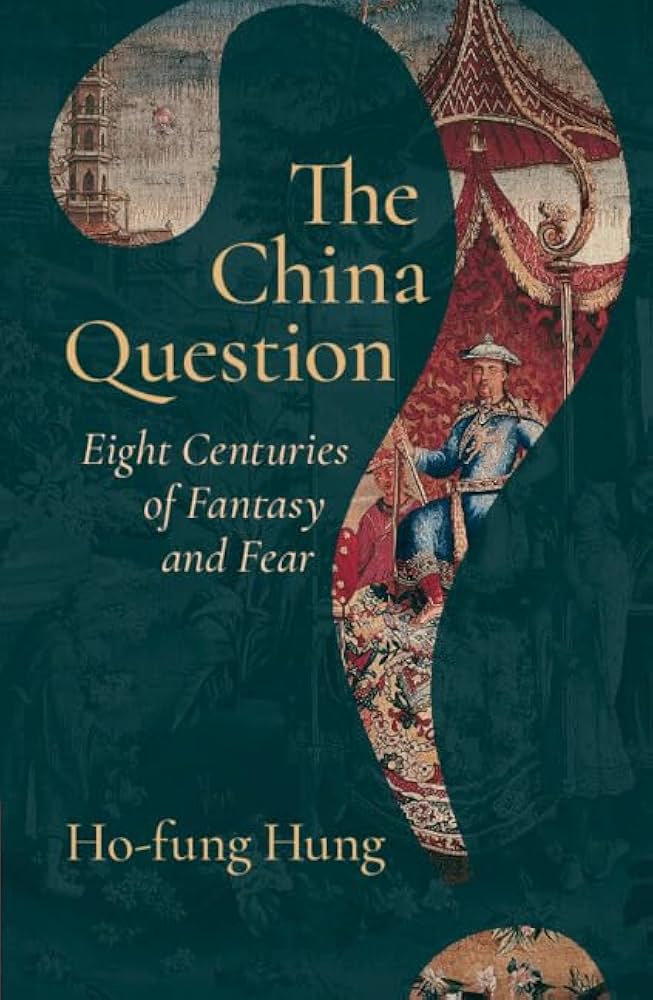 For centuries, Western scholars portrayed China either as a land of superior morality, economy, and governance or as a formidable country of pagans that posed a global threat to Western values. Idealized images of China were used to shame rulers for their incompetence, while China was demonized as an external threat to cover up domestic political failures. In the twentieth century, the geopolitics of global capitalism have facilitated more nuanced perspectives, but the diversifying of knowledge about China is far from complete. In this thought-provoking study, Ho-fung Hung finds that both Western elites and China’s authoritarian regime today continue to promote many Orientalist stereotypes to advance their economic interests and political projects. He shows how big-picture historical, social, and economic changes are inextricably linked to fluctuations in the realm of ideas. Only open debate can overcome extremes of fantasy and fear.
Ho-fung Hung is Henry M. and Elizabeth P. Wiesenfeld Professor in Political Economy in the Department of Sociology and Nitze School of Advanced International Studies, Johns Hopkins University.
c o n t e n t s
Figures
Preface
Introduction: Orientalism in the Longue Durée
I | Catholic Scholarship
1 From Pax Mongolica to the Long Sixteenth Century
2 The Seventeenth-Century Crisis and the Rise of Sinophilia
II | Enlightenment Philosophy
3 Early Enlightenment Sinophilia
4 Late Enlightenment Sinophobia
III | Institutionalized Orientalism
5 Romantic Sinology after the French Revolution
6 Scientific-Racist Sinology in the Age of Empire
IV | Cold War Area Studies
7 From Sinology to China Studies
8 The ‘Asiatic Mode of Production’ Myth
V | Self-Orientalism
9 Self-Orientalizing Nation Building
10 Contested Confucianism
Conclusion: De-Orientalizing Triumph, Re-Orientalizing Perils
References
Index
Exhibition | Philadelphia, China Trade, and the Making of America
From the press release (2 February 2026) for the exhibition . . .
Seeking Profit and Power: Philadelphia, China Trade, and the Making of America
Independence Seaport Museum, Philadelphia, 20 March — 3 January 2028
Curated by Susan Gail Johnson and Brett Palfreyman
Eager to prove itself worthy of trading on the world stage as a newly formed nation 250 years ago, America—and especially Philadelphians—embarked on the risky venture of trading with China by entrusting private citizens with the work of establishing trade and diplomatic relationships with the Chinese. Merchants saw dramatic opportunities to make money, building some of the fortunes that helped expand Philadelphia’s role as a major port and city. To celebrate the country’s 250th anniversary, Independence Seaport Museum presents Seeking Profit and Power: Philadelphia, China Trade, and the Making of America, a new exhibition informed by the latest scholarship and featuring approximately 150 unique, rarely seen objects from its collection ranging from ship logs and cargo manifests to examples of rare Chinese export porcelain, Chinese silks and sample books, to portraits of American and Chinese merchants, some of which will be exhibited for the first time. Additionally, museums and private collections, including George Washington’s Mount Vernon, The Society of The Cincinnati, The Dietrich American Foundation, and Andalusia Historic House and Gardens have also loaned important objects for Seeking Profit and Power. While other institutions can tell different aspects of this story, ISM is uniquely positioned to share it through its mission and location on the Delaware River, where Philadelphia’s China trade vessels launched and their cargo was unloaded.
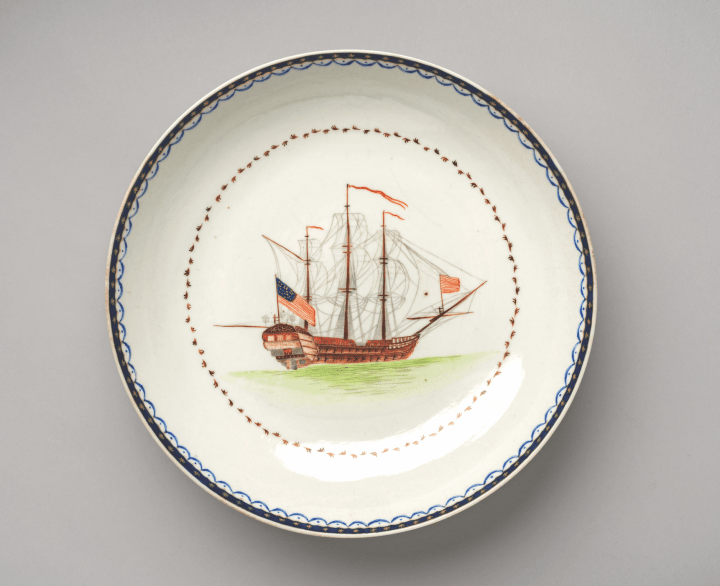
Bowl Depicting a Ship with American Flag, ca. 1790s, porcelain manufactured for the export market in Jingdezhen, decorated in Canton (Philadelphia: Independence Seaport Museum, acquired through exchange, courtesy of Friends of the Museum, 2023.038).
“This exhibition tells the story of a critical moment in the history of our nation,” said Peter Seibert, president and CEO of Independence Seaport Museum. “When the United States declared its independence from Great Britain, we also separated ourselves from the rules and regulations that governed overseas trade. As we came together as a nation 250 years ago, we also stepped out on the world’s stage for the first time. The ISM team, consisting not only of our curatorial, exhibition and education staff and an exceptional panel of outside scholars, have brought together an amazing assemblage of objects that tell the story of our look to the East as a new global trading power.”
Organized by guest curators Susan Gail Johnson and Brett Palfreyman, Seeking Profit and Power will explore five essential themes. “Making a Nation” focuses on why the United States opened direct trade with China. “Making it Work” illustrates the tremendous technical and logistical feat traveling the route from Philadelphia to China. “Making Money” shows the array of commodities the new nation could trade for sought-after Chinese tea, porcelain, and other goods. “Encountering Each Other” explains how the two cultures learned about one another through the goods that they traded. The final section, “The Old China Trade,” explores the end of the era and the place it still holds in American memory.
“Our goal for the exhibition is to show visitors that a teacup is more than just a teacup—it is an object that tells a story about sailing halfway around the world, America’s taste for luxury goods, and how the nation’s founders imagined that trade with China might help establish the newly independent nation as a player on the world stage,” said Susan Gail Johnson. “We hope visitors will never look at a teacup the same way again.”
The full press release with details about specific objects is available here»










 Enfilade
leave a comment