Lecture | Ana Lucia Araujo on the Work of Black Artists in the Americas
From The Institute of Fine Arts:
Ana Lucia Araujo | The Power of Art: The World Black Artists Made in the Americas
Daniel H. Silberberg Lecture Series
Online and in-person, The Institute of Fine Arts, New York University, 30 March 2026, 6pm
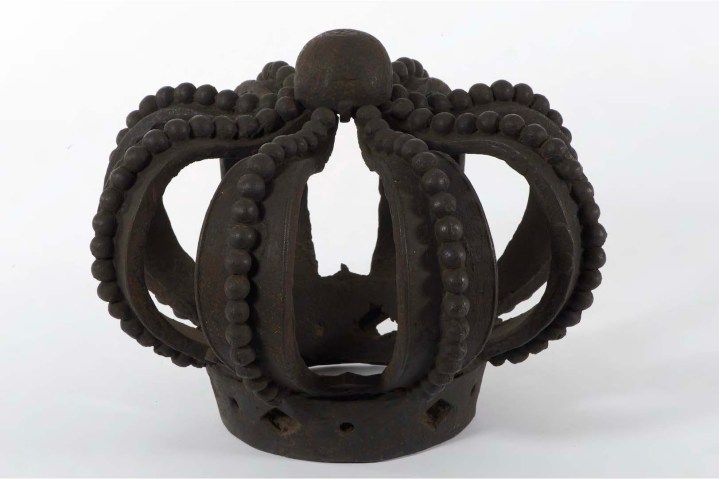
Iron crown, 34 × 45 cm, Real Fábrica de Ferro São João do Ipanema (Museu Paulista, Universidade de São Paulo, Brazil).
Throughout human history, men and women have used artistic expression to overcome the most horrible atrocities. Africans and their descendants also embraced artistic creation to survive the horrors of the Atlantic slave trade and slavery in the Americas, and to soothe their physical and spiritual wounds. Drawing on written and visual primary sources, artifacts, and artworks housed in archives and museums in the United States, Brazil, the United Kingdom, France, and the Netherlands, my book The Power of Art: The World Black Artists Made in the Americas combines history, art history, and art to tell the story of enslaved artists and examine the works they created in the Americas during the eighteenth and nineteenth centuries. I argue that Black creators drew on the long and powerful heritage of African arts and knowledge, which they combined with European and Native American artistic traditions, to design artworks and objects that asserted a defying world of their own.
Many enslaved and freed artists modeled clay objects, forged magnificent iron pieces, wove textiles, mats, and baskets, carved wood and stone sculptures. These artists embraced the knowledge transmitted to them by their African ancestors, while also introducing innovations learned from European and indigenous creators. Drawing on these rich economic and cultural exchanges, African artists and their descendants in the Americas adapted and developed new techniques and combinations of forms and colors. When creating new artworks, these artists also embraced new materials to which they assigned new uses and meanings. I contend that artistic creation offered bondspeople relief and hope, and sometimes also opened to them a path to emancipation. Ultimately, by shedding new light on the works of enslaved Africans and their descendants, which still remain largely invisible in most museum collections, The Power of Art illuminates their long-lasting contributions to the development of visual arts in the Americas.
Registration is available here»
Ana Lucia Araujo is a historian of slavery, the transatlantic slave trade and the global African diaspora. Trained as a historian and as an art historian, she has explored the legacies of slavery, including the history of calls for reparations, memory, heritage, material, and visual culture of slavery. Her recent books are Humans in Shackles: An Atlantic History of Slavery (University of Chicago Press, 2024), The Gift: How Objects of Prestige Shaped the Atlantic Slave Trade and Colonialism (Cambridge University Press, 2024), and Reparations for Slavery and the Slave Trade: A Transnational and Comparative History (Bloomsbury, 2017, 2023). A John Solomon Guggenheim Fellow (2025), her work has also been supported by the American Council of Learned Societies, the Getty Research Institute, the Institute of Advanced Study (Princeton, NJ), the Bonn Center for Dependency and Slavery Studies at Universität Bonn (Germany), the Clark Art Institute, and the American Philosophical Society.










 Enfilade
leave a comment