AHRC Studentship | Sarah Sophia Banks (1744–1818)
From UCL:
Rediscovering a Woman Collector at the British Library:
New Sources and Perspectives on Sarah Sophia Banks
Supervised by Lucy Brownson, Elizabeth Shepherd, Felicity Myrone, Maddy Smith, and Alice Marples
Applications due by 14 April 2026
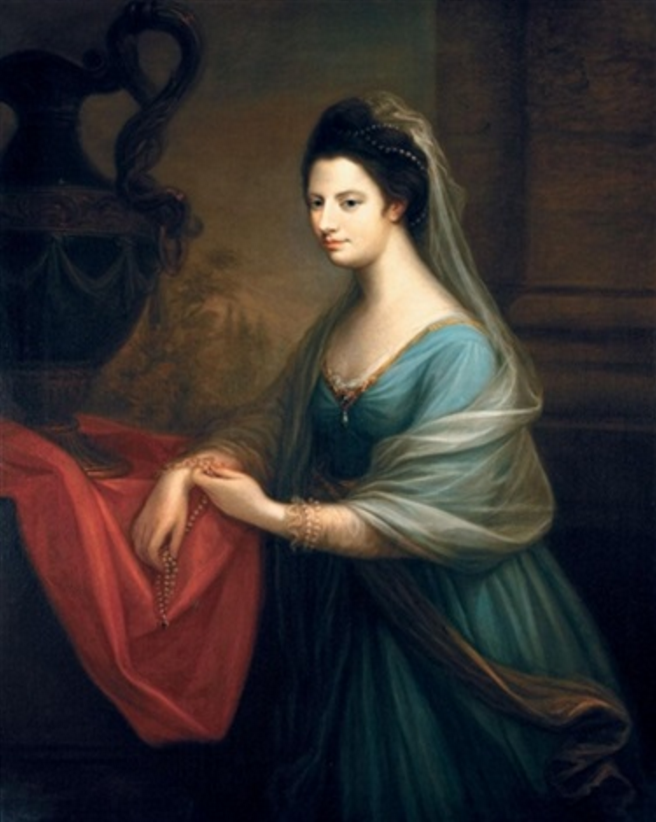
Angelica Kauffman, Portrait of Sarah Sophia Banks, oil on canvas, 49 × 40 inches.
It is intended that interviews will take place in person on Thursday 30 April 2026 at the British Library or UCL, but we will also offer online interviews for those unable to attend in person.
University College London (UCL) and the British Library are pleased to announce the availability of a fully funded Collaborative Doctoral Studentship from 1 October 2026 under the AHRC Collaborative Doctoral Partnership Scheme. This research will examine the collecting, knowledge production, and documentary practices of Sarah Sophia Banks (1744-1818), one of the most important antiquarian collectors of her time. It will interrogate Banks’s holdings at the British Library and elsewhere from a critical archival perspective, exploring these dispersed collections—and the taxonomies she devised for them—as maps of the social, intellectual, and imperial networks she inhabited.
This project will be jointly supervised by Dr Lucy Brownson and Prof Elizabeth Shepherd at UCL Department of Information Studies (UCL:DIS), and Felicity Myrone, Maddy Smith and Dr Alice Marples at the British Library. The student will spend time with both UCL:DIS and the British Library and will become part of the wider cohort of AHRC CDP funded PhD students across the UK.
UCL and the British Library are keen to encourage applications from a diverse range of people, from different backgrounds and career stages, and particularly welcome those currently underrepresented in doctoral student cohorts.
The Research Project
Extensive materials collected by the antiquarian collector Sarah Sophia Banks (1744–1818) were divided at her death and are held across the British Library, Royal Mint, and Prints & Drawings and Coins & Medals departments at the British Museum. Varying institutional interests and practicalities have impacted their visibility, and the focus of scholarship to date has been on the holdings at the Museum and her prints and ephemera in nine albums in the Library (L.R.301.h.3-11). This studentship will explore the significant holdings that are yet to be explored at the British Library, revealing Banks’s own cross-format interdisciplinary knowledge taxonomy in detail for the first time.
Banks wrote catalogues of her own collections and kept notes regarding provenance, many of which have been overlooked to date. This project will use these sources to rediscover the full extent and original arrangement, purpose and source of Banks’s prints, drawings, ephemera, books and manuscripts, focusing on those at the British Library. The student will explore Banks’s networks of knowledge, methods of collecting, network of contacts, and her strategies and systems for categorising her visual and textual materials. The project asks larger questions around the role of women collectors, knowledge practices, collecting history and scholarship, the emergence of (male) expertise, disciplinary norms and museological frameworks in the 18th and 19th centuries, and the relative status of visual and textual knowledge. While her brother Joseph Banks’s collections as a whole and Sarah Sophia Banks’s collections beyond the Library have had sustained academic attention, her holdings at the Library remain largely underexplored. This project matches the recent full cataloguing of her collections at the Royal Mint and British Museum, facilitating cross-institutional research, and impacting practically upon reader access to and understanding of these materials and their provenance.
This project calls for an interdisciplinary approach encompassing critical archival studies, museum studies, and feminist historiography to interrogate the research questions outlined below. The successful candidate will be embedded as an archivist and researcher—or, to paraphrase Lynée Lewis Gaillet (2012), archivist-as-researcher—working to catalogue and research Banks’s holdings at the Library. This research-by-doing will enable the student to familiarise themselves with the collection and identify foci for this study, by selecting specific areas of Banks’s collections and reading them as local windows onto global histories of British colonial expansion (Evans, 2021). The student will be encouraged to explore creative ways of tracing and mapping Banks’s dispersed holdings across institutions, their multiple and parallel provenances, and what they can reveal about the social and political worlds through which Banks and her contemporaries moved. Case studies will contextualise and deepen analysis of Banks’s gendered collecting and will bring insights into the longer histories of the curatorial and archival practices that shape dominant paradigms of knowledge organisation today. Ultimately, the student will be encouraged and empowered to devise their own methodological framing and draw out original insights on how Banks and her collections intersect with gender, class, and empire.
Possible Research Questions
• How and when did Sarah Sophia Banks acquire her collections? What do her annotations reveal about her network and collecting practices in the 18th century? How do these names connect with the Banks collections beyond the Library?
• What do Banks’s collections reveal about the imperial, social, cultural and gendered dimensions of her life and the worlds through which she moved?
• What knowledge systems and material ordering practices did she employ? How did she order and construct her unique assemblages? What does this tell us about gendered ways of structuring collections?
• How did her collecting constitute a form of ‘worldmaking’, particularly given her and her family’s social and global networks and perspectives?
• What is the evidence for Banks’s knowledge of other collections (in Britain or abroad)? How did this impact on her own practices?
• How did the nascent professionalism of male collecting and museology in her lifetime affect her collecting?
• Is she quoting from her own (or her brother’s) copies of works in her notes and cross-references? Can we reconstruct her library as a whole? How much survives?
• Can we reconstruct how the collection was physically placed at home, and what does this reveal about its history, value, visibility and use? How might dispersed and mixed-media collections be represented and made visible intra-institutionally?
• What might a history of Banks’s collections reveal about the broader ontologies and taxonomies of knowledge that shape many of our cultural institutions today?
Benefits and Opportunities
The successful candidate will be registered with the Department of Information Studies in the Faculty of Arts and Humanities at UCL. UCL is London’s leading multidisciplinary university, ranked 9th in the 2026 QS World University Rankings and rated 2nd in the UK for research power in the Research Excellence Framework 2021. UCL:DIS is an international centre for research and teaching in the fields of archival studies, librarianship, publishing and digital humanities and is host to the Centre for Critical Archives and Records Management Studies (CCARM). The Department, the Faculty of Arts and Humanities and the UCL Doctoral School all offer complementary programmes for research training and personal development for doctoral students. All doctoral students in UCL:DIS are enrolled on compulsory research methods and training classes in their first year to support their research plan development, writing skills, research ethics and appropriate research methods. These classes and other departmental activities support the research student cohort and individual research development.
At the British Library, the student will become part of a vibrant cohort of collaborative doctoral researchers and benefit from staff-level access to the Library’s collections, resources and in-house training and development opportunities. CDP students also benefit from a dedicated programme of CDP Consortium events delivered in tandem with the other museums, galleries and heritage organisations affiliated with the AHRC CDP scheme, designed to provide CDP researchers with the knowledge, networks and skills to thrive in their future careers.
This collaborative PhD studentship offers the opportunity to combine academic training with practice-based experience and research behind the scenes of a major cultural institution. The project offers a combination of sustained and systematic analysis of a dispersed collection with visual analysis, giving the student a broad knowledge of print history and artists, as well as a wider understanding of recordkeeping practices and systems such as scrapbooking, extra-illustration and commonplace books.
Given staff-level access to relevant holdings, the student will receive training in and gain hands on experience of handling, identifying, researching and cataloguing books, manuscripts, archives, and prints. They will catalogue using specially designed spreadsheets to create records which will then be ingested to the British Library’s main and archives and manuscripts catalogues. We will encourage the student to engage in supervised social media activity reflecting their discoveries. In contributing to blog posts, they will receive support and feedback regarding the use of social media tools and the development of writing skills, in accordance with Library guidelines and practice. They will also be encouraged to work with and potentially shadow colleagues in Conservation, Metadata, Digitisation, Western Heritage and Culture and Learning at the Library, gaining broad understanding of the history of the collections, and how they are being made more accessible through research, cataloguing, digitisation and display projects.
Details of Award
The PhD studentship can be undertaken on a full-time or part-time basis from 1 October 2026.
AHRC CDP doctoral training grants fund studentships for 4 years full-time or part-time equivalent (up to 7 years). AHRC CDP doctoral training grants also make provision of funding for student development activities to help the student extend their wider skills portfolio and improve their career prospects.
The award pays tuition fees up to the value of the full-time home UKRI rate for PhD degrees and UCL has agreed to waive the difference between the UK and overseas fees rate. International candidates will be required to reside in the UK until completion of the PhD. The indicative fee level for Research Council studentships for 2026/27 is £5,151. The award also pays full maintenance for all students, both home and international students. This stipend is tax free, increases slightly each year, and is the equivalent of an annual salary, enabling the student to pay living costs. The indicative UKRI Minimum Doctoral Stipend for 2026/27 is £21,383. An additional London Weighting allowance of £2000/year will be applied for this studentship. In addition, the successful candidate will receive a CDP maintenance payment of £600/year. Further details on UKRI funding for doctoral training can be found on the UKRI website.
In addition, the successful student will be eligible for an additional research allowance courtesy of the British Library, up to £1,000 per financial year or part-time equivalent, for the duration of the project.
Additional information is available here»










 Enfilade
leave a comment