New Book | Incognito: Friedrich Christian’s Two-Year Tour Abroad
This incredible labor of love is now available for free download at arthistoricum.net:
Maureen Cassidy-Geiger, Incognito: An Annotated Edition of the Archival Documentation for Saxon Electoral Prince Friedrich Christian’s Two-Year Tour Abroad in 1738–40 (ART-Dok: Publication Platform for Art and Visual Studies, full-text server of arthistoricum.net, Heidelberg University Library, 2026), 1628 pages.
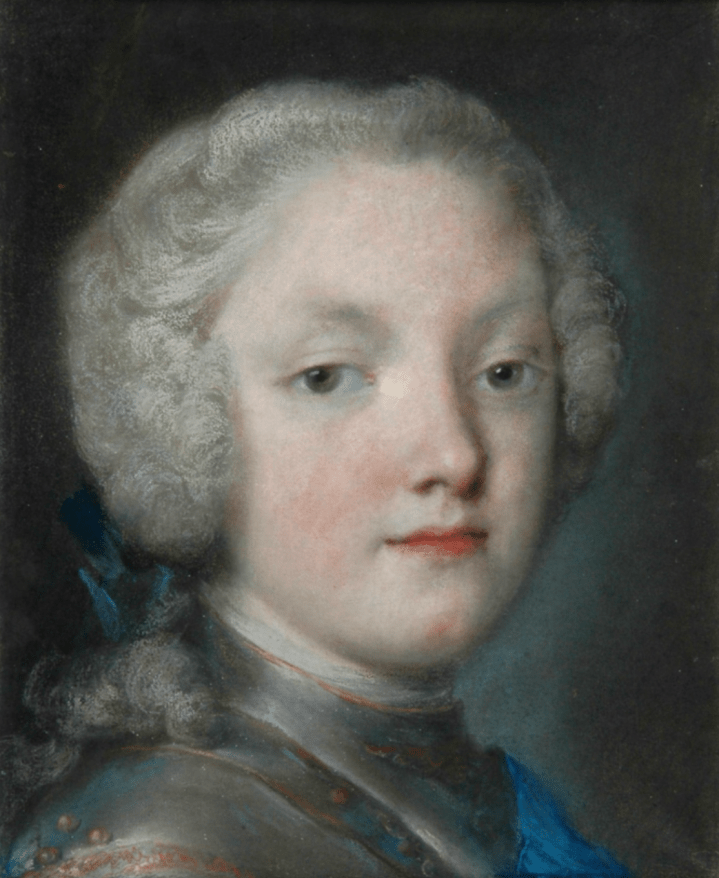
Rosalba Carriera, Portrait of Prince Friedrich Christian of Saxony, ca. 1740, pastel on paper (Richmond: Virginia Museum of Fine Arts, Gift of Mrs. Arthur W. Levy, Jr., in memory of her husband; inv. 66.55).
Electoral prince Friedrich Christian’s father, grandfather, and great uncle each traveled abroad as part of their princely educations, with Versailles the main objective; his father, Friedrich August II (1696–1763), also converted to Catholicism while on the grand tour, which enabled him to marry a Catholic princess and stand in line for the Polish crown, succeeding his father in 1733 as Augustus III.
Friedrich Christian (1722–1763) was the third and oldest surviving son of the future Augustus III and his Habsburg bride, Maria Josepha (1699–1757); three princesses followed, then three princes. Hence, he became and remained the heir to the throne despite having been born with an incurable disability, considered to have been cerebral palsy. When treatments in the mineral waters at Teplice, Bohemia, failed to improve the boy’s health, his parents sought medical advice from their representatives in France and even England.
Yet it was his sister’s marriage by proxy to Charles Bourbon (1716-1788), the king of Naples, in 1738 that opened the door to medical treatments on the island of Ischia in the Bay of Naples, and it was hastily decided to send the prince, incognito, to accompany Queen Maria Amalia (1724–1760), cognito, on the journey to meet her new husband. The route was scripted as a Marian pilgrimage, with stops in Prague, Mariazell and Loreto, bypassing Vienna and Rome to avoid the delays of state receptions for the new queen.
Following a cure on Ischia (July 12–Sept. 23, 1738) and a period of recuperation at Portici and Naples (July 23–Nov. 15, 1738), the prince sojourned for a year in Rome, residing in Palazzo Albani alle Quattro Fontane (Nov. 18, 1738 – Oct. 14, 1739). After Rome, he toured Tuscany, Lombardy and the Veneto (Oct. 14–Dec. 21, 1739), while his staff mostly went ahead, perhaps to quarantine, before they all floated into Venice on Dec. 21, 1739, where the prince resided for six months in Ca’Foscari, until June 11, 1740. Prior to returning to Dresden on Sept. 7, 1740, he spent two months in Vienna, to meet the Imperial Family and others, and spend time with his grandmother, dowager empress Wilhelmine Amalie (1673–1742).
The educational grand-tour-cum-cure undertaken by the handicapped crown prince of Saxony in 1738–40 is documented by an unparalleled array of archival evidence in Dresden and beyond. This includes four detailed journals, in French, German and Italian, one handwritten by the prince himself and the others by members of his staff, plus boundless correspondence, both official and personal, as well as the account book (privy purse) for his two-year odyssey abroad. Further evidence is found in eyewitness accounts penned by others, whether diplomats or tourists or the clergy, and in published reports. Hence, the transcriptions presented here in eight chapters, including the four handwritten diaries and the account book in Dresden, are annotated with relevant excerpts from archival material in foreign archives or with references to the many known or unknown works of art, relics, and antiquities cited in the journals, not to mention the countless people and places named. The footnotes also offer insights into practical matters, such as the logistics of moving people, correspondence or things from place to place under often challenging circumstances, household management and staffing; matters of protocol, given the prince was travelling incognito; and the patterns and rituals of gift-giving, Catholic devotion and courtly entertainment. Moreover, the transcriptions demonstrate four different approaches to reporting for posterity.
c o n t e n t s
Introduction, Selected Bibliography, and Acknowledgements
1 Electoral Prince Friedrich Christian’s Personal Diary for His Journey Abroad and Homecoming in 1738–40
2 Count Joseph Anton Gabaleon von Wackerbarth-Salmour’s Official Journal Dispatched to the King during the Prince’s Journey Abroad
3 Count Han Moritz von Brühl’s Journal Dispatched to His Brother, the Prime Minister, during the Prince’s Journey Abroad
4 Jesuit Father Wunibald Breinl’s Journal for his Sojourn in Rome
5 The Privy Purse for the Prince’s Journey Abroad
6 The Court Journal for Queen Maria Amalia’s Journey from Dresden to Palmanova in the Company of Electoral Prince Friedrich Christian
7 Diario Ordina










leave a comment