Exhibition | Hidden Valuables: Early-Period Meissen Porcelains
The catalogue is published by Arnoldsche and distributed by ACC Art Books:
Hidden Valuables: Early-Period Meissen Porcelains from Swiss Private Collections
Musée Ariana, Geneva, 7 February — 6 September 2020
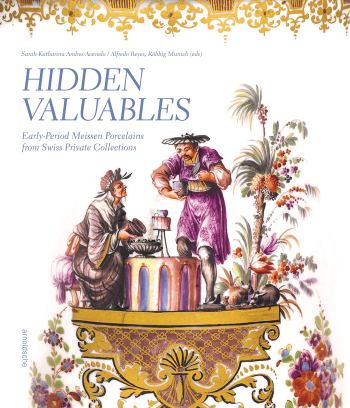 Switzerland is well-known for its host of remarkable collections of eighteenth-century European porcelain. Exemplary representatives of these are such extraordinary collector personalities as Albert Kocher or Dr Marcel Nyffeler. A number of these magnificent collections can be found today in Switzerland’s renowned institutions, and the ‘white gold’ from Saxony still fascinates Swiss connoisseurs. This exhibition is dedicated to their passionate collecting and exceptional treasures, while the catalogue is enriched with essays by renowned art historians and porcelain experts.
Sarah-Katharina Andres-Acevedo, Alfredo Reyes, and Röbbig München, eds., Hidden Valuables: Early-Period Meissen Porcelains from Swiss Private Collections (Stuttgart: Arnoldsche, 2020), 416 pages, ISBN 978-3897905863, £78 / $135.
New Book | A Passion for Porcelain
Published by the Gardiner Museum in association with Arnoldsche and distributed by ACC Art Books:
Karine Tsoumis and Vanessa Sigalas, eds., A Passion for Porcelain: Essays in Honour of Meredith Chilton (Stuttgart: Arnoldsche, 2020), 208 pages, ISBN: 978-3897905849, $50.
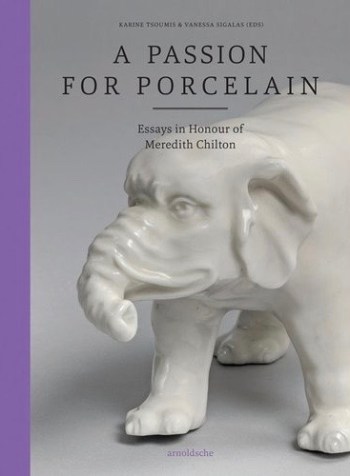 A Passion for Porcelain brings together papers delivered at an international symposium held in 2018 at Toronto’s Gardiner Museum in honour of Meredith Chilton, C.M., one of the foremost scholars and curators of eighteenth-century European porcelain. Authored by leading scholars in the field, the essays take us on a journey from France (Sèvres), to Japan via Boston, where we encounter both revered artists and anonymous makers, together with passionate collectors past and present. The contributions also explore the medium of porcelain in the context of artistic rivalry and gift exchange, as an object of fashion and scientific curiosity and as a symbol of status and power. Together, the essays reveal the versatility of the medium, changing perceptions, and endless possibilities for porcelain scholarship.
With contributions by Daniel Chen, Katharina Hantschmann, Peter Kaellgren, Sebastian Kuhn, Claudia Lehner-Jobst, Thomas Michie, Jeffrey Munger, Linda Roth, Rosalind Savill, Vanessa Sigalas, and Karine Tsoumis.
New Book | Porcelain Pugs
Published by Mercatorfonds and distributed by Yale UP:
Claire Dumortier and Patrick Habets, eds., with a foreword by Julia Weber, photography by Hughes Dubois, and contributions by A. Reyes, Ulrich Pietsch, Sarah K. Andres-Acevedo, Hans Ottomeyer, Roland Hanke, Marie-Laure de Rochebrune, and Barbara Beaucamp-Markowski, Porcelain Pugs: A Passion, The T. & T. Collection (Brussels: Mercatorfonds, 2020), 224 pages, ISBN: 9780300246537, $60.
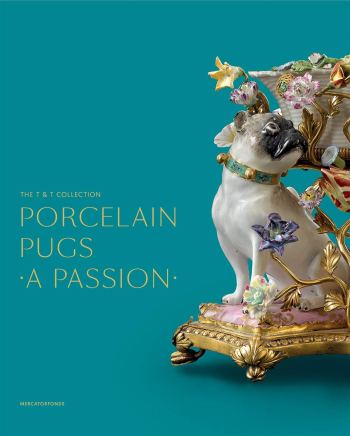 A superb collection of 18th-century porcelain pugs is showcased here alongside historical and artistic context for the beautiful objects.
A treasure trove for dog-lovers and porcelain enthusiasts alike, this book celebrates a collection of more than 100 porcelain pugs, most of which were designed in the mid-18th century by Johann Joaquim Kändler, the eminent modeler in the Meissen porcelain factory in Germany. Stunning new photography of the objects is accompanied by essays that place the figures in their historical and artistic context. Pugs were introduced to Europe in the late 16th or early 17th century and quickly gained popularity among the European aristocracy thanks to the animals’ even temperament and sociability. In 1740, a secret society called the Order of the Pug was established as an offshoot of the Freemasons; the pug was selected to represent the society due to its reputation for reliability, trust, and steadfastness. Also featured here is a survey of pug imagery in contemporary European decorative arts, including on snuff-boxes, flasks, and cane handles.
Claire Dumortier is honorary curator of the ceramics collections of the Royal Museum of Art and History in Brussels. Patrick Habets is emeritus professor of the Catholic University of Louvain.
Notes & Queries
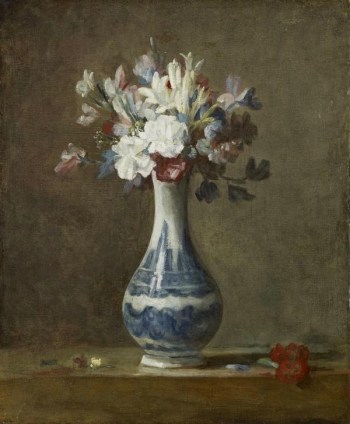
Jean-Baptiste Siméon Chardin, A Vase of Flowers, early 1760s, oil on canvas, 45 × 37 cm (Edinburgh: Scottish National Gallery, NG1883; purchased with the aid of the Cowan Smith Bequest Fund 1937).
My ‘note from the editor’ resulted in many kind words of support—in the comments section and in my inbox. Thanks so much! It also led to what I take to be a very clever idea from Joan Coutu, Professor of Art History and Visual Culture at the University of Waterloo. Observing that many of us find ourselves cut off from our regular research resources, she suggests that we might use Enfilade to identify needs, which the community might in turn be well-resourced to meet. This sort of thing happens often on Listservs, though often at the expense of annoying emails tied to a narrow, specific thread of interest. It would seem that the size and expertise of Enfilade’s readership should be well-suited to address lots of scholarly questions related to the long eighteenth century.
As a way to test the water, I would propose, using this posting as a Notes & Queries Page. Readers are welcome to send requests my way (CraigAshleyHanson@gmail.com), and I’ll add them here. If it’s a huge success, then great, and if it goes nowhere that’s fine, too. Feel free to treat it as a kind of ‘community classified page’. If you’re asking a question, please be sure to include an email address. Perhaps you’re looking for a specific article or a few pages from a book. Perhaps you have a question about online-teaching. Perhaps you’re wondering how best to contact a curator. General news items are also welcome: particularly as related to any major resources that might be foregoing their usual subscription firewalls (The Index of Medieval Art just announced that it will go open-access until 1 June 2020; here’s hoping that others follow suit). Anything that feels like it could be communicated in a sentence or two (rather than deserving its own posting) is potentially fair game. In addition to emailing me directly, you’re welcome to leave requests in the comments section; I’ll move them to to the posting, where people are more likely to notice them. Also, if you read Enfilade postings only as they’re delivered to your inbox, you’ll need to visit the website to see how this posting develops. –CH
N O T E S & Q U E R I E S
Requests
• Hope Saska writes (24 March): I’d love to hear from educators who have used their museums and special collections in their teaching presentations. I’m also keen to brainstorm ways we can work together to innovate in teaching from collections. Of course, nothing compares to firsthand experiences with objects, but many of us in academic art museums/special collections are eager to continue to share our collections. And many of us are eager to participate in instruction, much as we do in study room visits. I’d love feedback and can be reached at: hope.saska@colorado.edu.
Hope Saska, PhD
Curator of Collections and Exhibitions
CU Art Museum | Visual Arts Complex
University of Colorado | Boulder
Resources
• For $100 per annum, The York Society Library offers E-memberships for individuals primarily interested in taking advantage of the Library’s significant collection of electronic resources. The E-membership category provides remote and onsite access to the Library’s full array of electronic resources, including e-books, digital magazines, audiobook downloads, electronic databases, and event recordings.
• As Kee Il Choi notes (9 April): Jane Eyre, a collaboration with Bristol Old Vic, filmed by National Theatre Live at London’s National Theatre, is available via YouTube from now until 16 April. It’s followed by weekly offerings that include Treasure Island, Twelfth Night, and One Man, Two Guvnors. More information is available here.
• Open Culture, is a clearinghouse for free culture and educational media on the web with lots of audio books, online courses, MOOCs, films, etc.
• As Theresa Machemer writes in the Smithsonian Magazine (1 April 2020), “Last week, the nonprofit Internet Archive launched a National Emergency Library featuring 1.4 million digitized books from the last century, all freely available for download without the usual one-at-a-time reader restriction. Presented as a generous move in service of students and educators who no longer have access to their local libraries—many of which have closed in response to the COVID-19 pandemic—the announcement was initially met with praise. But backlash from authors and publishers has since framed the collection differently, presenting it as internet piracy that violates intellectual property laws.” Jill Lepore, writing in The New Yorker (26 March 2020) was one of the early voices of praise, while The Authors Guild offered an emphatic statement condemning the NEL (27 March 2020).
• Kee IL Choi writes (28 March): The New York Public Library has opened up a lot of its databases, including JStor (NYPL cards required for full access).
• We’re now in the second week (25 March) of The Metropolitan Opera’s free encore presentations from the company’s Live in HD series; eighteenth-century works were last week; this week is Wagner. From the Met’s website: “each performance [is] available for a period of 23 hours, from 7:30pm EDT until 6:30pm the following day. The schedule will include outstanding complete performances from the past 14 years of cinema transmissions, starring all of opera’s greatest singers.” -Craig Hanson
• Cristina Sofia Martinez writes: I have been compiling a number of free online resources for my students that others may also find useful. Very best, and keep safe! -Cristina
Libraries/Research/Books free resources on Muse during Covid-19.
Open-Access JSTOR Materials accessible to the public.
Le Guggenheim offre ses livres d’art, as noted at Vice.
La BnF choisit de rendre accessible gratuitement à tous l’ensemble de l’offre de son site de presse, RetroNews. Grace à toutes les ressources de presse que le site propose, vous pouvez à la fois relire l’histoire et la faire découvrir à vos enfants ou vos élèves. Tous les articles, vidéos, documents audio produits par les équipes de journalistes, chercheurs et universitaires sont consultables gratuitement pendant le confinement. Ils retracent et analysent les événements de la petite et de la grande histoire couverts par la presse de l’époque. Pour y accéder, il suffit de se créer un compte personnel. Toutes les données seront supprimées à l’issue de l’abonnement gratuit.
The Czech National Library has made its 206,000-title archive available online for free.
Virtual Tours of Twelve Famous Museums, via Travel + Leisure.
Nine Dazzling Art Experiences You Can Have From the Comfort of Your Home, via Artnet News.
A Five-Hour, One-Take Cinematic Tour of Russia’s Hermitage Museum, via Open Culture.
Watch Free IDFA Movies (International Documentary Film Festival Amsterdam).
4200 Rare Feature Films to Watch for Free and Legally at APAR.
‘Quarantine Soirees’: Classical Music and Opera to Stream at Home, via The Guardian.
Philharmonie de Paris, an exclusive concert each evening at 20:30.
Completed Requests (archive)
• Sharon Goodman writes (27 March): Would anyone be able to scan me a copy of plate 77 of C.H. Tatham’s Etchings, Representing the Best Examples of Ancient Ornamental Architecture; Drawn from The Originals In Rome, And Other Parts of Italy, During The Years 1794, 1795, And 1796 please? Unfortunately, this publication is not online to my knowledge. My email is: sgoodman@christies.com.
◊ ◊ ◊ ◊ ◊
Note (29 March 2020) — The original version of this posting appeared 25 March 2020; it’s updated based on incoming requests.
New Book | Becoming America
Distributed by Yale UP (portions of the collection have been on view at The Huntington since October 2016) . . .
James Glisson, ed., with contributions by John Demos, Jonathan and Karin Fielding, Robin Jaffee Frank, James Glisson, Stacy Hollander, Christina Nielsen, Sumpter Priddy, Elizabeth V. Warren, and David Wheatcroft, Becoming America: Highlights from the Jonathan and Karin Fielding Collection of Folk Art (San Marino: The Huntington Library, Art Collections, and Botanical Gardens, 2020), 264 pages, ISBN: 9780300247565, $50.
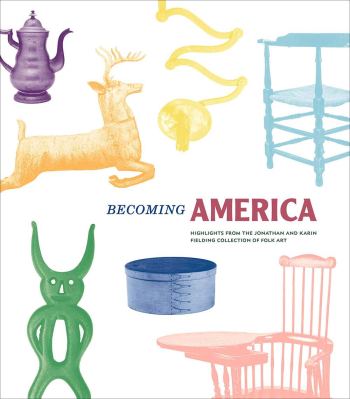 Becoming America offers a multifaceted view of one of the foremost collections of 18th- and 19th-century American folk and decorative art from the rural Northeast. Essays by leading specialists discuss the culture of furniture workshops, exuberant painted decoration, techniques of sewing and quilting, and poignant stories about the families depicted in the portraits. The collection itself includes Shaker boxes, a beaded Iroquois hat, embroidered samplers, metalwork, scrimshaw, handwoven rugs, ceramics, and a weather vane. The majority of these works have never before been published. With lively essays and profuse illustrations, this handsome volume brings to life the aesthetic of early Americans living in the countryside and is an essential exploration of the period’s taste and style.
James Glisson is interim chief curator of American art at The Huntington. Jonathan Fielding is the former director of the Los Angeles County Department of Public Health and Distinguished Professor at UCLA. Karin Fielding is a trustee of the American Folk Art Museum in New York.
Walpole Library Fellowships for 2020–21
The Lewis Walpole Library is delighted to announce the recipients of Visiting Fellowships and Travel Grants for 2020–21:
Fellowships
• Hillary Burlock (Queen Mary University of London), Politics and Pirouettes: The Intersection of Politics and Social Dance in Late Georgian Britain, George B. Cooper Fellowship
• Katherine Charles (Washington College), Inside Stories: Interpolated Tales and the Eighteenth-Century Novel
• Mita Choudhury (Purdue University Northwest) Mapping Cosmopolitanism and the Global Space at Home
• Daniel Froid (Purdue University), Enlightenment Devilry: Forbidden Epistemologies and the Devil in Eighteenth-Century British Literature
• Monica Hahn (Community College of Philadelphia), Harlequins of Empire: Staging Native Identity in British Imperial Art, ca. 1776, Joseph Peter Spang Fellowship
• Sarah Hancock (Carnegie Mellon University), The ‘Peculiar Science’ of Flowers in the British Landscape Garden
• Yuko Ito (Gakushuin University), Writing Richard III: Drama, History, and Translation in the Long Eighteenth Century
• Emrys Jones (Kings College London), The Levee: A Cultural History
• Ziona Kocher (The University of Tennessee, Knoxville), Cross-Dressing on the Eighteenth-Century Stage
• Thomas Leonard-Roy (Harvard University), Horace Walpole and the Pleasures of Hatred, ASECS/LWL Fellowship
• John Munns (University of Cambridge), Life and Work of Thomas Kerrich
• Giorgina Paiella (University of California, Santa Barbara), The Early Modern Android Automaton: Affect, Assembly, and Modern-Day Resonances
• Robert Phiddian (Flinders University), Graphic Humor, from Hogarth to Gillray, Charles J. Cole Fellowship
• Matthew Potter (Northumbria University), The Afterlife of Georgian Political Cartoons
• Edwin Rose (University of Cambridge), Classifying and Publishing Nature in Late Eighteenth-Century Britain
• Tess Somervell (University of Leeds), Georgic Climates: Writing the Weather in Eighteenth-Century Poetry
• Alexis Wolf (University of Leeds), Material Perspectives of Revolution in the Manuscripts of Mary and Agnes Berry, Roger W. Eddy Fellowship
Travel Grants
• Tymon Adamczewski (Kazimierz Wielki University), The (im)Materiality of Extra-Illustration: Multimodality, Iteration, and the Eighteenth-Century Book
• Carmen Casaliggi (Cardiff Metropolitan University), Rethinking Transnational Networks in Paris: Madame du Deffand, Adam Smith, and the Condorcet Circle
• Daniel Cook (University of Dundee), Gulliver’s Afterlives
• Laura Engel (Duquesne University), The Art of the Actress
• Kaitlin Pontzer (Cornell University), The Authority of Feeling: Jacobite Sentiment and Affective Allegiance in Britain after 1688
Amanda Lahikainen Named Director of OMAA
Press release (2 April 2020) from the Ogunquit Museum of American Art in Maine (Lahikainen’s scholarship to date has focused on late eighteenth- and early nineteenth-century print culture, including the reception and representation of paper money in Britain, ‘imitation banknotes’ during the Romantic period, and British representations of the French Revolution in graphic satire). . .
 David Mallen, President of the Board of the Ogunquit Museum of American Art (OMAA) announced today that Amanda Lahikainen, PhD, has been appointed as the museum’s new Executive Director, effective May 1, 2020. The board unanimously approved the appointment on March 23, 2020.
Dr. Lahikainen is currently Chair of the Art Department and a tenured Associate Professor of Art History at Aquinas College in Grand Rapids, Michigan, where she oversees the art gallery. Mallen said, “After a nationwide search, we are delighted to have selected Amanda as our next Executive Director. She is a gifted administrator and scholar.”
Dr. Lahikainen holds a PhD in art history from Brown University and a BA from Wellesley College. She oversaw and co-curated exhibitions at her college gallery and the Bell Gallery at Brown University, and has worked with local museums in Grand Rapids including the Grand Rapids Art Museum and the Meijer Gardens and Sculpture Park. She held the Kluge Fellowship at the Library of Congress in 2012 and has attracted grants and fellowships from the Paul Mellon Centre and the Lewis Walpole Library at Yale University. She previously taught at Brown University, Rhode Island College, and Roger Williams University, and she has worked or studied in London and Athens. She is widely published and has lectured and participated on panels across the US and in Canada and Australia.
Mallen added, “Amanda’s credentials are exceptional and will further strengthen the OMAA as we aim to expand our audiences and make our museum even better known. Amanda will relocate to Maine with her family from Grand Rapids. She grew up in Salem and has a summer home in Maine, so she is eager to live year-round in a region she knows and loves.”
Dr. Lahikainen said, “I am honored to lead OMAA with its wonderful collection, its sculpture garden, and strong sense of place. The museum is an important and beloved asset of the region and has a wonderful record of recent growth and accomplishment under my predecessor Michael Mansfield. The commitment of the Board is inspiring. While I have been happy and successful at Aquinas College, this is an opportunity I could not resist when recruited. I look forward to working with the board, staff, volunteers, and the community of artists and donors in Ogunquit and beyond to lead the next exciting chapter in the museum’s life.”
Dr. Lahikainen will replace Interim Executive Director Richard D’Abate, who Mallen said, “has led the museum strongly through the transition, and we are very grateful for his service.” D’Abate was appointed following former Executive Director Michael Mansfield’s appointment as President of Maine Media Workshops and College in Rockport, Maine on December 15, 2019.
Mallen stated, “The OMAA maintains its momentum as a strong and innovative institution, and we are excited for its future. The museum recently rehung the permanent collection and continues with exhibitions, performances, and publications. Its lecture series set attendance records in 2019. The 2020 exhibition season, now tentatively scheduled to begin May 31st, is planned with exciting shows, performances and lectures, subject, of course, to the coronavirus situation.
The search committee was chaired by former board member Diana Joyner and included Board President David Mallen and board members Chris Caraviello, Ann Ramsey-Jenkins, Carol Leary, Robyn LeBuff, and Alan Shepard. The museum retained Principal Marilyn Hoffman and Senior Search Consultant Scott Stevens of Museum Search & Reference, an executive search firm in Manchester, New Hampshire and Boston to conduct the national search.
The Ogunquit Museum of American Art was founded by Lost Generation artist Henry Strater and opened in 1953. Closely tied to one of the earliest art colonies of the American modernist art movement, OMAA today houses a permanent collection of important paintings, sculpture, drawings, prints, and photographs from the late 1800s to the present. The museum honors Strater’s vision to preserve and showcase American art by mounting innovative modern and contemporary exhibition programs each year from May through October. OMAA and its three-acre seaside sculpture gardens overlook Narrow Cove and the Atlantic Ocean
YCBA’s Scott Wilcox Begins Phased Retirement
Press release (31 March 2020) from YCBA:
 The Yale Center for British Art announced that Scott Wilcox, Deputy Director for Collections, will begin a two-year phased retirement starting April 1, 2020. Wilcox, who has worked for the Center for his entire career, will immediately take on a new position as Senior Research Scholar. His full retirement will begin on March 1, 2022, concluding a career that spans more than three decades. A search for his successor is forthcoming.
“Scott has shaped the curatorial ambitions of the Center over the past 30 years by enriching our knowledge of and appreciation for works on paper and by bringing significant examples of photography into the collection,” Director Courtney J. Martin said. “As a student at Yale in the early 2000s, I knew of Scott’s great achievements as a curator and scholar. When I returned to the Center as director, I learned that he was also a stellar colleague. Over the next two years, we will have the opportunity to learn more from him as he turns to a research role that will certainly benefit staff, visiting scholars, and visitors to our exhibitions.”
Wilcox received his PhD in the history of art from Yale University in 1985, completing his doctoral dissertation on the nineteenth-century watercolor painter David Cox. He joined the Center as Assistant Curator of Prints and Drawings in 1982 and later held the positions of Associate Curator (1991), Curator (1998), Chief Curator of Art Collections, and Senior Curator of Prints and Drawings (2009).
“As I look back on nearly 38 years at the Center, I feel tremendously grateful that I’ve had such a long run in an institution with such great collections, great programs, and great colleagues,” Wilcox said. “I hope I’ve been able to make a positive contribution to what makes the Center special. At different moments I considered moving on, but I always concluded that there was no other place I’d rather be.”
From 1987 to 2014, Wilcox served as the Center’s in-house curator for photographic exhibitions and was instrumental in establishing a collection of photography within the Department of Prints and Drawings through the purchase or gift of works from Charles Isaacs and Carol Nigro and the gift of works from the Joy of Giving Something, Inc.
In 2014, Wilcox was promoted to Deputy Director for Collections, expanding his curatorial role to include all the Center’s collections. In this role, one of five senior leadership positions at the Center, he has overseen the intellectual framework in which the Center’s art is interpreted, as well as the care of the art and growth of the collections. Between 2009 and 2010, Wilcox directed the creation and development of the new Department for Collections Information and Access, which catalogues the Center’s collections electronically and serves as their online platform. Wilcox co-led a team of curators to develop Britain in the World, the reinstallation of the Center’s collections that coincided with its reopening in 2016, following a major building conservation project. This ongoing exhibition offers a new interpretation of the collections that focuses on British art, history, and culture in a global context.
Wilcox’s deep knowledge of works on paper has resulted in many significant exhibitions at the Center: Victorian Landscape Watercolors (also at the Cleveland Museum of Art and the Birmingham Museum and Art Gallery) in 1992–93; Lucian Freud Etchings from the Paine Webber Art Collection (Museum of Contemporary Art, San Diego; Seattle Art Museum; Blaffer Gallery, University of Houston; Iris & B. Gerald Cantor Center for Visual Arts at Stanford University; and Carnegie Museum of Art) in 1999–2000; Sun, Wind, and Rain: The Art of David Cox (Birmingham Museum and Art Gallery) in 2008–9; and The English Prize: The Capture of the ‘Westmorland’, an Episode of the Grand Tour (Ashmolean Museum of Art and Archaeology, University of Oxford) in 2012–13. These exhibitions were accompanied by major publications with scholarly essays and illustrated catalogues.
“I have known Scott Wilcox throughout his illustrious career at Yale,” said Jules D. Prown, Founding Director of the Yale Center for British Art and Professor Emeritus in the History of Art at Yale University. “Our initial acquaintance began when, as Scott’s professor, I directed his dissertation on the English artist David Cox. Since he knew a great deal about the artist and I did not, it did not require much effort on my part. When Scott applied for a position in the Department of Prints and Drawings at the Center, he distinguished himself quickly from the other candidates by the accuracy of his eye in making attributions and aesthetic judgments. Scott is deeply respected by his colleagues, not only for his curatorial and administrative ability but also for his intelligent analysis, conclusions, and leadership.”
In his new role as Senior Research Scholar, Wilcox will assist in the transition to his successor and will cocurate (with Antonella Pelizzari) Photographs of Italy and the British Imagination, 1840–1914, scheduled to open at the Center in fall 2021. The exhibition will showcase the work of British photographers in Italy and consider the ways in which photography shaped the British appreciation and understanding of Italian art, culture, and politics.
New Book | British Art and the East India Company
From Boydell & Brewer:
Geoff Quilley, British Art and the East India Company (Martlesham, Suffolk: Boydell Press, 2020), 370 pages, ISBN: 9781783275106, $120.
 This book examines the role of the East India Company in the production and development of British art during the eighteenth and early nineteenth centuries, when a new ‘school’ of British art was in its formative stages with the foundation of exhibiting societies and the Royal Academy in 1768. It focuses on the Company’s patronage, promotion and uses of art, both in Britain and in India and the Far East, and how the Company and its trade with the East were represented visually, through maritime imagery, landscape, genre painting, and printmaking. It also considers how, for artists such as William Hodges and Arthur William Devis, the East India Company, and its provision of a wealthy market in British India, provided opportunities for career advancement, through alignment with Company commercial principles. In this light, the book’s main concern is to address the conflicted and ambiguous nature of art produced in the service of a corporation that was the ‘scandal of empire’ for most of its existence and how this has shaped and distorted our understanding of the history of British art in relation to the concomitant rise of Britain as a self-consciously commercial and maritime nation, whose prosperity relied upon global expansion, increasing colonialism and the development of mercantile organisations.
Geoff Quilley is Professor of Art History at the University of Sussex, specializing in the relation of British and western visual culture to empire and global expansion in the eighteenth and nineteenth centuries. He was previously Curator of Fine Art at the National Maritime Museum, London, and has written and edited numerous books, including Empire to Nation: Art, History and the Visualization of Maritime Britain, 1768–1829 (Yale University Press 2011).
C O N T E N T S
Introduction: Corporate Patronage and Company Artists
‘That Extensive Commerce’: The Maritime Image of the East India Company
Travels in India: Landscape and Colonial Patronage
Networks of Knowledge, Power, and Cultural Exchange
The Cries of India: Colonial Power, Classification, and the Diffusion of Knowledge
By Way of China
Collecting India
Conclusion
Notes
Bibliography
Index
New Book | The Napoleonic Wars: A Global History
From Oxford UP:
Alexander Mikaberidze, The Napoleonic Wars: A Global History (Oxford: Oxford University Press, 2020), 960 Pages, ISBN: 978-0199951062, $40.
 Austerlitz, Wagram, Borodino, Trafalgar, Leipzig, Waterloo: these are the places most closely associated with the era of the Napoleonic Wars. But how did this period of nearly continuous conflict affect the world beyond Europe? The immensity of the fighting waged by France against England, Prussia, Austria, and Russia, and the immediate consequences of the tremors that spread throughout the world.
In this ambitious and far-ranging work, Alexander Mikaberidze argues that the Napoleonic Wars can only be fully understood in an international perspective. France struggled for dominance not only on the plains of Europe but also in the Americas, West and South Africa, Ottoman Empire, Iran, India, Indonesia, the Philippines, Mediterranean Sea, and the Atlantic and Indian Oceans. Taking specific regions in turn, Mikaberidze discusses major political-military events around the world and situates geopolitical decision-making within its long- and short-term contexts. From the British expeditions to Argentina and South Africa to the Franco-Russian maneuvering in the Ottoman Empire, the effects of the French Revolution and Napoleonic Wars would shape international affairs well into the next century. In Egypt, the wars led to the rise of Mehmed Ali and the emergence of a powerful state; in North America, the period transformed and enlarged the newly established United States; and in South America, the Spanish colonial empire witnessed the start of national-liberation movements that ultimately ended imperial control.
Skillfully narrated and deeply researched, here at last is the global history of the period, one that expands our view of the Napoleonic Wars and their role in laying the foundations of the modern world.
Alexander Mikaberidze is Professor of European History at Louisiana State University at Shreveport, where he is also Ruth Herring Noel Endowed Chair for the Curatorship of the James Smith Noel Collection. He is the author of several books, including The Burning of Moscow: Napoleon’s Trial by Fire 1812 and The Battle of Borodino: Napoleon versus Kutuzov.
C O N T E N T S
1 The Revolutionary Prelude
2 The Eighteenth-Century International Order
3 The War of the First Coalition, 1792–97
4 The Making of ‘La Grande Nation’, 1797–1802
5 The Second Coalition War and the Origins of the ‘Great Game’
6 The Rites of Peace, 1801–02
7 The Road to War, 1802–03
8 The Rupture, 1803
9 The Elephant Against the Whale: France and Britain at War, 1803–1804
10 The Emperor’s Conquest, 1805–07
11 ‘War through Other Means’: Europe and the Continental System
12 The Struggle for Portugal and Spain, 1807–12
13 The Grand Empire, 1807–12
14 The Emperor’s Last Triumph
15 The Northern Question, 1807–11
16 ‘An Empire Besieged’: The Ottomans and the Napoleonic Wars
17 The Qajar Connection: Iran and the European Powers, 1804–14
18 Britain’s Expeditionary Warfare, 1805–10
19 Britain’s Eastern Empire, 1800–15
20 The Western Question? Struggle for the Americas, 1808–15
21 The Turning Point, 1812
22 The Fall of the French Empire
23 The War and Peace, 1814–1815
24 The Aftermath of the Great War
Notes
Select Bibliography
Index










 Enfilade
leave a comment