New Book | Restoration
The publication resulting from the 64th annual Mellon Lectures in the Fine Arts delivered at the National Gallery of Art in 2015 by Thomas Crow is now available from Princeton UP:
Thomas Crow, Restoration: The Fall of Napoleon in the Course of European Art, 1812–1820 (Princeton: Princeton University Press, 2018), 208 pages, ISBN: 978-0691181646, $40 / £30.
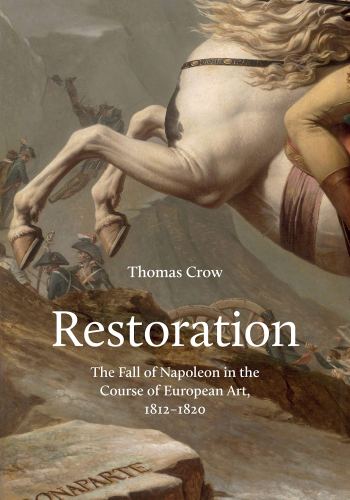 As the French Empire collapsed between 1812 and 1815, artists throughout Europe were left uncertain and adrift. The final abdication of Emperor Napoleon, clearing the way for a restored monarchy, profoundly unsettled prevailing national, religious, and social boundaries. In Restoration, Thomas Crow combines a sweeping view of European art centers—Rome, Paris, London, Madrid, Brussels, and Vienna—with a close-up look at pivotal artists, including Antonio Canova, Jacques-Louis David, Théodore Géricault, Francisco Goya, Jean-Auguste-Dominique Ingres, Thomas Lawrence, and forgotten but meteoric painters François-Joseph Navez and Antoine Jean-Baptiste Thomas. Whether directly or indirectly, all were joined in a newly international network, from which changing artistic priorities and possibilities emerged out of the ruins of the old.
Crow examines how artists of this period faced dramatic circumstances, from political condemnation and difficult diplomatic missions to a catastrophic episode of climate change. Navigating ever-changing pressures, they invented creative ways of incorporating critical events and significant historical actors into fresh artistic works. Crow discusses, among many topics, David’s art and influence during exile, Géricault’s odyssey through outcast Rome, Ingres’s drive to reconcile religious art with contemporary mentalities, the titled victors over Napoleon all sitting for portraits by Lawrence, and the campaign to restore art objects expropriated by the French from Italy, prefiguring the restitution controversies of our own time.
Beautifully illustrated, Restoration explores how cataclysmic social and political transformations in nineteenth-century Europe reshaped artists’ lives and careers with far-reaching consequences. Published in association with the National Gallery of Art, Washington, D.C.
Thomas Crow is the Rosalie Solow Professor of Art History at the Institute of Fine Arts, New York University. His many books include Emulation: David, Drouais, and Girodet in the Art of Revolutionary France; The Long March of Pop: Art, Music, and Design 1930–1995; and No Idols: The Missing Theology of Art. He lives in New York City and in Old Saybrook, Connecticut.
Exhibition | Prospects of India

Thomas Daniell (British, 1749–1840), On the Ganges, ca. 1788, watercolor (San Marino: The Huntington Library, Art Collections, and Botanical Gardens, Gilbert Davis Collection).
◊ ◊ ◊ ◊ ◊
Now on at The Huntington:
Prospects of India: 18th- and 19th-Century British Drawings from The Huntington’s Art Collections
The Huntington Library, Art Collections, and Botanical Gardens, San Marino, 2 March — 10 June 2019
The drawings in this exhibition take as their subject the landscape of India. They were made by British artists, some of whom traveled there on their own in hopes of finding new and ‘exotic’ subject matter. As these drawings attest, the history of Britain’s engagement with South Asia is a complicated one. It covers a spectrum of motivations that ranges from trade and mutually beneficial cultural exchange to violent imperial conquest. The fifteen images on view hint at this complexity, revealing a fascination and admiration for the Indian landscape and the people who lived there, as well as attitudes of cultural superiority and ownership. Works by professional artists such as George Chinnery and Thomas and William Daniell, hang alongside examples by accomplished, though amateur, draftsmen like Col. George Francis White, revealing both the range of artists who sought to depict the scenery of India and the diversity of the landscape itself.
Conference | Stereotypes
This week at The Huntington:
Stereotypes and Stereotyping in the Early Modern World
The Huntington Library, Art Collections, and Botanical Gardens, San Marino, 19–20 April 2019
 The use and abuse of stereotypes is not limited to present-day politics. In this conference, experts in British and American history examine stereotypes related to such vital issues as race, religion, gender, nationality, and occupation. The program explores how stereotyping then, as now, persisted across different spheres of life; how individuals and groups responded; and with what consequences.
Funding provided by The Huntington’s William French Smith Endowment.
F R I D A Y , 1 9 A P R I L 2 0 1 9
8:30 Registration and coffee
9:15 Welcome by Steve Hindle (The Huntington) and opening remarks by Koji Yamamoto (University of Tokyo)
9:30 Session 1: Popery and Religious Stereotypes
Moderator: Koji Yamamoto
• Jennifer Anderson (California State University, San Bernardino), Controversial Figures as Synecdoches: Thomas Nash’s Distorted Snapshots of Puritans and Catholics
• Peter Lake (Vanderbilt University), Puritans and Projectors in the Plays of Ben Jonson
• Abigail Swingen (Texas Tech University), Whigs, Tories, and Jacobites: Stereotypes and the Financial Revolution
12:30 Lunch
1:30 Session 2: Economy, Occupations, and Gender
Moderator: Peter Lake
• Koji Yamamoto, Beyond ‘Keywords’: History Plays, Stereotypes, and the Staging of Political Economy in Late Elizabethan England
• Jane Whittle (University of Exeter), The Early Modern Housewife: A Positive Stereotype of the Working Woman?
• Lisa Cody (Claremont McKenna College), Mind, Body, Soul, and Mirrors: Stereotyping Women in Early Modern England
S A T U R D A Y , 2 0 A P R I L 2 0 1 9
9:00 Registration and coffee
9:30 Session 3: Colonies and Empire
Moderator: Koji Yamamoto
• Kristen Block (University of Tennessee, Knoxville), Creating and Fighting Stereotypes of Sin and Sexual Excess: Leprosy and Race in the Eighteenth-Century Caribbean
• Valerie Forman (New York University), Managing Slave Plantation Labor: Or, How Productivity Became Beautiful and Accumulation Anti-tyrannical. A Study of the Political Economy of Sugar in the Early Modern Transatlantic World
• Sharon Block (University of California, Irvine), Daily Descriptions as Racemaking in Colonial North America
12:30 Lunch
1:30 Session 4: Stereotypes in Archives and on Stage
Moderator: Peter Lake
• Bridget Orr (Vanderbilt University), Re-presenting Character: Dramaturgy Versus Performance in Eighteenth-Century Stereotypes
• Miles Parks Grier (Queens College, City University of New York), Staging the Transferable Stigma of Early Modern Blackness
• Brendan Kane (University of Connecticut), Explicit Bias and the Politics of Difference in Irish-English Encounter
4:30 Closing Remarks
Exhibition | Image Control: Understanding the Georgian Selfie
Now on view at No. 1 Royal Crescent:
Image Control: Understanding the Georgian Selfie
No. 1 Royal Crescent, Bath, 13 April 2019 — 5 January 2020
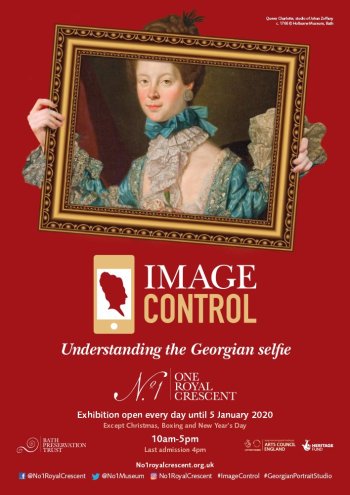 As the Age of Instagram erodes our mental well-being with manipulated and curated images of ideal lifestyles and standards, Image Control explores the way Georgians manipulated their own images to convey certain messages. By using these techniques, we aim to create our own manipulated images of historical figures to show how easy it is to create a fictionalised version of our lives today.
The exhibition is supported by new art commissions: we have commissioned three artists to create a portrait of Henry Sandford—the house’s first resident—to be displayed in the main house. There is an exhibition guide showing a recommended route, starting with the exhibition room and leading into the house, giving visitors a deeper understanding of the portraits and images throughout.
The project team included Lizzie Johansson-Hartley, Museum Manager, No.1 Royal Crescent; Dr Amy Frost, Senior Curator, Bath Preservation Trust; Isabel Wall, Assistant Curator, Bath Preservation Trust; Polly Andrews, Learning and Engagement Officer, Bath Preservation Trust; Katie O’Brien, Gallery Director, 44AD; and Amina Wright, Art Lecturer and Historian.
The earlier, working title of the project was Image Control: The Power of Perception Then and Now. The artist’s brief is available as a PDF file here.
Exhibition | Art in Focus: Blue

William Gilpin, leaves 33v–34r (with color chart laid in) from “Hints to form the taste & regulate ye judgment in sketching landscape,” ca. 1790, manuscript, with pen and ink and watercolor (New Haven: Yale Center for British Art, Paul Mellon Collection). More information on the manuscript is available here.
◊ ◊ ◊ ◊ ◊
Now on view at YCBA:
Art in Focus: Blue
Yale Center for British Art, New Haven, 5 April — 11 August 2019
Curated by Merritt Barnwell, Sunnie Liu, Sohum Pal, Jordan Schmolka, and Muriel Wang, led by Linda Friedlaender and Jennifer Reynolds-Kaye
This exhibition uses the color blue to trace a visual and material history of British exploration, trade, and colonialism. Starting from a consideration of Britain’s growing control over maritime trade, this display proceeds to examine how blue was used to depict the landscapes and peoples of the ‘Orient’ in the eighteenth and nineteenth centuries and concludes with a consideration of the postcolonial interventions of Anish Kapoor.
Art in Focus is an annual initiative for members of the Center’s Student Guide Program, providing Yale undergraduates with curatorial experience and an introduction to all aspects of exhibition practice. The student guide curators for Art in Focus: Blue are Merritt Barnwell, SY ’21; Sunnie Liu, JE ’21; Sohum Pal, BR ’20; Jordan Schmolka, SM ’20; and Muriel Wang, TC ’20. In researching and presenting the exhibition, the students have been led by Linda Friedlaender, Senior Curator of Education, and Jennifer Reynolds-Kaye, Curator of Education and Academic Outreach.
This exhibition and the accompanying brochure—available in the gallery and online—have been generously supported by the Marlene Burston Fund and the Dr. Carolyn M. Kaelin Memorial Fund.
Mary Beard to Deliver Gifford Lectures, 2018–19
From The University of Edinburgh:
Mary Beard, The Ancient World and Us: From Fear and Loathing to Enlightenment and Ethics
Sypert Concert Room, St Cecilia’s Hall, The University of Edinburgh, May 2019
This lecture series explores why the classical world still matters and what ethical dilemmas the study of classics raises (and has always raised). Taking six particular themes, it hopes to shows how antiquity can continue to challenge the moral certainties of modernity. The lectures will be recorded and links will be posted in the respective pages of each lecture. All lectures begin at 5.30pm.
 1 Introduction: Murderous Games
Monday, 6 May
2 Whiteness
Tuesday, 7 May
3 Lucretia and the Politics of Sexual Violence
Thursday, 9 May
4 Us and Them
Monday, 27 May
5 Tyranny and Democracy
Tuesday, 28 May
6 Classical Civilisation?
Thursday, 30 May
Mary Beard is one of Britain’s best-known classicists, Professor at the University of Cambridge and Fellow of Newnham College. She has written numerous books on the ancient world including the Wolfson Prize-winning Pompeii: The Life of a Roman Town; has presented highly-acclaimed TV series, Meet the Romans and Rome: Empire without Limit; and is a regular broadcaster and media commentator. Mary is one of the presenters for the BBC’s recent landmark Civilisations series. Mary is also classics editor of the Times Literary Supplement and writes a thought-provoking blog, A Don’s Life. Made an OBE in 2013 for services to classical scholarship, her latest books include the critically-acclaimed SPQR: A History of Ancient Rome and thought-provoking Women & Power: A Manifesto. Most recently Mary was made a Dame in the Queen’s Birthday Honours list 2018.
The prestigious Gifford Lectureships were established by Adam Lord Gifford (1820–1887), a senator of the College of Justice in Scotland. The purpose of Lord Gifford’s bequest to the universities of Edinburgh, Glasgow, St. Andrews and Aberdeen was to sponsor lectures to “promote and diffuse the study of Natural Theology in the widest sense of the term—in other words, the knowledge of God.” Since the first lecture in 1888, Gifford Lecturers have been recognized as pre-eminent thinkers in their respective fields. Among the many gifted lecturers are Hannah Arendt, Noam Chomsky, Stanley Hauerwas, William James, Jean-Luc Marion, Iris Murdoch, Roger Scruton, Eleonore Stump, Charles Taylor, Alfred North Whitehead, and Rowan Williams.
Courtney Martin Named Director of YCBA
Press release (10 April 2019) from the YCBA:
 Courtney J. Martin ’09 Ph.D., deputy director and chief curator of Dia Art Foundation, will be the next director of the Yale Center for British Art (YCBA), President Peter Salovey announced today.
“I am delighted to announce the appointment of Courtney J. Martin,” Salovey said. “An esteemed scholar of historical and contemporary art, she will use her extensive experience in research, teaching, and curation to further infuse the arts into the university’s work and shape the YCBA’s leadership in the field of British art.”
Martin is familiar with Yale, having earned her doctorate in history of art from the university. As a graduate student, she contributed substantially to the YCBA’s award-winning 2007 exhibition, Art and Emancipation in Jamaica. Her dissertation on British art and artists in the 1970s will soon be published as a book.
Before pursuing her Ph.D., Martin worked in the media, arts, and culture unit of the Ford Foundation in New York City. After receiving her doctorate, she conducted research and taught at Vanderbilt University and then joined the faculty of Brown University where she fostered understanding and appreciation of art, while using the work of artists to launch conversations and inspire discoveries across disciplines, Salovey said. In 2015, Martin joined Dia — a nonprofit organization that supports and presents commissions, exhibitions, and site-specific installations — as adjunct curator for an exhibition of the American painter Robert Ryman at Dia:Chelsea. In 2017, she became the deputy director and chief curator at Dia, where she oversees a complex operation that includes acquisitions, exhibitions, programming, research, and publications.
“With her love of Yale and extensive experience in teaching, research, and leading projects at museums, Courtney is committed to providing outstanding educational opportunities for our students, scholarly material for our faculty, and enriching experiences for the thousands of visitors that enjoy the YCBA every year,” Salovey said. “She is attentive to the core collection of 17th-, 18th-, and mid-19th-century art as well as modern and contemporary British art. I know that she will deftly guide the YCBA’s ever-increasing international prominence in the years ahead.”
Salovey praised current YCBA Director Amy Meyers, who will retire on June 30 after a 17-year tenure, “for making the YCBA one of the foremost destinations in the world for the study of British art and culture and an integral part of Yale and our home city.”
“The center has an amazing wealth of resources, not the least of which is its Louis Kahn building. I am so pleased to be returning to the YCBA and to New Haven,” said Martin. “Amy Meyers has expertly stewarded the collection for nearly 20 years. I look forward to further developing the many enagaging exhibitions, publications, and programs that have earned the center its international acclaim.”
Salovey expressed appreciation to the members of the search committee: Ruth Yeazell, Sterling Professor of English and the committee’s chair; Timothy Barringer, the Paul Mellon Professor in the History of Art; Edward Cooke, the Charles F. Montgomery Professor of the History of Art; Anoka Faruqee, director of graduate studies in painting/printmaking at the Yale School of Art; Susan Gibbons, the Stephen F. Gates ’68 University Librarian; Pericles Lewis, vice president for global strategy and deputy provost for international affairs; Ian McClure, the Susan Morse Hilles Chief Conservator of the Yale University Art Gallery; and Keith Wrightson, the Randolph W. Townsend Jr. Professor of History.
Lecture | Marcia Reed, Engraving China’s Last Golden Age
From Eventbrite:
Engraving China’s Last Golden Age: Qianlong Emperor’s Copper Plates
John Rylands Library, Manchester, 16 May 2019
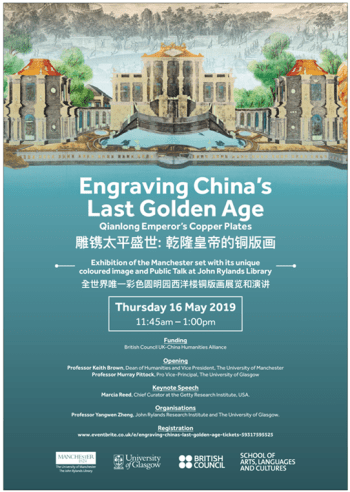 The recent discovery of a complete set of 圆明园西洋楼铜版画 (engravings of European Palaces in Yuan Ming Yuan) at the John Rylands Library, University of Manchester, and the presence of a complete set of 乾隆西征铜版画 (engravings of The Qianlong Emperor’s Western Campaigns) at the Hunterian Museum, University of Glasgow, makes Britain home to two of the most unusual and rare sets of engravings ever made. This is a most significant find, not just for Britain but also—and more importantly—for the study of 18th-century China, its engagement with Europe, and Anglo-Chinese relations in the 19th century and in the future. This discovery also presents challenges, as the two sets need considerable conservation and research.
This public event will digitally showcase some of the known complete sets, and—conservation work permitting—will also physically display the Manchester set, which uniquely contains a hand coloured plate.
Keynote: Marcia Reed (Chief Curator at the Getty Research Institute), followed by a Q&A discussion hosted by Professor Yangwen Zheng (University of Manchester). Thursday, 16 May 2019, 11:45am.
New Book | Chinese Architecture: A History
From Princeton UP:
Nancy Shatzman Steinhardt, Chinese Architecture: A History (Princeton: Princeton University Press, 2019), 400 pags, ISBN: 978-0691169989, $65 / £50.
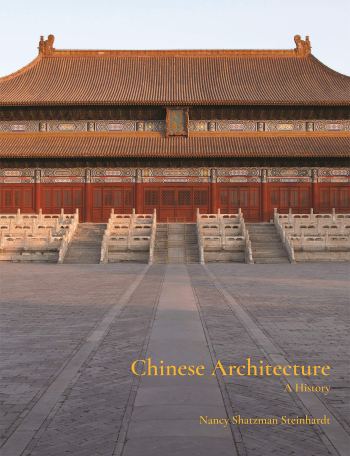 Throughout history, China has maintained one of the world’s richest built civilizations. The nation’s architectural achievements range from its earliest walled cities and the First Emperor’s vision of city and empire, to bridges, pagodas, and the twentieth-century constructions of the Socialist state. In this beautifully illustrated book, Nancy Shatzman Steinhardt presents the first fully comprehensive survey of Chinese architecture in any language. With rich political and historical context, Steinhardt covers forty centuries of architecture, from the genesis of Chinese building through to the twenty-first century and the challenges of urban expansion and globalism.
Steinhardt follows the extraordinary breadth of China’s architectural legacy—including excavation sites, gardens, guild halls, and relief sculpture—and considers the influence of Chinese architecture on Japan, Korea, Mongolia, and Tibet. Architectural examples from Chinese ethnic populations and various religions are examined, such as monasteries, mosques, observatories, and tombs. Steinhardt also shows that Chinese architecture is united by a standardized system of construction, applicable whether buildings are temples, imperial palaces, or shrines. Every architectural type is based on the models that came before it, and principles established centuries earlier dictate building practices. China’s unique system has allowed its built environment to stand as a profound symbol of Chinese culture.
With unprecedented breadth united by a continuous chronological narrative, Chinese Architecture offers the best scholarship available on this remarkable subject for scholars, students, and general readers.
Nancy Shatzman Steinhardt is professor of East Asian art and curator of Chinese art at the University of Pennsylvania. She has written, edited, or translated ten books, including China’s Early Mosques and Traditional Chinese Architecture: Twelve Essays (Princeton).
New Book | Ottoman Baroque
From Princeton UP:
Ünver Rüstem, Ottoman Baroque: The Architectural Refashioning of Eighteenth-Century Istanbul (Princeton: Princeton University Press, 2019), 336 pages, ISBN: 978-0691181875, $65 / £50.
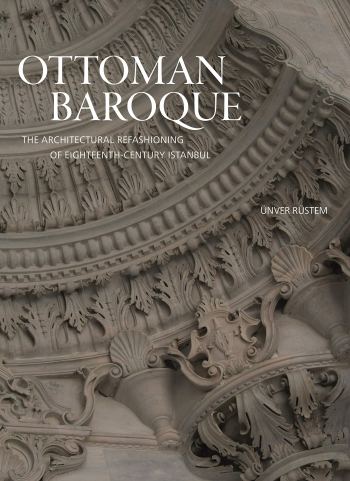 With its idiosyncratic yet unmistakable adaptation of European Baroque models, the eighteenth-century architecture of Istanbul has frequently been dismissed by modern observers as inauthentic and derivative, a view reflecting broader unease with notions of Western influence on Islamic cultures. In Ottoman Baroque—the first English-language book on the topic—Unver Rustem provides a compelling reassessment of this building style and shows how between 1740 and 1800 the Ottomans consciously coopted European forms to craft a new, politically charged, and globally resonant image for their empire’s capital.
Rüstem reclaims the label ‘Ottoman Baroque’ as a productive framework for exploring the connectedness of Istanbul’s eighteenth-century buildings to other traditions of the period. Using a wealth of primary sources, he demonstrates that this architecture was in its own day lauded by Ottomans and foreigners alike for its fresh, cosmopolitan effect. Purposefully and creatively assimilated, the style’s cross-cultural borrowings were combined with Byzantine references that asserted the Ottomans’ entitlement to the Classical artistic heritage of Europe. Such aesthetic rebranding was part of a larger endeavor to reaffirm the empire’s power at a time of intensified East-West contact, taking its boldest shape in a series of imperial mosques built across the city as landmarks of a state-sponsored idiom.
Copiously illustrated and drawing on previously unpublished documents, Ottoman Baroque breaks new ground in our understanding of Islamic visual culture in the modern era and offers a persuasive counterpoint to Eurocentric accounts of global art history.
Ünver Rüstem is assistant professor of Islamic art and architecture at Johns Hopkins University.
C O N T E N T S
Acknowledgments
Notes on Captions, Transliterations, and Translations
Introduction
1 Setting the Scene: The Return to Istanbul
2 Pleasing Times and Their ‘Pleasing New Style’: Mahmud I and the Emergence of the Ottoman Baroque
3 A Tradition Reborn: The Nuruosmaniye Mosque and Its Audiences
4 The Old, the New, and the In-Between: Stylistic Consciousness and the Establishment of Tradition
5 At the Sultan’s Threshold: The Architecture of Engagement as New Imperial Paradigm
Conclusion
Notes
Bibliography
Index
Image Credits










 Enfilade
leave a comment