Newberry Library Completes Renovations
The Newberry Library’s nine-month, $12.7 million renovation, including updated exhibition spaces, was completed several months ago, and just announced with a press release, via ArtDaily:
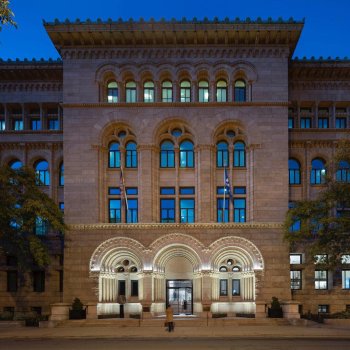 The Newberry Library, one of Chicago’s treasured landmarks, has completed renovations to enhance its public spaces and welcome visitors in new ways. As architect, Ann Beha Architects’ work balances historic preservation with clear and memorable contemporary design.
A world-renowned research library, the Newberry offers an extensive collection of rare books, maps, and manuscripts, with material spanning six centuries. The building was designed by notable Chicago architect Henry Ives Cobb in Romanesque Revival style, and completed in 1893. By renovating its entrance level, the Newberry sought to make the impressive building more accessible and inviting, and to renew historic interior spaces, introducing visitor services and settings for exhibitions and programs.
ABA’s design transforms public spaces and showcases the Library’s collections through its new exhibition galleries. Changes begin at the street, where new lighting, an information kiosk, and an accessible entry welcome the public. Inside, historic spaces have been restored, enhancing their rich details and providing new lighting and acoustical improvements. New spaces welcome and orient visitors, with amenities including an expanded bookstore, seminar and program spaces, and lounge. New galleries display thematic exhibitions, with a unique built-in display case highlighting notable items from the Newberry’s collection on an ongoing basis.
Ann Beha Architects is engaged in contemporary design and in the preservation and adaptive re-use of landmark buildings. Based in Boston and practicing nationally, ABA has led planning and design projects for the Museum of Fine Arts, Boston; Massachusetts Institute of Technology; University of Chicago; the Smithsonian Institution; the US Department of State; and Yale University.
Exhibition | Discriminating Thieves: Nazi-Looted Art and Restitution
Press release (16 January 2019) from The Nelson-Atkins:
Discriminating Thieves: Nazi-Looted Art and Restitution
The Nelson-Atkins Museum of Art, Kansas City, 26 January 2019 — 26 January 2020
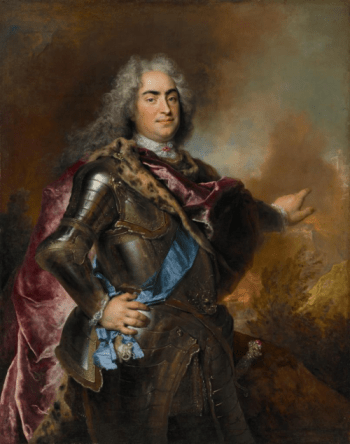
Nicolas de Largillière, Augustus the Strong, Elector of Saxony and King of Poland, ca. 1715, oil on canvas (Kansas City: Nelson-Atkins Museum of Art, William Rockhill Nelson Trust, 54-35).
Discriminating Thieves: Nazi-Looted Art and Restitution follows the journey of four works of art that were once in the hands of the Nazis. The exhibition explores the circumstances surrounding their thefts, their return to their rightful owners, and their subsequent legal acquisition by The Nelson-Atkins Museum of Art in Kansas City.
During World War II, Adolf Hitler and the Nazis looted art on an unprecedented scale. They stole thousands of objects across Europe between 1933 and 1945, keeping art for their own collections or stashing art for use in the museum Hitler planned to build. Other works, considered by the Nazis to be immoral, or ‘degenerate’, were destroyed, sold, or used as Nazi propaganda.
“This exhibition was extensively researched by MacKenzie Mallon, the Nelson-Atkins provenance specialist who is gaining a national reputation for her work in this important field,” said Julián Zugazagoitia, Menefee D. and Mary Louise Blackwell CEO and Director of the Nelson-Atkins. “This is very specific and painstaking research into ownership that is of utmost importance in the museum world and uncovers fascinating stories of the journey this art has traveled.”
Most of the looted objects were recovered by the Allies after the war, many by a group of art curators and scholars known as the Monuments Men. Paul Gardner, the first director of the Nelson-Atkins and himself a Monuments Man, described his journey to an Italian castle that had once housed an important art collection, and his dismay at finding that the Germans had reached it before him. Gardner wrote: “The custodian told us that experienced German officer-experts had systematically broken open all the bales and boxes, and had taken the cream of the collection. The Germans have proven all along to be discriminating thieves.”
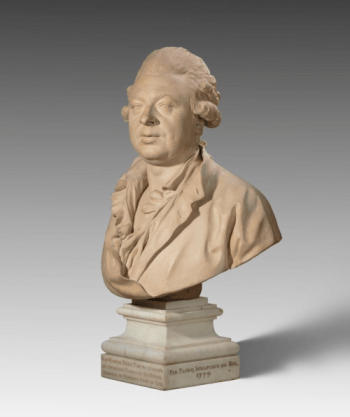
Augustin Pajou, Jean-François Ducis, 1779, terracotta on marble socle, bust 23 inches high (Kansas City: Nelson-Atkins Museum of Art, acquired through the McGreevy Family through the Westport Fund in honor of the Fiftieth Anniversary of the Nelson-Atkins, F83-22).
The focus exhibition is comprised of four works of art: Augustus the Strong, Elector of Saxony and King of Poland by Nicolas de Largillière; Still Life with Guelder Roses by Pierre Bonnard; Jean-François Ducis, a sculpture by Augustin Pajou; and Masks by the German artist Emil Nolde.
De Largilliere’s Augustus the Strong was among the works of art stolen by the Nazis and intended for Hitler’s museum of the future, the ‘Führermuseum’, which he imagined would be the greatest art museum in the world.
Emile Nolde’s Masks, however, was declared ‘degenerate’ because of its modern, expressionistic style, even though Nolde was a member of the Nazi party. It was removed from the Folkwang Museum in Essen, Germany in 1937 and given to a German art dealer, Karl Buchholz, to sell. The painting remained in his possession throughout the rest of the war, and he transferred it to a New York art gallery following an agreement among German museums not to pursue the restitution of ‘degenerate’ art that had been sold abroad.
“Masks remained in that gallery until the Nelson-Atkins purchased it in 1954,” said Mallon, Specialist, Provenance. “There is a human story behind each of these objects, and uncovering that ownership history is the purpose of provenance research. I think it’s important to remember the very personal cost of Nazi art looting during World War II and the subsequent return to the owners or their descendants and the museum’s legal acquisition of the works.”

Emil Nolde, Masks, 1911, oil on canvas, unframed: 73 × 77cm (Kansas City: Nelson-Atkins Museum of Art, Gift of the Friends of Art, 54-90).
Through a special guide, visitors to the exhibition will be encouraged to find other works of art in Nelson-Atkins galleries that have similar, interesting histories from World War II.
Special programming related to this exhibition includes a talk by Mallon on January 31, “What Once was Lost: Nazi Art Looting and Allied Restitution.” Mallon will discuss Nazi art looting during World War II, the recovery of much of the stolen art by the Allies, and how these stories intertwine with the history of the Nelson-Atkins collection. Mallon will also give a talk on October 3, “Safe Haven: the Nelson-Atkins and the Protection of Art during World War II.” On March 7, art historian and director of the Smithsonian Cultural Rescue Initiative Corine Wegener will give a talk, “The Monuments Men and Beyond: Saving Cultural Heritage in Today’s Conflicts,” sharing her insights into the role of museums in the development of the Monuments Men, the importance of provenance research in museums today, and how international law can help protect heritage in today’s conflicts. Three films will also be shown in conjunction with this exhibition: Hitler Versus Picasso and Others March 15 and 16, The Rape of Europa March 22 and 23, and Woman in Gold March 29 and 30.
Exhibition | Regency Fashion in Miniature

Left: John Smart, Portrait of a Woman, 1807, watercolor on ivory, 1 ¾ × 1 ½ inches (Kansas City: Nelson-Atkins Museum of Art, Gift of the Starr Foundation, Inc., F65-41/48). Right: Henry Bone, Portrait of King George IV of England, 1821, enamel on copper, 1 ¼ × 1 inches (Kansas City: Nelson-Atkins Museum of Art, Gift of Mr. and Mrs. John W. Starr and the Starr Foundation, Inc., F58-60/134).
◊ ◊ ◊ ◊ ◊
Now on view at The Nelson-Atkins:
Regency Fashion in Miniature
The Nelson-Atkins Museum of Art, Kansas City, 21 March 2018 — 17 March 2019
High-waisted dresses, open-necked shirts, and un-powdered curls abound in the extravagant age of the Regency era (about 1795–1837). A period in Britain associated with the rise of a handsome young prince who became King (George IV) and the work of novelist Jane Austen, this time left its mark on fashion, too. Many men followed the lead of the romantic poet Lord Byron, whose ‘Byronic’ curls cluster at the front of his head. Women, too, wore their hair in natural curls and followed a style of dress inspired by the classical fashions of Greece and Rome. The Regency era ended in 1837 with the ascension of Queen Victoria, who ushered in a new style that would bring fashion into the twentieth century.
This rotation of portrait miniatures features some of the leading miniaturists of the period including John Smart, Henry Bone, William Essex, and Jean Baptiste Isabey, among others.
Presented to the Nelson-Atkins by Mr. and Mrs. John W. Starr in two major gifts from 1958 and 1965, and numerous additional gifts through the years, the Starr Collection of Miniatures illustrates the history of European portrait miniatures through more than 250 objects. These delicate objects, many of which are painted in watercolor on ivory, include works by Britain’s greatest miniaturists, ranging from the late 1500s to the early 1800s, as well as some very fine examples by European and American artists made during the same time frame.
The exhibition of portrait miniatures in Gallery P24 changes every twelve months to showcase the variety of the collection and also to limit exposure of the light-sensitive pigments.
Call for Papers | Themis on Trial, 16th–18th Centuries

From H-ArtHist:
Colloque jeunes chercheur.e.s du CIREM
Thémis en procès: Justice et sentiment d’injustice, XVIe–XVIIIe siècles
Université du Québec à Montréal, 29–30 May 2019
Proposals due by 1 February 2019
L’actualité récente autant que la société d’Ancien Régime foisonne d’exemples révélant des justices parallèles aux institutions (polices, tribunaux), se déployant en marge des textes de lois et des rituels judiciaires. Inscrit aux fondements mêmes du lien communautaire et de l’ordre social, ces pratiques, que l’historien Benoît Garnot a conceptualisées par l’«infrajudiciaire», le «parajudiciaire, ou encore l’«extrajudiciaire» (Garnot 2000), se déploient dans les interstices de la justice officielle, hors de la portée de ses lieux de pouvoir et en amont des droits civil et religieux. La dix-neuvième édition du colloque «Jeunes chercheurs» du CIREM se propose d’interroger précisément les diverses formes de ce phénomène de régulation socioculturel opérant dans les zones poreuses de la justice instituée, là même où se développent les expressions du sentiment d’injustice. Une certaine conception d’une organisation sociale « juste » se dessine en filigrane de ces expressions du sentiment d’injustice, qui révèlent le seuil fluctuant de ce qui est moralement acceptable, par rapport à ce qui ne l’est pas. Dans L’Encyclopédie, le chevalier de Jaucourt rappelle d’ailleurs combien les fondements religieux et moraux de la justice dépassent largement le cadre légal pour l’établir comme baromètre du juste et de l’injuste devant permettre à chacun de « contribuer à l’avancement du bien commun » (tome 8, p. 754). Ainsi, l’accent porté sur l’injuste détourne notre attention des procédures judiciaires, des grands textes de loi et des symboles canoniques de l’imagerie judiciaire pour mieux permettre une perspective au ras du sol, plus à même de rendre compte de l’ensemble des pratiques, discours et représentations ayant cours au sein des communautés et des sociabilités modernes. Entre les soulèvements populaires et les réflexions théoriques des philosophes, à travers le miroir des œuvres de fiction et des productions artistiques, ou encore au cœur des conflits politiques et des tensions interindividuelles, la désignation de ce qui est « juste » et « injuste » comme comportement interroge jusqu’aux dimensions affectives qui rythment la vie des collectivités.
Afin d’approfondir ces quelques réflexions, nous sollicitons des propositions de communication qui s’inscrivent dans l’un des axes suivants (liste non exhaustive) :
• Les médias écrits et visuels comme modes d’expression du sentiment d’injustice, représentations et constitutions de référents moraux dans la littérature et dans l’art
• Les écarts entre les lois prescrites et leur application quotidienne, tensions entre régimes judiciaires concurrents, conflits armés et diplomatie politique
• Revendications socioéconomiques et remises en cause étatique, motivations des soulèvements, ainsi que les sociabilités qui en émergent
• Les productions littéraires dans leurs rapports entre elles (polémiques) et avec les autorités (censure), idées politiques et conceptions philosophiques du peuple
• Les lieux d’expression de l’injustice, rumeurs et mobilité de l’affect, la spatialisation de l’émotion collective
De nature interdisciplinaire, ce colloque est l’occasion pour les jeunes chercheurs et chercheuses (soit à la maîtrise, au doctorat ou au postdoctorat) de divers horizons—histoire, histoire de l’art, philosophie et littérature—de mettre en commun leurs réflexions concernant la justice et le sentiment d’injustice, et ce, dans la multitude de formes qu’ils ont pu avoir été vécus et exprimés dans l’Europe des 16e,17e et 18e siècles.
L’événement se tiendra à l’Université du Québec à Montréal, les 29 et 30 mai 2019. Les communications, inédites et en français, ne devront pas dépasser les vingt minutes allouées à chacune des participantes. Les propositions de communication (titre et résumé de 250 mots, niveau d’étude et affiliations institutionnelles) devront être envoyées au comité organisateur avant le 1er février à l’adresse suivante: colloque.etudiant.cirem.2019@gmail.com. Les Cahiers du CIERL (Éditions Hermann, Paris) accueilleront les articles issus des communications après examen par le comité organisateur et scientifique du colloque.
Comité organisateur
Annie Champagne, doctorante et chargée de cours en histoire de l’art, UQÀM
Antoine Champigny, doctorant en histoire et en lettres, UQÀM et Univ-Lyon 2
Virginie Cogné, doctorante en histoire, UQÀM
Julien Duval-Pélissier, maîtrisant en histoire, UQÀM
Direction scientifique
Sophie Abdela, professeure d’histoire moderne, Université de Sherbrooke
Pascal Bastien, professeur d’histoire moderne, UQÀM
Call for Papers | Spaces and Frontiers of Islamic Art and Archaeology
From H-ArtHist:
Spaces and Frontiers of Islamic Art and Archaeology
Fifteenth Ernst Herzfeld Gesellschaft (EHG) Colloquium
Budapest, 4–6 July 2019
Proposals due by 1 March 2019
The Ernst Herzfeld Society for Studies in Islamic Art and Archaeology and the Eötvös Loránd University are pleased to invite you to the 15th colloquium of the Society to be held in Budapest, July 4–6, 2019, under the title Spaces and Frontiers of Islamic Art and Archaeology.
The concepts of frontier, boundary, and border, and consequently of spaces and regions they delimit, have left a persistent mark on the perception of geography, whether expounded in pre-modern Muslim textual sources, or by modern geostrategists. The medieval Hudud-al-ʽAlam (Limits of the World, 372/982) suggests, encapsulating in its title the defining significance of boundaries, that such divisions, imposed by mountains, rivers, or deserts, are inherent and natural markers to differentiate spaces and regions. The spatial turn, related also to changes in Central and Eastern Europe not so many years ago, has brought the concept to the forefront once again, also in scholarship on visual and material culture, art history, and archaeology.
Attempts to do away with the constraints of the inherited perception of a trans-regional Muslim world have brought about new approaches of looking at them. Such experiments have inevitably created new, perhaps more subtle, ruptures: temporal junctures between past and present understandings of things, and new, globalized distinctions. Spatial and regional delimitations rely on conceptual frames within which entities are defined, yet definitions themselves remain fluid despite our dependence on the very idea of definition. ‘Islamic art’ is among the definitions that fall short of assuming a generally accepted outline, often particularly in the regional art historiography of the countries that supposedly are covered by the term. Postulating sets of criteria to imply that the visual and material culture of a Muslim community, or Muslim society, was perceived by that community or society as ‘Islamic’ may lead to unsatisfying results, yet scholarly discourse on art and archaeology needs a discussion of these attempts.
The 15th colloquium of the Ernst Herzfeld Society invites papers, and encourages panel proposals, to address the ways in which Islamic art developed within or expanded beyond external, internal, confessional, and political limits and resulted in a diversity of visual and material cultures. There will be, as usual, also room for papers that report on current research outside of the main theme of the colloquium.
The colloquium is planned to begin with a keynote lecture on the evening of Thursday, July 4, 2019. It continues with panel sessions on Friday and Saturday, July 5–6. A meeting of graduate students is scheduled for Thursday, July 4, for which a separate call will be circulated. The graduate meeting is planned to include also a discussion panel with professionals speaking on research skills, publishing, and finding a job.The annual general assembly of the Ernst Herzfeld Society will be held on Friday or Saturday afternoon.
Please submit your panel or paper proposal for the colloquium by March 1, 2019 to Dr Iván Szántó: szanto@caesar.elte.hu. All proposals will undergo a peer review selection process. Acceptance will be notified in the first week of April 2019.
Pre-arranged panels will preferably include three presentations. It is of course also possible to submit individual papers, which will be presented in open panels. Each presentation is limited to 20 minutes, followed by 10 minutes of discussion (or 30 minutes of discussion per panel). The colloquium languages are English and German.
• Individual papers: Please submit a title and an abstract of no more than 300 words.
• Pre-arranged panels: Please submit a title and an abstract of no-more than 500 words presenting the topic and the aim of the panel, as well as a provisional list of speakers.
If you want to submit a paper proposal for the graduate meeting, please send your title and abstract to Sarah Johnson: sarah.cresap.johnson@gmail.com.
Registration and participation in the colloquium are free for members of the Society. Other speakers and participants are asked to pay a conference fee equivalent to the annual membership fee of 50€ (reduced 25€). We kindly request that speakers and participants organize their own travel and accommodation. A list of hotels located in the vicinity of the colloquium venue will be sent in due course.
Organizer of the 15th EHG colloquium
Dr. Iván Szántó
Department of Iranian Studies Eötvös Loránd University, Budapest
szanto@caesar.elte.hu
Ernst Herzfeld-Gesellschaft Chairman
Prof. Dr. Markus Ritter
History of Islamic Art
Department of Art History, University of Vienna
Vice-Chairwoman
Prof. Dr. Francine Giese
SNF-Professor
Institute of Art History, University of Zurich
Call for Papers | Recycling Luxury
From H-ArtHist:
Recycling Luxury
Christie’s Education, 42 Portland Place, London, 5 July 2019
Proposals due by 1 March 2019
The concept of luxury is associated with ideas of excess (luxus) or even worse immodesty (luxure). An infamous example involving Cleopatra dissolving a priceless pearl and swallowing it encapsulates some common associations between luxury and immorality, or luxury as intrinsically linked to the idea of waste.
This conference intends to go beyond the common connotations attached to the concept of luxury, and challenge them. It will posit that luxury cannot be seen entirely in the light of dissipation. Rather we would like to invite contributions that explore the links between luxury and the idea of recycling i.e. the re-using, repurposing, remaking, reshaping of luxury materials and objects across time and place, hence giving more space for discussion to this understudied historical phenomenon.
Object case studies from all fields of the fine and decorative arts are welcomed to foster conversations across disciplines—for example:
• Historical Fashion and Textiles
• Furniture
• Silver
• Ceramics
• Jewellery
• Armour
• Painting
• Sculpture
• Books and Manuscripts
Contributors can select from the following submission formats:
• Full Paper: 25-minute conference presentation
• Short Paper: 15-minute conference presentation
• Flash Paper: 5-minute (no more than 5 slides). We particularly welcome proposals from emerging scholars in this category.
This conference has been designed to coincide with Classic Week at Christie’s in July 2019. For all submissions, please send a 300-word abstract and short biography to jansell@christies.edu and mtavinor@christies.edu.
The Burlington Magazine, January 2019
The eighteenth century in The Burlington: (with the issue focused on Westminster Abbey) . . .
The Burlington Magazine 161 (January 2019)
 A R T I C L E S
• Susan Jenkins, “‘Sunbeams and Shadows’: Exhibiting the Collection at Westminster Abbey,” pp. 4–8. The Queen’s Diamond Jubilee Galleries, opened last year, display works of art and historic artefacts from the collections at Westminster Abbey, London. To introduce this special issue of the Magazine, the Abbey’s Curator, outlines the history of the building’s museum displays and explains the thinking behind the new galleries.
• Gordon Higgott, “Sir Christopher Wren’s Failed Project for a Crossing Tower and Spire at Westminster Abbey, 1713–25,” pp. 44–57. In 1713, with funds available for ‘finishing’ Westminster Abbey, the Surveyor to the Fabric, Sir Christopher Wren, began to plan the addition of a lofty crossing tower and spire. After Wren’s death in 1723 the proposal was shelved by his successor, Nicholas Hawksmoor, who recognised that it presented an insoluble structural problem.
R E V I E W S
• Lynn Jones, Review of the exhibition Armenia! (The Metropolitan Museum of Art, 2018–19), pp. 60–63.
• Eric Zafran, Review of the exhibition The Orléans Collection (New Orleans Museum of Art, 2018–19), pp. 67–69.
• Reinier Baarsen, Review of the exhibition Luigi Valadier: Splendor in Eighteenth-Century Rome (The Frick Collection, 2018–19), pp. 70–71.
• Michael Hall, Review of Karl-Georg Pfändtner, ed., ‘Gold und Bücher lieb ich sehr…’: 480 Jahre Staats- und Stadtbibliothek Augsburg (Quaternio Verlag, 2017), pp. 85–87.
• Roger White, Review of Rosemary Yallop, Cottages Ornés: The Charms of the Simple Life (Yale University Press, 2017), pp. 89–90.
• Gauvin Alexander Bailey, Review of Vittorio Magnago Lampugnani, Die Stadt von der Neuzeit bis zum 19. Jahrhundert: Urbane Entwürfe in Europa und Nordamerika (Verlag Klaus Wagenbach, 2017), pp. 92–93.
Foundling Museum Acquires Portrait of Duchess of Manchester
From The Foundling Museum:

Andrea Soldi, Portrait of Isabella Duchess of Manchester, 1738 (London: The Foundling Museum).
The Foundling Museum has acquired a painting by celebrated 18th-century artist Andrea Soldi portraying Isabella, Duchess of Manchester, one of Thomas Coram’s key female supporters who provided the catalyst for the establishment of the Foundling Hospital. This is a significant acquisition for the Museum, being the only portrait of a key female supporter of the Foundling Hospital, prior to its foundation in 1739, to enter the Foundling Museum Collection and one of the first paintings of a woman to hang permanently in the Picture Gallery.
On 6 January 1730, the Duchess of Manchester became the fifth Lady to sign Coram’s petition. Her husband would subsequently put his name to the Royal Charter in 1739. This acquisition is complemented by two other paintings of women. A portrait of Charlotte, Duchess of Somerset (the petition’s first signatory) attributed to Charles D’Agar, on loan to the Museum from Lord Egremont, is joined by a portrait of Beatrice Forbes, one of the Foundling Hospital’s five female Governors, painted in 1906 by William Carter. Together, these three paintings are a landmark in the Picture Gallery’s permanent display, which until now has never included a portrait of a woman. Surrounded by paintings of the male governors who were the public face of the charity, these three portraits enable visitors to appreciate the crucial role that women played not only in establishing the Foundling Hospital, but also in shaping British society.
The acquisition follows the success of a year-long programme in 2018 marking the centenary of female suffrage—a programme that included the exhibition Ladies of Quality and Distinction, which featured the portrait of Isabella, Duchess of Manchester, alongside portraits of the other twenty-one Ladies who were Thomas Coram’s first supporters. In the face of male indifference and risking society’s disapproval, these women put their names to the first petition submitted to King George II in 1735 that called for the establishment of a home for “abandoned and deserted young children.” The support of these pioneering women was crucial in overcoming moral concerns about Coram’s project, enabling his campaign to gain the critical momentum that led to the establishment of the UK’s first children’s charity.
The acquisition of the portrait of the Duchess of Manchester has been made possible with the help of Art Fund, the Arts Council England/V&A Purchase Grant Fund, The Friends of Thomas Coram, and a number of generous individuals donors.
Exhibition | Early Gainsborough

Thomas Gainsborough, Mr. and Mrs. John Brown and Their Daughter, Anna Maria, ca. 1754–55, oil on canvas
(Private Collection, Norfolk)
◊ ◊ ◊ ◊ ◊
Now on view at Gainsborough’s House:
Early Gainsborough: ‘From the Obscurity of a Country Town’
Gainsborough’s House, Sudbury, Suffolk, 20 October 2018 — 17 February 2019
This exhibition focusses on the early life and art of Thomas Gainsborough (1727–1788). It explores how Gainsborough made his first steps in the art world from the inspiration of the landscape surrounding his hometown of Sudbury, through his training in London in the 1740s, to his return to Suffolk around 1748. This is a particularly important exhibition for Gainsborough’s House because it deals with Gainsborough’s time in Sudbury, his family, and reveals for the first time new research on this significant period of the burgeoning artist. The exhibition shows paintings from Gainsborough’s House collection, new acquisitions, and loans that give new insight into Gainsborough’s early life and development as an artist. It will draw on a significant collection of the paintings, prints, and ephemera on Gainsborough from the 1740s.
New Book | La peinture en Bourbonnais du XVIe au XVIIIe siècle
Published by PUR and available from Artbooks.com:
Guennola Thivolle, La peinture en Bourbonnais du XVIe au XVIIIe siècle (Rennes: Presses Universitaires de Rennes, 2019), 332 pages, ISBN: 978-2753575813, 35€ / $60.
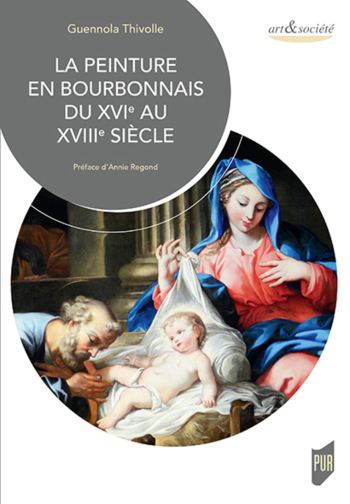 Cet ouvrage propose une étude des tableaux de chevalet et des décors peints réalisés en Bourbonnais entre 1531 et 1790 mais aussi de leurs commanditaires. Tous investissent l’œuvre d’une fonction, de la dévotion à l’apparat, qui s’exprime à travers les sujets représentés et leur emplacement dans l’édifice. Certains font appel à de grands maîtres de la peinture, d’autres à des artistes locaux alors assimilés à des artisans. La découverte de pièces d’archives relatives à ces peintres permet de comprendre leurs conditions de travail et leur cadre de vie. Quel que soit le niveau de fortune du commanditaire ou le talent du peintre, il apparaît que les réseaux de sociabilité jouent un rôle primordial dans le processus de la commande.
Guennola Thivolle est docteure en histoire de l’art moderne et conservatrice des Antiquités et Objets d’Art du département de l’Allier.
C O N T E N T S
Remerciements
Annie Regond, Préface: Une nouvelle approche de la vie artistique dans le Bourbonnais à l’époque moderne
Introduction
Les commandes religieuses: Entre piété et apparat
Les commandes profanes: Du prestige au raffinement
Les réseaux de sociabilité
Entre Paris et le Bourbonnais
Les peintres locaux
L’artiste au travail
Conclusion
Sources et bibliographie
Dictionnaire des peintres
Index
Crédits photographiques
A fully detailed table of contents is available here»










 Enfilade
leave a comment