Melinda Watt Appointed Curator of Textiles at AIC
Press release (12 March 2018) from the AIC:

Melinda Watt, Chair and Christa C. Mayer Thurman Curator of Textiles at the Art Institute of Chicago (Photo courtesy of The Metropolitan Museum of Art).
James Rondeau, President and Eloise W. Martin Director of the Art Institute of Chicago, announced today the appointment of Melinda Watt as the new Chair and Christa C. Mayer Thurman Curator of Textiles. Watt most recently served as Curator in the Department of European Decorative Arts and Sculpture (2016–18) and supervising curator for the Antonio Ratti Textile Center (2009–18) at The Metropolitan Museum of Art, where she oversaw exhibitions, research, and collections management for over 16,000 Western European textiles and 500 fans and led one of the largest, most technically advanced facilities for the study and storage of textiles in any major art museum in the world. She helped define a comprehensive, inclusive strategy for the care and research of works from all of the world’s civilizations—archaeological fragments, tapestries, carpets, quilts, ecclesiastical vestments, silks, embroideries, laces, velvets, and more—from 3000 BC to the present.
Watt will now lead the Art Institute of Chicago’s internationally renowned Department of Textiles and oversee its extensive collection of more than 13,000 textiles and 66,000 sample swatches ranging from 300 BC to the present, with particular strengths in Pre-Columbian textiles, European vestments, tapestries, woven silks and velvets, printed fabrics, needlework, and lace. The department has also strong holdings in 16th- and 17th-century English needlework, printed and woven materials of the 18th and 19th centuries, American quilts and woven coverlets, Eastern textiles, and 20th-century fiber art.
In announcing this appointment, Rondeau said: “Melinda has an outstanding reputation as a talented curator, an expert researcher and respected scholar, and brilliant administrator and leader. I am thrilled for our museum and our visitors that she is joining us in this crucial position and will re-energize our ambitious efforts to grow and elevate the reputation of our renowned Textiles department and present innovative and dynamic exhibitions.”
Watt shared: “From the earliest days of my career, I have admired the supreme quality and breadth of the textile collection at the Art Institute, so it comes as a great honor to be asked to lead the Department of Textiles. This is truly a unique opportunity to augment the museum’s already stellar collection and to have an impact on the scholarly field at large.”
Watt began her tenure at The Met in 1994, in The Costume Institute as a Study Storage Assistant, and soon took on increasingly complex and leadership roles, culminating in her leadership of the Antonio Ratti Textile Center beginning in 2009 and a curatorial rise within the Department of European Sculpture and Decorative Arts to become a full Curator in 2016. Her exhibitions at The Met include: The Secret Life of Textiles: The Milton Sonday Archive (2017–18), American and European Embroidered Samplers, 1600–1900 (with Amelia Peck, 2015–16), Elaborate Embroidery: Fabrics for Menswear before 1815 (2015), William Morris: Textiles and Wallpapers (with Connie McPhee and Alison Hokanson, 2014), Interwoven Globe: The International Textile Trade, 1500–1800, (co-curator with Amelia Peck et al., 2013–14), An ‘Industrial Museum’: John Forbes Watson’s Indian Textile Collection (2013–14), Renaissance Velvet: Textiles for the Nobility of Florence and Milan (2011–12), and European Textiles from the Collection of Friedrich Fischbach (2010).
Earlier in her career, Watt lectured and instructed at the Bard Graduate Center for Studies in the Decorative Arts, at The Graduate Center at the City University of New York, at New York University, and at the Fashion Institute of Technology in New York, NY. She has also lectured and published widely, from New York to Chicago and Copenhagen to Beijing, on subjects as diverse as Renaissance and Baroque luxury textiles, Anglo-Indian hangings, flora and fauna in English embroidery, Isabella Stewart Gardner’s pearls, mid-century American fashion, nature in western art, and dressing for 17th-century portraiture.
Watt earned her BFA, with a concentration in Art History, at Wittenberg University in Springfield, Ohio. She holds an MA in Costume Studies from New York University.
New Book | Die Fresken von Joseph Mages
Published by Schnell & Steiner and now available from Artbooks.com:
Angelika Dreyer, Die Fresken von Joseph Mages (1728–1769): Zwischen barocker Frömmigkeit und katholischer Aufklärung (Regensburg: Schnell & Steiner, 2017), 312 pages, ISBN: 9783795432560, 76€ / $95.
 Josef Mages (1729–1769) setzte sich in seinen Freskenausstattungen richtungsweisend mit den Reformbestrebungen der katholischen Aufklärung auseinander. Seinen vom künstlerischen Umfeld der Augsburger Kunstakademie geprägten Deckenmalereien wird hier erstmals eine umfassende Studie gewidmet, die zugleich eine wesentliche Lücke in der Erforschung des süddeutschen Barocks schließt.
Neben einer exemplarischen Künstlersozialgeschichte stehen insbesondere die jeweiligen Auftraggeber sowie ihre vorwiegend religionspolitischen Ansichten und Absichten bei der Auftragsvergabe im Vordergrund der Untersuchung. Dabei nahm die vor allem im Bistum Augsburg wesentlich an Bedeutung gewinnende Auseinandersetzung über eine aufgeklärte Erneuerung der nachtridentinischen Frömmigkeitspraxis entscheidenden Einfluss auf die ikonographischen Inhalte und formale Gestaltung der Freskomalereien von Josef Mages. Im Gegensatz zu dem maßgeblich von Lodovico Antonio Muratori (1672–1750) initiierten religiösen Wandel und seinen Auswirkungen auf die raumbestimmende Kirchenausstattung wurden die Deckengemälde in Altomünster bei Freising oder in Oberschönenfeld von den weit existenzielleren Sorgen der dortigen Konventualen geprägt. Diese können als frühe malerische Vorboten der vom katholischen Klerus mit sorgenvollem Blick verfolgten Entwicklung hin zur späteren Säkularisation gesehen werden.
Call for Papers | Collecting Dutch and Flemish Art in Germany
From H-ArtHist:
Collecting Dutch and Flemish Art in Germany, 1500–1900
Conference ANKK and RKD, Den Haag, 18–20 October 2018
Proposals due by 15 April 2018
Much of Dutch and Flemish Art was acquired by German collectors, so that today there are more of these artefacts in German collections than in those of other countries. The 2018 conference of the ANKK seeks to analyse the ways in which Netherlandish art was and is collected in the German speaking countries and how this influenced not only scholarship but also the art market.
The German organisation for the Study of Netherlandish Art and Culture [Arbeitskreis Niederländische Kunst- und Kulturgeschichte e.V.] will hold its decennial as an international conference in Den Haag in cooperation with the RKD from 18 to 20 October 2018. The RKD is currently investigating the cultural exchange between the Netherlands and Germany between 1500 and 1900 in its three-year project Gerson Digital: Germany. The basis of the project is the pioneering publication by Horst Gerson (1907–1978), Ausbreitung und Nachwirkung der holländischen Malerei des 17. Jahrhunderts (Amsterdam 1983, ed. princ. Haarlem 1942), in which the circulation and imitation of Dutch paintings in Europe are processed by country.
Proposals for 20-minute papers could address—but are by no means limited to—the following topics:
• spaces of the art market for Netherlandish Art and the main art centres for the German speaking countries, public and private collections, and clerical institution
• prize formation mechanisms for Dutch and Flemish Art
• networks of artists, dealers and collectors (both private and institutional), as well as writers on art and other audiences
• new scientific methods and methodologies of research and their influence on scholarship or collecting
• ‘art agents’ and their changing roles
• the nature of collections (municipal or princely), their buildings, and shared knowledge spaces
• interdependences of primary and secondary art markets for Netherlandish art
We also aim to have one open session of lightning talks in which any future, present or past project or exhibition, unrelated to the above-mentioned panels, can be presented in exactly eight minutes. Please indicate in your abstract whether your proposal is meant for the lightning talks or the more traditional panel format. No matter which format you prefer, we also encourage junior researchers to send us their proposals. Please send an abstract of the proposed paper (maximum of 500 words) in German or English and a short curriculum vitae to both the RKD (leeuwen@rkd.nl) and the ANKK (bmuench@uni-bonn.de) by 15 April 2018.
Exhibition | Salazar: Portraits of Influence in Spanish New Orleans
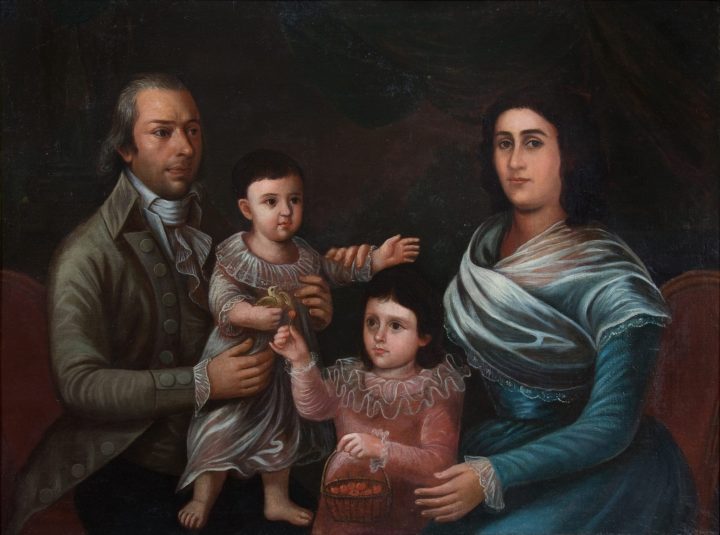
Josef Salazar y Mendoza, Portrait of Don Antonio Mendez (1750–1829) and His Family, 1795, oil on canvas, 36 × 49 inches (Collection of Mr. and Mrs. Robert J. Patrick).
◊ ◊ ◊ ◊ ◊
Now on view at the Ogden Museum of Southern Art:
Salazar: Portraits of Influence in Spanish New Orleans, 1785–1802
Ogden Museum of Southern Art, New Orleans, 8 March — 2 September 2018
Curated by Cybele Gontar
In conjunction with the tricentennial celebration of New Orleans, Salazar: Portraits of Influence in Spanish New Orleans tells the story of Yucatán-born Josef Francisco Xavier de Salazar y Mendoza (ca. 1750–1802), whose career spanned most of the Spanish administration of New Orleans. The exhibition offers a view of Spanish colonial New Orleans through a re-examination of about 30 of Salazar’s portraits. His oeuvre is contextualized in relation to works and other historical artifacts reflective of the city as a site of mobility and transatlantic artistic exchange.
The catalogue is available from ArtBooks.com:
Cybele Gontar, ed., Salazar: Portraits of Influence in Spanish New Orleans, 1785–1802 (New Orleans: University of New Orleans Press, 2018), 240 pages, ISBN: 9781608011544, $65.
The catalogue includes a comprehensive collection of Salazar’s portraits and essays that explore the historical and artistic implications of the era. The oeuvre of this Mexican artist is contextualized in relation to works by other early New Orleans portraitists including Antonio Meucci, Francois M. Guyol de Guiran (1775–1849), and Louis Collas (1775–1856).
Exhibition | New Orleans, the Founding Era

François Chéreau, Le Missisipi ou la Louisiane dans l’Amérique Septentrionale, ca. 1720, hand-colored engraving (The Historic New Orleans Collection, 1959.210).
◊ ◊ ◊ ◊ ◊
Now on view at THNOC:
New Orleans, the Founding Era
The Historic New Orleans Collection, 27 February — 27 May 2018
Curated by Erin Greenwald
In commemoration of the city’s 300th anniversary in 2018, The Historic New Orleans Collection provides a multifaceted exploration of the city’s first few decades and its earliest inhabitants with New Orleans, the Founding Era, an original exhibition and bilingual companion catalog. The exhibition brings together a vast array of rare artifacts from THNOC’s holdings and from institutions across Europe and North America to tell the stories of the city’s early days, when the city consisted of little more than hastily assembled huts and buildings.
Beginning with the region’s Native American tribes, through the waves of European arrival and the forced migration of enslaved African people, the exhibition reflects on the complicated and often conflicted meanings the settlement’s development held for individuals, empires, and indigenous nations. It features works on paper, ethnographic and archaeological artifacts, scientific and religious instruments, paintings, maps and charts, manuscripts and rare books. These original objects are complemented by large-scale reproductions and interactive items. More than 75 objects are on loan from organizations in Spain, France, Canada, and around the United States. A number of items, like a pair of 18th-century Native American bear-paw moccasins from the Musée du quai Branly in Paris and pieces of 15th-century Mississippian pottery from the University of Mississippi, have rarely traveled beyond their home institutions.
Digital interactives will include a gallery of photographs from archaeological digs at a variety of French Quarter sites, a game quizzing visitors on supplies needed for a new home in the settlement and a 1731 inventory of enslaved Africans and African-descended people living on a West Bank plantation.
Erin Greenwald, ed., New Orleans, the Founding Era / La Nouvelle-Orléans, les années fondatrices, translated by Henry Colomer (New Orleans: The Historic New Orleans Collection, 2018), 176 pages, ISBN 978-0917860744, $50.
The companion catalog—a bilingual edition, in English and French—will feature essays describing the different populations who inhabited precolonial New Orleans and the surrounding areas, as well as the forces driving the settlement’s growth. Essayists include exhibition curator Erin M. Greenwald and historians Emily Clark, Shannon Lee Dawdy, Robbie Ethridge, Gilles-Antoine Langlois, Yevan Terrien, Daniel Usner, and Cécile Vidal. Gérard Araud, ambassador of France to the United States, contributed the book’s foreword.
Erin M. Greenwald is curator of programs at the New Orleans Museum of Art. Formerly, as curator at The Historic New Orleans Collection, she was project director of the National Endowment for the Humanities-funded traveling exhibition Purchased Lives: The American Slave Trade from 1808 to 1865. Greenwald holds a PhD in history from the Ohio State University.
Henry Colomer is a French documentary filmmaker and translator. He has directed some thirty films, including various portraits of artists and writers (L’exilé, Iddu, Ricercar, Vies métalliques), as well as a number of documentaries about the upheavals of the twentieth century (Monte Verità, Sous les drapeaux). Colomer has won several awards (Best Historic Documentary, Festival of History Films, Pessac, 1998, 2008; Focal International Award, London, 2010).
New Book | Cultivating Commerce: Cultures of Botany
From Cambridge UP:
Sarah Easterby-Smith, Cultivating Commerce: Cultures of Botany in Britain and France, 1760–1815 (New York: Cambridge University Press, 2017), 252 pages, ISBN: 978-1107126848, $99.
 Sarah Easterby-Smith rewrites the histories of botany and horticulture from the perspectives of plant merchants who sold botanical specimens in the decades around 1800. These merchants were not professional botanists, nor were they the social equals of refined amateurs of botany. Nevertheless, they participated in Enlightenment scholarly networks, acting as intermediaries who communicated information and specimens. Thanks to their practical expertise, they also became sources of new knowledge in their own right. Cultivating Commerce argues that these merchants made essential contributions to botanical history, although their relatively humble status means that their contributions have received little sustained attention to date. Exploring how the expert nurseryman emerged as a new social figure in Britain and France, and examining what happened to the elitist, masculine culture of amateur botany when confronted by expanding public participation, Easterby-Smith sheds fresh light on the evolution of transnational Enlightenment networks during the Age of Revolutions.
C O N T E N T S
Figures
Maps
Acknowledgements
Note on the Text
Abbreviations
Introduction: Cultivating Commerce
1 Plant Traders and Expertise
2 Science, Commerce, and Culture
3 Amateur Botany
4 Social Status and the Communication of Knowledge
5 Commerce and Cosmopolitanism
6 Cosmopolitanism under Pressure
Conclusion: Commerce and Cultivation
Bibliography
Index
Exhibition | Shockingly Mad: Henry Fuseli
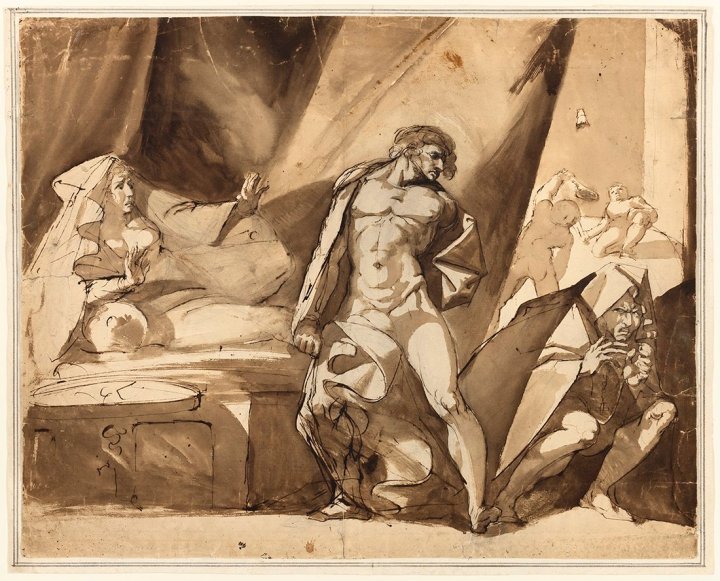
Henry Fuseli, The Discovery, 1767/69, pen and brown ink and brush and brown wash, over graphite with traces of opaque brown paint, on cream laid paper, tipped onto ivory laid paper, 53 × 66 cm (Art Institute of Chicago, 1956.33). From the AIC notes, “This powerful drawing—a bravura exercise in virtuoso line and tonal washes—illustrates a story from Swiss theologian Ludwig Lavater’s book De Spectris (On Ghosts), published in 1569. It describes a priest who, dressed in a sheet, haunts his wealthy niece who is living in his house, in an attempt to rape her and cheat her of her fortune. Terrified, the niece enlists the aid of a friend who exposes the repentant priest. The curious badminton match visible in the background—not in the story, but added by Fuseli as a critical commentary—is a reference to a proverb composed in Latin by the Dutch poet Jacob Cats (1577–1660): ‘Amor ut pila vices exiget’, ‘Love, like a ball, demands reciprocation’.”
◊ ◊ ◊ ◊ ◊
From the AIC:
Shockingly Mad: Henry Fuseli and the Art of Drawing
Art Institute of Chicago, 18 November 2017 — 1 April 2018
Curated by Kevin Salatino
A witness to political revolutions and radical aesthetic shifts, Henry Fuseli (1741–1825) forged a pictorial sensibility of his own, characterized by anatomical, gestural, and psychological extremes. Bizarre, exaggerated, theatrical, and often melodramatic, his drawings embraced obscure literary and historical subjects intended to elicit profound emotional response.
Fuseli was born in Switzerland but traveled to Germany and Italy early in his career, eventually settling in London, where he played a prominent role in the newly established Royal Academy. While he worked in various media, Fuseli excelled at drawing. This medium was central to his practice, evidenced by the extraordinary number of drawings he made—ranging from quick sketches to watercolors that often exceeded the ambitions of his oil paintings.
The Art Institute is home to a remarkably rich collection of Fuseli’s surviving works, including large-scale drawings; smaller, less-finished sketches; and significant paintings and prints. Shockingly Mad: Henry Fuseli and the Art of Drawing considers drawing as an expressive means unto itself, paralleling the broader arc of Fuseli’s career as writer, painter, critic, and teacher. As comparisons to the work of his contemporaries reveal, Fuseli can be said to have forged a radical new drawing style. With roots in Classical antiquity and Renaissance Italy, Fuseli’s passionate, unrestrained approach reflects the revolutionary spirit of his age, which was marked by social and political upheaval. The Art Institute’s holdings are complemented by a number of important local, national, and international loans, and the exhibition itself is accompanied by the adjacent installation Gods and (Super)heroes: Drawing in an Age of Revolution—a selection of drawings by Jacques-Louis David, Théodore Géricault, Francisco Goya, and others that further contextualizes Fuseli as a draftsman.
Lecture Series | Thinking about Exhibitions
This spring’s public lecture course at the Mellon Centre:
Thinking about Exhibitions: Interpretation, Reconstruction, and Curation
Paul Mellon Centre for Studies in British Art, London, Thursdays, 8 March — 12 April 2018 (excluding 29 March)
This five-part lecture course explores an exciting behind-the-scenes look at the research, writing, borrowing, design, and installation processes involved in putting on a major exhibition. Thinking about Exhibitions will use as case studies exhibitions held at major institutions around the world. Viewers can watch the lectures live on our Livestream page. Videos of the lectures will then be made available on our website 24 hours after the lecture.
8 March 2018
Mark Hallett | Looking Back: Three Eighteenth-Century Exhibitions
15 March 2018
Mark Hallett and Christine Riding | Looking Back: Hogarth, 2006–07 (Paris: Musée du Louvre; London: Tate Britain; and Barcelona: Caixa Forum)
22 March 2018
Mark Hallett and Sarah Victoria Turner | Looking Forward: The Great Spectacle: 250 Years of the Summer Exhibition, 2018 (London: Royal Academy)
5 April 2018
Mark Hallett and George Shaw | Looking Forward: George Shaw: A Corner of a Foreign Field, 2018–19 (New Haven: Yale Center for British Art; and Bath: Holburne Museum)
12 April 2018
Looking Back: Curating and Scholarship
The syllabus is available here»
Week One features our Director of Studies, Mark Hallett, discussing the history of exhibitions in Britain and reconstructs three eighteenth-century exhibitions.
Call for Papers | HECAA Session at UAAC, 2018
Thanks to Christina Smylitopoulos, who is again coordinating a HECAA session at this year’s UAAC Conference! Details and a full list of panels (68 in all) are available here»
◊ ◊ ◊ ◊ ◊
Universities Art Association of Canada / l’association d’art des universités du Canada
Department of Fine Arts, University of Waterloo, Ontario, 25–27 October 2018
Proposals due by 1 May 2018

Photo: Wikimedia Commons, Jason Paris, November 2011.
HECAA Open Session
The objective of this society is to stimulate, foster, and disseminate knowledge of all aspects of visual culture in the long eighteenth century. This HECAA open session welcomes papers that examine any aspect of art and visual culture from the 1680s to the 1830s. Special consideration will be given to proposals that demonstrate theoretical or methodological innovations. Please email proposals for 20-minute papers (300 words) and a short biography (150 words) to Dr. Christina Smylitopoulos (University of Guelph), csmylito@uoguelph.ca.
Tomasso Brothers Fine Art at TEFAF 2018
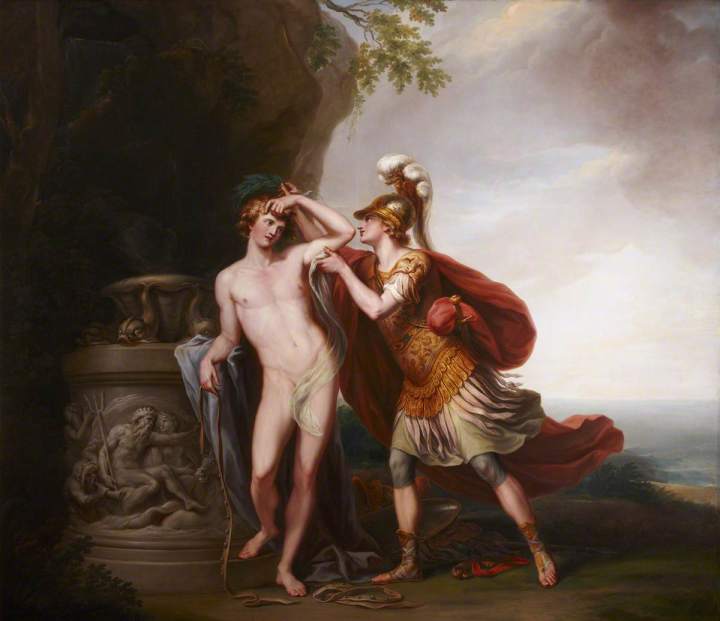
Giovanni Battista Cipriani, Castor and Pollux, 1783, oil on canvas, 275 × 316cm.
◊ ◊ ◊ ◊ ◊
Tomasso Brothers Fine Art at TEFAF
Maastricht, 8–18 March 2018
Tomasso Brothers Fine Art is pleased to report a number of significant sales at the TEFAF early access day, 8 March 2018, including a large oil on canvas by Giovanni Battista Cipriani (1727–1785) depicting Castor and Pollux that sold to a private collector within moments of the Fair’s opening. The asking price was in the region of 425,000€. This impressive neoclassical work was commissioned in 1783 by George Walpole, 3rd Earl of Orford for the Saloon at Houghton Hall along with two further mythological scenes. It remained in situ at Houghton until well in to the 20th century when it was purchased by The Rt. Hon. John Armar Lowry-Corry, 8th Earl Belmore of Castle Coole, Enniskillen and placed on public display.
The gallery also made an important sale to a new buyer, a private European collector, of a pair of monumental marble lion groups attributed to Giovanni Battista Foggini (1652–1725) and his workshop. Depicting a lion attacking a horse and a lion attacking a bull, the pair was offered for a price in the region of 1.75 million€.

Equestrian Monument of Emperor Marcus Aurelius, marble, after the antique bronze now in the Musei Capitolini (Rome, 18th century).
The works featured by Tomasso Brothers Fine Art at this year’s TEFAF Maastricht are inspired by Rome and classical Italy, dating from the ancient to the neoclassical. Other highlights include:
• The Forbes of Pitsligo Vases in white marble with corresponding plinths, attributed to Lorenzo Bartolini (1777–1850) made in Florence, ca. 1815–1830.
• An imposing Equestrian Monument of Emperor Marcus Aurelius in statuary marble, after the antique bronze now in the Musei Capitolini (Rome, 18th century).
• An exquisite Carrara marble sculpture by Cav. Emanuele Caroni (1826–after 1895) L’Amour Vainqueur de la Force, The Triumph of Love over Strength (Florence, ca. 1867).
Tomasso Brothers’ stand features original wallpaper designed by the gallery in-house. The design was inspired by the roman painted walls discovered in the region of the Bay of Naples, but perhaps most specifically, by a particular wall originating from the Villa di Agrippa Postumus at Boscotrecase (ca. 1st century BC – 1st century AD), which was painted in the ‘Third’ or ‘Ornate’ style of ancient wall fresco design, that flourished during the reign of Augustus. The idea of placing old master paintings and sculptures within a beautiful decorative scheme inspired by discoveries made at Pompeii and Herculaneum is essentially neoclassical in spirit, following the tradition established by the great architects and interior designers of the eighteenth century such as James ‘Athenian’ Stuart (1713–1788) for Spencer House, London (1759); Robert Adam (1728–1792) perhaps most notably at London’s Kenwood House, Osterley Park and Syon House; Joseph Bonomi (1739–1808) for Packington Hall, Warwickshire; and Sir John Soane (1753–1837) for the ‘Council Chamber’ at London’s Guildhall (1777).










 Enfilade
leave a comment