New Book | The Life and Work of Thomas Chippendale Junior
From Philip Wilson:
Judith Goodison, The Life and Work of Thomas Chippendale Junior (Philip Wilson, 2017), 464 pages, ISBN: 9781781300565, £65 / $95.
 The Chippendale cabinet-making firm, founded by Thomas Chippendale senior in about 1750 became famous partly through the succesful publication of his The Gentleman and Cabinet-Maker’s Director (1754, re-published 1755 and 1762), and partly through the fine furniture supplied to a number of illustrious clients. Chippendale senior ran the workshop for just over twenty years. His eldest son Thomas Chippendale junior (1749–1822) continued the business for over forty, the first two decades in partnership with Thomas Haig. Chippendale senior’s work has been well documented. Chippendale junior’s work has never, until now, been thoroughly researched. The Life and Work of Thomas Chippendale Junior repairs the omission. His patrons included members of the Royal Family, aristocrats, landed gentry, and antiquarians. He was adept at satisfying their demands, whether they required lavish gilt or simpler, often mahogany, pieces. Where family archives and original settings survive, as at Harewood House, Paxton House, and Stourhead, they reveal the variety and quality of Chippendale’s output. Analysis of client’s invoices, even when the furniture can no longer be traced, for the first time provides a colourful view of what customers chose and what prices they paid.
Judith Goodison FSA is a furniture historian and has been researching the work of Thomas Chippendale junior for the last ten years.
Exhibition | Chippendale 300

During 2018, the Chippendale 300 partnership is celebrating Thomas Chippendale (b. 5 June 1718) and his legacy as widely as possible, both by encouraging greater public awareness of his genius and the glories of 18th-century craftsmanship and by demonstrating how the same spirit animates today’s designers and makers. The following institutions and historic houses have joined together to create a programme of exhibitions and events to celebrate Thomas Chippendale’s tercentenary: Burton Constable Hall, The Chippendale Society, Dumfries House, Firle Place, The Furniture History Society, Harewood House, Leeds Museum & Galleries, Master Carvers’ Association, The National Trust, Newby Hall, Paxton House, Visit Otley, and Weston Park. Visit Chippendale 300 for more information. Opening in February at Leeds:
Thomas Chippendale: A Celebration of Craftsmanship and Design, 1718–2018
Leeds City Museum, 9 February — 10 June 2018
Curated by Adam Bowett and James Lomax
 This exhibition celebrates the life and work of Thomas Chippendale (1718–1779), Britain’s most famous furniture maker. It will be the most comprehensive exhibition of Thomas Chippendale’s work ever presented and will include furniture, accessories, drawings, documents and other material from collections throughout the United Kingdom. Alongside well-known masterpieces from public collections there will be rarely-seen furniture from private houses and some new discoveries, never before exhibited. The exhibition explores Thomas Chippendale’s life and work in five major themes: his family origins, training, career and the publication of the ground-breaking Director; his furniture in the Rococo, Gothic, Chinese, and neo-Classical styles; the management of his commissions, including relations with clients; his workshops, including manufacturing and decorative techniques; and his legacy from the 18th century to the present day.
◊ ◊ ◊ ◊ ◊
From ACC Publishing Group:
Adam Bowett and James Lomax, Thomas Chippendale (1718–1779): A Celebration of British Craftsmanship and Design (Bradford: The Chippendale Society, 2018), 208 pages, ISBN: 9781999922917, $90.
Celebrating the tercentenary of Thomas Chippendale’s birth, this catalogue of the 2018 Leeds exhibition covers all 95 exhibits including furniture, drawings, engravings, textiles and wallpaper, together with other contemporary and later material. Each entry is illustrated in colour, with supporting images in both colour and black and white. Also included are introductory essays to each section of the exhibition, covering Chippendale’s life and career, his furniture styles, his relationships with customers, and his legacy from the 18th century to the present day.
Adam Bowett is the Chairman of the Chippendale Society and co-curator of the tercentenary exhibition. He is a well-known historian of English furniture and has published widely on the subject in both popular and scholarly journals. He is also the author of three books on English furniture. James Lomax is the Curator of the Chippendale Society and co-curator of the tercentenary exhibition. He was formerly curator at Temple Newsam House, Leeds and is an acknowledged expert on 18th-century applied arts, particularly silver, and has a special interest in the work of Thomas Chippendale.
Note (added 4 March 2018) — The original posting did not include information about the catalogue.
Conference | CAA 2018, Los Angeles
Please pay particular attention to the HECAA session, Imitation, Influence, and Invention in the Enlightenment, chaired by Heidi Strobel and Amber Ludwig, which takes place Wednesday morning at 8:30, and the ASECS session The 1790s, chaired by Julia Sienkewicz, scheduled for Friday afternoon at 2:00. In addition, a few spots for the American Institute for Conservation’s annual ‘Learning to Look’ workshop on Eighteenth-Century Mexican Painting, held at LACMA in connection with the exhibition Pintado en México, 1700–1790: Pinxit Mexici, have generously been reserved for Enfilade readers (please see details below and email Rebecca Rushfield at wittert@juno.com to RSVP). Finally, with more and more thematic offerings, I’ve inevitably missed material relevant to the eighteenth century; so, please don’t be bashful about noting panels omitted below. –CH
106th Annual Conference of the College Art Association
Los Angeles Convention Center, 21–24 February 2018
In 2018, CAA will return to LA for its 106th Annual Conference. The four-day event will be held at the Los Angeles Convention Center from Wednesday, February 21 through Saturday, February 24. The conference consists of over 300 presentations, panel discussions, workshops, special events, and exhibitions exploring the study, practice, and history of art and visual culture. As the best-attended international forum in the visual arts, the Annual Conference creates a community of practitioners, scholars, and the general public seeking to learn and connect. Attendees expand their professional networks, meet with potential employers, and strengthen their skills in professional-development workshops. CAA’s annual gathering facilitates networking opportunities and enables the exchange of ideas and information with colleagues from across the globe.
◊ ◊ ◊ ◊ ◊
Historicizing Loss in Early Modern Europe
Wednesday, 21 February, 8:30–10:00am
Chair: Julia Vazquez (Columbia University)
• Losing Battles: The Memory of Perfection in Sixteenth-Century Italy, Francesca Borgo (Getty Research Institute)
• Villalpando’s View of the Zócalo of Mexico City and the Destruction of the Viceregal Palace in 1692: History or Politics?, Luis Javier Cuesta Hernández (Universidad Iberoamericana, Mexico City)
• Wax, Fire, and the Search for an Imperishable Medium, circa 1754, Oliver Wunsch (Harvard University)
◊ ◊ ◊ ◊ ◊
Imitation, Influence, and Invention in the Enlightenment (HECAA)
Wednesday, 21 February, 8:30–10:00am
Chairs: Heidi A. Strobel (University of Evansville) and Amber Ludwig (Independent Scholar)
• Contextualizing Carmontelle’s Profile Pictures: A Re-examination of an Amateur Artist’s Face-books, Margot Bernstein (Columbia University)
• Invention for imitation: The Troubled Status of Macklin Bible Paintings, Naomi Billingsley (University of Manchester)
• Fashion, Subjectivity, and Sociability in the Amateur Copy: Fleury Richard à la Hortense de Beauharnais, Marina Kliger (New York University)
• Artistic Copies, Imitation, and Exchange Value: The Case of Colonial Mexico’s Academy of Art, Oscar E. Vázquez (University of Illinois at Urbana-Champaign)
◊ ◊ ◊ ◊ ◊
State of the Art (History): Re-Examining the Exam (AHPT)
Wednesday, 21 February, 10:30–12:00
Chairs: Karen D. Shelby (Baruch College, The City University of New York/Art History Teaching Resources) and Virginia B. Spivey (Independent Scholar/Art History Teaching Resources)
• Agency in Test Design as Motivation for Art History Students, Eleanor Moseman (Colorado State University, Department of Art and Art History)
• Assessing Applied Art History: The eBay Project, Lisa Langlois (SUNY Oswego)
• When the Projector Fails: Transforming the Slide Exam, Martha Hollander (Hofstra University)
• Breaking Binaries: The Magic Square Essay Exam, Janice Simon (University of Georgia)
• Reacting to the Past: Game Play as a Replacement for Traditional Assessment Methods, Mary Frances Zawadzki, (Texas A&M)
• One Objective, Four Ways to Meet It: Replacing High-Stakes Exams with Multi-Option Creative Projects, Cara Smulevitz (San Diego Mesa College)
• EVERY BODY: Physical Engagement and Making in Portfolio Assessments for the General Education Art History Survey, Susannah Kite Strang (Arrupe College of Loyola University Chicago)
• Synthesizing the Survey, Illustrating the Timeline: Rethinking History Assignments for Design Students, Alexa Griffith Winton (Ryerson School of Interior Design)
• Alternative Student Projects for Assessment in Art History Courses, Michele Wirt
◊ ◊ ◊ ◊ ◊
The French Fragment: Revolution to Fin-de-Siècle, Part I
Wednesday, 21 February, 10:30–12:00
Chairs: Emily Eastgate Brink (University of Western Australia) and Marika Knowles (Harvard University)
• Painting History in the Shadow of the Guillotine, Stephanie O’Rourke (University of St. Andrews)
• The Artist Underwhelmed by the Grandeur of Antique Monuments: Fragment and Counter-Fragment, Mark Ledbury (University of Sydney)
• Broken Guardians: The Lamassu and Fragmented Historical Vision in Nineteenth-Century France, Sarah C. Schaefer (University of Wisconsin, Milwaukee)
• Fragments and Fragmentary Vision in Nineteenth-Century Architectural Photographs, Peter Sealy (University of Toronto)
◊ ◊ ◊ ◊ ◊
Travel, Diplomacy, and Networks of Global Exchange in the Early Modern Period, Part I
Wednesday, 21 February, 10:30–12:00
Chair: Justina Spencer (Carleton University)
• Roots, Routes, and Resignification: The Life Changing Travels of Louis XIV Prints and Medals, Robert Wellington (Australian National University)
• ‘The Noblest Building of all the East’: The Porcelain Pagoda of Nanjing in Europe, 1665–1762, Kara Lindsey Blakley (The University of Melbourne)
• Cultivating a Global Vision from Afar: Travel Journals Depicting the Port of Nagasaki During the Edo Period (1603–1868), Russell Kelty (Art Gallery of South Australia)
◊ ◊ ◊ ◊ ◊
Free/Open Workshop, Learning to Look: Eighteenth-Century Mexican Painting
Wednesday, 21 February, 12:30–2:00pm
Organized by Rebecca Rushfield
For this installment of the American Institute for Conservation’s annual ‘Learning to Look’ workshop, Ilona Katzew, curator, and Joe Fronek, conservator, will discuss the material aspects of works in the LACMA exhibit, Pintado en México, 1700–1790: Pinxit Mexici, in the museum’s galleries with participation from workshop attendees. Advance registration required. Please RSVP to Rebecca Rushfield at wittert@juno.com by February 16, 2018.
◊ ◊ ◊ ◊ ◊
Art, Agency, and the Making of Identities at a Global Level, 1600–2000, Part I
Wednesday, 21 February, 2:00–3:30pm
Chairs: Noémie Etienne (Bern University) and Yaelle Biro (The Metropolitan Museum of Art)
• The Picturesque in Peking: European Decoration at the Qing Court, Helen Glaister (SOAS, University of London/Victoria and Albert Museum, London)
• A Transnational Loop: Pakistan’s Repossession of the Oriental Carpet Imaginary and its Production, Dorothy Armstrong (Victoria and Albert Museum/Royal College of Art, London)
• The Rivers Folded: Souvenir Accordion Panoramas in the Late Nineteenth-Century Global Tourism, Tingting Xu (University of Chicago)
• Lozi Style: King Lewanika and the Marketing of Barotseland, Karen E. Milbourne (Smithsonian National Museum of African Art)
◊ ◊ ◊ ◊ ◊
Circumventing Censorship in Global Eighteenth-Century Visual Culture
Wednesday, 21 February, 2:00–3:30pm
Chairs: Lauren G. Kilroy-Ewbank (Pepperdine University) and Kristen L. Chiem (Pepperdine University)
• The Pueblo Revolt and the Art of Resistance, Caroline Jean Fernald (Millicent Rogers Museum)
• Ganymede, Eros, and Winged-Phalli, Joseph Cotter (Pennsylvania State University)
• Censoring the Sultan? Imperial Epigraphy and Popular Exegesis, David Simonowitz (Pepperdine University)
• Seditious Words, Innocuous Images? Qing Literary Inquisitions and the Visual Realm, Kristen L. Chiem (Pepperdine University)
◊ ◊ ◊ ◊ ◊
Travel, Diplomacy, and Networks of Global Exchange in the Early Modern Period, Part II
Wednesday, 21 February, 4:00–5:30pm
Chair: Justina Spencer (Carleton University)
• Matters of Resemblance and Remembrance, between Istanbul and Venice, Elizabeth Rodini (Johns Hopkins University)
• Ottoman Diplomatic Ceremonies as seen through the Eyes of the Flemish Artist Pieter Coecke van Aelst (1533), Talitha Maria G. Schepers (The Courtauld Institute of Art)
• Texture, Touch, and Color in the Ottoman Costume Book: On the Interpretation of Transcultural Art, Elisabeth Fraser (University of South Florida)
◊ ◊ ◊ ◊ ◊
All in the Family: Northern European Artistic Dynasties, ca. 1350–1750 (HNA)
Wednesday, 21 February, 4:00–5:30pm
Chair: Catharine Ingersoll (Virginia Military Institute)
• Visualizing the Francken Family Legacy: On the Gallery Paintings of Frans II Francken (1581-1642), Jamie Richardson (Bryn Mawr College)
• David Teniers II as a Brueghel, Lloyd DeWitt (Chrysler Museum of Art)
• Marketing Matriarchy: Maria Sibylla Merian, her Daughters, and their Blooming Watercolors, Catherine Powell (The University of Texas at Austin)
• The Far-flung Bendls: Stylistic Connections between Four Generations of an Early Modern Sculptural Family, Mirka C. Døj-Fetté (Princeton University)
◊ ◊ ◊ ◊ ◊
Objects of Change? Art, Liberalism, and Reform across the Eighteenth and Nineteenth Centuries
Wednesday, 21 February, 4:00–5:30pm
Chairs: Caitlin Beach (Columbia University) and Emily Casey (St. Mary’s College of Maryland)
• Engraving’s ‘Immoveable Veil of Black’: Phillis Wheatley’s Portrait and the Politics of Technique, Jennifer Chuong (Harvard University)
• Fire Prevention, Prefabrication, and Containing: Techniques of Managing Labor across the Early Nineteenth-Century British Atlantic, Jonah Rowen (Columbia University)
• A Visual Riot: Reform and Dissent in The History of Pennsylvania Hall (1838), Emily S. Warner (Vassar College)
• Archive Against Crime: Cesare Lombroso and Seeing the Criminal, Not the Crime, in Post-Risorgimento Italy, Nicole Coffineau (University of Pittsburgh)
◊ ◊ ◊ ◊ ◊
Yale University Press Exhibitor Session: Art and Architecture ePortal
Wednesday, 21 February, 4:00–5:30pm
Chairs: Patricia Fidler (Yale University Press) and Sara Sapire (Yale University Press)
Yale University Press has recently received grants from the Andrew W. Mellon Foundation to create an electronic portal for art and architectural history content. YUP believes that building a dynamic and specialized destination for scholarly content will be of significant value to the field. Backlist and out-of-print titles are currently being converted into ePub for the site and extensive metadata tagging of images is underway. Importantly, fair use is being asserted for the images used on this scholarly platform. While the initial content is from YUP and some of its exclusive museum partners, including its project partner the Art Institute of Chicago, the intention is for the portal to accommodate scholarly content from other university presses and museums. The site has also been built to publish born-digital content, which could provide a welcome new option for scholars and publishers alike, and features the ability to create custom coursepacks for teaching purposes. Members from YUP’s ePortal team will provide a formal demonstration of the beta site and will encourage questions and discussion from attendees. The Press will also collect important feedback from the audience (i.e., potential users) in the form of a questionnaire, which will inform further work on the project.
◊ ◊ ◊ ◊ ◊
Routledge, Taylor & Francis Exhibitor Session: How to Get Published and How to Get Read
Thursday, 22 February, 8:30–10:00am
Chair: Geraldine Richards (Routledge, Taylor & Francis)
This panel discussion is designed for scholars and artists looking to submit an article or book proposal for academic publication. Whether you are a seasoned publishing veteran or new to the publishing landscape, this session offers practical advice on how to get published and how to get read with helpful tricks and tips from journal editors, book authors, and visual arts Routledge staff.
◊ ◊ ◊ ◊ ◊
Envisioning Time in Early Modern China
Thursday, 22 February, 8:30–10:00am
Chair: Daniel M. Greenberg (Columbia University)
• The Temporality of the Rebus, Sophie Volpp (University of California, Berkeley)
• The Artful Time Machine: Horology, Art, and History, Lihong Liu (University of Rochester)
• Guest Ritual and the Shape of History, Daniel Greenberg (Columbia University)
Discussant: Patricio Keith Fleming Moxey (Barnard College)
◊ ◊ ◊ ◊ ◊
The ‘Three Empires’ Redux: Islamic Interregionality in the Age of Modernity (HIAA)
Thursday, 22 February, 10:30–12:00
Chairs: Chanchal Dadlani (Wake Forest University) and Ünver Rüstem (Johns Hopkins University)
• Transcultural Compilations in Eighteenth-Century Ottoman Albums: Connecting the Islamicate World through Material Exchange and Literary Imagination, Gwendolyn Collaço (Harvard University)
• Remembering Rūm: Worldly Milieus and the ‘Bastard’ Architecture of Colonial Modernity in a Hindu Pilgrimage Site, Sugata Ray (University of California, Berkeley)
• The Nasir al-Din Shah Album: A Narrative of Collecting from the Mughals to the Qajars, Naciem Nikkhah (University of Cambridge)
• Imperium Camera: How Photography Revolutionized Islamicate Empires in the Nineteenth Century, Staci Gem Scheiwiller (California State University, Stanislaus)
• Discussant: Anastassiia Botchkareva (Independent Scholar)
◊ ◊ ◊ ◊ ◊
The Audience as Producer, 1750–1900
Thursday, 22 February, 4:00–5:30pm
Chair: Todd Cronan (Emory University)
• On Hogarth’s Murder (Considered as one of the Fine Arts), Gordon Hughes (Rice University)
• The Figure of the Audience in Late Nineteenth-Century French Art, Bridget Alsdorf (Princeton University)
• Paranoiac Vision, Marnin Young (Yeshiva University)
• Art Against the Audience: Mallarmé and Frank Walter Benn Michaels (University of Illinois at Chicago)
◊ ◊ ◊ ◊ ◊
Teaching and Writing the Art Histories of Latin American Los Angeles (AHSC)
Thursday, 22 February, 6:00–7:30pm
• Decolonizing Art History: Institutional Challenges and the Histories of Latinx and Latin American Art, Charlene Villaseñor Black (UCLA, Keynote Speaker)
• Xerografia: Copyart in Brazil, 1970–1990: Local Art Histories and Common Points Across the Art Histories of Vastly Different Countries, Erin Aldana (Guest Curator and Research Scholar, University of San Diego)
• Félix González-Torres as a (Post)Latino Artist, Elizabeth Cerejido (University of Florida, Gainesville)
• Chicana/o Remix: Rethinking Art Histories and Endgames, Karen Mary Davalos (University of Minnesota, Twin Cities)
• Voids of the Aggregate: Materializing Ethnic Mexicans in Mission Revival and Spanish Colonial Revival Architecture in Southern California, Carolyn J. Schutten (University of California Riverside)
◊ ◊ ◊ ◊ ◊
A Critical Conversation on Affect Theory, Neuroscience, and Art-Science Collaborations
Friday, 23 February, 2:00–3:30pm
Chair: Anna Sigrídur Arnar, Minnesota State University Moorhead
• From Novalis to Neuroscience: Models for Art History, James Elkins (School of the Art Institute of Chicago)
• Knowing and Not-Knowing Matter, Sally McKay (McMaster University)
• Neuropower, Warren Neidich (Weissensee Kunst Hochschule Berlin)
• Discussants: Eduardo Kac (School of the Art Institute of Chicago) and Barbara Maria Stafford (University of Chicago, Emerita)
◊ ◊ ◊ ◊ ◊
Collaboration on Paper
Friday, 23 February, 2:00–3:30pm
Chairs: Lisa Pon (Southern Methodist University) and Dario Donetti (Kunsthistorisches Institut in Florenz Max Planck Institute)
• Inventing the New St. Peter’s: Drawing and Emulation in Renaissance Architecture, Dario Donetti (Kunsthistorisches Institut in Florenz Max Planck Institute)
• Drawing Together: Painters and Architects in Eighteenth-Century France, Basile Baudez (Université Paris Sorbonne)
• Drawing as Development: Competition, Collaboration, and Internationalism at the University of Baghdad, Michael Kubo (University of Houston)
• Discussant: Cammy Brothers (Northeastern University)
◊ ◊ ◊ ◊ ◊
The 1790s (ASECS)
Friday, 23 February, 2:00–3:30pm
Chair: Julia A. Sienkewicz (Roanoke College)
• Love and Loss Sublime: Claude-Vernet’s Death of Virginia (1798) at the End of the Eighteenth Century in France, Thomas Beachdel (Hostos Community College, City University of New York)
• The Status of the Artist in the Wake of the French Revolution: A Crisis told through Caricature, Kathryn Desplanque (University of North Carolina)
• Revolution and Artistic Reaction: The French 1790s, Daniella Berman (Institute of Fine Arts, New York University)
◊ ◊ ◊ ◊ ◊
Materials, Makers, and Commissions: Moving Objects between Asia, Europe, and the Americas during Early Modern Globalization
Saturday, 24 February, 10:30–12:00
Chair: Anton Schweizer (Kyushu University)
• Locating the Hispano-Philippine Ivory, Stephanie Porras (Tulane University)
• ‘Please Send a Picture of Feathers…’: Mexican Featherwork in Japan and the Transfer of a New World Phenomenon, Sofía Sanabrais (Independent Scholar)
• The Economy of Japanese Export Lacquer in Eighteenth-Century France, Monika Bincsik (The Metropolitan Museum of Art)
• Puppets for the Margravine: Rediscovering Japanese Ephemera of the Seventeenth Century, Anton Schweizer (Kyushu University)
◊ ◊ ◊ ◊ ◊
Update (added 28 January 2018) — Unfortunately, the original version of this posting omitted the panel Travel, Diplomacy, and Networks of Global Exchange in the Early Modern Period, Part II, scheduled for Wednesday, 21 February, 4:00–5:30pm.
Conference | Porcelain Circling the Globe
Looking ahead to next summer, from the conference programme:
Porcelain Circling the Globe: International Trading Structures and the East Asia Collection of Augustus the Strong (1670–1733)
The Porzellansammlung Dresden, 13–14 June 2018
The Porzellansammlung Dresden will host the international conference Porcelain Circling the Globe: International Trading Structures and the East Asia Collection of Augustus the Strong (1670–1733) in Dresden, Germany, on 13–14 June 2018. Over two days, the conference will discuss the porcelain trade conducted by individual dealers working outside of the dominant trading companies in the 17th and 18th centuries. It will focus on private networks in and beyond Asia, as well as the emergence of collecting East Asian art in Europe.
A significant focus of the conference will be on the former royal collection of Augustus the Strong (1670–1733), Elector of Saxony and King of Poland. Augustus was an avid collector of East Asian prints, lacquer work and textiles, and accumulated over 25,000 examples of East Asian porcelain, of which around 8,000 objects are extant at the Porzellansammlung Dresden. The provenance of many of these objects is remarkably well-documented as they were recorded in the early 18th century in extensive royal inventories. Considering the number of porcelain dealers specifically mentioned in these unique records, one must ask the question of how important and influential these private networks were for the formation of East Asian porcelain collections—not only in Saxony, but also in other parts of Europe in the 17th and 18th centuries.
The conference will discuss the extent and importance of these private networks, and will debate the phenomenon of trading and collecting East Asian objects from both the traders’ as well as the collectors’ perspectives, with the purpose of investigating interactions between agents from different cultures and backgrounds. The conference is part of the research project Microstructures of Global Trade: East Asian Porcelain in the Collection of Augustus the Strong in the Context of the Museum Inventories of the 18th Century, sponsored by the Deutsche Forschungsgemeinschaft (German Research Foundation). To join the mailing list for further details and updates, please write to ruth.simonis@skd.museum.
W E D N E S D A Y , 1 3 J U N E 2 0 1 8
9:00 Registration
9:30 Welcome by Marion Ackermann (SKD) and Julia Weber (SKD)
10:00 Panel 1 | Local Markets
Chair: Stacey Pierson
• Jingdezhen’s porcelain and the merchant route books in late imperial China – Anne Gerritsen (Universiteit Leiden)
• Imperial wares in the Dresden Porcelain Collection: Possibilities of Provenance – Sun Yue (Palace Museum Beijing) )
• The Chinese junk’s intermediate trade in Japanese porcelain for the West between the late 17th century and 1730s – Miki Sakuraba (National Museum of Japanese History)
12:00 Lunch break
13:30 Panel 2 | Trading Structures and Global Connections
Chair: Regina Krahl
• Let’s carefully balance it! Safavid adaptations of Chinese blue-and-white porcelain – Amelia Macioszek (Freie Universität Berlin)
• Some aspects of the Dutch porcelain trade in Asia in relation to the collection of Augustus the Strong – Christiaan Jörg (Groninger Museum, Universiteit Leiden)
• Chinese porcelain and the Netherlands – Jan Van Campen (Rijksmuseum Amsterdam)
15:00 Coffee break
15:30 Panel 3 | From Seller to Buyer: Collecting Porcelain in Europe
Chair: Cora Würmell
• ‘His Electoral Highness wishes to have a porcelain service mounted with gold’: The role of the agents and dealers supporting the East Asian porcelain collection of Elector Max Emanuel of Bavaria (1662–1726) – Max Tillmann (Independent scholar)
• From Cathay to Versailles: Oriental porcelain in the Louis XIV’s collection – Stephane Castelluccio (Centre André Chastel, Paris)
• Collecting Kakiemon porcelain in Holland and beyond – Menno Fitski (Rijksmuseum Amsterdam)
16:30 Discussion
18:00 Welcome reception and open galleries in the Porzellansammlung at the Zwinger Palace
T H U R S D A Y , 1 4 J U N E 2 0 1 8
9:30 Registration
10:00 Panel 4 | The Dresden Royal Collection of East Asian Porcelain
Chair: Christiaan Jörg
• The Dresden Porcelain Project: The 18th-century collection reassessed – Cora Würmell (SKD)
• Writing the Japanese Palace inventories 1721–27 and 1779 – Karolin Randhahn (Independent scholar)
• The King’s personal shopper: Count Lagnasco’s porcelain acquisitions in the Netherlands for Augustus the Strong, 1716/1717 – Ruth Sonja Simonis (SKD)
12:00 Lunch break
13:30 Panel 5 | Objects in Transfer
Chair: Ruth Sonja Simonis
• Augustus the Strong and his collection of Chinese prints and drawings: From China to Europe – Anita Xiaoming Wang (Independent scholar)
• From Europe to Dresden – Cordula Bischoff (Independent scholar)
• Early exported Arita wares in the collection of Augustus the Strong – Tomoko Fujiwara (Kyushu Ceramic Museum)
• Export or exported? Challenging classifications of traded porcelains – Stacey Pierson (SOAS University of London)
14:50 Discussion
15:20 Closing words
16:30 Visit to the Japanese Palace (optional)
20:00 Public concert at Chinesischer Pavillon (optional)
F R I D A Y , 1 5 J U N E 2 0 1 8
10:00–14:00 Optional visit to the workshops at the Meissen Manufactory
Exhibition | William Blake in Sussex: Visions of Albion
From the National Trust:
William Blake in Sussex: Visions of Albion
Petworth, Sussex, 13 January — 25 March 2018
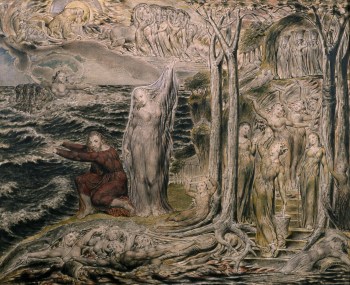
William Blake, The Sea of Time and Space, 1821 (Arlington Court, National Trust).
William Blake in Sussex: Visions of Albion offers a rare opportunity to see original works by Blake inspired by the Sussex coast and countryside re-united for the first time. The exhibition takes place in the Servants’ Quarters Gallery and the mansion. Due to limited space in the Servants’ Quarters Gallery, timed tickets are required for this part of the exhibition.
Celebrating Blake’s three years living in Sussex between 1800 and 1803, the exhibition features over 50 loans from such prestigious collections as the British Museum, V&A, and Tate. These are complimented by works from the Petworth collection acquired by George Wyndham, the 3rd Earl of Egremont and his estranged Countess, Elizabeth Ilive.
Sussex remains the only area outside of London where Blake ever lived, settling with his wife in a cottage in Felpham, which he described as “the sweetest spot on Earth.” It is here that Blake saw ‘Visions of Albion’, surrounded by the Sussex coast and countryside that would continue to inspire his work. This exhibition is the first to re-unite these works and nowhere could be more fitting than Petworth, the only great English country house to hold major paintings by the artist.
Among the highlights of the exhibition, on loan from the British Museum, are hand-coloured relief etchings from Blake’s illustrated epic poem Milton, of which only four are in existence. Written and illustrated between 1804 and 1811, the preface contains the words ‘And did those feet in ancient time’ that was adopted for the anthem Jerusalem.
As part of the William Blake in Sussex exhibition, step inside an immersive experience featuring the original drawings by the author and President of the Blake Society, Philip Pullman, created for his best-selling His Dark Materials trilogy. Using projections, sound, and text, Pullman’s Miltonian works are brought to life and offer parallels with Blake’s art which also draws inspiration from the 17th-century English poet John Milton.
A very limited amount of tickets are available on the day sold on a first come, first serve basis. We recommend arriving early and checking with our team for any last minute availabilities, but to avoid disappointment we advise booking at least 24 hours in advance.
New Book | Les Paradis Secrets de Marie-Antoinette
From Albin Michel:
Christophe Fouin, Thomas Garnier, Christian Milet, and Didier Saulnier, Les Paradis Secrets de Marie-Antoinette (Paris: Éditions Albin Michel, 2017), 240 pages, ISBN: 978 222632 1657, 49€.
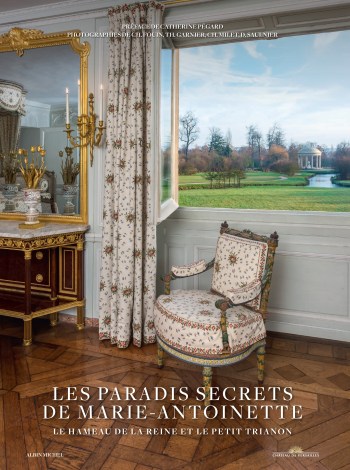 Le hameau de la Reine et le Petit Trianon comme vous ne les avez jamais vus.
Les photographes du Domaine vous ouvrent toutes les portes… même les plus secrètes : une promenade exclusive dans les pas de Marie-Antoinette. Alors que ses moindres faits et gestes étaient regardés, commentés et régulés au château de Versailles, selon l’étiquette stricte imposée par Louis XIV, Marie-Antoinette décida qu’elle n’avait plus aucun compte à rendre lorsqu’elle franchissait les haies de ses jardins privés, où sa liberté d’esprit la poussait à se retirer avec ses intimes…
Terracottas from Tomasso Brothers on View in New York
European Terracottas from Tomasso Brothers Fine Art
Carlton Hobbs LLC, New York, 25 January — 2 February 2018

Giovanni Bonazza, Allegory of Winter, ca. 1710, terracotta, 34 cm high.
Tomasso Brothers Fine Art of Leeds and London is participating in Master Drawings New York (MDNY) for the first time this coming winter when they hold their annual catalogued exhibition at Carlton Hobbs LLC on the Upper East Side from 25 January to 2 February 2018. Tomasso Brothers has for a number of years held a highly-regarded exhibition in New York in January. The decision this year by MDNY to additionally encompass painting and sculpture at its next edition (Saturday 27 January to Saturday 3 February 2018, Preview Friday 26 January 2018) offered a golden opportunity for the gallery to take part in this preeminent event.
This year Tomasso Brothers will present a selection of important European terracotta sculptures from the neolithic to the neoclassical periods. The exhibition traces the history of ‘fired clay’ starting with the Vinca civilisation of South-Eastern Europe in the fifth millennium BC, which produced the fascinating Idol of a Mother and Child in the show and from there, via the ancient classical period and the Renaissance, to the high baroque, ending with the neoclassical era.
Among the works to be offered is a North Italian idealised Portrait Relief of a Lady from the late fifteenth century, and an attentively described Portrait Bust of a Man from Emilia in Northern Italy, ca. 1500. Both testify to the birth of terracotta as a medium for portraiture which continued well into the early modern era. Among further highlights is a Portrait Bust of a Gentleman by the rare Flemish sculptor Servatius Cardon (1608–1649) and a poignant Portrait of a Young Man attributed to the great French artist Philippe-Laurent Roland (1746–1816). The latter work is a beautiful representation of the birth of the modern portrait, where hierarchy and status give way to the expression of individuality and emotion.
Parallel to this, the exhibition also demonstrates how terracotta was essential to artistic practice as a means for sculptors to develop ideas and compositions, shown by a recently rediscovered terracotta model for an allegorical representation of Winter, by the Venetian baroque master Giovanni Bonazza (1654–1736), which offers a crucial insight into the work of the sculptor, presenting a highly accomplished model for a finished work to be carved in either stone or marble.
A similar case is illustrated by a Character Head executed by Antonio Canova (1757–1822) around 1780, when he was still a young sculptor on the cusp of greatness. Inspired by the famous Laocoön group in the Vatican, this terracotta exists as an invenzione in its own right, and so a testimony to the sculptor’s search for his own artistic vocabulary. Deeply and richly modelled, the Character Head betrays a preoccupation with the representation of emotions, framed within a wider exploration of antiquity that would be a central theme throughout Canova’s career.
Another remarkable discovery and a highlight of the exhibition to be presented by Tomasso Brothers Fine Art is a terracotta model for a figure of Saint Mark by Giuseppe Piamontini (1664–1742), a colossal marble statue carved for the new baroque church of Santi Michele e Gaetano in Piazza Antinori on the central Via Tornabuoni in Florence.
Important European Terracottas, presented by Tomasso Brothers Fine Art as part of Master Drawings New York 2018, will take place at Carlton Hobbs LLC at 60 East 93rd Street NY from 25 January through 2 February 2018. A fully illustrated catalogue will be available. Prices will range from around $15,000 to $500,000.
Call for Papers | CSECS 2018, Niagara Falls
From the Call for Papers, which includes the full French version:
CSECS, 2018: Wonder / L’émerveillement
Four Points Sheraton, Niagara Falls, Canada, 10–13 October 2018
Organized by Christina Ionescu and Christina Smylitopoulos
Proposals due by 15 April [extended from 20 February]
 The 2018 annual meeting of the Canadian Society for Eighteenth-Century Studies will take place at Niagara Falls, Ontario. Comprised of three distinct cascades that monumentally culminate to drain Lake Erie into Lake Ontario, Niagara Falls occupies a significant place in eighteenth-century contemplations of natural wonder. When confronted with the unparalleled sight of a “vast and prodigious cadence of water,” the mesmerised Franciscan missionary Louis Hennepin (1626–1704) attempted to capture “this wonderful downfall” with both text and image in his travelogue, and his account had a long-lasting effect on how Niagara Falls was perceived in the following centuries. Niagara Falls, today considered one of the most spectacular natural wonders of the world, was more often imagined than visited during the Enlightenment years, when wonder-seekers relied upon the accounts of travellers who had experienced firsthand this natural masterpiece. During the Enlightenment, this preoccupation with the wonder of nature can be tied to engagements with wonder more generally. Despite Samuel Johnson’s disdain for wonder as “the effect of novelty upon ignorance,” contemporaneous writers, artists, thinkers, historians, travellers, and scientists sought to seize and understand this feeling of surprise mixed with admiration, caused by something beautiful, unexpected, unfamiliar, or inexplicable, which manifested itself across a broad spectrum of human experience and creative output.
This conference organizers invite papers that consider wonder as deployed, depicted, and discussed in a range of contexts: Enlightenment thought, natural science treatises, religious works, cultures of collecting, historical accounts, literary texts, visual production, as well as travel narratives. Possible topics include, but are not limited to the following:
• the theorisation of wonder as a concept
• the wonder of everyday life and material culture
• the cultivation of (or scepticism toward) wonder in Enlightenment thought
• spectacle and spectatorship in visual representation and culture
• artistry and wonder
• narrative strategies and rhetorical devices for producing wonder
• wonder as an affective response or aesthetic experience
• wonder and scientific knowledge
• wonder and its miraculous manifestations
• collections displaying wondrous thing
In keeping with CSECS tradition, proposals for papers devoted to elements of the long eighteenth century not directly related to the general theme of the conference are also welcome. Individual proposals should include a 150-word abstract of the paper and its title, as well as a biographical statement including the presenter’s name, academic status, institutional affiliation, and e-mail address. Panel proposals should include the above, as well as a brief description of the panel itself. Participants can present in either English or French. An issue of the Society’s bilingual journal, Lumen, will feature a selection of revised proceedings from this conference. Deadline to submit proposals for panels and integrated workshops: January 5, 2018. Deadline to submit individual proposals: February 20, 2018. Proposals should be emailed to csecs2018@yahoo.com.
Invited Speakers
Nathalie Ferrand (École Normale Supérieure / Institut des Textes et Manuscrits Modernes, Paris)
Sandro Jung (Herzog August Bibliothek, Wolfenbüttel)
Sarah Tindal Kareem (University of California, Los Angeles)
New Book | British Embassies
From Francis Lincoln, and imprint of The Quarto Group:
James Stourton, with photographs by Luke White, British Embassies: Their Diplomatic and Architectural History (Frances Lincoln, 2017), 352 pages, ISBN: 978 071123 8602, $65 / £40.
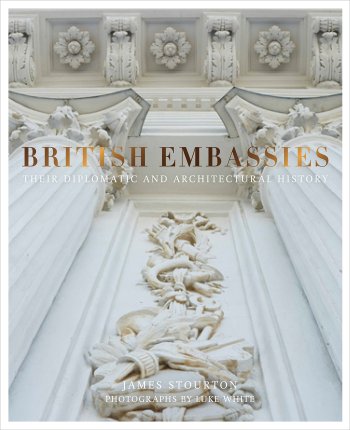 British Embassies have a special role in British history. They represent the country in bricks and stone and have often expressed—at least in the eyes of foreigners—British national character. Whether they are Lutyens buildings in Washington, grand palaces in Europe, beautiful old colonial buildings in Asia, or secure compounds in the Middle East, they all have stories to tell and reveal the changing face of British diplomacy. A mixture of history, architectural description, diplomacy and anecdote, this large format picture book covers residences and embassies in twenty-six countries to provide an authoritative text, accompanied by newly commissioned photography.
James Stourton is the prize-winning author of five books including Great Houses of London and the authorised biography of Kenneth Clark, Life, Art and Civilization. He is a former Chairman of Sotheby’s UK, he sits on the Heritage Memorial Fund panel and the Acceptance in Lieu panel, and is a senior fellow of the Institute of Historical Research, London University.
Luke White’s photographs have been widely published in interior design and architectural magazines including Architectural Digest, Vogue, and Homes and Gardens. His books include Sally Storey’s Lighting by Design and The Irish at Home by Jane and Sarah McDonnell.
Call for Articles | Stay Still: Tableau Vivant
From the Call for Papers:
Stay Still: Past, Present, and Practice of the Tableau Vivant
RACAR Special Issue, October 2019
Guest Edited by Mélanie Boucher and Ersy Contogouris
Proposals due by 1 February 2018; final essays will be due by 15 August 2018

Jules-Ernest Livernois, Mrs. Ed Foley’s Statuary Group, 1893 © Jules-Ernest Livernois/Library and Archives Canada/PA-024050.
While the conceptualization and modern incarnation of the tableau vivant are rooted in eighteenth-century Europe, its origins can be traced back to antique pantomime and to royal entrances in the early modern period. Presented first at the theatre, and then in private settings, for the pleasure and education of the aristocracy and bourgeoisie, the tableau vivant quickly migrated to other areas of the world, including North America. It decisively marked the beginning of photography and was fundamental to pictorialism and early cinema. Its practice was abandoned during the first half of the twentieth century, then re- emerged in 1960s experimental cinema, while its mise-en-scène and its exploration of immobility were exploited in contemporary art during this same period. The use of the term ‘tableau vivant’ to refer to contemporary artistic performances appeared in the mid-1990s, and probably stemmed from the interest then shown for Vanessa Becroft’s practice. In the early 2000s, the markedly growing engagement with the tableau vivant, the re-enactment of performances, and their presentation over long periods of time, in turn deeply impacted on museum practices. If it is in literature studies that reflexive analyses of the tableau vivant first appeared, recent scholarship—whether informed by literature, theatre, cinema, the visual arts, museology, or other fields of knowledge—is contributing to the rediscovery of the tableau vivant and to its recognition as a hybrid practice, the study of which can be productive in different areas.
The tableau vivant raises various issues that relate to its mechanisms of presentation as a performance, among them, theatrical, narrative, spatial, pictorial, and temporal. It also engages with social and political issues such as gender, race, sexuality, class, and the relationship of the subject to the material world. As an object that is collected and exhibited, it is inscribed in the history of analogical museography, but also raises present-day issues linked to conservation and exhibition. As an artistic practice today, it enters into dialogue with other forms of appropriation and relates to practices of re-enactment, reconstitution, remake, citation, and remixing that are particularly popular in contemporary art as well as in other areas of art and culture. What sets it apart from these other practices, its characteristic of immobility, in turn brings into play its own set of theoretical and interpretative questions.
By looking at the tableau vivant from a variety of standpoints, this special issue of RACAR aims to contribute to the knowledge and to the current thinking on this subject. We welcome historical or theoretical pieces that address either specific works or more general concerns relating to the tableau vivant; accounts of artistic and museological practices; as well as portfolios. The call is open to topics relating to all historical periods, all geographical and cultural areas, and all artistic media.
To this end, we are soliciting three types of proposals, in either French or English: articles (maximum 7,500 words, including notes), accounts of practices (maximum 3,500 words, including notes), and portfolios (maximum 10 images and 1,000 words, including notes). The articles and accounts of practices will be submitted to double-blind peer review. Please submit your proposals of a maximum of 250 words and a short CV before February 1, 2018, to Mélanie Boucher, Université du Québec, (melanie.boucher@uqo.ca) and Ersy Contogouris, Université de Montréal (ersy.contogouris@umontreal.ca).










 Enfilade
leave a comment