Exhibition | Witches: Metamorphosis of Goya
Press release (via Art Daily) for the exhibition:
Denise de la Rue, Witches: Metamorphosis of Goya / Brujas: Metamorfosis de Goya
Lázaro Galdiano Museum, Madrid, 21 June — 31 October 2017
Curated by Carmen Espinosa and Flavia Hohenlohe
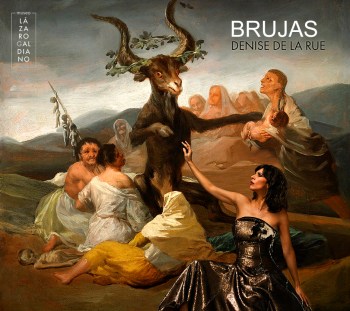
Denise de la Rue, ‘Maribel Verdú y Goya’, a partir de ‘El Aquelarre’ de Francisco de Goya (1798), 2017.
Witches, an exhibition by Mexican artist Denise de la Rue, curated by Carmen Espinosa and Flavia Hohenlohe at the Lázaro Galdiano Museum in Madrid, is the second component of her series Angels and Witches: Goya, Metamorphose, a study of Francisco de Goya’s paintings through a reinterpretation of the old master’s work. De la Rue has created a series of photographs juxtaposing iconic Spanish actresses with the painter’s work, analysing the dichotomies and similarities between these characters whilst engaging with historical and relevant sites such as the Museum. Taking elements of the actor profession that coincide with the characteristics of angels and witches such as mysticism, magic, life, death and the power of creation, transformation and destruction, De la Rue has created a dialogue between the actresses and Goya’s paintings. The essence of this series is the interest of the artist in researching the capability of women to transform and empower themselves, which historically has been seen as threatening to the conservative preconception of patriarchal societies.

Denise de la Rue, a partir de ‘Vuelo de Brujas’ de Francisco de Goya (Prado, 1798), 2017.
As a starting point to create Witches, a new body or work, De la Rue has taken Goya’s Vuelo de Brujas (Witches’ Flight), Prado Museum; El Aquelarre (Witches’ Sabbath) and Las Brujas (The Witches), both at the Lázaro Galdiano Museum; Hechizado a la Fuerza (The Forcibly Bewitched), National Gallery London; La Cocina de las Brujas (The Witches’ Kitchen), untraced; and Don Juan y el Comendador (Don Juan and the Commander), untraced. The series was commissioned by the Dukes of Osuna between 1797 and 1798 for the Alameda Palace in Madrid, best known as El Capricho.
Two of these pieces, Las Brujas and El Aquelarre, are part of the Museum’s permanent collection and will be displayed alongside De la Rue’s work, creating a conversation between the old master and the contemporary artist. The extravagance of these two pieces also draws special attention. Here the unreal becomes visible, riding between the terrifying and the ironic. Both paintings appear to be inspired by eighteenth-century texts as well as popular tradition, a key focus in De la Rue’s research. The exhibition of Witches is a unique opportunity not only to see two of Goya’s original paintings of witches together but to appreciate the full series through De la Rue’s work.
Two of the original paintings have been lost, and De la Rue has recaptured them by retrieving historic files that include details of the works. Using photography technology, the artist has reconstructed the works and reunited them in the same space for the first time since the pieces left the Dukes of Osuna’s hands.
In addition to the photographs, the Museum will present De la Rue’s video dedicated to the painting Las Brujas in which the actress Bárbara Lennie dances to the poem “Pequeño vals Vienés” (“Little Venice Waltz”) by Federico Garcia Lorca interpreted by flamenco singer Enrique Morente.
The first component of the exhibition Angels and Witches Goya, Metamorphose was the chapter of Angels at the Royal Chapel of San Antonio de la Florida in Madrid where Goya remains rest, as well as where some of his most recognised frescos are. The exhibition opened in February and was a highlight of the Madrid cultural calendar. Having the two exhibitions of Angels and Witches in dialogue with Goya’s work in these unique venues is a rare opportunity to see and understand Goya’s interest in witchcraft and the holy, revised by photography and a contemporary perspective.
Video from the previous installation Ángelas:
Conference | Digital Art History: Practice and Potential

From the Paul Mellon Centre:
Digital Art History: Practice and Potential
Paul Mellon Centre and the Courtald Institute of Art, London, 11 October 2017
Organized by Hana Leaper, Sophie Hatchwell, and Fern Insh
The first conference of the Early Career Researchers in British Art Network in partnership with The Courtauld Institute of Art’s Digital Art History Research Group (#DAHRG) and the Paul Mellon Centre for British Art
This conference, organised under the auspices of the Early Career Researchers in British Art Network, and Digital Art History Research Group (#DAHRG), provides a platform for Early Career Researchers engaged or interested in digital art history to showcase their work, develop skills, and think broadly about how digitisation can innovate, challenge convention, and inform art-historical practice.
In recent years, academics and institutions engaged in the Digital Humanities have brought together new technologies with historical research and scholarship. As a result, departments and institutions dedicated to the study of the Digital Humanities are becoming increasingly commonplace. Concurrently, art historians have sought to define what Digital Art History is, with eminent scholars such as Johanna Drucker and Diane M. Zorich interrogating its place within disciplinary practice and theory and many conferences and publications devoted to specifically defining what Digital Art History means. By inviting an emergent generation of scholars together, this conference intends to move beyond defining Digital Art History. Instead, we consider how digital technology integrates with and enhances art historical methodologies and theories in today’s digital world.
Convened by Dr Hana Leaper (Paul Mellon Centre), Dr Sophie Hatchwell (University of Bristol), and Dr Fern Insh (Courtauld Institute of Art)
S C H E D U L E
9.30 Registration and introduction at the Paul Mellon Centre
10.00 Panel 1 | Practice: Exploring the Nexus of Digital Technologies and Art Historical Research
• Élodie Gössant, Reconstructing a Lost Country House: The Case of Erlestoke Park (Wiltshire)
• Phillippa Plock and Colette Warbrick, Digital/ized Art History at Waddesdon Manor
• Shu-Chi Shen, Revisualising, Reconstruction and Recreation: The Case Study on a Digital Exhibition in the National Palace Museum
11.30 Break
12.00 Panel 2 | Potential: Evolution and Synthesis of Art Historical Methodologies
• Nirmalie Alexandra Mulloli and Christina Bartosch, Exhibitions of Modern European Art, 1905–15: Building Metadata to Reveal Artist Exhibition Strategies and Advance Theoretical Possibilities of Exhibition Spaces
• Ricarda Brosch and Adam Knight, The Quantitative Turn: Big Data Ethics in Digital Art History
• Rosário Salema de Carvalho and Inês Aguiar, Match! Image recognition issues on Az Infinitum: Azulejo Indexation and Referencing System
1.30 Lunch
1.30 Workshop Session
• Fern Insh, App Building for History and Heritage
3.30 Break
4.00 Roundtable Discussion
• Early Career Researchers’ Role in Developing Digital Practice
6.00 Lecture, at the Courtauld Institute of Art
• Emma Stanford, The Art of Losing: A Wishlist for Responsible Digitization
7.15 Reception
Abstracts are available here»
Symposium | Art of Power: The 3rd Earl of Bute, Politics, and Collecting
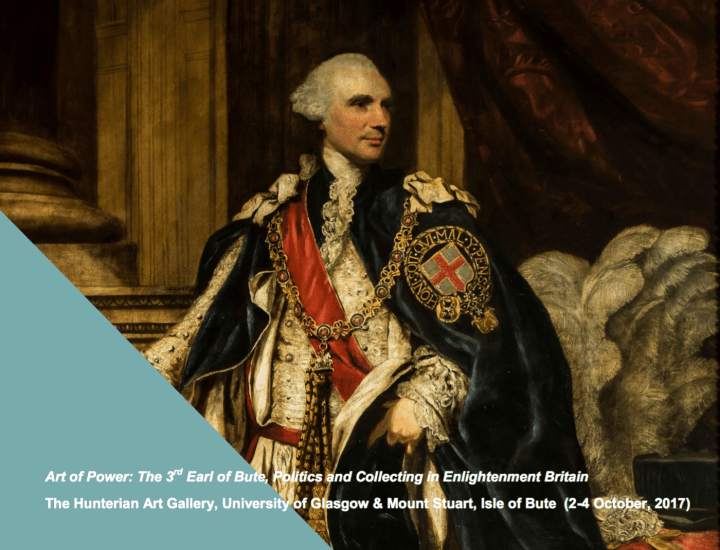
From the symposium flyer:
Art of Power: The 3rd Earl of Bute, Politics, and Collecting in Enlightenment Britain
The Hunterian Art Gallery, University of Glasgow and Mount Stuart, Isle of Bute, 2–4 October 2017
In 2017, the Mount Stuart Trust and The Hunterian Art Gallery, University of Glasgow, are hosting a major exhibition merging art, biography, politics, and cultural history. Art of Power: Masterpieces from the Bute Collection uncovers the fascinating Enlightenment figure, John Stuart, 3rd Earl of Bute (1713–1792), and his collection of rarely-seen masterpieces. A three-day interdisciplinary symposium inspired by themes of the exhibition will explore the dynamic interplay between art, politics, and collecting so evident in the life of the 3rd Earl of Bute. In sessions open to the public, papers will be delivered on day one in Glasgow. Days two and three will take place at Mount Stuart (with only a very limited number of spaces) and will include tours of the house, archives, and collection highlights.
Confirmed Speakers
Desmond Shawe-Taylor (Royal Collection), Rosie Razzall (Royal Collection), Anne T. Woollett (J. Paul Getty Museum), Anthony Lewis (Glasgow Museums), Wayne E. Franits (Syracuse University), Graham Rowe (University of Derby), Heiner Krellig (independent), Janet Stiles Tyson (Birkbeck), Oliver Cox (Oxford), Peter Black (Hunterian), Mungo Campbell (Hunterian), and Caitlin Blackwell (Mount Stuart)
Exhibition | In Her Majesty’s Hands: Medals of Maria Theresa
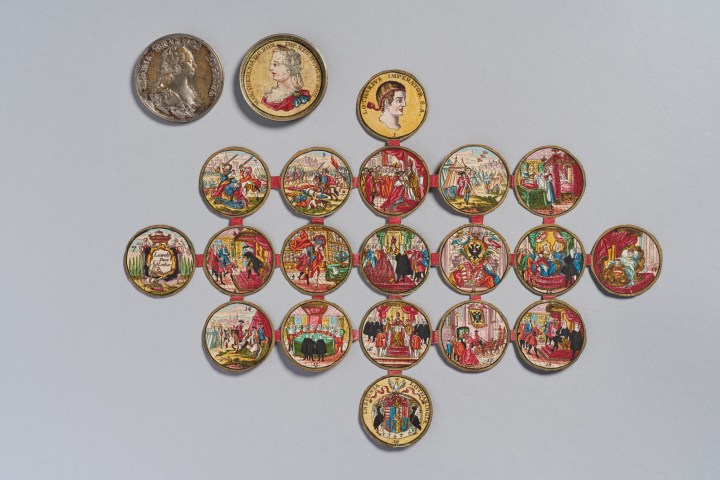
Matthäus Donner / Andreas Vestner, Maria Theresa Box Medal (Schraubmedaille) containing hand-coloured drawings; silver, hand-coloured drawing on paper inside the medal (Vienna, Kunsthistorisches Museum, Coin Collection, inv.no. 5955/1914B).
◊ ◊ ◊ ◊ ◊
Press release (via Art Daily) for the exhibition now on view at the KHM:
In Her Majesty’s Hands: Medals of Maria Theresa
Kunsthistorisches Museum, Vienna, 28 March 2017 — 18 February 2018
Curated by Anna Fabiankowitsch and Heinz Winter
The Kunsthistorisches Museum’s Coin Collection holds both the largest and by far the most important collection of coins minted under Maria Theresa; it is the best place, and now is the best time, to host an exhibition that presents the monarch’s life in medals to celebrate what would have been her 300th birthday.
 The exhibition focuses on the most important topoi in Maria Theresa’s private and public life. It presents her in the company of her large family, running the gamut of events from dynastic marriages to heart-breaking calamities. It showcases her role as a ruler forced to fight several wars for her inheritance and, together with her son and co-regent Joseph II, as a pioneering social reformer. The artefacts on show also illustrate the extent of Maria Theresa’s realm, which comprised many different ethnicities and cultures.
All these topoi are reflected in medals that emblematise historical events with the help of allegories. Maria Theresa was already widely glorified and celebrated during her lifetime, but the exhibition also documents how she was portrayed by her enemies. So-called satirical medals, which were passed around in private, turned Maria Theresa into an object of derision.
The exhibition focuses, too, on the historical background of medal production to illustrate the requisite technical skills, expenditure, and effort; introduce the most important protagonists; and document the range, purview, and media-value of Maria Theresa’s medals.
Maria Theresa (1717–1780) became a legend during her lifetime, and few female rulers were depicted more frequently or diversely. Her many likenesses—among them portraits, engravings, medals, and medallions—were designed to preserve her memory for posterity, turning her into an 18th-century media-star.
Medals played a central role in this propaganda effort controlled by the imperial court. Among the period’s foremost artistic mass media, medals were minted under the aegis of the court, and they continue to reflect the ruler’s political aims and the way she saw herself. Over three hundred different medals were produced during Maria Theresa’s reign to commemorate or celebrate either members of the imperial family or political events, both national and international.
Medals functioned as a way to commemorate important events of her reign, and as they were minted in large numbers, the material is noted for its longevity and their handy format made it easy to disseminate them, they were regarded as a historical record that would last forever. Contemporaries called these miniature memorials show- or commemorative coins, and they evolved into much sought-after and frequently exchanged collectors’ pieces. The monarch presented them as signs of imperial favour, in recognition of the recipient’s merits or achievements, or to strengthen diplomatic ties, and the majority of the medals produced in Vienna were destined for the court—ending up in Her Majesty’s hands.
Zuhanden Ihrer Majestät: Medaillen Maria Theresias (Vienna: Kunst Historisches Museum, 2017), 100 pages, 15€.

Curator Anna Fabiankowitsch during preparations for the exhibition
Photo by Lukas Beck
New Book | Maria Theresa and the Arts
From Hirmer:
Stella Rollig and Georg Lechner, eds., Maria Theresa and the Arts (Munich: Hirmer Velag, 2017), 232 pages, ISBN: 978 37774 29236, £38.
With contributions by A. Gamerith, S. Grabner, M. Hohn, R. Johannsen, G. Lechner, M. Pötzl-Malikova, S. Rollig, B. Schmidt, K. Schmitz-von Ledebur, S. Schuster-Hofstätter
 The 300th birthday of Empress Maria Theresia provides an opportunity to examine her outstanding interest in the fine arts. At the invitation of the reforming monarch a large number of painters, sculptors and other artists in Austria and abroad found a wealth of work opportunities. Correspondingly, this era has left its mark on the countries of the former Habsburg monarchy to this day. Maria Theresia pursued an individual approach with regard to cultural policy. She was interested in reform not only in education, but also in the field of art. She commissioned contemporary artists and helped portrait painting to a new upswing, leading not least to the international consolidation of the newly formed House of Habsburg-Lorraine. This was the function also fulfilled by the allegorical paintings and ceiling frescoes for which impressive cartoons have survived. Landscape painting was highly esteemed, and finally outstanding masterpieces were produced in sculpture and three-dimensional works, for example by Balthasar Ferdinand Moll and Franz Xaver Messerschmidt.
Exhibition | Stones Steeped in History
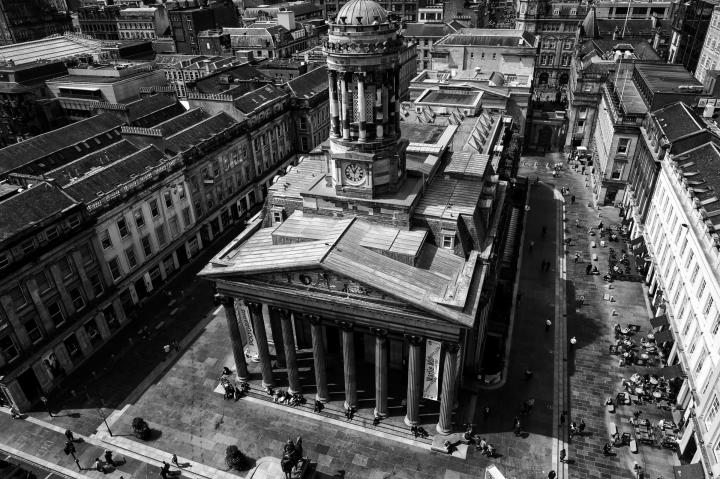
GoMA and Royal Exchange Square taken from Grant Thornton offices on the 8th floor of 110 Queen Street. Photo by Jamie Simpson.
◊ ◊ ◊ ◊ ◊
Press release (9 August 2017) from GoMA:
Stones Steeped in History
Gallery of Modern Art, Glasgow, from August 2017
As Scotland’s most popular modern art gallery and one of the country’s top ten visitor attractions, the Gallery of Modern Art, Glasgow has opened a new display charting significant dates in the development of the site, together with important milestones in the cultural development of Glasgow. Stones Steeped in History tells the story from 1777, when the original building was commissioned as a mansion for tobacco merchant, William Cunninghame, until the present day. The permanent show will inform visitors of the history of the building and is also part of the city’s ambition to aid a deeper understanding of the role slavery played in the narrative of Glasgow. Images of beautiful old photographs, watercolours, and postcards complement nostalgic images of Glasgow throughout the years, which enhance the detailed timeline on display.
Stones Steeped in History begins with a brief account of the life of William Cunninghame and moves through times of great wealth, created by international trade. The building’s first commercial purpose was as a bank some forty years later, before becoming Glasgow’s Royal Exchange in 1827, where for over 100 years businessmen gathered to trade cotton, sugar, coal, and iron. Many, like Exchange founder James Ewing of Strathleven, owned or profited from the labour of enslaved people on the sugar and tobacco plantations in the American colonies and West Indies.
The display continues with innovations such as one of Glasgow’s first telephone exchanges, housed in the building from 1880 and records the iconic Duke of Wellington statue being erected outside in 1884. Glasgow Corporation purchased the building in 1954. Its first civic use was as a library, containing both the Stirling and Commercial Library collections. Stones Steeped in History then chronicles the building’s key role in Glasgow’s rise as a centre for art and culture, which began in the 1970s.
Chair of Glasgow Life, Councillor David McDonald, said: “We are pleased to open Stones Steeped in History and share a few of this historic building’s stories, including its undeniable ties to slavery. GoMA has been a home, a bank, an exchange, a library, and is now a respected gallery of modern and contemporary art. This building’s stones really are steeped in history. This exhibition records some of the key events in the cultural development of Glasgow. Importantly it continues to tell the story of Glasgow’s links to the slave trade, by providing a fuller appreciation of the part slavery played in the narrative of the city and how important that is not only to the past, but also to the future.”
Glasgow had a reputation as a tough city, but always running alongside this has been a history of innovation and creativity. In the 1970s, Glasgow City Council recognised how culture could be used to re-frame the city’s reputation. The first major project was the creation of a new museum to hold Sir William Burrell’s gift to the city—his collection of over 9,000 objects. The Burrell Collection opened in 1983, to international acclaim. The Garden Festival followed in 1988, attracting over 4 million visitors and in 1990 Glasgow won the title of European Capital of Culture, changing its cultural standing forever. Glasgow and the artists who have emerged from it are now acknowledged around the world and the city boasts one of the finest civic art collections in Europe.
The Mitchell Library opened in 1911, incorporating much of the book collection housed in the building. Stirling’s Library remained until work began on the Gallery of Modern Art in 1994. GoMA opened in 1996, under the leadership of then Director of Museums Julian Spalding. It had six galleries, five showing works from the permanent collection, with one for exhibitions. Spalding’s vision was quite radical—to display only works by living artists—but his selection of artists was met with dismay by the artistic community. Glasgow Museums’ current approach to collecting and commissioning is quite different and now focuses on building the collection and important social justice and human rights issues. Curators continue to collect and commission work by artists with a Glasgow connection. Visitors can see displays of local and international artworks from the collection as well as temporary exhibitions and artist events across the building’s four galleries. The basement is home to a library and café; there is a shop and artists workspace on the top floor.
Stones Steeped in History is located on two balconies across level 1 and 2 at GoMA. The display covers the period from when the first building appeared in the 1700s up to the opening of the Gallery of Modern Art in 1996. It highlights some of the significant dates and functions in the history of the venue, alongside some key points in the cultural development of Glasgow. It is open now. The exhibition was made possible thanks to the generous donations from the 3.1 million visitors who visit Glasgow Museums every year.
Call for Proposals | History of Collecting Seminars
History of Collecting Seminars
The Wallace Collection, London, 2018
Proposals due by 11 September 2017
The seminar series was established as part of the Wallace Collection’s commitment to the research and study of the history of collections and collecting, especially in the eighteenth and nineteenth centuries in Paris and London. In 2018, as in previous years, we plan to organise a series of 10 seminars.
The Wallace Collection will be celebrating the bicentenary of Sir Richard Wallace’s birth in 2018. To mark the occasion we hope that the seminars will have a special emphasis on collecting in Paris and London during the second half of the nineteenth century. We are also keen, though, to encourage wider contributions for 2018, covering all aspects of the history of collecting, including:
• Formation and dispersal of collections
• Dealers, auctioneers and the art market
• Collectors
• Museums
• Inventory work
• Research resources
The seminars, which are normally held on the last Monday of every month during the calendar year, excluding August and December, act as a forum for the presentation and discussion of new research into the history of collecting. Seminars are open to curators, academics, historians, archivists, and all those with an interest in the subject. Papers are generally 45–60 minutes long, and all the seminars take place at the Wallace Collection between 5.30 and 7pm. If interested, please send a short text (500 words), including a brief CV, indicating any months when you would not be available to speak, by 11 September 2017. For more information and to submit a proposal, please contact: collection@wallacecollection.org. Please note that we are able to contribute up to the following sums towards speakers’ travelling expenses on submission of receipts:
• Speakers within the UK, £80
• Speakers from Continental Europe, £160
• Speakers from outside Europe, £250
The 2017 programme is available here»
New Book | The Museum by the Park: 14 Queen Anne’s Gate
From Paul Holberton Publishing:
Max Bryant, The Museum by the Park: 14 Queen Anne’s Gate (London: Paul Holberton Publishing, 2017), 128 pages, ISBN: 978 1911300 328, £25 / $35.
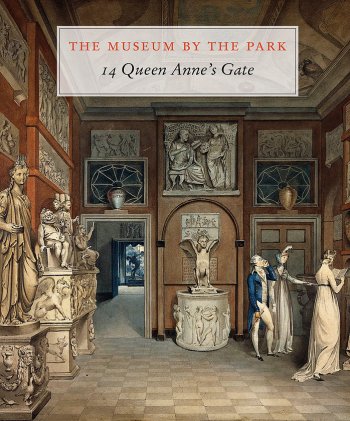 The depth of history at Queen Anne’s Gate—a handsome Baroque street overlooking St James’s Park—is unusual even in London, and few houses resonate with more memories than the extraordinary number 14. The story of the house over the centuries features political revolutionaries, occult initiations, clandestine war meetings, and a decapitated head. It begins, however, as a museum of Roman sculpture, unrivalled outside Italy, designed for connoisseur and virtuoso Charles Townley (1737–1805). Townley embodied Enlightenment values perhaps more completely than any other figure in the art world of 18th-century Britain—his portrait by Johann Zoffany is one of the iconic paintings of the period—yet remarkably he has never been the subject of a major publication.
Written with a sparkle matching Townley’s own enthusiasm, this beautiful and engaging publication tells the story of 14 Queen Anne’s Gate and examines the extraordinary life of Charles Townley and his remarkable collection of over 150 Roman marble statues (mostly now in The British Museum but captured in spectacular engravings of the period). It will be a revelation.
The house was designed as a temple to the past, reviving in the modern city the occult practices of the ancient world. Here visitors in the eighteenth century would have found an assembly of Roman sculpture unrivalled outside Italy, as well as a library and collection devoted to understanding a universal ‘generative sprit’ worshipped by early civilizations. That spirit may be found in the succession of major roles the house has continued to take through generations of dramatic change up to the present day.
Charles Townley, for whom the house was built, was a figure both marginal and emblematic. Catholic and bisexual, he forged a life literally on the borders of the Protestant British establishment. He remains little understood or appreciated in his homeland and, remarkably, has never been the subject of a major exhibition or publication. The ‘emblematic’ side of Townley’s life was dedicated to virtù, the term used for an appreciation of fine art pursued for its own sake. The ‘marginal’ side of Townley, by contrast, manifested itself in a fascination with the ancient occult, particularly the Bacchic mysteries. The house he made for himself was at once a temple to virtu and to Bacchus and contained an unprecedented programme of Bacchic iconography.
Library Research Grants from the Getty
From The Getty:
Getty Research Institute Library Research Grants
Applications due by 16 October 2017
Getty Library Research Grants provide partial, short-term support for researchers requiring the use of specific collections housed in the Getty Research Institute (GRI). The GRI’s grant budget has been generously supplemented by donations from Getty Research Institute Council members and the Getty Conservation Institute.
Specialized Library Research Grant Opportunities
In addition to the open call for applications relating to projects utilizing any specific area of the GRI’s collections, several focused grants will be awarded in the following areas of study:
• Research related to the modern commercial art market, Los Angeles modern architecture, or design
• Research in the area of 18th-century German art as it relates to the religious, philosophical, and aesthetic contextualization of the Romantic movement
• Research within the GRI’s photo archive, a collection of two million photographs of works of art and architecture providing opportunities for original pictorial research in the fine arts, including the history of photography
• Research that utilizes the Conservation Collection, specialized research materials related to the preservation and conservation of material cultural heritage
Eligibility
Library Research Grants are intended for researchers of all nationalities and at any level who demonstrate a compelling need to use materials housed in the Research Library, and whose place of residence is more than eighty miles from the Getty Center. Projects must relate to specific items in the library collection. (To search the collections, please consult the Research Library’s Search Tools and Databases.)
Terms
Library Research Grants are intended to provide partial support for costs relating to travel, lodging, and living expenses. Housing is not provided. In general, grants are awarded as follows depending upon the distance traveled:
• Within California (must be more than 80 miles away from GRI): $800
• North America, including Canada and Mexico: $1,500
• International outside of North America: $3,000
The research period may range from several days to a maximum of three months. These terms apply as of August 2017 and are subject to future changes. Please see important information about the terms of these grants here.
Notification Process
Applicants are notified of the Research Institute’s decision approximately two months following the deadline. Applicants who do not receive grant awards are still welcome to use the Research Library in accordance with its access policy.
Application Availability and Deadline
Complete application materials are now accepted through an online application process only. The next deadline to submit application materials (including letters of recommendation) for these grants is 5:00pm (PDT) October 16, 2017.
More information is available here»
The Burlington Magazine, August 2017
The eighteenth century in The Burlington:
The Burlington Magazine 159 (August 2017)
 E D I T O R I A L
• “Reflected Glory: University Art Collections in Britain,” p. 599.
O B I T U A R I E S
• Simon Jervis, “Rudolf Hermann Wackernagel (1933–2017),” p. 639. His great article, “Carlton House Mews: The State Coach of the Prince of Wales and of the Later Kings of Hanover, A Study in the Late-Eighteenth-Century ‘Mystery’ of Coach-Building, in Furniture History 31 (1995) remains the most authoritative statement on London coach building in the late eighteenth century. But his crowning achievement was the massive two-volume Staats- und Galawagen der Wittelsbacher (Stuttgart, 2002). This is a catalogue of the wonderful collection of the Marstallmuseum at Schloss Nymphenburg, outside Munich, where he generously deposited part of his own extensive and systematic archive on coaches and carriages…
R E V I E W S
• Gauvin Alexander Bailey, Review of Christine Casey, Making Magnificence: Architects, Stuccatori and the Eighteenth-Century Interior (Yale University Press, 2017), pp. 642–43.
• Ayla Lepine, Review of Julian Holder and Elizabeth McKellar, eds., Neo-Georgian Architecture, 1880–1970: A Reappraisal (Historic England, 2016), pp. 643–44.
• Michael Hall, Review of Pauline Prévost-Marcilhacy, ed., Les Rothschild: une dynastie de mécènes en France, 1873–2016 (Somogy éditions d’Art, 2016), pp. 644–46.
• Francis Russell, Review of the exhibition Canaletto and the Art of Venice (London: The Queen’s Gallery, Buckingham Palace, 2017), pp. 651–52.
• Matthi Forrer, Review of the exhibition Hokusai: Beyond the Great Wave (London, The British Museum; and Osaka: Abeno Harukas Art Museum, 2017), pp. 652–53.
•Eric Zafran, Review of the exhibition America Collects Eighteenth-Century French Painting (Washington: D.C.: National Gallery of Art, 2017), pp. 669–70.
R E C E N T A C Q U I S I T I O N S
Recent acquisitions (2007–17) by regional university collections in Britain
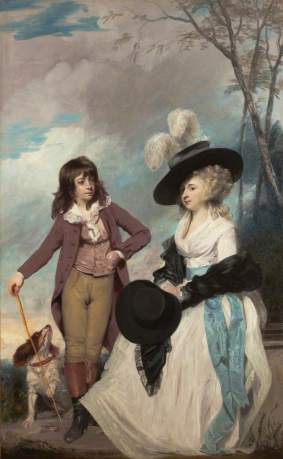
Joshua Reynolds, Maria Marow Gideon and Her Brother, William, 1786–87 (Birmingham: The Barber Institute of Fine Arts), January 2013.
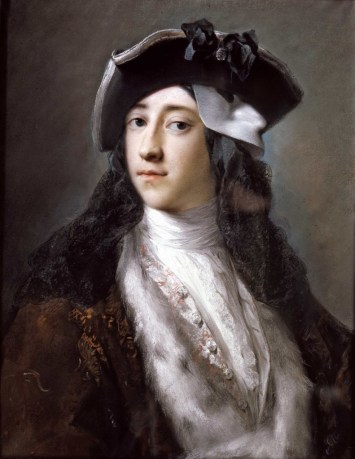
Rosalba Carriera, Portrait of Gustavus Hamilton, 2nd Viscount Boyne, ca. 1730–31; pastel, heightened with white bodycolour on paper (Birmingham: The Barber Institute of Fine Arts), 2009.
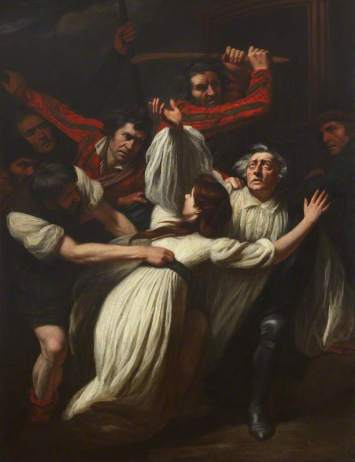
John Opie, The Death of Archbishop Sharpe, 1797; oil on canvas (University of St Andrews), 2008.










 Enfilade
leave a comment