Exhibition | Project Blue Boy
Press release (3 August 2017) from The Huntington:
Project Blue Boy
The Huntington, San Marino, 22 September 2018 — 30 September 2019
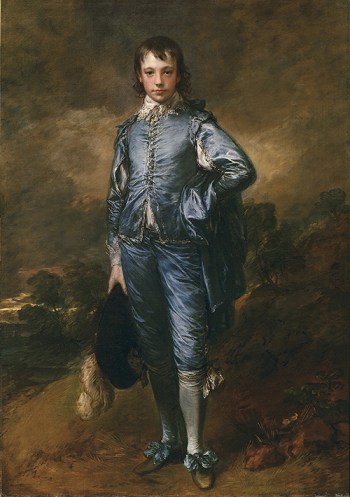
Thomas Gainsborough, The Blue Boy, ca. 1770; oil on canvas, 71 × 49 inches (San Marino: The Huntington Library, Art Collections, and Botanical Gardens).
One of the most famous paintings in British and American history, The Blue Boy, made around 1770 by English painter Thomas Gainsborough (1727–1788), will undergo its first major technical examination and conservation treatment. Project Blue Boy begins on August 8, 2017, when the life-size image of a young man in an iconic blue satin costume will go off public view for preliminary conservation analysis until November 1. The Huntington Library, Art Collections, and Botanical Gardens, home to The Blue Boy since its acquisition by founder Henry E. Huntington in 1921, will conduct the conservation project over a two-year period. The final part of the project will largely take place in public view, during a year-long exhibition, also called Project Blue Boy, presented from September 2018 to September 2019 in the Thornton Portrait Gallery, where the painting traditionally hangs.
“We are profoundly conscious of our duty of care towards this unique and remarkable treasure,” said Steve Hindle, The Huntington’s Interim President and W.M. Keck Foundation Director of Research. “The Blue Boy has been the most beloved work of art at The Huntington since it opened its doors in 1928. It is with great pride that we launch this thoughtful and painstaking endeavor to study, restore, and preserve Gainsborough’s masterpiece. The fact that we are able to do so while inviting the public to watch and to learn is both gratifying and exciting—not least since the project is so perfectly suited to our mission.”
The Blue Boy requires conservation to address both structural and visual concerns. The painting is so important and popular that it has been on almost constant display since The Huntington opened to the public almost 100 years ago. “The most recent conservation treatments have mainly involved adding new layers of varnish as temporary solutions to keep The Blue Boy on view as much as possible,” said Christina O’Connell, The Huntington’s senior paintings conservator and co-curator of the exhibition. “The original colors now appear hazy and dull, and many of the details are obscured.” According to O’Connell, there are also several areas where the paint is beginning to lift and flake, making the work vulnerable to loss and permanent damage; and the adhesive that binds the canvas to its lining is failing, meaning the painting does not have adequate support for long-term display. These issues and more will be addressed by Project Blue Boy.
In addition to contributing to scholarship in the field of conservation, the undertaking will likely uncover new information of interest to art historians. O’Connell will use a Haag-Streit surgical microscope to closely examine the painting. To gather material information, she will employ imaging techniques including digital x-radiography, infrared reflectography, ultraviolet fluorescence, and x-ray fluorescence. The data from these analytical techniques will contribute to a better understanding of the materials Gainsborough procured to create The Blue Boy while at the same time revealing information about earlier conservation treatments. The Huntington will address several questions. “One area we’d like to better understand is, what technical means did Gainsborough use to achieve his spectacular visual effects?” said Melinda McCurdy, The Huntington’s associate curator for British art and co-curator of the exhibition. “He was known for his lively brushwork and brilliant, multifaceted color. Did he develop special pigments, create new materials, pioneer new techniques?” She and O’Connell will build upon clues gleaned from previous conservation projects to learn more. “We know from earlier x-rays that The Blue Boy was painted on a used canvas, on which the artist had begun the portrait of a man,” she said. “What might new technologies tell us about this earlier abandoned portrait? Where does this lost painting fit into his career? How does it compare with other portraits from the 1760s?” McCurdy also looks forward to discovering other anomalies that may become visible beneath the surface paint, and what they might indicate about Gainsborough’s painting practice.
The Huntington’s website will track the project as it unfolds.
Exhibition | Silk: From Spitalfields to Sudbury
Now on view at Gainsborough’s House:
Silk: From Spitalfields to Sudbury
Gainsborough’s House, Sudbury, Suffolk, 17 June – 8 October 2017
 The market town of Sudbury in Suffolk has a surprising history. Regarded today as Great Britain’s most important centre for silk manufacture, Sudbury produces nearly 95 per cent of the nation’s woven silk textiles from its three working mills: Vanners Silk Weavers, Stephen Walters & Sons, and Gainsborough Silks. Dating back to the late 1700s, Sudbury’s nascent silk industry was facilitated by the town’s former history as a wool centre, to which many family members of the Sudbury-born artist Thomas Gainsborough, R.A. (1727–1788) plied their trade.
The exhibition Silk: From Spitalfields to Sudbury will explore the local and national history of silk in England from the eighteenth century to the present day, focussing on the diaspora of silk manufacture from Spitalfields in London to Sudbury in Suffolk. In the first part of the exhibition, the formation of the English silk industry in Spitalfields in the early 1700s will be examined, highlighting the important Huguenot silk weavers who formed the basis of this work force. Objects displayed will illustrate the processes of design and manufacture and include everything from silk pattern books and historic costume to paintings and drawings featuring silk fashions of the era.
In the second part of the exhibition, the focus will turn to the relocation of silk manufacture from London to Suffolk over the course of the nineteenth century, exploring the history of Sudbury’s silk mills and the textiles they produced. Objects on show from the town’s three mills, in addition to the Sudbury manufacturer Humphries Weaving, will illustrate the many types of silk made in Sudbury, past and present—from furnishing textiles for historic palaces to contemporary design fabrics made for major British fashion houses.
This exhibition will draw together artworks and textiles from both national and local collections, including the Victoria & Albert Museum, Norfolk Museums Service, and the Warner Textile Archive. As the childhood home of the artist Thomas Gainsborough situated at the very heart of the nation’s active silk industry, Gainsborough’s House is ideally placed to tell this important story of silk in England, from Spitalfields to Sudbury.
Study Day | 300 Years of Silk

One of a pair of shoes, ca 1720; leather sole, with brocaded silk uppers with silk woven in Spitalfields
(London: V&A, T.446&A-1913)
◊ ◊ ◊ ◊ ◊
300 Years of Silk: A Study Day at Gainsborough’s House
Gainsborough’s House, Sudbury, Suffolk, 26 September 2017
Join us for 300 Years of Silk, an exclusive Silk Study Day held at Gainsborough’s House in Sudbury, Suffolk. Hosted by textile specialists Mary Schoeser and Kate Wigley of the School of Textiles, Coggeshall, and Keeper of Art & Place Louisa Brouwer of Gainsborough’s House, this event will feature a series of informative lectures, interactive handling sessions and a curator-led tour of the current exhibition, Silk: From Spitalfields to Sudbury (17 June — 8 October 2017). The daylong programme will include opportunities to study a range of silk textiles from the eighteenth to twentieth centuries in close detail and will offer privileged access to the Sudbury silk mill Vanners Silk Weavers, with guided tours led around this vibrant working factory in the afternoon.
Organised to accompany the current exhibition Silk: From Spitalfields to Sudbury at Gainsborough’s House, this Study Day will explore the fascinating history of the English silk industry, focussing on the town of Sudbury, Suffolk—regarded today as Great Britain’s most important centre for silk manufacture. Sudbury now produces more woven silk textiles than anywhere else in the nation, with four working firms still in operation: Vanners Silk Weavers, The Gainsborough Silk Weaving Company, Stephen Walters & Sons, and The Humphries Weaving Company. Dating back to the early years of the nineteenth century, Sudbury’s nascent silk industry was facilitated by the town’s former history as a wool centre, to which many family members of the Sudbury-born artist Thomas Gainsborough, R.A. (1727–1788) plied their trade.
Open to students, curators, and textile enthusiasts alike, this Study Day offers full access to Gainsborough’s House in the historic market town of Sudbury, located just 1 hour 20 minutes by train from London Liverpool Street. The day will run from 10am to 5pm and cost £80 per person (inc. VAT). Tickets will include tea, coffee, and biscuits upon arrival, followed by a light sandwich lunch in the afternoon. For further enquiries and to reserve your place, please contact louisa@gainsborough.org. Limited places are available so early booking is recommended.
National Museum Wales Acquires Rare Richard Wilson Portrait
Press release (7 July 2017) from the UK’s Art Fund:
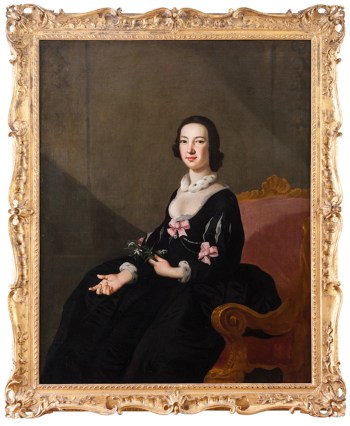 With support from Art Fund, National Museum Wales has acquired the painting Portrait of a Lady (ca. 1750), which is now on display at National Museum Cardiff. Thought to be an image of Miss Mary Jenkins, whose family owned Priston Manor in Somerset, the work joins only one other female portrait by Wilson in National Museum Wales’ collection. It offers insight into Wilson’s early career, when he first trained in London as a society portrait painter, before later becoming best known for his landscapes.
The acquisition has also enabled further research, which is currently trying to establish whether this may in fact be a marriage portrait, rather than one of a pair of siblings (Wilson also painted Jenkins’ sister, Elizabeth, in the same year). The woman’s hand clasps a sprig of white blossom, which may be choisya (orange blossom), sometimes used to symbolise an eternal bond.
“This striking and intriguing Portrait of a Lady is a strong example of Wilson’s early practice, and further enriches Amgueddfa Cymru’s collection of works by the artist,” said Andrew Renton, keeper of art at National Museum Wales. “This portrait not only strengthens the female presence in our 18th-century displays but it also enables us to undertake interesting further research—the identity of the sitter is speculative and we’d love to be sure who she really is!”
“Richard Wilson is of course one of Wales’ most celebrated landscape painters, but his portraits are particularly rare,” said Stephen Deuchar, director of Art Fund. “We’re very pleased to support this acquisition for Amgueddfa Cymru—National Museum Wales, a leading centre for his work in all its range and depth.”
Newly Attributed Self-Portrait by Wright on View at LAPADA Fair
As noted at Art Daily (29 July 2017) . . .
LAPADA Art & Antiques Fair
Berkeley Square, London, 15–20 September 2017

Joseph Wright of Derby, Self-portrait, 1793.
An 18th-century painting catalogued as being by a ‘Follower of Joshua Reynolds’ at auction has been revealed as a genuine self-portrait by renowned British artist Joseph Wright of Derby (1734–1797). The discovery, a rarity for 18th-century works by high-profile British artists, will be unveiled at the LAPADA Art & Antiques Fair in Berkeley Square, Mayfair, from the 15th to 20th of September.
Acquired by Archie Parker of The Parker Gallery, a leading dealer in Old Master and British works of art, the painting has been traced back to 1793, when records indicate that Wright gifted it to the Rev. Thomas Gisborne of Yoxall. Gisborne was a close friend of Wright’s and had amassed an extensive collection of paintings and drawings by the artist, including a portrait featuring Gisborne and his wife, two landscapes of the Lake District (subsequently at Kedleston Hall), and a painting of Mount Vesuvius.
In 1793, Wright presented Gisborne with a self-portrait that had, until now, disappeared from view, its existence known only from a copy belonging to the collection of Sir John Crompton-Inglefield. A Latin inscription on the copy’s reverse reads: “Joseph Wright the artist presented this painting by his own hand as a gift to his friend T. Gisborne in the year of Our Lord 1793 and 59th of his age.” The newly discovered self-portrait is almost certainly the missing original that inspired the copy and was later reproduced as the frontispiece of the 1885 monograph The Life and Works of Joseph Wright A.R.A., commonly called ‘Wright of Derby’.
Thomas Gisborne (1758–1846) was educated at Harrow. Scholarly and artistic, he was later admitted as a Fellow Commoner to St. John’s College, Cambridge, where his immense achievements pleased his old headmaster, Dr. Heath. In celebration of his achievements, Heath arranged for Gisborne’s portrait to be painted by Wright and despite their significant age difference, Gisborne struck up a friendship with the artist that was to last until the end of Wright’s life. In 1781, Gisborne was ordained a deacon and then a priest and subsequently inherited his father’s mansion at Yoxall, three miles from his church. Wright was a frequent guest at the peaceful house and produced some of his most beautiful sketches and studies while exploring the surrounding ancient oak wood. In 1793, Wright was once again staying at Yoxall when he presented Gisborne with the recently discovered self-portrait.
The annual LAPADA Art & Antiques Fair, sponsored by award-winning investment house Killik & Co, returns to Berkeley Square, London, for its 2017 edition from Friday 15th to Wednesday 20th September—this year bridging two weeks—and will showcase a fascinating array of one-of-a-kind works of art, antiques, design, jewellery and decorative art.

Exhibition | Divine Visions, Earthly Pleasures
Press release (27 June 2017) for the exhibition now on view at BAMPFA:
Divine Visions, Earthly Pleasures: Five Hundred Years of Indian Painting
Berkeley Art Museum and Pacific Film Archive, 22 June — 10 September 2017
Curated by Robert J. Del Bontà
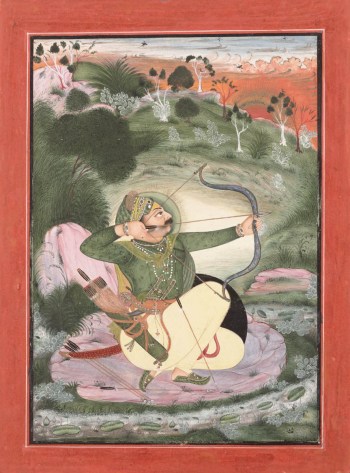
Unknown artist, Surajamala-ji, Son of Rao Nirandasa, 1820; ink, gouache, and gold on paper, 21 × 8 inches (Berkeley: BAMPFA, gift of Jean and Francis Marshall).
This summer, the UC Berkeley Art Museum and Pacific Film Archive (BAMPFA) presents a new exhibition of paintings that encompasses five hundred years of Indian art-making traditions. Divine Visions, Earthly Pleasures: Five Hundred Years of Indian Painting draws on the institution’s extensive holdings of Asian art, in particular a renowned collection of more than three hundred works donated to BAMPFA in 1998. Guest curated by the distinguished Indian art scholar Robert J. Del Bontà, the exhibition is on view from June 28 through September 10, 2017.
Divine Visions, Earthly Pleasures comprises more than sixty paintings from BAMPFA’s collection, representing a vast range of Indian art and cultural history from the early fifteenth through twentieth centuries. Reflecting the distinctive collecting interests of Jean and Francis Marshall—whose gift forms the core of BAMPFA’s Indian art holdings—the works display a diverse array of subject matter, ranging from early religious traditions and aristocratic portraiture to romantic narratives and musical performances. By presenting some early extant examples of Indian painting alongside more recent works, the exhibition illuminates common aesthetic conventions—in particular a subtle interplay between realistic and abstract forms that emerges as a persistent theme across centuries of artistic practice.
“Since Jean and Francis Marshall’s transformative gift in 1998, BAMPFA’s Asian art holdings have grown to be one of the defining strengths of our encyclopedic collection, and we’re thrilled to highlight that strength with a show that brings some of most exceptional of these works together for the first time in years,” said Lawrence Rinder, director and chief curator of BAMPFA. “We are especially grateful to our friend and colleague Robert J. Del Bontà for providing a fresh scholarly perspective on these paintings that will allow our visitors to rediscover them in a new and illuminating context.”
“For more than five hundred years, the Indian subcontinent has nurtured some of the world’s most vibrant and distinctive painting traditions, which are richly encapsulated in BAMFPA’s remarkable collection,” said Del Bonta, who previously served as research associate and guest curator at the Asian Art Museum of San Francisco. “The works in this exhibition present subtle interplays between representational and abstract aesthetics and between sacred and secular subject matter—often in a single painting. It’s a pleasure to partner with BAMPFA in sharing these breathtaking works with the public.”
Divine Visions, Earthly Pleasures: Five Hundred Years of Indian Painting is organized by guest curator Robert J. Del Bontà, with funding provided by the Asian Art Endowment Fund.
The 32-page exhibition brochure by Robert J. Del Bontà is available as a PDF file here»
New | Book Silent Witnesses: Trees in British Art, 1760–1870
From Sansom & Co:
Christiana Payne, Silent Witnesses: Trees in British Art, 1760–1870 (Bristol: Sansom & Company, 2017), 176 pages, ISBN: 978 1911408 123, £25.
 In the eighteenth and nineteenth centuries, naturalists, poets and artists were united in their love of trees. William Gilpin began his influential Remarks on Forest Scenery (1791) with the bold statement that ‘It is no exaggerated praise to call a tree the grandest, and most beautiful of all the productions of the earth.’ Illustrated books and tree portraits celebrated the beauty, antiquity and diversity of individual, and particularly ancient specimens. A wide range of drawing manuals showed artists and amateurs how to express their ‘character’ and ‘anatomy’, as if they were human subjects.
Paintings of woodland scenes provided welcome relief from city life, and studies of exotic trees reflected the growth of tourism and empire. The arrival of new species from all over the world aroused much excitement and scientific activity. At the same time, the native trees—oak, ash, beech, elm—acquired new resonance as emblems of the rural countryside. Many of Britain’s most important landscape painters, including Paul Sandby, John Constable, Samuel Palmer, Edward Lear, and the Pre-Raphaelites, made themselves experts in the drawing and painting of trees.
Christiana Payne is Professor of History of Art at Oxford Brookes University, where she has been teaching since 1994. Her previous books include Where the Sea Meets the Land: Artists on the Coast in Nineteenth-Century Britain (Sansom and Company, 2007) and John Brett, Pre-Raphaelite Landscape Painter (Yale University Press, 2010). She has curated major exhibitions and displays at the Yale Center for British Art, Tate Britain, and the Royal West of England Academy, Bristol.
Exhibition | Nelson & Norfolk
The Battle of the Nile was fought on August 1 and 2 in 1798. Press release (via Art Daily) for the exhibition now on view at Norwich Castle Museum:
Nelson & Norfolk
Norwich Castle Museum & Art Gallery, 29 July — 1 October 2017

Pierre Nicolas Legrand, Apotheosis of Nelson, ca. 1805–18 (Greenwich: National Maritime Museum).
Admiral Lord Nelson (1758–1805) and his affection for his native county of Norfolk is the subject of a major exhibition Nelson & Norfolk, on view at Norwich Castle Museum & Art Gallery from 29 July until 1 October 2017. The exhibition presents some of the most extraordinary and potent objects connected to Nelson, from his boyhood in Norfolk to his death at the Battle of Trafalgar in 1805.
The single bullet (or musket ball), which mortally wounded Admiral Lord Nelson at the Battle of Trafalgar in 1805, is one of the important objects on display as part of the revelatory exhibition. The bullet, which is usually on display at Windsor Castle has been generously lent by Her Majesty The Queen from the Royal Collection, and this is the first time it has been shown in Norfolk, Nelson’s home county. Measuring 15mm, the lead shot bullet is mounted in a hinged silver locket together with some remnants of gold lace from Admiral Nelson’s uniform and a small handwritten note with the words “The bullet by which Nelson was killed.” Although it cost Nelson his life, The Battle of Trafalgar, which took place on the 21 October 1805, is still regarded today as one of Britain’s greatest naval victories.
Another centerpiece is the highly important, early French Tricolour—the monumental Ensign (or flag) of the French warship Le Généreux, which took part in the Battle of the Nile in 1798. A British victory, the battle sealed Nelson’s reputation as England’s greatest hero. Although Le Généreux was one of only two ships of the line from the French fleet to escape this historic battle, it was subsequently captured, on 18 February 1800 by Nelson’s flag captain Sir Edward Berry, on board the HMS Foudroyant. When the huge Ensign of Le Généreux was ‘struck’, that is removed from the flagpole at the rear of the ship, and surrendered to Sir Edward Berry, it was immediately despatched as a gift to the City of Norwich. One of the largest (it measures 16 × 8.3 meters—roughly the size of a tennis-court) and most iconic objects connected to Norfolk’s most famous son, Admiral Lord Nelson, this is the first time this historic object has been on public display for more than a century.
Ruth Battersby Tooke, Senior Curator of Costume and Textiles at Norwich Castle, said: “The exhibition is built around key objects such as the fatal bullet and the Ensign, with their remarkable histories. In explaining the story of each of the unique and significant exhibits, we are providing insights into Nelson and his times, the cult of his personality and the way he has been lionised and commemorated. The exhibition’s main themes are Nelson’s extraordinary legacy, his reputation and the ongoing nature of his ‘Immortal Memory’.”
The exhibition is divided into several sections each one examining a key part or element of Nelson’s life and career starting with his birth and early years in his beloved home county of Norfolk. The Norfolk section includes the Burnham Thorpe Parish Register, the village where Nelson was born, which is annotated in the margin by Nelson’s father, rector of the parish, with dates of significant milestones and naval victories. The register is displayed alongside the poignant “Dear, dear Burnham letter” written by Nelson in 1804. Also of interest is a Freedom Box, presented to Nelson by the Corporation of Thetford following the decision to bestow upon him the Freedom of the town in 1798. Personalia from Strangers’ Hall in Norwich include a lock of Nelson’s hair, owned originally by Captain Hardy and given to Norwich Museums in 1847, a napkin bearing the monogram of NB for Nelson Duke of Bronte, an honour conferred to him after the Battle of the Nile, as well as scraps of the British Ensign and sailcloth from HMS Victory. Collectively these diverse objects all illustrate Nelson’s early life and the affection for his home county. Other sections focus on The Battle of the Nile, which took place on 1 August 1798, Naples and Emma, Nelson’s Death, and finally his Funeral.
Extremely apt to be exhibited together with the Ensign from Le Généreux is Nelson’s famous coat, which he wore at the Battle of the Nile kindly loaned by the National Maritime Museum Greenwich. Made in wool and linen with large brass buttons and gold alloy braiding, this is a typical flag officer’s undress coat of the period. The coat also gives an indication as to how slight Nelson was. Excitingly the hat, which Nelson wore at this decisive battle, is also on display. This is the first time that the coat and hat have been reunited since 1891.
The drama of the final moments of this historic Battle of the Nile are vividly depicted in a dramatic oil painting by artist Thomas Whitcombe. Amidst the smoke from cannons and fires, the magnificent ships are shown with their sails billowing and respective ensigns flying, the foreground littered with debris of wrecked ships and lifeboats filled with sailors lucky to have escaped alive. The painting was executed in 1799 a year after the Battle of the Nile took place.
No exhibition about Nelson can avoid the subject of his time in Naples (1798–1800), where he met the extraordinary Emma Hamilton, who became the love of his life. Particularly poignant is a charming locket (in the collection of Norwich Castle) that contains two different locks of hair. The high quality of the workmanship suggests that it was probably a private commission and there is a possibility that the hair enclosed is that of Nelson and Emma Hamilton, making this a hugely romantic and enigmatic object. Also in this section is the border of a dress embellished in honour of Lord Nelson and worn by Emma Hamilton at Palermo around 1799, together with a touching picture embroidered in silk of Nelson and his beloved Emma.
Nelson’s death is illustrated by the painting The Apotheosis of Nelson on loan from the National Maritime Museum painted by Scott Pierre Nicolas Legrand, circa 1805–18. It clearly conveys the level of hero-worship that Nelson had inspired during his life-time and which was set to continue for generations to come. This highly romantic painting depicts a deified Nelson achieving immortality as he ascends up to the gods on Mount Olympus, while his sailors grieve for him on the decks of the ship below.
Nelson’s funeral resulted in a public demonstration of grief on a national scale. The dramatic black velvet drape from Nelson’s funeral car, together with the painted silk hatchment, both used at his funeral, have not been seen together since the funeral car was dismantled around 1826. There is also a uniform worn by a Greenwich Volunteer who guarded Nelson’s coffin during his two-day lying-in-state, a model of the funeral barge made by a French prisoner of war at Norman Cross internment camp, a picture on glass showing Lord Nelson Lying in State by J. Hinton and additional extensive Nelson funeral memorabilia.
Presiding over the exhibition, as a whole, is the large, compelling portrait in oils of Nelson by the artist William Beechey, commissioned by the City of Norwich and completed in 1801. The portrait features another noteworthy exhibit, namely the sword surrendered to Nelson by the Spanish Admiral Xavier Winthuysen after the Battle of Cape St Vincent on 14 February 1797. When two Spanish ships, the San Nicolas and the San Josef, became entangled Nelson was able to board one then the other. On the deck of the San Josef, Nelson received the surrendered swords of the Spanish, including this one. Nelson’s naval officer’s hat, depicted prominently in the portrait and given to the artist William Beechey by Nelson after he sat for the famous portrait, adds further human interest.
Complementing the important loans from major national museums and institutions around the country are additional fascinating and unique objects drawn from Norfolk Museums Service’s own Nelson archives, as well as other local collections in the county including those of Norwich Social History, Fine and Decorative Art, the Great Yarmouth Sailors’ Home, as well as Nelson’s schools; The Norwich School and Paston College. Numerous items have also been generously loaned by private collectors.
Nelson & Norfolk is not intended to be a chronology of the life and times of Nelson illustrated by objects. Instead this exhibition takes its starting point and narrative from the objects themselves. In bringing together so much authentic material, the exhibition reflects the ways in which Nelson has been represented in imagery and how his remarkable life story has been told through objects. Likewise a strong cohesive thread is the affection that Nelson had for the county that ‘gave him birth’ and Norfolk’s immeasurable pride in its most famous son. This is the first time that these objects have ever been presented together in one exhibition.
Margaret Dewsbury, Chair of Norfolk County Council Communities Committee said: “The people of Norfolk are understandably proud to claim Nelson as one of our own; with this exhibition we can take stock of what his influence and reputation has meant to both his home county and the country as a whole. We are very grateful to all the lenders to the exhibition whose generosity has enabled us to bring together a truly unique collection of artefacts. To be able to include items which take us from his birth in the beautiful Norfolk village of Burnham Thorpe to his heroic death at Trafalgar is remarkable and moving and will make for an unforgettable experience for visitors.”
The exhibition is timely in that coincides with the 200th anniversary of the laying of the foundation stone of the Nelson memorial in Great Yarmouth, the county’s most significant memorial to its local hero.
Symposium | Enlightened Princesses: Britain and Europe, 1700–1820
From the Paul Mellon Centre for Studies in British Art:
Enlightened Princesses: Britain and Europe, 1700–1820
Kensington Palace, Hampton Court Palace, and the Tower of London, 29–31 October 2017
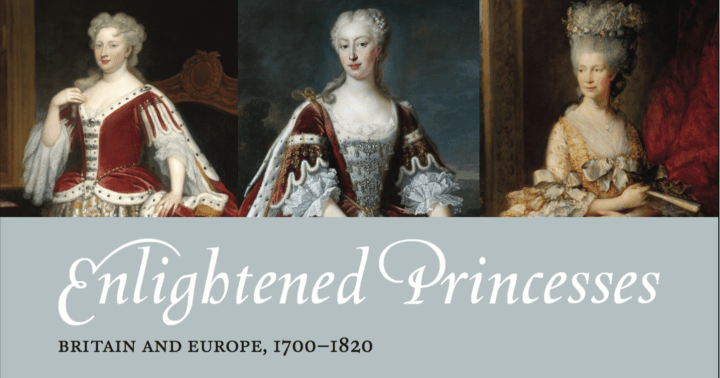
Caroline of Ansbach (1683–1737), Augusta of Saxe-Gotha (1719–1772), and Charlotte of Mecklenburg-Strelitz (1744–1818), three Protestant German princesses, became variously Princess of Wales, Queen Consort, and Princess Dowager of Great Britain. Recent research has explored how in fulfilling these roles they made major contributions to the arts, the development of new models of philanthropy and social welfare, the promotion and support of advances in science and medicine, as well as trade and industry, and the furthering of imperial ambition. While local contexts may have conditioned the forms such initiatives took, their objectives were rooted in a European tradition of elite female empowerment.
This symposium, Enlightened Princesses: Britain and Europe, 1700–1820, will bring together eminent academicians and museum scholars to investigate the role played by royal women-electresses, princesses, queens consort, reigning queens, and empresses—in the shaping of court culture and politics in Europe of the long eighteenth century.
Papers will explore the following themes:
• Royal women as political agents
• Royal women: networks and conversations
• Royal women as patrons of art and architecture
• Royal women and the crafting of image
• Royal women: engaging with nature and technology
The symposium will take place 29–31 October 2017 at Kensington Palace, Hampton Court Palace, and the Tower of London. The programme will include special tours of the Enlightened Princesses exhibition at Kensington Palace, followed by two full days of lectures, themed panels, and discussions at Hampton Court Palace and the Tower of London.
The fee for attending the conference is £100. Reduction are available for a limited number of students on application to the symposium organiser. The symposium organiser can be contacted at emily.knight@hrp.org.uk.
Co-organised by Historic Royal Palaces, the Yale Center for British Art, and the Paul Mellon Centre for Studies in British Art, London, in association the exhibition Enlightened Princesses: Caroline, Augusta, Charlotte, and the Shaping of the Modern World, on view at Kensington Palaces, 22 June – 12 November 2017.
S U N D A Y , 2 9 O C T O B E R 2 0 1 7
14.00 Exhibition tour 1
15.00 Exhibition tour 2
16.00 Exhibition tour 3
Tea served in Orangery from 14.00 to 17.00
M O N D A Y , 3 0 O C T O B E R 2 0 1 7
9.00 Registration and coffee
9.30 Welcome from Adrian Phillips and Amy Meyers
9.45 Keynote Lecture
• Joanna Marschner, Enlightened Princesses: Britain and Europe, 1700–1820
10.30 Break
10.45 Session 1 | Royal Women as Political Agents
Moderator: Lisa Ford
• Elise Dermineur, Queens Consort as political agents: A tentative research framework through the example Queen Louisa Ulrika of Sweden (1720–1782)
• Heather Carroll, ‘Charlotte has the breeches’: The shifting political perception of Queen Charlotte
• Allison Goudie, ‘A woman of great feminine beauty, but of a masculine understanding’: Queen Maria Carolina of Naples and Canova’s statue of the king ‘as Minerva’
• Martin Eberle, Luise Dorothea: Duchess of Saxony-Gotha-Altenburg
13.00 Lunch
14.00 Session 2 | Royal Women: Networks and Conversations
Moderator: Lucy Peltz
• Elizabeth Montagu, ‘Queen of the Bluestockings’: Women and literary authority in the age of Enlightenment
• Lisa Skogh de Zoete, Queen Hedwig Eleanora—A Liebhaberin of the arts: Political culture and sources of knowledge as part of Northern German Court Culture
• Merit Laine, Creative conversations: Queen Louisa Ulrika and the formulation of Swedish court culture in the Age of Liberty
• Sonja Fielitz, ‘A silent but impressive language’: The quietly worked female empowerment of Charlotte of Mecklenburg-Strelitz
16.00 Tea
16.30 Discussion
Moderators: Sebastian Edwards and Desmond Shawe-Taylor
17.30 Drinks and musical programme with harpsichord virtuoso Nathaniel Mander
T U E S D A Y , 3 1 O C T O B E R 2 0 1 7
9.00 Registration and coffee
9.30 Welcome by Joanna Marschner and Amy Meyers
9.45 Session 3 | Royal Women as Patrons of Art and Architecture
Moderators: Aurélie Chatenet-Calyste and Desmond Shawe-Taylor
• Tara Zanardi, Material Temptations: Isabel de Farnesio and the politics of the interior
• Veronica Biermann, ‘Let’s have a look’: G.L. Bernini’s mirror for Queen Christina and her self-image
• Christopher Johns, Two Queens and a villa: Enlightenment sociability in Turin
• Christopher Baker, Augusta, Princess of Wales and Jean Etienne Liotard
• Heidi Strobel, Queen Charlotte as patron of female artists
13.00 Lunch
14.00 Session 4 | Royal Women and the Crafting of Image
Moderator: Matthew Storey
• Heather Belnap Jensen, Dynastic dressing: The portraits of Caroline Bonaparte Murat, Queen of Naples and the art of costume
• Eva-Lena Karlsson, Sofia Albertina: A Swedish princess from Rococo to Biedermeier
15.00 Session 5 | Royal Women: Engaging with Nature and Technology
Moderator: Joanna Marschner
• Tessa Murdoch, Measuring time at the Hanoverian Court: Caroline, Augusta and Charlotte as promoters of clock and watch-making in London
• Emily Roy, Catherine the Great’s Russian mountain: The imagery of the Thunder Stone
16.25 Tea
17.00 Discussion
Moderator: Helen Watanabe-O’Kelly
◊ ◊ ◊ ◊ ◊
Note (added 19 September 2017) — An updated schedule has replaced the previous, provisional programme.
Note (added 26 October 2017) — Several small changes were made to the programme and corrected in the posting above; a final copy is available here.
The Getty Purchases Watteau’s La Surprise and 16 Master Drawings
As reported by Jori Finkel in The New York Times (20 July 2017) . . .
The Getty Museum has made the biggest financial outlay for art in its history . . . . Judging from sales records for several of these artworks during weaker art-market periods, the Getty’s purchase price could have easily topped $100 million. The museum’s director, Timothy Potts, would not confirm the amount except to say that the deal was “the Getty’s biggest in terms of financial value. . . ”
◊ ◊ ◊ ◊ ◊
Paul Jeromack writes in The Art Newspaper (26 July 2017) . . .
According to sources in the field, the windfall comes from the collection of the 62-year-old collector Luca Padulli, the co-founder of the British investment management company Camomille Associates, who bought the works at auction over the last 17 years, through the British Old Master dealer, Jean-Luc Baroni. . .
◊ ◊ ◊ ◊ ◊
La Surprise was believed to have been destroyed until it re-emerged in 2007; it sold at Christie’s in 2008 for over $24million. Press release (20 July 2017) from The Getty:
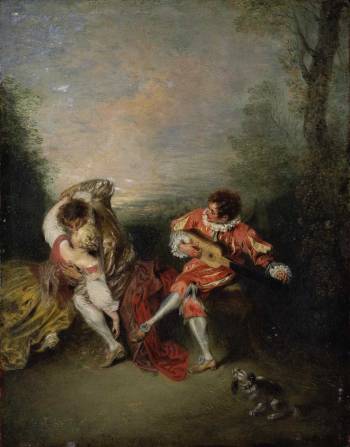
Jean Antoine Watteau, La Surprise, ca. 1718; oil on panel, 36 × 28 cm (Los Angeles: The Getty Museum).
The J. Paul Getty Museum announced today the most important acquisition in the history of the Museum’s Department of Drawings. Acquired as a group from a British private collection, the 16 drawings are by many of the greatest artists of western art history, including Michelangelo, Lorenzo di Credi, Andrea del Sarto, Parmigianino, Rubens, Barocci, Goya, Degas, and others. From the same collection, the Museum has acquired a celebrated painting by the great eighteenth-century French artist Jean Antoine Watteau.
“This acquisition is truly a transformative event in the history of the Getty Museum,” said Timothy Potts, director of the J. Paul Getty Museum. “It brings into our collection many of the finest drawings of the Renaissance through 19th century that have come to market over the past 30 years, including a number of masterpieces that are among the most famous works on paper by these artists: Michelangelo’s Study of a Mourning Woman, Parmigianino’s Head of a Young Man, and Andrea del Sarto’s Study for the Head of St Joseph (the highlight of the Getty’s recent exhibition on that artist). It is very unlikely that there will ever be another opportunity to elevate so significantly our representation of these artists, and, more importantly, the status of the Getty collection overall.”
“Beyond the core of Renaissance through Rococo works, our modern holdings too are magnificently enhanced by one of Goya’s late, bizarre subjects, The Eagle Hunter, and Degas’s majestic pastel After the Bath (Woman Drying Herself).”
Potts added, “No less exciting for the Department of Paintings is the addition of one of Watteau’s most famous and canonical works, La Surprise. It was indeed a very welcome surprise when this lost masterpiece reappeared ten years ago in Britain. And one can see why: the act of seduction portrayed in the painting is matched only by the artist’s delicately flickering brushwork—the combination of titillating subject and charming rendition that made him the most esteemed painter of his day. It will be very much at home at the Getty, where it crowns our other exceptional eighteenth-century French paintings by Lancret, Chardin, Greuze, Fragonard, and Boucher.”
La Surprise is a fête galante, a popular genre depicting outdoor revelry that Watteau invented and which epitomizes the light-hearted spirit of French painting in the early eighteenth century. The scene features a young woman and man in passionate embrace seemingly oblivious to the musician seated next to them. He is Mezzetin, the trouble maker, a stock comic character from the commedia dell’arte. Throughout Watteau’s short but illustrious career—he died when he was only 27 years old—the characters of the commedia dell’arte figured prominently in his paintings, often mingling with elegant contemporary figures in a park or landscape.
Highly admired in the eighteenth century, the painting was thought lost and for centuries was known to art historians only from a 1731 engraving and a copy in the British Royal Collection. In 2007 it was found in an English private collection, becoming the most important work by Watteau to be rediscovered in recent times.
“La Surprise exemplifies Watteau’s delightful pictorial inventions, brilliant brushwork, and refined, elegant compositions,” said Davide Gasparotto, senior curator of paintings at the Getty Museum. “It is undoubtedly one of the most exquisite and important Watteau paintings to become available in modern times. We are now able to present to the public a seminal genre of French eighteenth-century painting in a masterwork by its inventor. La Surprise will no doubt become one of our most beloved and recognizable paintings.”
The painting and all of the 16 drawings were purchased as a group from a British private collection. The drawings are mostly Italian but there are also exceptional works by British, Dutch, Flemish, French, and Spanish artists. A nucleus of Italian Renaissance works anchors the group, including a rare and beautiful ‘cartoon’ (full-sized direct transfer drawing for a painting) by Lorenzo di Credi; one of Andrea del Sarto’s finest drawings (from the collection of artist-writer Giorgio Vasari); and Michelangelo’s powerful pen and ink study of a mourning woman, a famous discovery made at Castle Howard, England in 2000.
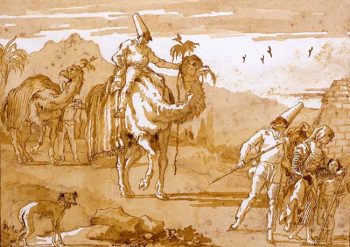
Giovanni Domenico Tiepolo, Punchinello Riding a Camel at the Head of a Caravan, late 1790s (Los Angeles: The Getty Museum).
Other highlights include Parmigianino’s ink drawing of the head of a young man; Savoldo’s Study for St Peter; Beccafumi’s Head of a Youth; and Sebastiano del Piombo’s Study for the Figure of Christ Carrying the Cross. From the post-Renaissance period, the collection features Barocci’s masterful Head Study of St Joseph; Rubens’s powerful oil-on-paper Study of an African Man Wearing a Turban; Cuyp’s panoramic View of Dordrecht, one of the great landscape drawings of the Dutch Golden Age; and Giovanni Domenico Tiepolo’s Punchinello Riding a Camel at the Head of a Caravan, a brilliant example of the narrative mastery for which Tiepolo was admired.
Goya’s The Eagle Hunter, a darkly satirical brush and ink drawing depicts a hunter wearing a metal cooking pot for a helmet while precariously suspending himself over a cliff to try to snatch young eagles from a nest. Degas, arguably the greatest draftsman of the nineteenth century, is represented by two drawings, a sheet with two chalk studies of ballet dancers, used by the artist for no fewer than three paintings, and a large and startlingly bold pastel showing his unrivaled innovation in that medium.
“Any one of these sheets on its own is truly extraordinary and would be a worthy and meaningful acquisition for the Getty. Together, the 16 drawings form an unparalleled roll call of the ‘best of the best,’ with iconic sheets by some of the world’s most celebrated artists,” said Julian Brooks, senior curator of drawings at the Getty Museum. “This powerful group of works represent the finest aspects of Western art history captured on paper. I am eagerly anticipating sharing these masterworks with our visitors as well as our international scholarly and museum community.”
While the majority of works are currently at the Getty Museum, some are still pending export licenses from the U.K. Research on further drawings from the same collection, with a view to possible acquisition, is currently underway. Plans are also proceeding to display the group together at the Getty Museum in a special installation in the near future.
The 16 Drawings
• Study of a Mourning Woman, about 1500-05, by Michelangelo Buonarroti (Italian, 1475–1564)
• Head of a Young Boy Crowned with Laurel, about 1500-05, by Lorenzo di Credi (Italian, c. 1457–1537)
• Heads of Two Dominican Friars, about 1511, by Fra Bartolommeo (Italian, 1472–1517)
• Study for the Head of Saint Joseph, about 1526–27, Andrea del Sarto (Italian, 1486–1530)
• Study for the Figure of Christ Carrying the Cross, about 1513–14, by Sebastiano del Piombo (c. 1485–1547)
• The Head of a Young Man, about 1539–40, by Parmigianino (Girolamo Francesco Maria Mazzola) (Italian, 1503–1540)
• Head of a Youth, about 1530, by Domenico Beccafumi (Italian, 1484–1551)
• Study for Saint Peter, about 1533, by Giovanni Girolamo Savoldo (Italian, c. 1480–1540)
• Head of Saint Joseph, about 1586, by Federico Barocci (Italian, c. 1535–1612)
• Head of an African Man Wearing a Turban, about 1609–13, by Peter Paul Rubens (Flemish, 1577–1640)
• Panoramic View of Dordrecht and the River Maas, about 1645–52, by Aelbert Cuyp (Dutch, 1620–1692)
• Punchinello Riding a Camel at the Head of a Caravan, late 1790s, by Giovanni Domenico Tiepolo (Italian, 1727–1804)
• The Eagle Hunter, about 1812–20, by Francisco Jose de Goya y Lucientes (Spanish, 1746–1828)
• The Destruction of Pharaoh’s Host, 1836, by John Martin (British, 1789–1854)
• Two Studies of Dancers, about 1873, by Edgar Degas (French, 1834–1917)
• After the Bath (Woman Drying Herself), about 1886, by Edgar Degas (French, 1834–1917)










 Enfilade
leave a comment