Thomas Campbell Receives Getty/Rothschild Fellowship
Press release (27 July 2017) from The Getty:
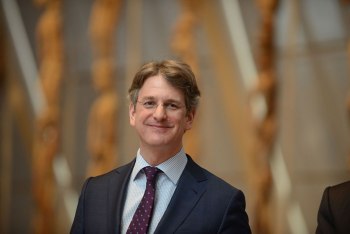 The Getty and the Rothschild Foundation today announced Dr. Thomas P. Campbell as the second recipient of the Getty Rothschild Fellowship. The fellowship supports innovative scholarship in the history of art, collecting, and conservation, using the collection and resources of both institutions. It offers art historians, museum professionals, or conservators the opportunity to research and study at both the Getty in Los Angeles and Waddesdon Manor in Buckinghamshire, England.
As the ninth director of The Metropolitan Museum of Art from 2009 to 2017, Campbell pursued a groundbreaking agenda that combined scholarship with accessibility. He reinforced the Museum’s excellence in its collections, exhibitions, publications and international engagement while reimagining the visitor experience both in the galleries and via an industry-leading digital presence. During his tenure, the museum increased its audience by 40%. His project for the Getty Rothschild fellowship will focus on the changing environment in which museums are operating and the ways art and cultural heritage can be used to promote mutual understanding.
The selection process for the Getty Rothschild fellowship considers a number of criteria, including whether the applicant’s work would benefit from proximity to the Getty and Rothschild collections. Fellowships are for up to eight months, with the time split equally between the Getty and Waddesdon Manor. Campbell will be at the Getty from November 2017 to February 2018 and at Waddesdon Manor from March to June 2018. Fellows also receive a stipend during their time at both locations. The fellowship is administered by the Getty Foundation.
Campbell says of his selection for the fellowship: “I am honored to be named a Getty/Rothschild fellow and to be given the opportunity to devote the coming year to examine, first, the fundamental question of where the cultural sector is heading as it responds to various geo-political, economic and digital challenges. And second, the related question of how we can use art and culture as a gateway to promote understanding in an ever-more connected but ever-more divided world.”
The inaugural recipient of the fellowship was Dr. David Saunders, a foremost expert in the area of conservation science who worked on museum and gallery lighting during the fellowship. In 2014, Lord Jacob Rothschild received the Getty Medal for his contributions to the practice, understanding, and support of the arts.
New Book | The Prince of Antiquarians: Francesco de Ficoroni
Available from ArtBooks.com:
Ronald Ridley, The Prince of Antiquarians: Francesco de Ficoroni (Rome: Quasar, 2017), 300 pages, ISBN: 978 887140 7753, 36€ / $55.
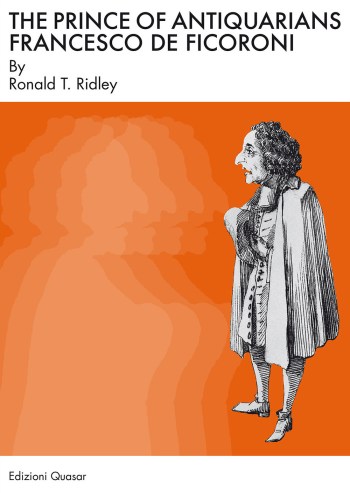 In all the literature on Rome in the eighteenth century, a figure is constantly—but fleetingly—mentioned: (Francesco di) Ficoroni. It is time to restore him to his rightful place, namely as the leading antiquarian in Rome of his age (1662–1747). He is the author of many books on his collections, and more than 500 of his letters survive, showing him as a central figure in the antiquarian life of Europe in the first half of the century, relied on by aristocrats, Church figures, and collectors. He was the leading cicerone (guide) to the early visitors of the Grand Tour. The richness and importance of his life are here revealed for the first time.
Ronald T. Ridley retired from University of Melbourne in 2005. He is the author of numerous books, including Napoleon’s Proconsul in Egypt, The Eagle and the Spade, and The Emperor’s Retrospect. He is a Fellow of the Antiquaries’ Society, the Royal Historical Society, the Pontifical Academy of Roman Archaeology, and the Australian Academy of the Humanities.
Exhibition | Morgan: Mind of the Collector
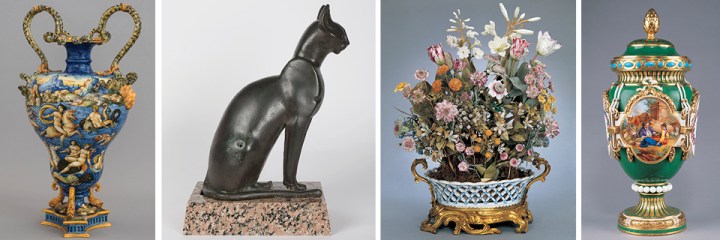
On this fall at the Wadsworth Atheneum:
Morgan: Mind of the Collector
Wadsworth Atheneum Museum of Art, Hartford, CT, 23 September — 31 December 2017
Nearly 100 years ago, the Wadsworth Atheneum received an extraordinary gift of more than 1,350 works of art from the collection of financier J. Pierpont Morgan. These objects, an array of 18th century German and French porcelains, Italian majolica, baroque goldsmith’s work and glass, and a small group of antiquities, now form the core of the museum’s European decorative arts collection.
Morgan’s story as a collector is not as well known as the story of his business career despite the groundbreaking quantity, scope, and character of his collection. Estimated to have exceeded 20,000 works of art assembled in only 23 years, the quality of the collection was remarkably high—a great achievement at a time when scholarship was young and fakery rampant.
Pierpont began to seriously collect art after his father’s death in 1890, and by 1907 he was devoting most of his time to building collections for himself and for institutions. Simultaneously, Morgan’s extensive philanthropies invigorated and reshaped a number of fledgling public institutions like the Metropolitan Museum, the Museum of Natural History, and the Wadsworth Atheneum Museum of Art.
Morgan: Mind of the Collector explores Pierpont’s groundbreaking collecting career through its impact on art scholarship, the art market, and the redefining of collecting in American and European culture. Profiling what he collected and how, the exhibition assesses this remarkable man and his colossal achievement with fresh eyes and the distance of a century. Was he a cultural super-hero, a ransacking barbarian, or something more nuanced? Featuring stellar works of art from the Wadsworth Atheneum, the Metropolitan Museum of Art, and the Morgan Library, this exhibition tells a variety of illuminating stories about J. Pierpont Morgan as a collector, delving into his mind and exploring his enduring legacy.
Conference | Morgan: Mind of the Collector
From H-ArtHist:
Morgan: Mind of the Collector
Wadsworth Atheneum Museum of Art, Hartford, CT, 10–11 November 2017
J. Pierpont Morgan (1837–1913) spent over twenty years traveling the globe to amass the largest collection of art and cultural artifacts of his time. Estimated to have exceeded 20,000 works of art, Morgan’s collections represent a broad historical and geographic range of art and cultural artifacts. Acting on his father’s wishes, J.P. Morgan’s son, Jack, donated more than 1,350 works collected by his father to the Wadsworth Atheneum in his native Hartford. In fall 2017, the Wadsworth Atheneum will mark the centennial anniversary of Morgan’s gift and its historical impact with an exhibition, Morgan: Mind of the Collector. The Wadsworth Atheneum will host an international symposium in conjunction with the exhibition to reexamine and showcase the latest research about Morgan’s collection and how he shaped the identity of the collector in the modern age.
For more information or to register, please contact faculty@wadsworthatheneum.org. Hotel discounts are available for the attendees of the conference at the Hartford Marriott Downtown.
F R I D A Y , 1 0 N O V E M B E R 2 0 1 7
12:00 Registration
1:15 Introduction
• Neil Harris (University of Chicago), Morgan the Collector
1:45 1 | Morgan and the Biblical Lands (chair, Steven Tinney, University of Pennsylvania)
• Yelena Rakic (Metropolitan Museum of Art, New York), Discovering the Ancient Near East
• Lyle Humphrey (North Carolina Museum of Art, Raleigh), Morgan in Egypt
• John Bidwell (Morgan Library & Museum, New York), Morgan’s Bibles
3:30 Break
3:45 2 | The Romance of History (chair, Christine Brennan, Metropolitan Museum of Art)
• Christine Brennan (Metropolitan Museum of Art, New York), Morgan and Medieval Art
• Roger Wieck (Morgan Library & Museum, New York), Morgan and Manuscripts
5:15 Exhibition Viewing and Reception
6:30 Speakers’ Dinner
S A T U R D A Y , 1 1 N O V E M B E R 2 0 1 7
10:00 3 | Building a Beautiful Life (chair, Colin Bailey, Morgan Library & Museum)
• Wolfram Koeppe (Metropolitan Museum of Art, New York), Gold and Garnets: A Love of Precious Objects
• Linda Roth (Wadsworth Atheneum Museum of Art, Hartford), Prince’s Gate, London
• Alice Cooney Frelinghuysen (Metropolitan Museum of Art, New York), From Gilded Age Interior to Renaissance Palazzo: Morgan’s New York House
12:00 Lunch
1:00 4 | The Politics of Collecting: The Global Network (chair, Inge Reist, Center for the History of Collecting at the Frick Collection)
• Catherine Scallen (Case Western Reserve University, Cleveland), Turning to the Experts
• Jennifer Tonkovich (Morgan Library & Museum, New York), Morgan’s Experts and Dealers in London and Europe
• Barbara Pezzini (National Gallery, London), Collecting British Paintings
3:00 Break
3:15 5 | Crafting a Legacy (chair, Jennifer Tonkovich, Morgan Library & Museum)
• Charlotte Vignon (Frick Collection, New York), Morgan and Duveen: The Formation and Dispersal of a Collection
• Jo Briggs (Walters Art Gallery, Baltimore), Morgan and His Fellow American Collectors
5:00 Reception and Exhibition Viewing
Call for Papers | Collage, Montage, Assemblage, 1700–Present
From the conference website:
Collage, Montage, Assemblage: Collected and Composite Forms, 1700–Present
University of Edinburgh, 18–19 April 2018
Proposals due by 1 December 2017
This two-day multidisciplinary conference will explore the medium of collage across an unprecedentedly broad chronological range, considering its production and consumption over a period of more than three hundred years. While research on paper collage plays a key role in histories of modern art, particularly of the 1920s and 1930s, its longer history and diverse range of manifestations are often overlooked within art historical scholarship. Though important work is being done on collage at both the level of the individual work and the medium more broadly, this has often overlooked collage’s multitudinous forms and assorted temporal variants. This conference accordingly aims to tackle this oversight by thinking about collage across history, medium, and discipline. Employing an inclusive definition of the term, the conference invites papers discussing a variety of material, literary, and musical forms of collage, including traditional papier collé alongside practices such as writing, making music and commonplacing, and the production of composite objects such as grangerized texts, decoupage, quilts, shellwork, scrapbooks, assemblage, and photomontage.
In so doing, the conference will situate histories of modernist collage in relation to a much broader range of cultural practices, allowing for productive parallels to be drawn between the cultural productions of periods that are often subject to rigid chronological divisions. Reciprocally, the conference will encourage a consideration of collage made in the eighteenth and nineteenth centuries against key concepts and methodologies from the study of modernism and postmodernism, such as the objet trouvé or assemblage. From papier collé to the digital age, the conference will highlight collage’s rich history and crucial role in cultural production over the last three hundred years.
We invite contributions from scholars working in the fields of art history, history, music, material culture studies, and literature. We also welcome and encourage papers from practitioners working in any medium whose practice is influenced by collage, assemblage, and/or montage. Potential topics could include, but are not limited to
• Collage as medium
• Collage, assemblage, montage: terminologies and categories
• Defining/redefining collage
• Making/viewing collage
• Collage and identity
• Collage and intention: chance, agency, intentionality
• Collage and the modern/pre-modern/postmodern
• Collage in art historical writing/literary criticism
• Object biographies
• Collage as political tool
• Collage in space
• Collage in the digital age
• Collage and collaboration
• Processes: collecting, collating, compiling, combining
• Collage in/as music
• Writing/reading collage
• Collage and geography
Please send abstracts of no more than 300 words, and biographies of no more than 100 words, to Cole Collins and Freya Gowrley at collage.assemblage.montage@gmail.com by 1 December 2017.
The conference is supported by Edinburgh College of Art’s Dada and Surrealist Research Group with the University of Edinburgh’s Institute for Advance Studies in the Humanities. For further information, please contact the above email address; check out our website; or follow us on Twitter for updates @Collage_Conf.
New Book | Cerimoniale dei Borbone di Napoli
Available from ArtBooks.com:
Attilio Antonelli, ed., Cerimoniale dei Borbone di Napoli, 1734–1801 (Naples: Arte’m, 2017), 560 pages, ISBN: 9788 85690 5595, 65€ / $100.
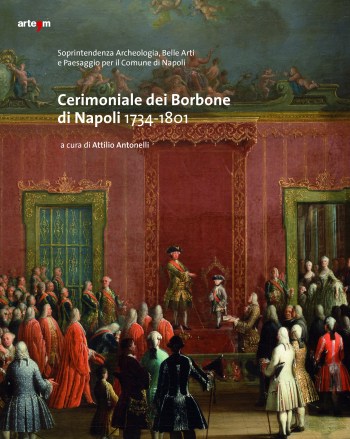 Quarto volume della collana, esemplare per rigore filologico e ricchezza degli apparati iconografici, dedicata ai cerimoniali della corte di Napoli, dato alle stampe in occasione del terzo centenario della nascita di Carlo di Borbone. Arricchito da una magistrale introduzione di Raffaele Ajello, il volume—corredato di saggi, illustrazioni, note e apparati corposi—presenta due manoscritti che illustrano la vita di corte nell’arco della lunga parabola del nuovo regno: dall’arrivo di Carlo nel 1734 fino alla sua partenza nel 1759, quando meriterà una nuova corona, quella di re di Spagna. Accanto a Carlo, le figure della moglie Maria Amalia di Sassonia e del ministro Bernardo Tanucci. Il ritorno di Ferdinando di Borbone da Palermo a Napoli nel 1801 segna il momento conclusivo della cronaca cerimoniale.
The Burlington Magazine, July 2017
The eighteenth century in The Burlington:
The Burlington Magazine 159 (July 2017), Decorative Arts

E D I T O R I A L
• “Furniture History: The Digital Future,” p. 519.
On the eve of the 300th anniversary of the birth of Thomas Chippendale in 2018, the editorial addresses the British and Irish Furniture Makers Online Project (BIFMO), which updates the The Dictionary of English Furniture Makers 1660–1840, edited by Geoffrey Beard and Christopher Gilbert and published by the Furniture History Society in 1986. The BIFMO—a collaboration between the FHS and the Centre for Metropolitan History (CMH) at the Institute of Historical Research, University of London—is an open-access searchable database of all the entries from The Dictionary, together with the names of furniture makers from Laurie Lindey’s recent PhD thesis (Lindey, as a post-doctoral research fellow is overseeing the project at the IHR with Mark Merry of the CMH). The first phase of the BIFMO’s launch is scheduled for 30 September.
A R T I C L E S
• Koenraad Brosens and Astrid Slegten, “Creativity and Disruption in Brussels Tapestry, 1698–1706: New Data on Jan van Orley and Judocus de Vos,” pp. 528–35.
• Francesco Morena, “The Emperor of Mexico’s Screen: Maximilian I’s ‘Biombo’ in Trieste,” pp. 536–43.
R E V I E W S
• Simonetta Prosperi Valenti Rodinò, Review of Sabina de Cavi, ed., Dibujos y ornamento: Trazas y Dibujos de Artes decorativas entre Portugal, España, Italia, Malta y Grecia: Estudio en honor de Fuensanta García de la Torre (De Luca Editori d’Arte, 2015), pp. 559–60.
• Pierre Terjanian, Review of A. V. B. Norman and Ian Eaves, Arms & Armour in the Collection of Her Majesty The Queen, European Armour (Royal Collection Trust, 2016),” pp. 560–61.
• Robin Hildyard, Review of Brian Gallagher, Barbara Stone Perry, Letitia Roberts, Diana Edwards, Pat Halfpenny, Maurice Hillis and Margaret Ferris Zimmerman, British Ceramics, 1675–1825: The Mint Museum (D. Giles, 2015), pp. 561–62.
• Gauvin Alexander Bailey, Review of Christopher M.S. Johns, China and the Church: Chinoiserie in Global Context (University of California Press, 2016) and Marco Musillo, The Shining Inheritance: Italian Painters at the Qing Court, 1699–1812 (Getty Publications, 2016),” pp. 562–63.
• Philippa Glanville, Review of James Rothwell, Silver for Entertaining: The Ickworth Collection (Philip Wilson, 2017), pp. 563–64.
• Humphrey Wine, Review of the exhibition Le Baroque des Lumières: Chefs-d’œuvre des églises parisiennes au XVIIIe siècle (Paris: Petit Palais, 2017), pp. 572–73.
• Patrick Bade, Review of the exhibition La Quête de la ligne: Trois siècles de dessin en Allemagne (Hamburg: Kunsthalle, 2016 and Paris: Fondation Custodia, 2017), pp. 574–75.
• Jamie Mulherron, Review of the exhibition Marie Madeleine: La Passion révélée (Bourg-en-Bresse: Monastère Royal de Brou; Carcassonne: Musée des Beaux Arts; and Douai: Musée de la Chartreuse, 2017), pp. 577–79.
• Elsje van Kessel, Review of the newly refurbished gallery of Portuguese painting and sculpture at the Museu Nacional de Arte Antiga (MNAA), pp. 579–80.
• Philippe Bordes, Review of the exhibition Charles Percier: Architecture and Design in an Age of Revolutions (New York, Bard Graduate Center Gallery; and Château de Fontainebleau, 2016–17), pp. 583–84.
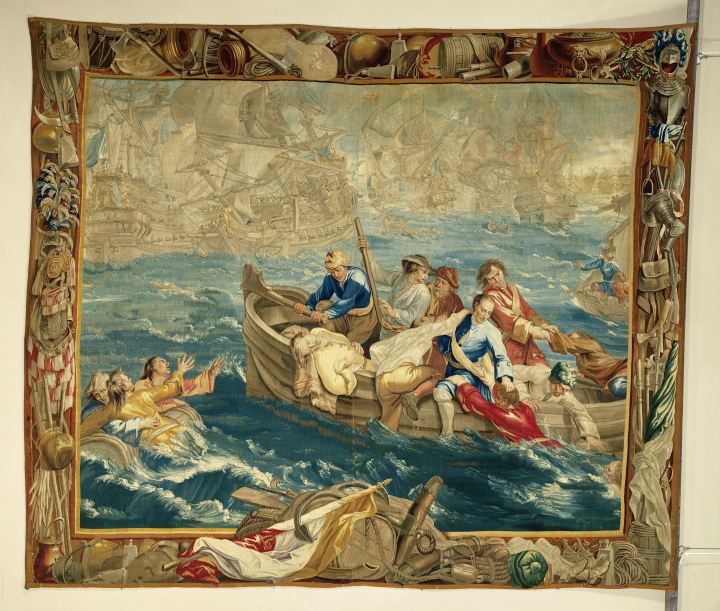
Judocus de Vos, after Lambert de Hondt, Lucas Achtschellinck, and Jan van Orley, Naval Battle from the Art of War series, ca. 1715–20; wool and silk, 344 × 400 cm (Amsterdam: Rijksmuseum).
New Book | Pour la plus grande gloire du roi: Louis XIV en thèses
As Pierre-Henri Biger notes on his Facebook page (with thanks to him for forwarding the notice for publication here at Enfilade) . . .
Comment réaliser des ouvrages traitant de l’Art abondamment illustrés et savants sans qu’ils coûtent une fortune ? Cela les écarte de leur public, car les savants sont rarement riches, et les riches rarement savants dans ce domaine. Mme Véronique Meyer, qui me fit l’honneur d’être membre de mon jury de thèse (et donné le plaisir de lire son élogieux pré-rapport) a élégamment, intelligemment et généreusement résolu le problème. Pour accompagner l’ouvrage Pour la plus grande gloire du Roi qu’elle publie aux Presses Universitaires de Rennes, elle met en ligne un impressionnant catalogue, plein d’images de thèses à la gloire de Louis XIV et de commentaires détaillés. Et ce document a vocation à s’enrichir. Bravo, Madame (et bravo aux PUR et au Centre de Recherches du Château de Versailles) !
From PUR:
Véronique Meyer, Pour la plus grande gloire du roi: Louis XIV en thèses (Rennes: Presses Universitaires de Rennes, 2017), 372 pages, ISBN: 978 27535 54641, 23€.
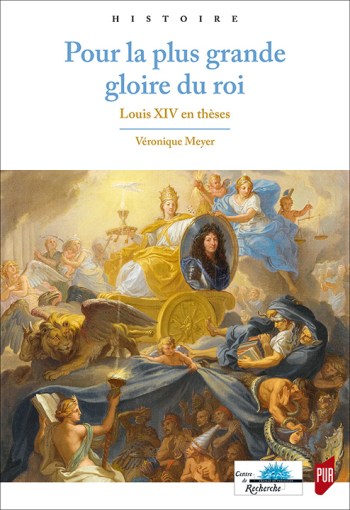 C’est au xviie siècle en France que la thèse illustrée connaît son apogée. À l’exemple de Richelieu et de Mazarin, Louis XIV accorda aux thèses une place de choix dans la di usion de son image. De 1638 à 1704, plus de 130 thèses de philosophie, théologie, droit et médecine lui furent dédiées. Même si certaines sont destinées à son père, à sa mère ou aux parlements de province, il apparaît en haut de l’a che en personne ou par ses armoiries. Les étudiants étaient issus de l’entourage royal, ls de ministres ou de parlementaires, membres de congrégations religieuses, et quelquefois même étrangers. Courtisans, parlementaires et ecclésiastiques de haut rang participaient à la soutenance publique où le candidat et sa famille adressaient des éloges au roi. On y distribuait des a ches ornées de son portrait ou d’une allégorie à sa gloire exécutées par les meilleurs artistes du temps, aussi les dépenses engagées étaient-elles considérables. Soutenues à Paris, mais également en province et à l’étranger, les thèses, et avec elles l’image du roi, pénétraient les demeures des Français et se di usaient à l’extérieur du royaume. Cet ouvrage décrit successivement la place des thèses dans le cursus universitaire, leur soutenance, leur dédicace et leur di usion ainsi que l’élaboration de leurs illustrations, en insistant sur le rôle des peintres, graveurs et éditeurs. Il montre comment elles rendent compte de l’histoire du roi et de l’évolution de son portrait physique et moral. Ce volume est accompagné d’un catalogue raisonné, abondamment illustré, des thèses dédiées au roi, consultable sur les sites du Centre de recherche du château de Versailles et des Presses universitaires de Rennes.
Veronique Meyer, professeur d’histoire de l’art à l’université de Poitiers, est spécialiste de l’estampe à l’époque moderne. Elle a publié notamment avec la Commission des travaux historiques de la Ville de Paris L’illustration des thèses à Paris dans la seconde moitié du xviie siècle. Peintres, graveurs, éditeurs (2002) et L’œuvre gravé de Gilles Rousselet (2004), et participé à l’exposition Images du Grand Siècle. L’estampe française au temps de Louis XIV (1660–1715), (Bnf-Getty Research Institute, 2015–16).
T A B L E D E S M A T I È R E S
Remerciements
Avertissement
Introduction
Première partie: LA THÈSE : L’UNIVERSITÉ, LE CANDIDAT ET LE DÉDICATAIRE
1 Les thèses dans le cursus universitaire
La faculté des arts
La faculté de théologie
La faculté de médecine et de pharmacie
La faculté de droit
2 La soutenance
Les candidats
L’invitation à la soutenance
Le décor de la salle: tapisseries et tentures
Le dais et le portrait du roi
Le public
Protocole et préséance
Panégyriques, harangues et odes
3 L’illustration des thèses
Le placard et le livret
La dédicace et ses raisons d’être
Les cadres
La réception
Deuxième partie: ÉLABORATION, DIFFUSION, RÉCEPTION
4 Les peintres
Charles Le Brun
Pierre Mignard
Nicolas Mignard
Pierre-Paul Sevin
Antoine Paillet
5 Les graveurs
Les portraitistes
Les graveurs d’histoire
Les graveurs en lettres
6 Contrats et dépenses
Le prix des gravures
Diffusion et réutilisation
Troisième partie: LE ROI, SON HISTOIRE ET SON PORTRAIT
7 L’histoire du roi
De la naissance au règne personnel, 1638–1660
Célébration du roi en province et à l’étranger, 1649–1653
Vers l’affirmation du pouvoir royal, 1653–1660
Le pouvoir personnel : le roi triomphant, 1661–1715
8 Le portrait du roi
Le portrait physique : du visage au costume
Le portrait moral dans les sujets d’histoire : l’allégorie et l’emblème
Les vertus
Le portrait en buste : attributs et symboles
Conclusion
Abréviations
Table des thèses dédiées au roi
Annexe : table des thèses dédiées à la famille royale, aux fils légitimés de Louis XIV et aux favorites
Sources et bibliographie
Table de concordance
Table des illustrations
Crédits photographiques
Index des noms de personnes
More information about the online Catalogue des theses dediees à Louis XIV is available here»
Exhibition | Mary Magdalen: Passion Revealed

Laurent Pécheux, Penitent St Mary Magdalene, 1768, oil on canvas
(Lyon: Galerie Michel Descours)
◊ ◊ ◊ ◊ ◊
Now on view at the Musée de la Chartreuse:
Marie Madeleine: La Passion Révélée
Monastère Royal de Brou, Bourg-en-Bresse, 29 October 2016 — 5 February 2017
Musée des Beaux Arts, Carcassonne, 24 February — 24 May 2017
Musée de la Chartreuse, Douai, 17 June — 24 September 2017
Intercesseur majeur entre le terrestre et le céleste, pécheresse et repentante, voluptueuse et ascète, mondaine et ermite, Marie Madeleine est à la fois inclassable et mystique. Synthèse de trois figures féminines qui apparaissent dans les Évangiles, elle a inspiré de très nombreux artistes depuis l’époque médiévale jusqu’à nos jours. Ces derniers ont été sensibles aux mystères de cette femme et aux thèmes qui l’entourent : l’amour du péché, la féminité et le sacré. Tous ont été marqués par sa beauté, par l’évocation de sa solitude dans le désert ou encore par sa représentation en méditation ou en extase. Ce personnage biblique présente ainsi plusieurs facettes et chaque époque a inventé « sa » Madeleine : du XIIe siècle—quand le culte lié à ses reliques se développe et sa légende s’étoffe—jusqu’à notre époque contemporaine, où les amateurs de secrets et de mystères s’emparent du personnage et lui font porter leurs goûts pour l’ésotérisme, dont le Da Vinci Code de Dan Brown est un exemple retentissant. Dans cette exposition, peintures, sculptures et objets d’art retracent l’évolution de cette figure du Moyen Âge à nos jours, en mettant en lumière les différentes utilisations du personnage par les courants artistiques, spirituels et théologiques, tout en montrant comment chacun l’a adapté à ses aspirations.
Commissariat de l’exposition
Marie-Paule Botte, historienne de l’art ; Magali Briat-Philippe, conservatrice du patrimoine, responsable du service des patrimoines au Monastère Royal de Brou ; Pierre-Gilles Girault, administrateur du Monastère Royal de Brou ; Anne Labourdette, directrice du musée de la Chartreuse de Douai ; Marie-Noëlle Maynard, directrice du musée des Beaux-Arts de Carcassonne.
Bernard Ceysson, François Ceysson, Loïc Bénétière, Marie-Paule Botte, Magali Briat-Philippe, and Marie-Noëlle Maynard, Marie Madeleine: La Passion Révélée (Saint-Etienne: IAC Éditions d’Art, 2016), 220 pages, ISBN: 978 291637 3935, 25€.
New Book | Tin-Glazed Earthenware
Distributed by The University of Chicago Press:
Ulla Houkjær, Tin-Glazed Earthenware from the Netherlands, France, and Germany, 1600–1800 (Copenhagen: Museum Tusculanum Press, 2017), 415 pages, ISBN: 978 8763545 655, $75.
 Designmuseum Denmark is home to a large collection of ceramic works that is quite unique in terms of size and width of representation, since the collection covers all known techniques within the main groups of earthenware, stoneware, tin-glazed earthenware, and porcelain as well as new hybrid materials and techniques. This catalogue covers an extremely important period in the history of European glazed ceramic ware from c. 1600 to 1800 when the technique enjoyed the widest distribution. Ulla Houkjaer focuses on three central areas: the Netherlands, France, and Germany. This comprehensive and highly illustrated introduction to the history of tin-glazed earthenware in these three countries offers an overview of the history of important developments within the field during the period and highlights important changes in aesthetics and usage.
Ulla Houkjær is curator at Designmuseum Denmark. She is the author of Tim-Glazed Earthenware, 1300–1750: Spain, Italy, France.










 Enfilade
leave a comment