Conference | Early Modern Viewers and Buildings in Motion
From H-ArtHist:
Early Modern Viewers and Buildings in Motion
St. John’s College, University of Cambridge, 25 February 2017
Registration due by 12 February 2017
Movement, both literal and metaphorical, lies at the heart of early modern European architectural theory, design and experience. Architectural authors invoked the notion of progress as temporal motion, structured their books as tours of buildings, and followed the ancient Roman Vitruvius in explaining how to manipulate the motions of winds through building design. Simultaneously, poets led their readers on tours of house and estate, and Aristotelian as well as mechanistic philosophers averred that motion was inherent to human perception from particle vibrations in one’s senses to neural vibrations in one’s brain. Across a range of scales in actual lived experience, moreover, viewers and buildings were frequently in motion; people walked through built spaces, interiors contained portable furnishings, and travellers and prints circulated ideas of buildings internationally.
This conference seeks to examine the range of scales, media, and theoretical discussions which foreground early modern intersections of architecture and motion. In so doing, it both puts into motion the usually static viewer and building of historical narratives and merges often independent yet overlapping strands of analysis—for instance, the ‘mobile viewer’ studied by art historians Michael Baxandall and Svetlana Alpers and the tensions surrounding early modern globalization discussed by cultural historians. These and other strands of inquiry are brought together by an international, interdisciplinary group of speakers examining case studies encompassing England, France, Italy, German-speaking areas, and the New World during the fourteenth through nineteenth centuries.
Supported by St. John’s College, University of Cambridge and by the Institute of Advanced Study, the Institute of Medieval and Early Modern Studies, and the School of Modern Languages and Cultures, Durham University.
The fee, which includes lunch and refreshments, is £15. More information is available here»
P R O G R A M M E
9.30 Registration
10.00 Welcome | Frank Salmon (University of Cambridge) and Kimberley Skelton (Durham University)
10.05 Session 1 | Chair: Kimberley Skelton (Durham University)
• Allison Stielau (University College London), The Censer as Mobile Mini-Building, Swung Structure, and Producer of Olfactory Space
• Andrew Chen (University of Cambridge), Fourteenth-century Ascetic Imagery in a Staircase at Santa Maria della Scala, Siena
• Donal Cooper (University of Cambridge), Fleeting Visions: Occluded Altarpieces and Mobile Eyes in the Italian Renaissance Church Interior
11.30 Coffee
12.00 Session 2 | Chair: Frank Salmon (University of Cambridge)
• Stefano Cracolici (Durham University), The Poliphilo Syndrome
• Kimberley Skelton (Durham University), Sensory Vibrations and Social Reform at San Michele a Ripa in Rome
• Bram Van Oostveldt (University of Amsterdam/Leiden University), Frantic Memories and Excessive Objects: Monicart’s Versailles immortalisé ou les merveilles parlantes de Versailles (1720)
1.30 Lunch
2.30 Session 3 | Chair: Donal Cooper (University of Cambridge)
• Caroline van Eck (University of Cambridge), Moving through Space and Time: Immersive Spaces at the Hôtel de Beauharnais in Paris
• Edmund Thomas (Durham University), Movement Through Ruins: Re-experiencing the Antique in Eighteenth-Century Travelogues
• Rebecca Tropp (University of Cambridge), Movement and the Central Core: Design Principles in the Country Houses of John Nash
4.00 Tea
4.30 Session 4 | Chair: Stefano Cracolici (Durham University)
• Daniel Jütte (New York University/University of Cambridge), Entering the Early Modern City: Gates as Sites of Passage
• James Campbell (University of Cambridge), Libraries in Motion
• Emily Mann (University of Kent), From Ship to Shore: The Architecture of Early Modern Trading Companies
6.00 Wine Reception
Call for Papers | The Street and the City: Thresholds
From the conference website:
The Street and the City: Thresholds
University of Lisbon, 5–7 April 2017
The Street and the City: Thresholds is the second of a series of multidisciplinary conferences with special emphasis on cities and the life that has evolved around them through time. Although English studies play a central role in this conference series from both cultural and geographical points of view, other fields of study relating to the conference theme are welcome. The first International Conference The Street and the City: Awakenings drew participants from a wide array of disciplines, such as literature, architecture, sociology, tourism or gender studies, to name but a few. This second conference aims for a comprehensive view of the street and the city focusing on its streets and people as well as on its less known spaces and hidden gems.
Throughout the centuries cities have been hubs of cultural experience and exchange, bringing people together time and again. The streets have been the public space where peoples and individuals both merge in a web and are isolated in the crowd. Cities have also channelled the voices of unsatisfied or rebellious citizens in periods of crises, or become a platform for gathering collective support in dire moments. In times of such conflicts, cities open up spaces for hope and multicultural dialogue. Such dynamics and challenges of an urban milieu constantly pose new questions to researchers concerning, for example, aspects of aesthetic and political representation, and the ways they are interpreted and experienced. Thus, studies of such currents and challenges have become highly diversified, promoting a variety of perspectives of the space we identify ourselves with.
Lisbon is the 2017 Ibero-American Capital of Culture, in the words of the City Council, an “event [which] will be the catalyst for a year of artistic innovation, in which there will be recognition of the historical processes and exchanges of ideas that underpin the relationships between European and American cities, and an acknowledgement of current artistic production, which is unique and intrinsically diverse.” In this sense, we wish to welcome everyone to share this urban atmosphere, which goes beyond the boundaries of Europe and connects the city in a global way.
The Second International Conference The Street and the City: Thresholds will take place at the School of Arts and Humanities, University of Lisbon, and at the Estoril Higher Institute for Tourism and Hotel Studies from 5 to 7 April 2017.
This scholarly meeting keeps its primary goal of fostering an interdisciplinary debate within English studies and of serving as a productive space for disseminating the most recent academic research alongside the studies of culture, urban studies and other fields of interest in relation to cities, their spaces and cultures. While encouraging the interchange of different academic perspectives, the Organising Committee also aims to promote informal networking gatherings among its participants. As such, topics and themes of interest—related to the Street and/or the City—include, but are not restricted to, the following:
• Aesthetic Representations of the City
• Cities as Havens of Hope or Despair
• Streets and Cities as Hives of Negotiation
• Gendered Urban Spaces
• Imagined Cities
• Literary Cities
• Mobility in the City and Urban Flows
• Streets, Consumerism and Fashion
• Sustainable Cities
• The City and Community Expressions
• The City and the Commons
• The Street and the Senses
• The Political Street
• The Tourist and the Flâneur
• Urban Cultural Heritage
• Urban Rhythms
We welcome suggestions for papers, pre-organised panels, and roundtables (20 minutes per speaker) by 28th February 2017, to be submitted on the conference webpage. Abstracts of 300 words for individual papers of twenty-minute duration. Please include the full title of your paper, name, institutional affiliation, contact information (postal address and e-mail address) and a bionote (max. 100 words).
Display | The First Inauguration
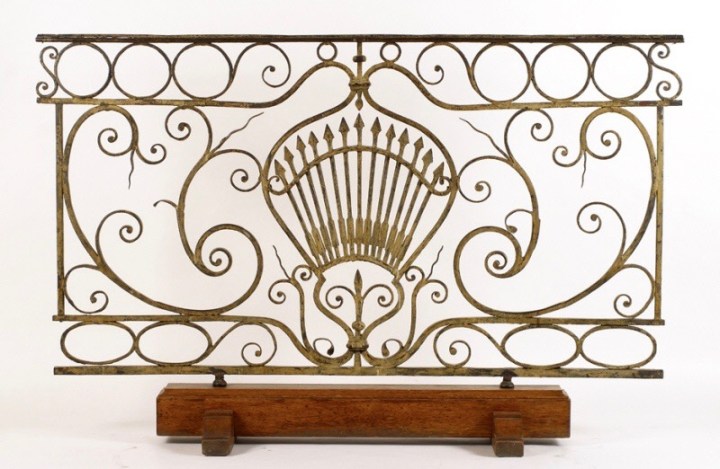
Balustrade Section from Federal Hall, New York, 1788–89, painted wrought iron, 95 × 178 × 4 cm (New York Historical Society, 1884.3). More information is available here»
◊ ◊ ◊ ◊ ◊
This installation is part of The Presidency Project at the New-York Historical Society:
The First Inauguration: George Washington’s 1789 Ceremony at Federal Hall
New-York Historical Society, 9 January — 26 February 2017
On April 30, 1789, George Washington was sworn in as president of the United States on the balcony of Federal Hall in lower Manhattan, uttering for the first time the words that every succeeding president would recite: “I do solemnly swear that I will faithfully execute the Office of President of the United States, and will to the best of my ability, preserve, protect, and defend the Constitution of the United States.” To mark the 2017 inauguration and as part of the The Presidency Project, the New-York Historical Society presents artifacts and documents linked to the nation’s first presidential inauguration. At its center, the installation showcases an original section of the wrought-iron railing from Federal Hall, a municipal building that was transformed by French architect Pierre-Charles L’Enfant into a suitable headquarters for the national government. L’Enfant adorned the facade with classical and patriotic motifs, including the railing’s thirteen arrows—one for each state in the republic.
This special installation also features an armchair used by George Washington in the Senate chamber of Federal Hall just after his swearing in. The storied armchair, designed in the latest neoclassical fashion, was later used for the inaugurations of Ulysses S. Grant and James A. Garfield. A printed broadside of Washington’s inaugural address is also on view.
Exhibition | Legacy: The Artist’s Album and Richard Cooper, Jr
From UCL Art Museum:
Legacy: The Artist’s Album and Richard Cooper Jnr
UCL Art Museum, London, 10 January — 9 June 2017
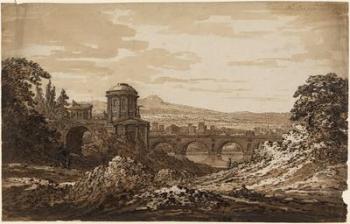
Richard Cooper Jr, Italian Landscape with Bridge, pen and brown ink with brown wash (London: UCL Art Museum 3751).
Legacy at UCL Art Museum features for the first time various artist’s albums by Richard Cooper, Jr (1740–1822). Cooper was a versatile and experimental artist, highly regarded by his contemporaries for his contributions to printmaking, draftsmanship, and art education. A true child of the Scottish enlightenment, Cooper worked in France, Spain, and Italy, where he was closely associated with the leading lights of his generation, including Jacob More, Gavin Hamilton, and Joseph Wright of Derby. Upon his return to London around 1777, he was celebrated for his capriccios or ‘invented views’ of the Roman Campagna, which he reproduced using the latest printmaking technologies. The contents of Cooper’s marbled-paper covered albums—carefully assembled with original prints and copy drawings—reveal the breadth of his involvement with the new techniques of lithography and soft-ground etching. They introduce Cooper as an innovative printmaker and highlight technological developments in printmaking that took place in the late eighteenth century.
In addition, the exhibition provides an opportunity to consider artists’ albums more broadly—how and why they are compiled and used and the role they can play in establishing a legacy. Also on display are more contemporary examples of the artist’s albums from our Slade Collections, including an album of discarded sketches by Augustus John, which was collected and assembled by fellow student Cuthbert Hamilton, as well as Stanley Spencer’s bound postcard collection. Also a feature of Legacy will be a changing display of contemporary innovations in printmaking by Phyllida Barlow, Bartolomeu dos Santos, Philip Sutton, and others.
P R O G R A M M I N G
Who Was Richard Cooper, Jr?
17 January 2017, 1:00–2:00
Richard Cooper, Jr was well regarded by his peers as a draughtsman, printmaker, drawing master, and antiques dealer; yet no thorough study of his life and work exists. Art dealer Tom Edwards tells us more about the artist and his influence.
Pop-up Exhibition: Printing Innovation at UCL
1 February 2017, 1:00–5:00
UCL Art Museum’s volunteers put together a pop-up exhibition of highlights from the collection with a focus on printing innovation at the Slade School of Art.
Innovation in Printmaking
15 February 2017, 1:00–2:00
Come and learn about innovation in printmaking at UCL Art Museum directly from the artists.
Liz Rideal on Rome and the Campagna
28 February 2017, 1:00–2:00
Artist and Slade lecturer Liz Rideal talks about her Leverhume research project to create images, curate period photographs, and organise these into an interactive digital map of Rome and the Campagna in relation to the Legacy exhibition.
Call for Papers | Source: Notes in the History of Art
Source: Notes in the History of Art
We welcome essays on art from any period or geographical area of interest. Our concise format—up to 2500 words and 3 illustrations—is perfect for introducing fresh interpretations, discoveries, and speculations, resolving old points of dispute, and bringing new ones to light.
Source was founded in 1981 as a scholarly journal in art history. Its mission is to publish articles of 2500 words or less, accompanied by a maximum of three illustrations. The range of articles spans antiquity to the present and includes western and non-western art. The original premise has been borne out: there is an audience for scholarly articles in art history that are clearly written, adequately illustrated, and above all, succinct. Furthermore, scholars welcome having a forum to present ideas and speculations that don’t warrant a major treatise but might nevertheless make interesting ‘notes’ for specialists and non-specialists alike.
Manuscripts may be submitted in English, French, or German. Please note that French, German, or other foreign-language submissions take more time to review, and so even a draft English translation is preferable.
More information is available here»
Editor: John Cunnally
Sponsored by the Bard Graduate Center, New York
Lady Liberty Looks Better Than Ever
This is my first time to publish a press release (12 January 2017) from the United State Mint, and I’m afraid it reads like a government press release. But oh, the news! I especially like the headline from The New York Times, “The Coin? Gold. Its ‘Real Value’? Lady Liberty Is Black.”
Those familiar words of Dr. Martin Luther King now probe another layer of meaning, at the intersection not only of economics and justice, but also currency and representation: “But we refuse to believe that the bank of justice is bankrupt. We refuse to believe that there are insufficient funds in the great vaults of opportunity of this nation. And so, we’ve come to cash this check, a check that will give us upon demand the riches of freedom and the security of justice.” –CH

Designed by Justin Kunz and sculpted by Phebe Hemphill, 2017 American Liberty 225th Anniversary Gold Coin.
Treasury Secretary Jacob Lew, Deputy Treasury Secretary Sarah Bloom Raskin, and United States Mint (Mint) Principal Deputy Director Rhett Jeppson today unveiled designs for the 2017 American Liberty 225th Anniversary Gold Coin in the historic Department of the Treasury’s Cash Room. The ceremony, led by Mint Chief of Staff Elisa Basnight, kicked off a year-long series of events in celebration of the Mint’s 225th anniversary in 2017.
“We are very proud of the fact that the United States Mint is rooted in the Constitution,” said Principal Deputy Director Jeppson. “Our founding fathers realized the critical need for our fledgling nation to have a respected monetary system, and over the last 225 years, the Mint has never failed in its mission.”
The 2017 American Liberty 225th Anniversary Gold Coin design is unique in that it portrays Liberty as an African-American woman, a departure from previous classic designs. The obverse (heads) design depicts a profile of Liberty wearing a crown of stars, with the inscriptions: ‘LIBERTY’, ‘1792’, ‘2017’, and ‘IN GOD WE TRUST’. The reverse (tails) design depicts a bold and powerful eagle in flight, with eyes toward opportunity and a determination to attain it. Inscriptions include ‘UNITED STATES OF AMERICA’, ‘E PLURIBUS UNUM’, ‘1OZ. .9999 FINE GOLD’, and ‘100 DOLLARS’. The obverse was designed by Mint Artistic Infusion Program (AIP) Designer Justin Kunz and sculpted by Mint Sculptor-Engraver Phebe Hemphill, while the reverse was designed by AIP Designer Chris Costello and sculpted by Mint Sculptor-Engraver Michael Gaudioso.
The 2017 American Liberty 225th Anniversary Gold Coin will be struck in .9999 fine 24-karat gold at the West Point Mint in high relief, with a proof finish. The one-ounce coin will be encapsulated and placed in a custom designed, black wood presentation case. A 225th anniversary booklet with certificate of authenticity will accompany each coin.
The 2017 American Liberty 225th Anniversary Gold Coin is the first in a series of 24-karat gold coins that will feature designs which depict an allegorical Liberty in a variety of contemporary forms-including designs representing Asian-Americans, Hispanic-Americans, and Indian-Americans among others-to reflect the cultural and ethnic diversity of the United States. These 24-karat gold coins will be issued biennially. A corresponding series of medals struck in .999 silver, with the same designs featured on the gold coins, will also be available. The Mint will announce additional information about the 2017 American Liberty 225th Anniversary Gold Coin prior to its release on April 6.
New Book | Britannia: Icon on the Coin
From The Royal Mint (at Llantrisant, just outside of Cardiff), which incidentally just this past year opened to the public with a new visitor’s center.
Katharine Eustace, Britannia: Icon on the Coin (Llantrisant: The Royal Mint Museum, 2016), 144 pages, ISBN: 978 18699 17029, £35.
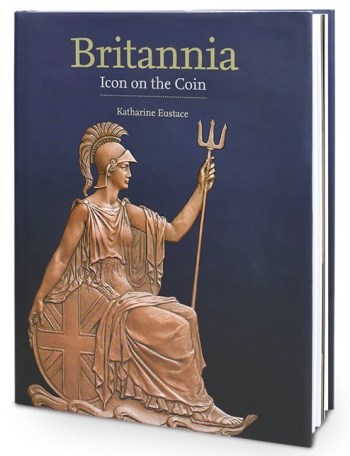 At a time when the idea of Britain is being debated more than ever, a book that reveals the rich history of British identity has been published. The story of Britannia on the coinage is also the story of Britain. Katharine Eustace charts Britannia’s history and explores the shifts in art and politics, technology and popular culture that have influenced the icon’s image. For two years, Eustace immersed herself in the subject of Britannia, and the result is a fascinating story revealed in this compelling new book. Her new history of Britannia on the coinage is an enlightening illustration of how studying one object can reveal a bigger picture. Britannia’s appearance on coins may have evolved over the centuries, but she has remained a popular symbol of the nation.
Katharine Eustace is an expert in eighteenth-century sculpture, with an extraordinary knowledge of decorative art and sculpture in Britain. She was a curator in the Ashmolean Museum and the National Portrait Gallery, and editor of the Sculpture Journal for ten years.
Christopher Eimer provides a helpful review at 3rd Dimension, the online newsletter of the Public Monuments and Sculpture Association.
Study Day | First Look: Portrait Medals
From H-ArtHist:
First Look: Portrait Medals Study Day
The Frick Collection, New York, 24 March 2017
Applications due by 7 February 2017
The Frick Collection invites applications for First Look: Portrait Medals Study Day, a program for graduate students organized in anticipation of the special exhibition The Pursuit of Immortality: Masterpieces from the Scher Collection of Portrait Medals (opening May 9, 2017). The Scher Collection—the largest and most significant collection of portrait medals in private hands—has been given in part to the Frick; the exhibition celebrates this gift and explores the art of the medal from its invention in the Renaissance through the 19th century, and its histories in Italy, Germany, France, the Netherlands, England, Russia and Scandinavia, Mexico, and the United States. Long considered a specialist field of study, portrait medals have been the focus of increasing scholarly attention. Recent studies have explored, for example, their function as a medium of commemoration, their role in social and cultural exchange, and their efficacy as reproducible vehicles of representation and identity.
Applications are welcome from students in all disciplines; participants need not have prior experience in the field of medallic art. The study day centers on the essential experience of handling a wide range of superlative examples from the Scher Collection in advance of their installation in the exhibition galleries. Session leaders, who will engage the art of the medal from various perspectives, include Aimee Ng (Associate Curator, The Frick Collection), Marisa Bass (Assistant Professor of the History of Art, Yale University), and Stephen Scher (collector and art historian). Admission is limited due to the hands-on nature of the program. Please submit a brief statement of interest (max. 250 words) and CV to edevents@frick.org by Tuesday, February 7, 2017. Accepted applicants will be notified by Tuesday, February 21, 2017.
Exhibition | The Pursuit of Immortality: Portrait Medals
Opening in May at The Frick:
The Pursuit of Immortality: Masterpieces from the Scher Collection of Portrait Medals
The Frick Collection, New York, 9 May — 10 September 2017
Curated by Aimee Ng and Stephen Scher
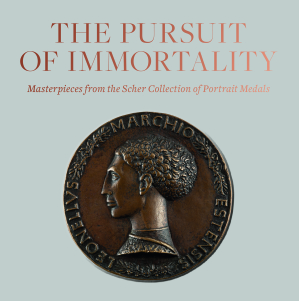 The Frick Collection recently announced the largest acquisition in its history—a promised gift of approximately 450 portrait medals from the incomparable collection of Stephen K. and Janie Woo Scher. Representing the development of the art of the portrait medal from its inception in fifteenth-century Italy to the nineteenth century, the Scher collection is arguably the world’s most comprehensive and significant collection of portrait medals. Comments Director Ian Wardropper, “Henry Clay Frick had an abiding interest in portraiture as expressed in the paintings, sculpture, enamels, and works on paper he acquired. The Scher medals will coalesce beautifully with these holdings, being understood in our galleries within the broader contexts of European art and culture. At the same time, the intimate scale of the institution will offer a superb platform for the medals to be appreciated as an independent art form, one long overdue for fresh attention and public appreciation.”
To celebrate the promised gift, The Frick Collection will mount an exhibition this spring entitled The Pursuit of Immortality: Masterpieces from the Scher Collection of Portrait Medals. The exhibition will explore the flourishing of the medallic arts in major European centers of artistic production and will feature superlative examples by masters of the art such as Pisanello (Italy), Dupré (France), and Reinhart (Germany). Taking and fresh approach to the study of medals, which have often been viewed in the past as specialist objects closer to the field of numismatics, this exhibition will examine medals within the larger context of art, honoring them as a triumph of sculptural production on a small scale. Visitors to the show will encounter a number of renowned sculptors who were also masters of the medal.
The Pursuit of Immortality: Masterpieces from the Scher Collection of Portrait Medals is organized by Aimee Ng, Associate Curator at the Frick, and Stephen K. Scher, an esteemed art historian as well as a collector. Accompanying the exhibition is a richly illustrated exhibition catalogue including an essay by Aimee Ng. (In the spring of 2018, a catalogue of the entire Scher Collection will be published, featuring essays by leading medals scholars and illustrated entries about each of the almost one thousand medals in the collection.)
◊ ◊ ◊ ◊ ◊
Aimee Ng, The Pursuit of Immortality: Masterpieces from the Scher Collection of Portrait Medals (London: Giles, 2017), 64 pages, ISBN: 978 19112 82068, £15 / $20.
Accompanying the exhibition is a richly illustrated exhibition catalogue including an essay by Aimee Ng. In the spring of 2018, a catalogue of the entire Scher Collection will be published, featuring essays by leading medals scholars and illustrated entries about each of the almost one thousand medals in the collection.
Aimee Ng is associate curator at The Frick Collection, New York, and a specialist in Italian Renaissance art. She has held curatorial and academic positions at the Morgan Library & Museum, where she was postdoctoral fellow at the Morgan’s Drawing Institute in 2014, and at Columbia University, where she earned her Ph.D. She was guest curator of The Poetry of Parmigianino’s ‘Schiava Turca’ (2014) and organizing curator of Andrea del Sarto: The Renaissance Workshop in Action (2015–16).
Former Labour MP Tristram Hunt To Direct the V&A
Press release (13 January 2017) from the V&A:
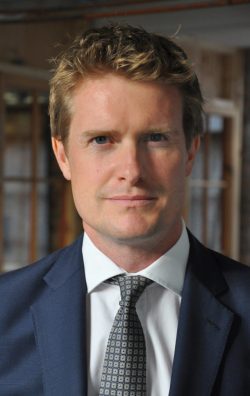 The V&A Trustees have today appointed Dr Tristram Hunt as the new Director of the V&A. Hunt has served as Labour MP for Stoke-on-Trent Central since 2010 and was previously the Shadow Secretary of State and Shadow Minister for Education. A historian, politician, writer, and broadcaster, Hunt is an expert on the eighteenth and nineteenth centuries, with a particular focus on Victorian urban history. He is the author of several books, including The English Civil War: At First Hand and most recently Ten Cities That Made An Empire. A regular history broadcaster on BBC and Channel 4, Hunt has made more than a dozen series on subjects including Elgar and Empire, Isaac Newton, and the English Civil War. Hunt lectures on modern British history at Queen Mary University of London. He is a Fellow of the Royal Historical Society, a founder of the Stoke-on-Trent Literary Festival and a Patron of the British Ceramics Biennial, and was previously a Trustee of both the Heritage Lottery Fund and the National Heritage Memorial Fund, and a Curator of the Mayor of London’s History Festival.
Hunt’s support of the ceramics industry, together with the Art Fund, played an important role in saving the Wedgwood Collection in 2014. The collection was gifted to the V&A and is on long-term loan to the Wedgwood Museum in Barlaston, Stoke-on-Trent. He brings widespread expertise across education, industry, and politics to the V&A and a keen awareness of the important role of major public institutions in the UK, having been at the forefront of political, cultural and public life for the last decade. Hunt’s appointment has been confirmed by the Prime Minister and the Secretary of State for Culture, Media and Sport, and he will join the Museum in the coming months.
Announcing the appointment, V&A Chairman Nicholas Coleridge said: “On behalf of the Trustees, I am delighted to announce the appointment of Dr Tristram Hunt as Director of the Victoria and Albert Museum. He has a highly compelling mixture of experience across public life, the arts, history, education and academia, and knows our collections well from his writing and broadcasting. In addition, he is an informed and articulate leader and communicator on numerous facets of culture, both historic and contemporary, and I greatly look forward to working with him at the V&A.”
Dr Tristram Hunt said: “I am delighted and honoured to have been appointed Director of the V&A. I have loved the V&A since I was a boy, and today it is a global leader in its unrivalled collections, special exhibitions, academic research, and visitor experience. It is a moment of transformation and renewal for the V&A, with the upcoming opening of the new Exhibition Road entrance and new sites and galleries in Dundee, China, and Stratford. I am particularly pleased that, through the V&A ownership of the Wedgwood Collection, my passion for education in Stoke-on-Trent can continue. The combination of the power of the collections and expertise of an inspirational team is what makes the V&A the world’s greatest museum of art, design, and performance. I am honoured to take on this exciting opportunity.”
Hunt has a First Class degree in history from the University of Cambridge (1995), before serving as an Exchange Fellow at The University of Chicago (1996). Hunt also has a PhD from the University of Cambridge on “Civil Thought in Britain, 1820–1860.” He has lectured on British and international culture at the Centre for European Studies, University of California, Berkeley; the Centre for European Studies at Harvard; Princeton University; and the National University of Singapore.
After working on the 1997 General Election campaign, he became a Special Adviser to Science Minister Lord Sainsbury (1997–2000), Associate Fellow at the Centre for History and Economics, King’s College, Cambridge and Senior Fellow at the Institute for Public Policy Research.
Between 2001 and 2010, Hunt combined his post as Senior Lecturer in British History at Queen Mary, University of London with work as a history broadcaster, presenting over fifteen radio and television programmes for the BBC and Channel 4 on subjects including Elgar and Empire, Isaac Newton, and the English Civil War. In addition to making regular contributions to The Guardian and The Observer, he is also the author of The English Civil War: At First Hand (2002), Building Jerusalem: The Rise and Fall of the Victorian City (2004), and the award-winning biography, The Frock-coated Communist: The Revolutionary Life of Friedrich Engels (2009), and Ten Cities That Made an Empire (2014). During this period, Hunt also served as a Trustee of the National Heritage Memorial Fund, the Heritage Lottery Fund, and the Centre for Cities think-tank.
Since entering Parliament, Hunt has focused on educational excellence, the regeneration needs of Stoke-on-Trent, the ceramics industry, and energy intensive sector. He is a Trustee of the History of Parliament Trust and fellow of the Royal Historical Society. From October 2013 until September 2015, Hunt served as Labour’s Shadow Education Secretary focusing on developing Labour’s policy on teachers’ professional development, vocational education and early years education.










 Enfilade
leave a comment