Martin Roth To Step Down as V&A Director
From the V&A press release(5 September 2016). . .
Martin Roth, Director of the V&A since September 2011, has announced to staff today he will leave his role in the Autumn after five years in post. Martin has presided over a succession of critically acclaimed exhibitions, most notably David Bowie is and Alexander McQueen: Savage Beauty, achieving record visitor numbers, which last year reached the highest level in the Museum’s 150 year history—as well as the ambitious refurbishment of multiple galleries showcasing the V&A’s world-leading collections, including most recently the new Europe 1600–1815 galleries. He has also overseen major developments including construction of the new Exhibition Road entrance, courtyard and gallery, due to open in 2017, as well as developing significant strategic partnerships in Shenzhen, Dundee and with V&A East in the Queen Elizabeth Park, East London.

Martin Roth, © Victoria & Albert Museum, London.
Under his directorship, Martin has established the new Design, Architecture and Digital Department and spearheaded new and socially responsive programming, from the Disobedient Objects exhibition to the current Engineering Season. He has also forged many innovative new partnerships, not least with the Venice Biennale, World Economic Forum and International Olympic Committee. The Museum was recently awarded Art Fund Museum of the Year 2016, the biggest museum prize in the world, and praised for its “exceptional imagination, innovation and achievement across the previous 12 months.”
Martin Roth said: “It’s been an enormous privilege and tremendously exciting to lead this great museum, with its outstanding staff and collections, and I’m proud to have steered it to new successes and a period of growth and expansion, including new partnerships around the UK and internationally. Our recent accolade as Art Fund Museum of the Year feels like the perfect moment to draw to a close my mission in London and hand over to a new director to take the V&A forward to an exciting future.”
Nicholas Coleridge, Chairman of the Trustees of the V&A said: “Martin’s tenure as Director has been marked by a highly successful period of creativity, expansion and reorganisation of the V&A. He has made a significant contribution to the success of this museum, and the Trustees are immensely grateful for all that he has achieved here. We are now starting the process of looking
for someone to take on the role and are fortunate to have an exceptional team in place to lead its activities and help build its future with the new Director.”
Martin intends to devote more time to various international cultural consultancies and plans to spend more time with his wife Harriet and their children, in Berlin and Vancouver. The V&A’s Board of Trustees will now begin the search to find a new Director.
Call for Papers | ASECS 2017, Minneapolis
Just a reminder that that the due date for ASECS 2017 proposals is next Thursday (15 September). Send them in!
2017 American Society for Eighteenth-Century Studies Conference
Hyatt Regency Minneapolis, 30 March — 2 April 2017
Proposals due by 15 September 2016
Proposals for papers at the at the 48th annual meeting of the American Society for Eighteenth-Century Studies, at the Hyatt Regency Minneapolis, are now being accepted. Proposals should be sent directly to the session chairs no later than 15 September 2016. Along with our annual luncheon and business meeting, HECAA will be represented with the Anne Schroder New Scholars’ Session, chaired by Jessica Fripp. A selection of other sessions that might be relevant for HECAA members is also included here»
Conference | French Royal Furniture by Jean-Henri Riesener
In connection with the exhibition now on view, Waddeson Manor is hosting this conference:
A Closer Look: Spotlight on French Royal Furniture by Jean-Henri Riesener
The National Trust and Waddesdon Manor (Rothschild Collections) Annual Conference
Waddesdon Manor, Buckinghamshire, 20 September 2016
To book a place, please call 01296 653226 between 10am and 4pm. The fee for the day is £25, which includes all catering; the fee can be paid with a debit or credit card. Please let us know if you have any dietary requirements. The nearest railway station is Aylesbury Vale Parkway (5–10 minutes from Waddesdon), and it is advisable to pre-book a taxi from the station to Waddesdon Manor. Another option is Aylesbury Station (10–15 minutes from Waddesdon); as a rule, there are taxis outside the station.
P R O G R A M M E
10:00 Registration and coffee
10:30 Welcome and introduction, Christopher Rowell (Furniture Curator, National Trust) and Pippa Shirley (Head of Collection, National Trust / Waddesdon Manor)
10:40 Riesener at Waddesdon Manor
• Emily Roy (Curator) and Ulrich Leben (Associate Curator), Introduction to the Exhibition and Research Project
• Lindsay Macnaughton (Oxford University Intern), Grammar and the Garde-Meuble de la Couronne: Chests of Drawers by Jean-Henri Riesener, 1774–84
• Juliet Carey (Senoir Curator), A Newly Discovered Portrait of Riesener
11:30 Riesener at the Wallace Collection
• Helen Jacobsen (Head of Curatorial Team, Wallace Collection): The 4th Marquess of Hertford’s Taste for Riesener, 1840–70
• Jürgen Huber (Senior Conservator, Wallace Collection): Riesener Revealed: Documentation and Observation…The Journey So Far
12:00 Rufus Bird (Deputy Surveyor of The Queen’s Works of Art, Royal Collections Trust), George IV and Riesener
12:15 Yannick Chastang (Independent Conservator), Riesener’s Floral Marquetry
12:30 Questions and discussion
13:00 Lunch
14:30 Bertrand Rondot (Chief Curator, Château de Versailles), Versailles, Riesener’s Palace
14.50 Wolf Burchardt (Furniture Research Curator, National Trust), Continental Furniture in National Trust Houses
15:10 Matthew Hirst (Curator, Woburn Abbey), French and Francophile Furniture in the Woburn Abbey Collection
15:30 Miriam Schefzyk (PhD Candidate, Westfälische Wilhelms-Universität Münster & École Pratique des Hautes Études, Paris), Furniture with Porcelain Plaques at Waddesdon Manor
15:45 Carolyn Sargentson (Senior Lecturer in Art History, University of Sussex), A Business Model for Refinement? Riesener’s 1773 Commission for Pierre de Fontanieu
16:05 Questions and discussion
16:30 Tea
16:45 Entry to see the Riesener exhibition and collections
17:30 Wine reception
Conference | Art in the British Country House

Joseph Mallord William Turner, The South Wall of the Square Dining-Room (Petworth), 1827, gouache on paper, 13.8 × 18.8 cm
(London: Tate).
◊ ◊ ◊ ◊ ◊
From the Paul Mellon Centre for Studies in British Art:
Art in the British Country House: Collecting and Display
Paul Mellon Centre for Studies in British Art, London, 7 October 2016
This conference is the first in a series associated with the Paul Mellon Centre’s flagship research project Art in the British Country House: Collecting and Display, which investigates the collection and display of works of art in the country house in Britain from the sixteenth century to the present day.
The crucial importance of the country house to understanding the history of art-collection and display in Britain is indisputable and of long-standing interest to historians of British art. This project, in turning a fresh eye on the collections of art associated with the country house, builds on exciting new developments within this area of scholarship, which shed new light on the wide range of motivations and circumstances that have shaped such collections. The project extends to the country house a growing scholarly interest in modes of pictorial display, which has hitherto tended to focus on the display of paintings, sculpture and prints within more urban and public environments, and on the exhibition space in particular.
The conference will consist of eight papers, followed by a keynote lecture. The papers will be grouped together in themes over four sections, addressing subject matter ranging from the mid-seventeenth century to the late nineteenth century. In the keynote lecture Adriano Ayminino will address the aspects of the history and methodology of country house scholarship over the past hundred years.
General Admission: £20 (+ admin fee)
Concession ticket: £15 (+ admin fee)
The concession rate is available for students and 60+. Ticket prices include refreshments, lunch and drinks reception
◊ ◊ ◊ ◊ ◊
P R O G R A M M E
9:00 Registration
9:30 Welcome and Introduction by Martin Postle
9:45 Emily Burns (University of Nottingham), The Grand Designs of Sir Justinian Isham: Investigating the Patronage, Collecting and Display at Lamport Hall during the Interregnum
10:10 Amelia Smith (Birkbeck College, University of London), “The most capital masters dispers’d all over the house”: Displays of Art at Longford Castle in the Late Eighteenth Century
10:55 Coffee
11:25 Susan Gordon (University of Leicester), ‘Bronzo Mad’: The Choice, Order and Location of General James Dormer’s Sculpture, Collection at Rousham, Oxfordshire
11:50 Joan Coutu (University of Waterloo), The Future of the Past: Copies of Antique Statues at Wentworth Woodhouse
12:35 Lunch
13:50 Peter Björn Kerber (J. Paul Getty Museum), The Audio- Visual Charles Jennens
14:15 Andrew Loukes (Petworth House, National Trust) ‘Solid, liberal, rich and English’: Patronage and Patriotism at Petworth in the Early 19th Century
15:00 Tea and coffee
15:30 Caroline McCaffrey-Howarth (University of Leeds) Forming Hierarchies and Creating Dialogues: Ferdinand de Rothschild’s Display of Sèvres Porcelain at Waddesdon Manor
15:55 Nicola Pickering (London Transport Museum), Mayer Amschel de Rothschild and Mentmore Towers: Displaying le goût Rothschild
16:40 Keynote Speaker: Adriano Aymonino (University of Buckingham)
17:45 Drinks Reception
New Book | Lancelot Brown and the Capability Men
The Capability Brown Festival 2016 has marked the 300th anniversary of the landscape designer’s birth in August 1716. This week, a major conference addressing Brown and his international significance takes place in Bath, and now come the books!
Distributed by The University of Chicago Press:
David Brown and Tom Williamson, Lancelot Brown and the Capability Men: Landscape Revolution in Eighteenth-Century England (London: Reaktion Books, 2016), 352 pages, ISBN: 978-1780236445, $45.
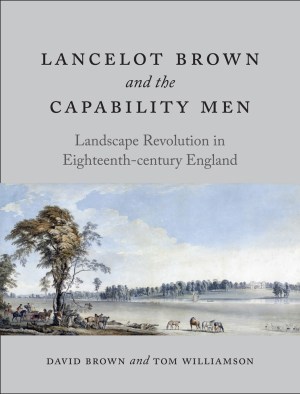 Lancelot ‘Capability’ Brown is often thought of as the innovative genius who single-handedly pioneered a new, naturalistic style of landscape design, but he was in fact only one of many landscape designers in Georgian England. Published to commemorate the three hundredth anniversary of Brown’s birth, this book casts important new light on his world-renowned work, his eventful life, and the wider and robust world of landscape design in Georgian England.
David Brown and Tom Williamson argue that Brown was one of the most successful designers of his time working in a style that was otherwise widespread—and that it was his skill with this style, and not his having invented it, that linked his name to it. The authors look closely at Brown’s design business and the products he offered clients, showing that his design packages helped define the era’s aesthetic. They compare Brown’s business to those of similar designers such as the Adam brothers, Thomas Chippendale, and Josiah Wedgwood, and they contextualize Brown’s work within the wider contexts of domestic planning and the rise of neoclassicism. Beautifully illustrated throughout, this book celebrates the work of a master designer who was both a product and harbinger of the modern world.
David Brown is a tutor of landscape history at the University of Cambridge. Tom Williamson is professor of landscape history at the University of East Anglia and the author of many books, including An Environmental History of Wildlife in England, 1650–1950.
C O N T E N T S
1 The World of Mr Brown
2 Gardens and Society, 1700–1750
3 The ‘Brownian’ Landscape
4 The Brown Connection
5 Landscape and Modernity
6 Alternatives and Oppositions
Conclusion: Afterlife and Legacy
References
Bibliography
Acknowledgements
Photo Acknowledgements
Index
New Book | Capability Brown: Designing the English Landscape
From Rizzoli:
John Phibbs, with photography by Joe Cornish, Capability Brown: Designing the English Landscape (New York: Rizzoli, 2016), 280 pages, ISBN: 978-0847848836, $65.
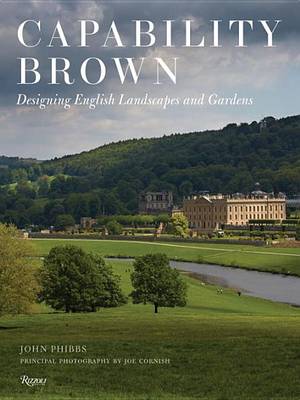 In celebration of his 300th year, a definitive survey of Capability Brown’s most famous gardens and landscapes in Britain. Widely acknowledged as the most influential landscape designer of his age, Lancelot ‘Capability’ Brown was to England what Frederick Law Olmsted was to America—responsible for shaping the very ideal of the nation’s parkland. Brown’s ambition was to bring out of a landscape the best of its potential rather than impose his own ideas upon it. His designs are organic, weaving gestures of color and perspective into the features that the country already afforded. So natural are his designs, and so perfectly do they complement the houses within them, that for many a Capability Brown landscape is the epitome of the English estate. His gardens and parklands—as much as the houses themselves—would become icons of British country life. Published to coincide with the tercentenary of his birth, this remarkable book illuminates fifteen of Brown’s most celebrated landscapes. To love the great English estates is to love the settings with which Brown surrounded them—from idyllic parklands at Milton and Broadlands to structured landscapes around iconic houses at Blenheim, Burghley, Wakefield, and Chatsworth. With photography commissioned for the book, and including rarely seen archival drawings that shed light on Brown’s process, this book serves as a guide to Britain’s most beloved landscapes and an exploration of the masterful mind behind their creation.
John Phibbs set up the Capability Brown 1716–2016 Partnership and is a renowned garden historian and author with more than thirty years’ experience in the management and restoration of historic landscapes. Joe Cornish is an award-winning landscape photographer and an honorary fellow of the Royal Photographic Society with a studio and gallery in Yorkshire, England.
New Book | Place-Making: The Art of Capability Brown, 1716–1783
This one is an interesting economic model of publication. Historic England is the publisher, but at least a portion of the funding depends upon supporters (‘subscribers’ to use the eighteenth-century term) pledging money at Unbound. Hearing John Phibbs pitch for the project in the 3-minute video is fascinating: in effect, the ‘elevator pitch’ is directed toward potential readers rather than an editor. –CH
John Phibbs, Place-Making: The Art of Capability Brown, 1716–1783 (London: Historic England, 2016), 320 pages, £50.
Capability Brown was a great artist, and this book shows what his artistry consisted of. His influence on the culture of England has been as great as that of Turner, Telford and Wordsworth.
Lancelot ‘Capability’ Brown (1716–1783) is the iconic figure at the head of the English landscape style, a tradition that has dominated landscape design in the western world. He was widely acclaimed for his genius in his own day, lived on personal terms with the king, a friend of five prime-ministers, and the great men of his day.
Two factors make his astonishing achievements relevant to us today: first the scale at which he worked and the prolixity of his commissions have given him a direct influence on some half a million acres of England and Wales (that’s an average size English county); and second, arising from that, Brown didn’t just transform the English countryside, he also transformed our idea of what it is to be English and what England is. His work is everywhere, but goes largely unnoticed, the phrase ‘Invisible in plain sight’ comes to mind. Even today though he has had biographers, his work has generated very little analysis.
Very little of what he wrote survives, but the reason why he isn’t noticed—and this point was made in his own day in the 18th century—is that his was such a naturalistic style that all his best work was mistaken for untouched nature. This has made it very difficult to see and understand, which leaves us in a strange situation today. Of the 250 or so country houses for which he designed parks, about 200 are still worth seeing, and millions of people every year visit the 140 that are at least occasionally open to the public. Yet if you were to ask any one of these visitors the simplest questions about the parks (‘what are they for?’, ‘how do they work?’, ‘why did they need so much grass?’ ‘what do they have to do with country houses?’, for example), they would look at you bemused, as if you had asked what mountains are for. For people who are used to English landscape, parks simply are what they are: parks have grass because they are parks.
This blindness to these obvious questions is not confined to the general public. Professional landscape architects, academics and those involved in landscape conservation would be no more able to answer them. It is not just that there is no consensus in understanding Capability Brown’s work, but there has been no attempt to understand it. Even the framework of language for understanding it is lacking. For all his acknowledged importance, Brown is a blank. This book for the first time answers these simple questions about the English landscape tradition and Brown’s place in it, but it aims primarily to make landscape legible, to show people where to stand, what to look at and how to see.
John Phibbs read Classics at Oxford and then developed the idea that historic parks and gardens could and should be recorded and analysed like any other works of art, and that this would be a sensible first step towards deciding what should happen to them next. This idea was widely adopted after the great storm of October 1987. John Phibbs himself spent the next five years building up his own practice in landscape management and assessing landscapes for English Heritage. It was an amazing education out of which came the realisations that Lancelot ‘Capability’ Brown was not only the most prolific but also the greatest of the English landscape gardeners, and that his work had long been misunderstood, largely because of the mischievous attacks made on it by the proponents of the Picturesque style, which arose after his death in reaction to his work. In this book John hopes to put right the wrongs that have been done to Brown’s reputation and to re-establish him in his rightful place as a figure of great significance in the characterisation of England and Wales.
New Book | Moving Heaven and Earth
From Unicorn Publishing:
Steffie Shields, Moving Heaven and Earth: Capability Brown’s Gift of Landscape (London: Unicorn Publishing Group, 2016), 240 pages, ISBN: 978-1910787151, £30.
 Moving Heaven and Earth reveals the driven polymath behind the famous nickname. It explores both Brown’s artistic legacy and his pioneering work with water in the landscape. The book evaluates the rise of the English landscape garden in the climatic context of his designs and also forms a comprehensive guide for tours and visits. Approximately 350 clearly labelled colour photographs pin-point Brown’s enduring views and surprisingly vibrant planting palette.
Steffie Shields is a professional garden photographer, writer, and historic landscape consultant. Having researched ‘Capability’ Brown for over twenty-five years, she has now compiled a photographic archive of over 200 attributed works. She lectures country-wide, has appeared on Channel 4 television, and been an advisor for More 4. Her photographic awards include several commendations in the International Garden Photographer of the
Year competition.
New Book | Capability Brown and His Landscape Gardens
From the National Trust:
Sarah Rutherford, Capability Brown and His Landscape Gardens (National Trust, 2016), 192 pages, ISBN: 978:1909881549, £15.
 One of the most remarkable men of the 18th century, Lancelot ‘Capability’ Brown was known to many as ‘The Omnipotent Magician’ who could transform unpromising countryside into beautiful parks that seemed to be only the work of nature. His list of clients included half the House of Lords, six Prime Ministers and even royalty. Although his fame has dimmed, we still enjoy many of his works today at National Trust properties such as Croome Park, Petworth, Berrington, Stowe, Wimpole, Blenheim Palace, Highclere Castle (location of the ITV series Downton Abbey) and many more. In Capability Brown, author and garden historian Sarah Rutherford tells his triumphant story, uncovers his aims, and reveals why he was so successful. Illustrated throughout with colour photographs of contemporary sites, historical paintings, and garden plans, this is an accessible book for anyone who wants to know more about the man who changed the face of the nation and created landscape style which for many of us defines the English countryside.
Sarah Rutherford is an enthusiastic garden historian and Kew-trained gardener. She has a passion for Capability Brown and his landscape gardens and has visited and studied many to understand the man and his legendary capabilities. As a consultant she has been preparing conservation plans for over twelve years for all sorts of historic parks and gardens. She has written books on subjects as diverse as Victorian Asylums, Georgian Garden Buildings, and Botanic Gardens.
New Book | The English Landscape Garden in Europe
From Historic England:
Michael Symes, The English Landscape Garden in Europe (London: Historic England, 2016), 136 pages, ISBN: 978-1848023574, £25.
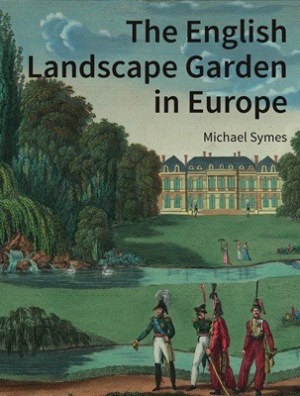 This book provides an overview of the extent to which the 18th-century English landscape garden spread through Europe and Russia. While this type of garden acted widely as an inspiration, it was not slavishly copied but adapted to local conditions, circumstances and agendas.
A garden ‘in the English style’ is commonly used to denote a landscape garden in Europe, while the term ‘landscape garden’ is used for layouts that are naturalistic in plan and resemble natural scenery, though they might be highly contrived and usually large in scale.
The landscape garden took hold in mainland Europe from about 1760. Due to the differing geopolitical character of several of the countries, and a distinct division between Catholic and Protestant, the notion of the landscape garden held different significance and was interpreted and applied variously in those countries: in other words, they found it a very flexible medium.
Each country is considered individually, with a special chapter devoted to ‘Le Jardin Anglo-Chinois’, since that constitutes a major issue of its own. The gardens have been chosen to illustrate the range and variety of applications of the landscape garden, though they are also those about which most is known in English.
C O N T E N T S
The Many Faces of the Landscape Garden
Exporting the English Garden
Le Jardin Anglo-Chinois
France
Germany
Russia
Poland
The Czech Republic
Sweden
Hungary
Italy
Other Countries










 Enfilade
leave a comment