Call for Papers | A Year’s Art: The Royal Academy Summer Exhibition
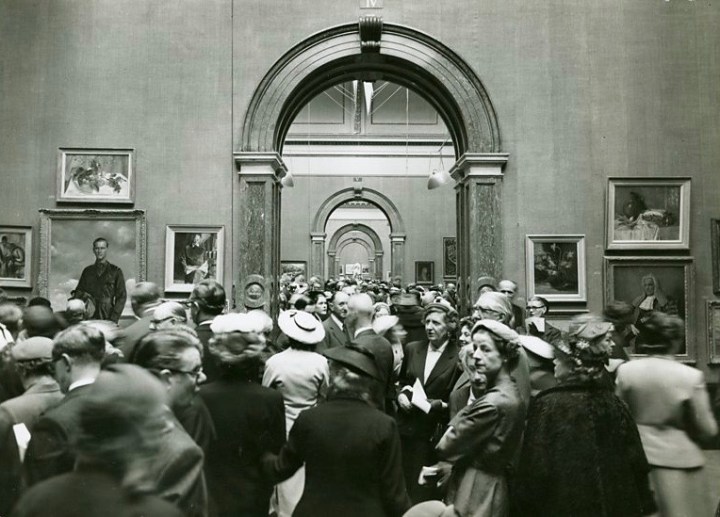
The Main Galleries of the Royal Academy of Arts during the Summer Exhibition, 1956 (unidentified photographer working for Keystone Press Agency Ltd. Photo credit: © Royal Academy of Arts, London)
◊ ◊ ◊ ◊ ◊
From the PMC:
A Year’s Art: The Royal Academy Summer Exhibition, 1769–2016
The Paul Mellon Centre for Studies in British Art, London, 29–30 September 2016
Proposals due by 17 June 2016
2018 will see the opening of a major exhibition devoted to the history of the Royal Academy’s annual Summer Exhibition. Provisionally entitled The Great Spectacle: The Royal Academy and Its Summer Exhibitions, 1769–2018, this display is planned to take place in what will be the Academy’s newly expanded and interconnected premises in Burlington House and Gardens. Forming part of the Academy’s 250th Anniversary celebrations, the exhibition will be curated by Mark Hallett and Sarah Turner of the Paul Mellon Centre, with the assistance of the Academy’s Per Rumberg and the PMC’s Jessica Feather.
Alongside the exhibition and its accompanying catalogue, the PMC members of the team are planning to develop an extensive, multi-authored online chronicle of the RA Summer Exhibition’s histories. This will take the form of a series of 250 short, illustrated texts—of around 1000 words each—that will focus on every individual exhibition in turn, beginning with the first such display, held in 1769. Featuring a wide range of scholarly and critical voices telling a multitude of stories about the exhibition, the chronicle will be developed in tandem with an ambitious digitisation programme that will place historic and contemporary summer exhibition catalogues online. This innovative project is designed to offer scholars, students, and exhibition-visitors with an intellectually lively online resource for research and learning, long after the exhibition itself closes. Whilst focusing on the Academy’s summer exhibitions, it will also contribute to the growing field of study on exhibition histories more broadly. As the longest running exhibition of contemporary art in the world, the Royal Academy Summer Exhibition offers an extremely rich focus for this area of research.
In advance of the 2018 Great Spectacle exhibition, the Paul Mellon Centre is organising and hosting a two-day event that is designed to highlight and develop new perspectives on the Academy’s display. The conference will take place on 29th–30th September 2016.
In the spirit of our planned online chronicle, the conference will be structured around groupings of short papers dealing with individual years in the exhibition’s history. It is designed to be fast-moving, provocative, and surprising, and to feature time both for speedy feedback and extended discussion. We invite proposals for 1000-word papers that, through focusing on an individual year, enable us to think afresh about the Royal Academy’s summer exhibition, and that do so from different art-historical perspectives. The premium on such papers will be to deliver pithy, refreshing, and original insights into the exhibition: to offer an illuminating art-historical snapshot, alighting on a particular work or artist, or a prominent theme to come out of an individual year.
We are especially keen to showcase new research into the histories of the exhibition and into its contemporary character, appeal, and function. We invite proposals that deal with the different kinds of objects that have been exhibited at the Academy, including sculpture, drawings, prints, and architectural models, as well as the paintings that have been the mainstay of the display since its inception. Proposals might focus on the summer exhibition as a venue of artistic competition and collaboration; on its status as an entertaining form of urban spectacle; on the interaction of works of art within its walls; on its fluctuating critical fortunes and its shifting status within the British art world; on the role of women artists within its history; on its position within the London social scene; on the function and impact of its selection and hanging committees; on its engagement with the themes of war, empire and celebrity; on the kinds of art-criticism it has generated; and on a wide range of other topics. We especially welcome applications from junior scholars and researchers, as well as from experienced academics, curators, critics and independent art-historians. Cross-disciplinary, comparative and collaborative studies are also very welcome.
Please submit proposals, of no more than 250 words, together with a short cv to Ella Fleming (efleming@paul-mellon-centre.ac.uk) by Friday, 17th June 2016. We will accept up to three proposals from individual applicants, and we would encourage multiple proposals to be on non-sequential years. Travel and accommodation will be provided for speakers travelling from outside the London area.
Conference | Becoming Roman: Artistic Immigration
From H-ArtHist:
Becoming Roman: Artistic Immigration in the
Urbe from the Sixteenth to the Twentieth Centuries
The British School at Rome, 20 May 2016
Organized by Ariane Varela Braga and Thomas-Leo True
Questions of artistic travel and mobility have been the focus of recent scholarly attention. Rome’s special status as caput mundi and the opportunities it provided as a cultural centre have attracted migrant artists from the Renaissance to the present day.
This conference addresses the issue of mobility from a novel perspective, by concentrating on case-studies of artists—or groups of artists—that not only travelled to, but settled in, Rome and examines issues of mobility, artistic exchange and cultural transfer, patronage and professional networks, cultural identity, and strategies for integration or voluntary exclusion from the local artistic life. When (and how) do foreign artists become Roman artists? What is the role played by social and institutional networks for their integration? How does the process of integration evolve and modify over time? For what sort of clientele (particularly foreign or local) do foreign artists work? How do foreign artist interact with the local artistic environment? How does their activity shape questions of Romanitas or Roman cultural identity?
The conference is an initiative of the Rome Art History Network (RAHN), an independent and international network, based in Rome, which encourages the exchange of ideas between researchers from foreign academies and Italian universities, at an early stage of their career.
◊ ◊ ◊ ◊ ◊
P R O G R A M M E
9:30 Welcome by Thomas-Leo True (BSR)
9:40 Introduction by Ariane Varela Braga (RAHN/University of Zurich)
10:00 Session 1 | Dynamics of Settlement and Integration: Studying Foreign Artists in Rome
Chair: Francesca Cappelletti (Università degli studi di Ferrara)
• Patrizia Cavazzini (BSR), La popolazione dei pittori a Roma nel Cinquecento
• Laura Bartoni (Universita Telematica Internazionale Uninettuno), Artisti stranieri nella Roma del Seicento tra fortuna e fallimento
• Gilles Montègre (Université de Grenoble Alpes), Sono stranieri o diventati romani ? Indagare sugli artisti e residenti francesi nella Roma settecentesca
11:40 Break
12:00 Session 2 | Networks and Socio-institutional Connections
Chair: Raffaella Morselli (Università degli Studi di Teramo)
• Piers Baker-Bates (The Open University), Tierra Tan Extraña: Spanish artists in sixteenth-century Rome
• Elisabeth Kieven (Bibliotheca Hertziana-Istituto Max Planck per la Storia dell‘Arte), Becoming successfully Roman: the case of Gaspar van Wittel (1653–1736)
13:40 Lunch
15:00 Session 3 | Cosmopolitan Circles
Chair: Sarah Linford (Accademia di Belle Arti di Roma)
• Anna Frasca-Rath (Universität Wien), Antonio Canova ed i borsisti internazionali a Roma
• Sarah Kinzel (Humboldt-Universität zu Berlin), Patrons, parties, priceless portraits: Franz von Lenbach’s network in Rome
16:10 Break
16:30 Session 4 | Out of Time: The Choice of Rome
Chair: Laura Iamurri (Università degli Studi Roma Tre)
• Anna Vyazentseva (Università dell’Insubria), Alcuni artisti e architetti Russi a Roma nel Primo Novecento: le questioni dell’integrazione
• Peter Benson Miller (American Academy in Rome), Resident/Alien: American artists in postwar Rome
18:00 Evening Lecture
• Irene Fosi (Università degli Studi “G. d’Annunzio”, Chieti-Pescara), Roma in età moderna: un mosaico di ‘nationes’
Study Day | Kimbolton Castle, Huntingdonshire
From the Society of Architectural Historians of Great Britain:
SAHGB Study Day: Kimbolton Castle
Huntingdonshire (Cambridgeshire), 13 July 2016
 Pete Smith and Nora Butler (Kimbolton School) will be leading a Study Day at Kimbolton Castle on Wednesday 13th July 2016. Kimbolton Castle was purchased by Sir Henry Montagu in around 1605. He was created Earl of Manchester by Charles I. It was his great-grandson Charles, the 4th Earl who inherited in 1683 and who, between 1690 and 1720, entirely rebuilt the original courtyard house. This rebuilding was carried out in three phases. The first possibly by Henry Bell of Kings Lynn between 1691 and 1696, the second by Sir John Vanbrugh between 1707 and 1710 and finally the east portico was added in 1719, this is usually assigned to Alessandro Galilei though recently discovered evidence suggests it may have been designed by Thomas Archer. Antonio Pellegrini decorated the staircase with paintings of The Triumph of Caesar in 1711–12. A new service range and gateway was added by Robert Adam for the 4th Duke of Manchester in around 1764. In the 1860s William Montagu, the 7th Duke, employed William Burn to modernize the house including new ceilings in the Dining Room and Saloon. He added an attic storey to the central section of north front and built a new stable block 1869–70. The 10th Duke of Manchester sold the castle to Kimbolton School in 1949. The school employed Marshall Sisson to restore the castle including the re-instatement of the glazing bars to all the sash windows. Cost: £35 (£25 students).
Lecture | Douglas Fordham on Aquatint Empires
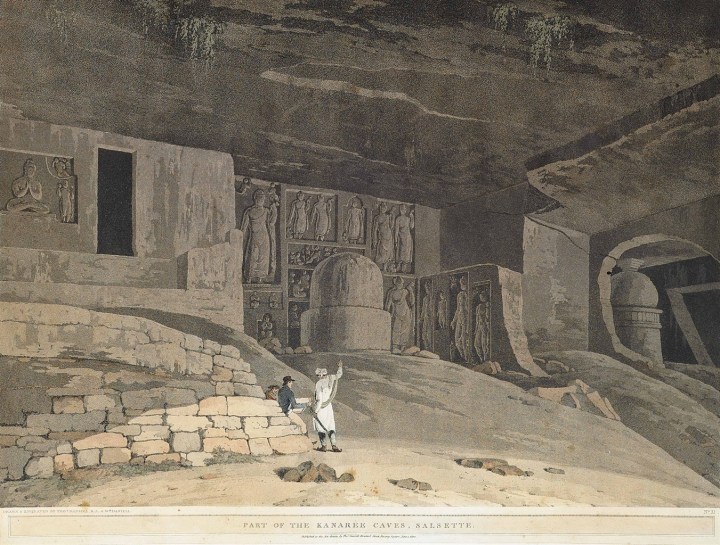
Thomas Daniell, “Part of the Kanaree [Kanheri] Caves, Salsette,” handcoloured aquatint, from Oriental Scenery, 1799.
◊ ◊ ◊ ◊ ◊
This week at the Paul Mellon Centre:
Douglas Fordham, Aquatint Empires
The Paul Mellon Centre for Studies in British Art, London, 18 May 2016
This talk considers the importance of what used to be known as ‘English Coloured Books’ to the conceptualization and visualization of the British Empire. Particular attention will be given to aquatint as a medium, and the ways in which this tonal intaglio process encouraged certain types of visual themes, historical narratives, and viewer responses. Making particular use of the J.R. Abbey collection of ‘Travel in Aquatint and Lithography’ in the Yale Center for British Art, this project explores the production and reception of three ambitious and beautifully illustrated publications: Thomas Daniell’s Hindoo Excavations (1803), William Alexander’s Costume of China (1805), and Samuel Daniell’s African Scenery and Animals (1804–05). This talk asks what these publications might reveal about Britain’s place in the world following the Treaty of Amiens. More broadly, it considers seriality as empire: how did elaborate aquatint publications colour British visions of Africa, Asia, and beyond?
Douglas Fordham is the author of British Art and the Seven Years’ War: Allegiance and Autonomy (University of Pennsylvania Press, 2010) and a co-editor with Tim Barringer and Geoff Quilley of Art and the British Empire (Manchester University Press, 2007). He has published articles relating to British art, visual culture, and empire in Art History, The Art Bulletin, Representations, Oxford Art Journal, and elsewhere.
All are welcome! However, places are limited; so if you would like to attend, please book a place in advance. The seminar will be followed by a drinks reception. Wednesday, 18 May 2016, 6:00–8:00pm.
New Book | Life in the Country House in Georgian Ireland
From Yale UP:
Patricia McCarthy, Life in the Country House in Georgian Ireland (London: The Paul Mellon Centre for Studies in British Art, 2016), 272 pages, ISBN: 978-0300218862, £45 / $75.
 For aristocrats and gentry in 18th-century Ireland, the townhouses and country estates they resided in were carefully constructed to accommodate their cultivated lifestyles. Based on new research from Irish national collections and correspondence culled from papers in private keeping, this publication provides a vivid and engaging look at the various ways in which families tailored their homes to their personal needs and preferences. Halls were designed in order to simultaneously support a variety of activities, including dining, music, and games, while closed porches allowed visitors to arrive fully protected from the country’s harsh weather. These grand houses were arranged in accordance with their residents’ daily procedures, demonstrating a distinction between public and private spaces, and even keeping in mind the roles and arrangements of the servants in their purposeful layouts. With careful consideration given to both the practicality of everyday routine and the occasional special event, this book illustrates how the lives and residential structures of these aristocrats were inextricably woven together.
Patricia McCarthy is an independent architectural historian based in Dublin.
◊ ◊ ◊ ◊ ◊
C O N T E N T S
Introduction
1 Approaching and Arriving
2 Crossing the Threshold
3 Dining
4 Public Rooms
5 Family Spaces
6 Servants and Privacy
Notes
List of Inventories
Glossary
Index
Acknowledgments
Call for Papers | Art and War
From H-ArtHist:
Art and War: New Perspectives
The Frick Collection, New York, 16 September 2016
Proposals due by 16 June 2016
The Frick Collection is pleased to invite submissions for Art and War, a symposium that will accompany the special exhibition Watteau’s Soldiers: Scenes of Military Life in Eighteenth-Century France. On view from July 12 to October 2, 2016, the exhibition presents a selection of Jean-Antoine Watteau’s little-known drawings and paintings of military life. In these works, Watteau eschews martial glory in favor of depicting more mundane aspects of life on the front: fatigue, boredom, simple diversions. Prompted by Watteau’s singular vision of war, The Frick Collection solicits 25-minute papers that consider the relationship between art and war in ways both direct and oblique, across all media, geographic regions, and time periods. We welcome a range of approaches that engage critically with the historical and theoretical problems posed by the relationship between art and war.
Questions to be addressed include, but are not limited to
• What representational pressures and aesthetic challenges has war created?
• Where have artists located themselves in, away from, or after ‘the fight’?
• How can art convey the experience of war—not only the violence of battle, but also its impact on everyday life?
• How has art glorified, condemned, or otherwise commented on war?
• What can we learn from examining this relationship in an age of perpetual war?
Please send a 250-word abstract and CV by Thursday, June 16, 2016, to Caitlin Henningsen (henningsen@frick.org) and Aaron Wile (wile@frick.org). Proposals from emerging scholars are particularly encouraged.
Call for Papers | HECAA Session at UAAC, 2016
Thanks again to Christina Smylitopoulos, HECAA is scheduled to be represented at this year’s UAAC Conference! Details and a full list of panels (65 in all) are available here»
◊ ◊ ◊ ◊ ◊
Universities Art Association of Canada / l’association d’art des universités du Canada
Université du Québec, Montréal, 27–30 October 2016
Proposals due by 24 June 2016
HECAA Open Session (Historians of Eighteenth-Century Art and Architecture)
The objective of this society is to stimulate, foster, and disseminate knowledge of all aspects of visual culture in the long eighteenth century. This HECAA open session welcomes papers that examine any aspect of art and visual culture from the 1680s to the 1830s. Special consideration will be given to proposals that demonstrate innovation in theoretical and/or methodological approaches. Please email proposals for 20-minute papers to Dr. Christina Smylitopoulos (University of Guelph), csmylito@uoguelph.ca.
New Book | Agents of Space
This collection of essays grew out of HECAA-sponsored panels at conferences of the Universities Art Association of Canada. From Cambridge Scholars Publishing:
Christina Smylitopoulos, ed., Agents of Space: Eighteenth-Century Art, Architecture, and Visual Culture (Newcastle upon Tyne: Cambridge Scholars Publishing, 2016), 238 pages, ISBN: 978-1443888837, £48.
 In the last twenty-five years, the concept of space has emerged as a productive lens through which historians of the long eighteenth century can examine the varied and mutable issues at play in the creation and reception of objects, images, spectacles, and the built environment. This collection of essays investigates the potentialities afforded by space in eighteenth-century art and visual culture. Rather than being defined by a particular school of art or the type of space invoked, it invites global difference and reflects scholarly engagement in the eighteenth-century artistic phenomena of Italy, Mexico, and India, as well as Britain and France in immediate, imperial, and transnational contexts. The contributions here share an emphasis on agency, which in this context means the way in which objects, artists, architects, and patrons (in their many guises) have attempted to negotiate various artistic, political, philosophical, and socio-economic values through creating, reflecting, appropriating, denying, or reimagining space.
Divided into two sections, the chapters in the first part, “Memory,” examine specific episodes of eighteenth-century art and visual culture that are acts of remembering, or a result of such action, or objects used to persuade through reminding. In these essays, space’s agency—whether understood as real, theoretical, or imagined—is harnessed by recalling past cultures so as to assert and reassert identities that are also bound by limiting factors, including class, religion, artistic methodology, and materiality. The chapters in the second section, “Reform,” demonstrate memory’s perseverance in eighteenth-century attempts to strike off in new directions, and consider more concrete and purposeful cases of reaching toward the future. In this section, the capacity of space to inform the development, growth, and even transformation of this period is emphasized, revealing an interest in the incremental or radical reform of politics, psychological states, artistic eminence, and colonial/imperial identities.
This book invites a broader geographical scope to studies of space and underscores the ways in which agency can be productive to multifarious lines of artistic, cultural, and historical inquiry.
Christina Smylitopoulos is Assistant Professor of Art History in the School of Fine Art and Music at the University of Guelph. Prior to her position at Guelph, Smylitopoulos was a Postdoctoral Research Associate at the Yale Center for British Art, a Social Science and Humanities Research Council of Canada Doctoral Fellow and a Paul Mellon Centre for Studies in British Art Junior Fellow.
◊ ◊ ◊ ◊ ◊
C O N T E N T S
List of Illustrations
Acknowledgements
Michael Yonan, Preface
Christina Smylitopoulos, Introduction—Discursivity: Space, Agency, and Eighteenth-Century Art, Architecture, and Visual Culture
Part I: Memory
1 Joan Coutu, On Being There: The Significance of Place and the Grand Tour for Britons in the Eighteenth Century
2 Elizabeth Nogan Ranieri, Sacred Space and Imagery: The Basilica of San Domenico Maggiore’s Eighteenth-Century Sacristy
3 Barbara Tetti, The Space Between the Banks of the Tevere River: Carlo Marchionni’s Drawings of Three Roman Bridges
4 Kristin Campbell, “The Proprietor exerts his utmost Care…”: The Commercial and Commemorative Fates and Fortunes of John Boydell’s Houghton Gallery Project
Part II: Reform
5 Paul Holmquist, Tying the Seductive Powers of Art to the Innate Rights of Man: The Architect as Legislator in the Ideal City of Chaux
6 Ji Eun You, Draping the Republic: Fabric Furnishings in Interior Spaces during the French Revolution
7 Diana Cheng, Lord Chesterfield’s Boudoir: A Room Without the Sulks
8 Alena Robin, Voices from the Archives: Phelipe Chacón, José de Ibarra, Nicolás Enríquez, and The Painter’s Profession in Mexico City in 1735
9 Sutapa Dutta, Agents of an Epistemological Space: Education and the Civilizing Mission in Early Colonial Bengal
Contributors
Index
Exhibition | Madame de Pompadour: Patron and Printmaker
◊ ◊ ◊ ◊ ◊
Press release (16 February 2016) from The Walters
Madame de Pompadour: Patron and Printmaker
The Walters Art Museum, Baltimore, 28 February — 29 May 2016
Curated by Susan Wager
Madame de Pompadour (1721–1764) is known for being the influential mistress of King Louis XV of France and an enthusiastic patron of the arts, but few know that she was also a printmaker. An unexpected finding in the Rare Books Collection of the Walters Art Museum uncovered an extremely rare first-edition set of etchings she created in the early 1750s. Her intellectual and artistic prowess are highlighted in the exhibition Madame de Pompadour, Patron and Printmaker.
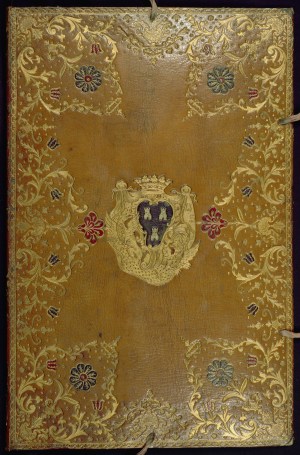
Suite of Prints Engraved by Madame the Marquise de Pompadour after the Carved Gems of Jacques Guay, ca. 1755 (Baltimore: The Walters Art Museum/Ariel Tabritha/Kimber Wiegand)
On display are seven selections from the Suite of Prints Engraved by Madame the Marquise de Pompadour after the Carved Gems of Jacques Guay. Museum founder Henry Walters acquired the Suite in 1895 from a Parisian book dealer. The set comprises more than 50 detailed etchings of gems carved with diverse images, including portraits of the crown prince and the royal mistress’s spaniel, Bébé. About 20 of these rare first-edition sets were produced around 1755, and the copy at the Walters is the only complete set to survive.
Complementing the selection of prints are 18 objects that touch on aspects of Pompadour’s wide-ranging patronage. Over time, she accumulated paintings, sculpture, porcelain, tapestries, metalwork, and other sumptuous objects for her many personal residences. Included are works she likely owned, such as two pairs of Sèvres vases and a pair of French-mounted Asian porcelains.
“The works on view show that she was thinking about these objects and images in a very sophisticated way,” says Susan Wager, curator of the exhibition. “I hope that comes through when visitors see her prints and the objects that she was drawn to as a collector.”
Formerly the Andrew W. Mellon postdoctoral curatorial fellow in the Department of 18th- and 19th-Century Art, Wager discovered the volume after an object listed in the museum’s database as a late posthumous edition caught her eye. The etchings had remained unrecognized for more than a century. The Suite is contained in an 18th-century leather portfolio emblazoned with Pompadour’s coat of arms and, unlike other editions, contains a handwritten table of contents.
Susan Stamberg reported on the exhibition for NPR’s Morning Edition on 10 May 2016 (the site includes additional images). Details of the discovery will be published by Wager in a forthcoming article for The Burlington Magazine.
Call for Papers | Understanding Material Loss
From the conference website:
Understanding Material Loss across Time and Space
University of Birmingham, 17–18 February 2017
Proposals due by 14 October 2016
 Understanding Material Loss across Time and Space is an innovative conference that will take place in 2017 at the University of Birmingham. Kate Smith, who works as Lecturer in Eighteenth-Century History, is organizing the conference to complement her current research on loss, lost property, and the making of modern Britain. Rather than focus solely on modern Britain, however, the conference seeks to consider the methodological and historical insights that might be revealed by utilizing loss as significant analytical framework across time and space, particularly when examining the material world.
Archaeologists, anthropologists, philosophers, literary scholars, sociologists and historians have increasingly come to understand the material world as an active and shaping force. Nevertheless, while significant, such studies have consistently privileged material presence as the basis for understanding how and why the material world has played an increasingly important role in the lives of humans. In contrast, Understanding Material Loss suggests that instances of absence, as much as presence, provide important means of understanding how and why the material world has shaped human life and historical processes.
Speculative and exploratory in nature, Understanding Material Loss asserts that in a period marked by ecological destruction, but also economic austerity, large scale migration, and increasing resource scarcity, it is important that historians work to better understand the ways in which humans have responded to material loss in the past and how such responses have shaped change. Understanding Material Loss asks: how have humans historically responded to material loss and how has this shaped historical processes? The conference will bring together a range of scholars in an effort more to begin to explore and frame a problem, than provide definitive answers.
Confirmed keynote speakers include
• Pamela Smith, History, Columbia
• Simon Werrett, Science and Technology Studies, UCL
• Maya Jasanoff, History, Harvard
• Jonathan Lamb, English, Vanderbilt
• Anthony Bale, English and Humanities, Birkbeck
• Astrid Swenson, Politics and History, Brunel
Understanding Material Loss seeks to uncover the multiple practices and institutions that emerged in response to different forms of material loss in the past and asks, how has loss shaped (and been shaped by) processes of acquisition, possession, stability, abundance and permanence? By doing so it seeks to gauge the extent to which ‘loss’ can be used as an organizing framework of study across different disciplines and subfields. Understanding Material Loss seeks papers from across a variety of time periods and geographies. Although open and speculative in nature, this conference will focus on three broad topics within the wider rubric of loss, in order to facilitate meaningful conversations and exchanges.
Using Materials
• How has the ‘loss’ of particular materials affected scientific practice, manufacturing, architectural design or development in the past?
• How have humans responded to the partial loss or decay of materials?
• How have ‘lost’ skills or knowledge affected the use of materials?
• How have humans re-appropriated or recycled seemingly damaged or obsolete materials?
Possessing Objects
• How have humans sought to maintain and mark the ownership of objects?
• How has the loss of possessions and property affected human mobility and constructions of identity?
• How have communities historically responded to the loss of particular objects? When and why have they sought to stave off the loss of things?
• Where, when and how have cultures of repair flourished?
• How has the loss of possessions and property (or the potential for loss) affected processes of production, consumption or financial stability?
Inhabiting Sites and Spaces
• When and why have particular sites or buildings been understood as destroyed or obsolete?
• How have past societies responded to the loss of particular sites?
• When and how have landscapes been actively purged of symbols and sites?
• How have past societies worked to rebuild or reclaim particular sites?
• What strategies did past societies develop to ensure the resilience of certain structures?
If you are interested in participating in the conference, please send proposals (250 words max per paper) for papers and panels to conference organizer Kate Smith (k.smith@bham.ac.uk) by Friday 14 October 2016. Papers should not exceed 20 minutes. Roundtable panels featuring 5–6 papers of 10 minutes each or other innovative formats are encouraged.
Thanks to Past & Present and the University of Birmingham for their generous support for the conference.










 Enfilade
leave a comment