Call for Session Proposals | ASECS 2017, Minneapolis
Panel proposals are due this weekend:
2017 American Society for Eighteenth-Century Studies Conference
Minneapolis, 30 March — 2 April 2017
Session Proposals due by 15 May 2016
Proposals for panels at the at the 48th annual meeting of the American Society for Eighteenth-Century Studies, to take place in Minneapolis, are now being accepted. Please complete the form (available as a Word document) and email it to asecs@wfu.edu.
Please note that in accordance with the Handbook on the Annual Meeting, III. The Conduct and Procedures of Seminars [i.e. Sessions]; E. No person may present more than one paper at a single annual meeting or appear more than twice on the program excluding participants in plenary sessions and winners of the Innovative Course Design Competition. This means that in addition to presenting a paper, a person may also serve as either a session chair, a respondent, OR a panel discussant. A person who does not present a paper may serve in no more than two of these other capacities. It is not permitted for a session chair to present a paper in his/ her own session.
Please note also that in order to hold down the number of concurrent sessions, which has increased considerably over the last decade, the Executive Board has decided that requests for double sessions will no longer be entertained.
As a reminder, ASECS caucuses continue to be guaranteed two sessions and affiliate societies one session; regional societies are no longer guaranteed a session on the program unless they are meeting jointly with ASECS when it is in their region. Like individual members, affiliate societies, regional societies, and caucuses are encouraged to submit session proposals to be considered by the Program Committee.
Lecture | Amelia Smith on the Art Collections at Longford Castle
From the flyer for this evening’s lecture:
Amelia Smith, Art in the Archives: Insights into the
18th-Century Art Collections at Longford Castle, Wiltshire
Wiltshire and Swindon History Centre, Chippenham, 12 May 2016
Longford Castle, an Elizabethan country house situated near Salisbury in Wiltshire and owned by the Earls of Radnor, has been home to an art collection of national significance since the eighteenth century. The recent donation of the family papers to the Wiltshire and Swindon History Centre has enabled this important archive (reference 1946) to be studied for the first time. This talk will tell the story of the formation of the art collection, highlighting key documents from the archive, such as inventories, account books and letters, contextualising them alongside pictures from Longford itself.
Thursday, 12 May 2016, 7:00pm, at Wiltshire and Swindon History Centre. While the talk is free, it is essential to book a ticket in advance, from localstudies@wiltshire.gov.uk (or tel 01249 705500), to avoid disappointment. Tickets will be allocated on a first come, first served, basis.
Amelia Smith is writing a PhD on “Patronage, Acquisition and Display: Contextualising the Art Collections of Longford Castle during the Long Eighteenth Century,” a collaborative project between the National Gallery and Birkbeck, University of London. Her research draws upon the previously untapped archival material on Longford now housed at the Wiltshire and Swindon History Centre.
Exhibition | Turner and Color

J.M.W. Turner, Bonneville, Savoy with Mont Blanc, exhibited at the Royal Academy, 1803, oil on canvas, 92.1 x 123.2 cm (Dallas Museum of Art)
◊ ◊ ◊ ◊ ◊
Press release (via Art Daily) for the exhibition:
Turner et la couleur
Centre d’Art de l’Hôtel de Caumont, Aix-en-Provence, 4 May — 18 September 2016
Turner Contemporary, Margate, 8 October 2016 — 8 January 2017
Following the success of the exhibitions, Canaletto—Rome, London, Venice and The Collections of the Prince of Liechtenstein, the Hôtel de Caumont Centre d’Art in Aix-en-Provence presents a new exhibition, paying tribute to the work of Joseph Mallord William Turner (1775–1851), undoubtedly one of the most iconic English painters of the 19th century. The exhibition entitled Turner and Colour was organized in partnership with the Turner Contemporary of Margate (England) and benefits from the remarkable generosity of the Tate Gallery London, which provided over thirty of the masterpieces bequeathed by the artist to the British nation. With over 120 watercolours, gouaches and oils on display coming from some of the most prestigious English and international museums—the Royal Academy of London, the Ashmolean Museum of Oxford, and the Dallas Museum of Art, among others—this exhibition also provides the public with an opportunity to discover previously unseen works coming from private collections, as well as some ensembles of watercolours shown together for the first time.
With its emphasis on colour—the very essence of Turner’s creation—the exhibition invites visitors to rediscover the life and work of this great artist from a perspective that had gone unexplored in most of the major retrospectives devoted to the artist to date. In an exhibit organized by chronology, theme and geography, the public can follow the evolutions in Turner’s palette.
The first canvases and watercolours show how the young self-taught painter explored the work of the great colourists of the past, from Rembrandt to Poussin and from Titian to Claude Lorrain, before perfecting a uniquely personal technique thanks to his keen observation of natural phenomena and their endless chromatic variations, painted from life, in the open air.
One of the rooms of the exhibition space recreates the atmosphere of the artist’s studio, allowing the public to gain a greater insight into his way of working through the palettes, pigments and tools on display. Turner’s interest for scientific and philosophical theories on colour, from Newton to Goethe, is evident in this room, as well as his avant-gardist use of pigments and unusual techniques. While his bold experimentation resulted in harsh criticism from his contemporaries, it also earned him the admiration of some of the greatest art connoisseurs of the time.
A large section of the exhibition is devoted to the artist’s travels throughout Europe and illustrates the variety and lyricism of his golden sunsets, his seascapes in hues of blue, and the remarkable landscapes that are typical of his oeuvre. If Venice proved to be an ideal subject, thanks to the luminous reflections of the water in the lagoon, Provence was no less fascinating for the artist. Attracted by the warm light and the blue skies of the region, he immortalized his landscapes in an ensemble of watercolours and sketches which find, deservedly so, an important place in this exhibition in Aix-en-Provence.
From the delicate tones that colour the sketches executed during his travels to the powerful hues that fill some of the most famous of his later canvases, colour in Turner’s work reveals, from room to room of the exhibition space, the public and private face of this controversial artist, who was at once a mysterious figure and an adventure-loving explorer. The public will be struck by the qualities of this prodigious colourist and talented connoisseur of the visual and emotional effects of colour, to the extent that Claude Monet once described him as knowing “how to paint with his eyes open.” The major impact of his oeuvre on later generations of artists cannot be contested and indeed would have an influence, some decades later, on the Impressionist movement.
Focusing on the painter’s widespread travels, part of the exhibition however is also devoted to the time Turner spent in Margate, on the Kent coast in England. Towards the end of his life, Turner would spend much time in this small coastal village, attracted by the unique quality of its light. In Margate, Turner created some of his most beautiful pictorial experiments, and it is here that the exhibition can be seen from 8 October 2016 to 8 January 2017 at the Turner Contemporary.
Key figures of the exhibition
• 133 items exhibited, including 19 oil paintings, 99 watercolours and works on paper, 1 portrait, and 1 caricature of Turner, as well as archives, books, and painting materials once belonging to the artist
• 36 works lent by the Tate Gallery, London
Exhibition | Yinka Shonibare MBE

Yinka Shonibare MBE, The British Library. Courtesy the artist and Stephen Friedman Gallery, London, Co-commissioned by HOUSE 2014 and Brighton Festival, Photographer: Jonathan Bassett.
◊ ◊ ◊ ◊ ◊
Now on view at Turner Contemporary:
Yinka Shonibare MBE
Turner Contemporary, Margate, 22 March — 30 October 2016
As part of the 14-18 NOW programme of World War 1 Centenary Art commissions, Turner Contemporary’s Sunley Gallery is transformed by two major works by leading contemporary artist Yinka Shonibare MBE. Coinciding with the gallery’s fifth anniversary, Shonibare’s powerful work explores themes of conflict, empire and migration in the centenary year of The Battle of the Somme, poignantly shown at Turner Contemporary against the dramatic backdrop of the North Sea.
Co-commissioned by Turner Contemporary and 14-18 NOW, Shonibare’s newest sculptural work End of Empire explores how alliances forged in the First World War changed British society forever, and continue to affect us today. The new work features two figures dressed in the artist’s signature bright and patterned fabrics; their globe-heads highlighting the countries involved in the First World War. Seated on a Victorian see-saw, the entire work slowly pivots in the gallery space, offering a metaphor for dialogue, balance and conflict, while symbolising the possibility of compromise and resolution between two opposing forces.
Presented alongside this new commission is Shonibare’s The British Library, a colourful work, celebrating and questioning how immigration has contributed to the British culture that we live in today. Shelves of books covered in colourful wax fabric fill the Sunley Gallery, their spines bearing the names of immigrants who have enriched British society. From T.S. Eliot and Hans Holbein to Zaha Hadid, The British Library reminds us that the displacement of communities by global war has consequences that inform our lives and attitudes today.
Accompanying the exhibition, Shonibare discussed his exhibition and artistic practice in conversation broadcaster and journalist Kirsty Lang, with writer and broadcaster Barnaby Phillips, and SOAS Lecturer in International Relations Dr Meera Sabaratnam at Turner Contemporary on Tuesday 22 March at 6.30pm. End of Empire is co-commissioned by 14-18 NOW and Turner Contemporary The British Library was a HOUSE 2014 and Brighton Festival co-commission.
Exhibition | Moving Earth
From the YCBA:
Moving Earth: ‘Capability’ Brown, Humphry Repton, and the Creation of the English Landscape
Sterling Memorial Library, Yale University, New Haven, 7 March — 3 June 2016
Curated by Elizabeth Morris
Approximately one hundred objects from the Center’s collection are represented in this exhibition, which is on view at Yale’s Sterling Memorial Library. Curated by Beth Morris, Assistant Librarian at the Center, the exhibition includes items from the Reference Library and Archives, and reproductions from the Rare Books and Manuscripts, Prints and Drawings, and Paintings collections. Featured here are representations of work by Nathaniel Dance-Holland (Portrait of Lancelot ‘Capability’ Brown, 1773), William Taverner (Classical Landscape, ca. 1760), and Humphrey Repton (Sketches and hints on landscape gardening [London: W. Bulmer and Co., 1794]).
More information is available at the exhibition website.
YCBA Reopens on Wednesday
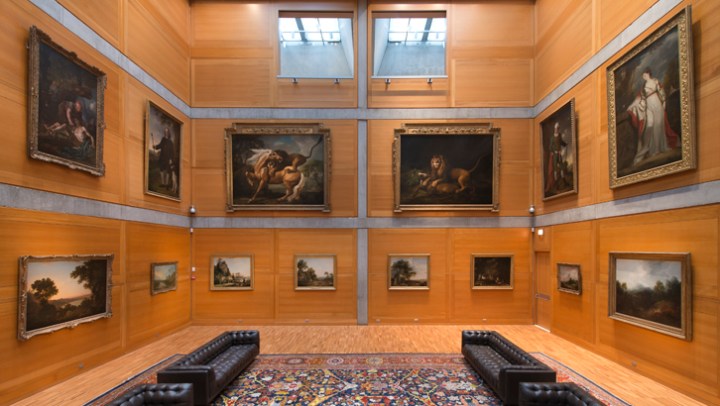
Yale Center for British Art, Library Court following reinstallation facing west, March 2016
Photo by Richard Caspole
◊ ◊ ◊ ◊ ◊
Press release for the reopening of the Yale Center for British Art upon the completion of the interior conservation of its landmark Louis Kahn building:
The Yale Center for British Art will reopen to the public on May 11, 2016, after completing the third phase of a major building conservation project. Visitors to the renovated building will experience a stimulating new installation of the Center’s unparalleled collection of more than five centuries of British art, largely the gift of the institution’s founder, Paul Mellon (Yale College, Class of 1929).
The Long Gallery, located on the fourth floor, will be wholly reconfigured, restoring the original conception of the space as a teaching and study gallery, as formulated by the Center’s founding director, Jules Prown, and as designed by Kahn. Over two hundred works will be installed from floor to ceiling across seven bays. Adjacent to this gallery, in a space that formerly served as an office, will be a new seminar room for faculty, students, and visiting scholars to engage in the close study of collection objects. In addition to the reinstallation of the collection, which explores the theme of “Britain in the World,” the reopening will also feature two special exhibitions.

Yale Center for British Art, fourth floor, Long Gallery following reinstallation, January 2016
Photo by Richard Caspole
◊ ◊ ◊ ◊ ◊
The Center first opened to the public in April 1977, and this project marks the most complex and comprehensive interior conservation work undertaken to date, affecting the entire structure, including the basement and roof. The project features significant mechanical, electrical, plumbing, and telecommunications upgrades, as well as important improvements to accessibility, re prevention systems, and patron amenities.
During the closure, construction crews have been busily restoring the galleries to pristine condition. Old linen and plywood were removed from the permanent walls, the former donated to the Yale School of Art and the latter given to the Hartford Area Habitat for Humanity. After insulation was removed from the exterior walls, the inside of the exterior stainless steel panels was revealed, allowing areas of corrosion to be treated and the interior of the walls to be rebuilt. Two layers of mineral wool insulation were covered with galvanized steel, re-rated plywood, and fresh Belgian linen. Worn synthetic carpet was replaced with new wool carpet, refinished wood trim was installed, and some travertine floor tiles were repaired or replaced. The existing moveable gallery partitions, known as “pogo” walls, were also dismantled, and will be replaced by new ‘pogo’ panels based closely on a drawing produced by Kahn shortly before his death in March 1974.
Extensive renovations also have also been undertaken in the Lecture Hall, which is the only remaining space that has never been refurbished. New seats have been configured in the center of the room, flanked by new steps and railings along each side wall. Five seats for disabled patrons have been installed, each with a companion seat. Audio/visual and lighting upgrades will enable better broadcasting and performance capabilities, including integrated video conferencing. There are also two new accessible public restrooms on the basement level, as well as a bank of new lockers for use by Center visitors.
As with past building conservation projects, the Center has benefited from the expertise and dedication of its partners in the Yale Office of Facilities; Knight Architecture LLC, New Haven; Peter Inskip + Peter Jenkins Architects, London; and Turner Construction Company; as well as the talents and hard work of numerous other collaborators.
This project follows more than a decade of research on the history of the design, construction, and renovation of the Center’s landmark building, as well as the publication in 2011 of Louis Kahn and the Yale Center for British Art: A Conservation Plan by the Center in association with Yale University Press. Written by Peter Inskip and Stephen Gee, in association with Constance Clement, the Center’s deputy director, this book details the conservation plan and proposes a series of policies for the building’s care and maintenance in the years ahead. The first of its kind in the United States, the conservation plan addresses the evolution and appropriate upkeep of a modern building, rather than the preservation of an historic structure, by identifying the key features characterizing its cultural significance and determining those which should be protected and others that could be allowed to change.
The first phase of work to be guided by the conservation plan involved the rehabilitation of the Center’s exterior Lower Court and extensive repairs to the adjacent Lecture Hall Lobby in 2010–2013. This was followed by two additional projects addressing the building’s interior spaces: The second phase, in 2013, focused on refurbishment of the department of Prints & Drawings and Rare Books & Manuscripts. Along with vitally increasing storage capacity for works on paper, behind-the-scenes renovations included the replacement of carpeting and wall coverings; the renewal of the finish on white oak storage cabinets; and the reconfiguration of offices to better accommodate the needs of staff. The third phase, begun in 2015, concentrated primarily on enhancing the Center’s public spaces, while also addressing extensive building-wide mechanical and electrical upgrades, as well as improvements to safety and accessibility.
The Yale Center for British Art houses the largest collection of British art outside the United Kingdom. Presented to the university by Paul Mellon, the collection reflects the development of British art and culture from the Elizabethan period onward. The Center’s collections include more than 2,000 paintings and 200 sculptures, 20,000 drawings and watercolors, 30,000 prints and 35,000 rare books and manuscripts. More than 30,000 volumes supporting research in British art and related fields are available in the Center’s library.
In celebration of the reopening, the Center will host extended hours on Wednesday, May 11, and Thursday, May 12, with special behind-the-scenes tours on opening day. On Saturday, May 14, the Center will welcome the community with a full day of programs and activities. Screenings of a brief documentary on the architecture of the institution’s iconic building, designed by Louis I. Kahn, will be shown in the newly refurbished Lecture Hall. The film will provide insight into the architecture, the building conservation project, and the relationship of the building to the collections. Visitors will be able to tour the reinstallation, which interprets the museum’s extraordinary collections of five centuries of British art in the context of the larger world. The reinstallation is presented in the galleries on the fourth and second floors. The special exhibitions Modernism and Memory: Rhoda Pritzker and the Art of Collecting (May 11–August 21, 2016) and Art in Focus: Relics of Old London (May 11–August 14, 2016) are located on the third-floor galleries. Everyone is welcome. Admission is free.
Exhibition | A Third Gender: Beautiful Youths in Japanese Prints
Press release (via Art Daily) for the exhibition now on view at ROM:
A Third Gender: Beautiful Youths in Japanese Prints
Royal Ontario Museum, Toronto, 7 May — 27 November 2016
Japan Society, New York, 10 March — 11 June 2017
Curated by Asato Ikeda

Suzuki Harunobu, Mitate-e of a Poem by Saigyō Hōshi. 1767/68 (Ontario: ROM, Sir Edmund Walker Collection 926.18.113)
The ground-breaking A Third Gender: Beautiful Youths in Japanese Prints opened at the Royal Ontario Museum on Saturday, May 7, 2016. Featuring stunning woodblock prints, samurai armor, a kimono, screen paintings, lacquerwork, and illustrated books, the exhibition explores issues of gender and tells a pivotal story of sexuality in Japan’s Edo period (1603–1868).
A Third Gender is the first North American display on wakashu. Four hundred years ago in Japan, a complex social structure existed in which gender involved more than a person’s biological sex. Age, position in the sexual hierarchy, and appearance were also considered. Fundamental to this structure were youths termed wakashu. Neither ‘adult man’ nor ‘woman’—each a separate gender—wakashu were objects of desire for both, playing distinct social and sexual roles. Constituting a third gender, they are visually represented in these Edo period woodblock prints.
The exhibition features approximately 60 woodblock prints (ukiyo-e), visually representing wakashu. Many never before displayed, they are from the ROM’s Japanese art collection—the largest in Canada. Produced since the 8th century in Japan, woodblock prints, created collaboratively by a designer, engraver, printer, and publisher, became popular in the 17th century. The exhibition’s prints were created in early 18th to mid-19th centuries by major ukiyo-e masters including Okumura Masanobu, Suzuki Harunobu, and Kitagawa Utamaro.
A Third Gender is curated by Dr. Asato Ikeda, Assistant Professor of Art History at Fordham University, New York and the ROM’s 2014–16 Bishop White Postdoctoral Fellow of Japanese Art and Culture. In Ikeda’s words, “A Third Gender invites ROM visitors to think differently about gender and sexuality and we anticipate the exhibition will be of interest to a diverse audience.”
◊ ◊ ◊ ◊ ◊
From Brill:
Joshua Mostow, Asato Ikeda, and Ryoko Matsuba, A Third Gender: Beautiful Youth in Japanese Edo-period Prints, 1600–1868 (Leiden: Hotei, 2016), 215 pages, ISBN 978-0888545145, $50.
 For the first time outside Japan, A Third Gender examines the fascination with wakashu in Edo-period culture and their visual representation in art, demonstrating how they destabilize the conventionally held model of gender binarism. The volume will reproduce, in color, over a hundred works, mostly woodblock prints and illustrated books from the eighteenth and nineteenth centuries produced by a number of designers ranging from such well-known artists as Okumura Masanobu, Suzuki Harunobu, Kitagawa Utamaro, and Utagawa Kunisada, to lesser known artists such as Shigemasa, Eishi, and Eiri. A Third Gender is based on the collection of the Royal Ontario Museum, which houses the largest collection of Japanese art in Canada, including more than 2500 woodblock prints.
Joshua S. Mostow is Professor of Asian Studies at the University of British Columbia, Vancouver. Asato Ikeda is Assistant Professor of Art History at Fordham University, New York and the ROM’s 2014–16 Bishop White Postdoctoral Fellow of Japanese Art and Culture.
◊ ◊ ◊ ◊ ◊
P R O G R A M S E R I E S
Elements of Sake
3 May 2016
Join Michael Tremblay for an introduction and guided tasting of sake, designed to demystify and engage. This special evening will explore the basics of sake, its production and history, and the culture that created it.
Japanese Visual Culture: Gender and Sexual Diversity
12 May 2016
Asato Ikeda, the curator of A Third Gender, will examine the role of male youths in Edo-period Japan and how this gender and sexuality system can be understood from a contemporary North American perspective.
It’s Complicated: Gender Ambiguity in Early-Mondern Japan
7 June 2016
Explore the roles of gender, sexuality, and erotic art in Japanese culture with internationally renowned scholar Joshua Mostow. Please note this lecture will contain explicit images and discussions of a sexual nature, and is not recommended for those under the age of 18.
Lost in Translation? Gender and Sexuality Across Time and Cultures
21 June 2016
How do we understand representations of sexuality, including same sex sexuality, across different historical and cultural moments without imposing contemporary norms? Join our panel as they explore concepts surrounding our exhibition A Third Gender.
The Art of Japan
16 October 2016
Experience the fundamentals of Japanese art in this in-depth workshop lead by ROM Educator George Hewson. This full day workshop includes a guided visit of the exhibition A Third Gender and lunch.
◊ ◊ ◊ ◊ ◊
Note (added 14 March 2017) — The original posting did not include the Japan Society as a venue.
Jonathan Bober Named Senior Curator of Prints and Drawing at NGA
Press release (6 May 2016) from the NGA:

Jonathan Bober in the prints and drawings study room at the National Gallery of Art, Washington (Photo by Division of Imaging and Visual Services)
Jonathan Bober has been named the National Gallery of Art’s Andrew W. Mellon Senior Curator of Prints and Drawings. Bober’s appointment becomes effective on October 1, 2016, when he succeeds Andrew Robison, who retires from the position on September 30, 2016. Bober will oversee the continuing work and growth of the Gallery’s three departments of prints and drawings that Robison cultivated and nurtured for more than 40 years.
“Jonathan Bober is a brilliant curator and connoisseur with an outstanding track record of exhibitions and publications, and a remarkable degree of knowledge about both prints and drawings,” said Earl A. Powell III, director, National Gallery of Art. “We are delighted that he is assuming this prestigious role in our curatorial ranks.”
Since 2011 Bober has served as curator and head of old master prints at the National Gallery of Art and has played a very active role across the institution, from key acquisitions to mentoring emerging scholars. Bober led the acquisition of some 2,000 prints by purchase, gift, and promised gift, most notably 18th-century Venetian and 19th-century Italian, making the Gallery’s holdings the most significant in the U.S. During his tenure at the Gallery, Bober organized four Gallery exhibitions: The Baroque Genius of Giovanni Benedetto Castiglione (2012), Northern Mannerist Prints from the Kainen Collection (2013), From Neoclassicism to Futurism: Italian Prints and Drawings, 1800–1925 (2014), and Recent Acquisitions of Italian Renaissance Prints: Ideas Made Flesh (2015). Since 2015, Bober has been the Gallery’s curatorial liaison to the Center for Advanced Study in the Visual Arts (CASVA).
The Gallery’s division of old master and modern prints and drawings, with nine curators, oversees one of the nation’s finest collections of works on paper. In total, the Gallery’s collection of prints, drawings, and illustrated books contains approximately 121,000 Western European and American works on paper and vellum dating from the 11th century to the present day.
Bober came to the Gallery in 2011 from the Blanton Museum at the University of Texas at Austin, where he served as a curator since 1987, first as curator of prints and drawings; from 1998 as curator of prints, drawings, and European painting; and from 2010 as senior curator of European art. Prior to his work at the Blanton Museum, he was curatorial associate in the print department of the Fogg Art Museum, Harvard University, from 1984 to 1987, where he completed his graduate work with Sydney Freedberg and Henri Zerner.
Over the course of Bober’s career his exhibitions and publications have focused on old master paintings and old master and modern prints and drawings. They include Luca Cambiaso, 1527–1585, the international loan exhibition of the paintings, drawings, and prints of Luca Cambiaso and his Genoese contemporaries, (co-organized with the Palazzo Ducale, Genoa; Austin, September 2006–January 2007, and Genoa, March–July 2007), and Capolavori della Suida-Manning Collection (co-organized with Giulio Bora, Museo Civico, Cremona, October 2001–April 2002). In addition to catalogs of the Italian drawings in the Fogg Art Museum (1988) and Blanton Museum (2001), and numerous exhibition catalogs at the Blanton, Bober is the author of many catalog essays and scholarly articles appearing in such periodicals as Master Drawings, The Burlington Magazine, and Arte Lombarda. These concern painting and drawing as well as printmaking in 16th- and 17th-century Milan, Cremona, Venice, and Genoa.
Bober acquired for the Blanton Museum 11,000 of its 18,000 works (most with private support), including the extraordinary Suida-Manning Collection of old master paintings and drawings, art critic Leo Steinberg’s extensive collection of old master prints, and many outstanding individual works in the field, including modern and contemporary. In addition to organizing exhibitions from the Blanton Museum’s collection, such as Prints of the Ancien Régime (1996) and The Language of Prints (2008), Bober maintained a rotation of prints and drawings from the permanent collection in seven dedicated galleries. He helped develop the design of the new Blanton Museum and oversaw the creation of a new center for prints and drawings, which opened in April 2006.
Andrew Robison joined the curatorial staff of the National Gallery of Art in 1974, becoming Senior Curator in 1983 and A. W. Mellon Senior Curator in 1991. Over four decades Robison has curated dozens of exhibitions on art from the 15th through the 20th centuries, especially drawings and prints by early German artists, Rembrandt, 18th-century Venetian artists, German expressionists, and Pablo Picasso, as well as the multimedia exhibitions Art for the Nation: Gifts in Honor of the 50th Anniversary of the National Gallery of Art (1991), The Glory of Venice: Art in the Eighteenth Century (1994–1995), Ernst Ludwig Kirchner: 1880–1938 (2003), and Albrecht Dürer: Master Drawings, Watercolors, and Prints from the Albertina (2013).
Exhibition | The British Landscape Tradition
Press release from Pallant House:
The British Landscape Tradition: From Gainsborough to Nash
Pallant House Gallery, Chichester, 11 May – 26 June 2016

Thomas Gainsborough, A Suffolk Lane, 1750–60 (Chichester: Pallant House Gallery)
A new exhibition at Pallant House Gallery showcases the Gallery’s significant but rarely-seen collection of historic works on paper from the 18th to 20th centuries. The exhibition forms a representative overview of depictions of the British landscape, beginning with early watercolours and drawings by Alexander Cozens, Thomas Gainsborough, and John Sell Cotman, to watercolours by 20th-century artists associated with ‘Neo-Romanticism’ in Britain in particular Ivon Hitchens, Paul Nash and Graham Sutherland. The exhibition will go on display in the De’Longhi Print Room at Pallant House Gallery from 11 May until 26 June 2016.
The majority of the Gallery’s collection of historic works on paper were donated by Walter Hussey, Dean of Chichester Cathedral from 1956 to 1978. Best known for commissioning and collecting the work of modern artists such as Moore, Piper, and Sutherland, which formed the founding collection of the Gallery in 1982, Hussey also collected exquisite Old Master watercolours and drawings that are represented in this exhibition.
Although heavily influenced by Dutch landscape paintings, Thomas Gainsborough often travelled into the English countryside, sketching directly from nature in order to record scenes that he thought to be particularly picturesque, such as his drawing A Suffolk Lane (ca. 1750–60). For Gainsborough, landscapes were a relief from painting grand portraits and he wished “to take my viola da gamba and walk off to some sweet village where I can paint landskips and enjoy the fag end of life in quietness and ease.”
Born in Russia, Alexander Cozens is thought to have been the first English artist to work entirely with landscape subjects. Cozens was famous for inventing a ‘blot’ technique in the 1750s, which he developed as a teaching aid to liberate the mind of students, whom he felt spent too much time copying the work of others. His son John Robert Cozens was considered by John Constable to be “the greatest genius that ever touched landscape,” describing his work as “all poetry.” Cozens worked extensively in Italy but concentrated on English subjects in the last decade of his life.
A brilliant watercolourist, John Sell Cotman was one of the leading members of the Norwich School of Artists in the early 19th century. Born in Norwich, Cotman moved to London then toured widely in England and Wales before settling again in Norwich. His watercolour of Capel Curig (ca. 1802) was probably created during his second tour of Wales.
The Welsh countryside was also an inspiration for John Varley who made numerous sketching trips to Wales between 1798 and 1802. His sketches and memories of these trips were used in works he created until the end of his life and include Snowdon (With Lyn Padorn) (ca. 1809), which features in the exhibition.
Artists such as Varley and Cotman were an important point of reference for artists in the early 20th-century such as Paul Nash. Art historian John Rothenstein noted in 1957 that Nash “was too personal an artist to imitate an Old Master, but what he did was to assimilate something of the spirit of Girtin, Cotman and others, and to evolve a free contemporary version of traditional idioms.” In 1929 the critic R. H. Wilenski went so far as to call Nash ‘the John Sell Cotman’ of today.
At the outbreak of the Second World War Graham Sutherland produced a number of paintings based on the view of Sandy Lane in Pembrokeshire. The preliminary studies in the Gallery’s collection for the celebrated completed oil known as Entrance to a Lane in the Tate collection, reveal Sutherland’s process of ‘paraphrasing nature’, drawing on continental abstraction as a way of representing the Welsh landscape in a poetic and modern way.
Also included in the exhibition are several views of the Sussex landscape around Chichester. These include George Romney’s ink and wash view of Eartham Park, the home of his patron William Hayley—a rare example of landscape in his oeuvre. Also featured are watercolours of the South Downs by George Catt (1869–1920), who taught the young Eric Gill at Chichester College, and one of Ivon Hitchens’s earliest known works: Didling on the Downs (ca. 1920) featuring a pastoral scene before he had developed his abstract style of the 1930s onwards.
New Book | Marie-Antoinette
From The Getty:
Hélène Delalex, Alexandre Maral, and Nicolas Milovanovic, Marie-Antoinette (Los Angeles: J. Paul Getty Museum, 2016), 216 pages, ISBN 978-1606064832, $50.
 Marie-Antoinette (1755–1793) continues to fascinate historians, writers, and filmmakers more than two centuries after her death. She became a symbol of the excesses of France’s aristocracy in the eighteenth century that helped pave the way to dissolution of the country’s monarchy. The great material privileges she enjoyed and her glamorous role as an arbiter of fashion and a patron of the arts in the French court, set against her tragic death on the scaffold, still spark the popular imagination.
In this gorgeously illustrated volume, the authors find a fresh and nuanced approach to Marie-Antoinette’s much-told story through the objects and locations that made up the fabric of her world. They trace the major events of her life, from her upbringing in Vienna as the archduchess of Austria, to her ascension to the French throne, to her execution at the hands of the revolutionary tribunal. The exquisite objects that populated Marie-Antoinette’s rarefied surroundings—beautiful gowns, gilt-mounted furniture, chinoiserie porcelains, and opulent tableware—are depicted. But so too are possessions representing her personal pursuits and private world, including her sewing kit, her harp, her children’s toys, and even the simple cotton chemise she wore as a condemned prisoner. The narrative is sprinkled with excerpts from her correspondence, which offer a glimpse into her personality and daily life.
Hélène Delalex is curator attaché at the Palace of Versailles, where Alexandre Maral is curator. Nicolas Milovanovic is curator at the Louvre Museum.










 Enfilade
leave a comment