Exhibition | Faces of Terror: Violence and Fantasy
The exhibition closes in Paris this weekend:
Faces of Terror: Violence and Fantasy from David to Delacroix
Visages de l’effroi: Violence et Fantastique de David à Delacroix
Musée de la Vie Romantique, Paris, 3 November 2015 — 28 February 2016
Musée Municipal, La Roche-sur-Yon, 19 March — 19 June 2016
 With a collection of more than 100 paintings, drawings and sculptures by David, Girodet, Gericault, Ingres and Delacroix, Faces of Terror presents French forms of fantastical Romanticism. This darker part of 19th-century art reveals a certain strength of spirit and provides a fascinating perspective on imagination during the romantic period.
Romanticism, although often reduced to a feeling of discontentment among the people of the 18th century that was generated by the upheavals of the time, without a doubt expresses the feeling of disenchantment of a whole generation, built on the ruins of the Ancien Régime and the tumult of the French Revolution. In the overflow of extreme emotions these artists skilfully found subjects for a new kind of aesthetic, exploring the dark side of the human soul, at a time when dreams and the irrational were emerging from the latency of Reason and the spirit of the Enlightenment period.
From the end of the 18th century, the form of Neoclassicism adopted by the greatest artists depicted the death of heroes and portrayed the violence of tragedies from ancient history, simultaneously justified by both moral values and academic proprieties. Terror, political upheaval and Napoleonic war generated a much more blatant perspective of horror that was no longer the prerogative of historical paintings. During the period of the Restoration of the monarchy, the development of the mainstream press led to broadcasts of reports of bloody violence across the country, which became topical issues for artists.
The Romantic period focuses on the supernatural and sometimes morbid, and depicts—thanks to an abundant but often unknown production of works of art—a crude reality as well as the strange, dusky figures of spectres and devils from the literature and poetry of the time. This dialogue with the supernatural is notably depicted in representations of the myth of Ossian, or in the success of Dante’s work with the torment of the condemned.
Jérôme Farigoule and Hélène Jagot, eds., Visages de l’effroi: Violence et fantastique de David à Delacroix (Liénart, 2015), 288 pages, ISBN: 978-2359061475, 26€.
At Auction | Rare Books at Ketterer Kunst in Hamburg
From Art Daily:

From John Hill, Vegetable System
It is a masterpiece of utmost rarity: the complete series of John Hill’s The Vegetable System (1759–75). The remarkably well-preserved copy will be called up with an estimate of €60,000 in the auction of Rare Books at Ketterer Kunst on 23/24 May (#430). One of the 18th century’s most elaborate botanic publications is thus offered on the auction market. The comprehensive work with 1544 colored copper plates delivers an extensive account of 26,000 different plants. Even the great Carl von Linné, founding father of modern taxonomy, noted in awe: “I almost fainted in the face of the magnificence of Hill’s work…” (Henrey). John Hill dedicated his lifetime achievement, which lead him into bankruptcy despite financially strong sponsors, to the Prince of Wales and later King George III.
A likewise noble provenance is also true for a Book of Hours made in Paris in 1533, as it is inscribed with the autographed ownership entry of the Elector and archbishop of Mainz, Georg Friedrich von Greiffenclau zu Vollrad. He, as well as the other owners, must have cherished the entirely illuminated work very much, since it still is in excellent condition. The price estimate is €20,000.
The work Atlas de la navigation et de du commerce by Louis Renard, published in 1739, carries the same estimate. The splendid work is based on the sea maps by Frederik de Wit; however, each map was thoroughly revised. Additionally, it features an extra world map in two hemispheres. All maps are in excellent print with a fine coloring.
The series of 80 sheets Los Caprichos by Francisco de Goya will be called up with an estimate of €16,000 and promises some excitement in the salesroom. The famous cycle of etchings, in which Goya scorns the church’s errors with bitter mockery and decries the political and social miseries of his days, had already been sold successfully by Ketterer Kunst in 2013 – both in the very rare first edition that was released in Goya’s lifetime (calling price: €96,000, result: €195,000*) as well as in sixth edition (calling price: €9,600, result: €25,000*).
One of the most beautiful and most comprehensive herbal- and medical books from the 15th and early 16th century could perhaps be available for the estimate of €12,000. The Hortus sanitatis, endowed with numerous expressive illustrated woodcuts, covers the drugs extracted from plants, animals, stones and metals and explains their medicinal benefits under the caption ‘operationes’.
The range of offerings is rounded off by George Edward’s work in several volumes Histoire naturelle (estimate: €28,000), as well as the autographed manuscript “The Seals of Obezvelvolpal” by Alexei Michailowitsch Remisov (estimate: €8,500), the first edition of the magnificent publication Paléographie universelle by Joseph Balthazar Silvestre (estimate: €5,000), Georges Bataille’s Histoire de l’oeil (estimate: €3,000), and The American Woods by Romeyn Beck Hough (estimate: €5,000), with more than 940 samples of wood.
Alongside rare books, manuscripts, autographs and decorative prints, the auction also comprises works of maritime and Northern German art. While the latter features works by, among others, Fritz Overbeck (Bergkuppe im Engadin, estimate: €3,000) and Fritz Fleer (St. Christophoros (Entwurfsmodell für St. Christophoros Hamburg), estimate: €2,500), the section of maritime art offers works such as Johannes Holst’s Vollschiff ‘Grossherzogin Elisabeth’ auf bewegter See (estimate: €4,000) and Anton Melbye’s Segelschiff and Besegelter Dampfer auf See vor einer Küste (estimate: €2,500).
Exhibition | Closer: Intimacies in Art, 1730–1930
Now on view at the National Gallery of Denmark:
Closer: Intimacies in Art / Tæt på: Intimiteter i kunsten
Statens Museum for Kunst, Copenhagen, 11 February — 8 May 2016
Curated by Mikkel Bogh

Jean-Siméon Chardin, Soap Bubbles, ca. 1733–34 (New York: The Metropolitan Museum of Art)
Something happened in the eighteenth century. Artists gradually turned their attention away from historic and mythological scenes towards the private, intimate realm.
What do moods and emotions look like when expressed in art? And how can intimacy between people be depicted? The exhibition explores these issues by means of more than a hundred spectacular masterpieces and rarely seen gems from 1730 to 1930. At the same time the exhibition looks at how portrayals of intimacy have changed over time.
The concept of intimacy—the sense of being closely attuned to other people, places, spaces or things—has always been in a state of flux, and this holds true in art, too. In the eighteenth century, artists begin to depict intimacy in portraits featuring the artists with their families. In the nineteenth century, they invite observers to enter the intimate spheres of others in works that depict domestic interiors and everyday scenes. The early twentieth century sees the advent of experimental modern art, and at this point artists seek to forge intimate connections between art and observer. The exhibition relates how art became modern when it began homing in on the human face, the body, and everyday objects.
Delve into great masterpieces as well as previously hidden gems—and explore how they depict intimacies in widely different ways. Some display intimacy through close proximity; others by showing private moments, erotic tension, or through sensuousness, tactility and touch. One of the key examples presented at the exhibition is Jean-Siméon Chardin’s Soap Bubbles, which may cause you to hold your breath in order to avoid puncturing the fragile bubble that the boy strives so hard to keep intact.
You can look behind the surface of things as we reveal what lies hidden underneath a pair of traditional landscape paintings. Hinged on the back of quite innocuous-looking paintings you will find depictions of erotic aspects of intimacy that leave little to the imagination, and which are shown publicly for the first time ever at this exhibition.
Closer also delves down into experimental art from the early twentieth century. For example, it takes a close look at Franciska Clausen’s Cerles et Carré: the play of colour, nuance and shapes on the surface draw observers in, demanding very close scrutiny and a proximity that creates a strong sense of intimacy between work and observer.
The exhibition is curated by the director of the SMK, Mikkel Bogh, who set out to relate the story of how the intimate sphere and the private, personal body entered the realm of art from 1730 to 1930. The exhibition allows you to get close to more than a hundred works of art, exploring intimacies in paintings, sculptures, drawings, prints and photographs—by artists such as Jean-Siméon Chardin, Adolph Menzel, William Bendz, Berthe Morisot and Edvard Munch.
Conference | Leonardo in Britain: Collections and Reception
From the conference programme:
Leonardo in Britain: Collections and Reception
Birkbeck College, The National Gallery, The Warbug Institute, London, 25–27 May 2016
 This conference explore the important role and impact of Leonardo’s paintings and drawings in key British private and public collections. With a focus on the reception of Leonardo in Britain, this conference also looks at the broader British context of the reception of his art and science by addressing selected manuscripts and the first English editions of his Treatise on Painting, as well as historiographical approaches to Leonardo.
Initially conceived as a collaborative project between the late Romano Nanni, former director of the Biblioteca Leonardiana, Vinci and Juliana Barone at Birkbeck College, University of London, the conference has developed into a wider collaboration between these two institutions and the National Gallery, the Warburg Institute, London, and the Kunsthistorisches Institut, Florence. The conference has received support from the Paul Mellon Centre, the British Museum, and the Leonardo da Vinci Society, London.
Each day of the three-day conference will be held at the different partner institutions:
25 May: Birkbeck College, free admission (book tickets)
26 May: The National Gallery, £55/£48 senior citizens/£45 members and Leonardo da Vinici Society members/£28 students
27 May: The Warburg Institute, £15
◊ ◊ ◊ ◊ ◊
W E D N E S D A Y , 2 6 M A Y 2 0 1 6
4.45 Registration
5.15 Welcome and introduction: Juliana Barone (Birkbeck College) and Susanna Avery-Quash (National Gallery)
5.30 Martin Kemp (Oxford University) – ‘Spinning a yarn or two: Leonardo’s two matching Madonnas’
6.30 Drinks
T H U R S D A Y , 2 6 M A Y 2 0 1 6
10.00 Registration
10.30 Welcome and introduction: Juliana Barone (Birkbeck College) and Susanna Avery-Quash (National Gallery)
10.45 Panel 1: Drawings Collections
• Martin Clayton (Royal Collection Trust, Windsor) – ‘The ‘Windsor’ Leonardos after Arundel’
• Jacqueline Thalmann (Christ Church Picture Gallery, Oxford) – ‘Leonardo in the collection of General John Guise (1682–1765)’
• Hugo Chapman and Sarah Vowles (British Museum, London) – ‘Leonardo drawings in Bloomsbury and beyond’
12.45 Lunch break
1.45 Panel 2: Originals, Versions, and Copies
• Carmen Bambach (The Metropolitan Museum, New York) – ‘The St Anne Burlington cartoon: Function, provenance and dating’
• Caroline Campbell and Larry Keith (National Gallery) – ‘Some observations on the provenance and conservation history of the London Virgin of the Rocks’
• Pietro Marani (Università Cattolica, Politecnico, Milan) – ‘Clarifications and novelties on the issue of the copy of the Last Supper at the Royal Academy and its reception in England in the first half of the 19th century’
3.45 Refreshment break
4.15 Panel 3: What Was Thought to Be a Leonardo?
• Margaret Dalivalle (Centre for Medieval and Renaissance Studies, Oxford University) – ‘Said to be of Leonard de Vincia: Or out of his Scoule: Appraising Leonardo in 17th-century England’
• Susanna Avery-Quash (National Gallery) – ‘Sir Charles Eastlake at the National Gallery (1843–1865): Towards a clearer picture of Leonardo as an artist’
F R I D A Y , 2 7 M A Y 2 0 1 6
10.00 Registration
10.10 Welcome and introduction: Juliana Barone (Birkbeck College) and Susanna Avery-Quash (National Gallery)
10.15 Panel 4: Leonardo on Art and Science
• J. V. Field (Birkbeck College) – ‘Leonardo’s after-life in the world of new philosophy’
• Domenico Laurenza (Museo Galileo, Florence) –‘Leonardo’s science in 17th- and 18th-century England: The Codices Leicester, Arundel, and Huygens’
11.30 Refreshment break
12.00 Panel 5: Around the Treatise on Painting
• Juliana Barone (Birkbeck College) – ‘The Treatise on Painting: British collectors’ manuscript copies and the first English printed edition’
• Harry Mount (Oxford Brookes, Oxford) – ‘Leonardo’s Treatise and the empirical undertow in British art theory’
1.15 Lunch (provided)
2.15 Panel 6: Teaching and Theoretical Knowledge
• Charles Saumarez Smith (Royal Academy, London) – ‘Leonardo’s legacy in London: The teaching programme at the Royal Academy’
• Francesco Galluzzi (Accademia Belle Arti, Carrara) – ‘Alexander Cozens, Leonardo da Vinci and landscape painting in England between the 18th and 19th centuries’
3.30 Refreshment break
4.00 Panel 7: Re-reading Leonardo
• Francesca Fiorani (University of Virginia, Virginia) – ‘Kenneth Clark’s Leonardo’
• Alessandro Nova (Kunsthistorisches Institut, Florence) – ‘John Shearman’s Leonardo’
• Claire Farago (University of Colorado at Boulder, Colorado) – ‘Re-reading Richter and MacCurdy in conversation with Carlo Pedretti: Lessons in translation’
5.30 Concluding remarks
Call for Papers | Copies of Paintings in the Iberian World
From H-ArtHist (which includes Spanish and Portuguese versions). . .
Copies of Paintings in Portugal, Spain, and the New World, 1552–1752
Fundação Gulbenkian, Lisbon, 11–12 October 2016
Proposals due by 29 April 2016
The artistic patrimony of Portugal, Spain, and the Latin American countries that once formed part of the Iberian empires includes a great number of pictorial copies made between the sixteenth and the eighteenth centuries. Although on a smaller scale, copies of paintings also circulated and were a part of the heritage of the African and Asian territories that had ties to the Portuguese and Spanish empires. These works have received little attention even though they constitute a valuable source for understanding artistic taste as well as the devotional preferences of Iberian and Latin American society in this period. At the same time, pictorial copies shed light on a number of art historical issues, including the means of diffusion of artistic models, stylistic trends, the kinds of referents available to local painters, and the dynamics of the art market and collecting. Although copies after works by Portuguese, Spanish, and Latin American artists existed, it is notable that copies of famous paintings by Italian and Flemish painters such as Raphael, Titian, Francesco Bassano, Rubens, and Van Dyck were far more abundant. The copies of non-Iberian art are a valuable testimony to the political, commercial, and cultural ties that existed between the Iberian territories and Italy and Flanders.
The international congress Copies of Paintings in Portugal, Spain, and the New World, 1552–1752 invites reconsideration of the topic of the copy in these territories over the course of these two centuries. The period covered begins in 1552, the year in which Antonio Moro arrived in Portugal, and ends in 1752, when the Royal Academy of Fine Arts of San Fernando was established in Madrid. To a certain extent, these events mark the beginning and end of the history of the copy during the early modern period in the Iberian world. This time period also includes the period of sixty years during which Portugal and Spain were unified under the same government owing to the turns of dynastic succession, the so-called period of the ‘two Philips’ (1580–1640). Leaving aside the conflicts that emerged from Iberian union, which would eventually lead to the Portuguese Restauração in 1640, this period saw a rise in the circulation and exchange of sources and ideas between Spanish and Portuguese artistic centers, a circumstance which may also have had repercussions for the production of pictorial copies.
The congress will be organized around the following four sessions:
1. The state of research: Projects completed or currently being undertaken on the copy in Iberia, Latin America and Asia. Artistic Literature and Copies
2. Case studies on Iberia, Latin America and Asia, 1552–1640
3. Case studies on Iberia, Latin America and Asia, 1640–1752
4. Technical research and study: the process of production, under-drawing, priming and grounds, conservation, technical analysis.
Members of the academic community are invited to submit their proposals for this conference before 29 April 2016. Please email abstract proposals (up to 20 lines), including a brief CV (1 page), to copimonarch@gmail.com. Papers will be accepted in Portuguese, Spanish, and English. The committee will inform of their selection to all the applicants in June 2016. A registration fee of 50€ will be required of all participants. The conference is unable to cover travel and accommodation costs for speakers. The organizers encourage interested parties to apply for outside aid from their respective institutions.
The selected speakers will have the option of submitting their papers for publication in a special issue of the journal Revista de História da Arte–Serie W, due to appear in 2017. Papers for publication will have to comply with the journal’s editorial guidelines, including peer review.
Further information on the conference will be available from April 29th 2016 at the conference website.
Organising Committee/ Comissão organizadora/ Comité organizador: Pedro Flor (Universidade Aberta de Lisboa), Susana Varela Flor (Universidade Nova de Lisboa), Luisa Elena Alcalá (Universidad Autónoma de Madrid), David García Cueto (Universidad de Granada) and Carla Mazzarelli (Università della Svizzera italiana)
Sponsored by the Instituto de História da Arte, Faculdade de Ciências Sociais e Humanas da Universidade Nova de Lisboa, the Spanish National Research Project COPIMONARCH (I+D HAR2014-52061-P) at the Universidad de Granada, and the Fundação Calouste Gulbenkian in Lisbon
A Cópia Pictórica em Portugal, Espanha e no Novo Mundo, 1552–1752
La copia pictórica en Portugal, España y el Nuevo Mundo, 1552–1752
Colloquium | Sculpture and Parisian Decorative Arts in Europe, Part II

◊ ◊ ◊ ◊ ◊
From H-ArtHist, with the programme as a PDF file available here:
Le rôle de la sculpture dans la conception, la production, le collectionnisme et
la présentation des arts décoratifs parisiens en Europe, 1715–1815
Centre André Chastel de l’université de Paris-Sorbonne, 14–15 March 2016
Collaboration entre le Centre André Chastel de l’université de Paris-Sorbonne et l’association Low Countries Sculpture, avec nos vifs remerciements pour son soutien à The Boulle Project, Paris. Seconde Partie, suite à la première tenue en 2015 à Mons alors Capitale européenne de la Culture.
Between 1715 and 1830 Paris gradually became the capital of Europe, “a city of power and pleasure, a magnet for people of all nationalities that exerted an influence far beyond the reaches of France,” as Philip Mansel wrote, or as Prince Metternich phrased it, “When Paris sneezes, Europe catches cold.” Within this historical framework and in a time of profound societal change, the consumption and appreciation of luxury goods reached a peak in Paris.
The focus of this one-day international conference will be to investigate the role of the sculptor in the design and production processes of Parisian decorative arts, from large-scale furniture and interior decoration projects to porcelain, silver, gilt bronzes and clocks. In the last few years a number of studies were carried out under the auspices of decorative arts museums and societies such as the Furniture History Society and the French Porcelain Society. It now seems appropriate to bring some of these together to encourage cross-disciplinary approaches on a European level and discussion between all those interested in the materiality and the three-dimensionality of their objects of study.
The relationships between, on the one hand, architects, ornemanistes and other designers, and on the other sculptors, menuisiers, ébénistes, goldsmiths, porcelain manufacturers, bronze casters and other producers, as well as the marchands merciers, will be at the heart of the studies about the design processes. A second layer of understanding of the importance of sculpture in the decorative arts will be shown in the collecting and display in European capitals in subsequent generations, particularly those immediately after the French Revolution, as epitomised by King George IV.
Overall, the intention of this conference is to attempt to shed light on the sculptural aspect of decorative arts produced in Paris in the long 18th century and collected and displayed in the capitals of Europe. Without pretending to be exhaustive, this study day—and its publication—hopes to bring together discussions about the histories and methodologies that could lead to furthering the study of hitherto all too often neglected aspects of the decorative arts.
◊ ◊ ◊ ◊ ◊
L U N D I , 1 4 M A R S 2 0 1 6
Le colloque est accessible gratuitement à tous sur inscription préalable obligatoire par email. Les inscriptions seront clôturées le jeudi 10 mars à minuit.
15.00 Accueil
15.30 Bienvenue et introduction
15.40 Session 1: Collectionnisme et emprunts faits à Paris pour les élites européennes
Président: Peter Fuhring (Fondation Custodia, Paris)
• Lilit Sadoyan (University of California, Santa Barbara / J. Paul Getty Museum, Los Angeles), Collecting at court and beyond: The dissemination and display of Girardon’s sculptural groups
• Jean-Baptiste Corne (École du Louvre / École Pratique des Hautes Études, Paris), Gilles-Paul Cauvet, architecte, sculpteur, graveur, bronzier et collectionneur: un artiste parisien des Lumières?
• Elisabeth Fritz (Universität Jena), Framing the ‘fête galante’ at the court of Frederick the Great
• Giuseppe Dardanello (Università degli Studi di Torino), Francesco Ladatte’s Parisian legacy in the decorative arts in Piedmont
M A R D I , 1 5 M A R S 2 0 1 6
8.30 Inscription au colloque
9.00 Session 2: La représentation d’arts décoratifs sculpturaux
• Ute Christina Koch (LWL-Museumsamt für Westfalen, Münster), From Paris to Dresden: Two recently discovered paintings by Jean-Baptiste Monnoyer and their references to the decoration at the court of Louis XIV
• Miriam Schefzyk (Universität Münster), Les ébénistes allemands à Paris et leurs conceptions sculpturales de meubles (1750–1800): L’exemple des meubles à plaques de porcelaine de Martin Carlin
• John Whitehead (historien d’art), Piat-Joseph Sauvage – une carrière variée: de la peinture monumentale à la miniature en passant par la porcelaine
10.40 Pause café
11.00 Session 3: Le rôle des modèles et la transformation de deux en trois dimensions, I.
Président: Emmanuel Lurin (Centre André Chastel, Université de Paris-Sorbonne)
• Grégory Maugé et Jean-Dominique Augarde (historiens d’art), La sculpture d’André-Charles Boulle et les gravures de Charmeton
• Jarl Kremeier (historien d’art, Berlin), Balthasar Neumann in Paris in 1723: Sculpture and Decoration, Books and Prints
• Léon Lock (université de Leuven), Comment la rocaille parisienne conquit Munich. Le rôle de l’architecte et dessinateur François Cuvilliés (1695–1768)
12.45 Déjeuner
13.45 Session 4: Le rôle des modèles et la transformation de deux en trois dimensions, II.
Président: Antonia Boström (Victoria & Albert Museum, London)
• Alan Darr (The Detroit Institute of Arts), The Role of Sculpture in French Decorative Arts: Case Studies of Notable Acquisitions at the Detroit Institute of Arts
• Laura Langelüddecke (The Wallace Collection, London), Jean-Claude Duplessis père’s designs for the Vincennes/Sèvres manufactory
• Kee Il Choi Jr. (University of Warwick), A Qing imperial portrait as a design source at the Royal Porcelain Manufactory at Sèvres
15.25 Pause café
15.45 Session 5: Nouveauté et continuité dans le rôle de la sculpture entre Louis XVI et Napoléon III
• Alicia Adamczak (Institut catholique de Paris), La sculpture au service des arts décoratifs à l’aube de la Révolution: les ouvrages de Jean-Joseph Foucou pour la duchesse de Mazarin et le comte de Vaudreuil
• Stéphane Laurent (Université de Paris I, Panthéon-Sorbonne), Jean-Baptiste Jules Klagmann, un sculpteur pour les arts décoratifs au dix-neuvième siècle
• Alexandre Gady (Centre André Chastel, Université de Paris-Sorbonne), Jean-Baptiste-Louis Plantar (1790–1879), dernier sculpteur des Bâtiments du Roi
17.30 Conclusions
Call for Papers | Architect-Designed Objects, 1650–1950
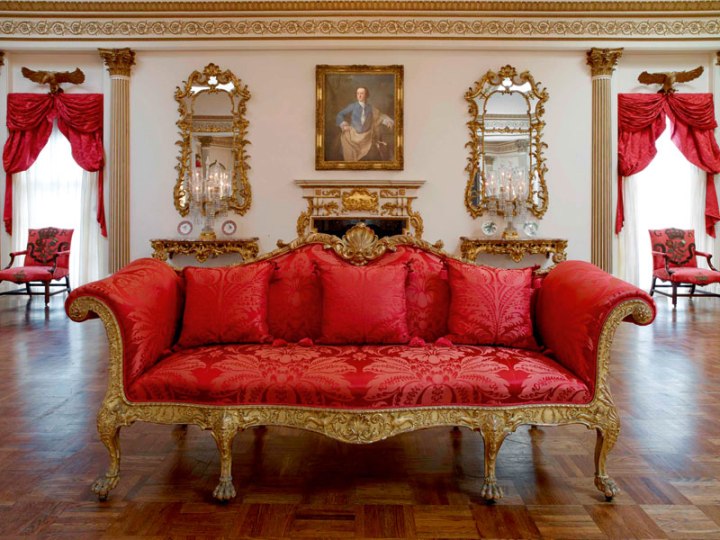
Designed by Robert Adam, made by Thomas Chippendale, The Dundas Sofa, commissioned 1764, made 1765, gilt pine and beech, with later silk upholstery (Museum of Fine Arts, Houston)
◊ ◊ ◊ ◊ ◊
From the MFAH:
A Sense of Proportion: Architect-Designed Objects, 1650–1950
Museum of Fine Arts, Houston, 23–24 September 2016
Proposals due by 15 June 2016 (extended from the original 1 June due date)
Rienzi, the house museum for European decorative arts of the Museum of Fine Arts, Houston, hosts the biennial symposium, A Sense of Proportion: Architect-Designed Objects, 1650–1950. The symposium aims to focus on objects that are the embodiments or extensions of an architect’s ideas or aesthetic. Scholars are asked to discuss objects made for particular spaces, objects used to explore new design sources and objects intended to be part of an integrated space. In short, why do objects that have been designed by architects look the way they do?
Rienzi houses a significant collection of European paintings, sculpture, furniture, porcelain, and silver from the mid-17th through mid-19th centuries. Built in 1953 as a residence and opened to the public as a house museum in 1999, Rienzi evokes fine European houses of the 18th century with architecture reminiscent of the Italian Palladian style, surrounded by period European decorative arts and paintings. Recently, Rienzi acquired the, elegant, nine-foot-long Dundas Sofa, designed by Robert Adam (1728-1792), renowned neoclassical architect of the 18th-century and made by the celebrated English furniture maker, Thomas Chippendale (1718-1779). It is from the only suite of furniture known to be a collaboration between these two masters.
Master’s and doctoral students as well as entry level and mid-career professionals are invited to submit a 400-word abstract outlining a 20-minute presentation, along with a CV, by June 1, 2016. Selected participants will be notified by July 15, 2016 and offered a $600 stipend for travel and lodging. All presentations are given Saturday, September 24, 2016, at the Museum of Fine Arts, Houston. The keynote lecture is held Friday evening followed by a reception at Rienzi.
Possible themes of investigation may include, but are not limited to:
• Interiors
• Design
• Architecture
• Dining
• Privacy
• Leisure Activities
• Etiquette
• Gender
• Costume
• Travel
• Technology
• Economics
◊ ◊ ◊ ◊ ◊
Keynote Address by Adriano Aymonino (University of Buckingham)
Museum of Fine Arts, Houston, Friday, 23 September, 5:00pm
Aymonino obtained his PhD at the University of Venice. His main academic interest is the reception of the classical tradition in the Early Modern period, with a particular focus on Britain. He has held postdoctoral fellowships at the Paul Mellon Centre for Studies in British Art of Yale University and at the Getty Research Institute. He is working on a revised edition of Francis Haskell and Nicholas Penny’s Taste and the Antique, as well as on a project tracing the impact of antiquarian publications on 17th- and 18th-century European art and architecture.
Exhibition | Catwalk: Fashion at the Rijksmuseum, 1625–1960

Mantua purportedly worn by Helena Slicher for her marriage to Aelbrecht baron van Slingelandt on 4 September 1759
(Amsterdam: Rijksmuseum)
◊ ◊ ◊ ◊ ◊
Now on view at the Rijksmuseum:
Catwalk, 1625–1960
Rijksmuseum, Amsterdam, 20 February — 16 May 2016
Curated by Bianca du Mortier; designed by Erwin Olaf
For the first time, the Rijksmuseum presents a large selection of its diverse fashion collection in an exhibition designed by world-renowned Dutch photographer Erwin Olaf.
From February 20 through May 16 2016, six galleries of the Philips Wing will be dedicated to fashion of the Dutch from 1625 to 1960. Starting with garments worn by members of the Frisian branch of the house of Nassau in the Golden Age, the exhibits will feature vibrantly coloured French silk gowns and luxurious velvet gentlemen’s suits of the eighteenth century, classically-inspired Empire dresses, and bustles of the Fin de Siècle—culminating in twentieth-century French haute couture by Dior and Yves Saint Laurent.

Wedding dress, 1759; photo by Erwin Olaf, model is Ymre Stiekema.
As Rijksmuseum Curator of Costumes Bianca du Mortier explains, “The garments presented in this exhibition reflect the stories of the people who wore them. In fashion, the choices of the wearer count—they make him or her a trendsetter or a follower. Even today the clothes of the very rich and powerful always convey a conscious or unconscious message. In that respect, nothing has changed over the last 330 years. These choices are restricted by such factors as budget, opportunity, age, social status, climate, personal likes and dislikes and so forth. And when presented in a museum, there is a final selection: the selection of the Rijksmuseum.”
The exhibition is designed by world-renowned Dutch photographer Erwin Olaf. He states, “The challenge and honour of designing this exhibition . . . for the most extraordinary museum in the Netherlands came at exactly the right moment for me. For several years now I’ve been exploring alternative ways to present my photographic work and to integrate it in installations, sound, video and films as means to immerse viewers in a world that fires and challenges their personal imaginations and, ultimately, sparks a stimulating dialogue between the viewer and the work on view.
Highlights include
• A pair of underpants belonging to Hendrik Casimir I, Count of Nassau Dietz (1612–1640)
• The widest dress in the Netherlands: Helena Slicher’s (1737–1776) wedding gown or mantua, which she supposedly wore at her marriage to Aelbrecht baron van Slingelandt (1732–1801) on 4 September 1759
• An exceptionally precious and fragile dress of blonde silk bobbin lace (1815–1820)
• A silk taffeta cocktail dress by Cristóbal Balenciaga (1951–1952)
The Rijksmuseum’s fashion collection totals some 10,000 items , with men’s, women’s and children’s attire and accessories spanning the period from 1700 until 1960. In addition, the History Department owns the earliest Dutch costumes, worn in the seventeenth century by the Frisian branch of the Nassau family and by the Stadtholder and King William III. Being the oldest costumes collection in the country, having begun in 1870, acquisitions initially emphasized on the eighteenth and nineteenth centuries, but over time gradually expanded to include the first half of the twentieth century. All of the garments comes from the wardrobes of upper-class Dutch men and women, but they were not necessarily made in the Netherlands. Foreign fashion houses and fabrics from all the leading textile-manufacturing countries around the world are amply represented. Acquisitions for the collection are based on historical significance, such as a post-war dress made of silk RAF pilots maps; design relevance, such as Yves Saint Laurent’s 1965 ‘Mondrian dress’; and costume-historical importance, such as a silk taffeta cocktail gown by Cristóbal Balenciaga (1951–1952). Most items were donated or bequeathed, supplemented with purchases.
To coincide with the exhibition, the Rijksmuseum is publishing a richly illustrated ‘Collection Book’ – Costume & Fashion, authored by Curator of Costumes Bianca du Mortier, with contributions from the museum’s textile restorers, fellow conservators, and a specialized colour analyst. The photography is by Rijksmuseum photographer Carola Van Wijk in collaboration with Frans Pegt. Various activities will be organized in conjunction with the exhibition, including a series of lectures by the catalogue’s authors and external experts.
◊ ◊ ◊ ◊ ◊
Symposium | Fashion in Museums: Past, Present, and Future
Rijksmuseum, Amsterdam, 21–22 April 2016
Not only the curator’s and conservator’s point of view will be presented, but also the administrator’s—who is often unfamiliar with costume and fashion’s different requirements and has to be convinced of the steep costs of a fashion exhibit. Experts from leading national and international institutions will present their insights: a conference not to be missed!
Over the past two decades most of the blockbuster fashion exhibitions around the world have centered around present day fashion designers and were more or less offered to the respective institutions as a complete package including the extensive marketing and publicity apparatus of the fashion brand. This is a far cry from Diana Vreeland’s original concept (1983–84) of a museum celebrating a contemporary designer—in her case Yves Saint Laurent—by presenting a retrospective curated by the museum and presented by them.
In a speech delivered by renowned fashion journalist Suzy Menkes (International Vogue Editor) at the Rijksmuseum in June 2015 she called for a return to museum curated exhibitions based on in-depth research of their own collections which hold so many amazing yet unexplored treasures. With the exhibition Catwalk, Fashion at the Rijksmuseum, the museum puts a renewed step in this direction by presenting a cross-section of its costume collection—the oldest in the country—in a setting designed by renowned Dutch photographer, Erwin Olaf.
Speakers
• Gieneke Arnolli (Fries Museum, Leeuwarden)
• Ninke Bloemberg (Centraal Museum, Utrecht)
• Bianca du Mortier (Rijksmuseum)
• Johanna Hashagen (Bowes Museum, UK)
• Johannes Pietsch (Bayerisches Nationalmuseum, Munich)
• Ellinoor Bergvelt and Christine Delhaye (University of Amsterdam)
• Angelika Riley (Museum für Kunst und Gewerbe Hamburg)
• Alexandra Bosc (Palais Galliera, Musée de la mode de la Ville de Paris)
• Mila Ernst (Digitaal platform Modemuze)
• Sue-an van der Zijpp (Groninger Museum)
Details are available here»
Exhibition | Heavy Retro: Painted Furniture, 1750–1850
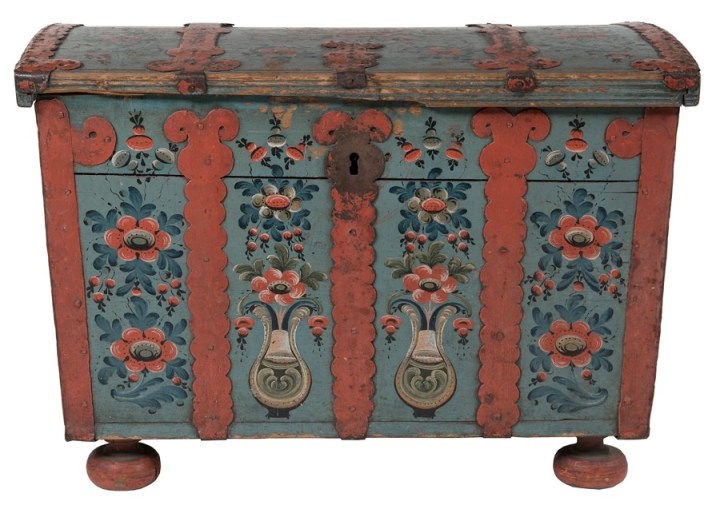
Painted chest, inscribed P.J.D 1802.
◊ ◊ ◊ ◊ ◊
Now on view at Stockholm’s Nordic Museum:
Rejält Retro: Målade Allmogemöbler, 1750–1850
Nordiska Museet, Stockholm, 21 October 2015 — 4 September 2016
The well-made, durable, patterned, and colorful are clear trends today, and just what characterizes rustic furniture from the 1700s and 1800s. Rejält Retro features grandfather clocks, cabinets, boxes, and chests—over fifty items from across the country, against a contemporary background in unexpected combinations.
◊ ◊ ◊ ◊ ◊
Det välgjorda, hållbara, mönstrade och färgstarka är tydliga trender idag, och precis vad som utmärker allmogemöblerna från 1700- och 1800-talen. I Rejält retro visas golvur, skåp, skrin och kistor, drygt femtio utvalda statusobjekt från hela landet, mot en modern bakgrund i oväntade kombinationer.
Vilka är dagens statusmöbler? En exklusiv soffa kanske? Danskt 50-tal eller modernisternas designikoner? I en välbärgad bondgård för 200 år sedan motsvarades de av kistan, skrinet, skåpet och golvuret. Mycket var väggfast och platsbyggt men det här var möbler man kunde ta med sig om man flyttade. Och med stora ytor perfekta för målad dekor.
Skåpet var den möbel som ett nygift par vanligtvis skaffade när de skulle sätta bo. Helst ett som stod på golvet, ett ståndskåp, med både hans och hennes initialer. Kistan hade den nygifta kvinnan med sig till det nya hemmet, fylld med dyrbara inredningstextilier. En möbel med gamla anor och högt symbolvärde. Skrinet hade ett symboliskt värde som förvaring för trolovningsgåvan – handskar, psalmbok och sjal. När kvinnan i vittnens närvaro tackat ja till skrinet var trolovningen klar och offentliggjord. Golvuret var precis som skåpet en modebetonad statusmöbel. Få använde det som klocka. Många urverk tillverkades i Mora och såldes över hela landet. Men själva möbeln, golvursfodralet, tillverkades lokalt.
Allmogekonst är konst skapad av folk på landet, för folk på landet. Under ungefär hundra år, från mitten av 1700-talet till mitten av 1800-talet, blomstrade allmogens möbelmåleri. Det typiska för dessa möbler är stiliserade mönster, starka färger som blymönjerött och pariserblått, att flera stilar blandas och att hela ytan fylls ut med dekoration. Allmogemålarnas ambition var att göra mönster, inte att avbilda verkligheten.
Reportage från lyxiga hem påverkar hur vi inreder hemma i dag och så även förr. I vissa områden är allmogemöblerna tydligt påverkade av herrgårdsmodet och de möbler som tillverkades av städernas skråsnickare. Då är motiven också mer verklighetstrogna.
Six-Week Online Course | The Gothic Revival, 1700–1850
◊ ◊ ◊ ◊ ◊
From Open Education:
Six-Week MOOC | The Gothic Revival, 1700–1850: Interdisciplinary Perspectives
Beginning 29 February 2016
Taught by Dale Townshend and Peter Lindfield
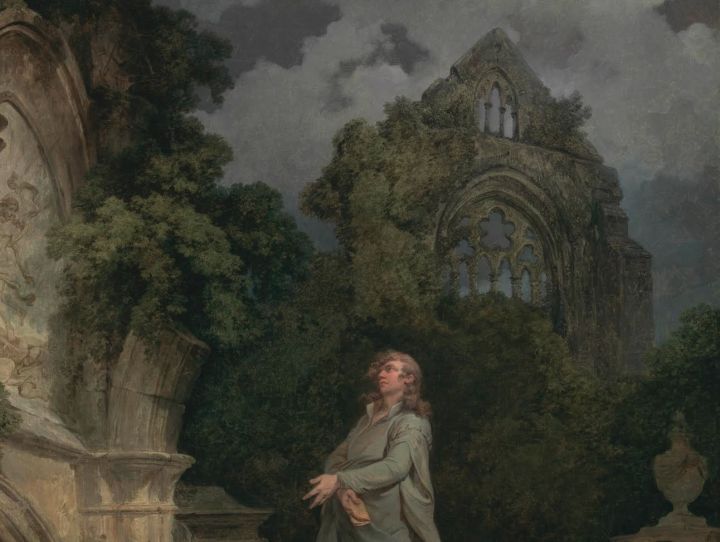
Designed for the non-specialist learner, this six-week course is intended as an introduction to the inter-disciplinary dimensions of the Gothic Revival in British culture of the long eighteenth century (1700–1850). Over 6 weekly sessions, you will be guided by acknowledged experts in the field of Gothic studies through the following topics:
1 Introduction, and the Meanings of the Term ‘Gothic’ in the Eighteenth Century
2 An Introduction to Gothic Literature: Horace Walpole’s The Castle of Otranto (1764)
3 Gothic Literature after Walpole
4 The Gothic Revival in Architecture
5 Gothic Interiors in the Eighteenth Century
6 Gothic in Eighteenth-Century Visual Art
The MOOC commences on Monday 29 February 2016. Each session consists of three mini-lectures, quizzes, the use of reflective diaries, and peer discussion. Your tutors will be available for a one-hour live Question and Answer session per week. Further details about this will follow in due course.
Prerequisites: None, other than an abiding interest in the early Gothic aesthetic.
Time Commitments: Approximately 1 hour of formal instruction time per week, excluding your own personal study and reading.
Rules of Progression: Each successive week will only become available to you once you have completed the quiz for the previous week. Although these weekly exercises to do not count towards your certificate of completion, you are encouraged to complete them in preparation for the final quiz.
Certificates of Completion: Proof of having successfully completed the MOOC will be available at the end of the course. In order to qualify for a certificate, you will have to have scored at least 50% in the final quiz, an informal test comprised of a selection of questions encountered in earlier sessions.
Instructors: Dale Townshend (Senior Lecturer in Gothic and Romantic Studies Division of English Studies, University of Stirling) and Peter Lindfield (Postdoctoral Research Fellow, Literature and Languages, University of Stirling)
◊ ◊ ◊ ◊ ◊










 Enfilade
leave a comment