New Book | Benjamin Franklin in London
From Yale UP:
George Goodwin, Benjamin Franklin in London: The British Life of America’s Founding Father (New Haven: Yale University Press, 2016), 400 pages, ISBN: 978-0300220247, $32.50.
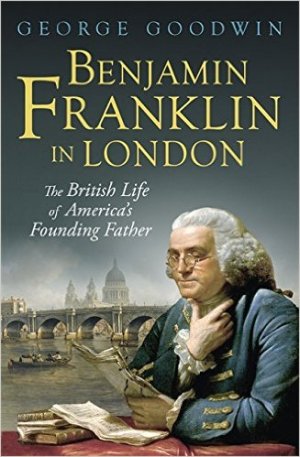 For more than one-fifth of his life, Benjamin Franklin lived in London. He dined with prime ministers, members of parliament, even kings, as well as with Britain’s most esteemed intellectuals—including David Hume, Joseph Priestley, and Erasmus Darwin—and with more notorious individuals, such as Francis Dashwood and James Boswell. Having spent eighteen formative months in England as a young man, Franklin returned in 1757 as a colonial representative during the Seven Years’ War, and left abruptly just prior to the outbreak of America’s War of Independence, barely escaping his impending arrest.
In this fascinating history, George Goodwin gives a colorful account of Franklin’s British years. The author offers a rich and revealing portrait of one of the most remarkable figures in U.S. history, effectively disputing the commonly held perception of Franklin as an outsider in British politics. It is an enthralling study of an American patriot who was a fiercely loyal British citizen for most of his life—until forces he had sought and failed to control finally made him a reluctant revolutionary at the age of sixty-nine.
George Goodwin is the author of numerous articles and two previous histories, Fatal Colours: Towton 1461 and Fatal Rivalry: Henry VIII, James IV, and the Battle for Renaissance Britain. He is currently Author in Residence at the Benjamin Franklin House in London and was a 2014 International Fellow at the Robert H. Smith International Center for Jefferson Studies, Monticello. He lives close to London’s Kew Gardens.
◊ ◊ ◊ ◊ ◊
C O N T E N T S
Prologue
Life Before London
A Young Man in London
Foundations
Conductor
Return to London
A London Life
Benjamin Franklins British Family
Moves and Countermoves
Intermission
The Stamp Act
Pivotal Years
12 Home Comforts and Discomforts
Seeking Balance
Movements
Drawn to the Cockpit
The Last Year in London
A Little Revenge
Selected Places to Visit and Related Organizations
Bibliography
Notes
Acknowledgements
Index
Redwood Library Acquires Collection of Early Modern Architecture Books

Redwood Library and Athenaeum in Newport, Rhode Island, with Harrison’s Mirror mounted on the front pediment of the 1750 building, designed by Peter Harrison; the mirror was one element of the installation exhibition To Arrive Where We Started by Peter Eudenbach (July 2012 — July 2013).
◊ ◊ ◊ ◊ ◊
From Art Daily (17 February 2016) . . .
The Redwood Library and Athenaeum—a hybrid historic site, museum, rare book repository, and the oldest continuously operating lending library in America (1747)—has acquired a comprehensive collection of seventeenth- and eighteenth-century British architecture books and building manuals from the antiquarian bookseller Charles Wood. Comprising 53 titles, the collection deepens the Library’s already significant holdings of material devoted to early modern architecture and design, one of its cornerstone collecting areas. The acquisition was made possible by a grant from the B.H. Breslauer Foundation, as well as from donations from a number of local and national benefactors.
 “By virtue of what the Redwood is—the country’s oldest public Neo-Classic structure and a touchstone of the nation’s architectural patrimony—we are duty bound to remain a center for the study of early American architecture,” said Benedict Leca, Executive Director of the Redwood Library. “This collection dovetails perfectly with our existing holdings, notably the Cary Collection of supremely rare eighteenth-century pattern books, and exemplifies our commitment to the scholarly interpretation of our own building and those of colonial Newport.”
Newport’s historic center of learning and a designated national landmark, the Redwood Library has been serving New England and beyond as a resource supporting the range of intellectual pursuit for nearly three hundred years. In a city especially known today as a hub of historic preservation, garden design and place making, the Redwood endures as a locus of research in these domains through a constellation of related collections, making this acquisition especially pertinent.
The Redwood’s Newport Collection, an indispensable trove when researching Newport and Aquidneck Island, comprises over 5,000 books and hundreds of archives and manuscripts. The Doris Duke Preservation Collection focuses on New England colonial and nineteenth-century architecture, with an emphasis on the preservation and restoration of both the exterior architectural structure, including windows, doors and moldings, and on interior decorative elements, such as wallpaper and textiles. The Dorrance Hamilton Gardening Collection currently holds over 500 titles of landscape architecture, classic ‘how-to’ guides by important historic designers, such as Geoffrey Jellicoe and Lancelot ‘Capability’ Brown, as well as a number of discerning treatments of historic world gardens. The Cynthia Cary Collection, collected over decades by Mr. and Mrs. Guy Fairfax Cary, Sr., contains nearly 200 fifteenth- to mid-nineteenth-century English and continental pattern books of furniture, decoration, and ornament. All of these collections are a resource for scholars from all over the world, and continue to grow through the acquisition of primary works and authoritative scholarly titles.
“This outstanding collection is particularly noteworthy as it is a blend of builder’s manuals on one hand, and of illustrated, so-called gentlemen’s folios on the other,” specified Benedict Leca. “It gives us a window not only on period building techniques, but also on the diffusion of architectural knowledge, its styles and fashions, by way of some real rarities. The Scamozzi Mirror of Architecture, for example, was often used practically by builders and thus literally consumed; for this reason it rarely survives complete. Of appeal to the connoisseur rather than the builder is a very rare suite of nine copperplate engravings of Chinese lattice designs by William Halfpenny, with the only two other known copies at the British and Avery libraries.”
Further highlights from the collection include a number of rare manuals and pamphlets, including Henry Cook’s Patent artificial slate manufactory (1786), one of only three copies listed in the National Union Catalog (NUC); Abraham Fletcher’s The Universal Measurer (1766), one of only six copies on OCLC; and The Rudiments of Architecture or the Young Workman’s Instructor (1775), one of only two known copies, the Redwood’s having an eighteenth-century Boston provenance. The folios include a copy of the now scarce pattern book produced by Abraham Swan, The British architect or the builder’s treasury of stair-cases (1765?); and Christopher Wren Jr’s Parentalia: or memoirs of the family of Wrens (1750), an exceptional copy complete with the often-missing mezzotint frontis portrait of Wren.
New Book | Parsonages
From Bloomsbury:
Kate Tiller, Parsonages (New York: Bloomsbury Shire Publications, 2016), 88 pages, ISBN: 978-1784421373, $15.
 From the Middle Ages to the present day, parsonages—vicarages, rectories, and later manses, presbyteries, and chapel houses—have been among the most significant dwellings in every kind of British community. Their roles have been wide and varied. Architecturally important, and ranging from medieval vernacular buildings to the bespoke house designs of leading architects of the nineteenth and twentieth centuries, to the more modest homes of today’s clergy, parsonages are important not only as buildings but for the part they—and their occupants—have played in the life of local communities, and in their links with the wider world. The parsonage, a hub of activity and connection, a place of change and continuity, provides fascinating historical insights both general and local. This study draws on the evidence of architecture, official documents, private records, literary accounts, and contemporary and modern images to build a picture of parsonages and their occupants. It includes a section on tracing the history of a parsonage.
C O N T E N T S
Parsonage Histories: Houses, Priests and People
Setting the Pattern: Medieval Priests’ Houses
The Post-Reformation Parsonage
Georgian Parsonages: A Golden Age?
Victorian and Edwardian Heyday
Vicarages and Rectories: The Recent Past
Further Reading
Tracing the History of a Parsonage: A Checklist of Sources
Index
Summer Course Offerings at Sotheby’s, 2016

◊ ◊ ◊ ◊ ◊
Among the course offerings this summer at Sotheby’s (for undergraduate credit). . .
European Decorative Arts: From Baroque to Art Nouveau
Sotheby’s Institute of Art, London, 31 May — 24 June 2016
Beginning in the seventeenth century with the rise of the Baroque and culminating in Art Nouveau at the end of the nineteenth, this varied and exciting course provides a comprehensive understanding of key stylistic developments in Western European design and the decorative arts. The course focuses on furniture, ceramics, glass and metalwork, explored within the context of architecture and interiors and the broader historical and cultural forces that have influenced the production and consumption of decorative art objects. It seeks also to provide students with a basic knowledge of materials and techniques.
A diverse programme of lectures is complemented by visits to leading museums, galleries and historic houses. Students are taught by a range of in-house tutors and visiting experts from the art world. The course is introductory and requires no prior knowledge. The teaching approach is object-based and enables students to gain confidence in analyzing and identifying a wide range of art objects. It promotes skills that will be useful for working in the art world and also serves as a bridging course for further study. Faculty: Helena Pickup (Course Leader), Lis Darby, Anne Ceresole, Daniel Packer, Elisabeth Bogdan.
◊ ◊ ◊ ◊ ◊
London, Art Capital of the World, 1700–2000
Sotheby’s Institute of Art, London, 28 June — 22 July 2016
The history of the market holds valuable lessons for those hoping to work in the commercial art world. London has been synonymous with the exhibiting, collecting, buying, and selling of art for centuries. This course will provide an in-depth exploration of the institutions, personalities, and locations that have made London the epicenter of the art world, historically and today. With many of these historic works and buildings still in existence and accessible, students will experience themselves how the art scene evolved along with the city itself. We will examine the key factors that led to an increase in the demand for fine arts and how London emerged as the favored location for auctions in the eighteenth century. The connection between opportunities to view works of art and the growth of collecting will be analyzed, as will the impact of the market on ‘native’ artists. Students acquire an understanding of the history of the art market, collecting, and museums. A comprehensive course of lectures is enhanced by visits to galleries, museums, and auction houses. Faculty: Elizabeth Pergam.
New Book | Architecture and Empire in Jamaica
From Yale UP:
Louis P. Nelson, Architecture and Empire in Jamaica (New Haven: Yale University Press, 2016), 324 pages, ISBN: 978-0300211009, $85.
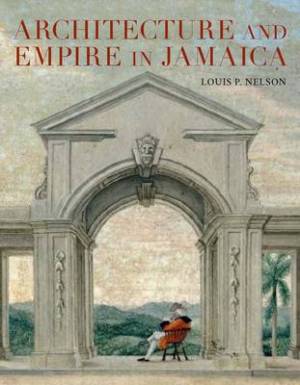 Through Creole houses and merchant stores to sugar fields and boiling houses, Jamaica played a leading role in the formation of both the early modern Atlantic world and the British Empire. Architecture and Empire in Jamaica offers the first scholarly analysis of Jamaican architecture in the long 18th century, spanning roughly from the Port Royal earthquake of 1692 to Emancipation in 1838. In this richly illustrated study, which includes hundreds of the author’s own photographs and drawings, Louis P. Nelson examines surviving buildings and archival records to write a social history of architecture.
Nelson begins with an overview of the architecture of the West African slave trade then moves to chapters framed around types of buildings and landscapes, including the Jamaican plantation landscape and fortified houses to the architecture of free blacks. He concludes with a consideration of Jamaican architecture in Britain. By connecting the architecture of the Caribbean first to West Africa and then to Britain, Nelson traces the flow of capital and makes explicit the material, economic, and political networks around the Atlantic.
Louis P. Nelson is professor of architectural history and associate dean for research in the School of Architecture, University of Virginia.
University of Buckingham’s MA in Decorative Arts and Historic Interiors
MA in French and British Decorative Arts and Historic Interiors
University of Buckingham
Applications are invited for a partial studentship on the London-based MA in Decorative Arts and Historic Interiors offered by the University of Buckingham starting in September 2016.
The bursary, worth £7500, will cover 82% of the course fees for EU students and 55% for international students. Priority will be given to applicants with excellent academic qualifications seeking, or currently pursuing, curatorial careers in museums or the built heritage. The bursary is also open to part-time students currently working in the field, who can take the course as a form of in-service training over two years.
This unique one-year MA in French and British Decorative Arts and Historic Interiors provides sounds vocational and academic training, first-hand study of furniture, silver and ceramics in the context of historic interiors, numerous study trips to museums and historic house collections, (including a study week in Paris) and placements in museums and heritage institutions.
For further details please visit our website or contact Dr Barbara Lasic: barbara.lasic@buckingham.ac.uk
Display | John Cornforth, A Passion for Houses
Now on view at the Paul Mellon Centre:
John Cornforth, A Passion for Houses: Material on the
Georgian Town House from the Cornforth Library Donation
Paul Mellon Centre for Studies in British Art, London, 8 February — 27 May 2016
Curated by Charlotte Brunskill, Frankie Drummond Charig, Emma Floyd, and Jenny Hill
The second Drawing Room Display, curated by Research Collections staff, focuses on material donated to the Paul Mellon Centre from the Estate of John Cornforth. The display concentrates on the town house in the 18th century and will run from February until May 2016.

Bookplate for John Cornforth, designed by Reynolds Stone (1909–1979).
John Lawley Cornforth (1937–2004) was an architectural historian who wrote numerous articles for Country Life from 1961 to 1993 and worked for the National Trust for many years. His specialism was the 17th- and 18th-century country house, but he also wrote extensively on the town house and its interiors. John Cornforth’s personal working library was donated to the Paul Mellon Centre, through the auspices of the National Trust, in August 2004, shortly after his death. This collection, from which staff selected nearly 800 books and journals, increased the Centre’s already extensive holdings on the history of the town and country house and added considerably to the previously small collection on eighteenth-century decorative arts. He also donated to the Centre’s Photographic Archive the collection of photographs taken for his book, Early Georgian Interiors, published posthumously by Yale University Press for the Paul Mellon Centre in 2004.
The display consists largely of materials donated from Cornforth’s collection but will also include a number of works about John Cornforth or written by him drawn from the rich holdings of the Centre’s library. The holdings relating to John Cornforth are just one of the many points of entry to study the town house of the 18th century in the Research Collections. The Centre’s Archive holds relevant material in, for example, the Oliver Millar Archive and the Brinsley Ford Archive on interiors and architects for this period.
This display is the second in a series featuring material drawn from the Paul Mellon Centre’s own Research Collections. Display and accompanying booklet produced by Charlotte Brunskill, Frankie Drummond Charig, Emma Floyd and Jenny Hill.
The 24-page booklet is available here»
Exhibition | Versailles and American Independence
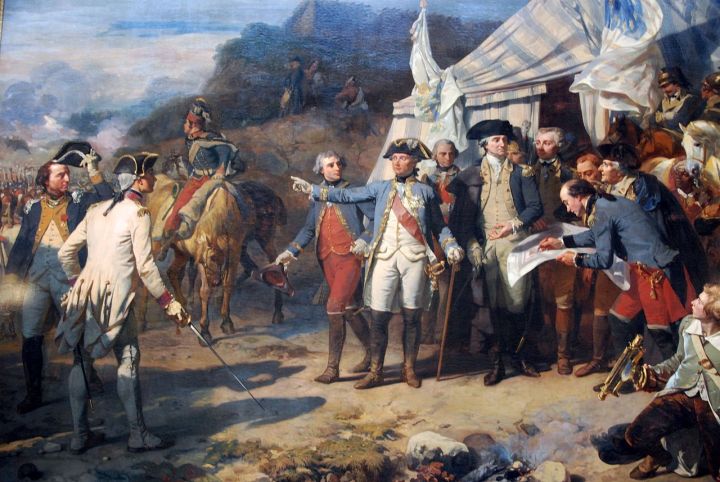
Auguste Couder, Siege of Yorktown: General Rochambeau and General Washington Give Last Orders before an Attack, October 1781, oil on canvas, 1836 (Versailles, via Wikimedia Commons)
◊ ◊ ◊ ◊ ◊
This summer at Versailles:
Versailles and American Independence / Versailles et l’Indépendance américaine
Château de Versailles, 5 July — 2 October 2016
This exhibition aims to reveal the importance of Franco-American relations at the end of the French Ancien Régime. By assisting the rebels, King Louis XVI showed he was in favour of new ideas, and for nearly a decade the Palace of Versailles, the centre of French government and authority, was a key location for independence and its promotion. The political and military alliance between France and the United States had a lasting effect on artistic principles; there was no such thing as major or minor art, as the infatuation with America found a unique place in everyday objects at Court and in popular American, English and French posters.
Note (added 13 July 2016) — A more complete posting for the exhibition is available here.
Lecture | Philip Morgan on Slavery at Mount Vernon
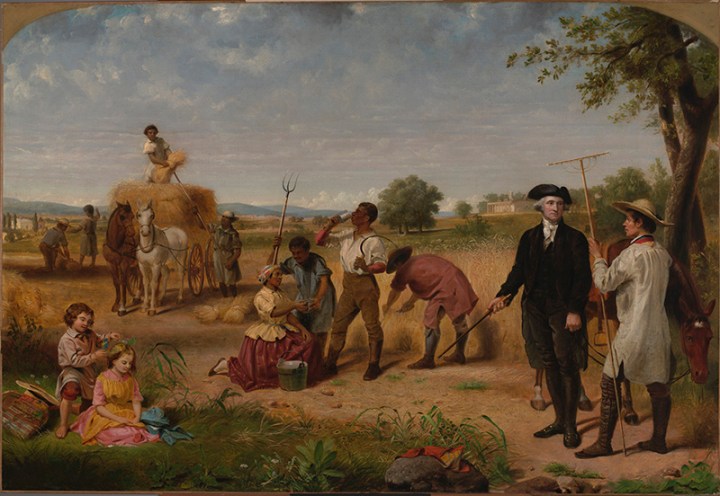
Junius Brutus Stearns, George Washington as a Farmer at Mount Vernon, 1851 (Richmond: Virginia Museum of Fine Arts; photo by Katherine Wetzel). Information on the painting from Colonial Williamsburg.
◊ ◊ ◊ ◊ ◊
From the Homewood Museum at Johns Hopkins:
Philip Morgan, Entangled Lives: Slavery at George Washington’s Mount Vernon
Johns Hopkins University, Baltimore, 18 February 2016
The fifth-largest slave owner in Virginia by the late 1780s, George Washington constantly struggled with the tangled web of slavery despite his personal desires to eliminate it from his life. In this lecture illuminating the lived experience of slavery, historian Philip Morgan will share the ways in which master and slaves, whites and blacks, interacted at Washington’s Mount Vernon plantation with special focus on the workplace, families and resistance.
A reception with the speaker will precede the lecture at 5pm. The lecture, at 6pm, is presented in celebration of African-American History Month by Homewood Museum, the former country house and slave-holding farm of the Carroll family in the early decades of the nineteenth century. Admission is free; however, reservations are requested. Walk-in registration is based on seating availability. The reception and lecture will be held in the Mason Hall Auditorium: 3101 Wyman Park Drive, Baltimore, MD 21211.
Philip Morgan is the Harry C. Black Professor of History at Johns Hopkins University and one of the leading specialists on the history of the Atlantic world.
Additional information on Morgan’s work on slavery at Mount Vernon is available from George Washington University.
◊ ◊ ◊ ◊ ◊
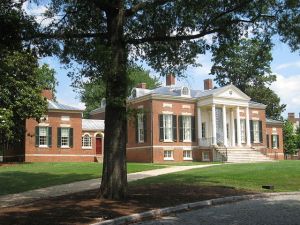
Homewood Museum, Johns Hopkins University, Baltimore. Photo: Wikimedia Commons, July 2008.
Located on the Johns Hopkins University campus, Homewood Museum offers visitors the chance to explore diverse interests in tremendous depth and provides an intimate look at life in early-19th-century Baltimore. The museum’s collections consist of fine and decorative arts objects representative of the furnishings during the Carroll family’s occupancy (1802–1833). Some works have direct affiliation with the Carroll family. The majority of the collection is American, with a strong concentration in high-quality Baltimore furniture of the period. English ceramics, silver, and furniture, as well as items of Chinese and French manufacture, are reflective of the imports available in early-19th century Baltimore.
Marriage Contract with Signatures of Napoleon and Josephine
From NYC-based Lion Heart Autographs:

Marriage contract between General Pierre Augustin Hulin and Jeanne Louise Fiersommier, which includes signatures of Napoleon and Josephine Bonaparte, May 1804.
Lion Heart Autographs—for nearly forty years an internationally recognized dealer of autographs and manuscripts focusing on art, history, literature, music and science—has announced an extraordinary opportunity to acquire the finest marriage document ever signed by Napoleon and Josephine. This rare Valentine’s Day opportunity celebrates history’s most romantic and often controversial couple: Napoleon and Josephine. Lion Heart’s rare and evocative marriage contract is not only signed by the historic couple, but by other French notables, including six of Napoleon’s original eighteen marshals (the highest military rank during the Empire). The Valentine’s Day presentation of such a unique, historical document marks the first time Lion Heart Autographs has offered it for sale; it is one of only a handful known to exist in private hands. Lion Heart Autographs will display the document at The Palm Beach Jewelry, Art & Antique Show at the Palm Beach County Convention Center, February 10–16, 2016, where it will be offered for $20,000.
Marie-Josèphe-Rose Tascher de La Pagerie, known as Josephine, was one of the most celebrated women of the 19th century, playing a colorful and pivotal role in the life of her six-year-younger husband, Napoleon Bonaparte. She was one of the most important women in the salons of Paris and her tumultuous love affair with General Bonaparte is well documented. Glamorous and a well-connected socialite, Josephine engaged in several love affairs with highly placed political and military leaders after the failure of her first marriage. Bonaparte, immediately smitten by her upon their first meeting, wed Josephine on March 9, 1796 only a few days before he left on his Italian campaign. During his absence he sent the first of many love letters he would pen throughout their marriage.
Napoleon and Josephine’s marriage was opposed by many members of his family because she was an older widow with children. His mother and sister were especially upset declaring that his new wife considered them well below her status. During Bonaparte’s 1799 Egyptian campaign Josephine purchased the Chateau de Malmaison near Paris taking a special interest in gardens and becoming proficient in botany and horticulture.
Throughout history stories are told of Napoleon and Josephine’s constant separations and rumors of her interest in other lovers. Infidelities troubled the marriage from the start although the couple renewed their marriage vows on December 1, 1804. The following day Napoleon was crowned Emperor and she Empress. The coronation became one of the most famous events of European history, but Josephine’s inability to give birth to a son strained their marriage, and in 1810, Napoleon had the marriage annulled on the pretext that a parish priest had not been present at the original ceremony. Nonetheless, Napoleon and Josephine remain one of history’s most famous couples. The former Emperor’s last words were reported to be “France, armee, tete d’ armee, Josephine.” (France, army, head of the army, Josephine).
The contract witnessed by Napoleon and Josephine celebrates the marriage between General August Hulin (1758–1841) and Marie Jeanne-Louise Tiersonnier (1782–1826). Hulin was an infantryman who rose through the ranks to join the Gardes Français. In the days leading to the storming of the Bastille in 1789, Hulin gave several inflammatory speeches, and on July 14, he organized a small band of armed men at the Hôtel de Ville, marched them to the Bastille where they opened fire and liberated the prisoners. It was this act that sparked the French Revolution. Though recognized as a hero, Hulin was imprisoned during the Reign of Terror. He later rejoined the army and served as an officer during the Napoleonic Wars and as military governor of Paris during Napoléon’s 1812 Russian campaign, where he suppressed a coup against the emperor.
In addition to Napoleon and Josephine’s signatures, the contract is signed by a remarkable cast including six of Napoleon’s original 18 marshals: John Baptiste Bessiers (1786–1813), Louis Nicholas Davout (1770–1823), Andre Massena (1758–1817), Edouard Adolphe Casimire Mortier (1768–1835), Joachim Murat (1767–1815; Napoleon’s brother-in-law and future King of Naples), and Catherine-Dominique de Perignon (1754–1818); two queens: Bonaparte’s step-daughter Hortense Eugenie Cecile Bonaparte (1783–1837) and his sister Marie Annonciade De Caroline Bonaparte Murat (1782–1839); two kings: Murat and Napoleon’s brother Louis-Napoleon Bonaparte (1778–1846) and father to Napoleon’s heir; the three former consuls of France, and many others including Maurice-Jean Raguideau De La Fosse (1759–1805) the Paris notary who presided over Napoleon and Josephine’s own marriage. Just twelve days prior to signing this document, the French Senate proclaimed Napoleon Emperor of France, making this marriage contract one of the earliest documents signed by the Emperor and his wife.
“I am thrilled to share the evocative nature of this historical document on Valentine’s Day. It is assuredly the finest marriage contract signed by Emperor Napoleon and his Empress Josephine available in the world,” said David Lowenherz, founder and owner of Lion Heart Autographs in New York, noting, “Napoleon and Josephine’s own marriage contract is preserved in National Archives of France.” Lowenherz adds, “I don’t think there is a person anywhere who isn’t fascinated by Napoleon and Josephine’s love story—a truly romantic couple joined together during a remarkable period in history. This contract, signed not just by them, but by family members and important military officers as well, all of whom gathered to celebrate the marriage of the man whose actions sparked the French Revolution, offers a rare glimpse into the splendid affairs of the royal household. I am thrilled at the opportunity to offer this precious document first at the Palm Beach Show during the week of Valentine’s Day. What could be more fitting?”
Other highlights to be featured by Lion Heart Autographs at The Palm Beach Jewelry, Art & Antique Show include a letter by Albert Einstein on how intellectuals and the working class should work together; doodles by President Dwight D. Eisenhower on White House stationery; a decorative proclamation signed by President Harry Truman declaring the end of WWII; a very moving letter by Louisa May Alcott about her ailing father and the care she is providing him; a land grant for a revolutionary soldier signed by Benjamin Franklin; an impressive document signed by Thomas Jefferson as Secretary of State about U.S. fishing rights; a very fine art related letter by Henri Matisse; an unpublished handwritten letter by Charles Darwin sending his photograph to a former shipmate aboard the Beagle; a charming letter by Mark Twain in which he offers his autograph to a young collector, and much more.










 Enfilade
leave a comment