Enfilade

Exhibition | By Dawn’s Early Light: Jewish Contributions

Posted in exhibitions by Editor on February 14, 2016

prince-2

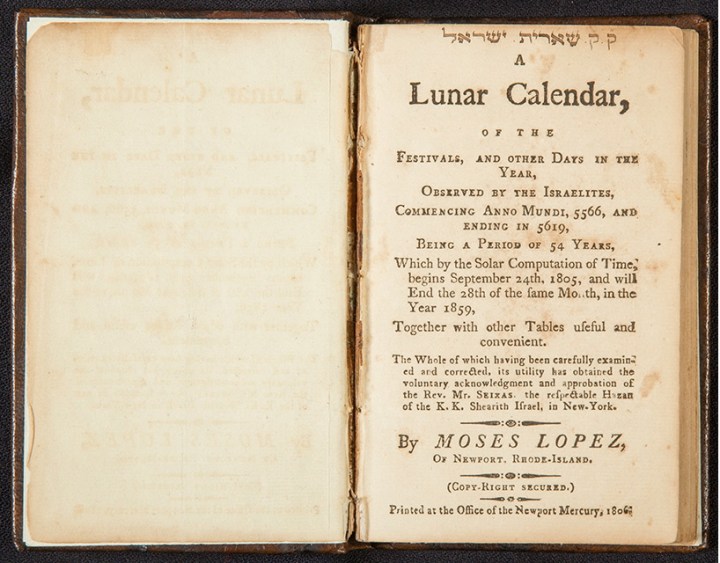
Moses Lopez, A Lunar Calendar, of the Festivals, and Other Days in the Year, Observed by the Israelites: Commencing Anno Mundi, 5566, and Ending in 5619, Being a Period of 54 Years: which by the Solar Computation of Time, Begins September 24th, 1805, and Will End the 28th of the Same Month in the Year 1859: Together with Other Tables Useful and Convenient … Newport, RI, 1806 (Princeton University Library).

◊  ◊  ◊  ◊  ◊

From the Princeton University Art Museum:

By Dawn’s Early Light: Jewish Contributions to American
Culture from the Nation’s Founding to the Civil War

Princeton University Art Museum, 13 February — 12 June 2016
New-York Historical Society, 28 October 2016 — 12 March 2017

Living in an age when Jews are fully integrated into so much of America’s public and popular culture, it is difficult to imagine a time before they shone on the stage and printed page. Such a future for Jews was scarcely imaginable in the crucible years after the birth of the United States. In the colonial period, there was little precedent for Jews speaking for themselves vocally and volubly in the public arena. At the dawn of the Republic, they were new to American public life. Yet as the United States started its grand experiment with liberty, and began to invent a culture of its own, Jews, too, began a grand experiment of living as equals. In a society that promised exceptional freedom, this was both liberating and confounding. As individuals, they were free to participate as full citizens in the hurly-burly of the new nation’s political and social life. But as members of a group that sought to remain distinctive, freedom was daunting. In response to the challenges of liberty, Jews adopted and adapted American and Jewish artistic idioms to express themselves in new ways as Americans and as Jews. In the process, they invented American Jewish culture, and contributed to the flowering of American culture during the earliest days of the Republic.

This exhibition, organized by the Princeton University Library, consists of more than 160 books, maps, manuscripts, prints, and paintings, including some of the earliest novels, plays, scientific treatises, and religious works produced by Jews in the United States. The exhibition is based on the loans and gifts to Princeton University of Leonard L. Milberg, Class of 1953, as well as loans from museums, libraries, synagogues, and private collections.

Note (added 8 March 2017) — The original posting did not include the New-York Historical Society as a venue.

Save

Save

Exhibition | Pastures Green & Dark Satanic Mills

Posted in books, catalogues, exhibitions by Editor on February 14, 2016

03_ThomasJones_TheBard

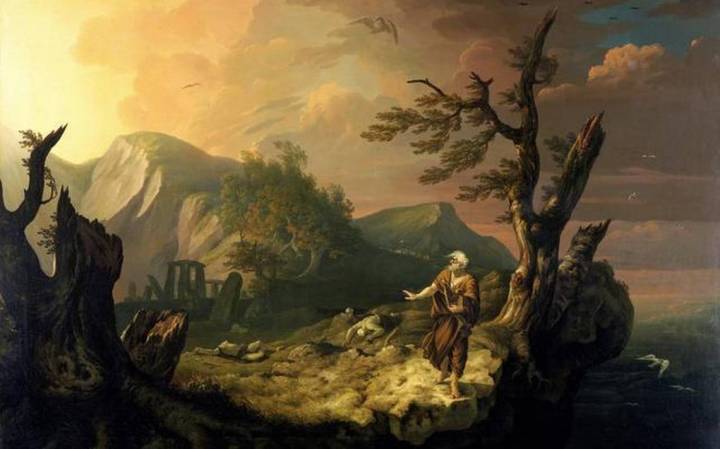
Thomas Jones, The Bard, 1774, oil on canvas, 14.5 x 168 cm
(Amgueddfa Cymru–National Museum, NMW A85)

◊  ◊  ◊  ◊  ◊

From the Princeton University Art Museum:

Pastures Green & Dark Satanic Mills: The British Passion for Landscape
Norton Museum of Art, West Palm Beach, 23 December 2014 — 5 April 2015
Frick Art and Historical Center, Pittsburgh, 7 May — 2 August 2015
Utah Museum of Fine Arts, Salt Lake City, 27 August — 13 December 2015
Princeton University Art Museum, 23 January — 24 April 2016

Organized by the American Federation of Arts and Amgueddfa Cymru–National Museum Wales

The British passion for landscape—already present in the literary works of Milton, Shakespeare, and even Chaucer—began to dominate the visual arts at the time of the Industrial Revolution. In his poem “Jerusalem” (1804), William Blake wrote of both “England’s green and pleasant land” and the “dark satanic mills” of its new industrial cities. Drawn from the remarkable collections of the National Museum Wales, Pastures Green & Dark Satanic Mills: The British Passion for Landscape will offer audiences a rare opportunity to follow the rise of landscape painting in Britain, unfolding a story that runs from the Industrial Revolution through the eras of Romanticism, Impressionism, and Modernism, to the postmodern and post-industrial imagery of today.

Showcasing masterpieces by artists from Constable to Turner, to Monet working in Britain, the exhibition offers new insights into the cultural history of Britain as it became the world’s first industrial nation late in the eighteenth century. Cities—where the nation’s new wealth was generated and its population concentrated—mills, and factories started to challenge country estates and rolling hills as the defining images of the nation, and artists tracked, recorded, and resisted these changes, inaugurating a new era of British landscape painting which both celebrated the land’s natural beauty and a certain idea of Britain while also observing the feverish energies of the modern world.

◊  ◊  ◊  ◊  ◊

The catalogue is published by Giles:

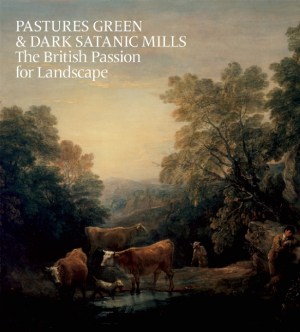
Tim Barringer and Oliver Fairclough, Pastures Green & Dark Satanic Mills: The British Passion for Landscape (London: Giles, 2014), 232 pages, ISBN: 978-1907804342, £40 / $60.

9781907804342Pastures Green & Dark Satanic Mills recounts the story of British landscape painting from the Industrial Revolution in the late 18th century to the present day. Examining 88 paintings from the National Museum of Wales, this volume traces the history of landscape art through romanticism, impressionism and modernism right up to the postindustrial imagery of the 21st century.

The book presents two major essays: one by Tim Barringer on the tradition of British landscape painting and its position within an increasingly industrialized society, the other by Oliver Fairclough on the significance of the Welsh landscape within the British tradition. Loosely chronological and divided into six thematic sections, this new volume demonstrates the strong continuity between the British art of today and that of over 250 years ago: contemporary works, such as conceptual artist Richard Long’s photo pieces based on hiking in the Welsh mountains echo the poetics of place as deeply as Richard Wilson’s landscapes of the 1740s.

Tim Barringer is Paul Mellon Professor of the History of Art, Yale University. His recent publications include Edwardian Opulence: British Art at the Dawn of the Twentieth Century (2013), Pre-Raphaelites: Victorian Art and Design (2013) and Landscape, Innovation, and Nostalgia: The Manton Collection of British Art (2012). Oliver Fairclough is Keeper of Art, National Museum of Wales, and the author of A Companion Guide to the Welsh National Museum of Art (2011) and Turner to Cezanne: Masterpieces from the Davies Collection (2009).


New Book | Rediscovering a Baroque Villa in Rome

Posted in books by Editor on February 14, 2016

From L’ Erma di Bretschneider:

David R. Marshall, Rediscovering a Baroque Villa in Rome: Cardinal Patrizi and the Villa Patrizi, 1715–1909 (Rome: L’ Erma di Bretschneider, 2015), 508 pages, ISBN: 978-8891309310, €290.

00013000Rediscovering a Baroque Villa in Rome: Cardinal Patrizi and the Villa Patrizi, 1715–1909 draws on a large body of archival material to reconstruct in detail the creation of the Villa Patrizi outside Porta Pia from 1715 to 1727 and its afterlife. This material includes building documentation, inventories, and above all the letters written by Cardinal Giovanni Batista Patrizi, papal legate in Ferrara, to his brothers in Rome, both dilettante artist-architects. These letters provide a unique insight into the decision-making processes involved in such a large-scale enterprise, in particular the hiring of artists and the decoration of individual rooms. These rooms included a Gallery inspired by the Galleria Colonna, a romitorio, or fictive hermitage, a Mirror Room anticipating those created later in the century, and one of the first Chinoiserie interiors in Rome.

The Villa Patrizi emerges as perhaps the most important secular project in the barocchetto manner, a distinct design sensibility prevalent in the early decades of the eighteenth century that was oriented towards modern taste (to be found in Northern Italy and France), as opposed to the antiquarianism of Cardinal Albani, whose Villa Albani it faced across the valley. The book demonstrates the crucial role played by Giovanni Paolo Panini, later famous as a painter of capricci and Roman views, not only as a painter of the frescoes that decorated many of the rooms, but also as co-ordinator of the design of the more adventurous interiors, and his progress from employee to friend and collaborator of the family. We follow the fluctuating fortunes of the main building (the Casino) and its surroundings: from the terraces, gardens, and vigna of the original villa, through the acquisition of the Villa Bolognetti next door and the creation of one of the finest English-style gardens of nineteenth-century Rome, the almost complete destruction of the villa and grounds in 1849, its subsequent rebuilding to the same design, the subdivision of the garden in the building frenzy following unification in 1870, through to the demolition of the Casino in 1909 and the levelling of the site.

Embedded in the dominant narrative of the construction and destruction of the villa are the lives of the individual members of the Patrizi family (including the women): their marriages, alliances, and their preoccupation with succession and inheritance. We learn how a Roman family organised itself between its principal residences: the Villa Patrizi outside Porta Pia, the Palazzo Patrizi palace opposite the church of S. Luigi dei Francesi in Rome, and the palace at Castel Giuliano. The wealth of evidence that is drawn upon provides a unique insight into the motivations of Cardinal Patrizi and his brothers, who was preoccupied with the signs of status appropriate to a cardinal, the constraints of etiquette, and above all his desire to leave a building that would enhance the status of his family, and would be a blessing and not a burden on “those who come after me.”

David R. Marshall is Principal Fellow, Art History, School of Culture and Communication, the University of Melbourne, and a fellow of the Australian Academy of the Humanities. He is a specialist in seventeenth- and eighteenth-century landscape and view painting, particularly the work of Giovanni Paolo Panini, Piranesi, and Filippo Juvarra. His interest in architectural view painting was initiated by his research into the seventeenth-century architectural painters, Viviano and Niccolò Codazzi, resulting in his publication Viviano and Niccolò Codazzi and the Baroque Architectural Fantasy (Rome: Jan di Sapi Editori, 1993). He has published widely since on architectural view painting and landscape painting in seventeenth- and eighteenth-century Rome in such journals as The Art Bulletin, The Burlington Magazine, Journal of the History of Collections, Artibus et Historiae, Storia dell’ Arte, and Studies in the History of Gardens and Designed Landscapes. He was the founder and editor of Melbourne Art Journal from 1997 to 2015, and in this role he edited (and contributed chapters to) monographs that include The Italians in Australia: Studies in Renaissance and Baroque Art (Florence: Centro Di, 2004); Art, Site and Spectacle: Studies in Early Modern Visual Culture (Melbourne, 2007); and most recently, The Site of Rome: Studies in the Art and Topography of Rome 1400–1750 (Rome: L’ Erma di Bretschneider, 2014). With Susan Russell and Karin Wolfe he was the editor of Roma Britannica: Art Patronage and Cultural Exchange in Eighteenth-Century Rome (British School at Rome, London, 2010). Complementary to this monograph on the Villa Patrizi is his edition of the letters of Cardinal Patrizi, published in Collectanea Archivi Vaticani / Dall’Archivio Segreto Vaticano. Miscellanea di Testi, Saggi e Inventari 8 (2015), pp. 143–520 [information for ordering a copy is provided below].

◊  ◊  ◊  ◊  ◊

C O N T E N T S

Introduction: Roman Villas and the Villa Patrizi

Part 1 | The Cardinal and His Family
1.1  Patrizio Patrizi the Elder (1629–1689)
1.2  Architect and Patrons
1.3  The Cardinal in Ferrara, 1718–1727
1.4.  Ottavia Sacchetti and Patrizio Patrizi the Younger, 1722–1739
1.5  Maria Virginia and Giovanni, Porzia and Francesco

Part 2 | Vigna and Villa
2.1  Vigna Patrizi, 1650–1715
2.2  Constructing the Casino

Part 3 | Decoration and Function
3.1  Organisation of the Piano Nobile
3.2  Anterooms

◊  ◊  ◊  ◊  ◊

From the Archivo Segreto Vaticano:

David R. Marshall, ed., The Letters of Cardinal Patrizi to His Brothers Mariano and Francesco Concerning The Villa Patrizi (1718–1727), Collectanea Archivi Vaticani (Dall’Archivio Segreto Vaticano. Miscellanea di Testi, Saggi e Inventari VIII 2015), ISBN 978-8898638000, €40.

Orders for publications of the editorial series published by the Archivio Segreto Vaticano should be sent by fax or e-mail to:
Archivio Segreto Vaticano
Economato
Cortile del Belvedere
00120 Città del Vaticano
fax +39 06 69883150
economato@asv.va


Call for Papers | Towards a Cultural History of the Decorator

Posted in Calls for Papers by Editor on February 13, 2016

From H-ArtHist:

Towards a Cultural History of the Decorator, 18th–20th Centuries
Institut national d’histoire de l’art, Paris, 7–8 October 2016

Proposals due by 1 April 2016

Organized by the Institut National d’Histoire de l’Art and Les Arts Décoratifs, this symposium will propose a reevaluation of the traditional history of Western styles from the late 18th to the late 20th century by examining the figure of the interior decorator. While the historiography has mostly focused on the logical chain of formal and technical innovations and the notion of avant-garde, this symposium will highlight the socio-economical context in which the work of the decorator was rooted. This approach sheds new light on the visual culture of certain generations or social groups at a specific moment in time. It also helps shape the definition of notions such as the collective gaze (oeil collectif) or visual tolerance, still under-studied, and provides clues to understanding the alternation of over-furnishing and soberness. This approach may also explain the numerous variations regarding, for example, the intensity of colour and light, or the occupation of space.

To contribute to this cultural history of the interior decorator, this symposium will give priority to trans-historical and interdisciplinary proposals over monographic approaches. Proposals which fit into one of the themes detailed below will retain our attention:

1. Identity of the Decorator
The decorator is generally associated with the figure of the architect in the 18th century, with the upholsterer in the 19th century, and the ensemblier in the 20th century. This session’s aim is to analyze and perhaps reconsider these categories.

2. Spaces
This will be the opportunity to think about the complex relationship between the decorator and the various spaces in which s/he works (public/private space, scenography, etc.).

3. Diffusion of the Work of the Decorator
This session will examine the numerous means available for the decorator to diffuse and promote his/her work. From pattern books to magazines, how have these media brought to light the decorator’s work? To which extent can the descriptions found in literature inform his/her work?

4. Fashion-Maker or Follower?
If the work of the decorator seems to epitomize the tastes of a class or a social category at a specific moment in history, the relationships between the decorator and the patron needs to be further examined in order to evaluate their respective role and responsibility in the
creation and diffusion of a trend.

The papers will be given either in French or English. Proposals in French or English, about 2000 characters (including spaces) should be sent by April 1st 2016 to the following persons:
philippe.thiebaut@inha.fr
etienne.tornier@inha.fr
sebastien.quequet@lesartsdecoratifs.fr

New Book | Antonio Bonazza e la scultura veneta del Settecento

Posted in books, exhibitions by Editor on February 13, 2016

Essays resulting from a study day held in October of 2013 in conjunction with the exhibition on Antonio Bonazza (1698–1763) were published last year by Scripta and are now available from Michael Shamansky (the exhibition was L’anima della pietra: Antonio Bonazza scultore del Settecento, on view at the Museo Diocesano di Padova, 2 May — 31 October 2013).

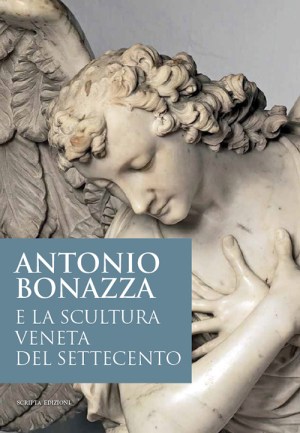
Carlo Cavalli and Andrew Nante, eds., Antonio Bonazza e la scultura veneta del Settecento: Atti della Giornata di studi, Padova, Museo Diocesano – Venerdì 25 Ottobre 2013 (Verona: Scripta, 2015), 208 pages, ISBN: 978-8898877416, $33.

5669447f7dea9Antonio Bonazza è esponente di spicco di una delle più operose famigliedi scultori del Settecento veneto: insieme al padre Giovanni eai fratelli Francesco e Tommaso ha lavorato in moltissime chiese diPadova e del territorio, oltre che nei giardini delle ville di campagna dinobili famiglie veneziane.Le sue opere si collocano spesso ben al di sopra del livello di quelle deisuoi contemporanei, e raggiungono esiti di eleganza e leggerezza tra ipiù alti della scultura veneta del Settecento.La giornata di studi, organizzata dal Museo Diocesano di Padova inoccasione dei 250 anni dalla morte dell’artista (12 gennaio 1763), è stata occasione per aggiornare il catalogo delle opere, precisare la cronologia, mettere a fuoco la personalità umana e artistica di Antonio e i suoi rapporti con quella del padre Giovanni e dei fratelli Francesco e Tommaso, indagare modelli e fonti visive ed esplorare le relazioni tra la sua arte e quella dei suoi contemporanei.

◊  ◊  ◊  ◊  ◊

I N D I C E

• Anrea Nante, ‘L’anima nella pietra’. Ricerca e valorizzazione per la scultura del Settecento veneto
• Simone Guerriero, Giovanni e Antonio Bonazza, eredità e invenzione
• Damir Tulić, Le opere dei Bonazza sulla costa orientale dell’Adriatico
• Paolo Goi, Sui Bonazza in Friuli Venezia Giulia
• Monica De Vincenti, Antonio Bonazza e l’ingresso della ‘scultura di costume’ nel giardino della villa veneta
• Massimo De Grassi, Tra suggestioni antiquarie e cinquecentismi: fonti visive di Antonio Bonazza
• Denis Ton, I Bonazza e la pittura veneta: interazioni e scambi
• Egidio Arlango e Monica Pregnolato, L’altare dell’Addolorata nella chiesa padovana dei Servi: lettura tecnica e materica di una ‘straordinaria invenzione’

New Appointment for Margaret Michniewicz

Posted in books, resources by Editor on February 12, 2016

Margaret Michniewicz Appointed Visual Arts Acquisition
Editor at Bloomsbury

MM pic - Version 2Having worked at Ashgate Publishing since 2011, Margaret Michniewicz recently joined Bloomsbury’s New York office as Visual Arts Acquisition Editor. In addition to welcoming proposals for book projects, she is currently focused on launching new series and invites inquiries and ideas from prospective series editors. Open to a wide array of subject matter, including interdisciplinary approaches and work addressing issues of gender and race, Michniewicz will be commissioning projects in art history and visual culture from the eighteenth century onward.

Kevin Ohe, US Academic Publishing Director at Bloomsbury, underscores the possibilities that lie ahead: “Bloomsbury is thrilled to welcome Margaret Michniewicz to our Editorial team. She brings with her deep experience working with a cohort of tremendous authors. She’ll help us add strength to our already robust publishing program in the visual arts, and we’re looking forward to working with the authors she’ll bring to our list and the new series she’ll create.”

The long list of books she edited at Ashgate includes Materializing Gender in Eighteenth-Century Europe edited by Jennifer Germann and Heidi Strobel; Mariette and the Science of the Connoisseur in Eighteenth-Century Europe by Kristel Smentek; and Académie Royale: A History in Portraits by Hannah Williams. Proposals for edited collections will still be welcome, and Bloomsbury has the capacity to offer both hardback and paperback editions.

In April, Michniewicz will be attending the Association of Art Historians conference in Edinburgh and is currently making appointments for meetings with prospective authors and editors. You can reach her by email at Margaret.michniewicz@bloomsbury.com and follow her on Twitter at BburyViaAshg8.

With her characteristic enthusiasm, Michniewicz comments on her new position: “As an art historian myself, I feel the stars have aligned: I have this opportunity to continue the work I love by developing Bloomsbury’s new research monographs program in art history and visual culture, expanding upon Bloomsbury’s already vibrant visual arts publishing. This is very good news for all art historians!”

Exhibition | Picturing Prestige: New York Portraits, 1700–1860

Posted in exhibitions, lectures (to attend) by Editor on February 11, 2016

Portraits hero

From left to right: John Trumball, Portrait of Alexander Hamilton, ca. 1804–08 (Museum of the City of New York, 72.31.3);  Nicholas Biddle Kittell, Portrait of Mr. and Mrs. Charles Henry Augustus Carter, ca. 1845 (Museum of the City of New York, 62.234.12); and George Peter Alexander Healy, Portrait of Caroline Slidell Perry Belmont (Mrs. August Belmont, Sr.), ca. 1855 (Museum of the City of New York, 51.317).

◊  ◊  ◊  ◊  ◊

Press release for the exhibition now on view at MCNY:

Picturing Prestige: New York Portraits, 1700–1860
Museum of the City of New York, 5 February — 18 November 2016

Curated by Bruce Weber

The Museum of the City of New York presents Picturing Prestige: New York Portraits, 1700–1860, an ensemble of iconic New Yorkers presented by intricate and elegant portraits, which were commissioned as status symbols and painted by the very best artists a young nation had to offer. The exhibition opened to the public on Friday, February 5, 2016.

Visitors can see familiar figures, such as the renowned John Trumbull portrait of Alexander Hamilton that inspired the image on our ten-dollar bill, and can also come face-to-face with New Yorkers like Richard Varick, of Varick Street in Greenwich Village, and the Brooks family, of Brooks Brothers fame, whose names are part of the city’s fabric but whose stories remain untold to a broad audience. This unique exhibition draws from the City Museum’s permanent collection to reveal the evolution of a dynamic city through its leading merchants, politicians and patrons, as well as the development of portraiture itself, one of New York’s oldest visual art forms.

“New York City’s distinctive character and unique personality have always come from its citizens,” said Whitney Donhauser, Ronay Menschel Director of the Museum of the City of New York. “This exhibition explores over 150 years of city life through the lives of many of history’s most celebrated New Yorkers, offering visitors an intensely engaging and deeply personal interaction with the past.”

Picturing Prestige relies on the people who shaped New York City in its formative years to tell the story of how the city grew from its colonial foundations through the Revolutionary War and blossomed into a mercantile powerhouse in the mid-19th century. The namesakes of Varick and McDougal Streets in Greenwich Village are brought to life by centuries-old paintings of Richard Varick and Alexander McDougall. Brooks Brothers is a household name in present-day America, and Picturing Prestige will display the early Brooks family in the light they wished to be shown in their own time.

The exhibition is also a study in the art of portraiture and New York City’s place as an artistic hub, showcasing over 40 oil paintings to go along with a dozen miniatures—small portraits kept as keepsakes, which were the original version of family wallet photos. The show is organized in three sections that demonstrate not only the growth and transformation of the city itself, but also the changing nature of portraiture as an art form, the city’s emergence as an artistic center, and the ways in which the city’s elite viewed itself over time:

• Colonial Foundations, 1700–1775
• Young Nationhood, 1777–1815
• The City Rises, 1815–1860

The scope of the exhibition, curated by Bruce Weber, City Museum Curator of Paintings and Sculpture, is made possible by the wealth of the City Museum’s permanent collection, offering portraits of iconic New Yorkers as painted by the leading artists of their respective generations. The artists themselves reveal nearly as much history as their subjects do, from the Duyckinck family demonstrating that the best painters in America in the 17th century were not from America, to John Singleton Copley personifying the rise of fine art in this country over one hundred years later.

“The portraits in this exhibition are works of art in and of themselves, but they are also windows into the lives and times of legendary New Yorkers,” added Weber. “In thinking about who commissioned these paintings and the artists who brought their subjects to life, we can tell the story of a city emerging from the throes of revolution to lead a young nation towards its rightful place at the vanguard of the artistic world. Today, New York City’s role as a cultural center is undisputed. Picturing Prestige helps explain how we got there.”

The conservation of many of the works and their related frames featured in Picturing Prestige: New York Portraits, 1700–1860 was made possible by a grant from the National Endowment for the Arts, as was digital photography and cataloguing of many of the paintings.

hero_hailton_final

◊  ◊  ◊  ◊  ◊

From MCNY:

Hamilton and Friends: Portraiture in Early New York
Museum of the City of New York, Thursday, 11 February 2016, 6:30 pm

Alexander Hamilton was a man of many faces: politician, economist, revolutionary—and rumored philanderer. After he was killed in a duel with Aaron Burr in 1804, Hamilton’s widow, Elizabeth Schuyler Hamilton, worked tirelessly to defend her husband’s reputation. Today we are familiar with likenesses of Alexander Hamilton—including one that is on the ten dollar bill. This panel will explore how portraiture served in the decades after the American Revolution as a critical tool in shaping and canonizing the public image of leaders and notables. Join us for a conversation about how the Hamiltons and other members of the colonial New York elite commissioned portraits to use both as status symbols and a means to craft their public image. This program delves into the themes of our exhibition Picturing Prestige: New York Portraits, 1700–1860.

William H. Gerdts, Professor Emeritus of Art History, CUNY Graduate Center
David Jaffee, Professor and Head of New Media Research, Bard Graduate Center
Elizabeth Mankin Kornhauser, Alice Pratt Brown Curator of American Paintings and Sculpture, The Metropolitan Museum of Art
Brett Palfreyman, Assistant Professor, History Department, Wagner College
Bruce Weber (moderator), Museum’s Curator of Picturing Prestige: New York Portraits, 1700–1860

New Book | Art, Animals and Politics: Knowsley and the Earls of Derby

Posted in books by Editor on February 10, 2016

Distributed by The University of Chicago Press:

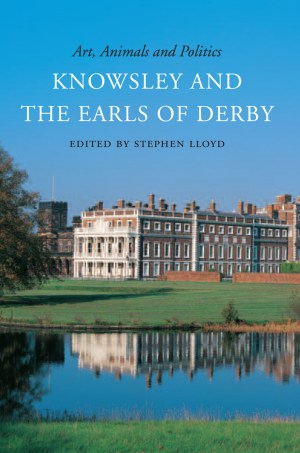
Stephen Lloyd, ed., Art, Animals and Politics: Knowsley and the Earls of Derby (Unicorn Press, 2015), 366 pages, ISBN: 978-1910065822, £60.

Layout 1Thomas, Lord Stanley, was created Earl of Derby in 1485 after the Battle of Bosworth Field. Since that time the Stanleys—a great Lancastrian family, whose seat, Knowsley Hall, is near Liverpool—have been significant in the life of the nation as patrons and collectors, sportsmen and politicians. These  absorbing essays by a distinguished cast of contributors led by historian David Starkey, writing about the political significance of Lady Margaret Beaufort, the first Countess of Derby, and broadcaster Sir David Attenborough, on Edward Lear’s zoological watercolours (many of which were done at Knowsley), cover key facets of the family’s diverse achievements

Stephen Lloyd is Curator of the Derby Collection at Knowsley Hall, with responsibility for the art collections, the celebrated natural history library and the family archive. In 2013, he organised a major conference at Knowsley, bringing together historians, art historians and natural historians to celebrate the wide-ranging achievements of the Stanley family and to raise the research profile of their legacy.

◊  ◊  ◊  ◊  ◊

Power, Play and Performance, c. 1450–1830
David Starkey, Elspeth Graham, Gill Perry

Patronage and Collecting, c. 1720–1735
Richard Stephens, Jonathan Yarker, Xanthe Brooke

Animals and Edward Lear, c. 1830–1890
David Attenborough, Clemency Fisher, Colin Harrison

Politics and Foreign Affairs, c. 1820–1900
Geoffrey Hicks, Angus Hawkins, Bendor  Grosvenor, Jennifer Davey

New Appointment for Erika Gaffney

Posted in books, resources by Editor on February 9, 2016

Erika Gaffney Appointed Senior Acquisitions Editor in Early Modern Studies for MIP and Arc Medieval Press

DSC_5133-croppedMedieval Institute Publications (MIP) and Arc Medieval Press, together with its partner, Amsterdam University Press (AUP), are delighted to announce the appointment of Erika Gaffney as Senior Acquisitions Editor in Early Modern Studies. Gaffney established her reputation as an acquisitions editor at Ashgate, where she worked for more than 20 years.

A sample of books on which she worked includes Melissa Hyde and Jennifer Milam, eds., Women, Art and the Politics of Identity in Eighteenth-Century Europe (2003); Daniel Guernsey, The Artist and the State, 1777–1855: The Politics of Universal History in British and French Painting (2007); Carole Paul, The Borghese Collections and the Display of Art in the Age of the Grand Tour (2008); Dorinda Evans, Gilbert Stuart and the Impact of Manic Depression (2013); and Gauvin Alexander Bailey, The Spiritual Rococo (2014).

In terms of future acquisitions, her interests for the early modern period will continue to include eighteenth-century European history and culture through the lens of art history and visual culture. Scholars wishing to renew their working relationship with Erika or new scholars interested in submitting not-yet-contracted volumes (or new series) should email her at erika.gaffney@arc-humanities.org to ask for a Proposal Form.

The Fitzwilliam Turns 200, with Exhibition and Book to Celebrate

Posted in books, exhibitions, museums by Editor on February 9, 2016

VenusCupid

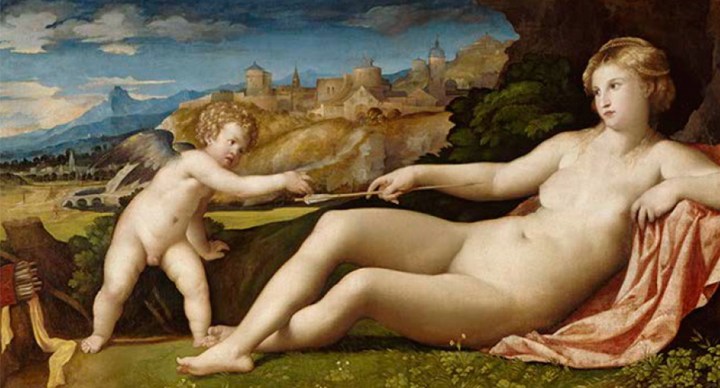
Palma Vecchio, Venus and Cupid, 1523–24 (Cambridge: The Fitzwilliam Museum). The painting was purchased by Lord Fitzwilliam from the London sale of the Duc d’Orléans collection in 1798. He first saw the collection at the Palais Royale during his visits to Paris.

◊  ◊  ◊  ◊  ◊

Press release from The Fitzwilliam:

Today (Thursday, 4 February 2016) one of the great collections of art in the UK celebrates its bicentenary. 200 years to the day of his death, the Fitzwilliam Museum has revealed previously unknown details of the life of its mysterious founder, Richard 7th Viscount Fitzwilliam of Merrion. Research for a new book has shown how his beloved library may have contributed to his death, and how his passion for music led him to the love of his life: a French dancer with whom he had two children, Fitz and Billy.

The Fitzwilliam Museum: A History is written by Lucilla Burn, Assistant Director for Collections at the Fitzwilliam. The book explores the full 200 year story of the Museum and the first chapter focuses on the founder. She comments: “Lord Fitzwilliam’s life has been described as ‘deeply obscure’. Many men of his class and period, who sought neither fame nor notoriety, nor wrote copious letters or diaries, do not leave a conspicuous record. But by going through the archives and letters that relate to him, for the first time we can paint a fuller picture of his history, including aspects of his life that have previously been unknown, even to staff here at the Fitzwilliam.”

Lord Fitzwilliam died on the 4th of February 1816, and founded the Fitzwilliam Museum through the bequest to the University of Cambridge of his splendid collection of art, books and manuscripts, along with £100,000 to build the Museum. This generous gift began the story of one of the finest museums in Britain, which now houses over half a million artworks and antiquities. Other than his close connection to Cambridge and his love of art and books, a motivation for Fitzwilliam’s bequest may have been his lack of legitimate heirs. The new details of his mistress help to explain why he never married.

Joseph Wright, The Hon. Richard Fitzwilliam, 7th Viscount Fitzwilliam of Merrion, 1764 (Cambridge: The Fitzwilliam Museum)

Joseph Wright, The Hon. Richard Fitzwilliam, 7th Viscount Fitzwilliam of Merrion, 1764 (Cambridge: The Fitzwilliam Museum)

In 1761 Richard Fitzwilliam entered Trinity Hall, Cambridge, and in 1763 his Latin ode, ‘Ad Pacem’, was published in a volume of loyal addresses to George III printed by the University of Cambridge. He made a strong impression on his tutor, the fiercely ambitious Samuel Hallifax, who commissioned Joseph Wright of Derby to paint a fine portrait of Fitzwilliam on his graduation with an MA degree in 1764. Fitzwilliam’s studies continued after Cambridge; he travelled widely on the continent, perfecting his harpsichord technique in Paris with Jacques Duphly, an eminent composer, teacher and performer. A number of Fitzwilliam’s own harpsichord compositions have survived, indicating he was a gifted musician.

But from 1784 he was also drawn to Paris by his passionate attachment to Marie Anne Bernard, a dancer at the Opéra whose stage name was Zacharie. With Zacharie, Fitzwilliam fathered three children, two of whom survived infancy—little boys known to their parents as ‘Fitz’ and ‘Billy’. How the love affair ended is unknown, but its fate was clouded, if not doomed, by the French Revolution. We do not know what happened to Zacharie after her last surviving letter, written to Lord Fitzwilliam late in December 1790. Her health was poor, so it is possible that she died in France. However, the elder son, Fitz (Henry Fitzwilliam Bernard), his wife Frances, and their daughter Catherine were living in Richmond with Lord Fitzwilliam at the time of the latter’s death in 1816. It is not known what happened to Billy.

At the age of seventy, early in August 1815, Lord Fitzwilliam fell from a ladder in his library and broke his knee. This accident may have contributed to his death the following spring, and on 18 August that year Fitzwilliam drew up his last will and testament. Over the course of his life he had travelled extensively in Europe. By the time of his death he had amassed around 144 paintings (including masterpieces by Titian, Veronese, and Palma Vecchio), 300 carefully ordered albums of Old Master prints, and a magnificent library containing illuminated manuscripts, musical autographs by Europe’s greatest composers, and 10,000 fine printed books.

His estates were left to his cousin’s son, George Augustus Herbert, eleventh Earl of Pembroke and eighth Earl of Montgomery. But he also carefully provided for his relatives and dearest friends. The family of Fitzwilliam’s illegitimate son, Henry Fitzwilliam Bernard (‘Fitz’)—including Fitz’s wife and daughter—received annuities for life totalling £2,100 a year. On Fitzwilliam’s motivation for leaving all his works of art to the University, he wrote: “And I do hereby declare that the bequests so by me made to the said Chancellor Masters and Scholars of the said University are so made to them for the purpose of promoting the Increase of Learning and the other great objects of that Noble Foundation.”

Director of the Fitzwilliam Museum, Tim Knox commented: “The gift Viscount Fitzwilliam left to the nation was one of the most important of his age. This was the period when public museums were just beginning to emerge. Being a connoisseur of art, books and music, our founder saw the importance of public collections for the benefit of all. But we are also lucky that his life circumstances enabled him to do so—had there been a legitimate heir, he might not have been able to give with such liberality. From the records we have discovered, he appears to have been as generous as he was learned: he arranged music concerts to raise funds for charity and helped many people escaping the bloodiest moments of the French Revolution. We are delighted to commemorate our founder in our bicentenary year.”

◊  ◊  ◊  ◊  ◊

Celebrating the First 200 Years: The Fitzwilliam Museum, 1816–2016
The Fitzwilliam Museum, Cambridge, 4 February — 30 December 2016

Running throughout 2016, this exhibition will explore the Fitzwilliam’s past, present and future. A timeline of the first 200 years will introduce key themes and characters, while displays of objects will show how the collections have developed over two centuries. The exhibition runs alongside a new book The Fitzwilliam Museum: A History. For the very first time, this will tell the full 200 year story of the Museum. The triumphs and challenges of successive Directors, the changing nature of the Museum’s relationship with its parent University, and its dogged survival through the two World Wars. It will also shed light on the colourful, but previously little-known, personal life of Viscount Fitzwilliam himself.

◊  ◊  ◊  ◊  ◊

Lucilla Burn, The Fitzwilliam Museum: A History (London: Philip Wilson Publishers, 2016), 224 pages, ISBN: 978-1781300343, £25.

411xkMs4MaL._SX396_BO1,204,203,200_The Fitzwilliam Museum: A History traces the full story from the Museum’s origins in the 1816 bequest of Richard, 7th Viscount Fitzwilliam of Merrion, up to the present day. It sets the Fitzwilliam’s individual story against the larger context of the growth and development of museums and galleries in the UK and further afield. The text and illustrations draw primarily on the rich and largely unpublished archives of the Fitzwilliam Museum, including the Syndicate Minutes, the reports of University debates published in the Cambridge University Reporter from 1870 onwards, compilations of earlier nineteenth-century documents, architectural plans and drawings, newspaper reports, letters, diaries, exhibition catalogues, photographs and other miscellaneous documents. With this material a substantial proportion of the narrative is told through contemporary voices, not least those of the Museum’s thirteen directors to date, each one a strong and influential character.

Starting with the obscure life of the 7th Viscount and concluding with a portrait of the Museum today, the narrative explores not just the Fitzwilliam’s own establishment and development, but also such wider issues as the changing purpose and character of museums and collections over the last 200 years, and in particular the role of the university museum. Many of the illustrations appear in the book for the first time, and include views of the galleries over the centuries as well as portraits of members of staff.