Exhibition | Light, Time, Legacy: Francis Towne’s Watercolours of Rome
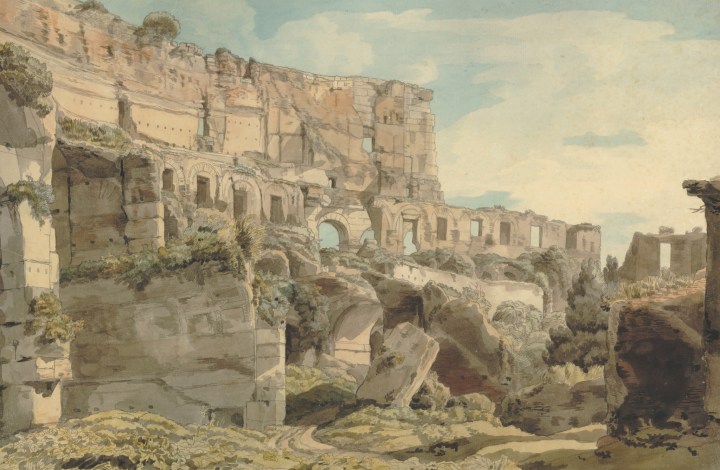
Francis Towne, Inside the Colosseum, 1780
(London: The British Museum)
◊ ◊ ◊ ◊ ◊
Press release for the upcoming exhibition:
Light, Time, Legacy: Francis Towne’s Watercolours of Rome
The British Museum, London, 21 January — 14 August 2016
Curated by Richard Stephens
2016 is the bicentenary of Francis Towne’s death and his historic bequest to the British Museum of 75 uniquely beautiful watercolours made on his visit to Italy in 1780–81. To celebrate this generous gift the watercolours are all on display here—at their heart are 52 views of Rome that have not been shown together since 1805. Towne’s decision to give the Museum such a major group of his drawings, so that they could be seen in the wider context of a collection that charted the history of the graphic arts from its Renaissance beginnings, was both strategic and pioneering as it set a pattern for artists to donate their work that endures to this day, as seen in the recent gift of 200 prints made by the American artist Jim Dine.

Francis Towne, Near the Arco Scuro, 1780, watercolour with pen and ink and some gum arabic, 320 x 467 mm (London: The British Museum)
Towne was born in London in 1739 where he later trained and then moved to Exeter. He tried unsuccessfully to gain recognition in the London art world, and failed to be elected to the Royal Academy on eleven separate occasions. Towne gained artistic recognition in his posthumous legacy at the British Museum. At the start of the 20th century, through these watercolours, Towne became the poster boy for the ‘new Georgian’ revival of interest in 18th-century art. The clarity and abstracted economy of Towne’s watercolours were not only admired by the public but also by early 20th-century modernists, and he is today recognised as one of Britain’s greatest watercolour artists.
Through Towne’s vision, the exhibition will explore Enlightenment Britain’s relationship with the classical past and Ancient Rome. Towne travelled to Rome in 1780–81 during a period of political crisis in England when America was in revolt, a French invasion of England was anticipated and a highly divisive general election had just concluded. Towne, and his social circle, viewed ancient Rome as a catastrophic precedent for what they perceived as a corrupt ruling power in England. The ruins that Towne depicted in his landscapes signified a warning to contemporary society not to suffer the same fate as the fallen Roman Empire.
Italy had a transformational effect on Towne’s work. When Towne first arrived in Rome he started making excursions north of city, making rural sketches instead of focusing on the ancient monuments. Towne’s delicate early studies were eventually replaced with large scale bolder work when Towne depicted such subjects as the Colosseum and other iconic Roman ruins. The experience of Rome was much different in the 18th century, few ruins had been excavated and tourists were free to explore them.
When Towne returned to England in 1781, these watercolours played a central role in his subsequent career. Although he was never accepted by the London art establishment, he organised an exhibition of his life’s work in 1805 with the Museum’s watercolours at its centre. Towne bequeathed the watercolours of Rome and others to the British Museum in 1816, with a further selection by his executors arriving in 1818.
A new open access catalogue raisonné of Francis Towne’s work by the guest curator of this exhibition, Dr Richard Stephens, will be published online in early 2016 by the Paul Mellon Centre for Studies in British Art.
The illustrated leaflet for the exhibition is available as a PDF file here»
◊ ◊ ◊ ◊ ◊
P R O G R A M M I N G
All events are free
Decline and Fall: Francis Towne and the Ruins of Rome
Tuesday, 26 January, 13.15–14.00, Room 90. Just drop in.
A gallery talk by exhibition curator Richard Stephens.
Light, Time, Legacy: Francis Towne’s Watercolours of Rome
Friday, 5 February, 13.30–14.15, BP Lecture Theatre. Booking essential.
Exhibition curator Richard Stephens gives a 45-minute illustrated introduction to the exhibition.
Theory and Practice in Towne’s Watercolours of Rome
Friday, 19 February, 13.15–14.00, Room 90. Just drop in.
A gallery talk by Timothy Wilcox, independent scholar.
The Selective Eye: Francis Towne’s Watercolours of Rome
Thursday, 21 April, 13.15–14.00, Room 90. Just drop in.
A gallery talk by art historian and curator Anne Lyles, independent speaker.
Magick Land? Francis Towne and His Response to Rome
Friday, 6 May, 13.15–14.00, Room 90. Just drop in.
A gallery talk by Jonny Yarker, Director of Lowell Libson Ltd.
Decline and Fall: Francis Towne and the Ruins of Rome
Wednesday, 15 June, 13.15–14.00, Room 90. Just drop in.
A gallery talk by exhibition curator Richard Stephens.
Exhibition | Turner in January
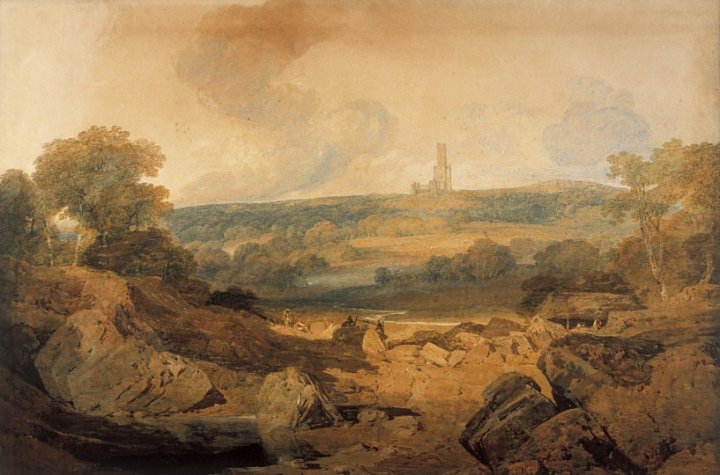
Joseph Mallord William Turner, East View of Fonthill Abbey, Noon, 1800, watercolour on paper
(Edinburgh: Scottish National Gallery)
◊ ◊ ◊ ◊ ◊
Press release for the exhibition:
Turner in January
Scottish National Gallery, Edinburgh, 1–31 January 2016
In keeping with a long-standing tradition now stretching over a century, New Year’s Day at the Scottish National Gallery will be marked by the opening of Turner in January: The Vaughan Bequest, an annual display of works by the artist Joseph Mallord William Turner (1775–1851).
 An outstanding collection by one of the great masters of British painting was bequeathed to the Gallery in 1900 by Henry Vaughan, a London art collector with a passion for Turner and a connoisseur’s eye for quality. Vaughan stipulated that the 38 exquisite works—which encapsulates the artist’s entire career—could not be subjected to permanent display, since continual exposure to light would result in their fading. Instead, these precious works were to be exhibited to the public “all at one time, free of charge, during the month of January,” when daylight in Edinburgh is at its lowest levels. Faithfully following Vaughan’s request, all of the works will be exhibited and Turner in January runs throughout the month, providing a welcome injection of light and colour during the darkest month of the year.
Clara Govier, Head of Charities at People’s Postcode Lottery (PPL), said: “This is the fourth year that players of PPL have supported Turner in January at the Scottish National Gallery, and we’re thrilled—even as relative newcomers in the grand scheme of things—to be involved in such an established tradition. It’s great for players to see that their valuable support is helping to provide thousands of visitors—some who come to see the exhibition every year, some for the very first time—with the opportunity to keep playing a part in this wonderful legacy.”
Recognised as perhaps the greatest of all British artists, Turner was born in London in 1775 and proved himself as an accomplished draughtsman while still a youth, exhibiting at the Royal Academy at the tender age of fifteen. He was a prolific and innovative artist who went on to exploit every possibility of the watercolour medium to create stunning land-and seascapes. Travelling widely, at first with sketching tours in England, Wales and Scotland and then later across Europe, Turner gathered material for masterful watercolours and oil paintings, discovering the awe-inspiring mountainous landscapes which became a major pre-occupation in his work.
Many of the works in the display reveal a youthful Turner’s artistic talents, such as the early wash drawings of the 1790s, while others show how this skill would come to be fused with the peripatetic lifestyle which dominated Turner’s life and career, resulting in colourful and atmospheric watercolour sketches of Continental Europe, such as Chatel Argent, in the Val d’Aosta, near Villeneuve (after 1836) and Falls of the Rhine at Schaffhausen, Side View (ca. 1841).
In his lifetime, Turner also managed three trips to Venice, first arriving there in 1819. The Vaughan Bequest features six of the artist’s stunning views of the city. In The Piazzetta, Venice (ca. 1835), one of Turner’s most spectacular Venetian studies, the Doge’s Palace and renowned St. Mark’s Basilica are dramatically illuminated by a bolt of lightning, an effect innovatively created by the artist by scratching away to reveal the paper once he had painted on it. Often, Turner would use his thumbnail and is reputed to have grown like an ‘eagle-claw’ for such a purpose. His third and final visit to the city in 1840 would see the artist produce a series of incredible works in which light itself appeared to have become the main subject, such as in The Grand Canal by the Salute, Venice (ca. 1840) and Venice from the Laguna (1840) where Turner’s consummate mastery of atmospheric lighting effects is clearly demonstrated.
As with many artists at the end of the 18th century, for Turner the vastness and tumultuous conditions of nature inspired senses of awe and terror. This life-long fascination—of the savageness of elemental forces—poured out of Turner’s art, namely in the form of avalanches, storms and mountainous seas. This can be seen in works from the bequest, such as Loch Coruisk, Skye (1831–34), with its miniature human figures set against a grand, stretching backdrop of painted swirls.
Turner’s Heidelberg (ca. 1846), a glowing, almost hallucinatory image of the ancient university town on the Rhine and one of his finest late works, will also be on display.
Also joining those from the bequest is the work East View of Fonthill Abbey, Noon (1800), a romantic view of the Gothic novelist William Beckford’s extraordinary cathedral-like mansion in rural Wiltshire, which was accepted by HM Government in lieu of inheritance tax in 1988 and loaned to National Trust for Scotland at Brodick Castle.
◊ ◊ ◊ ◊ ◊
Christopher Baker, J.M.W. Turner: The Vaughan Bequest (Edinburgh: National Galleries of Scotland, 2007), 120 pages, ISBN: 978-1903278895, £10.
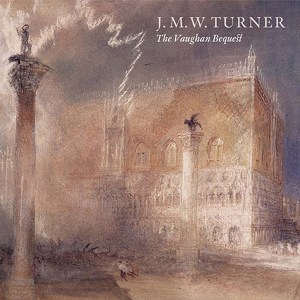 J.M.W. Turner (1775–1851) was perhaps the most prolific and innovative of all British artists. His outstanding watercolours in the collection of the National Gallery of Scotland are one of the most popular features of its collection. Bequeathed to the Gallery in 1899 by the distinguished collector Henry Vaughan, they have been exhibited, as he requested, every January for over 100 years at the National Galleries of Scotland. Renowned for their excellent state of preservation, they provide a remarkable overview of many of the most important aspects of Turner’s career.
This richly illustrated book, provides an authoritative commentary on the watercolours, taking account of recent research, and addressing questions of technique and function, as well as considering some of the numerous contacts Turner had with other artists, collectors and dealers. The introduction concentrates on Henry Vaughan, one of the greatest enthusiasts for British art in the late nineteenth century, whose diverse collections have not previously been fully studied and appreciated. The book accompanies the annual display every January of this bequest of Turner watercolours.
Exhibition | Venetian Painting in Honor of David Rosand
In Light of Venice: Venetian Painting in Honor of David Rosand
Otto Naumann Gallery, New York, 11 January — 12 February 2015

Bernardo Bellotto, Architectural Capriccio with a Self-Portrait in the Costume of a Venetian Nobleman, ca. 1762–65, oil on canvas, 61 x 44 inches.
New York: Otto Naumann and Robert Simon jointly announce that their exhibition In Light of Venice: Venetian Painting in Honor of David Rosand, will open on January 11th, 2016 at the Otto Naumann Gallery, 22 East 80th Street in New York. More than thirty important works of the Renaissance, Baroque, and Rococo periods—many never before seen publicly—will be on view for this milestone event. A portion of the proceeds of sales will benefit the David Rosand Tribute Fund at Columbia University, which was formed last year establishing a Professorship in Italian Renaissance Art History in David Rosand’s honor, as well as to fund other programs important to Venetian studies and to the teaching of art history. These include support for Casa Muraro, Columbia’s residence and study center in Venice, Italy that Professor Rosand first conceived and developed.
Both Naumann and Simon studied art history at Columbia and have continued their scholarly work while operating their eponymous art galleries devoted to Old Master paintings. Simon notes that with the changing focus of academic art history, support is needed to maintain the teaching of the crucial Renaissance period. “With the establishment of the Rosand Professorship in the Italian Renaissance, the subject is insured to be taught in perpetuity by distinguished scholars.”
Adds Naumann: “The exhibition demonstrates that important works by some of the greatest masters of the period are still on the market and many are certain to find homes in private collections, as well as in museums.”
While the exhibition will feature paintings from the fourteenth to the eighteenth centuries, the focus will be on the 1500s, the period most studied by Professor Rosand in his many books and publications. Featured artists include Carpaccio, Giovanni Bellini, Palma il Vecchio, Titian, Tintoretto, Paolo Veronese, and Jacopo Bassano. Other sixteenth-century paintings to be exhibited are by Palma il Giovane, the subject of Professor Rosand’s doctoral dissertation, Bonifazio Veronese, and Paris Bordone. Later Venetian paintings include significant works by Amigoni, Bambini, Guardi, Diziani, and Bernardo Bellotto. All paintings will be for sale.
David Rosand received his undergraduate and graduate education at Columbia, earning his Ph.D. in 1965. He was on the faculty there from that time until his death in August 2014, when he held the title of Meyer Schapiro Professor of Art History Emeritus. His impact on students at Columbia and in the field of Venetian Studies has been enormous—through his teaching, his groundbreaking publications on Venetian art, and his studies on the making of art spanning all periods.
New Acquisition | MFA Acquires Extraordinary Desk and Bookcase
Press release via Art Daily (30 December 2015). . .
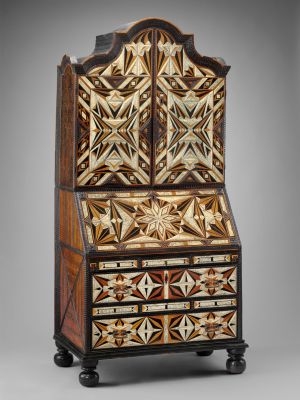
Desk and bookcase, mid-18th century, Mexico. Inlaid woods and incised and painted bone, maque, gold and polychrome paint, metal hardware (Museum of Fine Arts, Boston).
The Museum of Fine Arts, Boston, has acquired a rare and important desk and bookcase (mid-18th century, Mexico) from the Ann and Gordon Getty Collection. Originally made in Puebla de los Ángeles, this work is a remarkable piece of furniture that displays influences from Europe, Asia, Africa and the Americas. The striking geometric exterior looks toward Europe with its wood-and-bone Mudéjar designs—a Hispano-Moresque style popular during the era. Opening the doors reveals a dramatic interior of chinoiserie-style painting in gold on a red background. The inside recalls early colonial mapping traditions of Nahuatl-speaking artists, showing views of an extensive hacienda in Veracruz drawn in an indigenous style. The estate, once owned by a wealthy Spaniard, was the site of one of the earliest free African settlements in Mexico; the maps may depict descendants of these early African slaves or free blacks. This truly global mix of sources extends to the object’s material: the red background is likely maque (from the Japanese word for lacquer, maki-e), a resin created using local materials in the style of Asian painting.
The work is among the most rare pieces of furniture currently on view in the exhibition, Made in the Americas: The New World Discovers Asia, the first major, pan-American exhibition to examine the profound influence of Asia on the arts of the colonial Americas (on view through February 15).
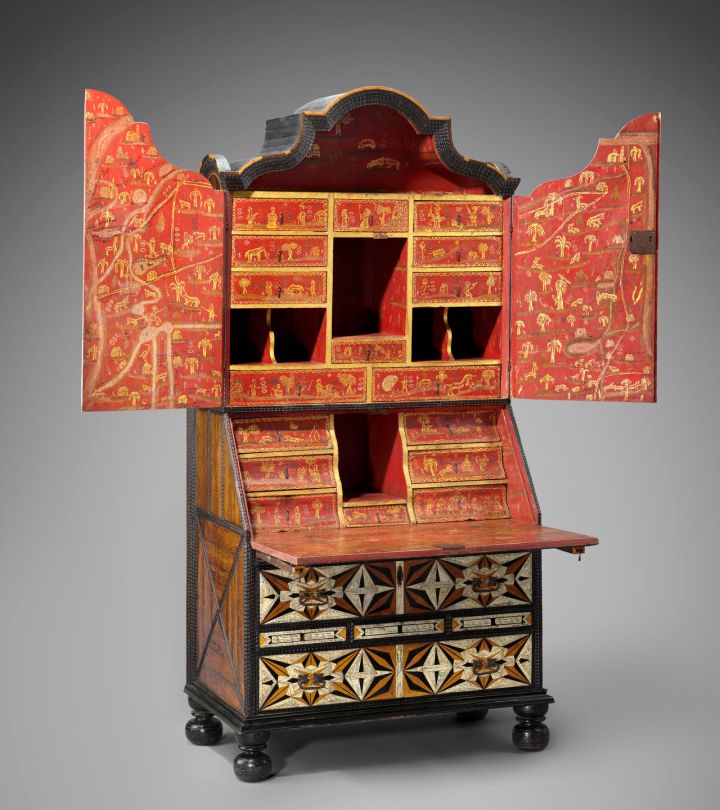
Desk and bookcase, mid-18th century, Mexico. Inlaid woods and incised and painted bone, maque, gold and polychrome paint, metal hardware (Museum of Fine Arts, Boston)
Rijksmuseum Research Fellowship Programme, 2016–17
The Rijksmuseum Fellowship Programme, 2016–17
Applications due by 13 March 2016
The Rijksmuseum operates a research Fellowship Programme for outstanding candidates working on the art and history of the Low Countries whose principal concern is object-based research. The aim of the programme is to train a new generation of museum professionals: inquisitive object-based specialists who will further develop understanding of art and history for the future. The focus of research should relate to the Rijksmuseum’s collection, and may encompass any of its varied holdings, including Netherlandish paintings, sculpture, decorative arts, prints, drawings, photography and historical artefacts. The purpose of the programme is to enable applicants to base part of their research at the Rijksmuseum, to strengthen the bonds between the universities and the Rijksmuseum, and to encourage the understanding of Netherlandish art and history. The programme offers students and academic scholars access to the museum’s collections, library, conservation laboratories and curatorial expertise.
Please review the eligibility, funding and application requirements by visiting the Rijksmuseum website. For the 2016–2017 academic year, candidates can apply for:
• Andrew W. Mellon Fellowship for art historical research
• Johan Huizinga Fellowship for historical research
• Migelien Gerritzen Fellowship for conservation research
• Manfred & Hanna Heiting Fellowship for photo-historical research
The closing date for all applications is 13 March 2016, at 6:00 p.m. (Amsterdam time/CET). No applications will be accepted after this deadline. All applications must be submitted online and in English. Applications or related materials delivered via email, postal mail, or in person will not be accepted. Selection will be made by an international committee in April 2016. The committee consists of eminent scholars in the relevant fields of study from European universities and institutions, and members of the curatorial staff of the Rijksmuseum. Applicants will be notified by 1 May 2016. All Fellowships will start in September 2016. Further information and application forms are available here.
Call for Papers | Between Revolution and Reaction: French Art
Details of this graduate student colloquium are available at H-ArtHist:
Between Revolution and Reaction: French Art in the European Context, 1750–1830
Zentralinstitut für Kunstgeschichte, Munich, 1 June 2016
Proposals due by 15 February 2016
Due to political and social Umwälzungen/alterations, between ca. 1750 and 1830 political key notions and aesthetic conceptions of the modern era changed considerably. It therefore seems legitimate to consider the decades around 1800 as an epoch-making turn. The colloquium offers insights into current research concerning French art of this period. It focuses on the dynamics between revolution and reaction as well as on functions of the cultural policy during the French revolutionary period and on the establishment of new artistic pictorial/Zeichen- and symbolic systems.
The half-day colloquium offers six doctoral students the possibility to present their dissertation project in a paper that should not be longer than 10 minutes. Papers and discussions can be in German, French, and English. Speakers residing outside Munich will receive a lump sum of 200,- euro covering travel expenses. Applications containing a short cv and an abstract of the paper (not to exceed 3000 signs in length) must be sent to frz1800@zikg.eu by February 15, 2016.
Organized by Iris Lauterbach and Christine Tauber, Zentralinstitut für Kunstgeschichte, Munich
Exhibition | From Poussin to Monet: The Colors of France
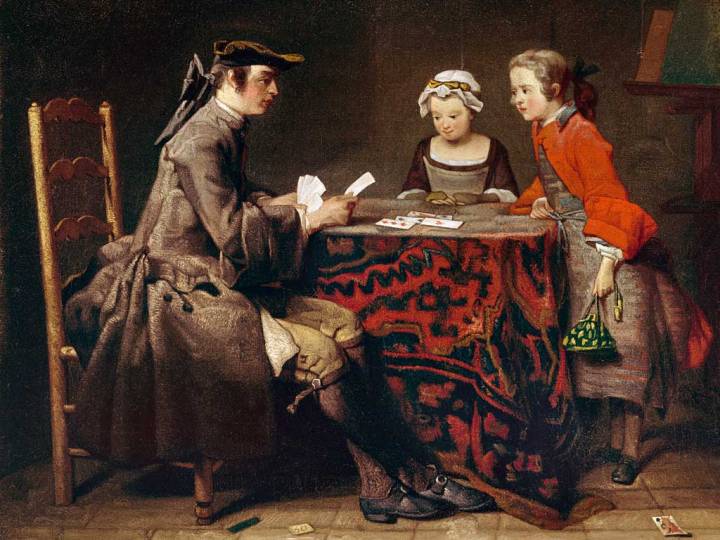
Jean-Siméon Chardin, Les Tours de Cartes (Card Tricks), ca.1735, oil on canvas, 31 x 39 cm
(Dublin: National Gallery of Ireland, NGI.478)
◊ ◊ ◊ ◊ ◊
Press release (via Art Daily) from the Bucerius Kunst Forum:
From Poussin to Monet: The Colors of France
Arp Museum Bahnhof Rolandseck, Remagen, 22 March — 6 September 2015
Bucerius Kunst Forum, Hamburg, 10 October 2015 — 17 January 2016
In the seventeenth century, French painting began to set the standards for all of Europe. Values in France during the Enlightenment began to shift toward a bourgeois society where painters were exposed to new themes and new artistic experiments. The French Revolution, the prototype of all struggles for liberation, marked a new era that became deeply entrenched in the development of French painting. The exhibition From Poussin to Monet: The Colors of France focuses on the effect that this dramatic social upheaval had on art.
During Poussin’s time, an argument broke out regarding the role of color in painting. Sensory experience and subjective perception became increasingly important until color was freed entirely by the Impressionists at the end of the nineteenth century. Paul Cézanne viewed nature as an arrangement of planes of color. Paintings no longer told a narrative; instead they gave to see. Color no longer depicted light; it became light. The exhibition demonstrates France’s path to modern art with paintings and drawings by Poussin, Watteau, Chardin, Delacroix, Corot, Courbet, Monet, Renoir, Cézanne, Van Gogh and others.
In cooperation with the National Gallery of Ireland in Dublin, and the Collection Rau for UNICEF at the Arp Museum Bahnhof Rolandseck in Remagen, Germany, where the exhibition ran from March 22 to September 6, 2015 under the title Revolution of Image: From Poussin to Monet.
Exhibition | Works from the Nationalmuseum in Stockholm

François Boucher, The Triumph of Venus, 1740, oil on canvas, 130 x 162 cm
(Nationalmuseum, Stockholm)
◊ ◊ ◊ ◊ ◊
Press release (24 December 2015) from The Morgan (with information for the show at the Louvre available here):
Paintings and Drawings from the Nationalmuseum in Stockholm (title forthcoming)
Musée du Louvre, Paris, 20 October 2016 — 16 January 2017
The Morgan Library & Museum, New York, 5 February — 14 May 2017
Seventy-six masterpieces of painting and drawing from the Nationalmuseum in Stockholm will make a rare appearance in New York beginning February 5, 2017 at the Morgan Library & Museum. The Nationalmuseum is Sweden’s largest and most distinguished museum, and it is lending to the Morgan outstanding works by Dürer, Raphael, Rubens, Rembrandt, Antoine Watteau, and François Boucher, among many celebrated artists. It is the first collaboration between the two institutions in almost fifty years.
“We are delighted to host this exhibition of treasures from the Nationalmuseum of Stockholm,” said Colin B. Bailey, director of the Morgan Library & Museum. “The selection of paintings and drawings is of extraordinary quality. Fine examples of work from the Italian, French, and Northern European schools are represented, with a group of sixty master drawings forming the heart of the show. We are deeply grateful to the museum’s director general Berndt Arell and his curatorial staff for making this collaboration possible.”
The exhibition will run through May 14, 2017 and continues a tradition at the Morgan of presenting drawings and other work from some of Europe’s most august institutions. Over the last several years, the Morgan has featured critically acclaimed shows from the Uffizi in Florence, the Louvre, and the Staatliche Graphische Sammlung in Munich.
The Nationalmuseum’s core holdings were assembled by Count Carl Gustav Tessin (1696–1770), a diplomat and one of the great art collectors of his day. The son and grandson of architects, Tessin held posts in Vienna, Berlin, and Paris, where he came into contact with the leading Parisian artists of the time and commissioned many works from them. By the time he left Paris in 1742, he had amassed a truly impressive collection of paintings and drawings.
Among the fourteen paintings in the exhibition are three commissioned by Tessin and exhibited at the 1740 Parisian Salon. These include Boucher’s Triumph of Venus, Jean-Baptiste Oudry’s Dachshound Pehr with Dead Game and Rifle, and a Portrait of Count Tessin by Jacques-André Joseph Aved, in which the collector is shown among his art, books, and medals. The group of paintings will also include six works by Jean-Siméon Chardin.
The drawings in the exhibition include works by Italian masters such as Domenico Ghirlandaio, Raphael, Giulio Romano, and Annibale Carracci. Northern European artists are represented by Dürer, Hendrik Goltzius, Peter Paul Rubens, Rembrandt, and Anthony van Dyck, among others. The French drawings begin with Primaticcio and practitioners of the Fountainebleau school and include works by Jacques Callot and Nicholas Poussin, as well as Count Tessin’s French contemporaries, Boucher, Chardin, and Antoine Watteau.
In the years following his return from France, Tessin encountered financial difficulties and was forced to sell much of his collection, with many of the finest works being acquired by the Swedish royal family. After the Count’s death, Swedish King Gustav III purchased most of his remaining works. Tessin’s holdings thus formed the nucleus of the Royal Museum of Sweden when it was created in 1794. It was later renamed the Nationalmuseum.
New Book | The Forge of Vision: A Visual History of Modern Christianity
From the University of California Press:
David Morgan, The Forge of Vision: A Visual History of Modern Christianity (Los Angeles: University of California Press, 2015), 407 pages, ISBN: 978-0520286955, $40 / £28.
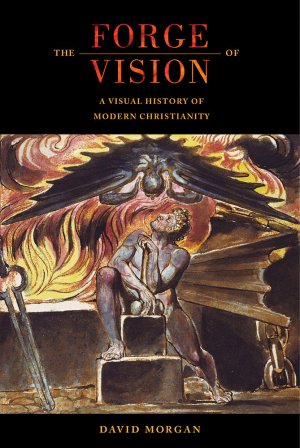 Religions teach their adherents how to see and feel at the same time; learning to see is not a disembodied process but one hammered from the forge of human need, social relations, and material practice. David Morgan argues that the history of religions may therefore be studied through the lens of their salient visual themes. The Forge of Vision tells the history of Christianity from the sixteenth century through the present by selecting the visual themes of faith that have profoundly influenced its development. After exploring how distinctive Catholic and Protestant visual cultures emerged in the early modern period, Morgan examines a variety of Christian visual practices, ranging from the imagination, visions of nationhood, the likeness of Jesus, the material life of words, and the role of modern art as a spiritual quest, to the importance of images for education, devotion, worship, and domestic life. An insightful, informed presentation of how Christianity has shaped and continues to shape the modern world, this work is a must-read for scholars and students across fields of religious studies, history, and art history.
David Morgan is Professor of Religious Studies at Duke University, with a secondary appointment in the Department of Art, Art History, and Visual Studies. He is the author of The Embodied Eye: Religious Visual Culture and the Social Life of Feeling and The Sacred Gaze: Religious Visual Culture in Theory and Practice, and coeditor of the journal Material Religion.
◊ ◊ ◊ ◊ ◊
C O N T E N T S
List of Illustrations
Acknowledgments
Introduction
I Word and Image
1 The Shape of the Holy
2 The Visible Word
II The Traffic of Images
3 Religion as Sacred Economy
4 The Agency of Words
5 Christianity and Nationhood
6 The Likeness of Jesus
7 Modern Art and Christianity
Conclusion
Notes
Selected Bibliography
Index
2015 Georgian Group Architectural Awards

Richard Samuel Coade, Belmont (Lyme Regis, Dorset), 1785, the home of Eleanor Coade; appropriately the house showcases the eponymous artificial stone she pioneered.
◊ ◊ ◊ ◊ ◊
The 2015 Georgian Group Architectural Awards were announced earlier in December. This year two joint winners share the award for Restoration of a Georgian Interior: the private apartment at Sir John Soane’s Museum and the Soane Tribune at Wotton House. The award for Restoration of a Georgian Building in an Urban Setting recognizes Belmont House in Lyme Regis (hooray for Eleanor Coade and the eponymous artificial stone she pioneered!). –CH
From The Georgian Group:
Belmont House in Lyme Regis is a 1785 maritime villa looking out over the Cobb. John Fowles wrote The French Lieutenant’s Woman here. By the time he died it was in a bad state, the gardens overgrown and the structural condition of the building poor. The Landmark Trust acquired it and took the decision, at once brave and controversial, to restore it to the form known by Mrs Coade, creator of the artificial stone that bears her name. That involved demolishing what was left of the substantial Victorian and later extensions in order to make it a villa in the round. The project has been informed by meticulous building analysis and documentary research and the building is now again a thing of real beauty, a delightful monument to one of the great female entrepreneurs of the Georgian period.
The full list of awards is available here»










 Enfilade
leave a comment