Exhibition | Colonial Williamsburg: The First 100 Years
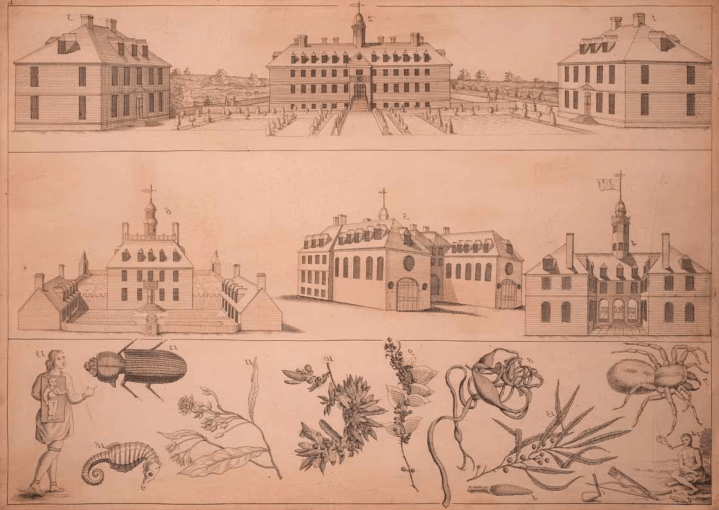
Illustration of Williamsburg Buildings, Flora, and Fauna, ca. 1740, copper plate 10 × 13.5 inches, possibly commissioned by William Byrd II
(Colonial Williamsburg, gift of the Bodleian Library, No. 1938-196)
◊ ◊ ◊ ◊ ◊
From the press release (12 February 2026) for the exhibition:
Colonial Williamsburg: The First 100 Years
Weldon Gallery, Colonial Williamsburg, 28 February — 31 December 2026
Developed by Margaret Pritchard, Neal Hurst, and Katie McKinney
As the nation observes its semiquincentennial in 2026, The Colonial Williamsburg Foundation is also celebrating its own 100-year history —a story that reflects a century of change in America itself. A new exhibition at the Art Museums of Colonial Williamsburg, entitled Colonial Williamsburg: The First 100 Years, explores the origins, evolution, and impact of this unique organization that today operates the world’s largest U.S. history museum.
From its groundbreaking preservation efforts to its evolving interpretations of America’s rich shared history and founding ideals, Colonial Williamsburg has often mirrored—and sometimes led—national conversations. One constant has driven the Foundation throughout its history: Everything it produces is grounded in ongoing research. Colonial Williamsburg: The First 100 Years explores the Foundation’s journey through that same lens using primary documents, objects and archival imagery to bring Colonial Williamsburg’s own history to life.
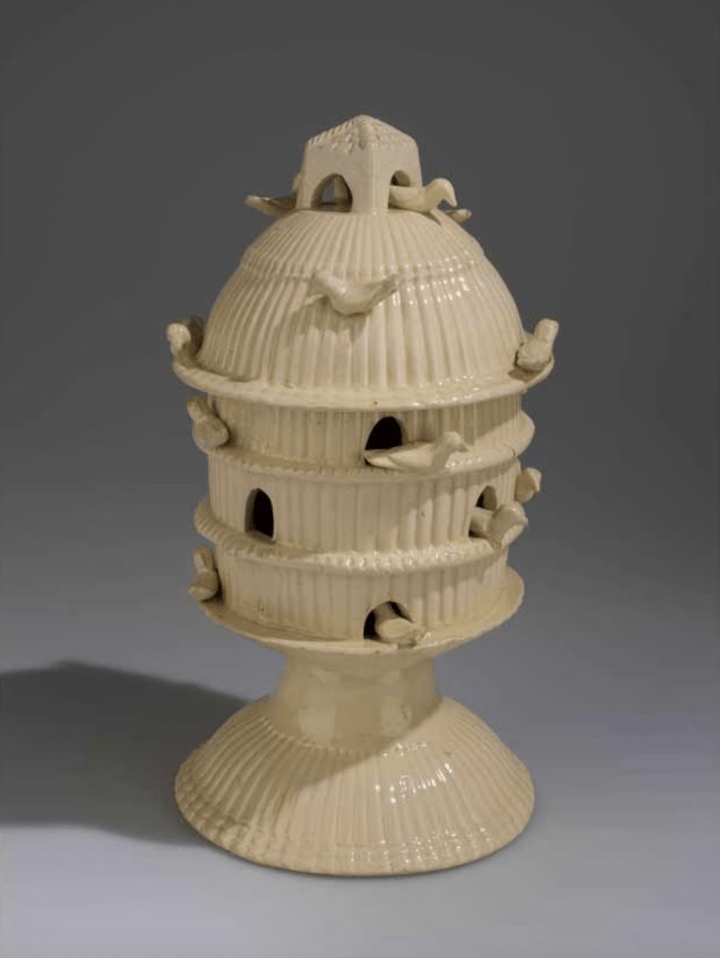
Dovecote, ca. 1770, made in England, Staffordshire or Yorkshire, lead-glazed earthenware (cream-colored earthenware / creamware), 8.5 inches high (Colonial Williamsburg, museum purchase, No. 1936-628).
The exhibition opens in the Art Museums’ 2500-square-foot Weldon Gallery on 28 February 2026, and will showcase more than 200 objects including decorative art, folk art, and archival material. Highlighting 100 years of history in one exhibition took Neal Hurst, curator of textiles and historic dress, and Katie McKinney, the Margaret Beck Pritchard Curator of Maps, several years. They took over the project, which former Deputy Chief Curator Margaret Pritchard began in 2021, continuing work on the exhibition after Pritchard’s retirement in 2024.
“It has been a joy to research, seek out objects, rediscover Colonial Williamsburg’s history, and talk to people who have worked for the Foundation, all of which culminates in this exhibition. Like any exhibit, space is always limited, but visitors will walk away with an understanding of The Colonial Williamsburg Foundation’s impact on public history, as well as its influence on preservation, collecting and education around the world,” Hurst said.
Added McKinney, “After 100 years, Colonial Williamsburg has become historic in its own right. Our colleagues across the Foundation, past and present, made this exhibition a reality. They shared their stories, expertise and lent objects. We were fascinated by how we continue to build upon the foundations laid out by the work of our predecessors. Time and again we were reminded of our motto: ‘That the future may learn from the past.’ Ultimately, the exhibition is about the people who have nurtured and built upon the Rev. Dr. W.A.R. Goodwin’s dream for the past century.”
Designed to be experienced chronologically, the exhibition begins with a look at communities and institutions who called Williamsburg home after Virginia’s capital was moved to Richmond in 1780. It offers a look at what inspired the Rev. Dr. W.A.R. Goodwin to envision Williamsburg’s restoration to its 18th-century appearance and John D. Rockefeller Jr.’s decision to support the project. Beginning with Rockefeller’s initial purchase of the Ludwell-Paradise house in 1926, the exhibition traces Colonial Williamsburg’s evolution from a patriotic preservation project to its current iteration as a premier educational organization that operates the world’s largest U.S. history museum. The exhibition explores Colonial Williamsburg’s research in interpretation, trades, preservation techniques and other aspects of the Foundation’s work over the decades. Each section includes maps, prints, and photographs from Colonial Williamsburg’s extensive archival collection, including aerial images of Williamsburg during the early years of the restoration and pictures of the men and women who restored and reconstructed the colonial capital city.
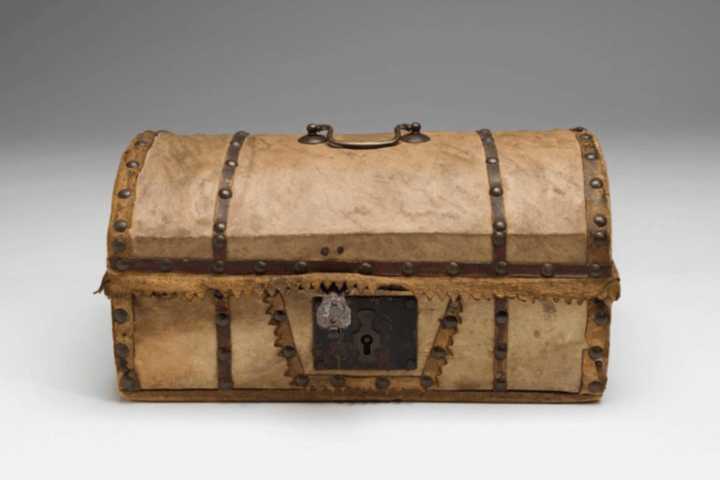
Document Box, ca. 1843, basswood (Tilia, Spp. by micro id), calfskin, leather, brass, iron, paper, textile, and paint, 6 × 7 × 12 inches (Colonial Williamsburg, gift of Catherine H. Latane, No, 2011-26). Owned by a formerly enslaved woman in Williamsburg at the end of the 19th century who lived with the Edwin and Isabel Beale family on Duke of Gloucester Street (on the site of the Orlando Jones House), where the family operated a hardware store.
◊ ◊ ◊ ◊ ◊
Curators sourced objects from archaeological, architectural, and museum collections, as well as ordinary objects from across the Foundation. Among those featured is the Bodleian Plate, known as ‘the cornerstone of the restoration’, which was discovered in England in the 1920s and helped guide the reconstruction of the Capitol and Governor’s Palace; Dr. Goodwin’s cane; George III’s coat of arms, which was once displayed in the Governor’s Palace; a document box that once held the treasured possessions of a formerly enslaved resident of Williamsburg; and a window sash removed during the preservation of the Williamsburg Bray School.
Other notable items on display:
• Ceramic objects from the collection that were buried in sand inside barrels for their safekeeping during WWII
• A mid-20th-century brick mold used to manufacture bricks in support of the restoration
• A paint chip board displaying Colonial Williamsburg’s signature colors that was originally installed in the Foundation’s paint shop in 1950
• An exhibit that explores the evolution of the interiors of the Governor’s Palace supper room, including samples of Chinese-painted wallpaper and ornate furnishings that had a major influence on American interior design
• A view of the Ludwell-Paradise House, where in 1935 an exhibition of American folk art loaned by Abby Aldrich Rockefeller went on view, including Washington and Lafayette at the Battle of Yorktown
• A vignette from the Anderson House Archaeological Exhibit (1975–83), which was designed to demystify the relatively new field of historical archaeology championed by the Colonial Williamsburg Foundation
The exhibition also includes several captioned videos and a touchscreen that allows guests to access short segments of several films produced by the Foundation to showcase its work in the digital space. Visitors familiar with Colonial Williamsburg’s history will recognize props from the film Story of a Patriot; Felicity Merriman, the American Girl doll whose story is set in 18th-century Williamsburg; and several of the Foundation’s numerous Emmy Awards won for its educational video productions.
“The Foundation has led the field of public history for a century, and Colonial Williamsburg: The First 100 Years traces that journey. As we celebrate America’s 250th anniversary and Colonial Williamsburg’s 100th, we welcome the nation—and the world—to join us throughout 2026 in honoring the past, engaging the present, and inspiring the future,” said Ron Hurst, chief mission officer for the Foundation and chief curator for the Art Museums of Colonial Williamsburg.
Exhibition | Philadelphia, China Trade, and the Making of America
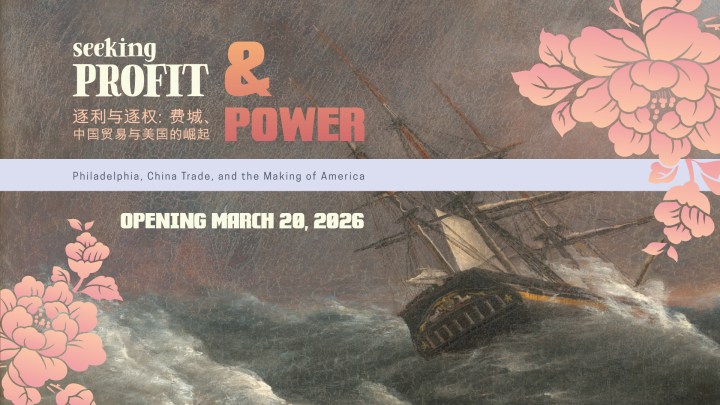
From the press release (2 February 2026) for the exhibition . . .
Seeking Profit and Power: Philadelphia, China Trade, and the Making of America
Independence Seaport Museum, Philadelphia, 20 March — 3 January 2028
Curated by Susan Gail Johnson and Brett Palfreyman
Eager to prove itself worthy of trading on the world stage as a newly formed nation 250 years ago, America—and especially Philadelphians—embarked on the risky venture of trading with China by entrusting private citizens with the work of establishing trade and diplomatic relationships with the Chinese. Merchants saw dramatic opportunities to make money, building some of the fortunes that helped expand Philadelphia’s role as a major port and city. To celebrate the country’s 250th anniversary, Independence Seaport Museum presents Seeking Profit and Power: Philadelphia, China Trade, and the Making of America, a new exhibition informed by the latest scholarship and featuring approximately 150 unique, rarely seen objects from its collection ranging from ship logs and cargo manifests to examples of rare Chinese export porcelain, Chinese silks and sample books, to portraits of American and Chinese merchants, some of which will be exhibited for the first time. Additionally, museums and private collections, including George Washington’s Mount Vernon, The Society of The Cincinnati, The Dietrich American Foundation, and Andalusia Historic House and Gardens have also loaned important objects for Seeking Profit and Power. While other institutions can tell different aspects of this story, ISM is uniquely positioned to share it through its mission and location on the Delaware River, where Philadelphia’s China trade vessels launched and their cargo was unloaded.
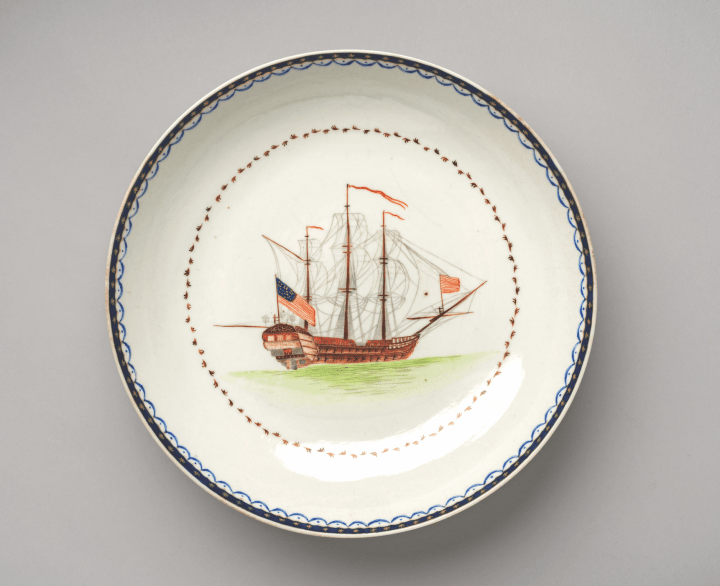
Bowl Depicting a Ship with American Flag, ca. 1790s, porcelain manufactured for the export market in Jingdezhen, decorated in Canton (Philadelphia: Independence Seaport Museum, acquired through exchange, courtesy of Friends of the Museum, 2023.038).
“This exhibition tells the story of a critical moment in the history of our nation,” said Peter Seibert, president and CEO of Independence Seaport Museum. “When the United States declared its independence from Great Britain, we also separated ourselves from the rules and regulations that governed overseas trade. As we came together as a nation 250 years ago, we also stepped out on the world’s stage for the first time. The ISM team, consisting not only of our curatorial, exhibition and education staff and an exceptional panel of outside scholars, have brought together an amazing assemblage of objects that tell the story of our look to the East as a new global trading power.”
Organized by guest curators Susan Gail Johnson and Brett Palfreyman, Seeking Profit and Power will explore five essential themes. “Making a Nation” focuses on why the United States opened direct trade with China. “Making it Work” illustrates the tremendous technical and logistical feat traveling the route from Philadelphia to China. “Making Money” shows the array of commodities the new nation could trade for sought-after Chinese tea, porcelain, and other goods. “Encountering Each Other” explains how the two cultures learned about one another through the goods that they traded. The final section, “The Old China Trade,” explores the end of the era and the place it still holds in American memory.
“Our goal for the exhibition is to show visitors that a teacup is more than just a teacup—it is an object that tells a story about sailing halfway around the world, America’s taste for luxury goods, and how the nation’s founders imagined that trade with China might help establish the newly independent nation as a player on the world stage,” said Susan Gail Johnson. “We hope visitors will never look at a teacup the same way again.”
The full press release with details about specific objects is available here»
Exhibition | The First Salute
From the press release for the exhibition:
The First Salute: An Untold Story of the American Revolution
Weitzman National Museum of American Jewish History, Philadelphia, 23 April 2026 — April 2027
Curated by Josh Perelman, with Jonathan Sarna, Pamela Nadell, and Laura Leibman
“Had it not been for… this infamous island, the American rebellion could not possibly have subsisted.”*
This landmark exhibition marking America’s 250th will take you on an adventure through America’s fight for freedom as you’ve never seen it before—where Jewish faith, courage, and persecution collided on the high seas to change the course of history. The First Salute: An Untold Story of the American Revolution is the first-ever major museum exhibition to explore the little-known story of a small group of Jewish merchants in the Caribbean whose outsized contributions to the cause of American Liberty tipped the scales in the fight for American Independence.
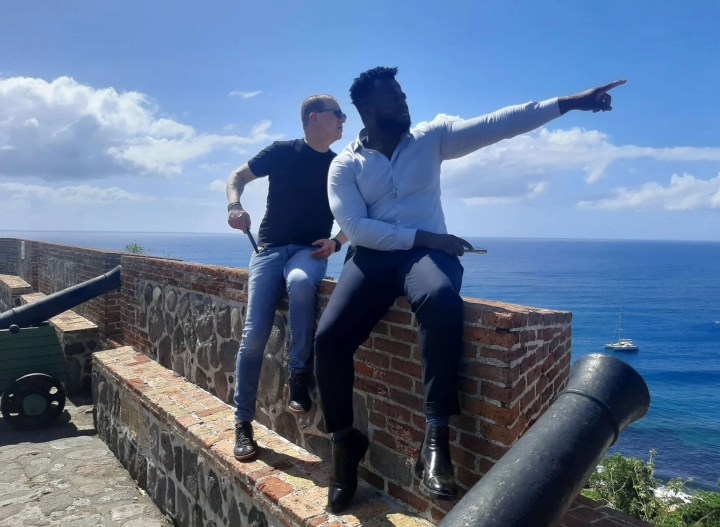
Exhibition curator Josh Perelman (left) with Heritage Inspector Raimie Richardson (right) on St. Eustatius (known locally as ‘Statia’) (Photo by Avida Linvy, November 2025).
The First Salute is the high-stakes, true story sparked by two key moments on the high seas that tipped the scales of the American Revolution and its founding principles. Set against the backdrop of the tiny Caribbean island of St. Eustatius, this riveting tale explores how religious liberty, Jewish trade merchants, and the cruelty toward the Jewish community by a debt-ridden British admiral converged at a pivotal time in world history, and impacted the trajectory of the Revolutionary War.
From Jewish expulsion from Spain and Portugal in the 15th century, to secret shipments of gunpowder disguised as tea by a network of Jewish merchants in the Caribbean in the 18th century, this tale of resilience, ingenuity, survival, and the promise of freedom still resonates today. This semiquincentennial exhibition features original films, rarely seen artifacts, storytelling, and an immersive video experience that situates visitors within three of the four original walls of St. Eustatius’s synagogue and Jewish cemetery that still stand today. The exhibition expands the understanding of the American Revolution by including the greater Atlantic World and illustrating the connections between North American and Caribbean Jewish communities, offering new insights into people and events that helped secure America’s independence.
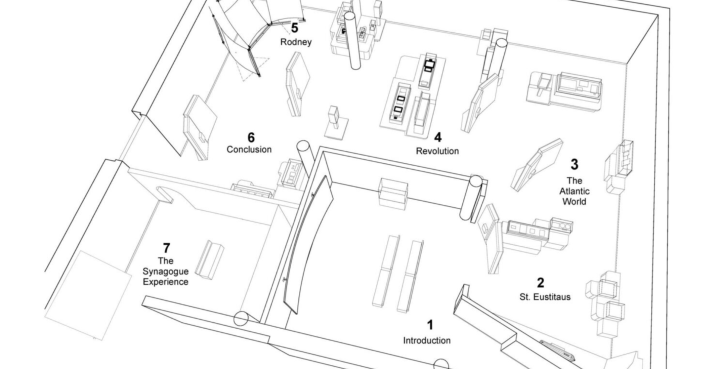 “The First Salute reminds us that America’s strength lies in its enduring commitment to religious liberty,” said Dan Tadmor, President and CEO of The Weitzman. “Two hundred and fifty years after America’s founding, this exhibition connects historical events to present-day challenges. We hope that visitors walk away considering the roles of faith, community, and discrimination — in both historical and contemporary contexts.”
The First Salute is made possible with financial assistance provided by the Commonwealth of Pennsylvania, Honorable Josh Shapiro, Governor; support from Lilly Endowment Inc. through its Religion and Cultural Institutions Initiative which propelled this exhibition’s development; and The Pew Center for Arts & Heritage. Additional funding has been provided by the Maimonides Fund, Mayor Cherelle L. Parker & the City of Philadelphia, America250PA, Betsy and Philip M. Darivoff, and other generous individuals.
The full press release is available here»
*Header quote: Admiral Sir George Rodney in a letter to Rear Admiral Sir Peter Parker in 1781 that “had it not been for that nest of vipers… this infamous island, the American rebellion could not possibly have subsisted.”
Constable 250
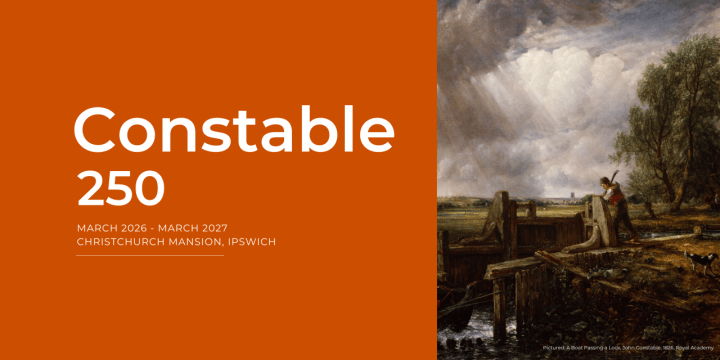
From the Colchester and Ipswich Museums:
Constable 250
Christchurch Mansion, Ipswich, March 2026 — March 2027
2026 marks the 250th anniversary of the birth of Suffolk born artist, John Constable (1776–1837), who would become one of the most important of all British painters. To commemorate his life and work Colchester and Ipswich Museums present Constable 250, a programme of exhibitions and activities at the heart of which will be three landmark exhibitions at Ipswich’s Christchurch Mansion, featuring works from CIMS own collections alongside major loans from across the UK.
Watch this space for ticket and booking details, which will be available in the new year, along with further information about Constable 250 Project activities.
Constable: A Cast of Characters
28 March — 14 June 2026
Introducing those who inspired and supported the artist. New work by international sculptor and direct descendant, Sasha Constable will also feature.
Constable: Walking the Landscape
11 July — 4 October 2026
Showcasing loans from Tate, V&A, Royal Academy, National Galleries of Scotland, and many in Suffolk for the first time. Seen alongside Colchester & Ipswich’s Constable collection, all exploring the theme of walking.
Constable to Contemporary
24 October 2026 — 28 February 2027
The final exhibition will highlight the relevancy and contemporary responses to Constable’s art.
Conference | Turner 250
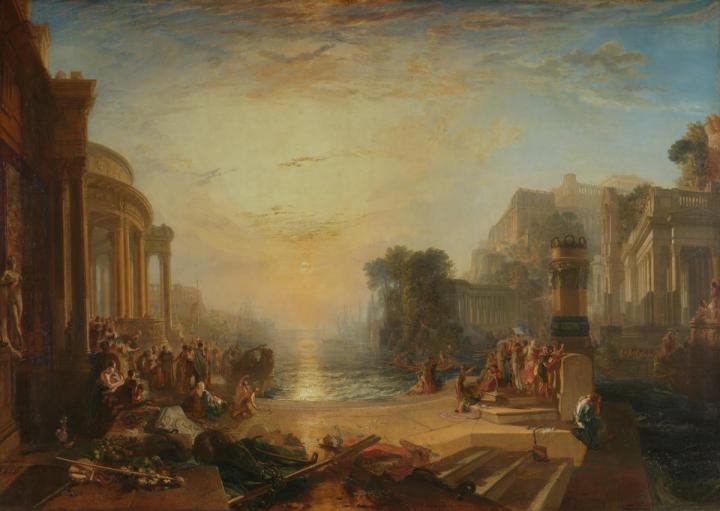
J.M.W. Turner, The Decline of the Carthaginian Empire, exhibited in 1817, oil on canvas, 170 × 239 cm (London: Tate, accepted by the nation as part of the Turner Bequest 1856, N00499).
◊ ◊ ◊ ◊ ◊
From the Paul Mellon Centre:
Turner 250
Tate Britain, London, 4–5 December 2025
2025 marks two hundred and fifty years since the birth of Romantic painter J.M.W. Turner (1775–1851). Timed to coincide with the Turner and Constable exhibition at Tate Britain and to help bring celebrations of Turner’s 250th anniversary year to a close, this conference will take Turner’s art and life as a starting point for exploring what it means to research Turner and to curate his work today.
t h u r s d a y , 4 d e c e m b e r
9.30 Registration with tea and coffee
10.00 Opening Remarks — Amy Concannon (Manton Senior Curator of Historic British Art at Tate)
10.10 Panel 1 | Curating Turner Now
Chair: Esther Chadwick (senior lecturer in history of art and Head of the History of Art Department, The Courtauld)
• Turner as Teacher: Lessons in Perspective — Helen Cobby (curator and lecturer, Bath Spa University)
• A Maligned Masterpiece? Displaying Turner’s The Battle of Trafalgar in Greenwich — Katherine Gazzard (Curator of Art (Post-1800), Royal Museums Greenwich)
• Reimagining the Liber Studiorum: Reasserting the Primacy of Print in Turner’s Art — Imogen Holmes-Roe (Curator (Historic Art), the Whitworth, University of Manchester)
• Curating Turner in East Anglia — Emma Roodhouse (curator and researcher) and Francesca Vanke (Senior Curator and Keeper of Fine and Decorative Art, Norwich Museums)
• A Site of Inspiration: Curating Turner at Petworth — Emily Knight (Property Curator, Petworth House) and Sue Rhodes (Visitor Experience Manager, Petworth House)
• The New Carthaginian: Turner, Memory, and Imperial Echoes (Performative Lecture) — Nick Makoha (poet and playwright)
12.50 Lunch break
Completing the Turner Cataloguing Project, the Paul Mellon Centre (PMC) film to be screened
2.00 Panel 2 | Researching Turner’s Bequest
Chair: Nicola Moorby (Curator, British Art 1790–1850, Tate)
• Introduction to Turner Bequest Catalogue — Matthew Imms (former Senior Cataloguer and Editor: Turner Bequest, Tate)
• The Discovery and Assembly of the 1838 Tour — Hayley Flynn (former Turner Cataloguer, Tate), with support from the Turner Society.
• Turner Technical Studies: Their Legacy and Preservation — Joyce Townsend (Senior Conservation Scientist, Tate)
3.10 Tea and coffee break
Completing the Turner Cataloguing Project, PMC film to be screened
3.40 Panel 3 | Building Turner’s Reputation
• About Carthage – An Exhibition of Seven Paintings by Stephen Farthing RA Held at the UK Ambassador’s Residence in Carthage 2025 — Stephen Farthing (artist)
• Turner and Robert Hills: Collaborating Contemporaries? — Kimberly Rhodes (professor of art history, Drew University)
• Paper Galleries and the Mediation of Art: Turner, John Constable, and Clarkson Stanfield in The Royal Gallery of British Art (ca. 1851) — Chia-Chuan Hsieh (professor, Graduate Institute of Art Studies, National Central University, Taiwan)
• From Patriotic Patronage to National Property: The Trajectory of the Petworth Turners, 1805–1956 — Andrew Loukes (Curator of the Egremont Collection, Petworth House)
5.20 Drinks reception
6.15 Evening Lecture
• Art, Music, and the Sublime — Tim Barringer, with live performance by the Kyan Quartet of Franz Schubert’s string quartet no.14 in D minor, D.810, Death and the Maiden
f r i d a y , 5 d e c e m b e r
10.00 Registration with tea and coffee
10.30 Panel 4 | Eco-critical Approaches to the Artist
Chair: Tom Ardill (Curator of Paintings, Prints and Drawings, London Museum)
• Out of the Blue: Exploring Water in Turner’s Work — Martha Cattell (artist, curator and researcher)
• Watermarks: Environmental Contingencies and the Turner Bequest — Tobah Aukland-Peck (postdoctoral fellow, PMC), with support from the Turner Society.
• Rethinking Turner’s Human Landscape — Caterina Franciosi (PhD candidate in the history of art, Yale University), with support from the Turner Society.
• What Was in Turner’s Lungs? — Sarah Gould (assistant professor, Université Paris 1, Panthéon-Sorbonne)
• Necro-Geographies of the Sublime: A Posthuman Reckoning with Turner’s Horizon (Multimedia Video-Essay) — Parham Ghalmdar (artist and researcher, The New Centre for Research & Practice)
12.40 Lunch break
Completing the Turner Cataloguing Project, PMC film to be screened
1.40 Panel 5 | Artistic Legacies
Chair: John Bonehill (senior lecturer in history of art, University of Glasgow)
• Encounters at MoMA: Turner, Rothko, and the Invention of ‘Modernist’ — Nicole Cochrane (Assistant Curator, Historic Art, 1790–1850, Tate Britain)
• 1966: Turner, Frank Bowling, and the Subject of Modernism — Ed Kettleborough (PhD candidate in history of art, University of Bristol), with support from the Turner Society.
• Where Sky Meets Ground: Turner and Sheila Fell in the Solway Firth — Kate Brock (researcher, Royal College of Art)
• Reservoirs of Recollection: John Akomfrah and the Oceanic Afterlives of Turner’s Sublime — Sabo Kpade (writer, curator, and researcher)
• What Can We Find in Turner’s Shadows? Artist Libby Heaney at Orleans House Gallery — Julia DeFabo (curator and creative producer), with support from the Turner Society.
4.20 Historical Fiction
• Varnishing Day: Ruskin, Turner, and the End of Idolatry — Cal Barton (writer and teacher)
4.40 Closing Remarks — Nicola Moorby and Amy Concannon (Tate) and Martin Myrone (PMC)
Documentary | The American Revolution

The series premiers Sunday evening. Jill Lepore addresses it within the larger context of institutions celebrating the 250th anniversary of the Revolution, “Revolutionary Whiplash: Commemorating a Nation’s Founding in a Time of Fear and Foreboding,” The New Yorker (17 November 2025), pp. 14–18. . . . .
The American Revolution: A Film by Ken Burns, Sarah Botstein, and David Schmidt, 12 hours, PBS, 2025. With Claire Danes, Hugh Dancy, Josh Brolin, Kenneth Branagh, and Liev Schreiber.
The American Revolution examines how America’s founding turned the world upside-down. Thirteen British colonies on the Atlantic Coast rose in rebellion, won their independence, and established a new form of government that radically reshaped the continent and inspired centuries of democratic movements around the globe.
 An expansive look at the virtues and contradictions of the war and the birth of the United States of America, the film follows dozens of figures from a wide variety of backgrounds. Through their individual stories, viewers experience the war through the memories of the men and women who experienced it: the rank-and-file Continental soldiers and American militiamen (some of them teenagers), Patriot political and military leaders, British Army officers, American Loyalists, Native soldiers and civilians, enslaved and free African Americans, German soldiers in the British service, French and Spanish allies, and various civilians living in North America, Loyalist as well as Patriot, including many made refugees by the war.
The Revolution began a movement for people around the world to imagine new and better futures for themselves, their nations, and for humanity. It declared American independence with promises that we continue to strive for. The American Revolution opened the door to advance civil liberties and human rights, and it asked questions that we are still trying to answer today.
Each episode is two hours.
1 | In Order to Be Free (May 1754 – May 1775)
2| An Asylum for Mankind (May 1775 – July 1776)
3 | The Times That Try Men’s Souls (July 1776 – January 1777)
4 | Conquer by a Drawn Game (January 1777 – February 1778)
5 | The Soul of All America (December 1777 – May 1780)
6 | The Most Sacred Thing (May 1780 – Onward)
Geoffrey Ward and Ken Burns, The American Revolution: An Intimate History (New York: Knopf, 2025), 608 pages, ISBN: 978-0525658672, $80.
Colonial Williamsburg’s Antiques Forum, 2026
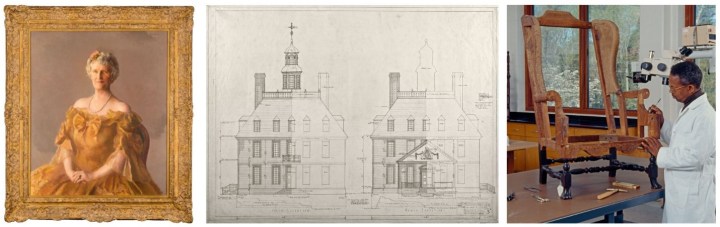
Left: Robert Brackman, Portrait of Abby Aldrich Rockefeller (Mrs. John D. Rockefeller), 1941, oil on canvas·(Gift of the Blanchette Hooker Rockefeller Fund through the generosity of John D. Rockefeller 3rd, his wife Blanchette Hooker Rockefeller, and their four children, 2019-82, A&B). Center: David Hayes, Governors Palace North and South Elevations, Drawing #5, 30 October 1931. Right: Upholstery Conservator Leroy Graves Examines an Easy Chair in the Conservation Lab RIG.
◊ ◊ ◊ ◊ ◊
In 2026 the US will turn 250 and Colonial Williamsburg 100. From the Antiques Forum press release:
78th Annual Antiques Forum at Colonial Williamsburg
Online and in-person, Williamsburg, Virginia 19–25 February 2026
Scholarship applications for students and emerging scholars due by 16 December 2025
The Colonial Williamsburg Foundation will host its 78th Annual Antiques Forum February 19–25, 2026. Offered both virtually and in-person, this year’s conference is organized around the Foundation’s mission statement, “That the future may learn from the past.” To commemorate the 250th anniversary of American independence and the 100th anniversary of Colonial Williamsburg’s founding, the 2026 forum will explore past inspiration and future influence through the lens of material culture and the decorative arts. Forum attendees will also have an exclusive opportunity to preview Colonial Williamsburg: The First 100 Years, a new exhibition at the Art Museums of Colonial Williamsburg opening February 28.

Mourning Ring with Print of George Washington, possibly by the Philadelphia jeweler Jean-Simon Chaudron with a print by Charles Balthazar Julien Fevret de Saint-Memin, ca. 1800, copper/gold/silver alloys, enamel, paper, glass (Colonial Williamsburg, Gift of Mike and Carolyn McNamara, 2025–26). The ring descended through the family of the Marquis de Lafayette who may have acquired it during his tour of the United States in 1824–25.
Curators and scholars from Colonial Williamsburg will be joined by leading experts and collectors from across the nation to present on historic preservation, decorative arts, antiques, architecture, historic costume and more. President and CEO of the Museum of the American Revolution in Philadelphia, Dr. R. Scott Stephenson, will open the conference with a keynote address that expands upon their recent exhibition, Banners of Liberty: Flags that Witnessed the American Revolution. Additional guest presenters include Jeff Evans, decorative arts specialist; Calder Loth, senior architectural historian, Virginia Department of Historic Resources; Amanda Keller, executive director, Wilton House Museum; Elyse Werling, director of interpretation and collections, Preservation Virginia; Samantha Dorsey, independent consultant; Matthew Wood, curator, Castle Howard; William L. Coleman, director of the Andrew & Betsy Wyeth Student Center, Brandywine Museum of Art; Janine Skerry, independent consultant; and emerging scholars presenting new scholarship as part of the Carolyn and Michael McNamara Young Scholars Series sponsored by the Decorative Arts Trust.
The majority of conference activities will take place in the Virginia Room of the Williamsburg Lodge, located at 310 S. England Street. A variety of exclusive pre- and post-conference activities are available for in-person registrants, as are special room rates at Colonial Williamsburg hotel properties. A limited number of in-person and virtual attendance scholarships are available to students and emerging professionals in relevant positions or programs; scholarship applications are due by December 16. In-person registration is $660 per person through January 4 and includes a welcome reception, continental breakfasts, coffee and refreshment breaks, conference reception and dinner, and presentations as well as access to the conference streaming platform. Virtual-only registration is $150 per person and includes access to all general session presentations through the conference streaming platform. Both in-person and virtual-only registrations include a seven-day ticket voucher to Colonial Williamsburg’s Art Museums and Historic Area, valid for redemption through December 31, 2026. Registration and payment in full are required by Sunday, February 8.
Details are available here»
Antiques Forum is sponsored by Roger & Ann Hall and Friends of Colonial Williamsburg Collections, Mark & Loretta Roman, Jeffrey S. Evans & Associates, Brunk Auctions, The Decorative Arts Trust, Doyle Auctions, Americana Insights, Winterthur Museum, Jamestown Yorktown Foundation, Bayou Bend, and The National Institute of American History & Democracy.
Turner’s ‘Battle of Trafalgar’ Back on Display at Greenwich
◊ ◊ ◊ ◊ ◊
From the press release (via Art Daily) . . .
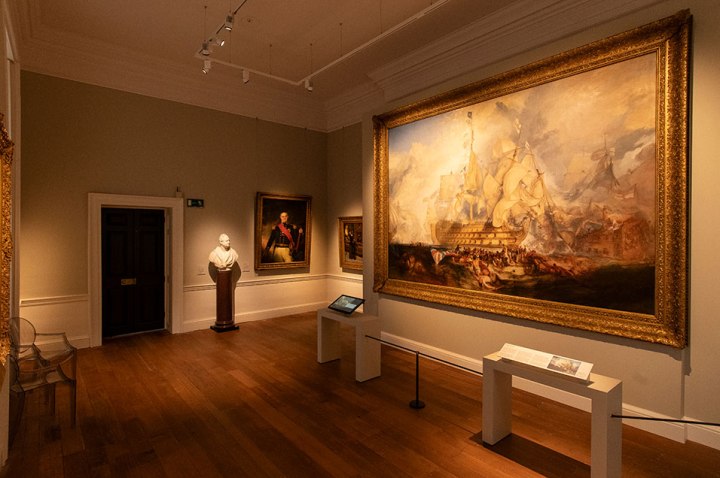
2025 marks the 250th anniversary of the birth of Joseph Mallord William Turner (1775–1851), one of Britain’s most admired Romantic painters. To commemorate this landmark anniversary, the National Maritime Museum is returning one of Turner’s most important masterpieces to display in the Queen’s House. The Battle of Trafalgar will be on public display from 21 October 2025, 220 years to the day since the Battle of Trafalgar.
Measuring more than three metres across, The Battle of Trafalgar is the largest painting that Turner ever completed. It commemorates the most decisive naval action of the Napoleonic Wars, the victory of the British Royal Navy over a combined French and Spanish fleet off Cape Trafalgar on 21 October 1805. The painting was made for King George IV in 1824—Turner’s only royal commission. It initially attracted criticism from naval officials, who complained about factual inaccuracies, but it was later acclaimed as a highlight of the Naval Gallery—a popular public art gallery set within the grounds of the Royal Hospital for Seamen at Greenwich.
In The Battle of Trafalgar, Turner captures the human drama of the action, from the struggles of the ordinary sailors to the fatal wounding of their commander, Vice-Admiral Horatio Nelson. The finished composition is a symbolic amalgamation of different moments in the battle. Nelson’s flagship, Victory, is depicted on an exaggerated scale, an artistic decision intended to emphasise the might of British naval power. The ship’s falling foremast, bearing the vice-admiral’s flag, symbolises Nelson’s demise. The signal flags spell the final three letters of ‘duty’, referencing both Nelson’s famous order, “England expects every man to do his duty,” and some of his dying words, “Thank God I have done my duty.”
The French ship Redoubtable, from which the fatal shot came, foundered in a storm after the battle but is depicted sinking in the thick of the action. In compressing the timeline, Turner emphasised the defeat of the Franco-Spanish fleet. However, while celebrating Britain’s triumph, Turner did not shy away from the brutal realities of naval warfare and encouraged respect and sympathy for sailors manning the ships on both sides of the conflict. In the centre of the image, at what would have been eye level when the painting was first displayed in St James’s Palace, the lifeless eyes of a dead seafarer gaze out. The Latin word ‘ferat’ appears in the water beside him, recalling Nelson’s motto, Palam qui meruit ferat (‘Let him who has earned it bear the Palm’). The palm referenced in the motto was a traditional symbol of victory, but the sailor’s suffering undermines this noble ideal of glory.
 In 1829, George IV had Turner’s The Battle of Trafalgar transferred from St James’s Palace to the Naval Gallery. Greenwich Hospital, where the gallery was situated, provided accommodation for elderly and disabled naval veterans, many of whom had served at Trafalgar. This made it a fitting home for Turner’s painting, given its emphasis on the labour and suffering of common sailors.
The painting was taken off display in March 2024 to protect it during a capital project at the National Maritime Museum. Its new home places it within the heart of the Museum’s fine art collection in the Queen’s House art gallery. It will be displayed alongside artworks from the Museum’s collection that tell the story of its journey from St James’s Palace to the Naval Gallery at Greenwich.
A new book has also been published celebrating this exceptional artwork. J.M.W. Turner’s The Battle of Trafalgar: Commemoration and Controversy is part of Royal Museums Greenwich’s new Spotlight series. Curator Katherine Gazzard considers the challenges that Turner faced during the creation of the painting, the public response to it and the fascinating history that led to its place at the centre of a national art collection.
Katherine Gazzard, J.M.W. The Battle of Trafalgar: Commemoration and Controversy (Greenwich: Royal Museums Greenwich, 2025), 96 pages, ISBN: 978-1068765995, £13.
Exhibitions | Casanova and Venice / Casanova and Europe
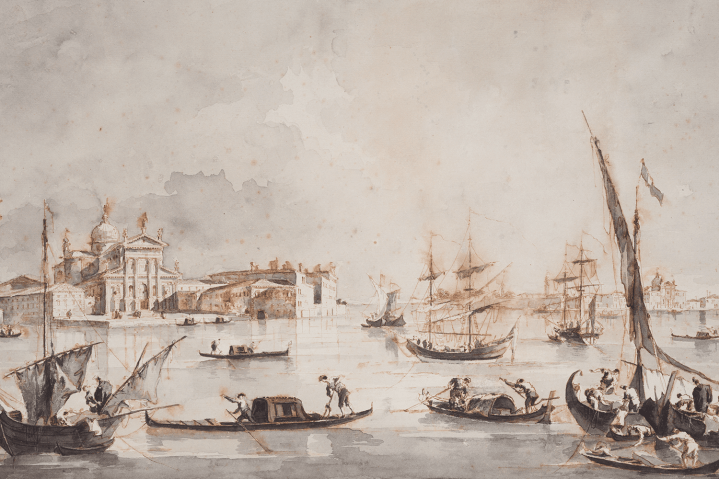
Francesco Guardi, View of San Giorgio Maggiore
(Venice: Fondazione Giorgio Cini)
◊ ◊ ◊ ◊ ◊
From the Fondazione Giorgio Cini:
Casanova and Venice
Palazzo Cini, Venice, 27 September 2025 — 2 March 2026
Casanova and Europe: An Opera in Multiple Acts
San Giorgio Maggiore, Venice, 17 October 2025 – 2 March 2026
 On the 300th anniversary of the birth of Giacomo Casanova (1725–1798), the Fondazione Giorgio Cini is dedicating a major exhibition and cultural project to the celebrated Venetian. The first chapter of the double exhibition opens at Palazzo Cini in San Vio on September 27. Curated by the Institute of Art History, with the participation of the Institute for Theater and Opera, the exhibition traces the multifaceted figure of Casanova—scholar, memoirist, philosopher, alchemist, traveler, and diplomat—throughout a restless century that ended with the fall of the Serenissima. Through nearly one hundred works including paintings, engravings, books, objets d’art, and documents from the Foundation’s collections and prestigious Italian and European institutions, the exhibition recounts the refined, cultured, and contradictory world of the Venetian 18th century—Casanova’s century.
The exhibition is part of a wider cultural program involving all the Fondazione Giorgio Cini institutions, with conferences, concerts, and seminars dedicated to the link between Casanova, Venice, and Europe. The aim is to present a complex and multidisciplinary portrait of one of the most iconic figures in the history of Venice, who was a central figure during the final century of the Serenissima’s existence. The Foundation celebrates the European spirit embodied by Casanova.
“The project dedicated to Casanova is an opportunity to highlight the deep connection between the Fondazione Giorgio Cini and the city, its history, and its cultural context, drawing inspiration,” explains President Gianfelice Rocca, “from the great personalities and significant themes that have shaped history. It is an opportunity to emphasise the expertise, research, and collaboration between the Foundation’s Institutes and Centres in an international context. The Foundation’s vocation is to be an active participant, through this and other events, in the global stage of dialogue based on cultural diplomacy as a useful and necessary tool to respond to an era like ours, in which cultures and civilisations risk becoming enemies, unable to listen to, understand, and collaborate with each other.”
The Scientific Director, Daniele Franco, emphasises, “Fondazione Giorgio Cini is working to propose a reading of Casanova that goes beyond the usual imagery, the ‘myth’ that has become entrenched in traditional interpretations surrounding him. The primary aim is to highlight a complex character, a man who, from Venice, travels throughout Europe, in a historical period of rapid cultural and political change, where a vision of European society begins to emerge, one that is permeated by uncertainties, tensions, and an increasingly open and complex cultural debate. In Casanova’s writings, we can find many of the contradictions and forces for change that Europe is grappling with today.”
• Casanova e Venezia, at Palazzo Cini (27 September 2025 – 2 March 2026) with a focus on Venice, the birthplace and the first stage of Casanova’s life.
• Casanova e l’Europa: Opera in più atti, on the island of San Giorgio Maggiore (17 October 2025 – 2 March 2026), a look at Europe and the network of travels, relationships, and adventures that made Casanova an ante litteram European figure. The exhibition is produced in collaboration for the staging with the Fondazione Teatro La Fenice.
◊ ◊ ◊ ◊ ◊
Note (added 2 November 2025) — The press release for Casanova e l’Europa: Opera in più atti is available here.
The Decorative Arts Trust Launches Collecting250
From the press release:
Collecting250
The Decorative Arts Trust
New Online Resource Commemorates the Semiquincentennial through 250 Objects from across America.
The Decorative Arts Trust is pleased to share Collecting250.org, an interactive online resource that celebrates the importance of objects in narrating the history and evolution of the United States and the communities contained within. To commemorate America’s 250th, the United States Semiquincentennial, the Trust asked museums and historical societies to submit images and information about objects in their collections that tell powerful stories about national, state, or local identity. Collecting250 showcases 250 objects from over 140 institutions, and the release is timed in conjunction with the commencement of festivities honoring the 250th anniversary of the American Revolution’s first salvos in Massachusetts in 1775.
“We sought objects that are attached to a specific place, time, and people,” shares Trust Executive Director Matthew A. Thurlow. “Our aim was to present 250 objects from public collections across the country, thereby drawing attention to the broad swath of institutions that steward decorative arts of historical significance. This project aligns beautifully with the Trust’s mission to promote and foster an interest in decorative arts and material culture through our role as a community foundation elevating curatorial efforts to steward and study objects.”
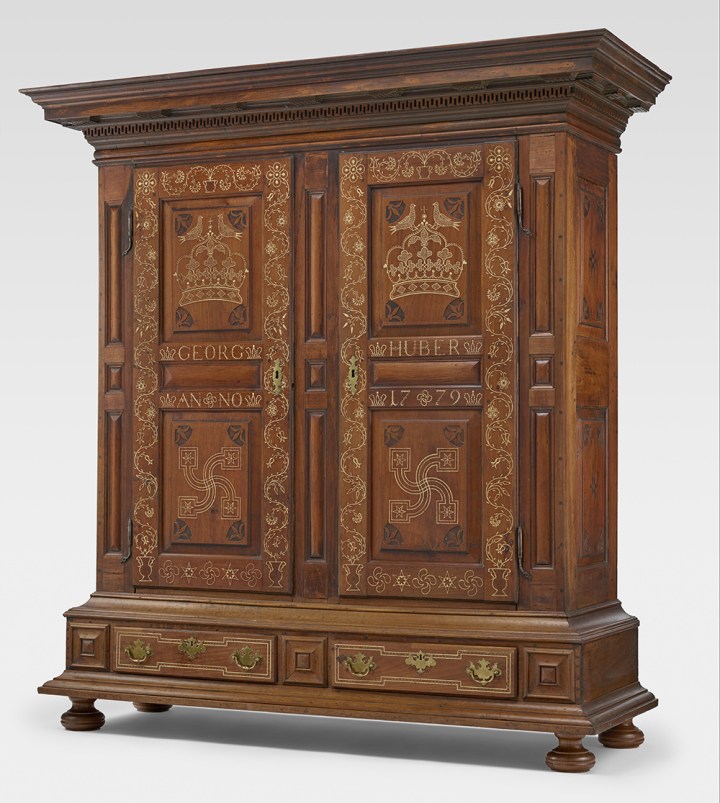
Kleiderschrank (Clothes Press), 1779, Lancaster County, Pennsylvania; walnut, yellow pine, oak, sulfur, iron; 6 feet 10 inches × 6 feet 6 inches × 27 inches (Philadelphia Museum of Art, 1957-30-1).
All 50 states and the District of Columbia are represented, and each record contains an image, tombstone information, and a description of the object’s importance. The ability to search for entries based on location, category, and keyword provides the chance to make exciting and enlightening discoveries in unexpected places. The Trust developed connections with museums and historical societies beyond our traditional network, allowing them to highlight extraordinary artistic achievements in the west, including a mid-19th-century bed covering (New Mexico History Museum) featuring churro wool yarn and colcha embroidery introduced by early Spanish settlers.
There is an interplay between objects that are isolated from one another by time, location, maker, and function. For example, two disparate entries associated with the care and storage of textiles: a humble, late-19th-century pressing iron (Illinois State Museum) that Mississippian Bettye Kelly brought to Joliet, IL, in the 1960s; and a stunning sulfur-inlaid kleiderschrank (Philadelphia Museum of Art) made in Manheim, Pennsylvania, in 1779 for Georg Huber. The former speaks to the Great Migration of African Americans northward in the 20th century; the latter to the Germanic communities that were thriving on the eastern seaboard during the American Revolution.
The tradition of basket weaving has been practiced and perfected by various cultures over the past 10,000 years. Two entries separated by a century and the entire continent of North America illustrate the cultural convergences and impulses behind the production of basketry. In 1905, Aleksandra Kudrin Reinken, the daughter of a Unangax̂ (Aleut) mother and Russian father used her community’s traditional weaving techniques to create a basket (Hood Museum of Art) for a tourist clientele that incorporates ornamentation from prints, magazines, and perhaps even a Whitman’s Chocolate Sampler box. In 2007, Mary Jackson, an internationally recognized master of sweetgrass basketry, completed Never Again (Gibbes Museum of Art), inspired by the traditional Gullah rice fanner baskets that she learned to create from her mother and grandmother and that were once made and used on Lowcountry plantations.
Collecting250 is free and open to the public. Visit Collecting250.org to start exploring. The Decorative Arts Trust, founded in 1977, is a nonprofit organization that promotes and fosters the appreciation and study of the decorative arts through programs, partnerships, and grants. Learn more at decorativeartstrust.org.
Four Educator Guides, designed specifically for the Collecting250 project, are also available.
◊ ◊ ◊ ◊ ◊
Note (added 20 December 2025) — The post was updated to include the link for the educator guides.










 Enfilade
leave a comment