At Auction | The Kangxi Emperor’s Mandate of Heaven Seal

◊ ◊ ◊ ◊ ◊
At Wednesday’s auction in Hong Kong (Sotheby’s HK0642), the Kangxi Emperor’s Mandate of Heaven seal (shown above) sold for $10.4million and his Yuanjianzhai seal for approximately $5.4million (video coverage is available from the BBC News). The Kangxi Baosou, a catalogue of the Emperor’s seals commissioned by his grandson, the Qianlong Emperor in 1781 did not sell.
From the pre-sale press release (11 March 2016) . . .
This spring Sotheby’s Hong Kong is honoured to present the most important Chinese historical object ever to be offered at auction. Bearing the inscription “Revere Heaven and Serve thy People,” the Seal of the Mandate of Heaven is the largest and most powerful ever carved for the Kangxi Emperor, the greatest and longest reigning monarch of China (reigned 1661–1722). Two other important historic objects of the period will be offered to complement this extraordinary seal: the Yuanjianzhai seal and one of only two existing copies of the personal record of the Kangxi Emperor’s seals, in which the exact impressions of both seals are recorded. All three lots will be offered in a dedicated themed sale titled Kangxi: Emperorship and Power on 6 April 2016 at the Hong Kong Convention and Exhibition Centre.
Nicolas Chow, Deputy Chairman, Sotheby’s Asia, International Head and Chairman, Chinese Works of Art, said, “It is an unprecedented privilege for us to handle such an important historical relic of China’s Imperial past. This seal is emblematic of the Mandate of Heaven, which has legitimised the authority of rulers in China since the dawn of recorded history. This almighty principle was also the single guiding light for the Kangxi Emperor, China’s longest reigning emperor, who is credited for completing the conquest of China, anchoring the Qing dynasty and ushering in a long period of great prosperity and peace. The Kangxi Emperor was the single most powerful person on earth at the time, ruling over a vast Kingdom and over 100 million subjects.”
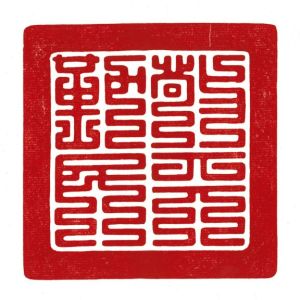 The Seal of the Mandate of Heaven is unusual among Qing imperial seals as it testifies to the close correspondence between Kangxi’s philosophical ideals and his deeds as emperor. The seal was so important that during Kangxi’s reign it was at all times kept in the Palace of Ultimate Purity (Qianqinggong), where Emperors entertained and a major venue for their policymaking. His son and grandson the Yongzheng and Qianlong Emperors, together with Kangxi, were the three greatest Emperors of the Qing dynasty, and they all had identical seals carved as they believed that the Imperial motto would bestow authority and blessing onto their reign.
The Mandate of Heaven (tianming) is the philosophical tenet that Heaven granted emperors the right to rule based on their ability to govern and their righteousness and was used throughout the history of China to validate and legitimise the rule of the emperors of China. According to this belief, Heaven will only bestow its mandate to a just and virtuous ruler, the Son of Heaven. Otherwise, the Mandate and thus his right over his kingdom and subjects will be forfeited in favour of someone better qualified. The overthrow of an emperor was often interpreted as the loss of the Mandate of Heaven. The kings of the Zhou dynasty (1046–256 BCE) first used the concept of the Mandate of Heaven to legitimise their rule and the overthrow of the earlier Shang dynasty (1600–1046 BCE).
As a non-Han Chinese ethnic ruler leading a dynasty barely established two decades before, Kangxi engaged in a relentless, almost obsessive pursuit of the Mandate of Heaven, working tirelessly to demonstrate his righteousness. He developed political reform to centralise power and maintain the unity of his empire and emphasised both economic and cultural development, driving his country to unprecedented heights. Kangxi built the foundation for the golden age of the Qing dynasty. He undoubtedly discharged his heavenly duty like no other emperor before or after him. Kangxi often expressed his devotion to his subjects, whom he considered the reason for the existence of imperial rule:
“Heaven gave birth to the subjects and then established Emperorship, not simply to bestow exceptional status or fortune on the emperor, but also to entrust him with the responsibility of moral cultivation, so that nobody within the four seas and the nine continents would be deficient in it.”
– [Qing] Xuanye [the Kangxi Emperor], Yuzhiwen ji, vol. 19.
Two other important historic objects of the period will be offered to complement this extraordinary seal, namely the Soapstone ‘Yuanjian Zhai’ Seal and the Kangxi Baosou, the only copy of the complete record of the Emperor’s seals in private hands. It is an extraordinarily fortuitous event to assemble these three exceptional legacies of Kangxi’s Emperorship in this auction.
 The soapstone seal is carved with the characters of the Yuanjianzhai (‘Studio of Profound Discernment), the Kangxi Emperor’s favourite personal retreat in the Imperial gardens northwest of Beijing, the studio where he cultivated his passion for calligraphy and research into Western science and art. The carving is of superlative quality, and is exceptional for featuring a dragon and a tiger in addition to mystical trigrams, a specific combination for evoking his status as the unsurpassed ruler of heaven and earth. The unusual positioning of the seal text between double dragons on this seal is a feature that was specifically commented on by Jean-François Gerbillon, the famous Jesuit missionary and close confidant of the emperor, when he was invited to inspect the Emperor’s seals in 1690 in the Yangxindian.
Both the Soapstone ‘Yuanjian Zhai’ Seal and Seal of the Mandate of Heaven are also recorded in the Kangxi Baosou, a complete record of the Emperor’s seals commissioned in 1781 as an act of piety by his grandson, the Qianlong Emperor. Only two copies were produced. The one offered in the upcoming sale is the only example in private hands, while the other copy is preserved in the Palace Museum, Beijing.
Exhibition | Ukiyo-e Tales: Stories from the Floating World
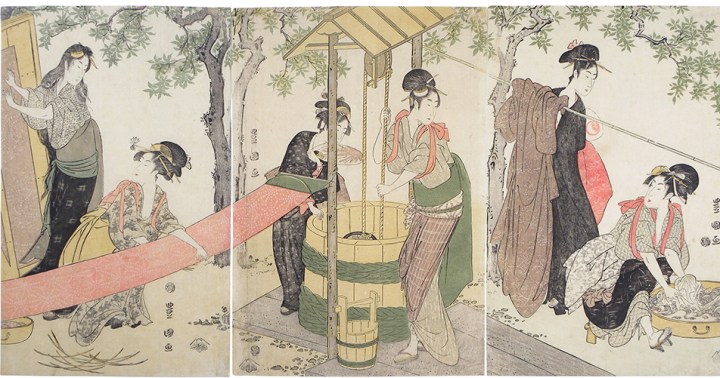
Utagawa Toyokuni I, Women Washing and Stretching Cloth, ca. 1795,
woodblock print triptych, 71.5 by 37 cm
◊ ◊ ◊ ◊ ◊
This year’s Asia Week in New York (March 10–19) offers an array of auctions, lectures, and exhibitions, including this one at Scholten Japanese Art:
Ukiyo-e Tales: Stories from the Floating World
Scholten Japanese Art, New York, 10–31 March 2016
Scholten Japanese Art participates in Asia Week 2016 with Ukiyo-e Tales: Stories from the Floating World, an exhibition focused on classic Japanese woodblock prints. The exhibition will take us back to the golden age of ukiyo-e and will feature works by some of the most important artists of the late 18th and up to the mid-19th century. We will focus predominately on images of beauties and the layers of meaning and stories that are conveyed via subtle (and sometimes not so subtle) clues found in the compositions. The exhibition will begin with works by Suzuki Harunobu (ca. 1724–70), who is largely credited with bringing together all of the elements that launched the production of nishiki -e (lit. brocade pictures), the full-color prints that we recognize today as ukiyo-e or images of the floating world. The term ukiyo (lit. ‘floating world’) references an older Buddhist concept regarding the impermanence of life, but during the prosperity of the Edo period in Japan the term began to be used to encompass and embolden everyday indulgences because of that impermanence. It was Harunobu’s designs, primarily celebrating youth and beauty, that are believed to have first launched the production of full-color woodblock printing in Japan around 1765.
One of the finest Harunobu prints included in this exhibition, Fashionable Snow, Moon, and Flowers: Snow, ca. 1768–69 depicts an elegant courtesan accompanied by her two kamuro (young girl attendants) and a male servant holding a large umbrella sheltering her from falling snow. The subject, a beautifully adorned courtesan parading en route to an assignation, and her placement within the lyrical setting of an evening snowfall, are hallmarks that define the genre of ukiyo-e. There are relatively few Harunobu prints extant, and due to their scarcity and the fragile nature of the vegetable pigments used at that time it is unusual to find a work in such good condition. Hence there are only two or three other authentic impressions of this particular design which have been recorded in public collections.
A print by a contemporary of Harunobu, Ippitsusai Buncho (fl. ca. 1755–90), titled Eight Views of Inky Water: Night Rain at Hashiba, ca. 1768–75, depicts the world from the perspective of a courtesan, without the pageantry of her parade through the pleasure quarters. Stepping out on to the verandah overlooking the Sumida River, she seems lost in thought as she adjusts the comb in her hair and looks down towards the small ferry boats navigating the dark (‘inky’) waters during a rainstorm while the passengers try vainly to protect themselves from the downpour. Streaks of rain partially obscure the view across the river where we see a figure carrying a lantern approaching a teahouse near the shore at Mukojima. While it was not uncommon to use accepted themes such as landscapes or literary subjects as a way to circumvent restrictions on overt depictions of famous actors and beauties or decadent displays of wealth, most of the time the ‘cover’ subject was relegated to an inset cartouche and the figural subject was front and center. In this composition the figure and the landscape are given equal consideration in a way that is unusual for the period because the landscape in the background tells as much of the ‘story’ as the figure in the foreground.
Another important artist well-represented in the show is Kitagawa Utamaro (1753–1806), a leading painting and print artist in his time, who practically owned the market for images of beauties in the 1790s and early 1800s, until his untimely death in 1806 shortly after a traumatizing episode when he was made to wear manacles under house arrest in punishment for having the audacity to depict the shogunate in an irreverent manner. A triptych of ‘Brine Carriers’ at a seashore was produced in happier times and visually references a classical literary subject, the sisters Matsukaze (‘Wind in the Pines’) and Murasame (‘Autumn Rain’), from the famous 14th-century Noh Drama, Matsukaze. Although the original story is about love and loss, Utamaro only barely references the cautionary legend and instead focuses on the opportunity to sidestep restrictions and depict women in revealing clothing in an everyday setting. The two sisters have been replaced by a bevy of beauties wearing grass skirts far shorter than acceptable in normal public settings, and their kimono tops are literally falling open while they wade in the surf collecting the brine.
Another story told by Utamaro is of a lovers’ quarrel. Eight Pledges at Lovers’ Meetings: Maternal Love between Sankatsu and Hanshichi, ca. 1798–99, is from a series that plays on puns referencing the classic landscape theme of Omi hakkei (‘Eight Famous Views of Omi’). This print uses the word ‘ bosetsu ‘ in the title, which can be translated as ‘a mother’s constant love,’ but also works as a pun for ‘evening snow,’ a clever reference to Hira no bosetsu (‘Evening Snow on Mount Hira’), one of the Omi hakkei subjects. But clever wordsmithing aside, what makes this print so remarkable is the tiny gesture of the woman, holding her index finger to her eye to wipe away a tear. For all of the dramas and tragedies in ukiyo-e, this small display of emotion stands out. While there are numerous visual shortcuts that artists employed to convey elements to a story, such as wisps of hair being out of place signaling excitement (good or bad), wiping away a tear is not at all common. Even more telling is the body language of her lover, who is looming over her shoulder and glaring at her. Their story is from a kabuki play (based on a true incident), in which the lovers resolve to give up their daughter and commit double suicide. Thus the ‘maternal love’ in the title suggests Sankatsu’s heartache over leaving her child, and it would seem Hanshichi is impatient with her hesitation. Utamaro, an artist known for his depictions of beautiful women of all ranks as well as erotic art, seems to convey his disapproval of their decision. Rather than feeding into the high drama in a way that romanticizes their story, Hanshichi especially is portrayed in an unflattering light.
There are several prints in the exhibition that show how young women, both in and out of the pleasure quarters, pass their time. Fashionable Five Festivals: Amusements of the Girls in the Seventh Month by Utagawa Toyokuni (1769–1825) from ca. 1796 shows a young girl struggling with writing her poetic wish for the Tanabata Festival. She sits at a writing table, brush in hand, with all the accoutrements needed, but the blank paper looms before her. On the floor are completed poems on decorative paper, rejected or not, is unclear. But a companion at her side holds open a copy of the poetry anthology, Ehon hyakunin shu (Picture Book of One Hundred Poets), ready to provide inspiration to the young poetess.
The private life of a courtesan inside the pleasure quarters is depicted by Kikugawa Eizan’s (1787–1867) Twelve Hours in the Pleasure Quarters: Daytime, Hour of the Snake, Courtesan Tomoshie of the Daimonji, ca. 1812. The so-called hour of the snake was a two-hour increment that began around 10 in the morning. Here we see the courtesan Tomoshie who is just getting up. She barely keeps her lightweight kimono closed, exposing an astounding length of leg and a deep décolletage. She seems to have just finished washing up and is using the sleeve of her robe to dry behind her ears. A young assistant holding a bowl of water is not entirely put together herself; her robe is disheveled at the collar and is opening at the legs revealing her upper thigh.
While some prints provide titles and puns to help us identify the story behind the composition, others provide only oblique clues and leave the rest to our imaginations. A stunningly well-preserved print by Keisai Eisen (1790–1848), has a curious title that seems to marry manufacturing with artistry: Modern Specialties and Dyed Fabrics: Sound of Insects at the Bank of the Sumida, ca. 1830. While the series title references a certain type of cloth dyed in a dappled pattern, the print title evokes the poetic sound of insects along the Sumida River in the summertime, and the composition itself seems to have little to do with either. The image is of a woman reading a letter by the light of a lantern which casts a dramatic beam across the room. The temperature must be uncomfortably warm because she wears her kimono very loosely, leaving the collar wide open at her chest with the sleeves pushed up, allowing it to open between her thighs to reveal a suggestive view of the red under-robe. She sits awkwardly with her knees folded at an angle, hunched over a long scroll of paper with an anguished look on her face with tell-tale wisps of hair falling forward signaling her distress. What is in the letter? Why is she so intense? Is it good or bad? We don’t know, her story is open for our interpretation.
The exhibition will feature 48 woodblock prints including works by: Suzuki Harunobu (ca. 1724–70), Katsukawa Shunsho (1726–1792), Kitao Shigemasa (1739–1820), Katsukawa Shunko (1743–1812), Kitagawa Utamaro (1753–1806), Ippitsusai Buncho (fl. ca. 1755–90), Hosoda Eishi (1756–1829), Katsukawa Shunsen (1762–ca. 1830), Utagawa Toyokuni I (1769–1825), Utagawa Toyokuni II (1777–1835), Chokosai Eisho (fl. ca. 1780–1800), Keisai Eisen (1790–1848), Kikugawa Eizan (1787–1867), and collaborative works by Utagawa Kunisada (1786–1865) and Utagawa Hiroshige (1797–1858); and one painting by Hosoda Eishi.
Gallery viewing will begin on Thursday, March 10th, and continue through Friday, March 18th. An online exhibition will be posted in advance of the opening. Scholten Japanese Art, located at 145 West 58th Street, Suite 6D, is open Monday through Friday, and some Saturdays, 11am–5pm, by appointment. For the duration of the first segment of the exhibition, March 10–18, the gallery will have general open hours (no appointment needed), 11am–5pm, and thereafter by appointment through March 31st.
Tomasso Brothers Fine Art Offerings at TEFAF 2016
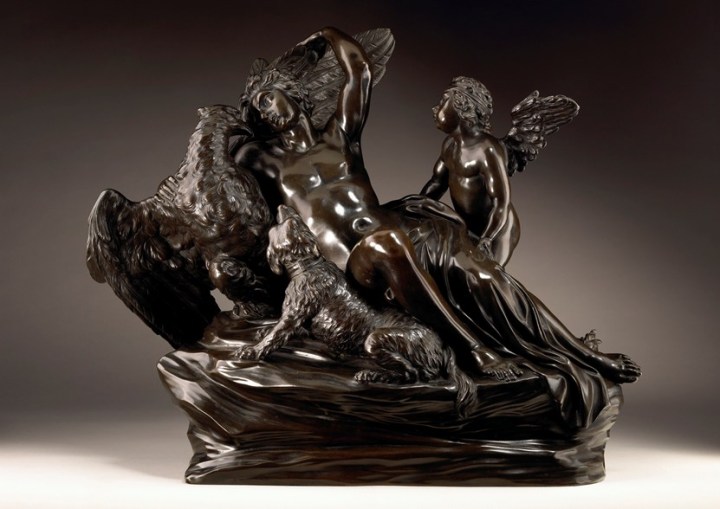
Massimiliano Soldani-Benzi, Ganymede and the Eagle,
bronze, 31.5cm high, 38.5cm wide, ca. 1714.
◊ ◊ ◊ ◊ ◊
Press release for the Tomasso Brothers:
Tomasso Brothers Fine Art at TEFAF
Maastricht, 11–20 March 2016
Leading international dealers in the field of important European sculpture, Tomasso Brothers Fine Art will unveil a rare work by the Florentine master of the late Baroque era, Massimiliano Soldani-Benzi (1656–1740). Ganymede and the Eagle, circa 1714, depicts a poetic moment from classical mythology when Zeus, disguised as an eagle, captures Ganymede, in Homer’s words “the loveliest born of the race of mortals,” to become his cup-bearer. This dramatic composition is a wonderful example of Soldani-Benzi’s suave modelling of form and the sumptuous finish of his bronzes. It is also an extremely rare model: the only other known version is held by the Fitzwilliam Museum, Cambridge.
Soldani-Benzi is acknowledged as the finest bronze caster in late 17th- and early 18th-century Europe and, along with Foggini, is considered the most significant proponent of the Florentine late Baroque style in sculpture. He excelled in medal and coin-making, enjoying commissions from Pope Innocent XI and Queen Christina of Sweden, and in 1682 he became Director of the Grand-Ducal Mint. His workshop, situated on the ground floor of the Galleria degli Uffizi, was patronised by the Medici Grand Dukes, the Elector Palatine, and the 1st Duke of Marlborough, among many prestigious foreign clients.
The present model is first mentioned in correspondence between Soldani-Benzi and his London agent Zamboni, dated 15th October 1716, regarding four casts Lord Burlington had ordered two years previously but not yet paid for. They included a Venus and Adonis, of which there is an example in the J. Paul Getty Museum, and a matching pair of groups depicting Leda and the Swan and Ganymede and the Eagle. The latter was sent to England, although Leda and the Swan is now missing. The present bronze was previously at Swithland Hall, Leicestershire, residence of the Earls of Lanesborough.
This historic work is just one of the highlights at Tomasso Brothers Fine Art, stand 166, TEFAF 2016, offered for sale priced in excess of €1,000,000 (euros). The fair, which is the world’s leading art and antiques event, takes place at the Maastricht Exhibition and Congress Centre (MECC) from 11–20 March 2016.
◊ ◊ ◊ ◊ ◊
And as a centrepiece for their TEFAF offerings, the Tomasso Brothers reunite a pair of Roman busts from Wilton House:
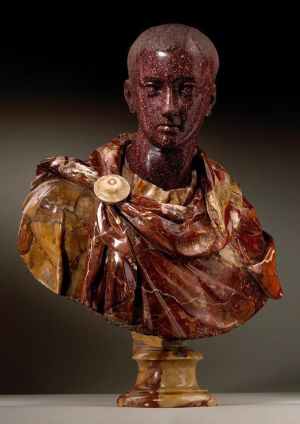
Horace, Rome, 17th century, Red Imperial Porphyry and Breccia Pernice marble , 54.5 cm wide, 71.5 cm high.
Extensive research by Tomasso Brothers Fine Art has reunited an important pair of polychrome marble portrait busts depicting Cicero, civic hero of the Roman Republic, and Horace, the famed poet. Carved in the same seventeenth-century Roman workshop, the busts have an illustrious provenance. Originally part of the Valletta collection in Naples, they were acquired around 1721 by Thomas Herbert, the 8th Earl of Pembroke (1654–1733) for his family’s splendid residence, Wilton House, near Salisbury, one of England’s finest stately houses.
For more than two centuries, the busts were displayed at the heart of one of the finest private art collections ever assembled in Europe. They flanked the main chimneypiece in the Earl’s ‘sanctum sanctorum’ of the Great ‘Double Cube’ Room designed by Inigo Jones, among family portraits by Sir Anthony Van Dyck, and works formerly in the esteemed collections of Cardinals Mazarin and Richelieu, King Charles I of England, and Thomas Howard, the 14th Earl of Arundel.
Pembroke’s influence on the tastes and collecting trends of the aristocratic English in the early eighteenth century were considerable. When he embarked on his Grand Tour in 1676 and set about building a collection in the 1680s, he was all but alone. Yet the fame of the galleries at Wilton House spread among the aristocracy, and by the time of his death in 1733, many of England’s great country houses were beginning to be decorated with antiquities, renaissance, and baroque sculpture.

Cicero, Rome, 17th century, Black Touchstone and Breccia Pernice marble, 61 cm wide, 76 cm high.
The history of this pair of busts is inextricably linked to some of the most important European art collections ever assembled, the rise of ‘The Grand Tour’, and thus with the history of art collecting.
It is through the expertise of Tomasso Brothers Fine Art that the two works have been reunited since their dispersal from Wilton House. Cicero came into the gallery’s collection a short while after the directors had become aware of Horace. They knew instinctively that they were both great 17th-century busts and that the particular specimen of imperial porphyry used for the Horace was a wonderful quality. While recognising the physical similarities of the two works, it was finding an old photograph of the Double Cube Room at Wilton House that set off months of study to discover the full history of the busts [photo from Arthur Stratton, The English Interiors (London 1920), plate XLII].
“Our research has taken us across Britain, from the Pembroke archives in Wiltshire, to the British Library, and on to the Bodleian Library, Oxford” says Dino Tomasso, Director. “We have uncovered eighteenth-century manuscripts, printed catalogues, and early guidebooks to the Wilton House Collection that detail in remarkable depth the journey of these illustrious busts from Naples to Wiltshire in the first quarter of the eighteenth century.”
Raffaello Tomasso, Director, adds: “It has been an exciting discovery to unearth the provenance of these two important works from Thomas Herbert’s famous collection, and our privilege to reunite them at TEFAF.”
◊ ◊ ◊ ◊ ◊
This year’s loan exhibition includes drawings by Fra Bartolommeo assembled in 1729 by Niccolò Gabburri:
Collecting Collectors in the Boijmans
Maastricht, 11–20 March 2016
As in previous years, the loan exhibition in TEFAF Paper will offer visitors a one-off opportunity to view a unique selection of prints and drawings from a museum with a major collection in the field. This year’s exhibition, entitled Collecting Collectors, shows a selection of master drawings and prints from Museum Boijmans Van Beuningen, Rotterdam, the Netherlands. The drawings and prints were acquired over the last 167 years.
A particular highlight of the collection are the works by Fra Bartolommeo (1473–1517), numbering 400 sheets with 500 drawings assembled in two luxury albums by Florentine collector Niccolò Gabburri in 1729. One of the albums will be included in the selection at TEFAF Maastricht 2016, as a prelude to the forthcoming large Fra Bartolommeo exhibition in the Boijmans in the autumn of 2016. Also included in Collecting Collectors are works by old masters such as Albrecht Dürer, Lucas van Leyden and Rembrandt van Rijn to modern and contemporary artists like Paul Cézanne, Salvador Dalí, René Magritte and Yayoi Kusama. . . .
Salon du Dessin 2016
From the art fair’s website:
Salon du Dessin 2016
Palais Brongniart, Paris, 30 March — 4 April 2016 / Symposium, 30–31 March 2016
 The Salon du Dessin is a unique event of worldwide renown, lead by its new chairman Louis de Bayser. Serving as a reference for drawing collectors, the Fair also gathers curators, experts or amateurs from across the globe. This year, the Salon du Dessin, will feature 39 prestigious galleries specialising in Old Masters, Modern and Contemporary drawings. More than 1000 drawings will be showcased in the prestigious Palais Brongniart.
To celebrate its 25th anniversary, special works from the Pushkin State Musuem will be unveiled for the first time in France. Curator of French drawings at the Pushkin State Museum and curator of the exhibition Vitaly Michine worked with curators from the private collections department along with the graphic arts department of the Pushkin State Museum to choose the twenty-six works that will be exhibited. Of the drawings, Russian artists produced seventeen, among which three come from Zilberstien collection; nine of the works were produced by European artists.
◊ ◊ ◊ ◊ ◊
Salon du Dessin 2016 Symposium
Palais Brongniart, Paris, 30–31 March 2016
W E D N E S D A Y , 3 0 M A R C H 2 0 1 6
• Sarah Catala, ‘Carcer Socratis Domus Honoris’: The Drawings of Hubert Robert in Prison
• Anne Lenoir and Sophie Join-Lambert, Joseph-Benoit Suvée: A New View of Italy, 1772–78
• Anna Ottani Cavina, Jean-Thomas Thibault: Italian Landscapes, 1788–92
• Emilie Beck Saiello, Typology of Vernet’s Sketchbooks
• Benjamin Couilleaux, Jean-Baptiste Huet: A Neoclassical Artist?
T H U R S D A Y , 3 1 M A R C H 2 0 1 6
• Louis-Antoine Prat, Some New Drawings by David
• Patrick Ramande, The Second Part of the Album of Jean-Germain Drouais de Rennes
• Sylain Laveissière, Prud’hon Draughtsman
• Mehdi Korchane, The Nude under His Skin: The Academic Drawings of Jean-Baptiste Regnault
• Isabelle Mayer-Michalon, Drawings by Charles-Toussaint Labadye for the 1798 Rome Competition: The Battle between the Horatii and the Curiatii
• Rébecca Duffeix, Drawings by Alexandre-Évariste Fragonard in Sèvres
At Sotheby’s | Pelham: The Public and the Private Collections
Press release (22 February 2016) from Sotheby’s:
Pelham: The Public and the Private Collections of Alan Rubin (L16322)
Sotheby’s London, 8 March 2016
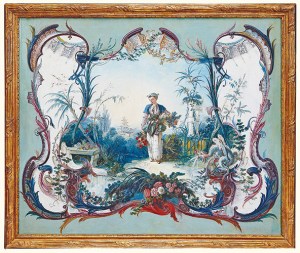
Lot 114: François Boucher, La Marchande de Fleurs in a Rocaille Surround, ca. 1742.
On 8th March 2016, Sotheby’s London will host an exceptional sale of furniture and works of art from the ‘public’ and ‘private’ collections of Alan Rubin of Pelham Galleries. The name Pelham is inextricably linked with the history of the 20th-century antiques trade. For almost 90 years, Pelham Galleries has been a mecca for international collectors, dealers and museums curators. The galleries in London and Paris have been instrumental in helping form some of today’s greatest collections, and treasures discovered by Alan Rubin, his father and uncle can be found in many of the world’s greatest museums including the Victoria and Albert Museum, The Metropolitan Museum, and the Louvre. The printed catalogue, which can be viewed online here, includes a substantial introduction by Alan Rubin with a fascinating history of the company and a masterly survey of the history of the London art trade, which will be a work of reference for future generations of dealers.
The sale will feature fascinating acquisitions made by two generations of antiques dealers with unrivalled expertise, alongside great rarities that have adorned Alan Rubin’s wonderful Queen Anne house in London for the past 30 years. Together, the 180 lots include outstanding examples of English and European furniture, an exceptionally rich group of Italian decorative arts, chinoiserie masterpieces and a number of items reflecting Alan Rubin’s passion for early music.
Commenting on the forthcoming auction, Alan Rubin said: “This sale marks a new chapter for Pelham Galleries which will now be run from our Paris gallery. The sale includes a number of pieces never previously offered to the public, some acquired by my family over sixty years ago. I hope they will give as much pleasure to their new owners as they have given to me.”
Henry House, Head of Sotheby’s Furniture and Decorative Arts Department added: “This sale celebrates the great eye, sublime taste and academic rigour that have contributed to Alan Rubin’s worldwide reputation. In addition to their extraordinary quality and rarity, many items in the sale come with fascinating provenances and carry the imprimatur of one of Britain’s most renowned antique dealing families.”
English Furniture
Pelham Galleries has been synonymous with the finest English Furniture since it was founded in 1928. The sale features outstanding pieces which were acquired either by Alan Rubin in his early years as a dealer or by his father, Ernest Rubin in the 1950s. Stunning examples of neo-classical furniture include a George III satinwood, harewood and tulipwood breakfront bookcase, circa 1780 by Mayhew and Ince, acquired from Lord and Lady Mountbatten in the 1950s (est. £40,000–60,000) and an important pair of George III painted and parcel-gilt satinwood pier tables, circa 1795 which adorned the Blue Room of the White House between 1972 and 2002. Formerly in the collection of the Dukes of Sutherland, these tables are among the finest examples of their period (est. £100,000–150,000).
Italian Decorative Arts
Alan Rubin’s profound interest in Italian decorative arts is reflected in an impressive ensemble of 18th-century furniture and works of art. Highlights comprise one of the finest pairs of Genoese giltwood torchères by Fillipo Parodi (1630–1702) ever to come on the market. These exceptional pieces are extremely rare in private hands. The majority of surviving examples are now in public collections or remain in situ in Genoese palaces (est. £50,000–100,000). Exceptional examples of English Palladian furniture include a George II mahogany breakfront secrétaire-cabinet, circa 1750, by William Hallett which was acquired privately from Wentworth Woodhouse over sixty years ago (est. £70,000–100,000) and a beautiful hall settee by William and John Linnell (est. £70,000–100,000). An astonishing painted trompe l’oeil and grisaille Cassapanca from first quarter 18th century (est. £25,000–50,000) and its matching torchères (est. £20,000–40,000) are a rare testament to the tradition of illusionist painting in Italian interiors. Such furniture often adorned the entrance halls of palazzi but most original pieces have now been lost or dispersed, which makes the survival of such a set remarkable. Equally fascinating, examples of Italian hardstone and mosaic works of art include an exquisite pair of micromosaics by the outstanding Roman mosaicist Giacomo Raffaelli (1753–1836) from the Hamilton Palace collection (est. £50,000–100,000) and a magnificent pietre dure plaque produced by the Grand Ducal Workshops in Florence in the 17th century (est. £20,000–30,000).
French Furniture and Works of Arts
Testament to Alan Rubin’s taste for Chinoiserie, the sale includes masterpieces by the great proponents of the style, including an unpublished work by François Boucher (1703–1770), La Marchande d’Oiseaux which was previously in the collection of Baron Edmond de Rothschild, circa 1915 (est. £100,000–150,000). The sale also features rare and evocative objects from 18th-century France, including the only recorded surviving life-size 18th-century French mannequin de mode, circa 1765 which recently featured in exhibitions at the Fitzwilliam Museum, Cambridge and the Musée Bourdelle, Paris (est. £30,000–50,000), a 1783 miniature recording the first flight in a hot-air balloon (est. £12,000–18,000) and an impressive Consulat armchair, circa 1796–1803 similar to the one in the Chateau de Malmaison, where Napoléon lived with his first wife, Joséphine de Beauharnais (est. £30,000–50,000).
Works of Art on the Theme of Music
A keen music lover and collector of early musical instruments, Alan Rubin also made fascinating acquisitions on the theme of music, such as a rare Indian duet stand, circa 1810 which once belonged to world famous violinist, Yehudi Menuhin (est. £5,000–7,000), a late-16th-century Italian harpsichord, (est. £30,000–50,000), and a pair of 17th-century musical still-lives attributed to Bettera of Bergamo (est. £20,000–30,000).
At Auction | Rare Books at Ketterer Kunst in Hamburg
From Art Daily:

From John Hill, Vegetable System
It is a masterpiece of utmost rarity: the complete series of John Hill’s The Vegetable System (1759–75). The remarkably well-preserved copy will be called up with an estimate of €60,000 in the auction of Rare Books at Ketterer Kunst on 23/24 May (#430). One of the 18th century’s most elaborate botanic publications is thus offered on the auction market. The comprehensive work with 1544 colored copper plates delivers an extensive account of 26,000 different plants. Even the great Carl von Linné, founding father of modern taxonomy, noted in awe: “I almost fainted in the face of the magnificence of Hill’s work…” (Henrey). John Hill dedicated his lifetime achievement, which lead him into bankruptcy despite financially strong sponsors, to the Prince of Wales and later King George III.
A likewise noble provenance is also true for a Book of Hours made in Paris in 1533, as it is inscribed with the autographed ownership entry of the Elector and archbishop of Mainz, Georg Friedrich von Greiffenclau zu Vollrad. He, as well as the other owners, must have cherished the entirely illuminated work very much, since it still is in excellent condition. The price estimate is €20,000.
The work Atlas de la navigation et de du commerce by Louis Renard, published in 1739, carries the same estimate. The splendid work is based on the sea maps by Frederik de Wit; however, each map was thoroughly revised. Additionally, it features an extra world map in two hemispheres. All maps are in excellent print with a fine coloring.
The series of 80 sheets Los Caprichos by Francisco de Goya will be called up with an estimate of €16,000 and promises some excitement in the salesroom. The famous cycle of etchings, in which Goya scorns the church’s errors with bitter mockery and decries the political and social miseries of his days, had already been sold successfully by Ketterer Kunst in 2013 – both in the very rare first edition that was released in Goya’s lifetime (calling price: €96,000, result: €195,000*) as well as in sixth edition (calling price: €9,600, result: €25,000*).
One of the most beautiful and most comprehensive herbal- and medical books from the 15th and early 16th century could perhaps be available for the estimate of €12,000. The Hortus sanitatis, endowed with numerous expressive illustrated woodcuts, covers the drugs extracted from plants, animals, stones and metals and explains their medicinal benefits under the caption ‘operationes’.
The range of offerings is rounded off by George Edward’s work in several volumes Histoire naturelle (estimate: €28,000), as well as the autographed manuscript “The Seals of Obezvelvolpal” by Alexei Michailowitsch Remisov (estimate: €8,500), the first edition of the magnificent publication Paléographie universelle by Joseph Balthazar Silvestre (estimate: €5,000), Georges Bataille’s Histoire de l’oeil (estimate: €3,000), and The American Woods by Romeyn Beck Hough (estimate: €5,000), with more than 940 samples of wood.
Alongside rare books, manuscripts, autographs and decorative prints, the auction also comprises works of maritime and Northern German art. While the latter features works by, among others, Fritz Overbeck (Bergkuppe im Engadin, estimate: €3,000) and Fritz Fleer (St. Christophoros (Entwurfsmodell für St. Christophoros Hamburg), estimate: €2,500), the section of maritime art offers works such as Johannes Holst’s Vollschiff ‘Grossherzogin Elisabeth’ auf bewegter See (estimate: €4,000) and Anton Melbye’s Segelschiff and Besegelter Dampfer auf See vor einer Küste (estimate: €2,500).
Marriage Contract with Signatures of Napoleon and Josephine
From NYC-based Lion Heart Autographs:

Marriage contract between General Pierre Augustin Hulin and Jeanne Louise Fiersommier, which includes signatures of Napoleon and Josephine Bonaparte, May 1804.
Lion Heart Autographs—for nearly forty years an internationally recognized dealer of autographs and manuscripts focusing on art, history, literature, music and science—has announced an extraordinary opportunity to acquire the finest marriage document ever signed by Napoleon and Josephine. This rare Valentine’s Day opportunity celebrates history’s most romantic and often controversial couple: Napoleon and Josephine. Lion Heart’s rare and evocative marriage contract is not only signed by the historic couple, but by other French notables, including six of Napoleon’s original eighteen marshals (the highest military rank during the Empire). The Valentine’s Day presentation of such a unique, historical document marks the first time Lion Heart Autographs has offered it for sale; it is one of only a handful known to exist in private hands. Lion Heart Autographs will display the document at The Palm Beach Jewelry, Art & Antique Show at the Palm Beach County Convention Center, February 10–16, 2016, where it will be offered for $20,000.
Marie-Josèphe-Rose Tascher de La Pagerie, known as Josephine, was one of the most celebrated women of the 19th century, playing a colorful and pivotal role in the life of her six-year-younger husband, Napoleon Bonaparte. She was one of the most important women in the salons of Paris and her tumultuous love affair with General Bonaparte is well documented. Glamorous and a well-connected socialite, Josephine engaged in several love affairs with highly placed political and military leaders after the failure of her first marriage. Bonaparte, immediately smitten by her upon their first meeting, wed Josephine on March 9, 1796 only a few days before he left on his Italian campaign. During his absence he sent the first of many love letters he would pen throughout their marriage.
Napoleon and Josephine’s marriage was opposed by many members of his family because she was an older widow with children. His mother and sister were especially upset declaring that his new wife considered them well below her status. During Bonaparte’s 1799 Egyptian campaign Josephine purchased the Chateau de Malmaison near Paris taking a special interest in gardens and becoming proficient in botany and horticulture.
Throughout history stories are told of Napoleon and Josephine’s constant separations and rumors of her interest in other lovers. Infidelities troubled the marriage from the start although the couple renewed their marriage vows on December 1, 1804. The following day Napoleon was crowned Emperor and she Empress. The coronation became one of the most famous events of European history, but Josephine’s inability to give birth to a son strained their marriage, and in 1810, Napoleon had the marriage annulled on the pretext that a parish priest had not been present at the original ceremony. Nonetheless, Napoleon and Josephine remain one of history’s most famous couples. The former Emperor’s last words were reported to be “France, armee, tete d’ armee, Josephine.” (France, army, head of the army, Josephine).
The contract witnessed by Napoleon and Josephine celebrates the marriage between General August Hulin (1758–1841) and Marie Jeanne-Louise Tiersonnier (1782–1826). Hulin was an infantryman who rose through the ranks to join the Gardes Français. In the days leading to the storming of the Bastille in 1789, Hulin gave several inflammatory speeches, and on July 14, he organized a small band of armed men at the Hôtel de Ville, marched them to the Bastille where they opened fire and liberated the prisoners. It was this act that sparked the French Revolution. Though recognized as a hero, Hulin was imprisoned during the Reign of Terror. He later rejoined the army and served as an officer during the Napoleonic Wars and as military governor of Paris during Napoléon’s 1812 Russian campaign, where he suppressed a coup against the emperor.
In addition to Napoleon and Josephine’s signatures, the contract is signed by a remarkable cast including six of Napoleon’s original 18 marshals: John Baptiste Bessiers (1786–1813), Louis Nicholas Davout (1770–1823), Andre Massena (1758–1817), Edouard Adolphe Casimire Mortier (1768–1835), Joachim Murat (1767–1815; Napoleon’s brother-in-law and future King of Naples), and Catherine-Dominique de Perignon (1754–1818); two queens: Bonaparte’s step-daughter Hortense Eugenie Cecile Bonaparte (1783–1837) and his sister Marie Annonciade De Caroline Bonaparte Murat (1782–1839); two kings: Murat and Napoleon’s brother Louis-Napoleon Bonaparte (1778–1846) and father to Napoleon’s heir; the three former consuls of France, and many others including Maurice-Jean Raguideau De La Fosse (1759–1805) the Paris notary who presided over Napoleon and Josephine’s own marriage. Just twelve days prior to signing this document, the French Senate proclaimed Napoleon Emperor of France, making this marriage contract one of the earliest documents signed by the Emperor and his wife.
“I am thrilled to share the evocative nature of this historical document on Valentine’s Day. It is assuredly the finest marriage contract signed by Emperor Napoleon and his Empress Josephine available in the world,” said David Lowenherz, founder and owner of Lion Heart Autographs in New York, noting, “Napoleon and Josephine’s own marriage contract is preserved in National Archives of France.” Lowenherz adds, “I don’t think there is a person anywhere who isn’t fascinated by Napoleon and Josephine’s love story—a truly romantic couple joined together during a remarkable period in history. This contract, signed not just by them, but by family members and important military officers as well, all of whom gathered to celebrate the marriage of the man whose actions sparked the French Revolution, offers a rare glimpse into the splendid affairs of the royal household. I am thrilled at the opportunity to offer this precious document first at the Palm Beach Show during the week of Valentine’s Day. What could be more fitting?”
Other highlights to be featured by Lion Heart Autographs at The Palm Beach Jewelry, Art & Antique Show include a letter by Albert Einstein on how intellectuals and the working class should work together; doodles by President Dwight D. Eisenhower on White House stationery; a decorative proclamation signed by President Harry Truman declaring the end of WWII; a very moving letter by Louisa May Alcott about her ailing father and the care she is providing him; a land grant for a revolutionary soldier signed by Benjamin Franklin; an impressive document signed by Thomas Jefferson as Secretary of State about U.S. fishing rights; a very fine art related letter by Henri Matisse; an unpublished handwritten letter by Charles Darwin sending his photograph to a former shipmate aboard the Beagle; a charming letter by Mark Twain in which he offers his autograph to a young collector, and much more.
Exhibition | China Observed
As noted at Art Daily:
China Observed: Historical Pictures by Chinese and Western Artists, 1750–1970
Hong Kong Maritime Museum, 7–14 October 2015
Mallett, New York, 21–31 January 2016

Chinese artist, late 18th century, one of a pair of paintings picturing Chinese Women Accompanied by Pipes and Pets, gouache on paper, 80 x 59 cm (London: The Martyn Gregory Gallery)
The world’s foremost expert in Chinese Export paintings, The Martyn Gregory Gallery of London, will exhibit 70 of these paintings (also known as China Coast or China Trade paintings), January 21–31, 2016, at Mallett, 929 Madison Avenue (at 74th Street). An exhibitor since 1990 at the annual Winter Antiques Show in New York, the gallery presents its first independent exhibition in the city with China Observed. These highly detailed works by Cantonese artists were bought by ships’ officers and merchants who came to trade at Canton (modern Guangzhou) in the 18th and early 19th centuries. Also on view will be paintings by Western artists who travelled to the East.
“New York has been one of the principal centers of the China Trade ever since America won its independence from Britain,” commented Martyn Gregory, “and the city still contains a wealth of China Trade pictures and keen collectors. We have always enjoyed coming to New York, and we look forward to meeting old friends and new enthusiasts in our new venue. We are bringing with us the finest collection of China Trade paintings to be found on the market at the present time, and perhaps for the foreseeable future.”
Among the most spectacular of the paintings by Chinese artists included in China Observed are detailed scenes of the ports visited by the Westerners: notably Canton, Hong Kong and Shanghai. One such example is The Hongs of Canton by an unknown Chinese artist, c. 1804. This oil on canvas (32 x 50 in.) is a large, impressive and finely detailed view of the hongs, or ‘Factories’, at Canton that commemorates the early years of direct trade between the United States and China. It also records a brief period when seven different nations (Great Britain, America, France, Sweden, Denmark, the Netherlands and Spain) were all actively trading at Canton, the only Chinese port at which Western trade was permitted.
Another large and unusually well-painted harbor painting is Hong Kong from the Harbour by an unknown Chinese artist, late 1850s (oil on canvas, 26 x 44 in.). Here, the island of Hong Kong is pictured before the erection of the signaling station on the Peak in 1861. Less than 20 years had elapsed since the British hoisted the Union Jack on the shore of Hong Kong Island, but in the intervening period, most of the waterfront between Western District and East Point had been developed. Several well-known structures are included in the landscape, including the tower of St. John’s Cathedral, which can be seen above the smaller paddlesteamer, with Government House uphill to its right. In the harbor, a great variety of vessels can be seen, including a coastal junk, Tanka boats operated by blue-robed women, covered hulks (superannuated sailing ships converted for use as naval base), small sidewheelers and three-masted sailing ships flying the flags of Britain, France and the United States. A curiosity of the painting is the presence, towards the right of the harbor, of a junk-rigged vessel with additional jib and topsails in the Western fashion.
A Panoramic View of the Bund at Shanghai, with a Regatta in Progress, an oil on canvas (16¾ x 55¾ in.) by an unknown Chinese artist, is apparently the earliest detailed view of the Shanghai Bund. The picture, which is known in several versions, would have been executed no earlier than July 1849, when the British consulate was first established on this site (far right) and not later than 1851, by which time Jardine, Matheson had replaced the Chinese-roofed building seen here (to the left of the British consulate) by a larger structure with a Western-style roof.
Also to be seen in China Observed will be remarkable Chinese export portraits of Western visitors to China and painted ‘in the Western manner’. Portrait of William Read of Philadelphia by the Cantonese artist known as Spoilum (fl. c.1774–c. 1805), an oil on canvas (24 x 20 in.) is an outstanding example of this artist’s distinctive work. The sitter, William Read (1767–1846), made several voyages to China. His father, George Read, was one of the signers of the Declaration of Independence.
Trampling Down Loose Tea in Tea Chests at Canton, a gouache by a late 18th-century unknown Chinese artist (12½ x 10 in.; 31.7 x 25.4 cm.) is another highlight of China Observed. This painting is one of a set of eight scenes illustrating the production of tea from the earliest stages—picking tea in the mountains—to the late stage seen here, in which dark-suited Westerners sample the tea as animated Chinese figures press down the tea within the chests in which it will be exported to the West.
An unusual and early pair of suave Chinese women holding long tobacco pipes—one shown with a dog and the other with a green-eyed cat—are also included in the exhibition. A Pair of Paintings of Chinese Women accompanied by Pipes and Pets by a late eighteenth-century Chinese artist (gouache on paper, each 31½ x 23¼ in.; 80 x 59 cm) depicts in each scene a woman beside a latticework shutter, as if at a window, with flowering shrubs and birds beyond. Each woman wears a fur-lined robe and flower-bedecked headdress and holds up a long tobacco pipe. One woman is accompanied by a small dog, the other by a green-eyed cat; both are placed within painted trompe-l’oeil frames of differing design. These unusual pictures are precursors perhaps of the more standardized ‘beauties’, painted in oils, which were exported in the mid-nineteenth century.
China Observed will be on view from 10:00 to 6:00 daily. During the exhibition, inquiries can be directed via Mallett at 212.249.8783.
The catalogue is available as a PDF file for download here»
◊ ◊ ◊ ◊ ◊
Martyn Gregory, the proprietor for whom the gallery is named, has been an art dealer for more than 50 years. In 1977 the gallery held its first exhibition relating to the China Trade (Catalogue 18) following the discovery of an album containing over one hundred works relating to China at the time of the Second Opium War. It was from this beginning that the gallery developed its interest in the ever-intriguing subject of the China Trade and in the many artistic connections between China and the West. In addition to Mr. Gregory, Dr. Patrick Conner is a director of the gallery. He is a historian and lecturer and former Keeper of Fine Art at the Royal Pavilion in Brighton; he is also the author of the definite work on the legendary artist of the China Coast, George Chinnery and more recently a book on the ‘Hongs of Canton’, a study of the pictorial icons of the China Trade and the merchants who traded there.
The Martyn Gregory Gallery sells works that are often both historically significant and highly decorative. At least once a year, the gallery produces illustrated and scholarly catalogues on this area of specialty. For over 40 years it has been located at 34 Bury Street, St James’s in the West End of London.
At Sotheby’s | Masters Week 2016
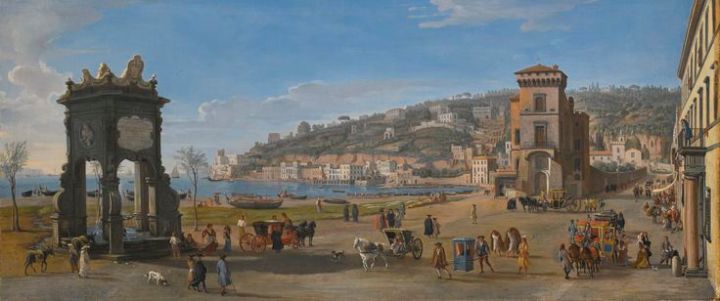
Gaspar van Wittel, called Vanvitelli, Naples, A View of the Riviera di Chiaia, oil on canvas, 75.7 by 174.8 cm (estimate: $1.5 / 2 million)
◊ ◊ ◊ ◊ ◊
Readers may recall that Christie’s decided to shift its Old Master sales (rebranded ‘Classic’) to April. Press release (19 January 2016) from Sotheby’s:
Sotheby’s Masters Week
New York, 27–30 January 2016
Sotheby’s annual Masters Week auctions in New York will be held 27–30 January 2016. This exciting auction series features rare and important European paintings, drawings, and sculpture dating from the 14th through the 19th centuries, including Orazio Gentileschi’s Danaë, one of the most important Baroque masterpieces left in private hands, and two very special private collection sales: The Collection of A. Alfred Taubman and The Road to Rome. The Masters Week exhibitions open 22 January in Sotheby’s York Avenue galleries.
The Collection of A. Alfred Taubman: Old Masters
27 January 2016 | 6:00pm
Master Drawings
28 January 2016 | 10:00am
The Road to Rome: A Distinguished Italian Private Collection, Part I
28 January 2016 | 2:00pm
Master Paintings Evening Sale
28 January 2016 | 6:00pm
Master Paintings and Sculpture Day Sale
29 January 2016 | 10:00am
Master Paintings and 19th-Century European Art
29–30 January 2016 | 2:00pm and 11:00am
◊ ◊ ◊ ◊ ◊
The Collection of A. Alfred Taubman: Old Masters
27 January 2016, 6:00pm

Thomas Gainsborough, The Blue Page, oil on canvas, ca. 1770, 165.5 by 113 cm.
Mr. Taubman’s remarkable collection of Old Masters includes rare pieces by two of the most iconic names in the history of art: Raphael, whose small Portrait of Valerio Belli, Bust Length, Facing Left (estimate: $2/3 million)—one of the last of his paintings remaining in private hands—is unique in the artist’s oeuvre as the only known profile bust representation, and Dürer, whose Christ Being Nailed To The Cross (estimate: $1/1.5 million) is related to his important series of drawings known as the Green Passion. Mr. Taubman’s collection also offers one of the strongest groups of Baroque works in private hands, led by Valentin de Boulogne’s The Crowning With Thorns (estimate: $1.5/2 million), as well as a number of classic 18th-century British pictures, featuring Thomas Gainsborough’s The Blue Page (estimate: $3/4 million).
Master Drawings
28 January 2016, 10:00am
Sotheby’s 28 January sale of Master Drawings offers a strong selection of Italian drawings, led by Giandomenico Tiepolo’s The Country School (estimate: $600/800,000) from his famous series of scenes from the life of ‘Punchinello.’ The auction also features: newly-discovered drawings by 17th-century Dutch masters Jacob van Ruisdael and Dirck Helmbreeker; major British works by William Blake and J.M.W. Turner; a series of studies by Ingres; a portrait of Jean-Claude Gaspard de Sireul (estimate: $120/180,000) by François Boucherand; and Guercino’s masterly red-chalk Study of a Baby in a Basket (estimate: $60/80,000)—one of an outstanding group of four drawings by the artist.
The Road to Rome: A Distinguished Italian Private Collection, Part I
28 January 2016, 2:00pm
The Road to Rome: A Distinguished Italian Private Collection, Part I comprises 35 view and portrait paintings that display a splendid overview of ‘Grand Tour’ taste. Throughout the 18th century, young aristocrats partook in the Grand Tour, visiting Italian cities including Venice, Naples and Rome as the culmination of their academic studies. Inspired by their voyages, many of these travelers developed an interest in art, sitting for some of the great portrait painters of the time and immortalizing their adventures by purchasing breathtaking view paintings. Many of the great artistic talents of the time including Vanvitelli, Bellotto, the Van Lint family, Hackert and Caffi directly benefited from the patronage of these Grand Tourists, and paintings by them will be highlights of the auction.
Master Paintings Evening Sale
28 January 2016, 6:00pm

Giovanni Antonio Canal, called Canaletto, An Interior View of The Henry VII Chapel, Westminster Abbey, 1750s, oil on canvas, 74.3 by 65.1 cm.
Orazio Gentileschi’s superb Danaë (estimate: $25/35 million) will lead the Master Paintings Evening Sale on 28 January. This undisputed masterpiece is one of the most important Italian Baroque paintings to come to market since World War II. Sotheby’s invited Pamela Romanowsky, writer and director of The Adderall Diaries, to create a film inspired by the work resulting in a beautiful and modern interpretation. View her film here: Reimagining Gentileschi’s Danaë.
In addition, the evening sale offers paintings by an impressive list of iconic artists: Sir Peter Paul Rubens, Lucas Cranach the Elder, Pieter Jansz. Saenredam, Sandro Botticelli, Eustache Le Sueur and Jacob Jordaens, whose St. Martin Healing a Possessed Man (estimate: $4/6 million) is one of the most exciting Flemish Baroque rediscoveries in decades. Further highlights include Canaletto’s An Interior View of The Henry VII Chapel, Westminster Abbey (estimate: $5/8 million), dating from the early 1750s, which depicts an remarkable view of Henry VII’s chapel in Westminster Abbey—one of the artist’s
rare works of an interior.
Master Paintings and Sculpture Day Sale
29 January 2016, 10:00am
The Day Sale offers a wide range of European paintings and sculpture spanning six centuries. Highlights of the paintings include works by esteemed artists Hubert Robert, Hans Bol, Jan van Goyen, Lucas Cranach the Younger, Apollonio di Giovanni di Tommaso, Edwaert Collier, and Pietro Antonio Rotari. Sculpture and works of art from the Medieval, Renaissance, and Baroque periods include an important pair of Venetian 15th-century Istrian stone figures of Hope and Charity (estimate: $400/600,000) by Bartolomeo Bon; a beautifully-painted enamel plaque of The Annunciation (estimate: $50/80,000) by Royal enameller Leonard Limosin; and a pair of elegant Italian terracotta figures of Mercury and Minerva (estimate: $80/120,000), attributed to the late 17th-century Florentine sculptor Giovanni Baratta.
Master Paintings and 19th-Century European Art
Session 1: 29 January 2016, 2:00pm / Session 2: 30 January 2016, 11:00am
Part 1 of the sale includes works by European artists from the 15th through the 18th centuries, while Part 2 focuses on 19th-century French, Italian, British, Dutch, German, Spanish and Scandinavian paintings, with a selection of Sporting pictures.
Colnaghi’s at New York’s Old Masters Week

Luis Egidio Meléndez, Still Life with Oysters,
Plate of Eggs, Garlic and Receptacles, 1772.
◊ ◊ ◊ ◊ ◊
As noted at Art Daily (20 January 2016). . .
Colnaghi’s Winter Exhibition of European Old Master Paintings and Sculpture will be held in the prestigious New York Galleries of Carlton Hobbs, from 21st to 30th January 2016, located at 60 East 93rd Street, together with Tomasso Brothers and Carlton Hobbs LLC. This joint exhibition will represent the first Colnaghi’s show in the United States after its merger with the Fine Art Dealers Coll & Cortés (London and Madrid). The exhibition will coincide with the New York annual Old Masters Week. The aim of this exhibition is to display the latest discoveries and examples of masterpieces that have never been presented before to the American public.
Still Life with Oysters, Plate of Eggs, Garlic and Receptacles is one of the most beautiful works by the highly regarded painter of still lifes, Luis Egidio Meléndez (Naples, 1716 – Madrid, 1780). The painting represents food and utensils typical of any eighteenth-century Spanish kitchen, but in Meléndez’s hands the arrangement results in an image of timeless and sublime beauty. This composition was so successful that Meléndez repeated it several times with small variations. One example that is particularly close to the one presented here, although slightly smaller is now in the collection of The Museo Nacional del Prado in Madrid. The work is signed and dated in black on the table edge at the right : Ls. Eo. Mz. Do ANNO 1772.
Colnaghi will also be exhibiting a Magnificat Anima Mea (My soul doth magnify the Lord) by the Spanish Baroque painter, Francisco de Zurbarán. The painting is signed ‘FZ’, and it has been dated by the artists scholar Odile Delenda between 1628 and 1630. This beautiful image was discovered by D. Manuel Gómez Moreno in the south of Spain in the middle of the twentieth century. After being rediscovered by Colnaghi it will be shown for the first time in more than 80 years.
Unlike painting, the art of polychrome sculpture is remarkable for the fact that many of its greatest masterpieces are not in museums but in the churches, convents and cathedrals for which they were originally made. Rather than being considered primarily as art works, Spanish polychrome sculpture is still revered today primarily for its function, as religious objects that are worshiped by the devout and carried through the streets during the annual Holy Week. But this fact has recently changed and a testimony to this shift is that museums have begun to acquire masterpieces of Spanish Sculpture. The Metropolitan Museum of Art acquired Pedro de Mena’s Ecce Homo and Mater Dolorosa from Coll & Cortés in 2014. They are now on display at one of the museum’s galleries dedicated to the Spanish art of the sixteenth and seventeenth centuries (Gallery 611). Notable for its outstanding quality is an Infant Christ by Mena (Spanish, Granada 1628–1688 Málaga). Carved wood sculpture, enhanced by paint and other media, including glass eyes and hair. Equally impacting is Mena’s highly sensitive Saint John the Baptist, made by Polychrome wood, glass and silver. The eyebrows, almond-shaped eyes and the modelling of the head and locks of hair that are softly carved to appear like modelled clay.










 Enfilade
leave a comment