Famous Golf Portrait Sells at Bonhams
Press release (10 December 2015) from Bonhams:

Lemuel Francis Abbott, Portrait of Henry Callender, 1790s.
[Last week] Bonhams sold one of the most famous golfing paintings in the world for £722,500. Lemuel Francis Abbott’s The Portrait of Henry Callender standing in a landscape, in the red coat of Captain General of the Blackheath Golf Club and holding a putter is now the most valuable portrait of golf ever sold at auction [sale 22645, lot 47]. Also in the Old Master Paintings sale at Bonhams London was an extremely rare iron headed putter from around 1780, almost certainly the same club featured in the portrait, which sold for £62,500. Both lots went to the same buyer in the packed saleroom.
Painted between 1790 and 1798, Henry Callender’s portrait is one of the earliest golf paintings of an identified sitter. Prints were made of the work in 1812 after Callender’s death and copies have hung in golf clubs and private collections worldwide for centuries. The original painting has hung at the Royal Blackheath Golf Club for more than 150 years, watching over the famous ‘Wee Dinners’ in the clubhouse. Traditionally, guests enjoyed haggis, neeps and tatties before hitting golf balls out of the window onto the 18th green from the dining room table. The Royal Blackheath has sold the painting to raise funds for the Club’s acquisition of the freehold of its course and clubhouse from The Crown Estate—a one-off opportunity to ensure its future. “Working with this painting has taken our department on a fascinating journey through British cultural history,” said Andrew McKenzie, Bonhams Director of Old Master Paintings. “A Scottish expatriate, Henry Callender was both connoisseur and sociable bon viveur and his charisma shines through this charming painting. The sale marked an incredibly exciting opportunity for golfing enthusiasts all over the world.”
Other highlights of the sale included a number of lots which sold for well over their pre-sale estimates. A winter landscape by Gysbrecht Leytens sold for £110,500, more than five times its estimate of £20,000–30,000, while a still life from the workshop of Jan Brueghel the Younger smashed its estimate of £30,000–50,000, selling for £86,500. An early 16th-century German School drawing, Portrait of a Gentleman, bust-length, in a red hat, also sold for £35,000, nearly ten times its pre-sale estimate of £4,000–6,000.
At Bonhams | Meissen Acquisitions

Meissen armorial two-handled beaker and saucer from the service for the Elector Clemens August of Cologne, 1735.
More information is available here»
◊ ◊ ◊ ◊ ◊
Press release (4 December 2015) from Bonhams:
Fine European Ceramics, Sale 22783
Bonhams, London, 2 December 2015
A rare Meissen armorial two-handed beaker and saucer, which once belonged to the Elector Clemens of Cologne, was bought this week at Bonhams Fine European Ceramics sale by the Brühl Palaces Augustusburg and Falkenlust. The UNESCO World Heritage Site, which belonged to the Elector Clemens August of Cologne (1700–1761), is the original home of the service to which this beaker and saucer belonged. Estimated at £50,000–60,000, the lot (#42) sold for £74,500. Bonhams Head of European Ceramics, Nette Megens said, “It’s very satisfying to know that this wonderful beaker is going back to its first home and will be re-united with other pieces from the same service in the Brühl Palaces’ collection.”
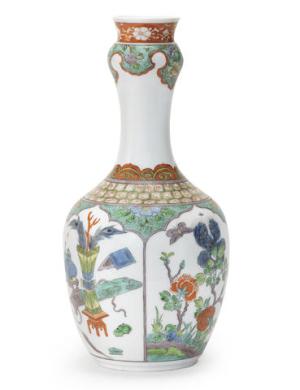
Meissen Famille verte vase, ca. 1735
Sold for £74,500.
The other top lot in the sale was a Meissen Famille verte vase from ca. 1735 (lot #40). One of very few examples of Meissen porcelain in the Chinese style, the vase sold for £74,500. Two other Meissen pieces were bought by major international museums confirming the manufactory’s importance in European cultural history.
The Palace Het Loo bought a Meissen soup plate for £6,875, more than double the lot’s pre-sale estimate of £3,000–5,000 (lot #51). The plate, made in the early 1770s, is from the service of Willem V of Orange, Stadholder of the United Provinces of the Netherlands. The service consists of 435 pieces which over the centuries have been dispersed across a range of museums and private collections. The plate will now join the Het Loo’s collection of around 170 pieces as, little by little, they bring the service together again. “It is one of the earliest Meissen topographical services and what we consider the most important related to the House of Orange,” said Suzanne Lambooy, Curator of Glass and Ceramics at Palace Het Loo. “We are excited to add this plate to our exhibition
as it is has an exceptional decoration depicting a view of
Vlissingen that we did not have before in our collection.”

Large Meissen figure of Paris, ca 1747
Sold for £4,750 (acquired by the V&A)
The Victoria & Albert Museum also purchased a large Meissen figure of Paris from a table centerpiece for £4,750 (lot #67). Reino Liefkes, Senior Curator of Ceramics and Glass at the V&A said: “The V&A is excited about acquiring this Meissen figure, which was originally modeled in 1747 for a grand table-centrepiece in white porcelain which has now been lost. The figure will be acquired with funds from the Capt. H.B. Murray Bequest and will go on display in the Museum’s Ceramics Galleries in due course. A spectacular Meissen centre-piece, also dating from 1747, has recently been restored by the V&A for the Museum’s new Europe 1600–1815 Galleries, which will open next week.”
Armorial Meissen was a further success of the sale. An armorial beaker from 1737 sold for £25,000 and an armorial teabowl and saucer from the service for Christian VI of Denmark sold for £12,500.
At Christie’s | Rebranding and Rescheduling the Old Masters
‘Classic Art’ and ‘Revolution’ are the latest labels chosen to make Old Master paintings more appealing to collectors of contemporary art. From The NY Times:
Scott Reyburn, “A New Battleground for ‘Classic Art’,” The New York Times (30 October 2015).
. . . Last month, Christie’s jolted the auction calendar by announcing that it would be introducing a new themed week devoted to auctions of historic artworks in New York in April. Instead of holding its old master paintings sales in January in the same week as Sotheby’s, Christie’s will offer them three months later, at the same time that it previews highlights of its May Impressionist, modern and contemporary auctions.
Traditionally, for the convenience of dealers and collectors, Sotheby’s and Christie’s, the two rival auction houses, have held their most important sales in the same week. . . .
[But] Christie’s is now going its own way with old masters, or what it now re-brands as “classic art.”
“There’s a sense that classical paintings aren’t fashionable,” said Jussi Pylkkanen, global president of Christie’s International. “But we’ve been selling them at the wrong time of year, when we haven’t been able to show them to our buyers of 20th-century art.” . . .
This shake-up of the New York auction calendar is the latest attempt—the Frieze Masters fair in London is another—to re-energize demand for historic works by exposing them to the wealthy collectors of 20th- and 21st-century art who dominate the buying. With that audience in mind, the April 2016 “Classic Art Week” will be given a modernist edge with a new themed “Revolution” sale comprising stand-out works from the 18th to 20th centuries, including photographs. . . .
Christie’s press release (6 October 2015) for the “Revolution” sale (New York, #11932, 13 April 2016) is available here»
Art Fair | Ceramics and Arts du Feu

◊ ◊ ◊ ◊ ◊
Next month in Paris:
8ème Parcours de la Céramique et des Arts du Feu
Paris, 22–27 September 2015
This year, participants will gather in the heart of the French capital, mainly within the Carré Rive Gauche, 75007 Paris. This event will last six days, from Tuesday 22 September until Sunday 27 September 2015, from 11am to 8pm, with an evening opening on the first day and closing at 6pm on the Sunday. The twenty-four participating French and European specialist antique dealers and gallery owners come from Paris, London, Rome, Brussels, etc. and are all members of the Association des Spécialistes de la Céramique de Collection. They will be offering quality pieces from all civilisations and all periods, within a wide price range, and specially set aside for this event. Encouraged by the participating dealers and with the warm support of museum curators, the Association des Spécialistes de la Céramique de Collection, whose aim is to promote ceramics and Arts du Feu, will be organising two days of lectures.
The cultural project of the 8th circuit will be celebrating the Adda Collection on the fiftieth anniversary of its sale by auction at Palais Galliéra, Paris, in 1965. This historic event lasted a whole week and saw the dispersal of exceptional pieces of Italian Majolica, items of Hispano-Mauresque origin, Chinese and Middle-Eastern ceramics, glass and enamels.
Lectures will be given on Wednesday 23 September 2015 on the following subjects: the transformation of the market for Italian Majolica over the last 50 years and the evolution in prices, and the scientific advances in attributions over the same period. Vincennes and Sèvres sculpture of the 18th century will be honoured with two lectures on this theme on Thursday 24 September, coinciding with the exhibition at Sèvres, Cité de la Céramique.
The 8th circuit of Ceramics and Arts du Feu is open to all: enthusiasts, art lovers, curators, historians and anyone tempted by this ceramic feast. You will discover not only rare and magnificent Italian majolica, faience, Chinese terracotta and porcelain, Iznik and Middle-Eastern ceramics, Meissen and Sèvres porcelain, but also enamels and antique and modern glass, not forgetting contemporary ceramics.
We are particularly grateful to our participating colleagues who run galleries specialising in the 20th and 21st centuries. They are numerous this year: Galerie Jean d’Albis, Galerie Arcanes, Galerie France de Forceville, Galerie Michèle Hayem, Lefebvre & Fils, Galerie Dumonteil, Gendras Regnier.

Earliest Topographical View of Niagara Falls

Thomas Davies, An East View of the
Great Cataract of Niagara, 1762
◊ ◊ ◊ ◊ ◊
From Art Daily (21 August 2015). . .
The very first eyewitness representation of Niagara Falls, a 1762 topographical watercolour by Thomas Davies, is at risk of being exported from the UK unless a buyer can be found to match the £151,800 asking price. In order to provide a last chance to keep it in the UK, Culture Minister Ed Vaizey has placed a temporary export bar on the watercolour by Captain Thomas Davies, An East View of the Great Cataract of Niagara.
The topographical watercolour of Niagara Falls by Captain Thomas Davies provides the very first accurate portrait of this iconic landscape, which has become one of the most recognisable views in the world. It was also the earliest inclusion of Niagara’s ever-present rainbow. Captain Thomas Davies was highly regarded as a military artist and collector, and this watercolour and Davies’ career was testament to Britain’s global role in the eighteenth century.
Culture Minister Ed Vaizey said, “This watercolour painting not only provides us with the first glimpse of Niagara Falls, but it also sheds light on Britain’s achievements in eighteenth-century exploration, military and topographical art. I hope that the temporary export bar I have put in place will result in a UK buyer coming forward and that the watercolour will be available for all to better understand Britain’s global role in the eighteenth century.”
While there are many examples of military artwork in the eighteenth century, military artist drawings of North America during this century are rare. Davies was the first military artists to record Niagara falls, and this particular watercolour is important in the study of the history of British military, topographical art and exploration. The watercolour previously belonged to Peter Winkworth, who had built an extensive collection of artwork of Canadian scenes.
Vaizey took the decision to defer granting an export licence for the watercolour following a recommendation by the Reviewing Committee on the Export of Works of Art and Objects of Cultural Interest (RCEWA), administered by Arts Council England. The RCEWA made their recommendation on the grounds of it’s close association with our history and national life, and its significance for the study of Britain’s history in the fields of eighteenth-century exploration, scientific and military endeavour.
RCEWA Member Christopher Wright said, “The significance of the work of the draughtsmen produced by the Military Academy at Woolwich has only come to be fully appreciated by a nonspecialist audience in the last few decades. That Captain Thomas Davies should have produced the first scientifically and topographically accurate portrayal of the greatest natural wonder of North America at the very moment that Wolfe’s victory at Quebec had brought the whole of the continent’s eastern landmass under British control at once gives him a pre-eminent place in the Woolwich tradition. However, most of his work has already left these shores. Davies produced three views of Niagara. An East View of the Falls, arguably the most important of the three, is the only one now remaining in this country.”
The decision on the export licence application for the watercolour will be deferred for a period ending on 18 November 2015 inclusive. This period may be extended until 18 February 2016 inclusive if a serious intention to raise funds to purchase the watercolour is made at the recommended price of £151,800 (inclusive of VAT).
London Art Week 2015

Zoffany, The Sayer Family of Richmond, 1781. The painting sold at Sotheby’s on 27 October 2011 (Old Master and British Paintings, Lot 138) for £43,250 as ‘circle of Zoffany’. It’s now offered by Colnaghi as an autograph work. As noted in the current entry: “Extensive research by [David] Wilson has made it possible to reconstruct the circumstances of the painting’s original commission, supply additional (previously unrecorded) information about its provenance, and establish the work as an autograph painting by Zoffany. That autograph status is accepted by all the major Zoffany scholars.”
◊ ◊ ◊ ◊ ◊
From London Art Week:
London Art Week 2015
Mayfair and St. James’s, 3–10 July 2015
London Art Week (3 to 10 July 2015) is the most important gallery-based celebration of traditional art, highlighting the unrivalled quality, riches and expertise available within the galleries of Mayfair and St. James’s. Bringing together over 40 leading art galleries and three auction houses, the event includes a series of dedicated exhibitions and will present a wealth of paintings, drawings, sculpture, and works of art from antiquity to the 20th century, many of which have been hidden from public view for decades.
Johnny van Haeften and Lowell Libson, Senior Committee members of London Art Week: “London Art Week is a key moment of the year which celebrates the resounding importance of the art gallery. It also highlights the position of Mayfair and St. James’s as the global centre of the traditional art market, and the leading destination for expertise. We look forward to welcoming collectors, curators and enthusiasts to this year’s event which will offer the strongest and most diverse selection of art to date.”
A myriad of exciting rediscoveries will be unveiled at London Art Week 2015. Highlights include The Sayer Family of Richmond, 1781, by Johan Zoffany, R.A. (1733–1810), one of the most important rediscoveries in the field of classical British art for decades (Colnaghi); a marble sculpture of Lucretia by Philippe Bertrand (1663–1724), artist at the Court of Louis XIV, which has been unseen since it was exhibited at the Salon de Louvre in 1704 (Galerie Sismann); the only known drawing by Cesare Magni (1511–1534), pupil of Leonardo da Vinci, to be firmly attributed to the artist (Martin Hirschboeck); and Madonna and Child by Simon Vouet (1590–1649), otherwise known as The Madonna Molé, whose existence was known by scholars through an engraving, but whose whereabouts were unknown until now (Maurizio Nobile).
Exhibitions presented for London Art Week 2015 include Portraiture through the Ages (Agnew’s), French Drawings from the 17th to 19th Century (Katrin Bellinger at Colnaghi), Reclaiming Antiquity: Creation and Revival between the Fall of Rome and the Renaissance (Sam Fogg), Fragments: From the Tiber to the Ganges (Oliver Forge and Brendan Lynch), Paintings from Georgian Britain: A Golden Age (Richard Green Fine Paintings), On Copper (Johnny van Haeften Ltd.), Ignacio Pinazo (1849–1916): A Valencian Master of Light (Galería José de la Mano), From the Salon (Daniel Katz Gallery), The Painter’s Menagerie and The Sculptor’s Menagerie (Rafael Valls Ltd. and Tomasso Brothers Fine Art), Shapely Forms: Vessels in Antiquity (Rupert Wace Ancient Art), and From Merchants to Monarchs: Frans Pourbus the Younger (The Weiss Gallery). Further details of highlights and exhibitions are available here . Full details of the event, including a map, are available at www.londonartweek.co.uk, via the app, and in the catalogue, which includes a forward by Dr. Nicholas Penny, Director of the National Gallery.
The Crown Estate is delighted to sponsor London Art Week in 2015. The participants are all situated a short walk from one another in the heart of London’s Mayfair and St James’s. The Crown Estate owns approximately 50% of St James’s and is implementing a £500m investment programme to sensitively refine and enhance the area, which forms part of its core holdings in London’s West End. James Cooksey, Head of the St James’s Portfolio, said: “The Crown Estate is delighted to support this important event in London’s art calendar which unites the art galleries of Mayfair and St. James’s, and helps to promote the extraordinary range of knowledge, expertise and heritage on offer in the art market’s historic home.”
London Art Week was launched in 2013 as a platform that united Master Drawings & Sculpture Week (est. 2001) and Master Paintings Week (est. 2009).
Images of selected works are available here»
At Christie’s | Old Master & British Paintings
Press release (11 June 2015) from Christie’s:
Old Master & British Paintings Evening Sale #10389
Christie’s, South Kensington, London, 9 July 2015
 Christie’s Old Master & British Paintings Evening Sale in London on Thursday 9 July will offer an exceptional selection of pictures from private collections, with emphasis on rarity, importance and provenance. Many of the highlights in the sale have not been seen on the market for generations. The sale is led by a masterpiece by Bernardo Bellotto (1721–1780), Dresden from the Right Bank of the Elbe above the Augustus Bridge, one of the last great views of the city by this artist still remaining in private hands (estimate: £8–12 million). The sale also includes six carefully selected paintings from The Alfred Beit Foundation with two superb panels by Rubens: Head of a Bearded Man (estimate: £2–3 million), and Venus and Jupiter (estimate: £1.2–1.8 million); and one of the greatest Kermesse scenes by David Teniers the Younger (estimate: £1.2–1.8 million). Other sale highlights are a portrait of Sir Richard Brooke, 5th Bt. by Thomas Gainsborough, which has never been on the market before (estimate: £2–3 million); the most important oil by Richard Parkes Bonington to come to the market in a generation, A Coastal Landscape with Fisherfolk (estimate: £2–3 million); four major works by Pieter Brueghel the Younger, featuring one of his rarest and most original compositions, The Kermesse of Saint George (estimate: £2.5–3.5 million); and seven Dutch paintings from the Cunningham collection, led by an exquisite Still-Life by Jan Davidsz. de Heem (estimate: £1.5–2.5 million). Other notable works which are at auction for the first time include: Christ on the Cross by El Greco and studio (estimate: £1–1.5 million), Hermes Entertained by Calypso by Jacob Jordaens (estimate: £600,000–800,000), Ruins of the Old Church at Muiderberg by Jacob van Ruisdael (estimate: £500,000–800,000), and a sublime, signed view of Venice by Francesco Guardi The Grand Canal, Venice, with San Simeone Piccolo (estimate: £1–1.5 million). A re-discovered panel by Jean-Antoine Watteau, La Lorgneuse, previously believed to be lost, will also be offered (estimate: £300,000–500,000).
This auction, together with the Day Sale on 10 July and the Old Master & British Drawings & Watercolours sale on 7 July, are all part of London Art Week 2015 (3 to 10 July), which highlights the exceptional riches and unparalleled expertise available within Mayfair and St. James’s. Celebrating the contemporary art of the past, the wealth of classical works at Christie’s from 7 to 10 July represent excellence and technical brilliance. They will be offered across the sales of Old Master & British Paintings, Drawings & Watercolours, The Exceptional Sale, the Taste of the Royal Court: Important French Furniture and Works of Art from a Private Collection sale, and The Collection of a Distinguished Swiss Gentleman. Together, the week of sales at Christie’s presents works by many of the most revered artists and craftsmen in history, who have stood the test of time and were ground-breaking and innovative in their day.
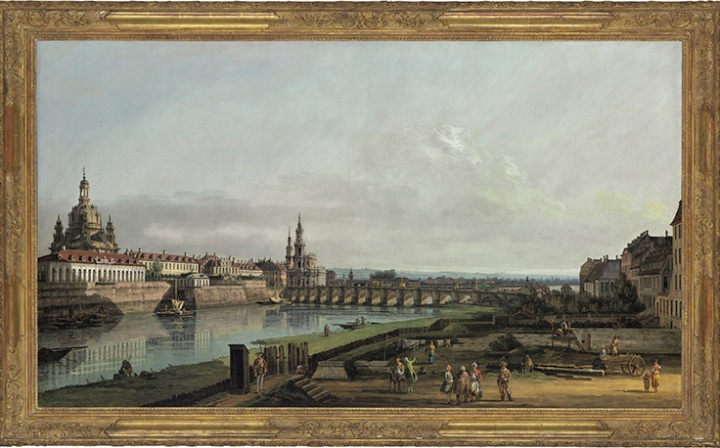
Bernardo Bellotto
Dresden from the Right Bank of the Elbe above the Augustus Bridge is a masterpiece of Bernardo Bellotto’s full maturity (estimate: £8–12 million). An artist of precocious talent, Bellotto emerged from the shadow of his uncle, Canaletto, to become one of the most skilful view painters of his time. His renditions of Dresden, Vienna, Munich and Warsaw were the defining records of four of the major capitals of northern Europe in the mid-eighteenth century and have a distinguished place in the development of European topographical painting. Bellotto’s early renown led to him being called to Dresden in 1747 to work for Friedrich-August II, Elector of Saxony, where he undertook a series of views of the city during the height of its powers, in the mid-eighteenth century.
This picture, one of the most remarkable views by the artist to appear on the market in recent times, is a variant of the very first view of Dresden that Bellotto executed for the Elector. It acted as a great showcase for his talent, exemplifying a method based on the highest levels of exactitude and topographical accuracy. Offered from the Property of a Private European Collector, the painting depicts some of the greatest civic and religious buildings that made up the so-called Brühlsche Terrasse that ran along the Elbe at the time, with the domed Frauenkirche rising up to the left, next to the Brühl Library and the Fürstenburg Palace. The promenade was devastated during the Second World War, but has largely been rebuilt. Painted in circa 1751–53, this view of Dresden is distinguished from Bellotto’s two earlier pictures of the same subject in its atmospheric tone, cooler palette and the wonderful reflections in the river. It is a picture of outstanding refinement and precision, without any loss of spontaneity, presenting one of Europe’s great cities in all its splendour.
The Alfred Beit Foundation
A group of six Old Master paintings from The Alfred Beit Foundation is led by two magnificent works on panel by Sir Peter Paul Rubens, Head of a Bearded Man (estimate: £2–3 million) and Venus and Jupiter (estimate: £1.2–1.8 million) and also includes a masterpiece by David Teniers II, one of the finest works by the artist still in private hands. The works are being sold by the foundation in order to set up an endowment fund to safeguard the long term future of Russborough, one of the greatest Georgian houses in Ireland, built almost 300 years ago, which was gifted by the Beit family to The Alfred Beit Foundation in 1976. In 1986, Sir Alfred and Lady Clementine Beit gifted many of the most celebrated pictures from the Beit Collection to the National Gallery of Ireland, which included masterpieces by Vermeer, Gabriel Metsu, Jacob van Ruisdael, Goya and Gainsborough amongst others. This donation transformed the Gallery’s collection of Old Master Paintings and a wing of the Gallery was fittingly named ‘The Beit Wing’ in recognition of this remarkable gift. Please click here for the separate press release.
Thomas Gainsborough
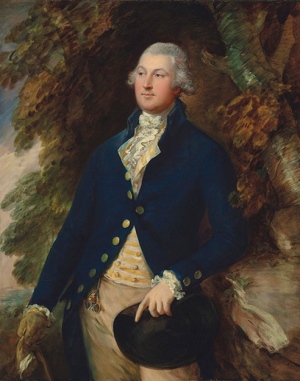
Thomas Gainsborough, Portrait of Sir Richard Brooke, 5th Bt., ca. 1780s
Only seen in public on one previous occasion, when it was exhibited in 1876, the Portrait of Sir Richard Brooke, 5th Bt. (1753–1795) by Thomas Gainsborough, R.A. (1727–1788) has descended through the family of the sitter to the present owner (estimate: £2–3 million). The picture will be included in Hugh Belsey’s forthcoming catalogue raisonné of Gainsborough’s portraits, having never previously been published in any of the monographs written on the artist. Sir Richard is understood to have commissioned the work shortly after he inherited the title and family estates in Cheshire from his father in July 1781. Refined and elegant, the portrait is a superb example of Gainsborough’s bravura draughtsmanship, and presents Sir Richard as the epitome of the sophisticated country gentleman.
Richard Parkes Bonington
Constituting the grandest statement in oil by Richard Parkes Bonington to appear at auction in a generation, and one of the last on this scale to remain in private hands, A Coastal Landscape with Fisherfolk, a Beached Boat Beyond was painted at the height of the artist’s career (estimate: £2–3 million). It displays Bonington’s virtuoso handling of the brush and the subtle observation of light and atmosphere that he had first mastered as a watercolourist. The picture belongs to a group of coastal scenes that were celebrated during Bonington’s lifetime and have captivated artists and collectors ever since. These are considered to be among the most beautiful of the romantic period and led Edith Wharton, the American novelist, to write in 1910 that “surely he was the Keats of painting.” The picture reveals the undeniable influence of Turner, whose landscapes Bonington would have seen on his trip from Paris to London in 1825. The following year, 1826, in which the present picture is thought to have been executed, was a key date in Bonington’s tragically short career, marking his debut, to great acclaim, at the British Institution in London; his works were soon much in demand from many of the great Whig patrons of the day, including John Russell, 6th Duke of Bedford, Henry Petty-Fitzmaurice, 3rd Marquess of Lansdowne, and Robert, 2nd Earl Grosvenor. This picture was acquired by Henry Wellesley (1773–1847), later Lord Cowley, the younger brother of Arthur Wellesley, 1st Duke of Wellington, who served as ambassador at Paris.
Cunningham Collection
The superb collection of Dutch and Flemish Old Master Paintings formed by Philip Tracy Cunningham and his wife Lizanne is a remarkable testimony to their passion for the arts and for the Dutch Golden Age in particular. The pictures being offered exemplify the Cunningham’s keen appreciation for condition and quality. Following three lots from the collection which were sold at Christie’s New York in June, the London sale will offer seven stellar Dutch paintings that have been on view at the National Gallery in Washington, D.C. for the past fifteen years. The group is led by an exquisite still-life by Jan Davidsz. de Heem (1606–1684), Grapes, Peaches, Blackberries, Oysters, Hazelnuts, and Wine in Façon-de-Venise Glasses on a Partially Draped Stone Ledge with a Snail, Butterfly, and a Bee (estimate: £1.5–2.5 million). The other works include a beautifully preserved example of Willem van de Velde II’s treatments of atmospheric Calms (estimate: £600–800,000), The Wedding Dance by Pieter Brueghel II, and cabinet pictures by Dirck van Delen, Jan van Goyen and Nicolaes Berchem.
Francesco Guardi
The Grand Canal, Venice, with San Simeone Piccolo by Francesco Guardi (estimate: £1–1.5 million). Previously unrecorded, this exquisite canvas is an important discovery, exemplifying the captivating, atmospheric qualities for which Francesco Guardi is most renowned. It has been in the possession of the present European family for more than a century and is signed prominently on the left. Datable to the 1770s, the picture is a work of Guardi’s full maturity, when his mastery of vedute painting in Venice was unrivalled. The view is taken from a bustling stretch of the Grand Canal, near to the church of the Scalzi, then the main route into the city from the mainland. Though the present-day scene is somewhat changed, the vibrancy of Guardi’s view is immediately recognisable. He renders the tranquil, shimmering beauty of the city with an incomparable touch, a superb addition to the oeuvre of one of the greatest of view painters.
Pieter Brueghel the Younger
The sale presents an exceptional selection of four major works by Pieter Brueghel the Younger. The Kermesse of Saint George (estimate: £2.5–3.5 million) is one of his rarest and most original inventions, entirely independent from any of his father’s works and more accomplished than any of his other original compositions. Including this picture, only four securely autograph versions are known. Georges Marlier, the pioneering Breughel scholar, dated the picture to before 1626–28. He praised it for brilliantly affirming the younger Brueghel’s personality, calling it “one hundred percent ‘Breughelian’, not only for the dramatic rhythms that pervade it, but also in the stylisation of the figures and in the colour harmonies. While maintaining the continuity of Pieter the Elder’s art through these themes, his son Pieter gives rein to his own particular vigour, his own taste for anecdote and his own mastery of his profession that is equal to those of the greatest artists.”
From a European Private Collection, The Birdtrap (estimate: £2–3 million) is a superbly preserved example, painted on a single panel, of what is arguably the Brueghel dynasty’s most iconic invention, and one of the most enduringly popular images in Western art. The Birdtrap is a composition of distinctive poetic beauty: in a hilly landscape, blanketed with snow, a merry band of country folk are skating, curling, playing skittles and hockey on a frozen river, in apparently carefree fashion. Yet there are hidden perils, serving as pertinent reminders of the precariousness and transience of life itself: the fishing hole in the centre of the frozen river is a sign of the dangers that lurk beneath the light-hearted pleasures of the Flemish winter; and to the right of the composition birds surround the eponymous trap, seemingly oblivious to its imminent threat. In this remarkable work, executed with poise and great delicacy, Brueghel delivers a message of lasting poignancy about the fickleness and uncertainty of life.
The other works include The Wedding Feast, which is offered from the property of a European Family (estimate: £1.5–2.5 million). The Wedding Feast is not only one of the most iconic images in the Brueghel canon, it is one of the most famous banquet scenes in the history of Western art by virtue of the prototype, the masterpiece by Pieter Bruegel the Elder now in the Kunsthistorisches Museum, Vienna. The picture offered for sale is one of only four recorded autograph versions by Brueghel the Younger and this will be the first to come to the market since the late 1970s. And the final picture by Brueghel the Younger comes from The Cunningham Collection, The Outdoor Wedding Dance, dated 1621 (estimate: £1.2–1.8 million).
At Christie’s | Three Country House Collections
Press release (28 May 2015) from Christie’s:
Glebe House, Mont Pellier, and Woodbury House
Three Country House Collections, Sale #11567
Christie’s, South Kensington, London, 17 June 2015
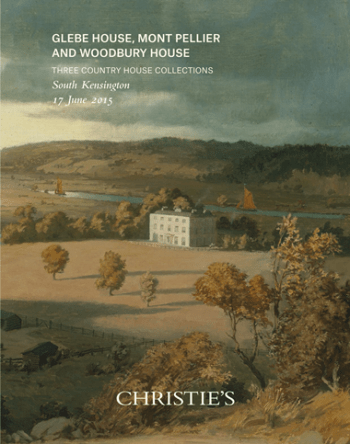 On 17 June Christie’s South Kensington will offer Three Country House Collections: Glebe House, the Property of the late Mr. Anthony Hobson; Mont Pellier, the Property of the late Mrs. Barbara Overland; and Woodbury House, the Property of the late The Hon. Mr. & Mrs. Anthony Samuel (Sale #11567). These three country house collections perfectly encapsulate the English home and together they present a superb selection of English and European furniture, Old Master paintings and drawings, decorative objects, silver and porcelain.
The sale comprises over 350 lots with estimates ranging from £500 to £50,000. The pre-auction viewing at Christie’s 85 Old Brompton Road will be open from 12 to 16 June for connoisseurs, decorators and collectors alike to explore the essence of the English country house.
Glebe House, the Property of the late Mr. Anthony Hobson
The late Anthony Hobson, a bibliophile of great distinction, and a world expert on Renaissance bookbinding, was appointed Head of Sotheby’s Book department when he was only 27, as well as being a past president of the Association Internationale de Bibliophilie (1985–1999). He was also a lifelong collector of art and furniture and amassed an extensive collection on which the taste of his wife, Tanya Vinogradoff, the granddaughter of the painter Algernon Newton, R.A, was also a significant influence.
Hobson was endlessly curious and maintained a voracious appetite for acquisition resulting in a collection which ranged with confidence across periods and registers: medieval Persian, Neoclassical, 18th-century Indian, Regency, Pre-Raphaelite—all individual delights which became part of a much larger whole in the beautiful Queen Anne Glebe House, Hampshire, where he lived for the last 55 years of his life. This sale is testament to an exceptional life led by the man singled out by Cyril Connolly as among the most “impressive scholar aesthetes of our day.” Highlights from the Hobson collection include The Interior of St Peter’s, Rome by Wilhelm Schubert van Ehrenberg (estimate: £20,000–30,000), alongside exceptional examples of English furniture and lighting, such as a pair of Louis XVI ormolu twin-branch wall-lights (estimate: £7,000–10,000) and a George II parcel-gilt mahogany rusticated architectural cabinet (estimate: £4,000–6,000).
Hobson’s remarkable library will also be offered at Christie’s South Kensington this June across two sales. The sale of Fine Printed Books and Manuscripts on 9 June includes scarce editions of the earliest known auction catalogues and inventories of the finest libraries in Europe from Hobson’s bibliographic library. Of immense importance to bibliographic study and provenance research, the library includes a first edition of the earliest Paris book auction which was held in 1706, sixty years before Christie’s held its first sale (estimate: £1,000–1,500). On 10 June Christie’s presents the sale of Modern Literature: The Personal Collection of Anthony Hobson—a truly personal collection in every sense: many of the books, editions, and manuscripts are affectionately inscribed with a message to Hobson from the authors with whom he became such great friends. Amongst the highlights are first edition presentation copies of Kingsley Amis’ Lucky Jim (estimate: £1,800–2,500) and a complete set of Anthony Powell’s A Dance to the Music of Time (estimate: £5,000–8,000).
Additionally, the sale includes a collection of love letters between the heiress and avant-garde literary muse Nancy Cunard and the African-American jazz musician Henry Crowder, containing a number of Cecil Beaton photographs of her (estimate: £3,000–5,000). These auctions present a unique opportunity to acquire a part of this illustrious library.
Mont Pellier, the Property of the late Mrs. Barbara Overland
The Overland family lived in Jersey for over 40 years, where they enjoyed the amenities of rural life and the unique privacy that the Channel Islands offer. They created a very special atmosphere at their house, Mont Pellier, which can be seen in the dedication and pride the late Mrs. Barbara Overland took in furnishing her home with English furniture, Old Master Paintings and decorative objects.
The pieces in her collection were acquired with great care and thought to enhance the serene interiors, which were so characteristic of Mont Pellier, such as the perfectly formed George II mahogany chest (estimate: £4,000–6,000) and the captivating trompe l’oeil painting of a letter rack by Edward Collier, acquired from Rafael Valls, London (estimate: £20,000–30,000). Further highlights include a George III polychrome-painted dummy-board (estimate: £3,000–5,000) and a group of ceramic fruit and vegetables by Anne Gordon (in two lots with estimates from £1,000).
The proceeds of the sale of the collection of the late Mrs. Barbara Overland will go to benefit the ongoing work of the charitable trust set up in the memory of the Overlands for generations to come.
Woodbury House, the Property of the late The Hon. Mr. & Mrs. Anthony Samuel
Woodbury House, an elegant Regency gothic villa in Hampshire, was the last home of the Hon. Mr and Mrs Anthony Samuel. Anthony Samuel was the younger son of Colonel Walter Samuel, 2nd Viscount Bearsted, and a grandson of Marcus Samuel, 1st Viscount Bearsted, the founder of The ‘Shell’ Transport and Trading Company, which in 1907 merged with its rival to form Royal Dutch Shell. After serving in the SOE during the Second World War, Samuel joined the family bank, Hill Samuel, as well as having interests in publishing, representing prominent authors such as P.G. Wodehouse. He also ventured into the world of horse racing owning several winners. In 1966 he married his third wife, the actress Mercy Haystead (1930–2015). Mercy rose to fame as a model and actress after being ‘discovered’ whilst holidaying in Positano in 1949 and was well known during the 1950s for her roles in films, such as What the Butler Saw and The Admirable Crichton.
The Samuels were renowned as generous hosts. They had houses in London and Scotland and frequently travelled to their suite in the Algonquin Hotel, New York. Their sophisticated London house on St. Leonard’s Terrace, Chelsea, had rich interiors designed by David Hicks, whilst their Scottish country house Arndilly, on the banks of the Spey, provided a more restrained setting, acting as a retreat from London and as a base from which country sports could be pursued and enjoyed.
Arndilly House was sold when the couple sought a quieter life and it was at this point that they acquired Woodbury House, a former rectory in Hampshire. A genteel decorative scheme was adopted, which not only suited the house’s rural location, but also its Regency architecture. It was decorated by Simon Playle under the keen eye of the ever stylish Mrs. Samuel. The Samuels had long been keen collectors. Their possessions had been inherited, collected and assembled over many decades and displayed all the characteristics of the discerning collector’s eye. Their collection of paintings ranged from Old Masters to the works of the Impressionist Edouard Vuillard, the Victorian painter John Atkinson Grimshaw and the 2oth-century artist Nicolas de Staël, the works of the latter being sold at Christie’s following the sale of the couple’s London home in 2008.
Highlights from Woodbury House include a painting of Two greyhounds in a wooded landscape with Parham House and a temple beyond (estimate: £10,000–15,000), a set of ten walnut rococo-style dining chairs (estimate: £3,000–5,000) and a set of four George III silver candlesticks and a pair of twin branch candelabra en suite (estimate: £6,000–8,000). La vie conjugale (Married Life) by Edouard Vuillard will be offered on 23 June in the Impressionist and Modern Art Evening Sale at Christie’s King Street (estimate: £500,000–800,000) and Rouen – les lumières sur la Seine, pris du Pont de Pierre by John Atkinson Grimshaw will be offered on 8 July at Christie’s South Kensington in the Victorian, Pre Raphaelite and British Impressionist Art, Sporting and Maritime Art sale (estimate: £80,000–120,000).
At Sotheby’s | Sale of Exceptional Louis XVI Vases
From Sotheby’s:
A Mansion: A Private Collection (L15318)
Sotheby’s, London, 28 April 2015
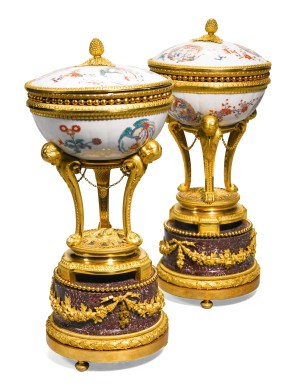 This week at Sotheby’s London a pair of exceptional vases once owned by Louis XVI sold for 10 times the estimate at a staggering £1,985,000 (lot 112, estimate: £150,000–250,000), a worldwide record price for a Louis XVI gilt bronze mounted porcelain work of art. Telling the tale of both French Royalty and revolution, the Brûle Parfums once formed part of the collection of Louis XVI, who bought them in 1782 with the intention of placing them in the Louvre Museum. With his demise. . . the vases were then taken to the State repository, the Dépôt de Nesle. The Dépôt was one of the cornerstones of the revolutionary drive to reorganize cultural properties and was fundamental to the success of the creation of national and provincial museums. Given their importance, in 1797 these vases were exchanged for a significant natural history collection. Decorated with delicate phoenix birds and dragons, this exquisite 18th-century Japanese porcelain is of the finest quality. The gilt-bronze-mounts, later added by the great connoisseur the Duc d’Aumont, were executed by Pierre Gouthière probably to a design by François-Joseph Belanger and date to Louis XVI, circa 1770–75. The auction launched a series of exceptional house sales taking place this year. Exceeding the high estimate, the sale totalled £6,631,065.
More information about the vases is available here»
The Chelsea Antiques Fair, March 2015
As noted at ArtDaily:
The Chelsea Antiques Fair
Chelsea Old Town Hall, Kings Road, London, 18–22 March 2015
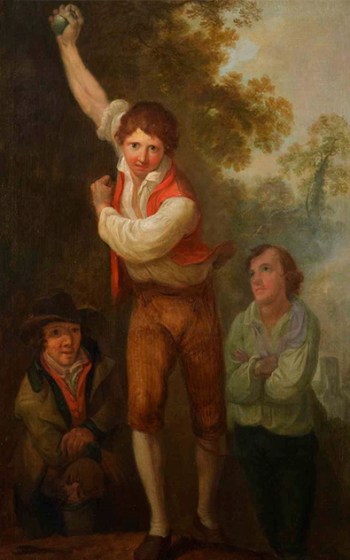
Irish Road Bowlers, ca. 1790s
The earliest known depiction of Irish Road Bowling will be offered by Bagshawe Fine Art at The Chelsea Antiques Fair, which opens the day after St Patrick’s Day at the Chelsea Old Town Hall on Wednesday, 18th March 2015 and runs until Sunday, 22nd March (it coincides with The BADA Fair, just half a mile away). Dr Fintan Lane, the Irish historian and author of Long Bullets: A History of Irish Road Bowling, has stated that in his opinion this is the earliest known visual depiction of the sport.
Nicholas Bagshawe explains: “This fascinating picture depicts the Irish sport of road bowling. This sport, possibly of Dutch origin, has been played in Ireland since the 17th century and is still played today, predominantly in the counties of Armagh and Cork. The sport consists of a contest between two or more players who attempt to throw a metal ball down a country road course of a specific length. The winner is the one who completes the course in the fewest throws.”
The Irish Road Bowling historian, Fintan Lane, states that the earliest painting known before this discovery was by Daniel MacDonald (1821–1853), which dates from circa 1847. According to Bagshawe “it is not yet totally certain who the artist of this picture is, but we are becoming increasingly convinced that it is the work of Nathaniel Grogan Junior (Irish, ca. 1765–1820).” The oil on canvas measures 47 x 33 inches and is dateable from the style of painting and the costumes of the players to the years around 1790 to 1800.
Bagshawe explains that “in English terms it appears to have an affinity with the styles of George Morland, Francis Wheatley or even the portraitist John Opie. But it is none of these directly, and given the specifically Irish nature of the subject, we must be looking for an Irish artist. The Grogans, both senior and junior, seem the most likely candidates; and, when we consider that they were both Cork artists, this becomes a very strong possibility. As art historians start to differentiate their work more accurately, it seems that Nathaniel Grogan senior, while a better known and seemingly more prolific artist, might not have been capable of painting a large front-of-stage figure with quite the fluency shown here. It is more likely that we are looking at the work of his son. Grogan Junior was, like his father, a Cork painter, and he must have started out as a pupil and collaborator of the older artist. However, such few documented sketches as we know to exist by the younger man do show a greater fluency with the figure, and he must be the most likely candidate for this picture. When we add to that the fact that he is known to have exhibited a picture in his lifetime called The Bowl Players, this attribution becomes all the more plausible. There is more to learn about this intriguing picture, but without doubt it already presents itself as a fascinating piece of Irish social history.”
The painting shows two young men, jackets off, competing with each other. The third figure, with hat and coat, is likely to be the ‘road-shower’. This man would have marked the point (the ‘tip’) where the previous shot had stopped and thus the place from where the bowler would take his next throw. The bowler holds the metal ball (probably still a cannon-ball at this stage) high in the air, from where he would bring it down in a fast underarm action. This high-arm action, sometimes known as the ‘windmill’ style was a technique favoured by players in the Cork area; therefore, it is felt that the scene depicted in the painting is taking place in Co. Cork.










 Enfilade
leave a comment