Master Drawings New York, 2013
Press release (October 2012) from Master Drawings New York:
Master Drawings New York, 2013
New York, 25 January — 2 February 2013
 The highly acclaimed Master Drawings New York returns to Manhattan where dealers from around the world are holding coordinated exhibitions in art galleries located on New York’s Upper East Side. This annual event, which has attracted four new international dealers this year, enables both collectors and curators to view a broad range of master works dating from the sixteenth to the twentieth centuries. Exhibitors hail from the UK, France, Italy, Spain, Germany, and the USA. During this week, their finest drawings are all displayed within walking distance of each other, allowing connoisseurs to buy drawings across a broad range of prices, styles, and centuries. A preview at all galleries on Friday January 25 from 4 to 8 pm enables collectors to view the exhibitions before the opening weekend.
New York dealer Les Eluminures are exhibiting the intensely colourful Presentation in the Temple (ca. 1520/30) by Netherlandish artist Simon Bening (1483/4–1561). The vibrancy of expression with which Bening depicts these biblical characters lends the work, almost 500 years old, a remarkable vitality. Fellow New Yorker Margot Gordon, who organises the event with London-based Crispian Riley-Smith, is showing a 17th-century study for the ‘Sala di Apollo’ at the Palazzo Pitti by Pietro da Cortona (1596–1669), which highlights the movement and dynamism of the artist’s work.

Antonio González Velázquez, The Apparition of the Virgin del Carmen to Saint Simon Stock, black chalk, sepia ink and brown wash on laid paper, 1780
18th- and 19th-century European drawings are one of the strengths of the 2013 edition of Master Drawings New York. Madrid based dealer José de la Mano Galería de Arte is bringing The Apparition of the Virgin del Carmen to Saint Simon Stock (1780), a stately biblical scene depicted in black chalk, sepia ink and brown wash on laid paper by Antonio González Velázquez (1723–1793). The drawing reveals Velázquez’s subtlety of stroke and includes fascinating sketches around the border. Paolo Antonacci from Rome, a first time exhibitor at Master Drawings New York, brings Paolo and Francesca Surprised by Giangiotto Malatesta by Giuseppe Cades (1750–1799) in ink and brown wash on paper while Crispian Riley-Smith is exhibiting a pencil and watercolour by Cornelia Maris Haakman (1787–1834) of Tulips, Carnations, Blue Bells in a Vase with a Still-Life of Butterfly and Snail (1806). London dealer James Mackinnon is bringing a pencil and watercolour drawing of The Monastery Cloister at Amalfi (1840) by Achille Vianelli (1803–1894). The roof of the cloisters vaulting above the habited monks creates an atmosphere of peace and contemplation in an Italian midday heat. Parisian dealer Laura Pecheur is bringing a vibrant pencil and watercolour on paper signed by Lorenz Frölich (1820–1908), of a Fisherman from Capri (ca. 1850).

Giuseppe Cades, Paolo and Francesca Surprised by Giangiotto Malatesta, ink and brown wash on paper
Moving into the 20th century, London dealer Stephen Ongpin Fine Art is bringing The Sleeping Child, a dream-like watercolour sketch by French symbolist Odilon Redon (1840–1916). The blooming, cloud-like forms and feverish colours of the sketch typify Redon’s drawings, described by Huysmans as, “[defying] classification; unheeding, for the most part, of the limitations of painting.” New York dealer Sigrid Freundorfer Fine Art is exhibiting an ink on paper sketch of Albert Einstein drawn by his friend Josef Scharl (1896–1954) in Princeton in 1950, which is signed by both Scharl and Einstein. Moeller Fine Art, also from New York, is showing The Academician (The Poet) (1954), a colourful oil pastel and ink on paper by Richard Lindner (1901–1978). Described by Claude Clement as “full of urban energy, and driven by weird eroticism,” Lindner was also in Einstein’s circle and an eminent academic until his death in 1978.
At Auction | Americana Week at Christie’s
Press release (20 December 2012) from Christie’s:
Four Sales Feature American Arts, English Pottery, and Chinese Export Art
Christie’s, New York, 24-28 January 2013
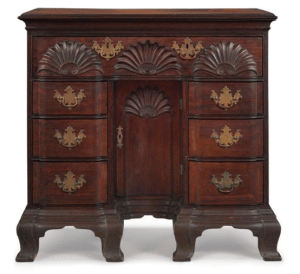
Chippendale carved mahogany block-and-shell bureau table signed by John Townsend (1733-1809), Newport, ca. 1770
Highlights include a newly discovered John Townsend bureau table; an exceptional silver teapot by Paul Revere; a Bartlam teabowl, the earliest porcelain made in Colonial America; and an extremely rare dish from the ‘Lady Martha Washington States China’ tea service.
Christie’s is delighted to announce Americana Week 2013, a series of public viewings and sales devoted to fine and rare examples of American artistry and craftsmanship. Included in the week are sales of Important American Silver (January 24), Important American Furniture, Folk Art and Prints (January 25), English Pottery (January 28) and Chinese Export Art (January 28). The Americana series of sales will offer over 400 lots, including a number of rare survivals from the 18th and 19th centuries and many works never before offered at auction.
◊ ◊ ◊ ◊ ◊
Important American Silver (Sale 2669) — January 24, 10am
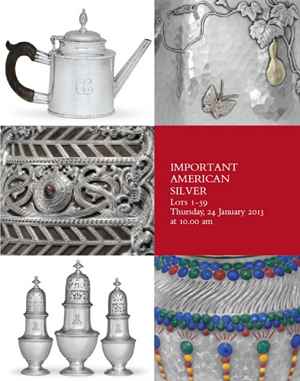 Christie’s is pleased to announce the sale of Important American Silver as the first auction in the Americana Week series. Leading the sale is an extraordinary and rare silver tea pot by patriot and silversmith Paul Revere, Boston, circa 1782 (estimate: $150,000-250,000). This drum-form teapot is fashioned in a classical style, typical of the early Federal period and one of the examples of Revere’s work after his return from the Revolution. There are only four other known drum-form teapots by Revere, with three in public collections− the Metropolitan Museum of Art, Museum of Fine Arts, Boston, and the Yale University Art Gallery.
Since its founding in 1837, Tiffany & Co. has set the standard for American silver designs and has been credited with some of the most important innovations in the field. A superb selection of rare and important pieces include an important silver-mounted and stone-set ebony ‘Viking’ bowl, designed by Paulding Farnham, New York, 1902 (estimate: $100,000-150,000); a silver, mixed-metal and hardstone three-piece tea service, New York, circa 1880, which is one of Tiffany & Co.’s most successful creations in the Japanesque style (estimate: $100,000-150,000); and an important silver and stone-set ‘Aztec’ paper knife, designed by Paulding Farnham, New York, circa 1902, which once belonged by Albert C. Burrage, a mining engineer and owner of a the 256-foot steam yacht Aztec (estimate: $60,000-90,000).
Additional highlights include a rare set of three silver casters, mark of Simeon Soumaine, New York, circa 1740, virtually unknown in American colonial silver with only two other complete sets recorded (estimate: $100,000-150,000); and a rare set of six silver cans with heraldic engraving, mark of Daniel Boyer, Boston, circa 1750, which was originally owned by the Kitchen family, one of the most prominent merchant families in the Salem at the turn of the 18th century (estimate: $50,000-80,000).
◊ ◊ ◊ ◊ ◊
Important American Furniture, Folk Art, and Prints (Sale 2670) — January 25, 10am
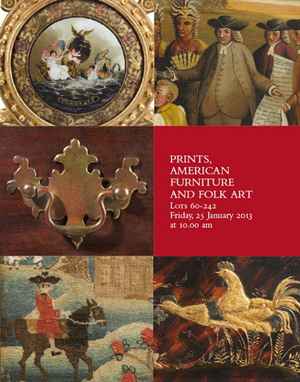 One of the lead highlights of the Americana Week sales is an important Chippendale carved mahogany block-and-shell bureau table signed by John Townsend (1733-1809), Newport, circa 1770 (illustrated above, estimate: $700,000-900,000). The iconic four-shell form displays the height of John Townsend’s talents and the renowned block-and-shell design of 18th-century Newport. One of less than ten known to survive, this newly discovered piece is an exceedingly rare example of the form bearing the signature of arguably colonial America’s greatest cabinetmaker. Written with a flourish in the cabinetmaker’s distinctive hand, Townsend’s signature appears on the underside of the top drawer and demonstrates the pride taken by the cabinetmaker in his most exceptional pieces. The rococo brasses are also a rarity as they retain much of their original coating, which was baked onto the plates at the time of their manufacture in England. The table was likely acquired in the 19th century by the prominent Pell family of New York during their sojourns in Newport, the summer destination for elite society of the period. The bureau table is known to have furnished the Pell House in New York State’s Tuxedo Park, the exclusive enclave founded by Pierre Lorillard IV in 1885 and home to prominent New York collecting families as that of Mr. and Mrs. J. Insley Blair. Property of direct descendants of the Pell and Coster families, the bureau table was recently discovered in New York City and has never before been offered at auction. Several comparable bureau tables attributed to Townsend are housed at the Metropolitan Museum of Art, the Art Institute of Chicago Winterthur Museum, Yale University Art Gallery, and the Museum of Fine Arts, Houston.
A Queen Anne carved maple armchair attributed to John Gaines III of Portsmouth, New Hampshire, 1735-1743 ($200,000–300,000), offered by WEA Enterprises, will also lead Americana week. The chair has been praised extensively by experts in American furniture and was described by legendary dealer Albert Sack in 1950 as “A great masterpiece of pure Colonial design… No price is too great for a chair of this quality.” One of only two armchairs assuredly attributed to Gaines, this example is extraordinarily well preserved and serves not only as an icon of early American regional design but also as a critical evidence of the practices of the Gaines shop. The chair is distinctive in its large, outsweeping ram’s-horn arms that are beautifully complemented and balanced by an archetypal crest and pronounced Spanish feet. Its closest counterpart housed at the Metropolitan Museum of Art, this “robust and gusty” piece has not appeared on the open market since 1974.
The remarkable painting of Penn’s Treaty by Edward Hicks’ (1780-1849) depicts the iconic American legend of William Penn’s treaty with Delaware tribal chiefs (estimate: $600,000-900,000). A Bucks County Pennsylvania native, Hicks worked as a sign painter and coach maker early in life, later becoming a well renowned Quaker minister and painter, who it is said, taught the gospel with his paintbrush. Penn’s Treaty was incorporated as a staple scene for Hicks’ Peaceable Kingdom series, which is a painted sermon depicting the prophecy of Isaiah preaching the theme of peace that still has meaning for us today. Representing in equal measure the artist’s Quaker conviction and his patriotic fervor, Penn’s Treaty is modeled on John Boudell’s 1775 print image of the painting by Benjamin West. The humble craftsman origins visible in Hicks’ painting style are hallmarks of the American folk vernacular painting style that is at once valued for its aesthetic singularity as well as its narrative richness.
The sale also features a superb group of early American needlework samplers from The Stonington Collection. These needleworks were amassed by Dolf Fuchs, a textiles commodities entrepreneur who was born in Switzerland, immigrated to the United States in 1953 and settled in Stonington, Connecticut where he lived in a late 18th-century home. A textile and early American history enthusiast, Fuchs cherished his collection of 18th- and 19th-century needlework samplers for their beauty, rarity, and unique history. Primarily worked by young women as instructive exercises, early American needleworks such as 25 works being offered illustrate the skills of these young women through their technical mastery and whimsical designs. Highlights include an exquisitely crafted needlework pictorial of a prominent ship worked by Nancy Winsor (1778-1850), Providence, Rhode Island, dated December 4, 1786 (estimate: $80,000-120,000) and a wool and silk needlework pictorial of a courting couple famously part of the “Fishing Lady” pictures, Boston, 1750-1760 (estimate: $30,000-50,000).
One of the rarest works at auction is an American (John Bartlam) soft paste porcelain teabowl, circa 1765-70, (estimate: $30,000-50,000). This tiny teabowl has only recently been identified as an example of the earliest porcelain made in Colonial America. Printed with Chinoiserie vignettes that mysteriously include palmetto trees, it is confirmed through archeological evidence and scientific analysis of the clay to have been made at the factory operated by the Staffordshire potter John Bartlam at Cain Hoy, outside of Charleston, South Carolina. Three other such teabowls are known, two in public collections, the decorations on all four corresponding exactly to sherds found at Cain Hoy in what has now been identified as the kiln site of Bartlam’s short-lived production.
◊ ◊ ◊ ◊ ◊
English Pottery (Sale 2671) — January 28, 10am
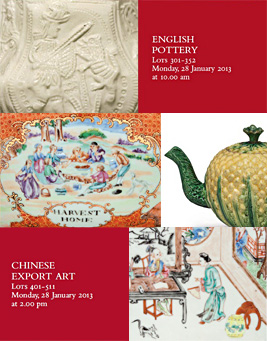 On January 28, Christie’s will offer over 50 lots of English Pottery, including a selection of early English saltglazed stoneware, redware and creamware formed by William Burton Goodwin. Collected mainly in the 1920s and 30s, these rare works were on loan to the Portland Museum of Art, Portland, Maine from 1983 to 2012. Highlights include a Staffordshire saltglazed seated camel teapot and cover, circa 1750 (estimate: $5,000-7,000); and a wonderfully amusing comparison of a Staffordshire glazed redware teapot and cover, circa 1745 (estimate: $6,000-8,000). A rare survival is a Staffordshire saltglazed stoneware enameled ‘Littler’s’ blue puzzle-jug, circa 1755-1760 (estimate: $10,000-15,000). This ‘Littler’s’ blue puzzle-jug is the only example of this form and type extant. Marked with an ‘L’, it is also potentially documentary.
Other highlights include a unique London delft polychrome dish, circa 1660, which is painted with the story of Abraham and Isaac (estimate: $50,000-70,000); and a pair of English delft dated models of shoes dated 1727, London or Bristol (estimate: $15,000-20,000). These two shoes are molded with a left and right buckle indicating that they were intended as a true pair. As shoes were considered symbols of good luck and often given as a token of affection, the initials and date inscribed on the soles of the present pair indicate that it may have been commissioned as a betrothal or wedding gift.
◊ ◊ ◊ ◊ ◊
Chinese Export Art (Sale 2671) — January 28, 2pm
As the grand finale of Americana Week, the sale of Chinese Export Art on January 28 will feature 110 works, a striking selection of Chinese porcelain and works of art made to order for American and European traders in the 17th, 18th, and 19th centuries. A particularly strong group of American market pieces is led by a very rare Chinese export ‘Lady Washington States China’ dish, circa 1795 (estimate: $20,000-40,000), which was presented to Martha Washington by Andreas van Braam Houckgeest in 1796. Van Braam (1739-1801), was a successful director of the Dutch East India Company, and designed the ‘States China’ himself, as an appropriate introductory gift for the First Lady.
The sale also features a rare Chinese export ‘Philadelphia’ punchbowl, circa 1815 (estimate: $20,000-30,000). This apparently unique and unrecorded punchbowl has strong Philadelphia associations and must have been commissioned by a member of one of the leading China Trade families of that city. The finely painted bowl depicts Centre Square, Philadelphia and the sides showing two views of the War of 1812 engagement between the U.S.S. Constitution (‘Old Ironsides’) and the HMS Guerriere. The interior has three delicately rendered grisaille fish, exact duplicates of those on the famed Schuylkill Fishing Company bowl.
Additional highlights include a Chinese export ‘orange Fitzhugh’ armorial dinner service, circa 1805-1810 (estimate: $70,000-100,000); a very rare Chinese export blue and white ‘Mr. No-body’, late 17th-century, inspired by the woodcut frontispiece of the 1606 popular play by Thomas Heywood, No-body and Some-body, (estimate: $40,000-60,000); a rare pair of Chinese export famille rose ‘porcelain production’ fishbowls, mid-18th-century, which displays very rare decoration of highly romanticized views of different stages of manufacturing Chinese porcelain (estimate: $100,000-150,000).
At Auction | Portrait Bust by Houdon at Sotheby’s
Press release from Sotheby’s:
Sotheby’s: Important Old Master Paintings and Sculpture, N08952
New York, 31 January and 1 February 2013
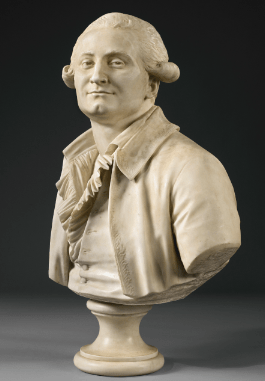
Sotheby’s Sale N08952, Lot 397. Jean-Antoine Houdon, Portrait of Jacques-Antoine-Hippolyte, the Comte de Guibert, 1791
Estimate: 800,000 – 1,200,000 USD
Important sculpture and works of art will be up for offer on 1 February 2013 during the second day of Sotheby’s Old Master Paintings and Sculpture sale in New York and will be highlighted by a commanding French marble bust of one of France’s foremost military tacticians Jacques-Antoine-Hippolyte, the Comte de Guibert. The bust was commissioned on 2 November 1791 from Houdon, the preeminent portrait sculptor of his time, by the sitter’s widow (est. $800/1.2 million). Guibert was a general, a writer and a friend to many of the Enlightenment’s leading intellectuals, and his Essai général de tactique had an enormous impact on the science of military strategy and was admired by George Washington, Frederick the Great, and the young Napoleon Bonaparte. In 1776, the year he was promoted to colonel, he was raised to the nobility as a count of the Holy Roman Empire. In 1781 he was promoted to the rank of brigadier general, and in 1778 he was promoted to the rank of marechal de camp. The work, which exemplifies Houdon’s mastery of the material and his fondness for both naturalistic detail and psychological realism, conveys the sitter’s strength, intelligence and virility. This marble bust remained in the Guibert family through 1918.
A further highlight is a beautifully carved pietra serena frieze by Francesco di Simone Ferrucci (1437-1493), a talented disciple of Verrocchio, which most likely adorned the lintel of a fireplace in the palazzo of a noble Florentine family circa 1460-1470 (est. $500/700,000). The present relief is centered by the coat of arms of the Tuscan counts, Guidi di Bagno, who were one of the largest and most powerful noble families in central Italy in the Middle Ages. The majority of pieces by Ferrucci are preserved in museum collections or in their original church installations, including a similar pietra serena frieze in the Museo Bardini, Florence and another in the Pierpont Morgan Library, New York. The outstanding clarity of form and detail in this frieze is underscored by the material from which it was carved. Pietra serena is a hard and fine-grained stone from Fiesole which was employed by Tuscan sculptors throughout the Renaissance. Here, Ferrucci was able to achieve a sense of depth, with very shallow relief, using of a variety of finely chiseled textures and contours. This impressive pietra serena frieze comes from the Collection of an Italian noble family.
A poignant South German limewood figure of the grieving Saint John from the workshop of Tilman Riemenschneider circa 1490 is estimated at $250/350,000. Riemenschneider was arguably the preeminent medieval German sculptor and this figure was probably carved for an altar. Few sculptures by Riemenschneider and his workshop remain in private hands.
Also included in the sale are nine rare terracotta anatomical sculptor’s models (est. $200/300,000) formerly in Paul von Praun’s famed collection in Nuremberg and attributed to accomplished sculptor Johann Gregor van der Schardt. Dating to the late 16th or early 17th century, the models have been consigned by and will benefit the Museum of Vancouver. Six of the nine models on offer are recognizable as studies after anatomical elements seen in famous monuments sculpted by Michelangelo. These terracottas are rare examples of study-models of Michelangelo’s work by this talented younger artist working within the master’s lifetime or shortly after his death. For decades, the unsigned terracottas were attributed to Michelangelo; however, extensive research and stylistic comparisons led scholars to determine that these Renaissance models were executed by Northern sculptor Johann Gregor van der Schardt who worked extensively in terracotta and was a follower of Michelangelo. Von Praun acquired the contents of van der Schardt’s studio after the artist’s death circa 1580, and these models were most likely among the contents purchased. Only one signed work by van der Schardt survives: a bronze statuette of Mercury probably presented to the Holy Roman Emperor Maximillian II in Vienna circa 1569. The collection of Paul von Praun, a wealthy Nuremberg silk merchant, was one of the most extensive of its time, comprised of works by Leonardo, Raphael and Titian, and it was one of the first to include a comprehensive, international group of contemporary sculpture. He also owned a pair of terracottas of Dawn and Night, after Michelangelo’s marbles for the Medici Chapel at San Lorenzo in Florence, which are now on exhibition at the Victoria and Albert Museum, London. After von Praun’s death in 1616 the collection was kept together by his heirs and displayed in Nuremberg, later known as Praunsche Kabinett. Among its visitors were Goethe and Marie Antoinette before its sale in 1801.
◊ ◊ ◊ ◊ ◊
Viewing Schedule in New York
Friday, 25 Jan | 10:00-5:00
Saturday, 26 Jan | 10:00-5:00
Sunday, 27 Jan | 1:00-5:00
Monday, 28 Jan | 10:00-5:00
Tuesday, 29 Jan | 10:00-5:00
Wednesday, 30 Jan | 10:00-5:00
Thursday, 31 Jan | 10:00-5:00, sculpture only
Friday, 1 Feb | 10:00-12:00, sculpture only
At Auction | Portrait of a Boxer at Bonhams
Press release (8 January 2013) from Bonhams:
Bonhams — Gentleman’s Library Sale (20448)
London, 29 January 2013

Bonhams Sale 20448, Lot 185, Portrait of the Pugilist
George ‘The Coachman’ Stevenson, 1742
Estimate 16,000 – 24,000 USD
An extremely rare early portrait of a boxer, George ‘The Coachman’ Stevenson 1742, whose tragic death led to the first set of rules for boxing, is being sold by Bonhams on January 29th in the Gentleman’s Library Sale in Knightsbridge. The English School Portrait of the Pugilist George ‘The Coachman’ Stevenson, 1742, an oil on canvas, is estimated to sell for £10,000-15,000.
Stevenson died a few days after a bout against the English champion, Jack Broughton, an event that led Broughton to draw up a code of rules in order to prevent a recurrence. Published as ‘Broughton’s Rules’ they were the first boxing rules and were universally used until 1838.
Alistair Laird a specialist in Bonhams Nineteenth-Century Paintings Department says: “I have never seen an eighteenth-century picture to do with boxing in my 30 years in art auctions. This is an extremely rare image.”
The Yorkshireman George Stevenson, had fought the English champion Jack Broughton on the 17th of February 1741 in a fairground booth on Tottenham Court Road. Unfortunately, Stevenson died a few days after his 45-minute fight, an event that triggered Broughton to draw up a code of rules in order
to prevent a recurrence.
Published on 16 August 1743, ‘Broughton’s Rules’ applied to the bare-knuckle Prize Ring and included ‘That no person is to hit his adversary when he is down, or seize him by the ham, the breeches, or any part below the waist; a man on his knees to be reckoned down’. Otherwise much was left to the discretion of referees. Rounds were not of a fixed length but continued until one of the fighters was knocked or thrown to the ground, after which those in his corner were allowed 30 seconds to return him to the ‘scratch’ – the middle of the ring – failing which his opponent was declared the victor.
Broughton’s rules were universally used until 1838. He was buried in Westminster Abbey in recognition of his contribution to English boxing. The sport enjoyed an unprecedented surge in popularity during the Regency period when it was openly patronized by the Prince Regent, (later George IV) and his brothers. Championship boxing matches acquired a louche reputation as the places to be seen by the wealthy upper classes. Thus a match would often be attended by thousands of people, many of whom had wagered money on the outcome.
TEFAF Museum Restoration Fund Announces 2013 Grants
Good news for a few eighteenth-century holdings at the Worcester Art Museum and the Ashmolean, announced by the TEFAF Museum Restoration Fund ahead of this year’s art fair at Maastricht (15-24 March 2013) . . .
◊ ◊ ◊ ◊ ◊
The Worcester Art Museum in the United States and the Ashmolean Museum in the United Kingdom are to receive grants from the TEFAF Museum Restoration Fund to help them carry out important conservation projects. The Fund was set up by TEFAF Maastricht, as one of its 2012 Silver Jubilee initiatives and provides up to €50,000 each year to help institutions around the world conserve works of art in their collections. A panel of independent, international experts considered many applications from museums before selecting the two winning projects, which will each receive €25,000.

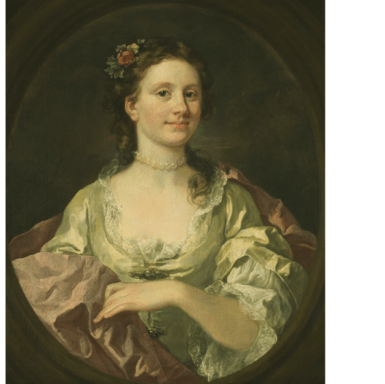
William Hogarth, Portraits of William and Elizabeth James,
1744 (Worcester Art Museum)
◊ ◊ ◊ ◊ ◊
The Worcester Art Museum in Worcester, Massachusetts is to restore a pair of portraits by the eighteenth-century British artist William Hogarth. The pendant portraits of William and Elizabeth James, painted by Hogarth in 1744, were acquired by the museum more than a century ago but have never been comprehensively treated or technically evaluated and will benefit greatly from a conservation project. The work will enable the Worcester Art Museum to feature them prominently in Hogarth and the English Character, an exhibition planned for 2016, and ultimately to return these cornerstone works to its permanent galleries. The restoration will allow those viewing them to experience the full impact of the paintings as exquisite works of art without any concerns about their condition. The newly conserved pictures will reveal more authentic palettes and broader tonal ranges that, when reunited with their newly conserved frames, will enable viewers to have the pleasing experience intended by Hogarth.
William Hogarth (1697-1764) was one of the masters of British painting. Although best known for his biting satires of society that were popularised in engravings, he was also a skilled portraitist. In these paintings he captured the confidence of William James, a country squire from the English county of Kent, and his wife Elizabeth, both proud of their fashionable London clothes.
◊ ◊ ◊ ◊ ◊
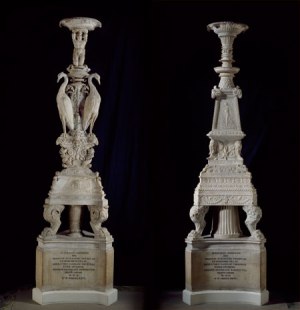 The Ashmolean Museum in Oxford is to carry out a conservation project on two candelabra by the Italian artist Giovanni Battista Piranesi (1720-78). The intricately carved candelabra are some of the finest examples of neo-classical sculpture in the United Kingdom. They form a key element of the collections displayed in the Ashmolean’s impressive Randolph Sculpture Gallery and are of international significance. They were purchased from Piranesi by Sir Roger Newdigate, who made two Grand Tours in 1739-40 and 1774-75. The candelabra were shipped in component form from Italy to Oxford with instructions for their re-assembly provided by Piranesi. The candelabra have become structurally unsound because the plaster bonding in the joints between each vertical section has failed during the 100 years since they were last restored. Until they were re-plinthed on pallets in 1991, these vulnerable objects were traditionally moved by masons dragging them across the floor, using winches, rather than lifting them. Although they are now mounted on pallets, disguised as plinths, moving them still puts them at risk as they comprise many loose components. For that reason the museum has developed this project to dismantle, conserve and structurally stabilize these remarkable objects.
At Auction | Joseph Wright’s ‘A Blacksmith Shop’
Warm thanks to John Chu for pointing out the results of this Christie’s auction, notable for its inclusion of a long-untraced painting by Joseph Wright. -CH
◊ ◊ ◊ ◊ ◊
From Christie’s:
Christie’s Old Master & British Paintings Evening Sale (Sale 5964)
London, King Street, 4 December 2012

Joseph Wright of Derby, A Blacksmith’s Shop, 1771-73 [estimate £400,000 – £600,000; sold for £914,850]
Wright’s dramatic portrayal of a lowly Blacksmith’s Shop is a highly significant re-discovery, having been untraced since it was exhibited at the Graves Galleries in 1910. Known only through an engraving executed by William Pether in 1771 (fig. 1), Benedict Nicolson, in his complete catalogue of Wright’s works published in 1968, lamented: ‘We have lost a fine invention’ (op. cit., p. 50). One of a group of five Blacksmith’s Shops and Iron Forges executed between 1771 and 1773, and the only one to remain in private hands, this painting is both an expression of Wright’s close engagement in the spirit of the Industrial Revolution and a sophisticated example of his mastery of chiaroscuro effects.
Wright was not the first British painter to depict contemporary industrial scenes. Thomas Smith had executed two detailed topographical views of a Shropshire industrial site as early as 1758, Edward Penny exhibited The Gossiping Blacksmith at the Royal Academy’s inaugural exhibition in 1769, and Sandby and Ibbetson made numerous sketches of mines, coal-pits and factories in the North of England. He was, however, the first artist of his generation to explore its full potential as a subject for serious, academic art. . .
The Old Master & British Paintings Evening Sale realised £11,562,250/$18,603,660/€11,426,147, selling 54% by lot and 70% by value.
The full catalogue entry is available here»
At Auction | Marouf Collection at Bonhams, Part I
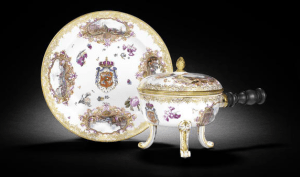
I was waiting until afer the auction of the Marouf Collection to run this posting so as to include results. Checking in yesterday morning, however, I see that the Meissen chamber pot was withdrawn from the first part of the sale, and I found results for neither the armorial beaker associated with Maria Amalia of Saxony nor the Meissen écuelle and cover. The bourdalou perhaps will be included in the second part in 2013. -CH
Note (added 16 March 2013): Part II of Bonhams’s Marouf Sale is scheduled for 2 May 2013. While the full catalogue has yet to be published, a press release highlights the inclusion of a small tureen from the Swan Service of Meissen porcelain, commissioned in 1736 for Heinrich Graf von Brühl.
◊ ◊ ◊ ◊ ◊
Press release (3 September 2012) from Bonhams:
The Marouf Collection, Part I (#19610)
Bonhams, London, 5 December 2012
 A rare Meissen bourdalou, otherwise known as a chamber pot, will go under the hammer along with several highly valuable pieces relating to the royal toilette at Bonhams single-owner sale of Meissen ceramics on 5th December at New Bond Street. The ornately decorated porcelain bourdalou, produced circa 1724 is estimated at £50,000-60,000 and is one of the most beautifully decorated examples of porcelain in the Said and Roswitha Marouf Collection. Other key items from the toilette included in
the sale are an important Meissen armorial beaker (estimate
£25,000-30,000), a Meissen armorial tureen, cover and stand
(estimate £60,000-80,000) [sold for £67,250 w/ premium], and
a rare Meissen écuelle and cover (estimate £20,000-25,000).
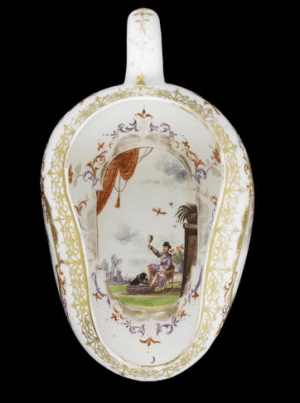 Although it was one of the most intimate parts of daily life, unlike today, many elements of the toilette were made public, and it became an important ritual in the eighteenth-century European courts. It was a way for courtiers to flaunt their wealth and rank in society, with elaborate displays becoming commonplace for those in the highest echelons of court. After the lady was sponged and bathed by her maid in private, the public part of the toilette was literally ‘performed’ with the assistance of servants. Often the lady would be dressed, take her breakfast and have an elaborate hair-do in front of a host of onlookers. It was a privilege to be a spectator on these occasions, and the beautifully decorated porcelain toilette pieces were luxury items that showed the reverence paid to the toilette ritual. The bourdalou would have been a well-used item in the eighteenth-century practice of the toilette. The term ‘bourdalou’ originated in the eighteenth century after the name of the priest Louis Bourdalou who preached at the court of Louis XIV. His sermons were so fascinating that the ladies of the court were loathe to leave his
service to relieve themselves. They used an oval jug with handles,
constructed so that ladies could put it beneath their skirts and
have their maids carry it away after use.
 Another important intimate object in the sale is an armorial chocolate beaker, which is highly decorated and carries an estimate of £25,000-30,000. Originally part of a set of six beakers, it was given as a wedding present to the Princess Maria Amalia of Saxony for her marriage in 1738 to Charles VII, King of Naples. The young bride was only 14 years old when her marriage was arranged by her father, King Augustus III, successor of Augustus the Strong, who first set up the Meissen porcelain factory near Dresden. The armorial beaker is one of the few surviving pieces from the wedding present, which originally comprised six teabowls and saucers and six chocolate beakers. It represents the most exceptional elements of Meissen porcelain:
unrivaled quality and fascinating provenance.
 The chocolate beaker was most likely used in the public part of the toilette, when a lady of the court would take her breakfast. Another remarkable piece that would have been used for the morning meal is the armorial tureen, cover and stand, estimated at £60,000 – 80,000. Made around 1745, it is spectacularly decorated with landscape scenes, scattered flowers, and gilt. Originally made for Maria Josepha, daughter-in-law of Augustus the Strong and wife of Augustus III, the item made its way back into aristocratic hands, owned for many years by the Dowager
Duchess of Westminster.
The Said and Roswitha Marouf Collection brings together a stunning collection of exceptionally rare pieces, such as an unprecedented eight objects from the ‘Half figure service’, arguably the rarest and most sought after chinoiserie decoration on Meissen porcelain. Many pieces in the collection have been published and exhibited in museum exhibitions, including the legendary 2010 exhibition in the Japanese Palace in Dresden to celebrate the 300th anniversary of the founding of the Meissen manufactory. The whole collection is superbly documented in the catalog Passion for Meissen written by Professor Ullrich Pietsch, Director of Porcelain in Dresden.
Sebastian Kuhn, Director of European porcelain at Bonhams said, “The Said and Roswitha Marouf Collection is without doubt one of the most important collections of eighteenth-century Meissen porcelain to come to the market. After the success of the Hoffmeister collection sales, it is incredible to see such a selection of fine pieces, including some rare and intimate items from the royal toilette, with fascinating provenance. Said Marouf has been an avid collector all his life and started out collecting pocket and wrist watches. It is not hard to see why his eye for detail attracted him to the extremely detailed and intricate decoration of early eighteenth-century Meissen porcelain.”
At Auction | Important Judaica at Sotheby’s
Press release from Sotheby’s:
Sotheby’s: Important Judaica, N08922
New York, 19 December 2012
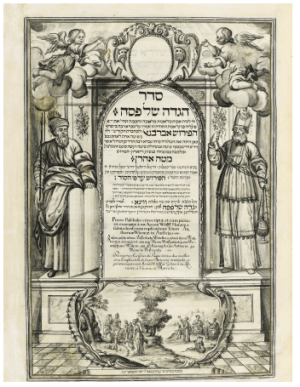
Lot 122 — Aaron Wolff Herlingen, The Herlingen Haggadah, 1730 (Vienna) — est. $800,000/1.2 million
Sotheby’s New York sale of Important Judaica on 19 December 2012 will offer examples of Hebrew ceremonial metalwork, illuminated manuscripts, early printed books, original decorative bindings, and fine art. The auction, which presents works from across the globe, is led by a magnificent Passover Haggadah, written and illustrated by Aaron Wolf Herlingen, from Vienna, 1730 (est. $800,000/1.2 million*).
The sale also includes important paintings by Isidor Kaufmann, a silver section highlighted by a German Hanukah Lamp, and the Kagan-Maremba Coin and Medal Collection that will be sold on behalf of The Jewish Museum (est. $300/500,000). The sale will be exhibited in its entirety in our York Avenue galleries beginning 14 December, alongside the sale of Israeli & International Art.
Undoubtedly the highlight of the Books and Manuscripts section of the sale, The Herlingen Haggadah from 1730 is a magnificent example of the 18th-century revival of Hebrew manuscript illumination that began in Vienna (est. $800,000/1.2 million).
 The scribe and artist of the manuscript is Aaron Wolff Herlingen, one of the finest Jewish calligraphers of the 18th-century renaissance of Hebrew manuscripts, and who became the scribe of the Imperial Library in Vienna in 1736. Herlingen signed his name on the title page of the present work in four languages – Hebrew, Latin, German and French – a conspicuous demonstration of his facility in the multiple languages of the Austrian Empire. The present haggadah is one of Herlingen’s finest efforts and his consummate skill as a scribe is evidenced in the superbly written letters of the text and commentaries. His artistic mastery is demonstrated in the numerous illustrative and decorative elements within the manuscript. The work features three ornamented initial word panels and 60 text illustrations, as well as a detailed manuscript map appended by Herlingen specifically for this volume.
Another highlighted manuscript is an extremely rare and important early Mahzor, France, 13th century. Estimated at $180/240,000, the work contains the liturgy from Yom Kippur, Sukkot and Hanukkah, according to the French rite. Research shows that the present manuscript and a Mahzor for Rosh ha-Shanah currently in the collection of the British Library, were penned by the same scribe and originally constituted a single, larger work. This volume also may well be the most important extant source of the liturgical rite of medieval French Jewry, and includes several customs and traditions that are unknown from any other source.

Lot 119 — Derekh Etz Heim (Path of the Tree of Life), ca. 1700-20, est: $60,000 – 80,000
Additional works on offer feature the first Haggadah printed in America, which contains service for the first two nights of the Passover in Hebrew and English (est. $80/100,000), and an important decorated Esther Scroll in a matching contemporary silver case, circa 1800 (est. $70/90,000). Also included in the sale is Derekh Etz Heim (Path of the Tree of Life), an 18th-century manuscript by Haim Vital of a kabbalistic masterwork (est. $60/80,000). This manuscript is the first part of Haim Vital’s authoritative summary of the kabbalistic teachings of his master, the preeminent kabbalist of 16th-century Safed, Isaac Luria.
The highlight of the silver and metalwork on offer in the December auction is an important German silver-gilt Hanukah Lamp made by Johann Valentin Schüler in Frankfurt, Germany, circa 1690 (est. $300/500,000). The magnificent lamp belongs to a group of seven related examples from late-17th- and early 18th-century Frankfurt, most of which are preserved in museum collections – the example in the Steiglitz Collection at the Israel Museum is closest to the piece on offer. These lamps show the wealth of Frankfurt’s Jewish community, at a time when the city’s ghetto was one of the most densely populated in Europe. The sale also features two fine singleowner groupings, one of which includes a very early German silvergilt Havdalah Compendium, made in Augsburg, circa 1630 (est. $30/50,000). (more…)
Billet-Doux from Nelson to Emma Hamilton Exceeds Estimates
Last week a letter sent from Lord Nelson to Lady Emma Hamilton during their affair sold for £20,000 — well above its estimate of £6,000-£8,000. The pre-sale press release from Bonhams (1 November 2012) . . .
Bonhams: Books, Maps, Manuscripts, and Photographs (Auction 20139)
London, 13 November 2012
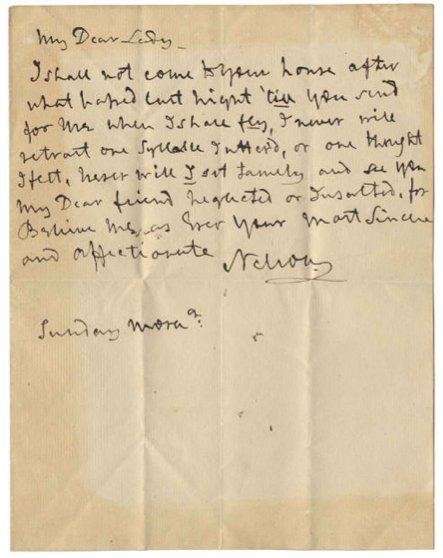 A lasting piece of evidence of the affair between Nelson and Lady Emma Hamilton is for sale with Bonhams in Knightsbridge, on 13th November. In the letter Nelson documents the turbulent love life between himself and his mistress, referring to a disagreement from the previous evening. He takes care to note his devotion to her and vows to defend her integrity amidst the scandal. At the time the letter has been roughly dated, Emma had given birth to their child and their affair was public. Despite Nelson’s wife’s demands, he refused to relinquish Emma as his mistress and eventually he left his wife. In the nineteenth century this was an unthinkable social affront and he aggravated the scandal further by choosing to live with Emma and their daughter upon his return from sea.
During the scandal Nelson urged Emma to destroy the letters sent between them, as he largely did. Emma, however, chose to keep her letters which were eventually published in 1814 contributing to her eventual downfall. Plagued by politics and social disgrace, their affair lasted only six years before Nelson’s death in 1805. After this tragic event, Emma was catapulted into a downward spiral and this letter is a delicate reminder of their love at the height of its devotion and is a rare living testament to their affair.
In June this year a marble chimneypiece from Lord Nelson and Lady Hamilton’s home sold for £25,000 at New Bond Street, and this note is a further glimpse into the private world behind the public façade of one of Britain’s great naval leaders.
◊ ◊ ◊ ◊ ◊
Post-sale press release from Bonhams (14 November 2012) . . .

Bonhams Auction 20139, 13 November 2012
A letter sent from Lord Nelson to Lady Emma Hamilton during their affair sold for twice its estimate today of £6,000-£8,000 for £20,000 at Knightsbridge in the Books, Maps and Manuscripts sale.
In the letter, dated c.1801, Nelson documents his turbulent love life with his mistress, referring to a disagreement from the previous evening. He outlines his devotion to her and vows to defend her integrity amidst the scandal of their affair. After Nelson’s death in 1805, Emma was at the mercy of society’s judgment without his protection and this letter is a rare living testament to their affair.
The top lot for the sale was a first edition of Charles Darwin’s The Origin of the Species (1859) which doubled its estimate of £15,000- £20,000 to sell for £45,650. As one of the most influential publications of the 19th century, this work marked a crucial turning point in modern science and this edition is a veritable collector’s item.
Darwin’s publication was followed closely by a first edition of Izaak Walton’s The Compleat Angler (1653). This work sold for £37,250 and is a very good copy of the most famous work in angling literature. The work is a unique celebration of angling and reflects Walton’s own desires to live a contemplative life.
Art Market | Winter Art & Antiques Fair
Press release from the Winter Fine Art & Antiques Fair:
Winter Fine Art & Antiques Fair, Olympia
Olympia Exhibition Centre, London, 12-18 November 2012
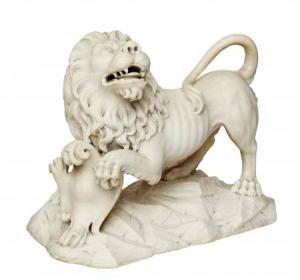
Armorial Lion, with his paw raised upon a cartouche and his tail curled across his back, ca. 1740 (Exhibitor: Hansord)
The Winter Fine Art & Antiques Fair at Olympia, now in its 22nd year, is considered one of the most important annual art and antiques events and is the only fair of its calibre between October and February. Highlights include artworks by Chagall, Miró and Braque, furniture by Trotter, glass by Lalique and even Bond-style accessories alongside silver, glass, jewellery, textiles and clocks for the collector and Christmas shopper. Attracting over 24,000 visitors, the Fair, which opens at 4pm on Monday, November 12, 2012 features around 130 exhibitors in an elegant setting.
Well positioned for buyers furnishing a home or shopping before Christmas, it has become an event in the annual social calendar. The buzzy preview night attracts over 3,000 keen buyers with queues down the road before opening and plenty of red dots and empty glasses at the end of the night. Attendees include Jemima Khan, Jools Holland, Jasper Conran, Bryan Ferry, Nicky Haslam, Sir Paul Smith, Sir David Tang and Sir Peter Blake. Furniture is an important element of the Winter Fair with a number of the UK’s top furniture dealers exhibiting. Wakelin and Linfield brings an early 18th-century English walnut bureau and Hansord will be showing a myriad of interesting objects such as a late 19th-century armchair constructed from timber from Nelsons ship The Foudroyant as well as a rare pair of early 19th century Dutch colonial burgermeisters chair with carved decoration and a fine George III period mahogany partners desk, with original brass swan neck handles and good veneers to the drawer fronts dating from 1775.
Fine Art makes up a good proportion of the fair with prices ranging from the hundreds to the hundreds of thousands. Print specialists Dinan & Chighine has two important sets of prints by Marc Chagall and Joan Miró while Court Gallery brings an oil on card laid on canvas, ‘l’aquarium au verre’, 1944 by Georges Braque. Held in the Vassar College Collection from 1956 until 2012, the work was the first of the artist’s fish bowl series and the motif was repeated many times by him in the 1940s and 50s.
Scottish-based, Victorian picture dealer, Campbell Wilson has an oil on canvas portrait of Isadora Duncan by Paul Swan (1883-1972) signed and dated. The most famous dancer of her time, Isadora is known as the ‘mother of modern dance’. It is for sale for £15,000. Nicholas Bagshawe’s Philip Alexius De Laszlo (1869-1937) portrait of Major Henry Frederick Elliott Lewin was painted during the First World War, and is a fine example of one of 38 portraits that the artist painted in 1915 of officers going to the front, as their families feared they might not return. Ironically after painting these patriotic and poignant portraits, Laszlo was imprisoned for two years in 1917 (at the hands of the very establishment he had been portraying so handsomely) and suffered a nervous breakdown.
For anyone inspired by the latest James Bond film, which will be released in late October, Hampton Antiques have several items that could leave you shaken and stirred. A very rare Art Deco ‘Smokers Companion, in the form of a stylised aeroplane, manufactured in Germany by J.A. Henckels in the late 1920s.This wonderfully rare smokers companion has a cigar box in the fuselage, a pair of removable cigarette cases in the wings, a set of four ashtrays housed in the cockpit, behind a match safe with removable cover and striker. A very simple but very stylish touch is provided by the propeller which is sprung and serves as a cigar cutter, the clippings drop into undercarriage. It has its original plated finish, with gilded interior to cigar receptacle, cigarette cases and ashtrays will be offered at £6,500. A chromium plated, 1960 Rolls-Royce decanter in the shape of a radiator with ‘Spirit of Ecstasy’ Silver Lady will be offered, while a chrome Bugatti Spirit Decanter with a super red enameled Bugatti badge and black grill, all incased around a single glass decanter has an asking price of £775.
Japanese specialist Laura Bordignon Antiques will be bringing a selection of Japanese ivories, bronzes and works of art from the Meiji Period. These include a Japanese silvered bronze okimono of an eagle, signed Seiya saku, dating from the Meiji period. The BADA (British Antique Dealers Association) are also holding a lecture titled, The Flamboyant Mr Chinnery: An Artist in India and China. At a time when the West’s eyes are looking towards China and India this lecture, given by Patrick Conner, reminds us of how 200 years ago one wayward genius, George Chinnery, interpreted through his brush the turbulent times of imperial expansion and the Opium Wars in the region.
The fair will have a strong section devoted to clocks and barometers, which in this current economic times can be a shrewd investment as they are seen as machines, so therefore exempt from Capital Gains Tax. Richard Price & Associates will be offering a Louis XVI white marble, bronze and ormolu mantel clock, dating from circa 1780, while Alan Walker Barometers will be displaying an impressive and very unusual aneroid barometer by Negretti & Zambra of London, dating from 1915. The barometer is in a mahogany case, made from timber removed from HMS Empress – a seaplane carrier during World War 1, having been refitted in 1914 from a cross-channel steamer.
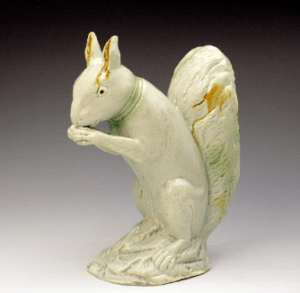
Staffordshire creamware model of a seated squirrel eating a nut, ca. 1775 (Exhibitor: John Howard)
Amongst the smaller objects such as silver, ceramics and glass; Paul Bennett will be exhibiting two exceptional pieces dating
from the 17th century. A continental silver-mounted carved coconut cup, dating from circa 1680 and inscribed by maker BA measures 10½inches tall, while a William and Mary flagon, made in 1694 in London by Frances Garthorne, weighs 51ounces and measures 12¾ inches high. Oxfordshire-based John Howard, who specialises in Early English ceramics, will be bringing a Staffordshire creamware model of a seated squirrel eating a nut. Measuring 8 inches high, the delightful squirrel dates from circa 1775 and will have an asking price in the region of £4,750. Meissen specialist, Alexandra Alfandary brings a Meissen vase, dating from circa 1880, and measuring 36cm high. It is a very unusual shape with ‘pâte-sur-pâte’ decoration to front showing a Centaur with a female on horseback.
For visitors searching for a one-of-a-kind Christmas present, many of the exhibitors will have interesting suggestions. Geoffrey Breeze Antique Canes has a cane inspired by Darwin’s Origin of the Species. Dating from 1870, the cane comprises a palm wood shaft with silver collar with a carved handle depicting an ape holding a human skull. There is a button on the handle, which makes the ape turn his head and open his mouth.
◊ ◊ ◊ ◊ ◊
From the Fair’s website:
Patrick Conner — The Flamboyant Mr Chinnery: An English Artist in India and China
Olympia Exhibition Centre, London, 15 November 2012
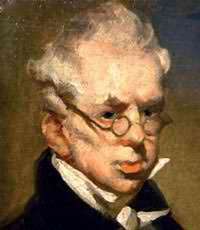 At a time when the West’s eyes are looking towards China and India, this year’s BADA Lecture, given by Patrick Conner, reminds us of how 200 years ago one wayward genius, George Chinnery (1774-1852), interpreted through his brush the turbulent times of imperial expansion and the Opium Wars in the region.
Chinnery enjoyed a double career in the Far East. Leaving wife and children behind in Ireland he sailed in 1802 to India where he rose to become the principal artist of the Raj. He had a successful studio, an Indian mistress and a huge appetite for curry. Then, hounded by creditors he fled to the China coast. Unable to make the voyage home, he lived on for another 27 years in Canton and Macau. Here he sketched and portrayed all those around him – the captains, the opium traders, the Chinese and the Westerners. Chinnery left a vivid pictorial legacy of
the key players at a time of immense change.
A former Keeper of Fine Art at the Royal Pavilion and Museums, Brighton, Patrick Conner is a Director of the Martyn Gregory Gallery, London, specialists in historical paintings related to the China Trade. A widely published author, his latest book is The Hongs of Canton. In his lecture Patrick will give a fascinating insight into the important historical period when Chinnery was active.
Lecture ticket price: £45 including lecture followed by a 2-course lunch with wine provided by Mosimann’s Winter Brasserie. To book for this event email Anne Green or call on +44 (0)20 7581 5259.










 Enfilade
leave a comment