Art Fair | Paris Tableau 2012
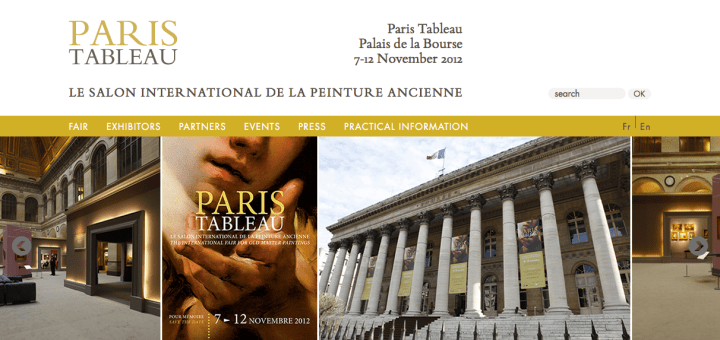
Paris Tableau: The International Fair for Old Master Painting
Palais de la Bourse, Paris, 7-12 November 2012
◊ ◊ ◊ ◊ ◊
Building on the success of its first edition in 2011, Paris Tableau 2012 will again open its doors at the Palais de la Bourse from 7 to 12 November 2012. Paris Tableau attracted over 6,000 serious collectors and sold sixty major paintings within just five days in November last year, and the ten dealer/organisers look forward again to sharing their passion for Old Master Paintings with international connoisseurs and enthusiasts in 2012. The work on display at Paris Tableau ranges from the Middle Ages to the Second Empire.
The full press package is available as a PDF here»
At Auction | One of Only Three Original Fahrenheit Thermometers
Christie’s press release for an upcoming sale:
Travel, Science, and Natural History Sale [6911]
Christie’s, South Kensington, London, 9 October 2012

Mercury thermometer, invented by Daniel Gabriel Fahrenheit
◊ ◊ ◊ ◊ ◊
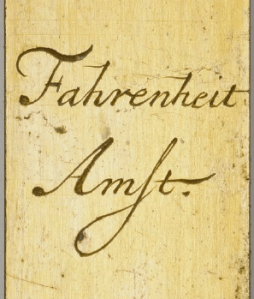
Christie’s is proud to announce that an original mercury thermometer, invented by Daniel Gabriel Fahrenheit in 1714 and the only remaining example in private hands, is to be offered at auction in October 2012. One of only three thermometers ever created by the famous physicist, the others are owned by Museum Boerhaave, in Leiden, the Netherlands, and until recently, these were thought to be the only examples in existence. When offered at auction within Christie’s sale of Travel, Science, and Natural History including the Polar Sale to commemorate the Scott Centenary, 1912-2012 on 9 October 2012 [Sale 6911, Lot 69], the thermometer is expected to fetch between £70,000 and £100,000.
James Hyslop, Scientific Specialist, Christie’s commented, “It is very exciting to be able to offer at auction such an incredibly important scientific instrument, and one which collectors would never have believed would come to market. Inscribed on the back by Fahrenheit himself, this is an exceptional piece which has no precedent, and which I expect to cause a real buzz with connoisseurs and institutions on every continent around the globe.”
Daniel Gabriel Fahrenheit (24 May 1686 – 16 September 1736)
 A household name during his lifetime and even more so in the centuries since, Daniel Gabriel Fahrenheit was a physicist, engineer, and glass blower, best known for the temperature scale bearing his name which is still used today in many countries, as well as for his improvements on the mercury thermometer (1714). Born in the Polish-Lithuanian Commonwealth, he spent most of his life in the Dutch Republic. At the age of fifteen, following the death of his parents through mushroom poisoning, Fahrenheit began training as a chemist, and his personal interest in natural science led to his studies and experimentation in the field.
At Auction | American Furniture at Christie’s, 24 September 2012
Press release from Christie’s:
Important American Furniture, Folk Art, and Decorative Arts (Sale #2584)
Christie’s, New York, 24 September 2012
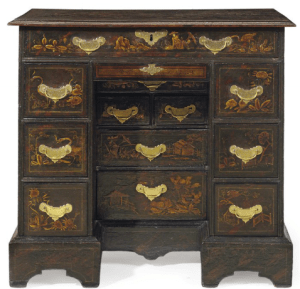
Queen Anne Japanned Maple Bureau Table, ornament attributed to Robert Davis (d. 1739), ca. 1735.
On September 24, Christie’s presents the sale of Important American Furniture, Folk Art & Decorative Arts (Sale #2584). This sale features over 100 diverse examples of American art and craftsmanship from the 18th and 19th centuries. Highlights include furniture from the Wunsch Americana Foundation, the Philadelphia Museum of Art, as well as a selection of American folk art and maritime paintings.
Leading the sale is a Chippendale Carved Mahogany Easy Chair, Philadelphia, 1760-65 (estimate: $600,000-900,000). One of the most successful creations of the renowned ‘Garvan’ carver, this easy chair is a triumph of Philadelphia design and artistry. Unidentified and known solely through his body of work spanning from the early 1750s to the mid-1760s, this craftsman was the city’s most accomplished and influential carver of his day and this easy chair, made during the his mature style, reflects the culmination of this remarkable carver’s talents. Similarly, the chair’s frame, expertly crafted with a number of distinctive features, can be linked to a larger body of work and placed within the oeuvre of a known, but also unidentified, cabinetmaking shop. Long hailed as a Philadelphia masterpiece, the Philadelphia Museum of Art purchased the chair in 1925, and is now deaccessioning it to provide funds for acquisitions.
Resplendent and extraordinarily rare, another sale highlight is a Queen Anne Japanned Maple Bureau Table, Boston, circa 1735, which is one of about forty known examples of japanned furniture from colonial America, most of which are in public collections today (estimate: $60,000-90,000). The only bureau table known to exist, this piece stands as a survival of the form with distinctive chinoiserie ornament. The japanned ornament is attributed to Robert Davis, a prominent craftsman in colonial Boston. The table’s decoration remains largely intact and reveals the full beauty of the sparking gem-like appearance intended by its eighteenth-century creator.
The sale also features a selection of property from the Wunsch Americana Foundation, including a Pair of Federal Eagle-Inlaid Mahogany Side Chairs, Attributed to William Singleton (w. 1789-1803, d. 1803), Baltimore, 1790-1800 (estimate: $60,000-90,000). This pair of chairs was lent to the Diplomatic Reception Rooms at the Department of State in 1968 and remained in the Monroe Reception Room as part of a larger set of four related chairs until they were returned to the Wunsch Americana Foundation. Until now, the location of this pair has been unknown. . .
Display | Jean-Henri Riesener (1734–1806)
Based on press releases from VisitParis and Art Media Agency:
Jean-Henri Riesener (1734–1806)
Biennale des Antiquaires, Grand Palais, Paris, 14-23 September 2012
Organized by Kraemer & Cie
 The Maison Kraemer, a Parisian gallery specialising in pieces from the 17th and 18th centuries, is organising the first ever exhibition to be entirely dedicated to the cabinet-maker Jean-Henri Riesener (1734-1806). It will run from the 14 to the 23 of September at stall 32 during the 26th Biennale des Antiquares. The solo exhibition is then to go on tour.
Introduced to the art of cabinetmaking by Jean-Francois Oeben, Riesener became a master in 1768, and was designated ‘carpenter to the King’ in 1774. He also supplied Queen Marie-Antoinette with furniture, creating for the Court and the Royal Family a collection of stunningly beautiful pieces of furniture, characterized the remarkable finesse in his use of gilt bronzes and precious inlay decorations. Riesener is one of the most commonly displayed cabinet-makers in museums throughout the world. Examples include the Louvre museum, the Château de Versailles, the Nassim de Camondo museum, the New York Metropolitan Museum and the Getty Museum in Los Angeles. At auction, his pieces regularly sell for remarkable prices:
• In 1999 a chest of drawers was sold by Christie’s for £7,041,500 or €8.5 million (with fees)
• In 2007 a chest of drawers was sold by Sotheby’s for €3,952,250 (with fees)
• In 2000, a desk was sold by Christie’s for £1,214,750 or €1.5 million (with fees)
• Recently, a chest of draws put up for sale by the auction house Sotheby’s in October 2011, estimated to be worth between €20-30 million, was sold for only €24,750.
Also see the article by Susan Moore for Apollo Magazine (September 2012) and the coverage (in French) at Artistik Rezo.
Art Fair | 2012 Biennale des Antiquaires in Paris
2012 Biennale des Antiquaires
Grand Palais, Paris, 14-23 September 2012
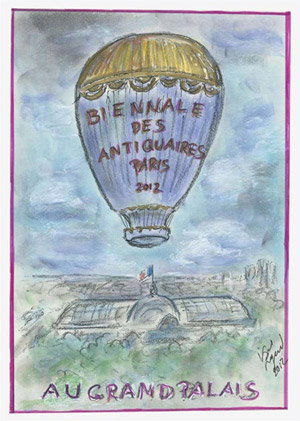
In the September 2012 issue of Apollo Magazine, Susan Moore previews the upcoming Biennale des Antiquaires, which thanks to the design work of Karl Lagerfeld is sure to garner plenty of press coverage in the coming weeks (he’s briefly profiled with a tease for the event in the current issue of Elle Decor). While the art fair will present a wide range of offerings (in keeping with the general trends of similar recent events), the established dealers of French decorative arts are to be well represented. As Moore writes:
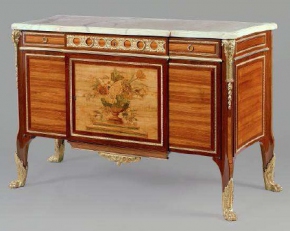
 Kraemer & Cie, for instance, arguably the grandest of them all, is presenting the first ever exhibition devoted to the great French cabinetmaker Jean-Henri Riesener (1734–1806; see Collectors’ Focus, pp. 94–95). Trained by Jean-François Oeben, Riesener became a maitre ébéniste in 1768 and was appointed ébéniste du roi to Louis XVI in 1774. He was also Marie-Antoinette’s preferred supplier. ‘While a lot of cabinet-makers at the time may seem similar,’ explains Laurent Kraemer, ‘Riesener’s work is immediately identifiable by the perfection of proportion and execution – whether [he was] producing extremely rich marquetry for the court or very simple mahogany pieces with no or few gilt-bronze mounts.’ Some 20 pieces will be presented in a simple museum-style display, including a transitional Louis XV–Louis XVI commode with a central panel comprising a polychrome marquetry vase of flowers, as well as a Louis XVI mahogany and mahogany veneered writing desk and cartonnier ornamented with chased and gilt-bronze mounts. Riesener’s only known pair of cabinets is also on display, along with two tables from Versailles. According to M. Kraemer, the last three years have seen a rise in the number of international collectors buying at the very top level. Prices here range from €50,000 to ‘many hundred thousands’. After the fair, the exhibition will transfer to the gallery on the rue de Monceau.
Other exhibitors represent 18th-century objets d’art, their wares displayed in a traditional setting. François Léage specialises in outstanding pieces of the period, and has installed the panelling from the Grand Salon of the Paris home of Le Normand de Mézières. It provides the perfect mise en scène for a handsome pair of ormolu and serpentine oval covered vases – a similar pair adorn the Queen’s private apartments at Versailles.
The full article is available here»
The Art Market and the Pursuit of Superlatives
At Enfilade we’ve noted a number of the events described in this article from the WSJ — including Masterpiece London, Treasures, Prince Taste at Sotheby’s, and the Exceptional Sale at Christie’s. Emma Cricthton-Miller here addresses the trend toward singularity and the strength of the high end of the market for art and luxury goods.
◊ ◊ ◊ ◊ ◊
From The Wall Street Journal:
Emma Crichton-Miller, “Redefining ‘Masterpiece’: How a Shift in Collectors’ Focus Is Changing the Art World,” The Wall Street Journal (28 June 2012).
Once, London’s Grosvenor House Art and Antiques Fair was as integral a part of the English summer season as Henley or Ascot. This year, its successor, Masterpiece, whose third edition runs through July 4, reaffirms its claim to Wimbledon fortnight. In between the big auctions at Sotheby’s, Christie’s and Bonhams, and running in tandem with Master Paintings Week (until July 6), the fair looks to attract a young international audience usually more inclined to spend its money on great wine, fine jewelry or fast cars, to the alternative pleasures of Old Master paintings, contemporary ceramics, antique sculptures or Georgian furniture.
The key to the event is its name. It is under the “masterpiece” rubric . . . This approach has come to dominate fairs and sale rooms around the globe, as collectors focus on outstanding individual examples across categories rather than box-ticking must-haves within a single category. For critics, it aligns art directly with luxury, suggesting that what ultimately unites these objects is their availability only to the very wealthy. But more broadly, it reflects a shift within the market that is changing how we look at objects, understand collections and live with art.
As newspaper headlines indicate, the top end of the market has emerged largely unscathed from the world financial crisis. Records continue to be broken, most recently with the $119.9 million May sale of Munch’s pastel The Scream (1895), now the most expensive work of art ever sold at auction. The middle of the market, however, has become more difficult, as auction houses struggle to sell pieces from less well-known artists and periods. . .
The full article is available here»
George Washington’s Constitution Sells for Record Price
With the Constitution of the United States as ideologically charged as ever, it’s hardly a surprise that George Washington’s own annotated copy would sell for a record price — almost $10 million. While I’m glad to know that it’s going back to Mount Vernon, my hunch is that this hardly marks the end of the politicization of this crucial historical document. -CH
◊ ◊ ◊ ◊ ◊
As Patrick Hruby reports for The Washington Times (22 June 2012) . . .
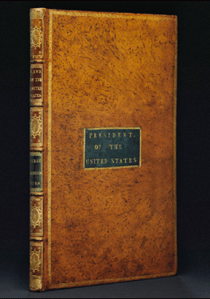 Having set a world record, George Washington’s personal copy of the Constitution is heading home. A book containing Washington’s annotated Constitution and a draft of the Bill of Rights was purchased for almost $10 million by the Mount Vernon Ladies’ Association in an auction Friday [22 June 2012] at Christie’s in New York.
Printed and bound in 1789, the book featuring Washington’s signature on the title page sold for a winning bid of $9,826,500 — an amount the venerable auction house said was a world auction record for an American book or historical document.
Part of Washington’s original private library at Mount Vernon, the book will once again be housed at the historic Virginia estate as part of the collection at the Fred W. Smith National Library for the Study of George Washington, currently under construction and set to open next fall. . .
The full article is available here»
◊ ◊ ◊ ◊ ◊
The Mount Vernon website provides an overview of the National Library for the Study of George Washington, including the following:
The 45,000-square-foot library will occupy a 15-acre site to the west of George Washington’s historic home on the banks of the Potomac River. A drive winding through a woodland of native trees and plantings will lead to the building’s entrance court and visitor parking area. A 6,000-square-foot Scholars’ Residence adjacent to the library will provide living quarters for up to eight resident scholars. . .
At Christie’s | Old Master and Early British Drawings and Watercolors
Press release, dated 22 June 2012, from Christie’s:
Old Master and Early British Drawings and Watercolours (Sale 5688)
Christie’s, London, 3 July 2012

Lot 68: Charles de La Fosse, A Mounted Soldier, Seen from Behind, black, red and white chalk on buff paper, Christie’s Estimate: £20,000 – 30,000
Christie’s announced the sale of Old Master and Early British Drawings and Watercolours which will take place on 3 July 2012, during London’s Master Drawings week. Featuring a selection of works by Old Masters that have been recently discovered, this auction offers the opportunity to acquire drawings and watercolours which have not been seen in public for up to 100 years. Comprising 168 lots, the sale is expected to realise in excess of £3 million. Headlining an important group of newly discovered drawings by Rembrandt (1606-1669) and his school is A Blind Beggar with a Boy and a Dog (estimate: £50,000 – 80,000). This group of six previously unpublished drawings was discovered in the attic of a Scottish country house in 2012 and has not been seen for over 100 years.
Benjamin Peronnet: International Head of Department, Old Master Drawings: “It is always a thrill to discover and to have the opportunity to offer for sale previously unrecorded drawings. This group is particularly exciting as it includes a drawing by Rembrandt himself and six by his pupils. They offer a rare overview of his studio practices and how his pupils reinterpreted and developed his technique.” The group also contains works after Willem Drost and by Samuel van Hoogstraten (1627-1678). An intricate drawing by Ferdinand Bol (1616-1680), Jacob and Rachel, bears all the trademarks of Bol’s style depicting figures in historic dress and also shows the strong influence Rembrandt’s work had on Bol (estimate: £20,000-30,000). This exceptional group is expected to realise a combined total in the region of £100,000.
Further highlights include a rare survival: a cartoon by Michelangelo Anselmi (1491-1554) for his frescoes in the Cathedral of Parma. The frescoes have since been overpainted but this cartoon section of Putti dancing with hoops hints at the elaborate design that once filled the vaults of the Duomo and is the only surviving segment of the cartoons. It is expected to realise between £150,000 and £250,000.
Also on offer is a previously unpublished drawing by Giovanni Battista Tiepolo (1696-1770) estimated at £100,000 – 150,000. This large-scale drawing includes preparatory studies for the figure of Mars and for a prostrate captive, both of whom appear in the fresco of Apollo and the Continents above the main staircase of the Residenz at Würzburg, considered to be Tiepolo’s greatest masterpiece. Between 1750 and 1753, Giovanni Battista Tiepolo and his sons Domenico and Lorenzo executed a monumental decorative scheme in this palace of the Prince-Bishops of Würzburg, which had been completed only a few years previously.

Lot 69: Jean-Etienne Liotard, A Pensive Woman on a Sofa, tempera on vellum, pen and black ink framing lines on the left and top edges, on cardboard. Estimate: £400,000 – 600,000
Coming to auction for the first time is an exquisite work on vellum by Jean-Etienne Liotard (1702-1789); Pensive Woman on a Sofa is based on a lost drawing of which only a counterproof is known, now in the Louvre. One of Liotard’s most compelling compositions executed on an intricate scale it is estimated at £400,000 – 600,000. The drawing was executed by the artist during his travels in the Greek islands and Turkey between 1738 and 1742. The subject sits in a pose which echoes Dürer’s Melencolia, with a crumpled letter discarded beside her, symbolizing the end of a relationship. Another pensive figure is seen in an imposing work by Caspar David Friedrich (1774-1840), A Seated Man with a Telescope on White Chalk Cliffs, in which a tiny figure of a man is shown in a vast landscape looking into the infinite distance (estimate: £200,000-300,000). (more…)
At Sotheby’s | Treasures, Princely Taste
Press release from Sotheby’s:
Treasures, Princely Taste (L12307 )
Sotheby’s, London, 4 July 2012
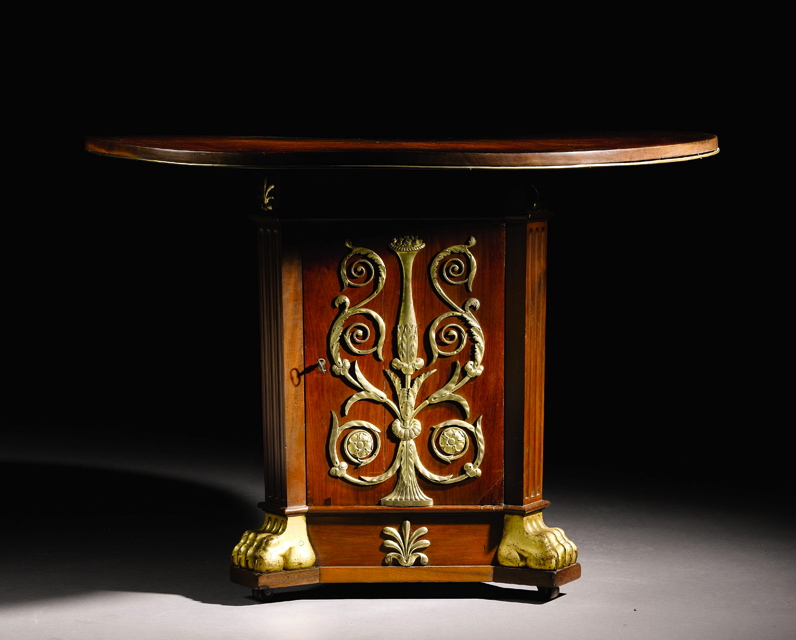
A gilt-bronze-mounted mahogany table “À l’Antique” designed by Jacques-Louis David (1748-1825), attributed to Georges Jacob (1739-1814), Louis XVI circa 1785-89 (est. £200,000-300,000). Photo: Sotheby’s.
Sotheby’s London will hold its third Treasures, Princely Taste auction on 4th July, 2012 (L12307) . The sale will comprise an outstanding selection of rare and important furniture, silver, objets de vertu and tapestries, many with aristocratic provenance and each displaying the remarkable qualities of princely taste. The centrepieces of the sale are a historic gilt-bronze-mounted table by Jacques-Louis David (est. £200,000-300,000), which appears in a painting by David in the collection of the Louvre Museum, and the Shah of Persia’s golden elephant automaton clock, an 18th-century, British-made technical marvel and a dazzling sight (est. £1-2 million). The sale comprises 42 lots, which are estimated to realise a total in excess of £12 million. Mario Tavella, Sotheby’s Deputy Chairman, Europe, comments: “Each of the masterpieces in this, our third offering of Treasures, Princely Taste, has its own compelling story to tell. In the case of the table designed by Jacques-Louis David, its history is recorded for posterity in a painting in the Louvre which communicates not just its sophisticated craftsmanship, but the extraordinary partnership between one of France’s greatest 18th-century ébénistes and one of the greatest painters of the day. The extraordinary Shah of Persia’s Elephant Automaton, was created specifically to redress the yawning trade balance between Britain and China. All the works we have selected reflect connoisseurs’ continued demand for the very finest pieces at the top-end of the market. Many of these spectacular and meticulously sourced works have aristocratic provenances, and represent the very pinnacle of the decorative arts of their era.”
Sale Highlights

Jacques-Louis David, The Lictors Bring to Brutus the Bodies of His Sons, 1789 (Paris: Louvre)
A gilt-bronze-mounted mahogany table À l’Antique designed by Jacques-Louis David (1748-1825), attributed to Georges Jacob (1739-1814), Louis XVI circa 1785-89 (est. £200,000-300,000). This exceptional table appears in David’s famous painting Les Licteurs rapportent a Brutus les corps de ses fils of 1789, in the Louvre. David designed and commissiond various pieces of furniture to use in his paintings. These were executed by the prominent Parisian cabinet-maker, Georges Jacob, who crafted the chairs for Marie-Antoinette’s laiterie at Rambouillet. The table can be considered as one of the most important precursors of what would be defined as the Empire style. A brass plaque inside the pedestal tells that the table was left to David’s great
granddaughter by David’s grandson, Jules David Chassagnol.
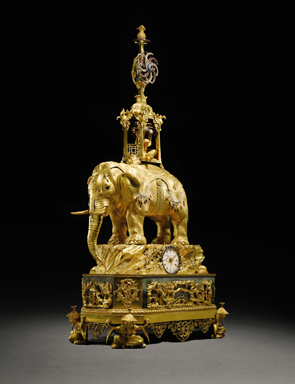
The Shah of Persia’s Elephant Automaton Clock – George III paste-set ormolu musical automaton clock, ca 1780, signed by Peter Torckler (est. £1-2 million). Photo: Sotheby’s.
The Shah of Persia’s Elephant Automaton Clock – A George III paste-set ormolu musical automaton clock, circa 1780, signed by Peter Torckler (est. £1-2 million). This magnificent automaton clock of a rare and impressive scale stands over one metre tall and was probably acquired by Naser al-Din Shah of Persia (1831–96) in London in the 1890s. The Shah had been mesmerized by similar clocks he saw while visiting Baron Ferdinand de Rothschild at Waddeson Manor in 1889. It typifies the intriguing and inventive objects produced in London by skilled British craftsmen in the second half of the 18th century and would have originally been destined for the Chinese market. Promoted by the East India Company, such objects played a key role in lessening the trade deficit between Britain and China and were articles of tribute in Chinese society, where gifts flowed through the official hierarchy, passing through the system to superiors and eventually, the Emperor. Similarly ornate elephant figures were frequently found throughout the Chinese Imperial Palaces and a large number remain in the Palace Museum, Beijing. The iconography of an elephant supporting a vase on its back forms
the auspicious rebus Daping Jingxian, or Daping Youxian,
representing the message of Peace and Harmony.

Sèvres soft-paste porcelain vases, with gilt-bronze mounts attributed to Pierre-Philippe Thomire (1751-1843), ca 1788-90 (est. £600,000-1,000,000). Photo: Sotheby’s.
A pair of important gilt-bronze-mounted Sèvres soft-paste porcelain vases, almost certainly supplied by the marchand-mercier Dominique Daguerre, the mounts attributed to Pierre-Philippe Thomire (1751-1843), circa 1788-1790 (est. £600,000-1,000,000). This magnificent pair of vases is exceptional in both form and decoration. The rare sky-blue colour was developed specifically for Louis XVI and Marie-Antoinette by the Royal Manufacture of Sèvres, during the king’s building and decoration of his Rambouillet estate. The design is by celebrated Parisian marchand-mercier Dominique Daguerre, who was the chief supplier to the court of Louis XVI, while the finely cast and chased gilt-bronze mounts can be almost certainly attributed to Pierre-Philippe Thomire, the renowned bronzier who made pieces for Louis XVI’s bedchamber at Compiègne and for Marie-Antoinette’s apartments at Versailles.
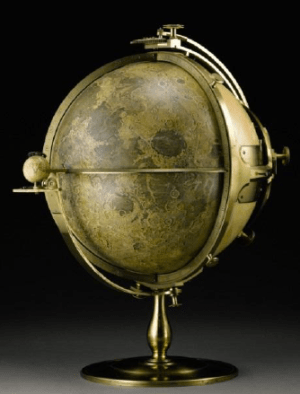
George III 12-inch diameter Selenographia, ca 1797 (est. £200,000-300,000). Photo: Sotheby’s.
A George III 12-inch diameter Selenographia, circa 1797 (est. £200,000-300,000). John Russell R.A., who patented this ‘moon globe’ in 1796, was a highly successful society portraitist, Royal Academician and painter to King George III and the Prince of Wales. Russell had a passion for astronomy and was so “stricken by the beauty of the Moon” that he devoted considerable time to observing, mapping and drawing it. This Selenographia apparatus accurately depicts the Moon, while a small globe of the Earth demonstrates the oscillations of the Moon in relation to the planet. The globe was first purchased by George O’Brien Wyndham, the 3rd Earl of Egremont (1751-1837), who also had an interest in science. The Earl’s mistress, ‘Mrs Wyndham’, was also a lady of great scientific repute and for whom much scientific equipment was purchased, so it is possible that it may have been purchased with her in mind. Only a few examples of Selenographia globes are known to have survived, and are currently held in prominent science museums in London, Oxford and Madrid as well as other private collections. (more…)
Art Fair | Masterpiece London 2012
From the fair’s website:
Masterpiece London 2012
Royal Hospital Chelsea, London, 28 June — 4 July 2012
 Now in its third year Masterpiece London confirms its position as the capital’s leading art and antiques fair. This is no ordinary event, but a forum for distinctive design and aesthetic excellence where every exhibit offered is scrutinized by a team of experts to ensure every confidence in each purchase. The variety on offer at the fair is second to none: cars, wine, contemporary design and exquisite jewellery sit alongside the best of the fine and decorative arts. Presenting a snapshot of the history of art and design from antiquity to the present day, visitors will relish the chance to acquire rare collectors’ items or simply enjoy temptation on a grand scale. There is nowhere better than Masterpiece London 2012 to discover a rich and varied treasure trove. . .
If your interest is piqued by what you see, Masterpiece London offers you the chance to develop your knowledge and appreciation. During each day of the fair, select exhibitors will present insights into their given area of expertise so if your interest is portraits or pocket watches, mirrors or miniatures, Degas or diamonds, Masterpiece London gives you the opportunity to get up close and personal with some of the finest examples shown at the fair and to learn from the world’s leading luminaries.
Building on the success of 2010 and 2011 Masterpiece London promises you an impressive choice of art and design enlivened with its own special twist to ensure you have a memorable and enjoyable visit. All is displayed in a fresh and lavish setting, so that whether you are a seasoned collector, or a new buyer or just an admirer of exquisite beauty, you will experience countless opportunities to buy, enjoy and learn from.
◊ ◊ ◊ ◊ ◊
Of all the events associated with the fair, Saturday’s Wallace Collection Symposium might be most interesting to Enfilade readers:
Wallace Collection Symposium at Masterpiece London
Royal Hospital Chelsea, London, 30 June 2012
The Wallace Collection will be hosting a symposium on Saturday 30 June, led by Director, Dr Christoph Vogtherr. There will be four talks by Collection curators, from 11.30 – 16.00 on great collectors and their collections to include the French court of Louis XVI and British collecting in the nineteenth century.
11.30 A Golden Age: Collecting Medieval and Renaissance Sculpture and Decorative Arts in the Nineteenth Century
Jeremy Warren, Collections and Academic Director
12.00 Nineteenth-Century British Collectors of Contemporary French Paintings
Stephen Duffy, Curator of Pictures
13.00 Lunch
14.30 Royal Collectors at the Court of Louis XVI
Helen Jacobsen, Curator French Eighteenth-Century Decorative Arts
15.15 How Paintings Were Displayed in the Eighteenth Century
Christoph Vogtherr, Director
The day and each talk is free to Masterpiece London ticket holders. To reserve a place at the symposium, please email contact@masterpiecefair.com with your full name and address, with the subject: The Wallace Collection Symposium, indicating how many spaces you wish to reserve and a confirmation letter will be sent to you. Places are subject to availability.
◊ ◊ ◊ ◊ ◊
Note (added 9 July 2012) — A press release highlighting the successes of Masterpiece London 2012 is available at Art Daily.










 Enfilade
leave a comment