At Christie’s | Exceptional Decorative Arts
Press release (1 June 2012) from Christie’s:
At Christie’s, The Exceptional Sale: Decorative Arts (#5702)
London, 5 July 2012

“Brand Cabinet,” a George II ivory-mounted padouk medal-cabinet, ca 1743. Est: £800,000-1,200,000. Photo: Christie’s Images.
In 2008 Christie’s launched a unique sale platform for the very best decorative arts; The Exceptional Furniture Sale saw 10 masterpiece works realise a total of £10.3 million. Building on the success of this sale and The Exceptional Sale held in 2011, Christie’s is pleased to announce details of The Exceptional Sale 2012 which will take place on the evening of 5 July. Comprising 48 lots, the sale presents three centuries of decorative arts, from the first quarter of the 16th century to the first quarter of the 19th century. Featuring the finest examples of furniture, silver, sculpture, clocks and porcelain – including recent discoveries and previously unknown examples – the sale exemplifies the very best of European decorative arts. It is expected to realise a total in excess of £13 million. Robert Copley, Deputy Chairman Christie’s UK, International Head of Furniture and Decorative Arts states: ‘With The Exceptional Sale Christie’s celebrates excellence in furniture and the decorative arts. The attributes of this carefully curated auction are provenance, rarity, design, and craftsmanship. From exquisite furniture by André-Charles Boulle and Thomas Chippendale to the magnificent Leinster silver dinner-service; from a rare maiolica plate by Nicola da Urbino to a newly discovered marble group by Jan van Delen; from glittering Chinese clocks and ormolu-mounted porcelain to the finest examples of Italian pietre dure, The Exceptional Sale offers collectors an opportunity to acquire the very best.’
The exceptional Brand Cabinet, a George II ivory-mounted padouk medal-cabinet, circa 1743 (estimate: £800,000-1,200,000), was made for the wealthy young Dilettante Thomas Brand, who like many English milordi went on The Grand Tour, arriving in Rome in 1738. It is here that he probably purchased the ivory plaques that depict figures from Classical mythology such as Leda and the Swan. A couple of years later, Brand’s contemporary and ‘intimate friend’ Horace Walpole also made the Tour. On his return he designed a cabinet to house his precious ‘enamels and miniatures’. No doubt inspired by William Kent, his cabinet and Brand’s are both made of padouk and are attributed to William Hallett of Great Newport Street, in Covent Garden. Walpole’s cabinet subsequently hung in the Tribune at Strawberry Hill and is now in the Victoria and Albert Museum, while Brand’s cabinet remained at the family house, The Hoo, in Hertfordshire until it was first sold at Christie’s in 1938.

The Ogden Mills Armoires a Six Medailles. Attributed to Andre-Charles Boulle and his workshop, first half 18th century. Estimate: £1,000,000-1,500,000. Photo: Christie’s Images Ltd 2012.
The Ogden Mills ‘Armoires à Six Medailles’ are lavishly decorated with spectacular gilt-bronze mounts that fuse seamlessly with the scrolling foliate pattern of the sumptuous ground of brass and tortoiseshell première and contre-partie marquetry (estimate: £1,000,000–1,500,000). The Louis XIV armoire in contre partie is attributed to André-Charles Boulle, while the late Louis XVI in première partie is by Delorme. They are decorated to the doors with trails of medals celebrating the Life of Louis XIV as well as the figures of Aspasia and Socrates. Conceived initially with shelves to house collections of precious medals this series of armoires proved so successful it remained in production in Boulle’s workshop throughout the first half of the 18th century and was subsequently continued by Boulle’s followers. (more…)
At Sotheby’s | de La Tour d’Auvergne Lauraguais Collection
Press release from Sotheby’s:
Collection of Prince and Princess Henry de La Tour d’Auvergne Lauraguais, L12308
Sotheby’s, London, 3 May 2012
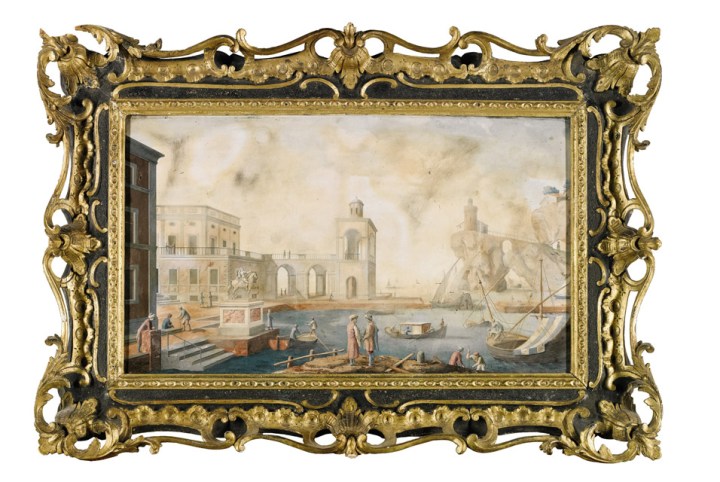
Enrico Hugford, one of a pair of Italian scagliola panels
within carved giltwood and ebonised frames, mid 18th century
◊ ◊ ◊ ◊ ◊
Sotheby’s London will offer for sale The Collection of Prince and Princess Henry de La Tour d’Auvergne Lauraguais on 3rd May 2012 [L12308]. The auction comprises property from the family’s London homes. It will include very fine Neo-classical and Empire furniture, the finest collection of 18th-century scagliola to appear at auction, Old Master paintings, silver, objets de vertu, and drawings and books from the library of celebrated designer and architect Emilio Terry from Château de Rochecotte. Estimates in the sale range from £400 to £300,000. In total, the auction is estimated to realise £2-4 million. The history of the de La Tour d’Auvergne Lauraguais family is a long and distinguished one. Related by marriage to the noblest dynasties in France, it is one of only six families (alongside the houses of Savoie, Lorraine, Grimaldi, Rohan and La Tremoille) to be granted the rights and privileges accorded to foreign princes.
Mario Tavella, Deputy Chairman, Sotheby’s Europe commented: “It is an honour for Sotheby’s to be entrusted with this wonderful collection from one of France’s greatest and most glamorous families. Collectors will be delighted with the quality and breadth of items on offer, which together exude a very chic look. Emilio Terry was at the heart of avant-garde circles in 1920s Paris and many of the books in his library reflect his intimate relationship with key figures such as Henri Matisse and Salvador Dali. More than that, his passionate interest in architecture is manifest in the host of important architectural books that he owned, as well as in his own fabulous and often fantastical drawings.”
The sale includes museum quality Neo-classical and Empire furniture by some of the greatest French ébenistes, including Jacob and Joseph. The group is headlined by a magnificent gilt-bronze mounted amaranth and tulip wood secrétaire by Joseph, circa 1770, which, with its very strong neo-classical outline, represents the pinnacle of Le Goût Grec style. Estimated at £150,000-300,000*, an identical secrétaire is held in the Getty Museum in Malibu.
The sale will present the greatest collection of 18th-century scagliola ever to come to the market. Developed in 17th-century Tuscany as an alternative to the costly marble inlays of pietra dura, scagliola is an extraordinarily complex technique, often used to produce decorative effects resembling inlays in marble and semi-precious stones. The technique is a particular passion of Princess Anne de La Tour d’Auvergne Lauraguais, who is an expert in the field. The sale will offer eight rare scagliola panels by virtuoso craftsmen Enrico Hugford and Lamberto Christiano Gori, which depict seascapes and marine scenes inspired by the Tuscan coast. Princess Anne de La Tour d’Auvergne Lauraguais commented: “It was my father, Prince Henry who inspired me to study the art of scagliola, and in turn it was my father’s uncle Emilio Terry who also truly appreciated this form of art and who had influenced him. In my father’s opinion, scagliola had a refinement of colour, texture and sensuality softened as if dimmed by a veil of fog, not like pietre dure which could be bright and almost screaming with colour. Scagliola is a man-made stone, not meant to be used outside, but to live with…. I followed his advice and am indebted to him for giving me a life-long love for the art of scagliola.” (more…)
At Sotheby’s in June 2012 | Pastel Portrait by Liotard
Press release (28 March 2012) from Sotheby’s:
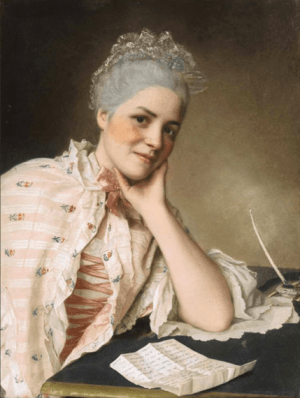
Jean Etienne Liotard, “Portrait of Mademoiselle Jacquet” (Photo: Sotheby’s)
Sotheby’s announced that their sale of Old Master & 19th Century Paintings & Drawings in Paris on 21 June 2012 will feature a very rare work of art by the most important pastellist of the 18th century, Jean Etienne Liotard. Estimated between 300.000 and 400.000€ ($400,000-530,000 / excluding buyer’s premium), this beautifully preserved pastel has been rediscovered by the Director of the Old Master Paintings Department at Sotheby’s in Paris, Pierre Etienne, in a collection in the South of France. This portrait of Mademoiselle Jacquet, a French actress at the Opéra (Académie Royale de Musique) in the 18th century, has never appeared before on the art market.
Liotard grew up in Geneva and trained as a miniaturist and enameller – first in Switzerland, then in France under Jean-Baptiste Massé, with whom he also studied engraving. However, apparently bored in his master’s studio, the young Liotard left for Italy in 1735, where he met Sir William Ponsonby, 2nd Earl of Bessborough, who offered to travel with him to Constantinople, drawing the costumes and characters they met along the way. Thereafter Liotard continued to travel, through Turkey, Greece, Moldavia (where the prince invited him to paint the royal family), Austria, Germany, Switzerland, Great Britain, Holland, Italy – and France. During his career Liotard came to Paris for three lengthy stays, and also stopped off in the French capital from time to time en route for other destinations.
The portrait of Mademoiselle Jacquet probably dates either from his second stay in Paris (1748-52), or from his brief trip to Paris in Spring 1757. When Liotard arrived in Paris in 1748 he was already famous. In 1749 he was asked to paint the royal family and, in the wake of this commission, numerous courtiers and other influential figures asked him to do their portraits, ranging from Madame de Pompadour and Voltaire to well-known figures of the theatre such as Marivaux and the great actress Madame Favart. It is thus interesting to note that the portrait of Louise Jacquet, also an actress, was probably commissioned during this period. The work to be offered for sale by Sotheby’s is drawn in pastel, Liotard’s preferred medium. Liotard’s first known pastel dates from his trip to Italy in 1736. Also in his autobiography, he explains that he especially appreciated pastel because it facilitated a subtle blend of colours and enabled him to rework a subject without having to repaint it. The portrait, executed with a pronounced delicacy, differs markedly from the standard format Liotard was used to propose, involving a frontal view of the sitter, without hands. The pastel is slightly larger than Liotard’s standard works of this type, and the sitter is unusually lent a context, or mise en scène.
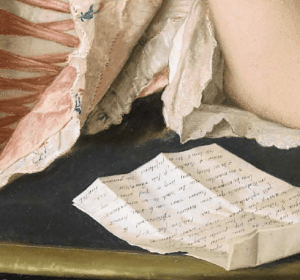 It is not unusual to find letters in Liotard’s portraits, but this one in particular is unusually explicit, and the only one to be partly legible. We can make out a string of compliments addressed to the young lady, such as ‘You know how much I am interested in and admire you… and your perfections.’ Such details suggest that it was the sitter herself, or one of her admirers, who chose this ambitious mode of representation – one that makes no allusion to her profession as a singer. Jacquet’s name has always been associated with the pastel; it was offered to the ancestors of the current owners by Louise Jacquet herself.
The portrait will be exhibited in Paris, 18-20 June 2012, 10am-6pm.
◊ ◊ ◊ ◊ ◊
Note (added 24 June 2012) — As reported at Art Daily, Liotard’s pastel far surpassed estimates, selling for a record €1,464,750 ($1,853,509).
Portrait of Chevalier D’Éon — Diplomat, Spy, and Transvestite
News from Philip Mould of a painting that’s reportedly attracted the attention of the National Portrait Gallery in London. The portrait is on display in London this week (16-20 April 2012). From Artdaily.com:

Thomas Stewart, "Portrait of Charles Genevieve Louis Auguste André Timothée D’Éon de Beaumont, called the Chevalier D’Éon," 1792
The earliest surviving formal portrait of a male transvestite has been discovered by Philip Mould in a New York saleroom. On first glance the historic portrait featuring a rather masculine looking woman piqued the renowned art sleuth’s interest. A gentle clean and further painstaking research uncovered a rich and colourful history. “The eighteenth-century portrait appeared to be of a somewhat manly middle-aged lady. Research before the sale suggested otherwise, and upon cleaning, the face revealed a distinctive 5 0’clock shadow. This fuelled further investigation that resulted in the astonishing discovery that the portrait is of the legendary spy, diplomat and transvestite, Chevalier D’Éon that has been lost since 1926. The painting is now “under serious consideration” by the National Portrait Gallery, London. Should it be purchased will represent the gallery’s first oil painting of a cross-dresser in guise. “The story of D’Éon is one of the more remarkable biographies of the eighteenth century. The recent rediscovery of this lost and only oil portrait should dramatically reawaken his historical significance,” adds Philip Mould.
The picture will be on display at Philip Mould & Company, 29 Dover St from Monday 16th – Friday 20th April 2012 (excluding Wednesday morning). Although some line engravings and satirical prints survive, until the re-discovery of this lost portrait last year no illuminating portrait of D’Éon was known to survive. The painting emerged, fittingly for the sitter, as Portrait of a Woman with a Feather in Her Hat, as attributed to Gilbert Stuart, as part of a general antique paintings auction a Thos. Cornell Galleries Ltd, New York, in November last year. It was part of the collection of Ruth Stone, daughter of Samuel Klein of Klein’s Department Stores, USA. Research undertaken by Philip Mould Ltd has since proved that the picture is by the theatrical artist called Thomas Stewart who specialised in painting actors and theatrical scenes in London in the 1790s – the same time as D’Éon was performing on stage as a fencer in drag.
D’Éon is known as the ‘Patron Saint of Transvestites’ and the word “eonism” meaning cross dressing and cross-sexuality derives from him. D’Éon was the son of middle class, provincial French parents and having excelled at school in 1756 the brilliant graduate was recruited by the top-secret network of spies called Le Secret du Roi, which worked personally for King Louis XV. The monarch sent D’Éon on a secret mission to Russia in order to meet Empress Elizabeth and intrigue with the pro-French faction against the Habsburgs. Later tales claim that D’Éon disguised herself as a lady to do so, and even became a maid of honour to the Empress. In 1763, having spent a heroic spell in the French dragoon guards where he distinguished himself as a master fencer, D’Éon was sent by Louis to London with the title Special Ambassador from France. His true mission was to spy for the king and collect information for a potential invasion – an initiative of which Louis’s ministers were unaware. Despite remaining private documents that prove he was buying female corsets, at this stage D’Éon kept his transvestite proclivities clandestine. After a year, D’Éon was replaced as ambassador by the aristocratic Count of Guerchy. Furious and humiliated by being reduced to his former rank as secretary, D’Éon decided to disobey orders to return to France, claiming that the new ambassador had tried to murder him. In an effort to save his position in London, D’Éon published most of the secret diplomatic correspondence. This breach of diplomatic protocol was unprecedented and scandalous, but D’Éon was careful to keep back from publication the King’s secret invasion documents and those relative to the Secret du Roi as ‘insurance’. With the invasion documents in hand, D’Éon held the king in check, and continued to work as a spy. But he could not return to France. At this point D’Éon began to dress publicly as a woman, the motives for which are not entirely clear, and a betting pool was started on the London Stock Exchange about his true sex. Observers described him as elaborately attired as a woman, but with masculine traits such as stubble and a tendency to hitch his skirts up when climbing stairs – all characteristics which have become more comprehensible since the emergence of the lost portrait. He was noted for his great intelligence and intellect but also his boorish lack of female charms. . .
The full article is available here»
At Auction | Rare 1792 Silver Center Cent Coin
A Heritage Auctions press release (5 April 2012), as noted at ArtDaily.com:
Heritage Auctions, Central States U.S. Coin Auction
Schaumburg, Illinois, 18-20 April 2012
Highest bid as of 13 April: $1,000,000
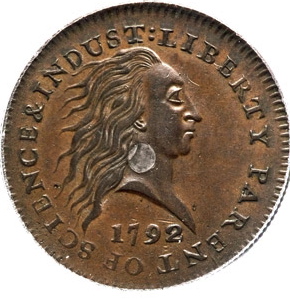 DALLAS – One of the most historic coins struck by the early U.S. Mint, a 1792 Judd-1 Silver Center cent pattern, MS61 Brown PCGS, headlines the Heritage Auctions April 2012 Central States Signature U.S. Coin Auction, April 18-20, with Platinum Night offerings on April 19.
“Our long-running relationship with the Central States Numismatic Society and conducting its annual convention’s official auction is alive and well,” said Greg Rohan, President of Heritage, “as is our tradition of bringing important rarities to those auctions. The 1792 Silver Center cent is tremendously important to the history of U.S. coinage – arguably far more so than a number of better-known and more celebrated rarities.”
 The 1792 Silver Center cents were experimental pieces designed by Chief Coiner Henry Voigt to remedy a flaw in the Mint Act of 1792: the official weight for one cent coins would have made them too large and heavy for practical use. Voigt suggested a small silver plug, worth ¾ of a cent, surrounded by copper worth ¼ of a cent. The value of the metal would be the same, but the Silver Center cent was designed to be smaller and easier to handle. The Silver Center cents were the first coins struck on the grounds of the U.S. Mint, lending them great historical importance, but they never went into general production and are very rare today. Congress reduced the official weight of the cent instead, making an all-copper coin more practical. Heritage’s roster of Silver Center cents counts only 14 positively identified survivors. This Silver
Center cent, presented as An Offering From The Liberty Collection,
was used to illustrate the type in Walter Breen’s famous
Encyclopedia and is pictured in certain past editions of A Guide
Book of United States Coins, popularly known as the “Red Book.” . . .
◊ ◊ ◊ ◊ ◊
Update (added 20 April 2012) — The coin sold for $1million (plus the 15% commission), as noted here»
Storied Reconstructed Furniture Sold at Bonhams
Bonhams, London, New Bond Street
Sale 19957 – Fine English Furniture and Works of Art, 7 March 2012
Lot No: 133*
A satinwood, mahogany, sycamore and marquetry and parcel gilt secretaire cabinet reconstructed from an important cabinet by Seddon, Son & Shackleton of 1793 reputedly for Charles IV of Spain, the panels possibly by William Hamilton R.A.
Estimate of £20,000 – 30,000; sold for £25,000 inclusive of Buyer’s Premium

Inlaid with boxwood and ebonised lines, the upper section with pierced gilt metal fret and white marble pilasters, above a bowed central drawer and door painted with a vase of flowers, flanked by a pair of lozenge panelled doors also painted with floral sprays, each with leaf carved reeded and fluted turned pilasters and each enclosing four pigeonholes and a shelf, flanked by larger bowed panelled doors, one painted with the figure of ‘Night’, the other with probably ‘Day’, surmounted by domed plinths with gilt crown finials; above five frieze drawers, the lower part with inverted breakfront and central secretaire drawer with gilt bronze moulded panelling painted with a cherub flanked by reeded pilasters, enclosing a leather lined writing surface, two short drawers and ten compartments, flanked by a short panelled bowed drawers to each side, on six leaf carved and fluted tapering legs joined by a platform stretcher, on turned feet, the central Wedgwood plaque now missing, stamped several times ‘3258’, the reverse marked, ‘MGM 5 X7760’, ‘A605-495’, ‘UAP’, 131cm wide, 49cm deep, 173cm high (51.5″ wide, 19″ deep, 68″ high).
This secretaire on stand is a remarkable survival. Not only is it made from one of the most spectacular late eighteenth century English cabinets ever produced, but it also belonged to the MGM studios in Hollywood where it was used as a film prop. Although parts of its history remain obscured, the exceptional quality of both the cabinet work and the painted decoration are clear to be seen.
The present secretaire comprises parts of the upper section of a magnificent cabinet believed to have been made by Seddon, Sons and Shackleton (active c.1790-1798), to designs by Sir William Chambers (1723-1796), with painted panels by William Hamilton RA (1751-1801). The cabinet was said to have been commissioned by King Carlos IV of Spain (1788-1808) in 1793.
The cabinet was well-known amongst Edwardian connoisseurs and was illustrated and described in early twentieth-century books on English eighteenth-century furniture. It was exhibited twice, once at the Franco British Exhibition in London in 1908, and secondly in a selling exhibition held in the Plaza Hotel in New York in 1910.
At some point during the twentieth century, the cabinet was broken up and made into separate pieces of furniture. A commode made from parts of the centre of the cabinet was sold twice at auction, first at Christie’s in London, 19th November 1987, lot 125 and secondly at Sotheby’s New York, The Collection of Mr & Mrs Saul P. Steinberg, 26 May 2000, lot 236. The fact that present secretaire was made from parts of the same cabinet was not known until it was recognised by Bonhams, London in 2011.
Delftware at Maastricht from Aronson Antiquairs
Press release (29 January 2012) from Aronson Antiquairs:
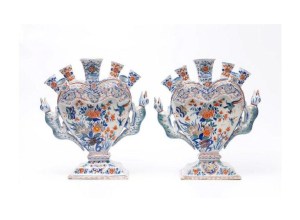
Cashmire palette flower vases Delft, ca. 1700-20, attributed to Lambertus van Eenhoorn
At The 25th Annual European Fine Art Fair, TEFAF in Maastricht (16-25 March), Robert Aronson of Aronson Antiquairs of Amsterdam is showcasing a wonderful and diverse collection of Dutch Delftware, accompanied by a new publication. Aronson says, “Among my favorites is a unique pair of massive Cashmire Palette Flower Vases that I am doubly delighted to have now as they had been on the ‘wish list’ of my late Father, Dave Aronson, who died in 2007. In fact, we had eagerly sought to acquire them in the mid-90s. Now they are here, and we are thrilled to be able to offer them at TEFAF.”
Dave Aronson headed the now 130 year old Aronson firm since his own Father died in 1990. He also was chairman of the Executive Committee of The European Fine Art Fair (TEFAF) in Maastricht from 1999 through his passing in 2007. His son, Robert, joined the firm twenty two years ago, following a tradition that began with his great-great grandfather, Leon, who founded the specialist firm in 1881. Robert Aronson is both a member of the Executive Committee of TEFAF and Chairman of the Dutch Antique Dealers Association.

Blue and White Delft ‘rijsttafel’ or ‘sweet meat’ set, ca. 1695-1705
Robert says that the 17 years he spent working side by side with his Father gave him both his passion for Dutch Delftware and a deep appreciation of the great collectors who became good friends to the Aronson family during those years. Now the younger Aronson has added a modern twist to a business that has served generations of the world’s most esteemed connoisseurs and curators. In fact, Robert Aronson is overseeing a truly 21st-century business that has embraced technology and e-commerce in ways his forebears could never have imagined.
“I’ve given Aronson Antiquairs a contemporary outlook that best serves both new collectors and old, using the latest tools, from Facebook and Twitter to You Tube video. Now, in whatever way that is most convenient for them, they can learn about Dutch Delft, examine our unrivaled collections, and come to understand the unique qualities of Delftware — more easily than at any time in our company’s 130 year history.”
Robert Aronson says the excitement of a TEFAF opening day still gives him a moment of pause. “I know I am going to see the most sophisticated and knowledgeable collectors, curators and dealers enjoying the finest artworks on the planet. Plus – You never lose the thrill of showing a truly rare or previously unknown object to a true Delft connoisseur,” he says. (more…)
TEFAF Opens in Maastricht March 16
A this year’s art fair at Maastricht, Moretti Fine Art will be offering a terracotta lion, a model likely produced in conjunction with a monument intended to celebrate the ascension of Queen Anne, which took place on this date 310 years ago (8 March 1702). Press release from Sue Bond:
The European Fine Art Fair (TEFAF)
Maastricht, 16-25 March 2012
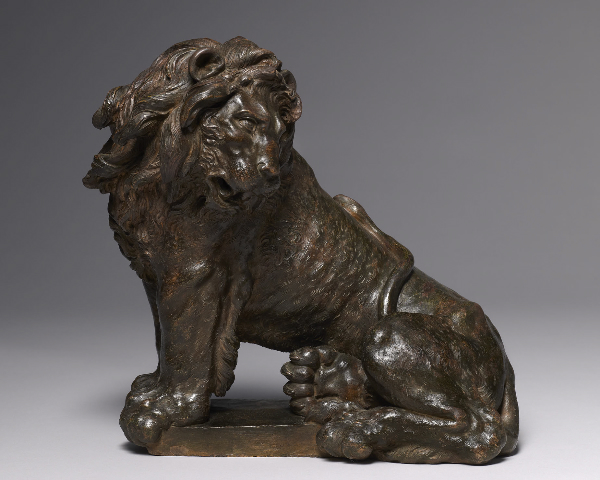
Giovan Battista Foggini (Florence, 1652-1725) "Lion," ca. 1715 Modelled hollow terracotta; original bronze patina imitation Base: 18.5 x 9.6 cm Lion: 26 x 24.4 x 17.6 cm
Moretti Fine Art will mark ten years at TEFAF Maastricht with some exceptional Medieval, Renaissance and Baroque Italian paintings and works of art. The fair, which is the world’s leading art and antiques event, is celebrating its Silver Jubilee and will take place at the Maastricht Exhibition and Congress Centre (MECC) from 16 to 25 March 2012. Stand 384.
One of the rarities Moretti will be offering is a terracotta figure of a lion dating from around 1715 by Giovan Battista Foggini (Florence, 1652-1725), almost certainly a model produced by this great Tuscan sculptor for a commemorative monument to England’s Queen Anne. Foggini was the court sculptor and architect to the Medici from 1687 until his death. In 1711 the British Parliament decided to celebrate their monarch Queen Anne who had ascended the throne in 1702. Initially they
planned to build fifty new churches but the cost was too high,
so in 1714 it was decided to build just one, Saint Mary-le-Strand,
and commission a statue of the sovereign.

Giovan Battista Foggini (Florence, 1652-1725) "Lion," ca. 1715 Modelled hollow terracotta; original bronze patina imitation Base: 18.5 x 9.6 cm Lion: 26 x 24.4 x 17.6 cm
John Talman, British Consul, scholar and collector of Italian art and antiquities, commissioned Foggini to build the monument which, had it been completed, would have been one of the most important accomplishments of public statuary in 18th-century Europe as illustrated by the surviving Foggini drawings in the Uffizi in Florence. One of these drawings depicts two lions seen from the back, one of which closely follows this model as it crouches, back arched and powerful, twisting its head with jaws open wide. These drawings, together with this recently-identified terracotta model, represent the only figurative evidence of this extraordinary commission. The modeling of the lion is especially skilled and vigorous, capturing the innate power, pride, majesty and monumentality of the animal even in this small scale. The figure, which retains its original patina simulating bronze,
is priced at €380,000.
Washington’s Wine Cooler
A silver wine cooler owned by Washington sold at Christie’s on 19 January 2012. Here’s the report from ArtDaily.com:
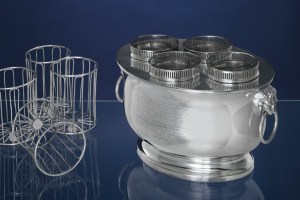 A Sheffield-plated silver wine cooler, ordered by George Washington in 1789, and given to Alexander Hamilton in 1797, sold at Christie’s during Americana Week for $782,500, exceeding its estimate of $400,000-600,000. This four-bottle wine cooler is an exceptionally well documented historical object, symbolizing the famous partnership between Washington and Hamilton in the early days of the republic. It was sold by direct descendants of Alexander Hamilton and bought by Americana expert, Gary Hendershott.
Jeanne Sloane, Deputy Chairman, Head of Silver, comments, “We are thrilled with the result of this unique piece of American history—the only three-dimensional object known to connect Washington with Hamilton, his most important collaborator.”
The four-bottle wine cooler is one of four commissioned by George Washington in 1789 to be used for entertaining after dinner. Detailed correspondence between Washington and his emissary, Gouvernor Morris, who was tasked with procuring objects to outfit the President’s House, describes the great level of forethought Washington devoted to creating an appropriate style for the new country.
In response to Washington’s admonition to “avoid extravagance,” Morris wrote to Washington in 1790, “I think it of very great importance to fix the Taste of our Country properly, and I think Your Example will go very far in that respect. It is therefore my Wish that every Thing about you should be substantially good and majestically plain; made to endure.”. . . .
The full article is available here»
At Christie’s: Old Masters Week in New York
At Christie’s, New York, 25 January 2012, Old Master Paintings (Sale 2534)
◊ ◊ ◊ ◊ ◊
Pompeo Girolamo Batoni, Portrait of a Gentleman, oil on canvas, 39 x 29 in. (99 x 73.6 cm.) — estimate, $400,000-600,000, sold for $866,500.
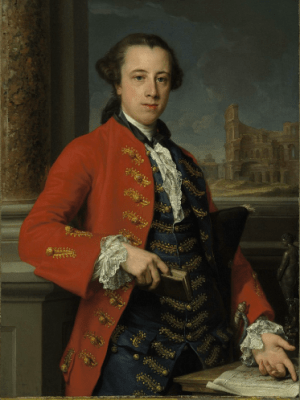 Three-quarter-length, in a red coat and a blue waistcoat with gold embroidery, holding a book and a tricorn hat, with a bronze statuette of the Venus de’ Medici on the table, the Colosseum in the distance.
Provenance
(Possibly) by descent within the Tew family.
Mr. J. Eyles; Christie’s, London, 17 December 1904, lot 111, as ‘Van Loo’ (36 gns. to Shepherd).
Anonymous sale; Sotheby’s, London, 5 July 1984, lot 272.
with Leger Galleries, London, 1990, where acquired by the present owner.
While the sitter in this portrait remains unidentified, his dress – particularly his scarlet coat – suggests that he was one of the many Grand Tourists who had their likeness captured by Batoni during their stay in Rome. The perfect souvenir of an educational voyage to the Italian peninsula, this painting presents the young gentleman as the consummate, erudite aristocrat. . . .
The full entry is available here»
◊ ◊ ◊ ◊ ◊
Giambattista Tiepolo, The Arrival of Henry III at the Villa Contarini, oil on canvas, 28¼ x 42 in. (71.7 x 106.7 cm.) — estimate, $4-6million, sold for $5.9million.
 Provenance
Count Francesco Algarotti, Venice, by 1756.
Wilhelm Rothschild, Schloss Grünberg, Frankfurt am Main, and (presumably) by descent to his daughter, Adelheid de Rothschild, and by descent in the Rothschild family;
Confiscated in Paris by the Einsatzstab Reichsleiter Rosenberg following the Nazi Occupation of Paris, May 1940;
Acquired for Hermann Goering on 4 December 1941 (inv. RM 1150);
Transferred to the Munich Collecting Point by Western Allied Forces (MCCP no. 6759);
Repatriated to Paris on 19 September 1946. Baron Edmond de Rothschild, Château de Prégny, Geneva, until 1980.
with Colnaghi’s, London, 1981, where acquired by S.T. Fee, Oklahoma City; Christie’s, New York, 9 May 1985, lot 20.
with Newhouse Galleries, New York, from whom acquired by the present owner.
Henri de Valois (1551-1589), third son of Henri II and Catherine de Medici, was elected King of Poland in May 1573, but it would not be until January of the following year that he would arrive at the Polish border and 21 February 1574 before he would be crowned in Warsaw. Less than four months later, Henry would abdicate the throne and depart Poland in unseemly haste, returning to France upon the news that his elder brother, Charles IX, had died and the French throne was his to claim. He was to be crowned Henri III, King of France, at the Cathedral of Reims on 13 February 1575.
Henri returned home by way of Vienna and Venice. He arrived in Venice on 18 July 1574 and stayed for ten days of official festivities and sightseeing. His welcome in front of the church of San Nicolò on the Lido was a lavish affair for which Palladio erected a triumphal arch and open loggia supported by ten Corinthian columns. This temporary loggia was decorated with scenes from the young king’s life painted by Tintoretto and Veronese and the ceiling was decorated with winged victories carrying wreaths as if to crown Henri when he passed beneath them. . . .
The full entry is available here»
◊ ◊ ◊ ◊ ◊
Andrea Locatelli, The Roman Forum, oil on copper, 29 x 37 in. (73.7 x 94 cm.) — estimate, $300,000-500,000, sold for $1,082,500.
 Provenance
Liechtenstein family collections, Vienna.
with Hazlitt, Gooden & Fox, London, 1997-1998, from whom acquired by Christian B. Peper.
This luminous view of the Roman Forum was almost certainly painted as a pendant to the View of the Piazza Navona with a market (fig. 1), signed and dated 1733, that was given to the Gemäldegalerie der Akademie der Bildenden Künste, Vienna by the estate of Prince Johann of Liechtenstein in 1881. Both compositions share the same dimensions and large copper support, which Locatelli only used on rare occasions. In fact, both panels stand out in the artist’s oeuvre as part of a remarkably small group of topographically accurate view paintings. In addition to the Vienna panel, Locatelli’s other known vedute reali are the pair of large perspective views of the projected Castello di Rivoli that the artist painted for another illustrious patron, (Castello di Racconigi, Turin), a view of the Tiber with the Ponte Rotto (Städtische’s Museum-Gemäldegalerie, Wiesbaden), and a View of the Tiber with the Castel Sant’Angelo (private collection, Rome).
The Vienna panel represents the same view from the piano nobile of the Palazzo Massimo Lancelotti that, working a generation earlier, Gaspare Vanvitelli had employed for a series of paintings datable from 1688 to 1723 (for an example, see lot 39 of this sale). In no small part due to Bernini’s unforgettable Four Rivers Fountain and the magnificent undulating façade of Borromini’s Sant’Agnese church, that the Piazza Navona became one of the most popular squares in Rome in the seventeenth and eighteenth centuries, and was often represented by view painters. The present composition appears to be entirely conceived by Locatelli and its pairing with the Piazza Navona is uncommon – views of the Piazza Navona were most frequently paired with views of the piazza of Saint Peter’s. . . .
The full entry is available here»










 Enfilade
1 comment