Furniture: ‘Inspired by Antiquity’ Highlights Thomas Hope
From a Carlton Hobbs press release:
Inspired by Antiquity: Classical Influences on 18th- and 19th-Century Furniture and Works of Art
Carlton Hobbs, New York, 20 January — 14 February 2011

One of a pair of wall lights in the form of a griffin, related to a design by Thomas Hope, bronze, ca. 1802
The opening night reception, on January 19th, benefited the Sir John Soane Museum Foundation. Tim Knox, the Soane Museum’s eminent director, lectured on the subject of the exhibition and elaborated on some of the highlights on view. “We are honored to have Sir John Soane’s Museum Foundation as the opening night beneficiary,” said Carlton Hobbs. “We are particularly enthusiastic to present forty magnificent pieces inspired by antiquity, including the important group of Thomas Hope pieces from the Philip Hewat-Jaboor collection of Regency furniture and works of art,” he said. “It is the single largest collection of Thomas Hope pieces to come onto the market since the Christie’s auction of the contents of Deepdene, Hope’s country estate, in 1917.” Thomas Hope, the fabulously successful banker, connoisseur collector and designer, revolutionized British taste of the late 18th, early 19th century with his radical, classically inspired design ideas and came to be one of the key figures shaping the Regency taste.
In the continuous effort to deepen our understanding of the decorative arts of the 18th and 19th centuries we wanted to further explore the visual and philosophical inspirations that gave rise to the multitude of fascinating designs, which are now broadly described as Neoclassical,” said Stefanie Rinza. “We are thrilled to collaborate with some of today’s leading academics in identifying the ancient design sources for our pieces and in interpreting the symbolism of the decorative devices used. We hope our clients, colleagues and friends will much enjoy the catalog accompanying the exhibition.
Carlton Hobbs is most grateful for the contributions and collaboration of some of today’s leading experts in the field of decorative arts and in the compilation of the catalog accompanying the exhibition, including Martin Levy, former chairman of the British Antiques Dealers Association, author and specialist in 19th-century furniture and works of art, Tim Knox, Director of the Sir John Soane Museum, Philip-Hewat Jaboor, the authority on Thomas Hope and independent art consultant to private and institutional collectors, and John Hardy, the long-time director of Osterley Park House Museum, who added his insights into the meaning of the symbolism of the classical design elements to every entry.
Ryskamp Collection to be Auctioned at Sotheby’s
Press release from Sotheby’s (23 November 2010) . . .
Property from the Collection of Charles Ryskamp
Old Masters Week at Sotheby’s, New York, 25 January 2011
 Sotheby’s will offer drawings, furniture and decorations from the private residences of museum director and art collector Charles Ryskamp on 25 January 2011, as a highlight of Old Masters Week in New York. Mr. Ryskamp served as Director of The Pierpont Morgan Library, now The Morgan Library & Museum, and the Frick Collection for a combined total of nearly 30 years, helping to make both institutions among the most prestigious museums in New York City. He began buying drawings at auction at age 13, and his collection has since been the subject of exhibitions at The Morgan Library & Museum and the Yale Center for British Art. Works from the sale will be on exhibition beginning 20 January, and are being sold for the primary benefit of Princeton University, where Mr. Ryskamp began his academic career.
Charles Ryskamp had an extraordinary impact on both the arts and society in New York City. He began teaching 18th-century British literature at Princeton in 1955, and simultaneously served as curator of English and American literature at the university’s library. These skills proved valuable when Mr. Ryskamp was appointed Director of The Pierpont Morgan Library in 1969. There, he oversaw several major donations and acquisitions that have helped make the Library one of New York’s most distinguished museums. Mr. Ryskamp was appointed Director of the Frick Collection in 1987, notably heading the institution’s first capital campaign that saved it from a potential closing.
Charles Ryskamp began collecting early, and quickly became enamored with drawings. A true intellectual, he educated himself in the print rooms of his favorite museums, with curators who would become his close friends. In his essay ‘‘Why I Collect,’’ Mr. Ryskamp notes: ‘‘As much as possible I have devoted my life to the appreciation, study, and teaching of art and literature; to those pursuits I must add, and with equal conviction, collecting . . . Collecting became a way of extending my knowledge. I bought works by uncommon artists and also uncommon works by celebrated draftsmen.”
Charles Ryksamp’s personal collections have been the subject of celebrated exhibitions: The Morgan Library & Museum exhibited The World Observed: Five Centuries of Drawings from the Collection of Charles Ryskamp in 2001, and the Yale Center for British Art presented Varieties of Romantic Experience: Drawings from the Collection of Charles Ryskamp in February 2010, a month before his death.
Sotheby’s New York sale of Property from the Collection of Charles Ryskamp features drawings from the 16th through mid-20th centuries that demonstrate his eye for both quality and aesthetic appeal. The works include a significant collection of English drawings, an extension of his expertise in British literature. The auction also includes furniture and decorations from Mr. Ryskamp’s private residences in both New York City and Princeton, New Jersey.
◊ ◊ ◊ ◊ ◊
Ryskamp’s essay “Why I Collect” is included in the catalogue for Varieties of Romantic Experience. A digital copy is accessible here»
Major Painting by Stubbs at Auction on December 8
Brood Mares and Foals goes on view in London on December 3. From a Sotheby’s press release (4 October 2010)
Old Master & British Paintings Evening Sale (L10036)
Sotheby’s, London, 8 December 2010
Lot 45 (fully entry available as a PDF file here)
Of all Stubbs’ groups of Mares and Foals, this is the noblest composition, its grandeur owing much to the towering rocky formation which seems to lend an air of hardiness to the animals, as well as acting as counterweight to the most spectacular figure in the group, the grey Arabian mare with her flowing tail.
-Judy Egerton, George Stubbs: Painter, Catalogue Raisonné (Paul Mellon Centre for Studies in British Art, 2007)
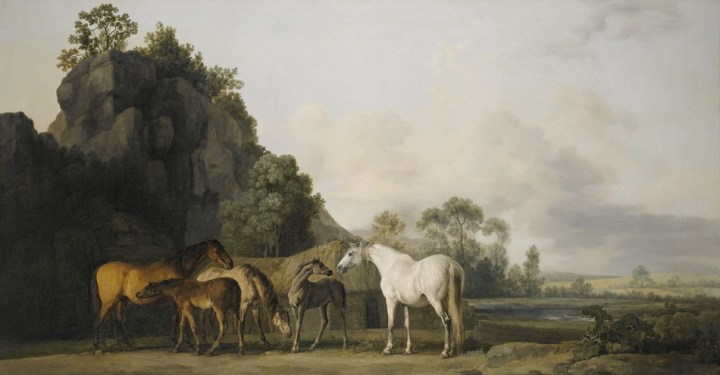
George Stubbs, Brood Mares and Foals, oil on canvas, estimate: £10-15 million, 100 x 187cm. Photo: Sotheby’s
On Wednesday, December 8, 2010, Sotheby’s London will present for sale arguably the finest painting by the British master George Stubbs (1724-1806) ever to come to the market: Brood Mares and Foals, estimated at £10-15 million. Painted in 1767, at the height of the artist’s career, the mares and foals scene is a superlative example of Stubbs’s talents as both a horse and landscape painter. Never before offered for sale, the painting has remained in a distinguished family collection for all of its life to date and its appearance at auction therefore represents an exceptionally rare opportunity for both equestrian and British art collectors alike.
The painting was probably commissioned by Colonel George Lane Parker, the second son of George Parker — the second Earl of Macclesfield of Shirburn Castle, Oxfordshire — and an important owner of Stubbs’s work. It then passed to Thomas Parker, the third Earl of Macclesfield, whose descendant now offers it for sale. Stubbs produced the distinctive group of compositions of mares and foals exclusively for his most important patrons during the early part of the 1760s; they all admired the exquisite accuracy and attention to detail of his work. These leading aristocratic patrons included Frederick St John, 2nd Viscount Bolingbroke; Charles Watson-Wentworth, 2nd Marquess of Rockingham; Augustus Henry Fitzroy, 3rd Duke of Grafton; George Brodrick, 3rd Viscount Midleton MP; Lord Grosvenor and the Duke of Cumberland.
A relatively unknown and unseen painting, Brood Mares and Foals has only been exhibited once since the eighteenth century. It was first shown at the Society of Artists in the Spring of 1768 and then again in the autumn of that year in a special exhibition to honour a visit by the King of Denmark. The painting was then carefully and privately preserved in the Earl of Macclefield’s family collection for the next 237 years, until it was part of the celebrated Stubbs and the Horse exhibition at the National Gallery in London in 2005, which also travelled to the Kimbell Museum in Texas. (more…)
Versace’s Stolen Zoffany Portrait Returned Home
Stolen in 1979, Johan Zoffany’s Portrait of Major George Maule was slated to be auctioned at Sotheby’s in March 2009 as the centerpiece of the contents of Gianni Versace’s Lake Como villa. The painting was pulled from the sale at the last moment, and — as reported this week by Reuters — has now been returned to its original owners:
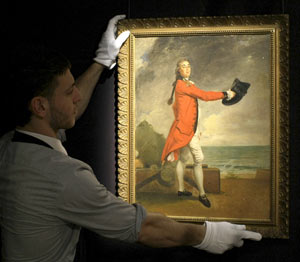
Johan Zoffany, "Portrait of Major George Maule, acting chief engineer of Madras" (Photo from "The Economist")
. . . A direct descendent of the subject of Portrait of Major George Maule contacted the Art Loss Register, which tracks lost and stolen art and antiquities, and the ALR in turn contacted Sotheby’s. “What could have been a protracted legal battle between two very well financed European families and their copious sets of lawyers has been amicably settled by the Art Loss Register’s art mediation team,” the ALR said. Although the terms of the settlement between the two families remained confidential, the ALR’s Christopher Marinello said: “There is no doubt that Gianni Versace had no knowledge that this painting was stolen when he purchased it in the 1980s. “This portrait does … hold particular sentimental value to the … heirs and the Versace family were extremely gracious in their willingness to compromise in seeing its return.” . . .
The Economist’s coverage of the story from March of last year is available here»
The Louvre Acquires Its First Work by Roubiliac

Louis-François Roubiliac, "Bust of Philipe Domer Stanhope, 4th Earl of Chesterfield" (Paris: Musée du Louvre)
As reported by Didier Rykner at La Tribune de l’Art (2 October 2010) . . .
. . . Le Louvre a acheté chez Sotheby’s Londres, le 14 juillet dernier, un buste en bronze de Roubiliac représentant Lord Stanhope, 4th Earl of Chesterfield (ill. 1) pour la somme de 115 250 £ (incluant les frais). Il s’agit de la première œuvre de l’artiste à entrer au Louvre et, semble-t-il, dans une collection publique française. . . .
The full article is available here»
Silver Playing Cards Fit for a Princess
As reported at ArtDaily, this set of seventeenth-century silver playing cards up for auction at Christie’s belonged, in the eighteenth century, to Princess Carlota, the daughter of King Carlos IV (as the wife of King João of Portugal, she was Princess of Portugal and Brazil). The cards are estimated to sell for between $150,000 and $250,000. From Christie’s:
Sale 2349, Lot 56
Important Silver Including The Stuart Collection of Magnificent Regency Silver , 19 October 2010, New York
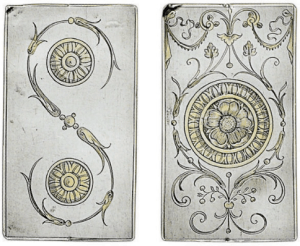
An Extremely Rare Set of German Engraved and Parcel-Gilt Silver Playing Cards, signed Michael Frömmer, Augsburg, 1616
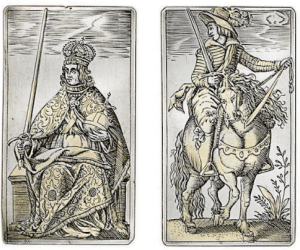 A complete set of 52 cards engraved in the four Italian suits: swords, batons, cups, and coins, each suit with a king, a knight, a knave, and pip cards ace through ten; the Knave of Swords signed M. frömmer fec, the Ace of Batons dated 1616; with a tooled-leather shadowbox case set with a brass plaque engraved with provenance. Each card is 3 3/8 inches (8.6 cm) high by 1 15/16 inches (5 cm) wide.
These cards, according to family tradition, were given to Josefa Oribe y Viana de Contucci, ancestor of the present owner, by Infanta Carlota Joaquina of Spain (1775-1830). Princess Carlota was daughter of King Carlos IV and, as wife of King João of
Portugal, Princess of Portugal and Brazil.
 During Napoleonic struggles, Carlota was exiled to Brazil with the Portuguese Court. When Napoleon forced her father to abdicate in Spain, she became claimant to the throne of Spain and Spanish America. Following the patriotic revolution in Buenos Aires in 1810, she ordered Portuguese-Brazilian troops into Montevideo to protect the interests of the Spanish monarchy. Carlota’s emissary in South America and the director of her military efforts there was Felipe Contucci. Carlota presented these cards to Contucci’s wife, and they descended to the present owner. . . .
The full catalogue entry is available here»
◊ ◊ ◊ ◊ ◊
Lots 158 and 121
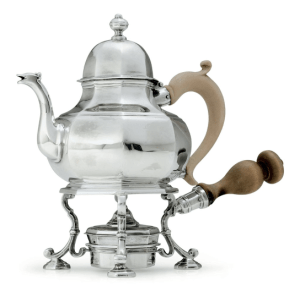

Much of the sale is dedicated to nineteenth-century silver, but there are some lovely eighteenth-century pieces such as a Queen Anne teapot-on-stand (mark of William Pearson, 1712) and this George III honey pot (marks of Paul Storr, 1798). Each is estimated to fetch between $20,000 and $30,000. (For more information click on the images.)
Chimneypieces at Sotheby’s
Press Release (PDF) from Sotheby’s:
Chesney’s Chimneypieces and Fire Furniture, Sale L10311
Sotheby’s New Bond Street, London, 14 September 2010
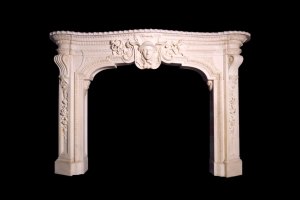
Chimney piece, designed by G.B. Borra c.1755, from one of London’s great “Lost Palaces” Norfolk House, in St James’s square. Estimate: £200,000-300,000
On Tuesday, September 14, Sotheby’s will hold its first-ever sale dedicated entirely to antique chimneypieces and fire grates. The sale –among the first of its kind at a leading auction house – will bring to the market some 200 rare, important and unusual pieces, ranging in date from the 1600s to the 19th century, and emanating from all corners of Europe. Amassed with a discerning eye over a period of some 25 years by Paul Chesney, founder of the leading eponymous fireplace suppliers, the pieces to be sold represent almost the entire antique stock of the company. With the business now focusing on its increasingly international operation of producing and supplying fine reproduction fireplaces, the company’s antique stock is to be released onto the market in a vast sale that will occupy almost all of Sotheby’s New Bond Street gallery space. While the sale as a whole will allow for an overview of chimneypiece design over the course of some 300 years, many of the individual pieces to be offered have interesting stories to tell: some are pieces of great architectural importance; some demonstrate the extraordinary craftsmanship of names such as Robert Adam; some are quirky and unusual; and all are fine examples of their period.
The Norfolk House Chimney Piece
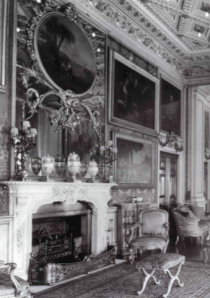 This extraordinary example of the best in fireplace design and execution was, for over half-century, believed to be lost. The crisp, fluently carved piece was once the centerpiece of the Saloon, or “Green Damask Room,” in one of London’s most celebrated “private palaces”: Norfolk House. This splendid palace, the interiors of which were “infinitely superior to anything in this Kingdom… and to most things… in Europe” (Capt. William Farrington, 1748) was built between 1748 and 1752 on the site of an earlier house (also Norfolk House).
While each of the rooms was decorated in a slightly different manner, it was – thanks to the influence of the incurable Francophile Mary, 9th Duchess of Norfolk – the rococo style that dominated. But even the wildest dreams of the indomitable Duchess (or “My Lord Duchess,” as Horace Walpole referred to her) could not have been made real without the creative genius of Italian architect Giovanni Battista Borra (1713-1770), who was responsible for almost every decorative detail inside the house, from the grimacing monkeys above the doorcases in the ballroom, to the rococo extravagance of the Music Room (“the most fluent expression of the rococo to be found in England,” now fully recreated in the Victoria & Albert Museum in London), to the fireplace that, long considered to be lost, now forms the centerpiece of September’s sale. (more…)
Communion Silver Acquired for Birmingham
Press release from the Art Fund (10 August 2010) . . .
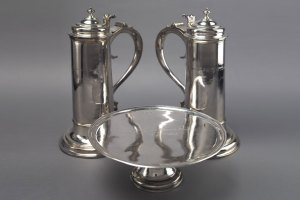 A rare collection of communion silver – with some pieces dating back over 500 years – has just been bought for Birmingham with the help of a £27,000 grant from the Art Fund. The collection consists of a rare pre-Reformation silver parcel-gilt paten engraved with the Manus Dei (‘Hand of God’) c.1450; a silver communion cup (1634) and a pair of silver flagons and standing paten by London silversmith Anthony Nelme. The flagons are engraved with the inscription: ‘A Gift to Castle Bromwich Chapple in the Year 1723’. The silver will initially go on display at Aston Hall, until the end of October, and will then move to its permanent home at Birmingham Museums & Art Gallery.
Stephen Deuchar, Director of the Art Fund, said: “This historic Anglican Communion highlights the history of the local Church and also shows off the work of a leading silversmith. We’re really pleased that Birmingham Museums & Art Gallery will now be its permanent home, so people can admire it for years to come.”
The other funding partners who helped reach the full £54,000 asking price were the MLA/V&A Purchase Grant Fund (£17,000), City of Birmingham Museums & Art Galleries Development Trust (£10,000) and Friends of Birmingham Museums & Art Gallery (£2,000).
Portrait of General Wolfe Tops $600,000 at Bonhams
As reported at Art Daily:

Circle of Joseph Highmore (?), "Portrait of General James Wolfe" Photo: Bonhams
Bonhams Old Master Paintings auction (7 July 2010) made £3,403,920 with a packed saleroom and numerous telephone bidders. The highlight was the sale of the last privately owned portrait of General James Wolfe – the soldier from Kent who conquered Canada – which sold to a Canadian buyer for £400,800.
Wolfe led the British assault on Quebec in 1759, with the resulting Battle of the Plains of Abraham (or the Battle of Quebec) being one of the most celebrated events in British military history and a pivotal victory in the Seven Years’ War. He was mortally wounded during the battle and died on the field; yet his victory earned him posthumous fame and it proved to be a deciding moment in the conflict between France and Britain. The portrait is attributed to the Circle of Joseph Highmore.
The top selling lot of the day was ‘A still life of tulips, a crown imperial, snowdrops, lilies, irises, roses and other flowers in a glass vase with a lizard, butterflies, a dragonfly and other insects’. Painted on copper by Jan van Kessel the Elder, it sold for £804,000. . . .
Porcelain at Bonhams
Press release from Bonhams:

A Naples, Real Fabbrica Ferdinandea cup and saucer Circa 1790-1800 Estimate: £3,500 - 4,500
The fantastic Procida Mirabelli di Lauro collection of Italian porcelain is to be auctioned at Bonhams, New Bond Street on Tuesday 6th July. This Italian single-owner collection, the most comprehensive of its type to ever come on to the market, is expected to fetch £300,000-500,000. Among the highlights of the sale are four plates from the Servizio del’Oca made for King Ferdinand IV’s private use, estimated to sell for £5,000 – £8,000, a rare Doccia perfume bottle, circa 1745-50, estimated to sell for £4,000 – £6,000 and a collection of Doccia snuffboxes, circa 1790, estimated to sell for £5,000 – £12,000. Also on offer are several documentary pieces from the Real Fabbrica Ferdinandea, amongst them a plate with a view of Virgil’s Temple, signed by Antonio Cioffi.
The collection comprises over 100 pieces and was assembled by Roberto Procida Mirabelli di Lauro from the early 1960s until his death in 2009. It includes highlights of Neapolitan porcelain of exceptional diversity and range of objects, from rare 16th century Venetian maiolica to precious late 18th century Doccia porcelain and French and Italian snuff boxes. Many of the pieces have been published in the standard literature on the subject. (more…)










 Enfilade
leave a comment