Sure to Inspire Some Wishful Thinking
Master Drawings New York
New York, 23-30 January 2010 (Opening Reception, 22 January, 4-9PM)
 Master Drawings New York will return to New York City’s Upper East Side for the fourth consecutive year from Saturday 23 January to Saturday 30 January 2010, with an open reception on Friday 22. Twenty-two exhibitors from the United States, the United Kingdom and Spain will be exhibiting with an outstanding selection of works from the 16th to the 20th centuries with prices ranging from $2,000 to over $1 million. The selection of works on paper include oil sketches, watercolours, drawings in charcoal, pencil and pen and ink. All of the galleries included in this Master Drawings week are within walking distance from one another on Manhattan’s Upper East Side.
Master Drawings New Yorkis based on the highly successful Master Drawings London, which was launched in 2001, this week-long event in New York will provide collectors with an opportunity to buy works from twenty-two different exhibitors. New this year are: Didier Aaron, Jill Newhouse, Addison Fine Arts,
Monroe Warshaw, Richard A. Berman and Jose de la Mano Galeria de Arte and
Thomas Williams Fine Art.

Antoine Coypel, “Standing Figure of Minerva, a Shield in Her Right Hand to Protect a Young Boy” Offered by Trinity Fine Art
For the first time this year Didier Aaron Gallery will be participating with a selection of about fifty French 18th-century drawings. The View of an Italian Park by Jean Honoré Fragonard is drawn with a brown wash on paper and dates from 1775. Monroe Warshaw will be showing a Joachim Beuckelaer drawing of The Adoration of the Shepherds circa 1560. The pen and ink drawing is for the St. Ursulakirche painting in Cologne. Jill Newhouse is exhibiting drawings formerly from the collection of Curtis O. Baer including a Max Beckmann Birdplay 1949, a pen and india ink over charcoal. London-based exhibitors Stephen Ongpin will show an untitled work by Jean Michel Basquiat (1960-1988) and Crispian Riley-Smith will be showing an important group of Dutch drawings and watercolours including Woodcutters by Vincent Vinne (1736-1811). Gerald Stiebel will be showing a watercolour, Marriage Ceremony at a Military Encampment by Charles Parrocel (1688-1752) and Margot Gordon will exhibit Pietro Testa’s Three Putti in the Clouds a red chalk study for the painting Adoration of The Magi, in the National Gallery of Scotland, Edinburgh.
Master Drawings New York, now in it’s fourth consecutive year, provides the collector that rare opportunity to spend one week visiting twenty-two different galleries who specialize in drawings and are all located on the Upper
East Side of New York City. Master Drawings London that involves a similar
number of outstanding galleries will take place from July 3-9, 2010.
Old Masters at Bonham’s
As noted at Artdaily.org, sales were strong at Bonham’s Old Masters auction (9 December 2009). A press release from the London auction house outlines the highlights, which included François Boucher’s Les Caresses Dangereuses and a pair of paintings by Johannes Christianus Roedig that established a record price for the artist. The following details for each lot come from Bonham’s website:
◊ ◊ ◊ ◊ ◊
 Lot #62 — François Boucher, Les Caresses Dangeureuses
oil on canvas, 80 x 64.5cm (31 1/2 x 25 3/8in)
Sold for £228,000 inclusive of Buyer’s Premium [pre-sale estimate: £80,000-120,000]
Provenance: Laborde de Méréville sale, Christie’s, London, 6-7 March 1801, Day, lot 14, as A Lady with a Cat by Boucher (bought by Parry for £3.5.0 d.); Mrs Orme Wilson, New York; Her posthumous sale, Parke-Bernet, 25-26 March, 1949, 2nd day, lot 366 (as Attributed to François Boucher and identifying the woman as the wife of the painter [Charles-Antoine] Coypel); Purchased by Mrs Lewis Latham Clark, and thence by descent to the present owner.
Literature: Hermann Voss, “François Boucher’s Early Development,” The Burlington Magazine, March 1953, fig. 69; Alexander Ananoff, François Boucher (Lausanne and Paris, 1976), Vol. I, p. 213, no. 80/2 and fig. 351 (described as a pastel); Pierrette Jean-Richard, L’Oeuvre gravé de François Boucher (Paris, 1978), p.336, implying that it was the work engraved by Joseph de Longeuil, and saying that: “the clumsy treatment of the cat indicates a production of [Boucher’s] youth.”
We are grateful to Alastair Laing for confirming on first hand inspection that the present painting is an autograph work by François Boucher. The composition probably dates from circa 1730/1732 and relates to Longeuil’s engraving, Les caresses dangereuses (see fig. 1), which, owing to certain differences of detail, was most likely based on a later, now lost, version of the subject. In it, Boucher picks up the main motif of a picture that he had painted in a number of versions before he went to Italy, known as La Surprise (cf. exh. cat. Boucher, The Metropolitan Museum of Art, New York; The Detroit Institute of Arts; and the Grand Palais, Paris, 1986-87, no. 2).
The engraving was accompanied by the following verse by Moraine:
Quoique ce Chat, belle Iris, vous caresse,
Défiez-vous toujours de sa patte traitresse:
Il ressemble fort à l’Amour,
Qui flatte, et dans l’instant v[ou]s joue un mauvais tour
For further details, click here»
◊ ◊ ◊ ◊ ◊

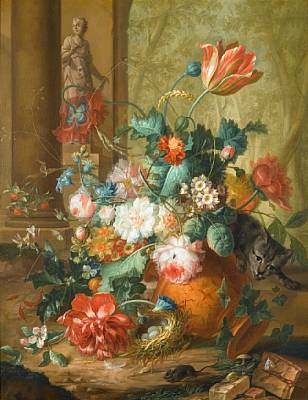
Lot #81 — Johannes Christianus Roedig, (L) Tulips, roses and other flowers in a classical urn overturned by a cat chasing a mouse with a statue of Flora beyond and (R) Peaches, grapes, pumpkins, a lemon, a pomegranate and other fruit and flowers in a wicker basket on a marble plinth, with a classical urn beyond, both signed and dated ‘C Roedig/1779’ (lower right, in brick and lower left, on stone), a pair, oil on panel, 73 x 57.5cm (28 3/4 x 22 5/8in)
Sold for £1,196,000 inclusive of Buyer’s Premium [pre-sale estimate: £700,000-900,000]
Provenance: Sale, Pieter Lyonet, Amsterdam (Bunel and Yver) 11 April, 1791, nos. 217 and 218; Sale, Amsterdam (Van der Schley .. Vinkeles) 7 May, 1804, no. 145; Sale, Wreesman, Amsterdam (Van der Schley .. Vries) 11 April, 1816, no. 154; Private Collection, the Netherlands, circa 1820 and thence by descent until circa 1970; Collection of Miss Wurfbain, Wassenaar, 1983; With Kunsthandel Hoogsteder and Hoogsteder, 1987, whence acquired by the present owner.
Exhibitions: Amsterdam, 1970, Boeket in Willet, no. 26 (only floral still life); De Boer, Amsterdam and Herzog Anton Ulrich Museum, Brunswick, 1983, De vrucht van het verleden, nos. 70-71
Literature: S. Segal, cat. Boeket in Willet, Amsterdam, 1970, no. 26, ill; S. Segal, cat. A Fruitful Past, Amsterdam and Brunswick, 1983, pp. 86-87, nos. 70-71, ill.
It is quite exceptional for examples of this artist’s work of such outstanding quality to appear on the market. Fred Meijer has interestingly pointed out that Roedig must have produced various levels of quality in his oeuvre to cater for a varying clientele. As well as producing individual works of very high quality, such as the present pair, Roedig appears to have produced deliberate fakes (bearing signatures) of such artist as Paul-Thedore van Brussel and Jan Davidsz. de Heem, in which his hand is clearly recognisable. From correspondence between Roedig’s son and the nineteenth century art historian, Adriaen van der Willigen, we know that the artist sold a large number of his works to Russia during his lifetime, which explains why hardly any, let alone his outstanding works, remained in his native Holland. For example, in 1783, the Russian Count Alexander Sergeyevich Stroganov, a confidant of Catherine II, bought two paintings by the artist and gave these to the connoisseur empress. The present pair of paintings thus provide a unique opportunity of acquiring examples of Roedig’s work of this calibre. It is also remarkable that this pair of paintings have remained together since they were painted and that their provenance can be traced back to shortly after their creation in 1791. . . .
For the full entry, click here»
Lighting the Lights
At the start of Hanukkah, some eighteenth-century highlights from the recent sale at Sotheby’s in New York of Important Judaica (Sale 8606, 24 November 2009), as drawn from Sotheby’s website:
◊ ◊ ◊ ◊ ◊
Lot 86: Property of a Descendant of Selig Meier Goldschmidt – An Important German Parcel-Gilt Silver Hanukah Lamp, probably from Augsburg, ca. 1750
Estimate: 200,000—300,000 USD; Hammer Price with Buyer’s Premium: 542,500 USD
 Height 13in. by length 12 3/8 in.
Raised at the front on four lion couchant feet, supporting scroll-based columns draped with floral pendants, each with two putti supporters and topped by figures of Judith, with sword and head, and David, with sling and spear, the backplate centered by a baroque cartouche surrounded by diaper and flanked by cornucopiae spilling flowers and topped by a flower-filled urn, all surmounted by two draped putti (formerly holding a shamas, now lacking), the leaf-form fonts above a shaped apron with fruit pendants, the lion rampant holding the Tablets applied probably later to backplate
Marked with large and small Austrian control mark for Brünn (now Brno, Czech Republic) 1806-07, and twice with Dutch control mark for foreign work (used 1813-1893)
◊ ◊ ◊ ◊ ◊
Lot 160: Medical Diploma of Israel Barukh Olmo, Manuscript on Vellum from Padua, 1755
Estimate: 25,000—35,000 USD. Hammer Price with Buyer’s Premium: 31,250 USD
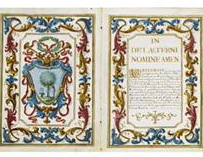 4 leaves (9 ¼ x 6 ¾ in.; 236 x 170 mm); Written in brown and gold ink on vellum, f. 4 blank. Decorated. Contemporary mottled calf, gilt tooled border.
From the 16th through the 18th centuries, the prestigious medical school of the University of Padua was one of the only European institutions of higher education that allowed Jews to attend. According to university records, only 230 Jews graduated in the more than two centuries between 1517-1721. It was customary, upon graduation, to commission diplomas in the form of small richly decorated booklets and the format and style of these diplomas was unique to universities in Northern Italy. The text of the standard diploma, however, included references to Christianity which were unsuitable for the Jewish graduates. As may be seen in the present lot, the university, demonstrating considerable tolerance, allowed for the alteration of the customary Christian formulae. Whereas the standard diplomas from Padua began with the words “In Christi Nomine aeterni” and recorded the date as “Anno a Christi nativitate,” diplomas created for Jews substituted these phrases with “In Nomine Dei aeterni” and “currente anno.”
The coat of arms of the Olmo family, featuring a spouting fountain and a stalk of wheat on either side of a verdant tree, is prominently depicted on the frontispiece within a gilt medallion. Israel Barukh Olmo, the recipient of this diploma, was born in Ferrara to Jacob Daniel Olmo (1690-1757), a noted Italian rabbi and poet. Jacob served as the head of the yeshivah in Ferrara and also as the rabbi of the Ashkenazi synagogue. He authored numerous works including occasional poems and hymns, legal decisions, a poetic drama entitled Eden Arukh, as well as a volume documenting the rabbis of the Ashkenazi synagogue of Ferrara. Israel Barukh Olmo followed in his father’s footsteps and, in addition to his medical studies, authored occasional poems such as the one celebrating the wedding of Asher Chefetz (Anselmo Gentili) and Abigail Luzzatto circa 1750 (JTS library MS 9027 V1:9).
Literature & References: Vivian B. Mann, ed. Gardens and Ghettos: The Art of Jewish Life in Italy (1989), p. 235; Natalia Berger, Jews and Medicine: Religion, Culture, Science (1995).
◊ ◊ ◊ ◊ ◊
Lot 169: A Magnificent Illustrated Esther Scroll, from Prague, ca. 1700
Estimate: 100,000—120,000 USD. Hammer Price with Buyer’s Premium: 134,500 USD
 Ink on parchment (12 ¼ x 103 in.; 310 x 2620 mm). Text written in square Hebrew script arranged in 16 columns of 25 lines on four membranes. Few very light stains. Housed in a turned cylindrical wooden case.
This splendid scroll of Esther is an extremely rare example of a megillah with a superb engraved border created by the artist Paul-Jean Franck. The eighteenth century witnessed the growth and success of numerous publishers of Hebrew books. These printers, presumably looking to further expand their market, undertook to produce illustrated megillot for use on the holiday of Purim. Recognizing that according to Jewish law, Esther scrolls must be written by hand in order to be ritually fit, the printers engraved highly decorative borders onto prepared parchment and left blocks of blank space within these borders, so that a scribe might insert the biblical text. The majority of eighteenth-century megillot with engraved borders were produced in Amsterdam and Venice. This Bohemian scroll, however, is an exceptionally rare example of a printed border published outside of these two centers. The signature of its remarkably skilled engraver, Paul-Jean Franck, can be found in the first panel of this scroll. . .
Literature & References: Cohen, Mintz and Schrijver. A Journey through Jewish Worlds. Highlights from the Braginsky Collection of Hebrew Manuscripts and Printed Books (Amsterdam: 2009), pp. 266-67.
For the full description, click here»
Eighteenth-Century Footnote to Raphael’s $48million Drawing
As Enfilade observed back in October when the announcement was first made regarding the sale of Raphael’s Head of a Muse, the drawing comes with an interesting eighteenth-century provenance; it once belonged to the Dutch collector Gosuinus Uilenbroek and the British painter Sir Thomas Lawrence. Last night in London, the work sold for a record $48million. As reported by Kelly Crow in the Wall Street Journal:
 A rare Raphael chalk drawing of a woman’s head sold for a record £29.1 million, or $48 million, at Christie’s in London – the highest price paid all year for a work of art at auction. In the same sale, Christie’s sold a Rembrandt portrait that hadn’t been seen in public for nearly four decades for a record £20.2 million pounds, or $33.2 million. Raphael’s Head of a Muse sold to an anonymous buyer for double its high estimate, a sign that collectors are willing to chase after older masterpieces even as global prices for living artists remain shaky. The work’s price outperforms a Henri Matisse table scene that Christie’s sold this spring for $46.5 million and an Andy Warhol screenprint of 200 dollar bills that Sotheby’s sold last month for $43.7 million. . .
For the full article, click here»
Books and Manuscripts Sale at Sotheby’s
As noted on NPR’s Morning Edition (Wednesday, 28 October 2009), autograph letters of Lord Byron to his friend Francis Hodgson are up for auction tomorrow at Sotheby’s in London. They probably don’t shed lots of light art historically, though — as noted on the Sotheby’s site — they are relevant for the later history of the Grand Tour. In fact, the sale generally is useful for materials related to travel and exploration. From NPR’s website:

Sotheby's London, 29 October 2009, Lot 19. Estimate: 150,000-180,000 GBP
The British poet Lord Byron is well-known for his flamboyance. He had love affairs with women, men and the occasional relative, and one mistress called him “mad, bad and dangerous to know” — all of which makes his friendship with Francis Hodgson a surprise. Byron and Hodgson, a clergyman whom the poet met at Cambridge, maintained a spirited, lifelong correspondence through letters. Now, a collection of their letters dating from 1808 to 1821 is up for auction at Sotheby’s. Gabriel Heaton, who works in the books and manuscripts department at Sotheby’s, describes the letters as “just beautiful.” “The way that you can get a sense of Byron’s thought process from his letters is just spine-tingling,” he tells Renee Montagne. “There’s always something interesting going on in Byron’s life, and he always expresses it so wonderfully.” The letters include Byron’s witty, sometimes crude, commentaries on various European cities, including Lisbon, Portugal, where, he writes, the only vices of the people are “lice and sodomy.” The letters also reveal a more fragile side of the poet, including the sadness he felt at the collapse of a romantic relationship with a maid named Susan Vaughn. . . .
For the full story, click here»
This Week at Auction
A sample of images from the upcoming sale at Sotheby’s, London (with a nod here toward All Hallows’ Eve); from Sotheby’s website:
Sotheby’s, ‘Old Master & Early British Paintings’
London, Thursday, 29 October 2009

Lot 97: Spanish School, 19th Century. Six Vanitas Still Lifes — A set of six, all oil on zinc, octagonal (two illustrated out of six). Each: 23 by 24 cm cm.; 9 by 91/2 in. Estimate 5,000 – 7,000 GBP
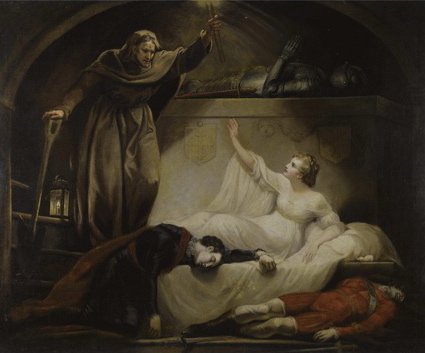
Lot 137: James Northcote, R.A., Plymouth (1746 – 1831) London, Friar Lawrence at Capulet’s Tomb, Romeo and Juliet, Act V, Scene 3, oil on canvas, 274 by 334.5 cm., 108 by 131 3/4 in. Estimate 10,000 – 15,000 GBP. Provenance: Boydell’s Shakespeare Gallery; Christie’s London, Boydell Gallery sale, 3rd day, 20th May 1805, lot 51, sold to G. Stainforth Esq for £210; Lord Northbrook, Stratton Park; Stratton Park sale, 27 November 1929, lot 492. Exhibited: Fondazione Magnani Rocca, Parma, Italy, Fuseli and Shakespeare. Painting and Theatre 1775-1825, 6 September 7 December 1997; Heim Gallery, The Painted Word, British History Painting 1750-1830, 1991, no. 66. Literature: S. Gwynn, Memories of an 18th Century Painter, 1898, p. 273, no. 254; W. M. Merchant, Shakespeare and the Artist, 1959, p. 238; W. H Friedman, Boydell’s Shakespeare Gallery, New York (Garland). The image was engraved P. Simon and J. Heath for J. Boydell’s collection.

 Lot 135: Joseph Wright of Derby, A.R.A. (1734-1797), Portrait of John Mason of Morton Hall, Retford, later inscribed verso: Mr John Mason of Retford, oil on canvas, 75 by 62 cm., 291/2 by 241/2 in. Estimate: 8,000 – 12,000 GBP. Provenance: Commissioned by the sitter’s family; thence by descent. Literature: Benedict Nicolson, Joseph Wright of Derby, Painter of Light, 1968, Vol.I, p. 2 and pp.212-13, no.104.
Lot 136: Joseph Wright of Derby, A.R.A. (1734-1797), Portrait of Catherine, Mrs John Mason of Morton Hall, Retford, later inscribed verso: Catherine wife of Mr John Mason of Retford, oil on canvas, in a painted oval, 75 by 63 cm., 291/2 by 243/4 in. Estimate: 8,000 – 12,000 GBP. Provenance: Commissioned by the sitter’s family; thence by descent. Literature: Benedict Nicolson, Joseph Wright of Derby, Painter of Light, 1968, Vol.I, p. 2 and pp.212-13, no.105.
Catalogue Note: Wright of Derby and the Mason of Morton Hall
The Masons were a prominent Nottinghamshire family in the later 17th and early 18th Century. They settled at Eaton, south of Retford where they had estates and were involved in the local leather trade. They also had considerable political power being one of the eight families who controlled the voting of the rotten borough of East Retford which returned two MPs to Westminster. The family acquired additional estates including the Manor of Morton in 1746. They continued to prosper and it was typical that they should sit for their portraits to the most famous of all Midland artists, Joseph Wright of Derby. Having established himself in his native Derby as a portrait painter in the 1750s, in 1760 Wright had sufficient confidence in himself to embark on a protracted tour of his neighbouring Midland towns. Offering his service as portrait painted to local middle-class families, he was in Retford, Nottinghamshire and then Lincoln in March. By April he had returned to Retford whilst also visiting Newark, Boston, Thorne and Doncaster in that same year. During one of these frequent visits to Retford Wright painted the present three portraits of members of the Mason family of Morton Hall.
Raphael Drawing and Its Eighteenth-Century Provenance
As reported this week by various news outlets (including The Guardian, The Telegraph, and Reuters), a drawing by Raphael is up for auction in December. The Financial Times notes that “it comes to the block after the Fitzwilliam Museum in Cambridge was unable to raise funds over the summer to purchase the drawing by Private Treaty Sale.” As reported by Artdaily.org:
 LONDON — Christie’s will offer an exceptional drawing by Raphael (1483-1520) at the Old Masters and 19th Century Art Evening Sale on Tuesday, December 8, 2009 in London. Head of a Muse was drawn by the artist as a study for a figure in Parnassus, one of the series of four frescoes in the Stanza della Segnatura in the Vatican which was commissioned by Pope Julius II and which was executed between 1508 and 1511. This series is widely considered to be the artist’s greatest masterpiece. The drawing will be offered at public auction for the first time in over 150 years at Christie’s in December and is expected to realize £12 million to £16 million. The current record price for an old master drawing sold at auction is £8.1 million which was realized by Michelangelo’s Risen Christ at Christie’s in July 2000, and by Leonardo da Vinci’s Horse and Rider, also at Christie’s, in July 2001. . . .
The drawing was first recorded in 1725 when it was engraved by Bernard Picart to be published in Impostures Innocentes. At the time it belonged to the celebrated Dutch collector Gosuinus Uilenbroeck (d.1741) who assembled one of the most important private libraries of the period, together with a number of splendid old master drawings. The drawing was subsequently in the collections of Sir Thomas Lawrence (1769-1830), the distinguished painter who was also one of the most celebrated old master drawing collectors, and the future King William II of Holland (1792-1849) who assembled one of the finest art collections in Europe.
◊ ◊ ◊ ◊ ◊
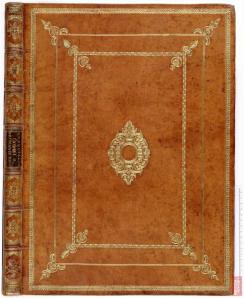
Carolus de Aquino, "Sacra exequialia in funere Jacobi II. Magne Brittanniae Regis" (Rome, 1702)
From an eighteenth-century vantage point, it’s the provenance that’s especially interesting. Lawrence’s ownership is notable, but my hunch is that the “celebrated” Dutch collector, whose name is more commonly spelled Gosuinus Uilenbroek, is largely unknown even to dixhuitièmistes. Perhaps the sale of the drawing will help make him more familiar. The British Library’s Database of Book Bindings — a remarkable resource, incidentally — includes several examples from Uilenbroek’s library.
— Craig Hanson
Birthday Surprises — Watteau Turns 325 Today
On this, the 325th birthday of Jean-Antoine Watteau (1684-1721), it’s worth recalling the circumstances surrounding the recent discovery and sale of La Surprise, which is, incidentally, included in the Watteau, Music, and Theater exhibition now on at the Metropolitan Museum of Art in New York. From ArtDaily.org, 9 July 2008:

Jean-Antoine Watteau, “La Surprise,” oil on panel, 14.1/2 x 11.1/2 inches, ca. 1718
LONDON — A recently rediscovered masterpiece by Jean-Antoine Watteau (1684-1721) sold at Christie’s auction of Important Old Master and British Pictures this evening for £12,361,250 / $24,376,385 / €15,513,369, a world record price for any French Old Master painting sold at auction. La Surprise had been missing for almost 200 years, presumed to have been destroyed, and was previously known only by a copy in the Royal Collection at Buckingham Palace and through a contemporary engraving. It was found in the corner of a drawing room in a British country house during a Christie’s valuation last year.
Richard Knight, International Director of Christie’s Old Master Department and Paul Raison, Director and Head of Old Master Pictures at Christie’s, London: “We are thrilled to have realised a record price for La Surprise by Jean-Antoine Watteau, who is recognised as one of the most influential artists in the history of European art. It was extremely exciting to have rediscovered the painting last year, its whereabouts having been a mystery for almost 200 years, and it has been a great honour to have shown the picture to the public for the first time in over two centuries during pre-sale exhibitions in London, Paris, New York and St Petersburg. This is not only one of the most extraordinary rediscoveries of recent years, but also the most expensive French Old Master painting ever sold at auction, and we are pleased to have welcomed international interest from a number of collectors and institutions at this evening’s sale” . . .
La Surprise by Jean-Antoine Watteau (1684-1721) was painted circa 1718 and was first owned by Nicolas Henin (1691-1724), an Advisor to the French King who was one of Watteau’s best and most constant friends. It is likely that the work was painted for Henin together with its pendant L’Accord Parfait, now in the Los Angeles Museum of Art. The legendary connoisseur and collector Pierre-Jean Mariette (1694-1774) noted in his Abecedario of 1746 that La Surprise is “one of [Watteau’s] most beautiful paintings.” On Nicolas Henin’s death in 1724, the two paintings went to the artist’s friend and biographer Jean de Jullienne (1686–1766) who had them engraved and published in the Recueil Jullienne, and who seems to have split the pair and sold them before 1756. La Surprise next appears in the celebrated collection of Ange-Laurent de La Live de Jully (1725-1779), who is recognised as assembling the first serious art collection dedicated to the encyclopedic display of French painting. The catalogue of his collection was published in 1764 and describes La Surprise as executed “with a piquant touch and richly tinted with the color of Rubens.” The picture had left the collection by 1770 and amidst the turmoil of the French Revolution, it is not recorded until it appears in a Lady Murray’s probate valuation of 1848, by whom it was bequeathed to the family of the vendors at this evening’s auction. The painting’s attribution and significance had remained lost until its rediscovery last year. . .
Jean-Antoine Watteau (1684-1721) was born in the Flemish town of Valenciennes, which had passed to France from Spanish rule just six years earlier, and left for Paris in about 1702. He was to be influenced by Flemish art throughout his career, and was often considered a Flemish painter by his contemporaries. In Paris, he worked with Claude Gillot (1673-1722) and became fascinated by theatre costume and stage design, before moving to the workshop of Claude Audran III, curator of the Palais du Luxembourg where Watteau was introduced to Rubens’s magnificent and inspirational canvases painted for Queen Marie de Medici. The work of Rubens was to influence Watteau throughout his career as he revitalised the Baroque style and became a pioneer of Rococo art. Watteau was frail and subject to ill health throughout his life and in 1720, he travelled to London to visit Dr. Richard Mead, a celebrated physician, in the hope of medical relief. Unfortunately, the climate and air quality in the city hindered any progress and he returned to France where he died in 1721 at the age of 37.
Market News: Porcelain Still Prized
From the Art Newspaper, 29 September 2009:
Porcelain Sales Unharmed by Economic Crisis: Shortage of Pieces Keeps Demand High
By Bettina Krogemann
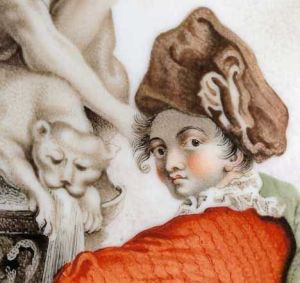
Small gold-mounted Meissen snuff box (detail), 1738, inspired by Watteau
MUNICH — Some sectors of the art market have been largely unaffected by the economic downturn, delegates were told at the annual conference of Confédération Internationale des Négociants en Oeuvres d’Art (Cinoa) held in Munich from 25-27 June.
According to Friedel Kirsch of the Elfriede Langeloh gallery in Weinheim, who specialises in early German porcelain: “Certain areas of collection are reacting in quite a different way to the economic crisis. Demand for 18th-century German porcelain, especially Meissen, remains unchanged.” Kirsch adds: “In fact, prices for finest-quality porcelain have been increasing for years and have risen even faster since the beginning of the recession. We have seen this happen with tableware, figurines and groups.”
Herbert van Mierlo, director and expert in works of art, furniture and porcelain at Sotheby’s in London, explains: “The market is dominated by a relatively small group of specialised, devoted collectors looking for exquisite pieces. Because of this, the market for porcelain has remained practically immune from the negative effects of the financial crisis, especially in comparison to the general art market.” According to Van Mierlo, “the price tendency for good porcelain is clearly upward as long as the collectors remain eager. The big and difficult challenge for the auction houses is to find the right pieces.” His view is shared by Rodney Woolley of Christie’s in London where, on 2 June 2009, bidding rose to £121,250 for a small gold-mounted Meissen snuff box dating from 1738, decorated on the inside with a delicately painted scene inspired by Watteau.
For the full article, click here»
Settecento at Auction
Market Watch
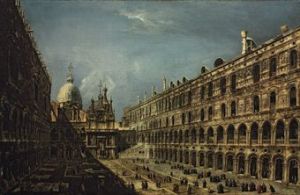
Marieschi, Courtyard of the Doge’s Palace, ca. 1735
As reported by Bruce Millar in The Art Newspaper (9 July 2009), old master paintings are “out-performing the summer’s impressionist, modern and contemporary sales for the first time in several years.”
At Christie’s, eighteenth-century Venice ranked among the top sellers. Courtyard of the Doge’s Palace, by Michele Giovanni Marieschi, ca. 1735, fetched £2,169,250 ($3,512,016) – just above the minimum estimated price of £2,000,000.
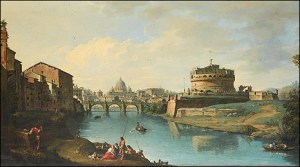
Zocchi, View of the Tiber Looking towards the Castel Sant'Angelo and Saint Peter's, mid-eighteenth century
And at Bonhams, View of the Tiber Looking towards the Castel Sant’Angelo, with Saint Peter’s in the Distance, a painting newly attributed to Giuseppe Zocchi (1711-1767) that was estimated at just £150,000-250,00, set a new record for the artist at £1.3m. It had previously been assigned to Locatelli until a sketch by Zocchi matching the painting was discovered.










 Enfilade
leave a comment