At Auction | Chardin’s Basket of Wild Strawberries
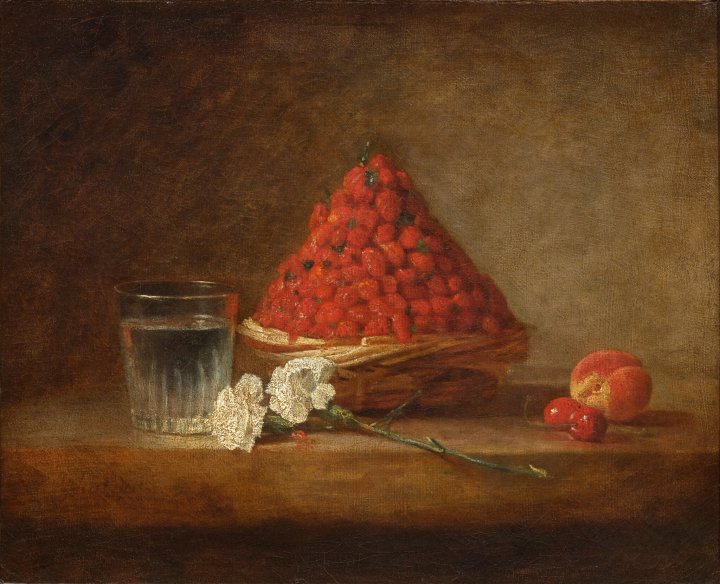
Jean-Siméon Chardin, The Basket of Wild Strawberries, shown at the Salon of 1761, oil on canvas, 38 × 46cm. The painting sold for €24,381,400 on 23 March 2022 at Artcurial in Paris. More information is available here.
◊ ◊ ◊ ◊ ◊
From The New York Times and Art Daily:
Laura Zornosa, “Louvre Bids to Keep a Chardin Bought by U.S. Museum in France,” The New York Times (4 May 2022). The Kimbell Art Museum in Texas is revealed to be the buyer of “Basket of Wild Strawberries,” at auction. The Louvre has been working to name it a national treasure.
On a computer screen, the still life Basket of Wild Strawberries by the 18th-century French painter Jean Siméon Chardin is quiet and unassuming. His talent in capturing the reflection of light off the rim of a water glass is muted in that setting. In person, though, it casts a spell.
“It’s deceptively simple, and it’s absolutely captivating and it’s magical,” said Eric Lee, the director of the Kimbell Art Museum, which bought the work at auction in France in March for more than $22 million. “The painting completely mesmerized me, and it mesmerizes almost anyone who sees it.”
But now the Kimbell, whose successful bid for the work was first reported by the Art Newspaper of France, has to wait to see whether it can actually export the picture, which it purchased at the auction house Artcurial in Paris.
The Louvre has requested that the artwork be classified as “a national treasure” and is looking for sponsorship to purchase it. Under French law, the export can be frozen for 30 months, or 2 1/2 years.
“We are fully mobilized to bring it into the national collection,” Laurence des Cars, president and director of the Louvre, told Le Figaro in March. . . .
The full article is available here»
The British Museum Releases NFTs of Piranesi Drawings

Giovanni Battista Piranesi, A Classical Forum with Steps and a Column, ca.1748–52, pen and brown ink, grey-brown wash, and red chalk
(London: The British Museum, 1908,0616.10)
◊ ◊ ◊ ◊ ◊
From the press release, via Art Daily:
For its latest collaboration with The British Museum, LaCollection has announced a new NFT drop drawn from a selection of 20 pen and chalk drawings from The British Museum’s collection by the Venetian-born artist Giovanni Battista Piranesi (1720–1778).
Piranesi is regarded as one of the greatest Italian printmakers of the 18th century, best known for his atmospheric representations of Roman antiquity, and in later years, his celebrated series of fictional prisons, La Carceri. His exceptional work as a draughtsman is less well known; yet, his drawings reveal the evolution of his practice and the relentless experimentation and innovation that underpinned his virtuoso ability with the etching needle.
Works included in this drop chart the evolution of the artist from early scenographic drawings to his more elaborate fantasy interiors. The selection includes some of the earliest drawings in The British Museum’s collection relating to his Prima Parte (1743) series of etchings of imaginary temples, palaces and the ruins of Rome.
A Monumental Staircase in a Vaulted Interior with Column (1750–55) is one of the most impressive Piranesi drawings in technique and scale found at The British Museum. Showcasing a mastery of craft, Piranesi deconstructed classical architecture language and reinvented it through dynamic compositions that animate and exaggerate the space; the use of red chalk combined with brown ink is unique in the Museum’s collection.
Piranesi’s drawings were investigative tools for experimentation that explore complex exercises in perspective and spatial representation as well as compelling fantasies. One such example is Architectural Fantasy with Monuments, Sculpture, and Ruins (1760–65), a fantasy scene bringing together a creative selection of different Roman monuments interspersed with figures drawn in miniature to accentuate the grandeur of the landscape.
The 20 artworks will be sold across three scarcity levels:
• Six will be Ultra Rare (two editions, one of which will be retained by The British Museum).
• Nine will be Super Rare (ten editions, one of which will be retained by The British Museum).
• Five will be Open Edition (a maximum of 50 editions will be sold with the final edition number set at the end of the primary sales window; one edition will be retained by The British Museum).
Ultra Rare artworks will be sold by auction, with a starting price of €4,000. Super Rare and Open Edition artworks will be sold at fixed price, selling for €2,000 and €499 respectively. Three preview artworks will be available to purchase from 25 April with the main drop starting on 2 May. All public sale artworks will be dropped by 13 May and the primary sales window will close on 30 June; after this point, no further sales of these artworks will be made by The British Museum. There will be a preferential sales window, closing on 15 May, after which the price of each Super Rare artwork will increase to €3,000 and each Open Edition to €749. For all existing NFT collectors there will be a private drop on 28 April and a final one on 16 May; artworks available to purchase in these drops will not be available in the public sale.
◊ ◊ ◊ ◊ ◊
Anyone looking for an introduction to NFTs might start with Kevin Roose, “What are NFTs? The Latecomer’s Guide to Crypto,” The New York Times (18 March 2022). Among the questions critics raise are the environmental impacts; some estimates place the carbon footprint of an NFT as equal to a month’s worth of electrical consumption for a person living in the EU, as noted by Justine Calma, “The Climate Controversy Swirling around NFTs,” Verge (15 March 2021). Also, see Charlotte Kent, “Can You Be an NFT Artist and an Environmentalist?” Wired (17 February 2022). –CH
At Christie’s | Old Masters
From the press release (via Art Daily) for the sale at Christie’s:
Maîtres Anciens: Dessins, Peintures, Sculptures, Sale 21059
Christie’s, Paris, 18 May 2022

Jacques Joseph André Aved (1702–1766), La dessineuse, oil on canvas, €150,000–250,000.
Ahead of the Salon du Dessin, which will be held from the 18th until the 23rd of May, Christie’s will present its sale dedicated to the Old Masters, led by an unpublished drawing by Michelangelo, one of the few still in private hands. The Old Masters sale will highlight a set of drawings, paintings, and sculptures carefully selected by our specialists. Major artists such as Théodore Gericault, Elisabeth Louise Vigée le Brun (whose painting has not been seen on the market since 1847), Jean-Baptiste Oudry, and Nicolas de Largillierre will be showcased in dialogue with the masters of drawing, such as Jean-Honoré Fragonard, Charles Natoire, and Jean-Antoine Watteau. The medium of sculpture will be represented including a splendid pyxis, enamelers such as Pierre Veyrier II, Jean II Pénicaud, and Léonard Limosin. The works will be exhibited alongside new creations by interior designer Hugo Toro. The sale consists of 264 lots for a global estimate of €6–9 million.
Drawings
The Old Master and 19th-Century Drawings Department will be highlighted with the drawing by Michelangelo, a nude man (after Masaccio), and two figures behind, along with a selection of about a hundred sheets under the common theme of rediscovery. They begin in the 17th century, with three unseen drawings by Martin Fréminet (1567–1619), an emblematic painter of the Fontainebleau School: Sketch for a Ceiling with an Allegorical Figure of Faith (€70,000–100,000), Study for a Biblical King (€20,000–30,000), and Medallion with Two Harpies and Garlands (€7,000–10,000). These studies, rendered in graphite and brown wash, are preparatory sketches for the painted decoration of the Trinity Chapel of the Château de Fontainebleau.
The French school will be well represented with such artists as Charles de La Fosse (1636–1716), Jean-Honoré Fragonard (1732–1806), Charles Natoire, and Jean-Antoine Watteau (1732–1806)—including a red chalk representation of A Couple Walking in a Landscape (€100,000–150,000) and Jean-Baptiste Greuze (1725–1805) with another beautiful ink and wash sheet representing Silenus’s March (€30,000–50,000). The latter drawing comes from the collections of Vincent Donjeux (1793), the Baron Charles de Vèze (1855), and François Walferdin (1860).
Paintings
The Old Master Paintings Department will present some beautiful rediscoveries, including a charming Portrait of a Child by Jacques Joseph André Aved (1702–1766), which illustrates perfectly the sometimes profoundly intimate art of 18th-century portraiture. The painting, called the La dessineuse, also testifies to the close artistic links between Aved and his friend Jean Siméon Chardin (1699–1779). Coming straight from the descendants of the artist, this painting will be sold for the first time since its inception. Estimated at €150,000–250,000, it will be presented with another important work from the same collection.
Another highlight from the painting section is a rare oil painting by Nicolas de Largillierre (1646–1756), whose religious subject makes it stands out within the artist’s corpus. This Saint Barthélemy (ca. 1710), with naturalistic features and bathed in divine light, was attributed to the artist only in 2003 by Dominique Brême, on the occasion of the exhibition at the musée Jacquemart-André. Brême recognized in the painting one of the apostles that decorated the painter’s elegant Parisian home on the rue Geoffroy-l’Angevin. It is estimated at €60,000–80,000.
Finally, with a distinguished provenance (which includes Delacroix’s personal collection, as well as Prince Napoléon’s and the collection of the Elie de Rothschild), a portrait of a soldier titled Lancier from the 1er Régiment de Chevau-Léger-Lanciers de la Garde, called Polonais, by Théodore Gericault (1791–1824) will number among this sale’s exceptional works (€80,000–100,000). Here, we find a few of the themes that were so dear to the artist and which herald romanticism, such as horses, battle scenes, and soldiers—themes that celebrate the artist’s ideals of liberty, heroism, and wonder.
Sculpture
Alexandre Mordret-Isambert, new specialist in sculpture in Paris, presents a selection that includes a rare liturgical object executed in Limoges during the second half of the 13th century, A Virgin and Child forming a pyxis. No equivalent is known in museums or private collections. The sculpture, in a very good state of preservation, has remained hidden from view since being exhibited at the Universal Exhibition of 1900. The pyxis comes from prestigious collections: first the Frédéric Spitzer collection (1815–1890), then the Victor Martin Le Roy collection (1842–1918), then by descent to his daughter Jeanne, wife of Jean-Joseph Marquet de Vasselot (1871–1946), curator at the Louvre and then director of the Cluny museum, an important collector of medieval and Renaissance art objects. In November 2011, Christie’s sold 24 works from the Marquet-Vassselot collection, including a carved ivory group representing The Virgin and Child Enthroned for €6,337,000. The family still kept this treasure. Many objects from the collection are now in museums, including the Louvre and Cluny.
Art Market | Court, Epic, Spirit: Indian Art, 15th–19th Century
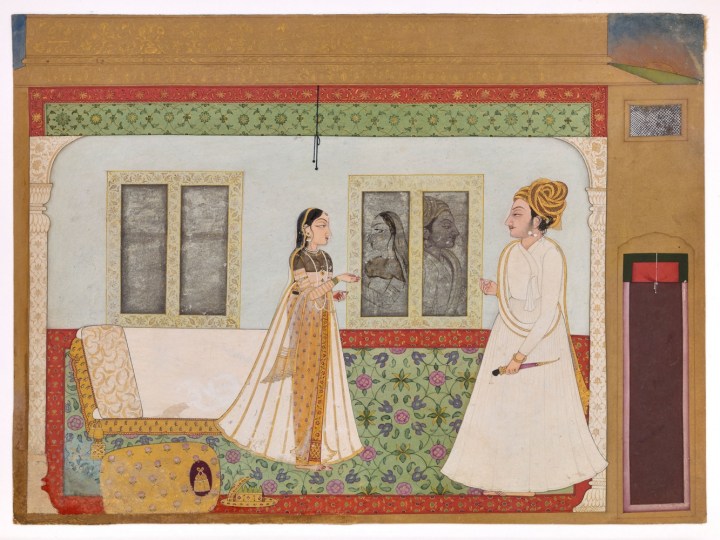
Return of the Unfaithful Lover, Khandidta Nayika, ca. 1720, Nurpur, opaque pigment and gold on paper, 20 × 26 cm.
◊ ◊ ◊ ◊ ◊
From Luhring Augustine:
Court, Epic, Spirit: Indian Art, 15th–19th Century
Luhring Augustine Tribeca, New York, 26 January — 24 March 2022
Luhring Augustine, in association with Francesca Galloway, is pleased to present Court, Epic, Spirit: Indian Art, 15th–19th Century, a show of historical artworks from India opening on January 26. It marks the first time that Luhring Augustine has partnered with the London-based gallery Francesca Galloway, internationally renowned in the field of Indian art. Court, Epic, Spirit presents a variety of artworks including textiles, paintings, and courtly objects. The title of the exhibition refers to three key lenses through which to view the arts of India. With these organizing principles as a guide, these exceptional and iconic works of art can be more fully considered and understood.
A fine and grand 17th-century panel from a lavish royal tent is among the exhibition’s featured objects. The panel is part of an important group thought to have been produced in the Deccan, a region of central India. For both Rajput and Mughal rulers, tents were immensely important, especially to the latter given the nomadic lifestyle required to govern their vast empire.
Indian painting is above all a storytelling medium, created to illustrate epic texts. These narratives, and the paintings that accompanied them were an integral aspect of the region’s cultural traditions throughout this period. A work of particular importance in the exhibition is a recently discovered 16th-century painting from the early Imperial Mughal manuscript of the great epic, the Hamzanama (‘Story of Hamza’), one of the supreme achievements of Indian art. Commissioned by a young Emperor Akbar, it is the only known folio depicting this episode and represents a significant addition to the scholarship, not least because it was painted by Dasvant, a master artist in the Imperial atelier.
Also significant to the artistic output of the region were artworks focusing on worship—some depicting and enabling acts of revery, and some imbued with spiritual power. Hindu ragamala paintings depict verses that in turn evoke a mode of music. Through a very unusual group of 17th-century ragamala paintings, most likely from the northern Deccan, the connection between sound, image, and spirit can be explored. Their wild sense of color and proportion, coupled with stark architecture and sumptuous textiles, lend these paintings an assured and individual aesthetic. Another highlight of the show will be a masterpiece of painting on cloth illustrating Dana Lila, or Krishna playfully demanding a toll from the gopis. This type of Deccani pichhvai, a painted cotton temple cloth, is rare, with only a handful of examples in museum collections around the world.
An additional highlight of the exhibition is the facade of a magnificent late 18th- or early 19th-century Mughal-style pleasure pavilion, a large-scale architectural marvel. The pavilion, installed at our Bushwick location, is available to view by appointment. Court, Epic, Spirit: Indian Art, 15th–19th Century will be on view at the Tribeca location through 24 March 2022 and will be accompanied by an illustrated catalogue.
At Colnaghi | Naples

Presepe, made in Naples, mid-18th century to early-nineteenth century, oil painted terracotta, carved wood, painted glass, shaped wire, tin, and cork, with stitched silks and linen, 113 × 173 × 108 inches (private collection).
◊ ◊ ◊ ◊ ◊
From the press release, via Art Daily, for the exhibition at Colnaghi, London:
Naples
Colnaghi, London, 3 December 2021 — 25 February 2022
Opening in conjunction with London Art Week (3–10 December), Colnaghi presents a special exhibition showcasing the enduring creative legacy of Old Master artists and artisans from Naples, marking the first exhibition in London devoted to the Italian city and its arts in over forty years. As the centrepiece of Naples, Colnaghi, together with Dario Porcini, present a magnificent 18th-century crèche, known in Italian as a presepe, a monumental nativity scene traditional to Baroque Naples. The exhibition also features a selection of religious, landscape, and still-life paintings by some of the greatest artists who worked in the city during the 17th and 18th centuries and served as inspiration for the craftsmen of the presepe, including Jusepe de Ribera, Luca Giordano, and Massimo Stanzione. Naples is on view at Colnaghi from 3 December 2021 through the festive season, until 25 February 2022.
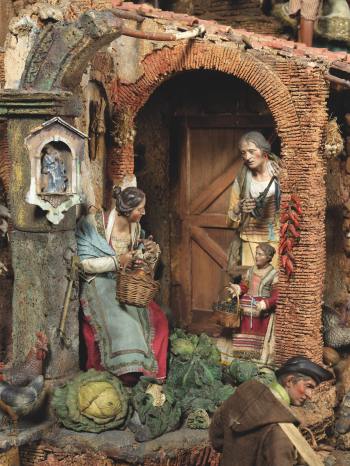 “Our winter exhibition in London transports our visitors to Baroque Naples and will feature important paintings by masters of the period, as well as a monumental presepe,” says Chloe Stead, Senior Global Director of Colnaghi. “Boldly transgressing artistic hierarchies, presepi unite different media and techniques to realise extraordinarily elaborate and exuberant nativity scenes that provide incredible glimpses into life in Naples at the time. Our presepe, created during the golden age of these works, is one of the most important examples outside Italy and reflects all the vitality and craftsmanship for which the Italian city is still known.”
The recreation of nativity scenes with modelled figures and animals during Christmastime was widespread throughout Italy in the 13th and 14th centuries. By the 18th century, what originally had been a relatively simple temporary tableaux underwent a transformation in Naples into highly dramatic and theatrical creations, often monumental in scale. These crèches combined traditional sacred elements of nativity scenes—the Holy Family, wise men, angels, and shepherds—with aspects of contemporary Neapolitan life—rowdy tavern scenes, processing musicians, and bawdy market shopkeepers—in dazzling displays of artistic techniques.
The presepe at Colnaghi, dating from the 18th century, is one of the very few and finest of these masterpieces of the Italian Baroque outside Naples. Crafted from oil painted terracotta, carved wood, painted glass, shaped wire, tin, and cork, with stitched silks and linen to recreate the detailed fashions of the time, the presepe stages the sacred scene in a true-to-life Neapolitan setting and measures a remarkable 340 × 445 cm.
Carmine Romano, translated by Gordon Pole and Caroline Paganussi, The 18th-Century Neapolitan Crèche: A Masterpiece of Baroque Spectacle (Naples: Porcini, 2021), 175 pages, ISBN: 978-8894136470. Available as a PDF file here»
Other exhibition highlights include:
• Two paintings by Jusepe de Ribera, including an Ecce Homo, signed by the artist and dated to 1644 and considered a high point of Neapolitan Baroque art; and Saint John the Baptist, 1630s, which showcases the bold gesture and a melancholic landscape typical of this artist.
• The Penitent Magdalene from the early 1640s by Massimo Stanzione, considered a great rival to Ribera. Signed with an elegant monogram, this well-preserved picture with its vivid, jewel-like sky is particularly unusual example of the artist’s work on copper.
• Two large-scale canvases by the celebrated artist of the later Baroque period, Luca Giordano, who was trained by Ribera. The Triumph of Galatea from the artist’s Roman period, ca. 1675–77, and Shepherds with their Herd (The Riches of the Earth), 1684, both reflect the artist’s ability to express the drama and pathos of religious and mythological subjects.
• Still lifes of fish, crustaceans and other seafood by Giuseppe Recco and his daughter Elena Recco from the 17th century, including two loans from the collection of Lord and Lady Rosse that have never before been presented outside of the dining room of Birr Castle.
• Landscape paintings by Antonio Joli, lent by Lord Montagu from Palace House, Beaulieu, presenting views of Naples-one depicting the Palazzo Reale and Castel Nuovo, and the other a view of the Largo di Palazzo at Carnival time. The works were commissioned by an ancestor of Lord Montagu during his Grand Tour.
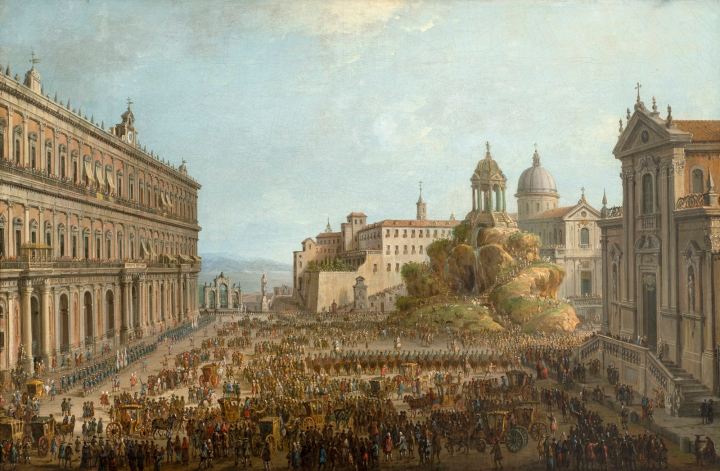
Antonio Joli, Naples, A Festival with a Cuccagna at the Largo di Palazzo, ca. 1756–58, oil on canvas, 19 x 30 inches (Collection of Lord Montagu of Beaulieu). More information on the painting and the cuccagna tradition of ephemeral architecture is available here.
UK Export Ban Placed on Tipu Sultan Throne Finial
Press release (12 November 2021) from Gov.UK’s Department for Culture, Media & Sport:
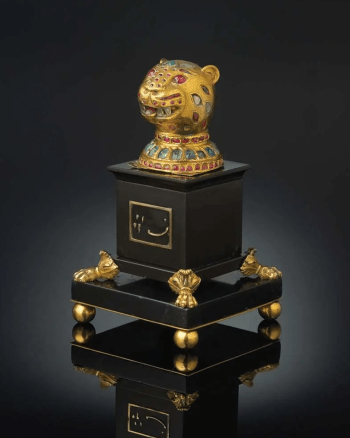
Tiger’s Head Finial from the throne of Tipu Sultan of Mysore, 1787–93, with the plinth possibly made in Madras or Calcutta, ca. 1799–1800. Gold over a lac core; set with rubies, diamonds, and emeralds. The head is mounted on a black marble pedestal with gilt metal inscription and mounts, with four gilt metal feet and four gilded balls. The head is 6.9cm high; the total height is 17.5cm.
Valued at £1.5 million, a gold jewelled tiger head, which in the late 18th century adorned the gold-covered throne of Tipu Sultan, is at risk of leaving the UK unless a UK buyer can be found. Tipu Sultan (1750–1799), the ‘Tiger of Mysore’, was regarded as the greatest threat to the British East India Company until his defeat and death in 1799. As ruler of Mysore, Tipu identified himself and his personal possessions with tiger imagery, and this finial offers scholars the opportunity to illustrate the vibrant culture of Tipu’s court and closely examine British imperial history. Three surviving contemporary images of the throne are all in the UK. The finial is one of eight gold tiger heads that adorned the throne.
The finial—made of gold and set with rubies, diamonds, and emeralds—is a rare example of fully documented 18th-century South Indian goldsmiths’ work, and its existence was unknown until 2009. Its marble pedestal is unique among the five surviving finials known, and the meaning of its gold inscription is still a mystery. Following Tipu’s defeat, many objects from his treasury arrived in Britain, where they influenced poetry (John Keats), fiction (Charles Dickens and Wilkie Collins), and artists (J.M.W. Turner), and were generally met with huge public interest.
Arts Minister Lord Parkinson of Whitley Bay said: “This fascinating finial illustrates the story of Tipu Sultan’s reign and leads us to examine our imperial history. I hope a UK-based buyer comes forward so that we can all continue to learn more about this important period in our shared history with India.”
The Minister’s decision follows the advice of the Reviewing Committee on the Export of Works of Art and Objects of Cultural Interest (RCEWA). The Committee agreed that it is an important symbolic object in Anglo-Indian history in the last years of the 18th century, with Tipu’s defeat having great historical importance to Britain’s imperial past and leading to a contemporary fascination with Tipu’s story and objects.
Committee Member Christopher Rowell said: “Tipu Sultan’s golden and bejewelled throne (c.1787–93) was broken up by the British army’s Prize Agents after Tipu’s defeat and death in defence of his capital, Seringapatam, in 1799. This tiger’s head is one of the original eight which were placed on the balustrade of the octagonal throne. Each gold tiger’s head from the railing is slightly differently set with gemstones, which makes this example both part of a set and unique in its design. Its quality attests to the expertise of Tipu’s goldsmiths and jewelers, in whose productions he took a close personal interest. The head of the large gold rock crystal tiger that supported the throne and a bejewelled huma bird that perched on the pinnacle of its canopy were presented to George III and Queen Charlotte (Royal Collection Trust). The tiger and its stripes were Tipu’s personal symbols. “Better to live one day as a tiger than 1,000 years as a sheep” he famously declared. His flirtation with Napoleonic France led to his downfall at British hands. This tiger’s head, one of four throne finials to survive, including a head in the Clive Museum at Powis Castle (NT), should remain in the country together with the other fragments of the throne, and I hope that every effort will be made to achieve this.”
The Committee made its recommendation on the grounds that the finial’s departure from the UK would be a misfortune because it is so closely connected with our history and national life and is of outstanding significance for the study of royal propaganda and 18th-century Anglo-Indian history. The decision on the export licence application for the finial will be deferred until 11 February 2022. This may be extended until 11 June 2022 if a serious intention to raise funds to purchase it is made at the recommended price of £1.5 million.
Provenance: Tipu Sultan of Mysore (1787–1799); Thomas Wallace, Baron Wallace of Knarsdale (ca.1800 or later)—listed in an 1843 inventory of the contents of Featherstone Castle (Northumberland), the family seat, and thence by descent; Bonhams, London, 2 April 2009 (lot 212); private collection.
Literature: Bonhams, London: 2 April 2009, lot 212; A Jaffer, ed., Beyond Extravagance (New York, 2013), pp. 189–90, cat. 61; N. N. Haidar, ed., Treasures from India (New York, 2014), pp. 46–7; Export of Objects of Cultural Interest 2010/11 (2011): Case 1, p. 23.
At Christie’s | Paintings and Drawings from the Marcille Collection

Lot 7: Jean-Siméon Chardin, La Fontaine (Water Urn), detail, ca. 1730s, oil on canvas, 50 × 43 cm (estimate €5–8million).
◊ ◊ ◊ ◊ ◊
From the press release (via Art Daily) for the auction:
De Chardin à Prud’hon, Tableaux et Dessins Provenant des Collections Marcille, Sale 20722
Christie’s Paris, 22 November 2021
Christie’s France—in collaboration with the auction house Tajan—presents an important group of paintings and drawings from the Marcille Collection, one of the most far-sighted collections of 18-century French art assembled in the 19th century. Initiated by François Marcille (1790–1856), and continued by his two sons Camille (1816–1875) and Eudoxe (1814–1890), the collection came to include some 4,600 paintings and other works. Although the collection was dispersed by inheritance within the family, collectors will now be able to acquire 27 works, including several masterpieces from major artists of the 18th and early 19th centuries, artists such as Jean-Siméon Chardin, Maurice-Quentin de la Tour, Théodore Gericault, Charles Coypel, and Pierre-Paul Prud’hon. The sale is estimated at between €5.7 million and €9.1 million.
Pierre Etienne, Director of the Department of Old Master Paintings: “There are names of collectors that are true stamps, labels of quality. The name Marcille evokes the excellence of the French 18th century, and even more vigorously for Chardin, La Tour, and Prud’hon.”
The Goncourts said of Camille Marcille that one should “study Chardin [at his home] to do full justice to the painter.” In 1979, at the time of the monographic exhibition of Chardin at the Grand Palais, the Marcille family loaned 22 of his paintings, including a superb genre scene representing a Woman at the Water Urn (estimate €5,000,000–8,000,000)—a work that entered the Marcille collection in 1848 and contributed to the rediscovery of Chardin in the 19th century through its inclusion in the first French exhibition devoted to the artist in 1860. Théophile Gautier was impressed by this very original work and wrote that it showed “what no one had ever talked about.” Chardin, not included in the canon of his time, preferred poetic scenes of everyday life to the more frivolous portraits of the century and came to be described as the ‘French Vermeer’. Chardin’s genre scenes were the most sought after and extremely rare on the market. Fontaine is one of the very first genre scenes in which Chardin fully reveals himself. Several museums have versions of the painting, including the first one, (on panel) from the Salon of 1737, at Stockholm’s Nationalmuseum and a version at the Toledo Museum of Art. The one from the Marcille Collection is the last in private hands and has not appeared on the market since 1848.

Lot 8: Jean-Siméon Chardin, L’hiver, à l’imitation de bas-relief d’après Edmé Bouchardon, 1776, oil on canvas, 55 × 88 cm (€80,000–120,000)
◊ ◊ ◊ ◊ ◊
Another painting by Chardin, Winter, in Imitation of Bas-relief after Edmé Bouchardon (estimate €80,000–120,000), will also be part of the sale. It attests to the Marcille family’s passion for the painter as well as to Chardin’s mastery of trompe l’oeil. The sale also features works acquired by Camille and Eudoxe Marcille—both of whom worked as curators, of the Chartres and Orléans museums respectively—in particular, an animated landscape by Hubert Robert (Lot 4: Waterfall Landscape with a Bridge, estimate €30,000–50,000) and two portraits by Nattier’s brilliant pupil, Louis Tocqué.
 A fine group of ten sheets by Pierre-Paul Prud’hon is included in the drawings section of the sale. The Marcilles had a particular passion for this neoclassical artist who gave drawing a prominent place in his work, typically combining black and white chalk on blue-grey paper. The ensemble illustrates the diversity and iconographic richness of the artist’s drawings. Among the highlights are portraits, including that of Baroness Alexandre de Talleyrand at the Age of Seven (estimate €25,000–35,000) and a Head of Napoleon in a Medallion, which was later engraved by Alexandre Tardieu (€20,000–30,000). Finally, Prud’hon’s commitment to the Empire is reflected in the collection by a Design for the Cradle of Roi de Rome (estimate €25,000–35,000), later created by Philippe Thomire and Odiot and now in the Schatzkammer in Vienna, along with a Design for a Chair for Empress Marie-Louise (estimate €12,000–18,000).
At Sotheby’s | In an Indian Garden: Company School Paintings
From the press release (via Art Daily) for the sale:
In an Indian Garden: The Carlton Rochell Collection of Company School Paintings
Sotheby’s, London, 27 October 2021
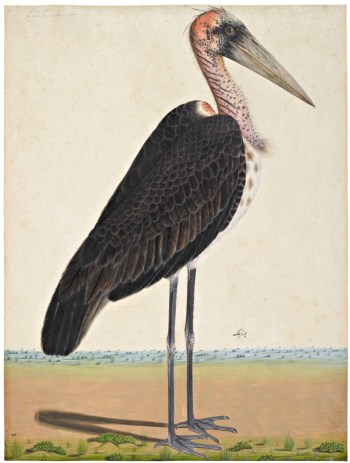
Lot 3: A Lesser Adjutant Stork (Leptoptilos Javanicus) in a Landscape, Company School, Lucknow, ca. 1775–85 (est. £60,000–80,000). The painting was included in The Wallace Collection’s 2020 exhibition Forgotten Masters: Indian Painting for the East India Company.
In October Sotheby’s will hold the first auction dedicated solely to Company School paintings, the work of Indian master artists who were commissioned by East India Company officials in the 18th and 19th centuries. Ranging in their subject matter from individual animal and human studies to complex architectural panoramas, the remarkable corpus of paintings encapsulates on paper the rich fauna, flora, and architecture of the Indian subcontinent. The 29 works in the auction are being offered by the American collector and art dealer Carlton C. Rochell, Jr., who spent the first 18 years of his career at Sotheby’s, where he founded the Indian and Southeast Asian Art Department in 1988. He was on the Board of Directors and served as Managing Director of Sotheby’s Asia. In 2002, Rochell opened his own gallery in New York.
In 2019 and 2020, The Wallace Collection presented Forgotten Masters: Indian Painting for the East India Company, curated by renowned writer and historian William Dalrymple. The ground-breaking exhibition brought to the fore the names of some of the finest Indian painters working on paper during the late Mughal period, introducing the public to the names of these truly great artists. Many of those same names—Shaykh Zayn al-Din, Ram Das, Bhawani Das, and Ghulam Ali Khan—are represented in this sale, with seven of the works having been loaned to The Wallace Collection exhibition. Most of the others have never been on public view and are emerging for the first time in decades.
“I first began to collect these lesser-known masterpieces over two decades ago simply for my personal enjoyment, my imagination having been captured by their ‘East meets West’ aesthetic. When they were painted, these works were the principal way in which India could be revealed to those in Great Britain, who otherwise could only hear stories about this sumptuous land. The meticulous ‘miniature’ style was scaled up to depict birds, animals, and botanical studies with remarkable lifelike detail, with the results rivalling any Western artists who recorded natural history and travel. Many years on, as they are beginning to take their rightful place in world art, these pieces can now inspire a new generation of collectors who, I hope, will cherish them as I have.” —Carlton C. Rochell, Jr.
“This remarkable collection contains quite simply some of the great masterpieces of Indian painting, brought together by a collector with an incredibly fine eye. This is a unique opportunity to purchase some of the greatest masterpieces of a genre that is only now beginning to receive its full credit.” —William Dalrymple, Writer, Historian, and Curator of Forgotten Masters
“These delightful paintings reflect a fascination and passion for India’s culture and history, from Lucknow to Calcutta to Delhi and Agra, and showcase a remarkable hybrid style merging Mughal and European elements. Both the patronage and the painters provide a great deal of interest to viewers, no more so than now, when this genre of painting is finally receiving the full attention it deserves. These works are the product of true collaboration—not grand portraits of the patrons themselves, but tableaux of everyday human activity, as well as meticulous studies of nature and vernacular architecture.” —Benedict Carter, Sotheby’s Head of Sale
In An Indian Garden features many works from the most renowned series of Company School paintings, including albums commissioned by Sir Elijah and Lady Impey, the Fraser brothers, Viscount Valentia, and Major General Claude Martin. The most famous is that of the Impey family, who created an enchanting menagerie of animals in their gardens in Calcutta and hired local artists to paint the surrounds, with more than half of their over 300-strong collection depicting birds. The Impey Collection was sold at auction in London in 1810, with several pieces held in international institutions, including The Metropolitan Museum of Art in New York—with a similar dramatic image of the Great Indian Fruit Bat—and the Victoria and Albert Museum in London. Perhaps the person who sparked the fashion for such commissions was merchant, soldier, architect, hot air balloonist, and collector Major General Claude Martin, and the sale offers a Lesser Adjutant Stork from his collection, which survives as a masterpiece of the genre. More recently, these works have passed through such hands as those of Jacqueline Kennedy Onassis, who for many years owned the arresting study of a Stork Eating a Snail; renowned South Asian paintings collector Edwin Binney 3rd; leading scholar and curator Stuart Cary Welch; and former United States Ambassador to Morocco, The Hon. Joseph Verner Reed, Jr.
Prior to the stand-alone auction in London on 27 October, highlights of In an Indian Garden went on view in Sotheby’s galleries in New York (17–20 September), Hong Kong (7–11 October), and London (22–26 October).
Print Market | Mad about Mezzotint at the Court of George III
From Isaac and Ede:
Mad about Mezzotint at the Court of George III
Reindeer Antiques, London, 6 October — 5 November 2021
 This exhibition organized by David Isaac of Isaac and Ede celebrates the bicentenary of the 60-year reign of King George III (1738–1820) through one mezzotint portrait for each year of his reign. Meet the movers and shakers, the courtiers and courtesans, the duchesses and dandies of the period. Each mezzotint was printed in the year it represents, so there are 61 prints to cover the years 1760–1820 with a couple of extras thrown in for good measure. Royalty and aristocracy dominate throughout the opening decades, but as the country finds itself increasingly at war with America, France, Spain (and practically everyone else), we see a predominance of naval and military heroes taking centre stage. Towards the end of our period, we begin to see the emergence of the self-made man, and the entrepreneurial spirit of that would come to symbolize the Victorian era. To be held at Reindeer Antiques, 81, Kensington Church Street, London W8 4BG.
Printed catalogues are available: UK £30 including P&P / USA £47 including P&P. View a PDF of the catalogue on Issuu. The catalogue is also distributed by Paul Holberton Publishing:
David Isaac, Mad about Mezzotint at the Court of George III (London: Isaac and Ede, 2022), 148 pages, ISBN 978-1913645359, £30.
◊ ◊ ◊ ◊ ◊
Note (added 6 July 2022) — The original posting did not include catalogue details from PHP.
Exhibition | Mary Ronayne: Fool’s Paradise
From the press release, via ArtFix Daily:
Mary Ronayne: Fool’s Paradise
HOFA Gallery, London, 16–29 September 2021

Mary Ronayne, The Farthington Family Portrait with Settee, 2021, enamel and emulsion on wood panel, 120 × 90 cm.
Irish figurative painter and multimedia artist known for her whimsical portraits is billed to unveil new, large-scale artworks at HOFA Gallery, London.
In this solo show, Mary Ronayne elevates comedy, wit, and fun to a level of purpose never seen in her work, paving the way for farcical elements like melting faces and candy pop colours to become celebrations of the fluidity of time, identity, and life. This fluidity, which underpins the resilience of a world gleefully returning to normalcy after the harrowing experience of a pandemic, is both literal and symbolic. Juxtaposed with scenes drawn from historical narratives and classical literature, it affirms the enduring elements of humanity in the carefree spirit fans have come to love about her work.
Ronayne’s technique of combining enamel and domestic paints is as much to credit for her charming style as her widely sourced subject matter. It plays a major role in the look and finish of her works which often contrast a glossy, vitreous shine with a more staid, matte texture. Enamel paint is also how the artist creates the gooey, farcical look, almost like candy—an unmistakable element of her signature style.
Drawing inspiration from a rich and diverse universe that includes magazine cut-outs, classical art, historical literature, movies, plays, and operas, Ronayne’s artworks are a tribute to life even when their undercurrent of Hogarthian satire and allegory are hard to deny. Ronayne has always employed humour as a tool to break the ice, disarming and drawing viewers in for a closer look while also conveying poignant critiques of the times.










 Enfilade
leave a comment