New Book | Luxurious Networks
I’m a year late, but in the event that it might still comes as news to some readers, from Stanford UP:
Yulian Wu, Luxurious Networks: Salt Merchants, Status, and Statecraft in Eighteenth-Century China (Redwood City: Stanford University Press, 2017), 320 pages, ISBN: 9780804798112, $65.
 From precious jade articles to monumental stone arches, Huizhou salt merchants in Jiangnan lived surrounded by objects in eighteenth-century China. How and why did these businessmen devote themselves to these items? What can we learn about eighteenth-century China by examining the relationship between merchants and objects? Luxurious Networks examines Huizhou salt merchants in the material world of High Qing China to reveal a dynamic interaction between people and objects. The Qianlong emperor purposely used objects to expand his influence in economic and cultural fields. Thanks to their broad networks, outstanding managerial skills, and abundant financial resources, these salt merchants were ideal agents for selecting and producing objects for imperial use. In contrast to the typical caricature of merchants as mimics of the literati, these wealthy businessmen became respected individuals who played a crucial role in the political, economic, social, and cultural world of eighteenth-century China. Their life experiences illustrate the dynamic relationship between the Manchu and Han, central and local, and humans and objects in Chinese history.
Yulian Wu is Assistant Professor of History at the University of South Carolina.
C O N T E N T S
Introduction: Merchant culture in the Material World of Eighteenth-Century China
1 Courting the Court
2 Furnishing the Court
3 Collecting as a ‘Collector’
4 Luxury and Lineage
5 Materializing Morality
Conclusion: Cultured and Cosmopolitan Men (tongren): Objects, Merchants, and the Manchu Court in High Qing China
New Book | The Social Life of Inkstones
I’m a year late, but in the event that it might still comes as news to some readers, from the University of Washington Press:
Dorothy Ko, The Social Life of Inkstones: Artisans and Scholars in Early Qing China (Seattle: University of Washington Press, 2017), 330 pages, ISBN: 9780295999180, $45.
 An inkstone, a piece of polished stone no bigger than an outstretched hand, is an instrument for grinding ink, an object of art, a token of exchange between friends or sovereign states, and a surface on which texts and images are carved. As such, the inkstone has been entangled with elite masculinity and the values of wen (culture, literature, civility) in China, Korea, and Japan for more than a millennium. However, for such a ubiquitous object in East Asia, it is virtually unknown in the Western world.
Examining imperial workshops in the Forbidden City, the Duan quarries in Guangdong, the commercial workshops in Suzhou, and collectors’ homes in Fujian, The Social Life of Inkstones traces inkstones between court and society and shows how collaboration between craftsmen and scholars created a new social order in which the traditional hierarchy of ‘head over hand’ no longer predominated. Dorothy Ko also highlights the craftswoman Gu Erniang, through whose work the artistry of inkstone-making achieved unprecedented refinement between the 1680s and 1730s.
Dorothy Ko is professor of history at Barnard College. She is the author of Cinderella’s Sisters: A Revisionist History of Footbinding and coeditor of The Birth of Chinese Feminism: Essential Texts in Transnational Theory.
C O N T E N T S
Acknowledgments
Conventions
Chinese Dynasties and Periods
Map of China
Introduction
1 The Palace Workshops: The Emperor and His Servants
2 Yellow Hill Villages: The Stonecutters
3 Suzhou: The Crafts(wo)man
4 Beyond Suzhou: Gu Erniang the Super-Brand
5 Fuzhou: The Collectors
Epilogue: The Craft of Wen
Appendix 1: Inkstones Made by Gu Erniang Mentioned in Textual Sources Contemporary to Gu
Appendix 2: Inkstones Bearing Signature Marks of Gu Erniang in Major Museum Collections
Appendix 3: Members of the Fuzhou Circle
Appendix 4: Textual History of Lin Fuyun’s Inkstone Chronicle (Yanshi)
Appendix 5: Chinese Texts
Notes
Glossary of Chinese Characters
References
Index
New Book | Threads of Global Desire: Silk in the Pre-Modern World
From Boydell & Brewer:
Dagmar Schäfer, Giorgio Riello, Luca Molà, eds., Threads of Global Desire: Silk in the Pre-Modern World (Woodbridge: Boydell Press, 2018), 438 pages, ISBN: 9781783272938, $99.
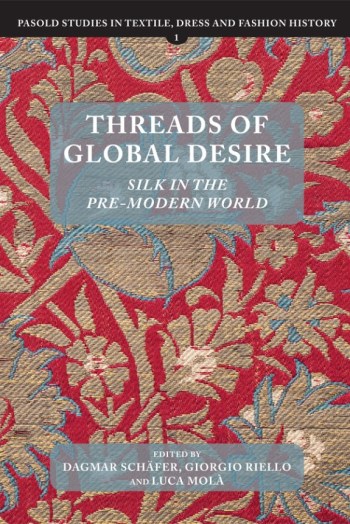 Considering silk as a major force of cross-cultural interaction, this book examines the integration of silk production and consumption into various cultures in the pre-modern world.
Silk has long been a global commodity that, because of its exceptional qualities, high value, and relative portability, came to be traded over very long distances. Similarly, the silk industry—from sericulture to the weaving of cloth—was one of the most important fields of production in the medieval and early modern world. The production and consumption of silks spread from China to Japan and Korea and travelled westward as far as India, Persia and the Byzantine Empire, Europe, Africa, and the Americas. As contributors to this book demonstrate, in this process of diffusion silk fostered technological innovation and allowed new forms of organization of labour to emerge. Its consumption constantly reshaped social hierarchies, gender roles, aesthetic and visual cultures, as well as rituals and representations of power.
Threads of Global Desire is the first attempt at considering a global history of silk in the pre-modern era. The book examines the role of silk production and use in various cultures and its relation to everyday and regulatory practices. It considers silk as a major force of cross cultural interaction through technological exchange and trade in finished and semi-finished goods. Silks mediated design and a taste for luxuries and were part of gifting practices in diplomatic and private contexts. Silk manufacturing also fostered the circulation of skilled craftsmen, connecting different centres and regions across continents and linking the countryside to urban production.
Dagmar Schäfer is Director of Department 3 ‘Artefacts, Action, and Knowledge’ at the Max Planck Institute for the History of Science in Berlin and Professor h.c. of the History of Technology at the Technical University, Berlin.
Giorgio Riello is Professor of Global History and Culture at the University of Warwick. He has published extensively on the history of material culture and trade in early modern Europe and Asia and in particular on textiles and fashion.
Luca Molà is Professor of Early Modern Europe: History of the Renaissance and the Mediterranean in a World Perspective at the European University Institute in Fiesole.
C O N T E N T S
• Luca Molà and Giorgio Riello and Dagmar Schäfer, Introduction: Silk in the Pre-Modern World
• Dagmar Schäfer, Power and Silk: The Central State and Localities in State-owned Manufacture during the Ming Reign (1368–1644)
• Angela Sheng, Why Velvet? Localised Textile Innovation in Ming China
• Rudi Matthee, The Dutch East India Company and Asian Raw Silk: From Iran to Bengal via China and Vietnam
• Amanda Phillips, The Localisation of the Global: Ottoman Silk Textiles and Markets, 1500–1790
• Suraiya Faroqhi, Ottoman Silks and their Markets at the Borders of the Empire, c. 1500–1800
• Lisa Monnas, A Study in Contrasts: Silk Consumption in Italy and England during the Fifteenth and Sixteenth Centuries
• David M. Mitchell, What d’ye lack Ladies? Hoods, Ribbands, very fine silk stockings: The Silk Trades in Restoration London
• Lesley Ellis Miller, From Design Studio to Marketplace: Products, Agents, and Methods of Distribution in the Lyons Silk Manufactures, 1660–1789
• José L. Gasch-Tomás, The Manila Galleon and the Reception of Chinese Silk in New Spain, c. 1550–1650
• Ben Marsh, ‘The Honour of the Thing’: Silk Culture in Eighteenth-Century Pennsylvania
• Karolina Hutková, A Global Transfer of Silk Reeling Technologies: The English East India Company and the Bengal Silk Industry
• Fujita Kayoko, Changing Silk Culture in Early Modern Japan: On Foreign Trade and the Development of ‘National’ Fashion, from the Sixteenth to Nineteenth Century
• Giorgio Riello, Textile Spheres: Silk in a Global and Comparative Context
Glossary
Bibliography
Notes on Contributors
Index
New Book | Jacques Pierre Jean Rousseau
From GHAMU and available from ArtBooks.com:
Jean-Loup Leguay, Jacques Pierre Jean Rousseau (1733–1801): Ingénieur et architecte en Picardie au siècle des lumières (Heule: Snoeck, 2018), 256 pages, ISBN: 978-9461614445, 32€ / $55.
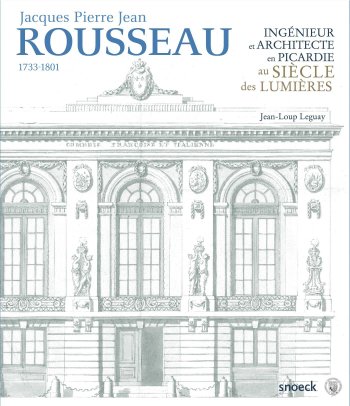 La monographie que Jean-Loup Leguay a consacré à Jacques Pierre Jean Rousseau (1733–1801), ingénieur et architecte en Picardie au Siècle des lumières, fera sa sortie en librairie au début du mois de mai 2018 ; il s’agira là du nouveau volume de la collection des Mémoires de la Société des Antiquaires de Picardie, publié en partenariat avec les éditions Snoeck.
Né à Saumur, Jacques Pierre Jean Rousseau arrive à Paris en 1752 et entre à l’École des ponts et chaussées. Formé au métier d’ingénieur des routes, il est désigné en 1757 pour servir en Picardie, région qu’il ne quittera plus. Vingt ans plus tard, il démissionne des Ponts et Chaussées et devient ingénieur municipal d’Amiens où il construit, tout comme à Abbeville, les derniers grands édifices publics du XVIIIe siècle. L’extraordinaire château de Saint-Gratien témoigne, quant à lui, de sa contribution à l’architecture privée.
Membre résidant de la Société des Antiquaires de Picardie, Jean-Loup Leguay est historien de l’art, spécialiste de l’architecture française au Siècle des lumières. Auteur de nombreux articles, il participe régulièrement aux différents colloques et publications organisés sur le sujet. Il a publié en 2010 le Guide de l’hôtel Biron : Musée Rodin.
New Book | Cadogan & Chelsea
Published by Unicorn and distributed by The University of Chicago Press:
Beatrice Behlen, Amber Butchart, John Julius Cooper, Brent Elliott, Alan Powers, John Simpson, and Alwyn Turner, Cadogan & Chelsea: The Making of a Modern Estate (London: Unicorn Publishing, 2017), 224 pages, ISBN: 978-1910787434, £50 / $75.
 The Cadogan Estate in Chelsea is one of the few remaining ancient family estates in London, covering one of the capital’s most dynamic, thriving and fashionable districts. Its foundations were laid in 1717, when Charles, Second Baron Cadogan married the daughter of Sir Hans Sloane, who had purchased the Manor of Chelsea in 1712. This lavish book celebrates the family’s three-hundred-year stewardship of the estate, which today is in the hands of the present Viscount Chelsea, who succeeded his father, Earl Cadogan, as group chairman in 2012.
Beautifully illustrated, this collection of essays by expert commentators looks at the history and lineage of this noble family and the formation of the Estate as we know it today.
Exhibition | Afro-Atlantic Histories
From ArtForum:
Histórias Afro-Atlânticas / Afro-Atlantic Histories
Museu de Arte de São Paulo (MASP) and concurrently at Instituto Tomie Ohtake, São Paulo, 28 June — 21 October 2018
Curated by Adriano Pedrosa, Ayrson Heráclito, Hélio Menezes, Lilia Schwarcz, and Tomás Toledo
In the most violent and uncertain times of its recent history, Brazil is revisiting the origins of its racial frictions: the slave trade. Histórias afro-atlânticas (Afro-Atlantic Histories) is a massive, 380-work survey of African, Latin American, and European art from the past five centuries, chronicling the largest diaspora in modern history. Nearly half of all Africans captured by slave traders were brought to Brazil, from the time the Portuguese arrived, in the sixteenth century, all the way through the nineteenth century. The show is a sequel to Histórias mestiças (Mestizo Histories), staged four years ago at the Instituto Tomie Ohtake, the cultural center that is also cohosting the current exhibition. Its scope is far-reaching, with pieces by colonial-era Dutch master Albert Eckhout and modern greats Théodore Géricault and Paul Cézanne, as well as contemporary art-world darlings Glenn Ligon, Kara Walker, and Hank Willis Thomas. A fully illustrated catalogue and companion reader will help sharpen our perspective on it all.
As noted in the May–August 2018 bulletin from the Yale Center for British Art, the YCBA has loaned six works including four paintings by Agostino Brunias (1728–1796).
Note (added 14 October 2018) — Reviewing the exhibition for The New York Times (12 October 2018), Holland Cotter describes it as “a hemispheric treasure chest, a redrafting of known narratives, and piece for piece one of the most enthralling shows I’ve seen in years, with one visual detonation after another.” The full review is available here.
New Book | Stowe House
From Scala Publishers:
Nick Morris, Stowe House: Saving an Architectural Masterpiece (London: Scala Arts & Heritage Publishers, 2018), 160 pages, ISBN: 978-1785511110, £20 / $28.
 The restoration of Stowe House and development of the surrounding estate by Stowe School, allied to work in the landscape gardens by the National Trust, is one of the greatest rescues of a country house ever achieved. The ancestral home of the Temple-Grenvilles came close to demolition in 1920, when the entire site was put up for sale. The formation of Stowe School in 1923 secured a future use that maintained the traditions of the Enlightenment with its unrelenting quest for knowledge and understanding. The past 94 years have seen innovation in land management with the gifting of the gardens to the National Trust and a renovation programme of truly monumental proportions. This book details the architectural history of the site, tells the story of the restoration through the words of those most closely involved, and demonstrates how the School has continued to build in a sympathetic and harmonious manner that preserves the estate’s identity and character.
Nick Morris, Stowe House’s Chief Executive Officer who has managed restoration work there for the past eight years, has drawn together contributions from leading experts to produce an authoritative work that looks behind the creation of the house, charting the continuing evolution of the site and demonstrating the care taken to ensure authenticity throughout the £40m restoration programme. As Stowe School’s Operations Director from 2009 to 2017, he was closely involved in the School’s building projects and management of the site.
Exhibition | Lost Treasures of Strawberry Hill
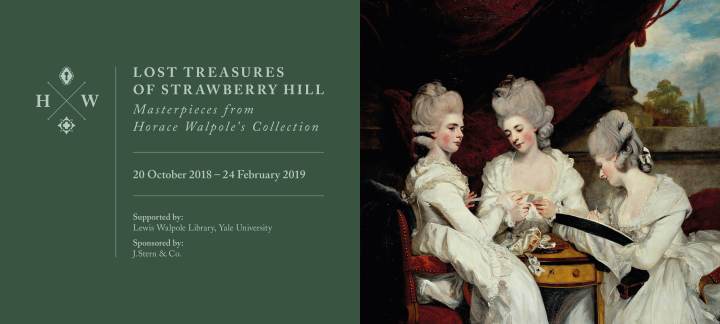
Joshua Reynolds, Portrait of the Ladies Waldegrave, 1780-81, oil on canvas, 143 × 168 cm (Edinburgh: National Galleries of Scotland, purchased with the aid of The Cowan Smith Bequest and the Art Fund 1952).
◊ ◊ ◊ ◊ ◊
This fall at Strawberry Hill:
Lost Treasures of Strawberry Hill
Strawberry Hill House & Garden, Twickenham, 20 October 2018 — 24 February 2019
Curated by Silvia Davoli and Michael Snodin
This exhibition brings back to Strawberry Hill some of the most important masterpieces in Horace Walpole’s famous and unique collection for a once-in-a-lifetime exhibition. Horace Walpole’s collection was one of the most important of the 18th century. It was dispersed in a great sale in 1842. For the first time in over 170 years, Strawberry Hill can be seen as Walpole conceived it, with the collection in the interiors as he designed it, shown in their original positions.
Strawberry Hill was filled with a celebrated collection of paintings, furniture, sculptures, and curiosities: great portraits by Sir Joshua Reynolds, Sir Peter Lely, Allan Ramsay, Rubens, Van Dyck, Hans Holbein, and Clouet; miniature portraits by Isaac and Peter Oliver, Hilliard and Petitot, a carved Roman eagle from the 1st century AD; fine furniture including a Boulle cabinet, fabulous Sèvres pieces as well as some oddities such as a lime-wood cravat, carved by Grinling Gibbons, a lock of Mary Tudor’s hair and a ‘magic mirror’ (an obsidian disc) which Dr Dee, Queen Elizabeth I’s necromancer, had used for conjuring up the spirits.
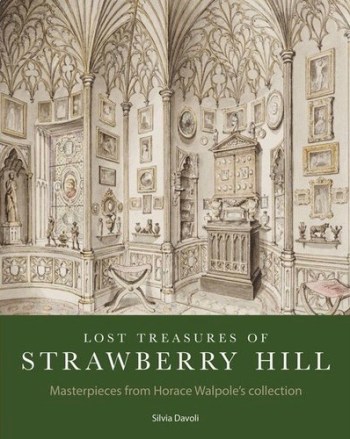 In 1842, the collection was dispersed worldwide in a 28-day ‘sale of the century’. From the 1920s to the ‘70s, Walpole scholar and consummate collector Wilmarth S. Lewis, who edited and published with Yale University Press the 48-volume Yale Edition of Horace Walpole’s Correspondence (New Haven, 1937–83), assembled the largest private collection of Walpoliana, including many pieces from Strawberry Hill, which he and his wife bequeathed to Yale University in 1980 as the Lewis Walpole Library, with whose help the Strawberry Hill Trust is delighted to be mounting this exhibition.
Walpole left detailed descriptions of the displays in each of the main rooms of his villa, so that nearly all the works can be shown in their original positions. In The Great Parlour, a display of portraits of Walpole’s family includes the famous Reynolds’s painting of Walpole’s nieces, The Ladies Waldegrave, (now in the National Gallery of Scotland). The Tribune will house the famous rosewood cabinet designed by Walpole, owned by the V&A, together with a display of exquisite portrait miniatures. Walpole’s gilded, crimson Gallery will be once again house the impressive Roman sculpture of an eagle and be hung with life-size portraits, including The Family of Catherine de Medici by Clouet.
Silvia Davoli, Lost Treasures of Strawberry Hill: Masterpieces from Horace Walpole’s Collection (London: Scala Arts & Heritage Publishers, 2018), ISBN: 9781785511806, £15.
Print Quarterly, June 2018
The eighteenth century in the current issue of Print Quarterly:
Print Quarterly 35.2 (June 2018):

Juan Camarón, Robinson in his Llama Skin Habit and Parasol, 1788–89, brush and grey wash, 110 × 65 mm (London, British Library).
A R T I C L E S
• Benito Navarrete Prieto and Alejandro Martínez Pérez, “Drawings for the Spanish Robinson Crusoe by José Juan Camarón and Rafael Ximeno,” pp. 160–72.
The article addresses newly identified drawings by José Camarón and Rafael Ximeno for the seminal Spanish edition of Robinson Crusoe by Tomás de Iriarte, published in Madrid in 1789. The presence of the drawing for the map and the narrative illustrations among Iriarte’s papers underscore the poet’s close involvement with the book’s production and illustration.
• Kate Heard, “The Royal Collection of Satirical Prints in the Nineteenth and Twentieth Centuries,” pp. 173–82.
In describing the the history of the collection of satirical prints in Britain’s royal collection before their sale in 1921 to the Library of Congress, the article explains the origins of the collection under George III, its development most famously under George IV, its continued growth under Queen Victoria and Prince Albert—when Georgian works entered the collection that would not have been acquired earlier, including prints that were critical of the royal family—and finally the disfavor the collection solicited during the reign of George V from the royal librarian John Fortescue, who brokered the 1921 sale.
N O T E S A N D R E V I E W S
• Celina Fox, Review of Bernard Nurse, London: Prints and Drawings before 1800 (Bodleian Library, 2017), pp. 198–200.
• Susan Sloman, Review of Ann Gunn, The Prints of Paul Sandby (1731–1809): A Catalogue Raisonné (Brepols and Harvey Miller Publishers, 2016), pp. 200–03.
• Flavia Pesci, Review of the exhibition catalogue Nicholas Stanley Price, At the Foot of the Pyramid: 300 Years of the Cemetery for Foreigners in Rome (Casa di Goethe Museum, 2016), pp. 203–04.
• Mark McDonald, Review of the catalogue Peter Raissis, Prints and Drawings: Europe 1500–1900 from the Art Gallery of New South Wales (Art Gallery of New South Wales, 2014), pp. 204–06.
• Charles Newton, Review of Elisabeth Fraser, Mediterranean Encounters: Artists between Europe and the Ottoman Empire, 1774–1839 (Pennsylvania State University Press, 2017), pp. 206–09.
◊ ◊ ◊ ◊ ◊
Note (added 6 June 2018) — The original posting did not include descriptions for the two articles.
The Burlington Magazine, May 2018
The eighteenth century in The Burlington:
The Burlington Magazine 160 (May 2018)
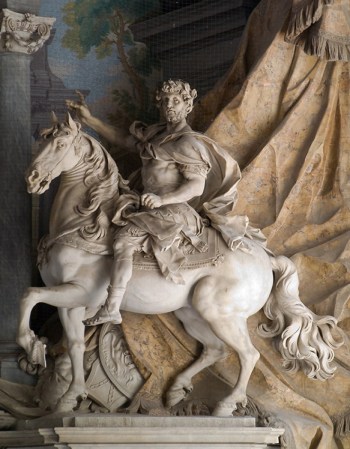
Agostino Cornacchini, Charlemagne, 1725, marble (St Peter’s Basilica).
A R T I C L E S
• Gloria Martínez Leiva, “Art as Diplomacy: John Closterman’s Portraits of Carlos II of Spain and His Wife Queen Maria Anna of Neuburg,” pp. 381–86.
• Teresa Leonor M. Vale, “Art and Festivities in Eighteenth-Century Rome: Letters from a Portuguese Priest, 1721–22,” pp. 387–93.
R E V I E W S
• Christopher Rowell, Review of the exhibition Thomas Chippendale: A Celebration of Craftsmanship and Design, 1718–2018 (Leeds City Museum, 2018), pp. 414–16.
• Charles Darwent, Review of the exhibition The Dutch in Paris, 1789–1914 (Paris: Petit Palais, 2018), pp. 420–21.
• Stéphane Loire, Review of Giancarlo Sestieri, Il capriccio architettonico in Italia nel XVII e XVIII secolo (Etgraphiae editoriale, 2015), p. 432.
• Andrew McClellan, Review of Geneviève Bresc-Bautier and Béatrice de Chancel-Bardelot, eds., Un musée révolutionaire: Le Musée des Monuments français d’Alexandre Lenoir (Musée du Louvre, 2016), pp. 432–33.










 Enfilade
leave a comment