Exhibition | World on the Horizon: Swahili Arts across the Indian Ocean

Frederick de Wit, Portolan Chart Indiarum Orientalum, from Harmonia macrocosmica, plate 56 (Amsterdam, 1708).
◊ ◊ ◊ ◊ ◊
Press release (9 March 2018) from The Smithsonian (also see the “Curators’ Notes,” which includes helpful installation photographs, from Journal18, published in October 2017). . .
World on the Horizon: Swahili Arts across the Indian Ocean
Krannert Art Museum, University of Illinois at Urbana-Champaign, 31 August 2017 — 24 March 2018
Smithsonian National Museum of African Art, Washington, D.C., 9 May — 3 September 2018
Fowler Museum, University of California at Los Angeles, 21 October 2018 — 10 February 2019
Curated by Allyson Purpura and Prita Meier
World on the Horizon: Swahili Arts Across the Indian Ocean opens at the Smithsonian’s National Museum of African Art May 9. The exhibition, on view through September 3 in the International Gallery, reveals the diverse interchanges that break down barriers between Africa and Asia in a space that physically connects the Smithsonian’s African and Asian art museums.
The Swahili coast, where East Africa meets the Indian Ocean, has long been a significant cultural, diplomatic, and commercial intersection for Africa, Asia, and Europe for millennia. World on the Horizon offers audiences an unprecedented opportunity to view over 160 artworks brought together from public and private collections from four continents. The artworks, through an intricate network of trade and diplomacy, have historically deep and enduring connections to eastern and central Africa, the port towns of the western Indian Ocean, Europe, and the eastern seaboard of the United States. One-of-a-kind objects loaned from the National Museums of Kenya and the Bait Al Zubair Museum in Oman will make their debut to North American audiences. The exhibition is thematically organized and features objects and images recognized for not only their artistic excellence, but also how they visualize wide-reaching networks of mobility and encounter. Ranging from intimate pieces of jewelry to impressive architectural elements, the exhibition includes exquisitely illuminated Qur’ans, carved doorposts, furniture, maps, and other works.
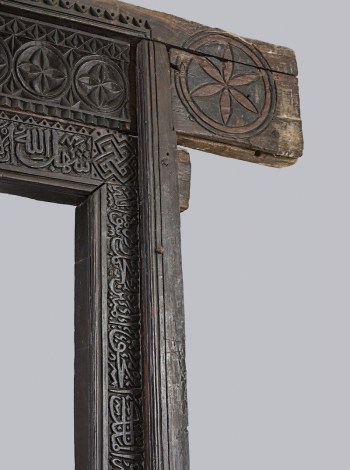
Door frame, detail, Kenya, Pate Island, Siyu, ca. 18th–19th century, African mahogany wood (Lamu Museum, National Museums of Kenya; photo: chrisbrownphoto.com).
“The arts of Africa are truly global, inspiring artists across the world,” said National Museum of African Art Director Gus Casely-Hayford. “But that inspiration also moves in multiple directions, and it includes African artists’ awareness and reflection of the aesthetic vision of other cultures. As the stunning and surprising works on view in this exhibition reveal, the seemingly rigid frontiers that have come to define places like Africa and Asia are in fact remarkably fluid, connected through the intersections of art, commerce, and culture.”
Swahili objects embody multiple cultural histories and aesthetic trends that are themselves itinerant and open to interpretation. World on the Horizon demonstrates how the Swahili coast is a vibrant site of global cultural convergence and to Africa’s contributions to the artistic vocabulary of the wider Indian Ocean world.
The exhibition is curated by Allyson Purpura, senior curator and curator of Global African Art at Krannert Art Museum in Urbana-Champaign, Illinois, and Prita Meier, assistant professor of art history at New York University, and overseen in Washington by Kevin Dumouchelle, curator at the National Museum of African Art. The exhibition opened at the Krannert in August 2017, and following its showing at the National Museum of African Art, it will travel to the Fowler Museum at UCLA in fall 2018.
“World on the Horizon is the exciting realization of years of research, collaboration and relationship building in the Swahili coast,” Dumouchelle said. “Loans secured from public and private collections in Kenya, Tanzania, Oman, Europe and the United States represent a once-in-a-lifetime opportunity for our audiences to see these artworks together in conversation.”
Allyson Purpura is senior curator and curator of Global African Art at the Krannert Art Museum at the University of Illinois at Urbana-Champaign. Her research on the politics of Islamic knowledge practices in Zanzibar led to her current interest in the broader connections between knowledge and power, particularly as they play out in the representational practices of museums. In addition to her teaching and curatorial practice, Purpura has published on a range of topics, including Islamic charisma and piety in Zanzibar, script and image in African art, ‘undisciplined’ knowledge, ephemeral art, and the politics of exhibiting African art. She has a Ph.D. from CUNY Graduate Center.
Prita S. Meier is assistant professor of art history at New York University. Her research focuses on the arts and architectures of east African port cities and the histories of transcontinental exchange and conflict. She is the author of Swahili Port Cities: The Architecture of Elsewhere (Indiana University Press, 2016). Meier is working on a new book about the social and aesthetic history of photography in Zanzibar and Mombasa. She is currently the William C. Seitz Senior Fellow at the Center for Advanced Study of the Visual Arts at the National Gallery of Art (Washington, D.C.). Meier has a Ph.D. from Harvard University.
Kevin D. Dumouchelle has served as curator at the National Museum of African Art since October 2016. He was the lead curator for Visionary: Viewpoints on Africa’s Arts (2017), the museum’s most recent, comprehensive presentation of its permanent collection. From 2007 to 2016, he was the Brooklyn Museum’s curator in charge of its African and Pacific Islands collections. At Brooklyn, he conceived two award-winning reinstallations of the African collection: African Innovations (2014) and Double Take: African Innovations (2014). He has written books and articles and curated a range of exhibitions on contemporary and historical African art, including Power Incarnate: Allan Stone’s Collection of Sculpture from the Congo (2011) at the Bruce Museum, and the Brooklyn Museum presentations of Gravity and Grace: Monumental Works by El Anatsui (2013) and Disguise: Masks and Global African Art (2016). Dumouchelle has a Ph.D. from Columbia University.
The catalogue is distributed by the University of Washington Press:
Prita Meier and Allyson Purpura, eds., World on the Horizon: Swahili Arts across the Indian Ocean (Seattle: University of Washington Press, 2018), 368 pages, ISBN: 9781883015497, $50.
With contributions by Edward A. Alpers, Heike Behrend, Ann Biersteker, Fahad Bishara, Allan deSouza, Jeffrey Fleisher, Athman Hussein, Paola Ivanov, Sarah Longair, Pedro Machado, Rebecca Gearhart Mafazy, Nidhi Mahajan, Janet McIntosh, Jeremy Prestholdt, Allen F. Roberts, Stephen J. Rockel, MacKenzie Moon Ryan, and Nancy Um
 Accompanying the World on the Horizon exhibition organized by Krannert Art Museum, this book is the first interdisciplinary study of Swahili visual arts and their historically deep and enduring connections to eastern and central Africa, the port towns of the western Indian Ocean, Europe, and the United States. At once exhibition catalogue and scholarly inquiry, the publication features eighteen essays in a mix of formats—personal reflections, object biographies, as well as more in-depth critical treatments—and includes never before published images of works from the National Museums of Kenya and Bait Al Zubair Museum in Oman. By approaching the east African coast as a vibrant arena of global cultural convergence, these essays offer compelling new perspectives on the situated yet mobile and deeply networked social lives of Swahili objects. Moving between the broader structural relations of political economic change to more intimate narratives through which such change is experienced, the essays throw light on the ways in which the material fabric of the arts structure Swahili people’s sense of self and community in an ever-changing world of oceanic and terrestrial movement.
New Book | The Eighteenth Centuries: Global Networks of Enlightenment
The essays in this collection, which includes a contribution by Mary Sheriff, are accompanied by “The Digital Eighteenth Centuries,” a digital atlas created on the MapScholar platform, available here. From the University of Virginia Press:
David Gies and Cynthia Wall, eds., The Eighteenth Centuries: Global Networks of Enlightenment (Charlottesville: University of Virginia Press, 2018), 316 pages, ISBN 978 0813940755, $40.
 Today, when ‘globalization’ is a buzzword invoked in nearly every realm, we turn back to the eighteenth century and witness the inherent globalization of its desires and, at times, its accomplishments. During the chronological eighteenth century, learning and knowledge were intimately connected across disciplinary and geographical boundaries, yet the connections themselves are largely unstudied. In The Eighteenth Centuries, twenty-two scholars across disciplines address the idea of plural Enlightenments and a global eighteenth century, transcending the demarcations that long limited our grasp of the period’s breadth and depth.
Engaging concepts that span divisions of chronology and continent, these essays address topics ranging from mechanist biology, painted geographies, and revolutionary opera to Americanization, theatrical subversion of marriage, and plantation architecture. Weaving together many disparate threads of the historical tapestry we call the Enlightenment, this volume illuminates our understanding of the interconnectedness of the eighteenth centuries.
David T. Gies, Commonwealth Professor of Spanish at the University of Virginia, is the author of The Theatre in Nineteenth-Century Spain and editor of The Cambridge History of Spanish Literature. Cynthia Wall, Professor of English at the University of Virginia, is the author of The Prose of Things: Transformations of Description in the Eighteenth Century and The Literary and Cultural Spaces of Restoration London.
C O N T E N T S
Acknowledgments
Part I | Knowledge and the Lives of Books
• Sophia Rosenfeld, Introduction
• Brad Pasanek and Chad Wellmon, Enlightenment, Some Assembly Required
• Michael Pickard, An Inventory of the Estate of William Straham in 1759
• Patricia Meyer Spacks, Understanding and Obscure Text: The Fortunate Foundlings and the Limits of Interdisciplinarity
Part II | Human Economies
• Andrew O’Shaughnessy, Introduction
• Ruth Hill, How Long Does Blood Last? Degeneration as Blanqueamiento in the Americas
• Carrie B. Douglass, Thomas Jefferson: Breeding and Buying Horses, Connecting Family, Friends, and Neighbors
• Louis P. Nelson, The Jamaican Plantation: Industrial, Global, Contested
Part III | Artists’ Geographies
• Richard Will, Introduction
• Mary D. Sheriff, Emotional Geographies: Watteau and the Fate of Women
• Katelyn D. Crawford, Painting New England in the Dutch West Indies: John Greenwood’s Sea Captains Carousing in Surinam
Part IV | Dramatic Politics
• Bonnie Gordon, Introduction
• Pierpaolo Polzonetti, Mozart and the American Revolution
• Adrienne Ward, The Drama of Marriage in Eighteenth-Century Venice: Carlo Goldoni’s La locandiera
• Jennifer Reed, Performances of Suffering and the Stagecraft of Symathy
• Casey R. Eriksen, The Aesthetics of Excess: Rococo Vestiges of Tartuffe in Isla’s Father Gerundio
• James P. Ambuske and Carol Guarnieri, About MapScholar
Notes on Contributors
Index
Exhibition | Like Life: Sculpture, Color, and the Body
Press release from The Met:
Like Life: Sculpture, Color, and the Body, 1300–Now
The Met Breuer, New York, 21 March — 22 July 2018
Curated by Luke Syson and Sheena Wagstaff, with Brinda Kumar, Emerson Bowyer, and Elyse Nelson
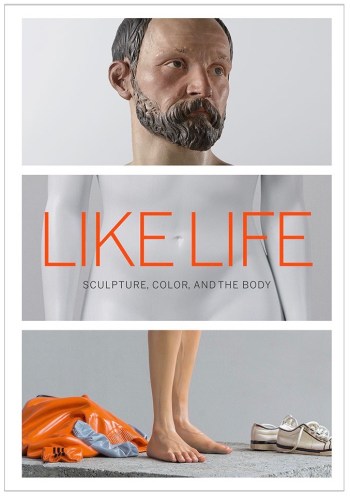 Seven hundred years of sculptural practice—from 14th-century Europe to the global present—will be examined anew in the groundbreaking exhibition Like Life: Sculpture, Color, and the Body (1300–Now). On view at The Met Breuer from March 21 through July 22, 2018, the exhibition will explore expanded narratives of sculpture through works in which artists have sought to replicate the literal, living presence of the human body. A major international loan exhibition of approximately 120 works, Like Life will draw on The Metropolitan Museum of Art’s rich collection of European sculpture and modern and contemporary art, while also featuring a selection of important works from national and international museums and private collections.
Just how perfectly should figurative sculpture resemble the human body? Histories and theories of Western sculpture have typically favored idealized representations, as exemplified by the austere, white marble statuary of the classical tradition. Such works create the fiction of bodies existing outside time, space, and personal or cultural experience. This exhibition, by contrast, will place key sculptures from different eras in conversation with each other in order to examine the age-old problem of realism and the different strategies deployed by artists to blur the distinctions between original and copy, and life and art. Foremost among these is the application of color to imitate skin and flesh. Other tactics include the use of casts taken from real bodies, dressing sculpted figures in clothing, constructing movable limbs and automated bodies, even incorporating human blood, hair, teeth, and bones. Uncanny in their approximation of life, such works have the potential to unsettle and disarm observers, forcing us to consider how we see ourselves and others, and to think deeply about our shared humanity.

Thomas Southwood Smith and Jacques Talrich, ‘Auto-Icon’ of Jeremy Bentham (1748–1832), wax figure built around Bentham’s own skeleton, with human hair, wool, cotton, linen textiles, straw hat, glasses, wood walking stick, table, and chair (London: UCL).
Juxtaposing well-known masterpieces with surprising and little-seen works, the exhibition brings together sculptures by artists from Donatello, El Greco, Jean-Léon Gérôme, Antonio Canova, Auguste Rodin, and Edgar Degas to Louise Bourgeois, Meret Oppenheim, Isa Genzken, Charles Ray, Fred Wilson, Robert Gober, Bharti Kher, Duane Hanson, Jeff Koons, and Yinka Shonibare MBE, as well as wax effigies, reliquaries, mannequins, and anatomical models. Together these works will highlight the continuing anxieties and pleasures attendant upon the three-dimensional simulation of the human body.
Like Life: Sculpture, Color, and the Body (1300–Now) is curated by Luke Syson, Iris and B. Gerald Cantor Chairman of European Sculpture and Decorative Arts, and Sheena Wagstaff, Leonard A. Lauder Chairman of Modern and Contemporary Art, both at The Met, with Brinda Kumar, Assistant Curator of Modern and Contemporary Art, The Met, and Emerson Bowyer, Searle Associate Curator of European Painting and Sculpture at the Art Institute of Chicago, with the assistance of Elyse Nelson, Research Associate, European Sculpture and Decorative Arts, The Met. The catalogue is made possible by the Mary C. and James W. Fosburgh Publications Fund.
Luke Syson and Sheena Wagstaff, with Emerson Bowyer, Brinda Kumar, Barti Kher, Jeff Koons, Schwartz Hillel, Marina Warner, and Fred Wilson, Like Life: Sculpture, Color, and the Body (New York: The Metroplitan Museum of Art, 2018), 312 pages, ISBN: 978 1588396440, $65.
A symposium explores themes raised by the exhibition on Saturday, 14 April 2018, from 10:30am until 6:30pm.
New Book | The Women Who Built the Ottoman World
From I. B. Tauris:
Muzaffer Özgüles, The Women Who Built the Ottoman World: Female Patronage and the Architectural Legacy of Gülnus Sultan (London: I. B. Tauris & Co, 2017), 304 pages, ISBN: 9781784539269, £64 / $99.
 At the beginning of the eighteenth century, the Ottoman Empire remained the grandest and most powerful of Middle Eastern empires. One hitherto overlooked aspect of the Empire’s remarkable cultural legacy was the role of powerful women—often the head of the harem, or wives or mothers of sultans. These educated and discerning patrons left a great array of buildings across the Ottoman lands: opulent, lavish, and powerful palaces and mausoleums, but also essential works for ordinary citizens, such as bridges and waterworks. Muzaffer Ozgules here uses new primary scholarship and archaeological evidence to reveal the stories of these Imperial builders. Gulnus Sultan (1642–1715), the favourite of the imperial harem under Mehmed IV and mother to his sons, was exceptionally pictured on horseback, travelled widely across the Middle East and Balkans, and commissioned architectural projects around the Empire. Her buildings were personal projects designed to showcase Ottoman power and they were built from Constantinople to Mecca, from modern-day Ukraine to Algeria. Ozgules seeks to re-establish the importance of some of these buildings, since lost, and traces the history of those that remain. The Women Who Built the Ottoman World is a valuable contribution to the architectural history of the Ottoman Empire and to the growing history of the women within it.
Muzaffer Özgüles is Assistant Professor in the Faculty of Architecture at Gaziantep University, Turkey, and was the Barakat Trust Post-Doctoral Research Fellow at the Khalili Research Centre at the University of Oxford from 2014 to 2015. He gained his PhD in Architectural History at Istanbul Technical University in 2013.
Exhibition | Thomas Gainsborough: Experiments in Drawing
From The Morgan:
Thomas Gainsborough: Experiments in Drawing
The Morgan Library & Museum, New York, 11 May — 19 August 2018
Curated by Marco Simone Bolzoni
 The eighteenth-century British master Thomas Gainsborough (1727–1788) is celebrated for his portraiture and for his depictions of rural landscapes. Although he was best known as a painter, he was also a draftsman of rare ability. Gainsborough experimented with various media to sketch preparatory studies, finished works, and in some cases exercises for his own enjoyment. Thomas Gainsborough: Experiments in Drawing brings together more than twenty works primarily from the Morgan’s collection that reveal the artist’s technical innovations, his mastery of materials, and his development of a new and original mode of drawing.
The exhibition is sponsored by Lowell Libson and Jonny Yarker Ltd. and generously supported by Mr. and Mrs. Clement C. Moore II and the Eugene V. and Clare E. Thaw Charitable Trust.
Marco Simone Bolzoni, Thomas Gainsborough: Experiments in Drawing (London: Holberton, 2018), 84 pages, ISBN: 9781911300458, $25.
New Book | François de Cuvilliés
From Allitera Verlag:
Albrecht Vorherr, ed., François de Cuvilliés: Rokokodesigner am Münchner Hof (Allitera Verlag, 2018), 280 pages, ISBN: 978-3962330224, 30€.
 Zum 250 Todestag von Francois de Cuvilliés (1695–1768) am 14. April 2018 erscheint diese Anthologie mit pointierten Texten namhafter Wissenschaftler zum großen Architekten und Designer des Rokokos. Elf Beiträge widmen sich dem stilsicheren Genie und vergessen dabei nicht die bitteren Seiten seiner Vita. Vor dem Hintergrund aktueller Forschung wird Cuvilliés zum einen als Künstler und Mensch vorgestellt, zum anderen auch ein Schlaglicht auf die Epoche des Rokoko in München geworfen: Handwerker- und Hofleben, Verwaltung und Realisierung barocker Bauprojekte, luxuriöses Design öffentlicher Bauten, Palais und Schlösser, Theater- und Festkultur. Der Belgier François de Cuvillies hat wie kein anderer die Haupt- und Residenzstadt mit seiner Bau- und Ausstattungskunst geprägt und das kurfürstliche München auf dem Niveau von Paris, Dresden und Venedig zum Strahlen gebracht.
Mit Beiträgen von, Magdalena Bayreuther, Neven Denhauser, Gabriele Dischinger, Hanna Dornieden, Ernst Götz, Alexandra Loske, Stefan Nadler, Hermann Neumann, Max Tillmann, Christian Quaeitzsch, Albrecht Vorherr.
Albrecht Vorherr ist Kunstpädagoge und Autor. Sein besonderes Interesse gilt der Kunst- und Kulturgeschichte des 18. Jahrhunderts. Mit Doris Fuchsberger veröffentlichte er im Allitera Verlag Schloss Nymphenburg unterm Hakenkreuz (2014) und den Bildband Schloss Nymphenburg: Menschen – Bauwerke – Geschichte (2015).
Exhibition | High Society
Press release (1 December 2017) from the Rijksmuseum:
High Society: Four Centuries of Glamour
Rijksmuseum, Amsterdam, 8 March — 3 June 2018

Sir Joshua Reynolds, Jane Fleming, later Countess of Harrington, ca. 1778–79 (San Marino, The Huntington Library, Art Collections and Botanical Gardens).
The Dutch national museum, the Rijksmuseum, is presenting High Society with over thirty-five life-size portraits of powerful princes, eccentric aristocrats, and fabulously wealthy citizens by the great masters of art history, including Cranach, Veronese, Velázquez, Reynolds, Gainsborough, Sargent, Munch, and Manet. The centrepiece are Rembrandt’s spectacular wedding portraits, Marten Soolmans and Oopjen Coppit, which will be shown for the first time following their restoration.
Never before has there been an exhibition dedicated to this most glamorous type of portrait: life-size, standing, and full length. Loans have come from museums and private collections from all over the world including Paris, London, Florence, Vienna, and Los Angeles. High Society also gives a glimpse into the informal life of the well-to-do. More than eighty prints and drawings from the Rijksmuseum’s own collection show what went on behind closed doors: parties, drinks, gambling, and amorous encounters.
International Masterpieces
The works vary from the early sixteenth to the start of the twentieth century. Masterpieces include the impressive portraits of Henry the Pious, Duke of Saxony and Catharina, Countess of Mecklenburg by Lucas Cranach the Elder (1514), the married couple Iseppo da Porto and Livia da Porto Thiene with Their Children by Veronese (1555), Don Pedro de Barberana y Aparregui by Velázquez (ca. 1631–33), Portrait Jane Fleming by Sir Joshua Reynolds (1778/79), The Artist by Edouard Manet (1875), and of course Marten Soolmans and Oopjen Coppit by Rembrandt (1634).
Four Centuries of Fashion
Most of the people portrayed are very lavishly dressed, giving the exhibition an overview of four centuries of fashion: from the tightly cut trousers and doublet from 1514 to the haute couture of the late nineteenth century. Some of the subjects portrayed, however, are wearing fancy garments in an antique style. Another is wearing a kilt, yet another is not wearing trousers and one is almost completely naked. Remarkably, those portrayed often have dogs with them. One man is accompanied by a lion. One couple have their children with them. The backgrounds can be richly decorated interiors, often with columns and/or curtains, or a summer or winter landscape. One man is standing in front of an imaginary landscape with palm trees, while another is adopting a flamboyant pose in front of the Colosseum in Rome.
Vices
Whereas the life-size portraits show the well-to-do in their Sunday best, three rooms in the exhibition are devoted to activities that take place for the most part behind closed doors: parties, drinks, gambling, amorous encounters, and brothel visits. Based on the vices of Gluttony, Greed, and Lust, more than eighty prints and drawings from the collection of the Rijksmuseum have been assembled, many showing humorous and satirical scenes, often with a strong moralizing message in the inscriptions.

Photo: Rijksmuseum/David van Dam.
◊ ◊ ◊ ◊ ◊
The catalogue by Jonathan Bikker (Curator of Research at the Rijksmuseum) will be available at the Rijksmuseum Shop from March 2018. An edition of the journal Kunstschrift entitled Ten Voeten Uit (Full Length) will also be published to accompany the exhibition.
Jonathan Bikker, High Society (Rotterdam: NAI Publishers, 2018), 136 pages, ISBN: 978-9462084261, 25€.
New Book | Die Fresken von Joseph Mages
Published by Schnell & Steiner and now available from Artbooks.com:
Angelika Dreyer, Die Fresken von Joseph Mages (1728–1769): Zwischen barocker Frömmigkeit und katholischer Aufklärung (Regensburg: Schnell & Steiner, 2017), 312 pages, ISBN: 9783795432560, 76€ / $95.
 Josef Mages (1729–1769) setzte sich in seinen Freskenausstattungen richtungsweisend mit den Reformbestrebungen der katholischen Aufklärung auseinander. Seinen vom künstlerischen Umfeld der Augsburger Kunstakademie geprägten Deckenmalereien wird hier erstmals eine umfassende Studie gewidmet, die zugleich eine wesentliche Lücke in der Erforschung des süddeutschen Barocks schließt.
Neben einer exemplarischen Künstlersozialgeschichte stehen insbesondere die jeweiligen Auftraggeber sowie ihre vorwiegend religionspolitischen Ansichten und Absichten bei der Auftragsvergabe im Vordergrund der Untersuchung. Dabei nahm die vor allem im Bistum Augsburg wesentlich an Bedeutung gewinnende Auseinandersetzung über eine aufgeklärte Erneuerung der nachtridentinischen Frömmigkeitspraxis entscheidenden Einfluss auf die ikonographischen Inhalte und formale Gestaltung der Freskomalereien von Josef Mages. Im Gegensatz zu dem maßgeblich von Lodovico Antonio Muratori (1672–1750) initiierten religiösen Wandel und seinen Auswirkungen auf die raumbestimmende Kirchenausstattung wurden die Deckengemälde in Altomünster bei Freising oder in Oberschönenfeld von den weit existenzielleren Sorgen der dortigen Konventualen geprägt. Diese können als frühe malerische Vorboten der vom katholischen Klerus mit sorgenvollem Blick verfolgten Entwicklung hin zur späteren Säkularisation gesehen werden.
Exhibition | Salazar: Portraits of Influence in Spanish New Orleans
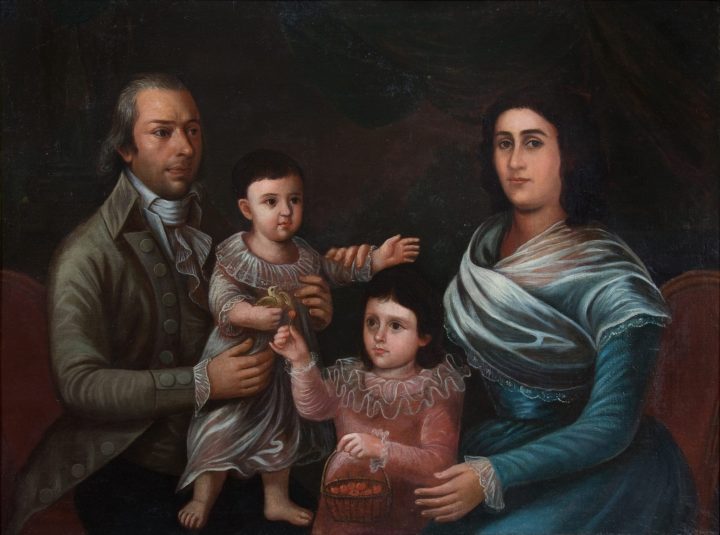
Josef Salazar y Mendoza, Portrait of Don Antonio Mendez (1750–1829) and His Family, 1795, oil on canvas, 36 × 49 inches (Collection of Mr. and Mrs. Robert J. Patrick).
◊ ◊ ◊ ◊ ◊
Now on view at the Ogden Museum of Southern Art:
Salazar: Portraits of Influence in Spanish New Orleans, 1785–1802
Ogden Museum of Southern Art, New Orleans, 8 March — 2 September 2018
Curated by Cybele Gontar
In conjunction with the tricentennial celebration of New Orleans, Salazar: Portraits of Influence in Spanish New Orleans tells the story of Yucatán-born Josef Francisco Xavier de Salazar y Mendoza (ca. 1750–1802), whose career spanned most of the Spanish administration of New Orleans. The exhibition offers a view of Spanish colonial New Orleans through a re-examination of about 30 of Salazar’s portraits. His oeuvre is contextualized in relation to works and other historical artifacts reflective of the city as a site of mobility and transatlantic artistic exchange.
The catalogue is available from ArtBooks.com:
Cybele Gontar, ed., Salazar: Portraits of Influence in Spanish New Orleans, 1785–1802 (New Orleans: University of New Orleans Press, 2018), 240 pages, ISBN: 9781608011544, $65.
The catalogue includes a comprehensive collection of Salazar’s portraits and essays that explore the historical and artistic implications of the era. The oeuvre of this Mexican artist is contextualized in relation to works by other early New Orleans portraitists including Antonio Meucci, Francois M. Guyol de Guiran (1775–1849), and Louis Collas (1775–1856).
Exhibition | New Orleans, the Founding Era

François Chéreau, Le Missisipi ou la Louisiane dans l’Amérique Septentrionale, ca. 1720, hand-colored engraving (The Historic New Orleans Collection, 1959.210).
◊ ◊ ◊ ◊ ◊
Now on view at THNOC:
New Orleans, the Founding Era
The Historic New Orleans Collection, 27 February — 27 May 2018
Curated by Erin Greenwald
In commemoration of the city’s 300th anniversary in 2018, The Historic New Orleans Collection provides a multifaceted exploration of the city’s first few decades and its earliest inhabitants with New Orleans, the Founding Era, an original exhibition and bilingual companion catalog. The exhibition brings together a vast array of rare artifacts from THNOC’s holdings and from institutions across Europe and North America to tell the stories of the city’s early days, when the city consisted of little more than hastily assembled huts and buildings.
Beginning with the region’s Native American tribes, through the waves of European arrival and the forced migration of enslaved African people, the exhibition reflects on the complicated and often conflicted meanings the settlement’s development held for individuals, empires, and indigenous nations. It features works on paper, ethnographic and archaeological artifacts, scientific and religious instruments, paintings, maps and charts, manuscripts and rare books. These original objects are complemented by large-scale reproductions and interactive items. More than 75 objects are on loan from organizations in Spain, France, Canada, and around the United States. A number of items, like a pair of 18th-century Native American bear-paw moccasins from the Musée du quai Branly in Paris and pieces of 15th-century Mississippian pottery from the University of Mississippi, have rarely traveled beyond their home institutions.
Digital interactives will include a gallery of photographs from archaeological digs at a variety of French Quarter sites, a game quizzing visitors on supplies needed for a new home in the settlement and a 1731 inventory of enslaved Africans and African-descended people living on a West Bank plantation.
Erin Greenwald, ed., New Orleans, the Founding Era / La Nouvelle-Orléans, les années fondatrices, translated by Henry Colomer (New Orleans: The Historic New Orleans Collection, 2018), 176 pages, ISBN 978-0917860744, $50.
The companion catalog—a bilingual edition, in English and French—will feature essays describing the different populations who inhabited precolonial New Orleans and the surrounding areas, as well as the forces driving the settlement’s growth. Essayists include exhibition curator Erin M. Greenwald and historians Emily Clark, Shannon Lee Dawdy, Robbie Ethridge, Gilles-Antoine Langlois, Yevan Terrien, Daniel Usner, and Cécile Vidal. Gérard Araud, ambassador of France to the United States, contributed the book’s foreword.
Erin M. Greenwald is curator of programs at the New Orleans Museum of Art. Formerly, as curator at The Historic New Orleans Collection, she was project director of the National Endowment for the Humanities-funded traveling exhibition Purchased Lives: The American Slave Trade from 1808 to 1865. Greenwald holds a PhD in history from the Ohio State University.
Henry Colomer is a French documentary filmmaker and translator. He has directed some thirty films, including various portraits of artists and writers (L’exilé, Iddu, Ricercar, Vies métalliques), as well as a number of documentaries about the upheavals of the twentieth century (Monte Verità, Sous les drapeaux). Colomer has won several awards (Best Historic Documentary, Festival of History Films, Pessac, 1998, 2008; Focal International Award, London, 2010).










 Enfilade
leave a comment