New Book | The Life and Work of Thomas Chippendale Junior
From Philip Wilson:
Judith Goodison, The Life and Work of Thomas Chippendale Junior (Philip Wilson, 2017), 464 pages, ISBN: 9781781300565, £65 / $95.
 The Chippendale cabinet-making firm, founded by Thomas Chippendale senior in about 1750 became famous partly through the succesful publication of his The Gentleman and Cabinet-Maker’s Director (1754, re-published 1755 and 1762), and partly through the fine furniture supplied to a number of illustrious clients. Chippendale senior ran the workshop for just over twenty years. His eldest son Thomas Chippendale junior (1749–1822) continued the business for over forty, the first two decades in partnership with Thomas Haig. Chippendale senior’s work has been well documented. Chippendale junior’s work has never, until now, been thoroughly researched. The Life and Work of Thomas Chippendale Junior repairs the omission. His patrons included members of the Royal Family, aristocrats, landed gentry, and antiquarians. He was adept at satisfying their demands, whether they required lavish gilt or simpler, often mahogany, pieces. Where family archives and original settings survive, as at Harewood House, Paxton House, and Stourhead, they reveal the variety and quality of Chippendale’s output. Analysis of client’s invoices, even when the furniture can no longer be traced, for the first time provides a colourful view of what customers chose and what prices they paid.
Judith Goodison FSA is a furniture historian and has been researching the work of Thomas Chippendale junior for the last ten years.
Exhibition | Chippendale 300

During 2018, the Chippendale 300 partnership is celebrating Thomas Chippendale (b. 5 June 1718) and his legacy as widely as possible, both by encouraging greater public awareness of his genius and the glories of 18th-century craftsmanship and by demonstrating how the same spirit animates today’s designers and makers. The following institutions and historic houses have joined together to create a programme of exhibitions and events to celebrate Thomas Chippendale’s tercentenary: Burton Constable Hall, The Chippendale Society, Dumfries House, Firle Place, The Furniture History Society, Harewood House, Leeds Museum & Galleries, Master Carvers’ Association, The National Trust, Newby Hall, Paxton House, Visit Otley, and Weston Park. Visit Chippendale 300 for more information. Opening in February at Leeds:
Thomas Chippendale: A Celebration of Craftsmanship and Design, 1718–2018
Leeds City Museum, 9 February — 10 June 2018
Curated by Adam Bowett and James Lomax
 This exhibition celebrates the life and work of Thomas Chippendale (1718–1779), Britain’s most famous furniture maker. It will be the most comprehensive exhibition of Thomas Chippendale’s work ever presented and will include furniture, accessories, drawings, documents and other material from collections throughout the United Kingdom. Alongside well-known masterpieces from public collections there will be rarely-seen furniture from private houses and some new discoveries, never before exhibited. The exhibition explores Thomas Chippendale’s life and work in five major themes: his family origins, training, career and the publication of the ground-breaking Director; his furniture in the Rococo, Gothic, Chinese, and neo-Classical styles; the management of his commissions, including relations with clients; his workshops, including manufacturing and decorative techniques; and his legacy from the 18th century to the present day.
◊ ◊ ◊ ◊ ◊
From ACC Publishing Group:
Adam Bowett and James Lomax, Thomas Chippendale (1718–1779): A Celebration of British Craftsmanship and Design (Bradford: The Chippendale Society, 2018), 208 pages, ISBN: 9781999922917, $90.
Celebrating the tercentenary of Thomas Chippendale’s birth, this catalogue of the 2018 Leeds exhibition covers all 95 exhibits including furniture, drawings, engravings, textiles and wallpaper, together with other contemporary and later material. Each entry is illustrated in colour, with supporting images in both colour and black and white. Also included are introductory essays to each section of the exhibition, covering Chippendale’s life and career, his furniture styles, his relationships with customers, and his legacy from the 18th century to the present day.
Adam Bowett is the Chairman of the Chippendale Society and co-curator of the tercentenary exhibition. He is a well-known historian of English furniture and has published widely on the subject in both popular and scholarly journals. He is also the author of three books on English furniture. James Lomax is the Curator of the Chippendale Society and co-curator of the tercentenary exhibition. He was formerly curator at Temple Newsam House, Leeds and is an acknowledged expert on 18th-century applied arts, particularly silver, and has a special interest in the work of Thomas Chippendale.
Note (added 4 March 2018) — The original posting did not include information about the catalogue.
New Book | American Quilts in the Industrial Age, 1760–1870
From the University of Nebraska Press:
Patricia Cox Crews and Carolyn Ducey, eds., American Quilts in the Industrial Age, 1760–1870: The International Quilt Study Center and Museum Collections (Lincoln: University of Nebraska Press, 2018), 528 pages, ISBN 978 08032 95926, $90.
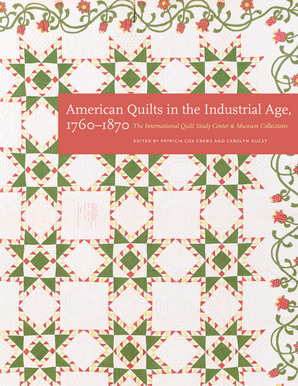 Part of a comprehensive catalog of the International Quilt Study Center and Museum collection, American Quilts in the Industrial Age, 1760–1870 highlights the dazzling designs and intricate needlework of America’s treasured material culture. From whole cloth to pieced quilts to elaborate appliqué examples, all reflecting various design movements such as Neoclassicism and Eastern exoticism, the contributing authors address the development of quilt making in America from its inception in the 1700s to the period of the U.S. Civil War.
Covering more than one hundred years of quilt making, this volume examines the period’s quilts from both an artistic and a historical perspective. The contributors provide critical information regarding the founding of the republic and the influential republican values and ideals manifested in the quilts of this era. They also address the role that immigration and industrialization played in the evolution of materials and styles. With full-color photographs of nearly six hundred quilts, American Quilts in the Industrial Age, 1760–1870 offers new insights into American society.
Patricia Cox Crews is founding director emerita of the International Quilt Study Center and Museum and professor emeritus in the Department of Textiles, Merchandising, and Fashion Design at the University of Nebraska–Lincoln. She has edited and co-edited multiple books, including American Quilts in the Modern Age, 1870–1940: The International Quilt Study Center Collections and Wild by Design: Two Hundred Years of Innovation and Artistry in American Quilts. Carolyn Ducey is curator of collections at the International Quilt Study Center and Museum. She is the author of Chintz Appliqué: From Imitation to Icon and is a contributing author of Wild by Design: Two Hundred Years of Innovation and Artistry in American Quilts.
New Book | Les Paradis Secrets de Marie-Antoinette
From Albin Michel:
Christophe Fouin, Thomas Garnier, Christian Milet, and Didier Saulnier, Les Paradis Secrets de Marie-Antoinette (Paris: Éditions Albin Michel, 2017), 240 pages, ISBN: 978 222632 1657, 49€.
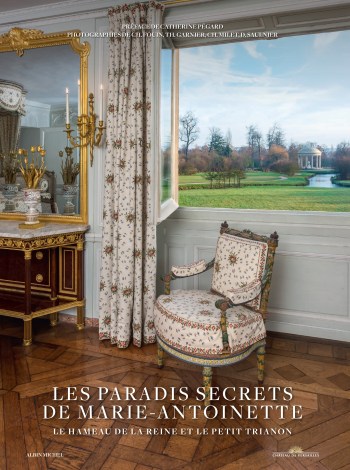 Le hameau de la Reine et le Petit Trianon comme vous ne les avez jamais vus.
Les photographes du Domaine vous ouvrent toutes les portes… même les plus secrètes : une promenade exclusive dans les pas de Marie-Antoinette. Alors que ses moindres faits et gestes étaient regardés, commentés et régulés au château de Versailles, selon l’étiquette stricte imposée par Louis XIV, Marie-Antoinette décida qu’elle n’avait plus aucun compte à rendre lorsqu’elle franchissait les haies de ses jardins privés, où sa liberté d’esprit la poussait à se retirer avec ses intimes…
New Book | British Embassies
From Francis Lincoln, and imprint of The Quarto Group:
James Stourton, with photographs by Luke White, British Embassies: Their Diplomatic and Architectural History (Frances Lincoln, 2017), 352 pages, ISBN: 978 071123 8602, $65 / £40.
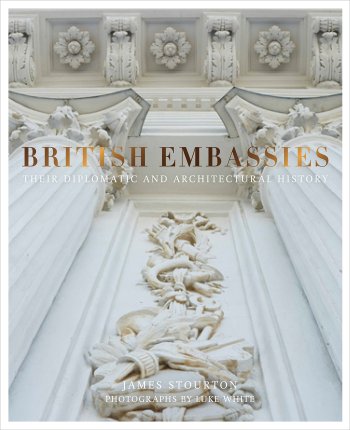 British Embassies have a special role in British history. They represent the country in bricks and stone and have often expressed—at least in the eyes of foreigners—British national character. Whether they are Lutyens buildings in Washington, grand palaces in Europe, beautiful old colonial buildings in Asia, or secure compounds in the Middle East, they all have stories to tell and reveal the changing face of British diplomacy. A mixture of history, architectural description, diplomacy and anecdote, this large format picture book covers residences and embassies in twenty-six countries to provide an authoritative text, accompanied by newly commissioned photography.
James Stourton is the prize-winning author of five books including Great Houses of London and the authorised biography of Kenneth Clark, Life, Art and Civilization. He is a former Chairman of Sotheby’s UK, he sits on the Heritage Memorial Fund panel and the Acceptance in Lieu panel, and is a senior fellow of the Institute of Historical Research, London University.
Luke White’s photographs have been widely published in interior design and architectural magazines including Architectural Digest, Vogue, and Homes and Gardens. His books include Sally Storey’s Lighting by Design and The Irish at Home by Jane and Sarah McDonnell.
Exhibition | San Antonio 1718: Art from Viceregal Mexico

José de Páez, Mexican Castes (Castas mexicanas), (15 total), ‘1. De Español, e India, produce mestizo’, oil on canvas, 1780
(Private Collection)
◊ ◊ ◊ ◊ ◊
From the San Antonio Museum of Art:
San Antonio 1718: Art from Viceregal Mexico, A Tricentennial Exhibition
San Antonio Museum of Art, 17 February 2018 — 13 May 2018
Three hundred years ago the city of San Antonio was founded as a strategic outpost of presidios defending the colonial interests of northern New Spain and missions advancing Christian conversion. The city’s missions bear architectural witness to the time of their founding, but few have walked these sites without wondering who once lived there, what they saw, valued, and thought. San Antonio 1718: Art from Viceregal Mexico tells the story of the city’s first century through more than one hundred landscapes, portraits, narrative paintings, sculptures, and devotional and decorative objects, many of them never before exhibited in the United States. The exhibition is organized in three sections: People and Places, The Cycle of Life, and The Church.
San Antonio 1718 includes portraits of political and economic power, Spanish viceroys and military leaders who helped shape the destiny of the city. It explores the intrepid Franciscan missionaries who spearheaded the evangelization of the region, including Fray Antonio Margil de Jésus, known as the ‘Patron Saint of Texas’, and the religious figures who anchored their teachings such as the Virgin of the Immaculate Conception and her American manifestation, the Virgin of Guadalupe. Many works are more personal: portraits of poised young women whose marriages will solidify status, aspirational paintings of young families at home, nuns depicted at the threshold of their vows or at their death, intimate miniatures of lovers and soldiers, post-mortem portraits of infants. Throughout, the works invoke the lineage and authority of mainland Spain, while revealing the lives and times of San Antonio’s earliest inhabitants.
Celebrating the city’s deep Hispanic roots and cultural ties with Mexico, San Antonio 1718 features works by New Spain’s most talented eighteenth-century artists, including Cristόbal de Villalpando (1649–1714), Miguel Cabrera (1695–1768), and José de Páez (1720–1790), as well as pieces by talented unknown vernacular artists.
Marion Oettinger, ed., with essays by Jaime Cuadriello, Cristina Cruz González, Ray Hernández-Durán, Katherine Luber, and Gerald Poyo, San Antonio 1718: Art from Mexico (San Antonio: Trinity University Press, 2018), 288 pages, ISBN: 9781595348340, $33.
◊ ◊ ◊ ◊ ◊
Note (added 19 February 2018) — The original posting did not include the catalogue details.
New Book | The Jewish Journey: 4000 Years in 22 Objects
Distributed by ACC Publishing:
Rebecca Abrams, The Jewish Journey: 4000 Years in 22 Objects from the Ashmolean Museum (Oxford: Ashmolean Museum, 2017), 232 pages, ISBN: 978 191080 7033, $20.
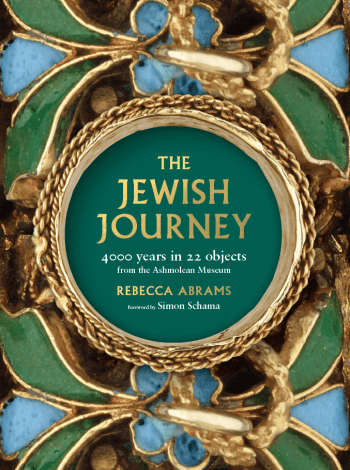 The 22 objects include pottery, coins, jewelry, household artifacts, sacred items, musical instruments and paintings. Together they bring to life the experiences of the real men and women who owned, made and used them, from kings, courtiers and scholars to guerrilla fighters, musicians and market stall holders. Individually and collectively, the objects vividly document dark periods of persecution and forced migration, whilst highlighting the astonishing resilience and diversity of Jewish life, revealing centuries of two-way interaction with many other cultures and religions. Through the histories of each of the objects, the reader is guided on a double journey, one leading through the galleries of the Ashmolean, the other accompanying the Jewish people across the centuries. The Jewish Journey brings to light for the first time the amazing Jewish treasures in the Ashmolean Museum, explaining their specifically Jewish significance in a direct, accessible style for the general reader.
The Jewish Journey is unique in three respects. First, it is a short, accessible, illustrated history of the Jewish people aimed at the general public. Secondly, the book is unique in highlighting Jewish objects drawn from the permanent collection of a world-renowned public museum. Jewish history is more normally confined to dedicated Jewish museums. This book breaks new ground by showing Jewish history in its wider historical, social and cultural context. In addition, it presents objects that reflect on daily life over the centuries, e.g. family, marriage, trade, travel, rather than the more common depictions of artifacts for sacred and religious use. Thirdly, the Jewish significance of these particular 22 objects has until now been overlooked. This book draws them together for the first time to highlight their specific relevance to Jewish history, revealing both distinctive features of Jewish experience and evidence of centuries of close interaction with other cultures and religions.
Rebecca Abrams is an award-winning author of both fiction and non-fiction. Her most recent book, Touching Distance, won the MJA Open Book Award and was shortlisted for the McKitterick Prize for Literature. A graduate of Newnham College, Cambridge, she is a longstanding tutor in Creative Writing at the University of Oxford, before which she was an Honorary Teaching Fellow on the Warwick University Writing Programme and 2014 Gladstone’s Library Writer-in-Residence. She has recently been appointed a Royal Literary Fund Writing Fellow. A regular literary critic for the Financial Times and a former columnist on The Daily Telegraph, she has written extensively for the UK national press and is the recipient of an Amnesty International Press Award.
Exhibition | From Life

Thomas Rowlandson, Drawing from Life at the Royal Academy, (Somerset House), hand-coloured aquatint by A. C. Pugin and Thomas Rowlandson published in Ackermann’s The Microcosm of London, 1 January 1808. 20 × 26 cm (London: Royal Academy of Arts).
◊ ◊ ◊ ◊ ◊
Press release from the RA for the exhibition:
From Life
Royal Academy of Arts, London, 11 December 2017 — 11 March 2018
Curated by Adrian Locke
The Royal Academy of Arts presents From Life, a special exhibition project taking place across two distinct spaces: the Sackler Wing of Galleries and the Tennant Gallery. From Life examines what making art from life has meant to artists throughout history and how the practice is evolving as technology opens up new ways of creating and visualising artwork.
Drawing from casts of Classical and Renaissance sculpture and life models was long considered essential training for any aspiring artist, and was once a staple of the RA Schools, Britain’s longest established fine art school. Beginning with a display of historic paintings and works on paper drawn from the RA Collection, From Life explores the practice of life drawing, from the origins of the Royal Academy in the 18th century to the present day, whilst also looking to the future. Historic paintings by artists such as Johann Zoffany are followed by works in a diverse range of media by contemporary artists, including Jeremy Deller’s Iggy Pop Life Class (2016), Cai Guo-Qiang’s film One Thousand Youngsters Drawing David (2010), and Jenny Saville’s Entry (2004). From Life also presents work by Royal Academicians who continue to interrogate the practice of working from life, among them Antony Gormley, Chantal Joffe, Michael Landy, and Gillian Wearing.
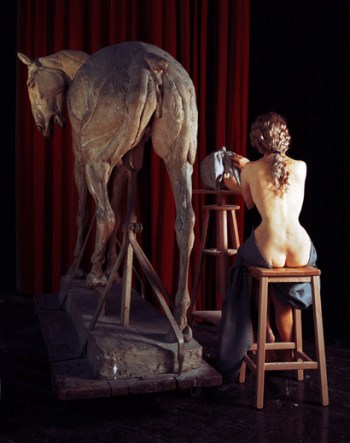
Liane Lang, Casts Series (Royal Academy), Ars Equina, 2006–07, c-type photographic print.
For the first time the Royal Academy is working with artists exploring emerging technologies, which presents them with new ways to both observe and represent themselves and the world around them. Farshid Moussavi RA, Humphrey Ocean RA, Yinka Shonibare RA, and Jonathan Yeo have experimented with virtual reality technologies, creating new artwork for the exhibition using virtual reality platform HTC Vive, Tilt Brush by Google, and artistic software programmes, including MakeVR Pro. Farshid Moussavi’s VR experience transports visitors into masterpieces of ecclesiastical architecture, which they can adapt and transform themselves, while creative technology and content studio Happy Finish have worked with Yinka Shonibare to develop a three-dimensional rendering of a neo-classical painting, featuring a cast of Venus dressed in Shonibare’s trademark batik fabric. Meanwhile, Humphrey Ocean invites audiences to create their own three-dimensional sketches within a playful virtual environment centred on the artist’s fascination with chairs.
From Life reveals the creative process in making these new artworks, as well as opening up the exciting potential of future artistic applications of virtual reality. HTC Vive has supported the development of these works, which will also be available for audiences to experience at home on Viveport, HTC’s global VR app store. Artist Jonathan Yeo has collaborated with Google Arts & Culture to create the first physical free-standing sculpture in metal made by using Tilt Brush, his creative process is captured in a VR film to be published on Google Arts & Culture Youtube channel. The visitors’ experience of the virtual reality element within the exhibition will depend on availability. As each virtual reality artwork can only be experienced individually, access cannot be guaranteed.
Tim Marlow, Artistic Director of the Royal Academy of Arts said: “This is an experimental project that explores everything from artistic process to technological evolution and creative collaboration. In a sense, From Life embodies what an artist-run academy was, is and might become.”
Sky Arts have commissioned immersive content studio Factory 42 to produce a documentary entitled Virtual Reality: Mystery of Creativity, which explores creating art in a virtual environment and how artists use these cutting-edge technologies to explore the limits of traditional artistic methods. There are also a series of short films across the Royal Academy’s online platforms, as well as available via the Sky VR and Google Arts & Culture apps.
To coincide with From Life and as part of the 250th anniversary celebrations in 2018, the Royal Academy is offering free life drawing classes for 250 people of all abilities in the historic Life Room in the RA Schools [dating to the 1860s]. Each class is for a particular group that has a special relationship with either the RA, drawing, or the human body, from members of the Royal Academy’s outreach programmes to nurses and architects. The guest tutors will not be revealed until the life drawing class begins. The project will be documented by online features and videos. The RA is also inviting the public and Friends of the RA to participate through an open ballot to win 50 places at the following free classes, led by guest tutors who will be revealed on the day. Enter the ballot here.
13 December 2017 (10.30am–1.30pm), exclusive to Friends of the RA
24 January 2018 (10.30am–1.30pm), open to all
Sam Phillips, ed., Artists Working From Life (London: Royal Academy, 2017), 160 pages, ISBN: 978 19103 50904, £22.
 From Michelangelo’s marbles to photographer’s self-portraits, artists have always been fascinated by their creative encounters with the human body. Often a key part of their early training, drawing and sculpting from life go on to inform their later work in unexpected and inspiring ways. This illuminating publication brings together interviews with over 19 artists from all disciplines, including painters, sculptors and conceptual artists, working in a variety of different media. Through in-depth conversations with them, the authors explore the many ways artists work ‘from life’: from Jeremy Deller’s open life class with Iggy Pop as model, to Jonathan Yeo’s innovative use of 3D scanners and virtual reality. The interviews are written by contributors including Caroline Bugler, Martin Gayford, Laura Gascoigne, Angela Kingston, Adrian Locke, Ben Luke, Sam Phillips, and Michael Prodger. The book is introduced by an essay on the history of life drawing by Annette Wickham, the Royal Academy’s Curator of Works on Paper.
Sam Phillips is editor of the Royal Academy of Arts Magazine.
New Book | Revolutionary Paris and the Market for Netherlandish Art
From Brill:
Darius Spieth, with a foreword by Marc Fumaroli, Revolutionary Paris and the Market for Netherlandish Art (Leiden: Brill, 2017), 514 pages, ISBN: 978 90043 36988, €116 / $134.
 Seventeenth-century Dutch and Flemish paintings were aesthetic, intellectual, and economic touchstones in the Parisian art world of the Revolutionary era, but their importance within this framework, while frequently acknowledged, has never attracted much subsequent attention. Darius Spieth’s Revolutionary Paris and the Market for Netherlandish Art reveals the dominance of ‘Golden Age’ pictures in the artistic discourse and sales transactions before, during, and after the French Revolution. A broadly based statistical investigation, undertaken as part of this study, shows that the upheaval reduced prices for Netherlandish paintings by about 55% compared to the Old Regime and that it took until after the July Revolution of 1830 for art prices to return where they stood before 1789.
Darius A. Spieth, PhD University of Illinois at Urbana-Champaign, is Professor of Art History at Louisiana State University. He is the editor of the Grove Guide to Art Markets and Collecting (forthcoming), and author of Napoleon’s Sorcerers: The Sophisians (2007).
C O N T E N T S
Acknowledgements
Foreword by Marc Fumaroli
List of Illustrations
A Note on Currencies
1 From Eyesores to Blue Chip Art
Origins of the Parisian Marketplace for Netherlandish Painting
Art Publications and the Dissemination of Information
France as International Tastemaker for Golden Age Art After 1740
Royal Collections and Northern Masters, 1777–1792
The Twilight of the Auction Business, 1775–1825
The Fate of Golden Age Art Under Terror and Inflation
The Louvre and the ‘Artistic Conquests’ in Belgium and the Netherlands
The Post-Revolutionary Market for Netherlandish Art
The Expanding Mass Market for Copies and the Rise of the Bourgeoisie
Golden Age Art and Popular Culture
Netherlandish versus Italian Art
The Parisian Apartment: A Bourgeois Space for Art
2 On the Art of Surviving the Revolution: Jean-Baptiste Pierre Lebrun
Art Dealer to the Ancien Régime’s Elite, 1776–1789
Painful Adjustments, 1789–1795
Co-Conspirator of Jacques-Louis David, 1792–1794
From The Ministry of Finance to the Louvre, 1794–1799
A Long Good-Bye from the Louvre, 1799–1803
A Difficult Comeback as Dealer-Expert, 1801–1804
Deceptions of the Napoleonic Age, 1807–1813
3 A Long Good Bye to the Palais Royal: The Northern Pictures in the Orléans Collection
The Art Collections in the Palais Royal until 1780
Inside the Art Deal of the Century
The Netherlandish Pictures of the Palais Royal Collection
A Look Inside the Galeries De Bois
4 Liberty’s Toll on Beauty’s Price
Myths and Realities of the Parisian Auction Market in the 1790s
Turnover of the Parisian Art Auction Market and its Economic Context, ca. 1775–1850
The Evolution of Prices for Netherlandish Art in Revolutionary Paris
Bidding Wars: The Picture Trade with Great Britain
The ‘Guilty Industry’ and Netherlandish Art
5 Netherlandish Art in France: A History of Taste and Money across Three Centuries
Poussinists versus Rubenists
The Marquis D’argens and Academic Prejudices Against Northern Art
The Re-Evaluation of Netherlandish Aesthetics from David to Thoré
The Politicization of Nehterlandish Art in the Nineteenth Century
Class, Taste, and the First Art Price Rankings
Appendix
Bibliography
Photograph Credits
Index
New Book | Artisanal Enlightenment
From Yale UP:
Paola Bertucci, Artisanal Enlightenment: Science and the Mechanical Arts in Old Regime France (New Haven: Yale University Press, 2017), 312 pages, ISBN: 978 03002 27413, $40.
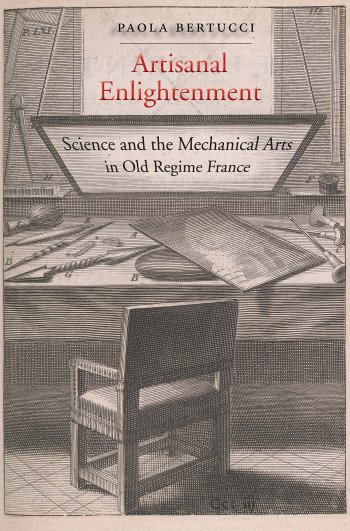 What would the Enlightenment look like from the perspective of artistes, the learned artisans with esprit, who presented themselves in contrast to philosophers, savants, and routine-bound craftsmen? Making a radical change of historical protagonists, Paola Bertucci places the mechanical arts and the world of making at the heart of the Enlightenment. At a time of great colonial, commercial, and imperial concerns, artistes planned encyclopedic projects and sought an official role in the administration of the French state. The Société des Arts, which they envisioned as a state institution that would foster France’s colonial and economic expansion, was the most ambitious expression of their collective aspirations. Artisanal Enlightenment provides the first in-depth study of the Société, and demonstrates its legacy in scientific programs, academies, and the making of Diderot and D’Alembert’s Encyclopédie. Through insightful analysis of textual, visual, and material sources, Bertucci provides a groundbreaking perspective on the politics of writing on the mechanical arts and the development of key Enlightenment concepts such as improvement, utility, and progress.
Paola Bertucci is associate professor of history at Yale University. She has published extensively on the public culture of science in eighteenth-century Europe, and is the author of prize-winning essays on secrecy, selective visibility, and industrial travel in the Enlightenment.










 Enfilade
leave a comment