New Book | De Dominici, Vite de’ pittori, scultori ed architetti napoletani
From ArtBooks.com:
Bernardo De Dominici, Vite de’ pittori, scultori ed architetti napoletani, edited by Fiorella Sricchia Santoro and Andrea Zezza (Naples: Paparo, 2017), 5 vols., 3206 pages, ISBN: 9788899130336, $340.
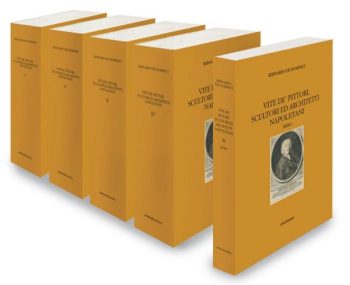 ‘Stomachevole’, ‘geniale imbroglione’, oppure scrittore ‘a cui siamo sempre disposti a concedere credito’; ‘la cui posizione e i cui meriti nei riguardi della storia artistica di Napoli non sono lontani da quelli Boschini per Venezia e di Malvasia per Bologna’: Bernardo De Dominici e la sua opera sono stati per due secoli e mezzo oggetto di feroci stroncature e di risolute riabilitazioni, restando sempre al centro dell’attenzione di chiunque si sia interessato alla storia dell’arte napoletana tra il Medioevo e l’età moderna. Nel 1950 Giuseppe Ceci, studioso di non comune rigore, invitò a fuggire dalle facili generalizzazioni e a intraprendere ‘l’umile ma indispensabile lavoro’ di una analisi completa delle Vite, un testo che rimane unico e insostituibile, pur con tutte le sue pecurialità e i suoi difetti. Da allora, mentre aumentava la consapevolezza della utilità dell’opera per gli studi, si è fatta sempre più presente la richiesta di una edizione commentata, che ne favorisse la lettura e insieme un uso cauto e criticamente avvertito: a questa esigenza vuole rispondere l’edizione commentata che, dopo un lavoro quindicennale, viene finalmente conclusa con questo tomo dedicato agli indici
Prima edizione moderna, commentata, di un’opera fondamentale per la storia dell’arte napoletana, stampata per la prima volta tra il 1742 e il 1745. L’opera si compone di due volumi: il primo dalle origini all’inizio del Seicento, il secondo (diviso in due tomi) dal Seicento al Settecento, il terzo dedicato agli indici.
Edizione a cura di Fiorella Sricchia Santoro e Andrea Zezza. Coordinatore al commento del primo tomo Francesco Aceto. Coordinatore al commento del secondo e terzo tomo Andrea Zezza. Testi a cura di Daria Di Bernardo, Marina Milella Consulenza filologica Nicola De Blasi. Autori delle introduzioni e delle note di commento delle singole vite Anna Bisceglia, Paola D’Agostino, Rosanna De Gennaro, Daniela del Pesco, Ippolita di Majo, Stefano D’Ovidio, Viviana Farina, Pierluigi Feliciano, Elena Fumagalli, Paolo Giannattasio, Fabiola Lagalla, Riccardo Naldi, Cristiana Pasqualetti, Maria Gabriella Pezone, Valter Pinto, Antonella Putaturo Murano, Concetta Restaino, Renato Ruotolo, Donato Salvatore, Fabio Speranza, Fiorella Sricchia Santoro, Andrea Zezza.
• Dalle Origini alla prima metà del Seicento
• Seicento (da J. de Ribera a L. Giordano)
• Seicento e Settecento (da G. Farelli a F. Solimena)
• Indici
Exhibition | Becoming a Woman in the Age of Enlightenment
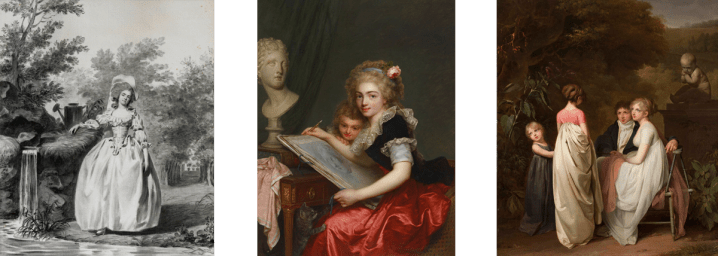
Jacques-Antoine-Marie Lemoine, Woman Standing in a Garden, 1783, black chalk and brush with gray wash on off-white laid paper; Antoine Vestier, Allegory of the Arts, 1788, oil on canvas; and Louis-Léopold Boilly, Conversation in a Park, oil on canvas. All on loan from The Horvitz Collection.
◊ ◊ ◊ ◊ ◊
From the Harn Museum of Art:
Becoming a Woman in the Age of Enlightenment: French Art from The Horvitz Collection
Harn Museum of Art, University of Florida, Gainesville, 6 October — 31 December 2017
Ackland Art Museum, The University of North Carolina at Chapel Hill, 26 January — 8 April 2018
Crocker Art Museum, Sacramento, 13 May — 19 August 2018
Smith College Museum of Art, Northampton, MA, dates TBA
Curated by Melissa Hyde and Mary D. Sheriff
Organized by Alvin Clark
Becoming a Woman in the Age of Enlightenment: French Art from the Horvitz Collection is primarily an exhibition of drawings but will include pastels, paintings, and sculptures selected from one of the world’s best private collections of French drawings. The exhibition will feature nearly 120 works by many of the most prominent artists of the eighteenth century, including Antoine Watteau, Nicolas Lancret, François Boucher, Jean-Honoré Fragonard, as well as lesser-known artists both male and female, such as Anne Vallayer-Coster, Gabrielle Capet, François-André Vincent, Philibert-Louis Debucourt. Ranging from spirited, improvisational sketches and figural studies, to highly finished drawings of exquisite beauty, the works included in the exhibition vary in terms of style, genre, and period.
Becoming a Woman will be organized into thematic sections that address some of the most important and defining questions of women’s lives in the eighteenth century. These include: how the stages of a woman’s life were measured; what cultural attitudes and conditions in France shaped how women were defined; what significant relations women formed with men; what social and familial rituals gave order to their lives; what pleasures they pursued; and what work they accomplished. The aim is to bring new insights to the questions of what it meant to be a woman in this period, by offering the first exhibition to focus specifically on representations of women of a broad range of ages and conditions.
The exhibition will offer fresh perspectives on a subject that still has direct relevance to our times but that has not been the focus of a significant exhibition for decades. Through its conceptual framework, thematic organization, and its emphasis on historical context, the exhibition will provide viewers opportunities to consider what issues pertaining to women’s lives seem to have changed or persisted through time and across space. Although the circumstances and the specifics have changed, many issues remain with us today and can still provoke contentious debates. Pay equity, reproductive rights, gender-discrimination, violence against women, work-family balance, the ‘plight’ of the alpha-female, and the devaluation of the stay-at-home mom, are but a few of the women’s issues that are still hotly contested in the media, in cultural production of all kinds, in politics, and in public and private life.
Becoming a Woman is curated by Melissa Hyde, Professor of Art History, University of Florida Research Foundation Professor, University of Florida, and the late Mary D. Sheriff, W.R. Kenan J. Distinguished Professor of Art History, University of North Carolina, Chapel Hill; the exhibition is organized by Alvin L. Clark, Jr, Curator, The Horvitz Collection and The J.E. Horvitz Research Curator, Harvard Art Museums/Fogg.
The catalogue is available from ArtBooks.com:
Melissa Hyde, Mary D. Sheriff, and Alvin Clark, Becoming a Woman in the Age of Enlightenment: French Art from The Horvitz Collection (Boston: The Horvitz Collection, 2017), 208 pages, ISBN: 978 099126 2526, $39.

François Boucher, Young Travelers, black chalk on cream antique laid paper, framing line in black ink, laid down on a decorated mount, 295 × 188 mm; Jacques-Louis David, Andromache Mourning the Death of Hector, pen with black ink and brush with gray wash over traces of black chalk on cream antique laid paper, 293 × 248 mm; Jean-Baptiste Greuze, The Chestnut Vendor, brush with gray and brown wash on cream antique laid paper, 385 × 460 mm. All works on loan from The Horvitz Collection.
◊ ◊ ◊ ◊ ◊
From the Lecture and Symposium Schedule:
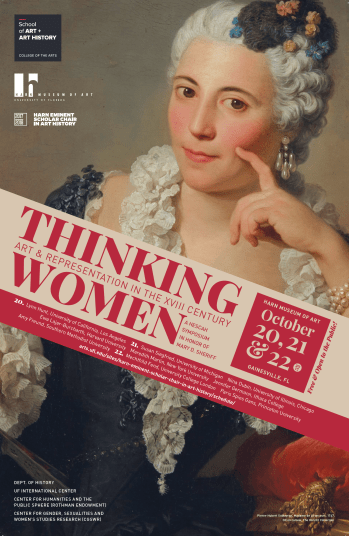
Thinking Women: Art and Representation in the Eighteenth Century
A Symposium in Honor of Mary D. Sheriff
Harn Museum of Art, University of Florida, Gainesville, 20–22 October 2017
• Keynote Address: “The Woman Artist and the Uncovering of the Social World,” Lynn Hunt, Distinguished Research Professor, University of California, Los Angeles
Art, women, and society came together in surprising ways at the end of the eighteenth century. ‘Society’ only began to be conceptualized as an object for study at the end of the 1700s, in particular in reaction to the French Revolution. Art, especially engraving and painting, helped make society visible to itself. Women could join the art world but rarely as fully fledged members, and as a consequence they occupied a kind of in-between position that made them especially attuned to social relations. The life and work of Marie-Gabrielle Capet will be highlighted to show how the social world could be uncovered.
 • “Fashion in Time: Visualizing Costume in the Eighteenth Century,” Susan Siegfried, Denise Riley Collegiate Professor of the History of Art and Women’s Studies, Department of Art History, University of Michigan
• “Beauty Is a Letter of Credit,” Nina Dubin, Associate Professor, Department of Art and Art History University of Illinois, Chicago
• “Chardin: Gender and Interiority,” Ewa Lajer-Burcharth, William Dorr Boardman Professor of Fine Arts, Department of History of Art and Architecture, Harvard University
• “The Global Allure of the Porcelain Room,” Meredith Martin, Department of Art History, New York University
• “Pictured Together? Questions of Gender, Race, and Social Rank in the Portrait of Dido Elizabeth Belle and Lady Elizabeth Murray,” Jennifer Germann, Associate Professor, Department of Art History, Ithaca College
• “Becoming an Animal in the Age of Enlightenment,” Amy Freund, Associate Professor & Kleinheinz Family Endowed Chair in Art History, Southern Methodist University
• “Marguerite Lecomte’s Smile: Portrait of a Woman Engraver,” Mechthild Fend, Reader in the History of Art, Department of History of Art, University College London
• “Exceptional, but not Exceptions: Women Artists in the Age of Revolution,” Paris Spies Gans, Doctoral Candidate, Department of History, Princeton University
The final program, with times, is available here»
At the Ackland Art Museum at UNC, Chapel Hill, there will be a sister symposium in Mary’s honor entitled “Taking Exception: Women, Gender, Representation in the Eighteenth Century,” 1–3 February 2018.
◊ ◊ ◊ ◊ ◊
Note (added 14 October 2017) — The posting has been updated with additional information, including details on the catalogue, venues, and the conferences.
New Book | Chinese Wallpaper in Britain and Ireland
From I. B. Tauris:
Emile de Bruijn, Chinese Wallpaper in Britain and Ireland (London: Philip Wilson Publishers, 2017), 272 pages, ISBN: 978 17813 00541, £30 / $55.
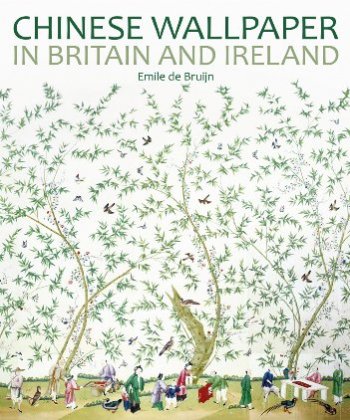 Chinese wallpaper has been an important element of western interior decoration for three hundred years. As trade between Europe and China flourished in the seventeenth century, Europeans developed a strong taste for Chinese art and design. The stunningly beautiful wall coverings now known as ‘Chinese wallpaper’ were developed by Chinese painting workshops in response to western demand. In spite of their spectacular beauty, Chinese wallpapers have not been studied in any depth until relatively recently. This book provides an overview of some of the most significant Chinese wallpapers surviving in the British Isles. Sumptuously illustrated, it shows how these wallpapers became a staple ingredient of high-end interiors while always retaining a touch of the exotic.
Emile de Bruijn studied Japanese and museology at the universities of Leiden and Essex. He worked in the Japanese and Chinese departments of the auctioneers Sotheby’s in London before joining the National Trust, where he is now a member of the central collections management team. Emile has lectured and published on many different aspects of chinoiserie in historic houses and gardens. He was co-author (with Andrew Bush and Helen Clifford) of the catalogue Chinese Wallpaper in National Trust Houses (National Trust, 2014)
New Book | Wedgwood: A Story of Creation and Innovation
From Rizzoli:
Gaye Blake-Roberts and Mariusz Skronski, with a foreword by Alice Rawsthorn, Wedgwood: A Story of Creation and Innovation (New York: Rizzoli, 2017), 304 pages, ISBN: 978 08478 60104, $60.
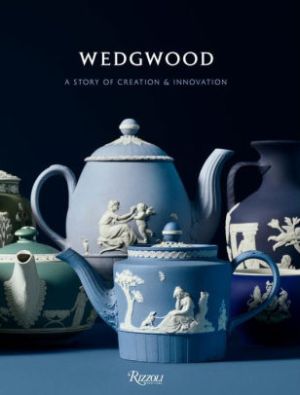 Founded in 1759, Wedgwood has a deep heritage in pottery making that represents timeless design and enduring style. The eponymous founder, Josiah Wedgwood, was an entrepreneur and visionary who quickly became Britain’s most successful ceramics pioneer, elevating pottery from a cottage craft into a luxury good and an art form. He was the mastermind behind Wedgwood’s most enduring pieces, including Queen’s Ware, Black Basalt, and Jasperware. That tradition of master craftsmanship and innovation continues today as Wedgwood works with celebrated designers such as Vera Wang and Jasper Conran.
With historic photographs, drawings, and watercolors from Wedgwood’s extensive archive, which display the craftsmanship and technical innovation, this book is a visual celebration of English design. It offers a lavish look at some of the most timeless china creations in history with a focus on Wedgwood’s 100 icons, in-depth essays on the brand and its history, and pattern books and sketches from the Wedgwood archives. While paying homage to the pioneering spirit of Wedgwood, this volume documents the achievements of a brand that is a symbol of elegance and timelessness, infusing classic craftsmanship with fresh design, and promises to impress fans of Wedgwood, old and new.
Gaye Blake-Roberts is a design historian and the curator of the Museum at Wedgwood. Alice Rawsthorn, OBE, is a British design critic who writes for the international edition of The New York Times. Mariusz Skronski is the creative and strategic director at Fiskars Living Brands.
New Book | Picturing India
From the University of Washington Press in conjunction with the British Library:
John McAleer, Picturing India: People, Places, and the World of the East India Company (Seattle: University of Washington Press, 2017), 224 pages, ISBN: 978 029574 2939, $40.
 The British engagement with India was an intensely visual one. Images of the subcontinent, produced by artists and travelers in the eighteenth- and nineteenth-century heyday of the East India Company, reflect the increasingly important role played by the Company in Indian life. And they mirror significant shifts in British policy and attitudes toward India. The Company’s story is one of wealth, power, and the pursuit of profit. It changed what people in Europe ate, what they drank, and how they dressed. Ultimately, it laid the foundations of the British Raj.
Few historians have considered the visual sources that survive and what they tell us about the link between images and empire, pictures and power. This book draws on the unrivalled riches of the British Library-both visual and textual-to tell that history. It weaves together the story of individual images, their creators, and the people and events they depict. And, in doing so, it presents a detailed picture of the Company and its complex relationship with India, its people and cultures.
John McAleer is lecturer in history at the University of Southampton. He was previously curator of imperial and maritime history at the National Maritime Museum, Greenwich. He is the author of Britain’s Maritime Empire: Southern Africa, the South Atlantic and the Indian Ocean 1763–1820.
New Book | The Art of Painting in Colonial Bolivia
From Saint Joseph’s University Press:
Suzanne Stratton-Pruitt, ed., The Art of Painting in Colonial Bolivia / El arte de la pintura en Bolivia colonial (Philadelphia: Saint Joseph’s University Press, 2017), 530 pages, ISBN: 978 1945402 319, $120.
 This anthological volume is dedicated to the art of painting in pre-independence Bolivia, prompted by the belief that a compendium of handsomely photographed, full-color images will bring renewed public and scholarly attention to a rich cultural heritage that has not received its due. An ambitious round of new photography has been joined by an international roster of scholarly contributors from the United States, Argentina, Peru, and Bolivia to offer both the general reader and specialists an overview of the art of painting in the region of South America once called ‘Charcas’ and later ‘Alto Perú’. Attention is brought to the role of European subjects and styles in the development of regional forms of expression, as well as the influence of art and artists from Cuzco, Peru. Works by painters active in La Paz, Sucre, and Potosí such as Leonardo Flores, Melchor Pérez Holguín, and Gaspar Miguel de Berrío have received close reading of iconographical themes that were often of particularly local interest.
Suzanne L. Stratton-Pruitt has, from the mid-1970s, taught, published, and curated exhibitions about Spanish Early Modern art, for which she was awarded the Lazo de Dama de la Orden de Isabel la Católica. Since 2003 she has focused on Spanish colonial art, co-editing with Joseph J. Rishel the catalogue of the exhibition The Arts in Latin America 1492–1820 (Philadelphia Museum of Art, 2006). As curator of the Carl and Marilynn Thoma Collection of Spanish Colonial Painting, she organized the exhibition catalogue The Virgin, Saints, and Angels: South American Paintings 1600–1825 from the Thoma Collection (Milan: Skira editore, 2006). Stratton-Pruitt edited The Art of Painting in Colonial Quito/El arte de la pintura en Quito colonial (Philadelphia: Saint Joseph’s University Press, 2012) as well as Journeys to New Worlds: Spanish and Portuguese Colonial Art in the Roberta and Richard Huber Collection (Philadelphia Museum of Art, 2013), and she wrote about “Paintings in the Home in Spanish Colonial America” for the catalogue of the exhibition Behind Closed Doors: Art in the Spanish-American Home 1492–1898 (Brooklyn Museum, 2013).
C O N T E N T S
Mitchell Codding, Prologue / Prólogo
Acknowledgments / Agradecimientos
Essays
• Suzanne Stratton-Pruitt, The Art of Painting in Colonial Bolivia 1600&1825 / El arte de la pintura en la Bolivia colonial, 1600&1825
• Philipp Schauer, Mural Painting in Bolivia / Pintura mural en la Bolivia
• Ramón Mujica Pinilla, The Pillars of Hercules in Charcas: Imperial Visual Politics in the Viceregal Art in Bolivia / Las columnas de Hércules en Charcas: Política visual imperial en el arte virreinal boliviano
• Almerindo Ojeda Di Ninno, The Use of Prints in Spanish Colonial Art: Approaching the Bolivian Corpus / El uso de grabados en el arte colonial: Una aproximación al corpus boliviano
• Carolyn C. Wilson, The Image of Saint Joseph in a Selection of Colonial Paintings in Bolivian Collections / La imagen de San José en una selección de pinturas coloniales en colecciones bolivianas
• Jaime Mariazza F., Portraiture in the Real Audiencia of Charcas / El retrato en la Real Audienca de Charcas
• Agustina Rodríguez Romero, Old Testament Paintings in Colonial Bolivia: A Remote Past for New Believers / Pinturas del Antiguo Testamento en la Bolivia colonial: Un pasado remoto para nuevos creyentes
• Jeffrey Schrader, Statue Paintings: The Wayfaring Marian Images of Spain in Bolivia / Pinturas de estatua: Las imágenes españolas viajares de María en Bolivia
• Maya Stanfield-Mazzi, Uniquely American Visions of the Virgin Mary / Imágenes unívocamente americanas de la Virgen María
• Gustavo Tudisco, Mountains, Volcanoes, Stones and Promontories: Eighteenth-Century Marian Devotion and Painting in the Andes / Montañas, volcanes, piedras y promontorios. El culto a María en los Andes y la pintura devocional del siglo XVIII
• Jeanette Favrot Peterson, Through Ocaña’s Eyes: Our Lady of Guadalupe in Sucre, Bolivia / A través de la mirada de Ocaña: Nuestra Señora de Guadalupe en Sucre, Bolivia
• Adriana Pacheco Bustillos, The Nuns of Colonial Bolivia and the Art of Painting / Las monjas en la Bolivia colonial y el arte de la pintura
• Gabriela Siracusano, The Carabuco Paintings of the ‘Four Last Things’ /La pinturas de las Postrimerías de Carabuco
• Lucía Querejazu Escobari, Iconography and Ideology in the Paintings of Caquiaviri / Iconografía e Iconología en las pinturas de Caquiaviri
Iconographical Studies / Estudios iconográficos
With contributions by Suzanne Stratton-Pruitt, Lucía Querejazu Escobari, Agustina Romero Rodríguez, Héctor Schenone, and Gustavo Tudisco
• The Painted Decoration of the Church of Jerusalem, Potosí / La decoración pintada de la Iglesia de Jerusalén de Potosí
• The Presbytery at the Sanctuary of Copacabana, Bolivia / Decoración del Presbiterio del Santuario de Copacabana, Bolivia
• Christ Crucified with Saints, Church of Santo Domingo, Sucre / Crucificado de Santo Domingo de Sucre
• Christ Carrying the Cross / Cristo con la cruz a cuestas
• The Passion of Christ / La Pasión de Cristo
• Christ of Malta / El Cristo de Malta
• ‘True Portraits’ of Jesus Christ and the Virgin Mary / ‘Retratos Verdaderos’ de Jesucristo y de la Virgen María
• Praise be / Alabado Sea
• The Soul of Mary / El Alma de María
• Our Lady of Succor / Nuestra Señora de Socorro
• Our Lady of Remedies of La Paz / Nuestra Señora de los Remedios de La Paz
• Our Lady of Multiple Devotions / Nuestra Señora de Advocaciones Múltiples
• Mary, Queen of Heaven / María, Reina del Cielo
• The Divine Shepherdess / La Divina Pastora
• Presentation of the Chasuble to Saint Ildephonsus / La imposición de la casulla a San Ildefonso
• Our Lady of Soterraña of Nieva / Nuestra Señora de Soterraña de Nieva
• The Virgin of the Immaculate Conception in Paintings in Colonial Bolivia / La Virgen de la Inmaculada Concepción en las pinturas de la Bolivia colonial
• The Painted Angels of Colonial Bolivia / Las pinturas de ángeles de la Bolivia colonial
• Saint Nicholas of Tolentino and Saint Nicholas of Bari / San Nicolás de Tolentino y San Nicholás de Bari
• Saint Augustine, Patron Saint of the Rich Hill of Potosí / San Agustín, Santo Patrono del Cerro Rico de Potosí
• Virgin Saints and Martyrs / Vírgenes Santas y Mártires
Bibliography/ Bibliografía
Index/ Índice
Contributors / Autores
New Book | Enchanted World of German Romantic Prints
The related exhibition was on display at the Philadelphia Museum of Art in the autumn of 2013. From Yale UP:
John Ittmann, ed., with essays by Warren Breckman, Mitchell B. Frank, Cordula Grewe, John Ittmann, Catriona MacLeod, and F. Carlo Schmid, Enchanted World of German Romantic Prints, 1770–1850 (New Haven: Yale University Press, 2017), 424 pages, ISBN: 978 03001 97624, $65.
 From the 1770s through the 1840s, German, Austrian, and Swiss artists used the medium of printmaking to create works that synthesized poetry, literature, music, and the visual arts in new and captivating ways. Finding an eager audience in the growing number of educated middle-class collectors, printmakers experimented with modern technologies, such as lithography, and drew on the contemporary interest in regional folklore and traditional fairy tales to produce innovative compositions that both contributed to and reflected the dramatic cultural and political upheavals of the Romantic era. Featuring the work of more than 120 artists, including Casper David Friedrich, Ludwig Emil Grimm, Joseph Anton Koch, Philipp Otto Runge, and Johann Gottfried Schadow, this authoritative book contains many unique and never-before-published examples of prints from the Philadelphia Museum of Art’s unrivaled collection.
John Ittmann is the Kathy and Ted Fernberger Curator of Prints at the Philadelphia Museum of Art.
New Book | Reconstructing the Lansdowne Collection
Published by Hirmer and distributed by The University of Chicago Press:
Elizabeth Angelicoussis, Reconstructing the Lansdowne Collection of Classical Marbles (Munich: Hirmer, 2017), 2 vols., 624 pages, ISBN: 978 37774 28178, £60 / $80.
 Begun by Gavin Hamilton (1723–1798), one of the most prominent British explorers of classical sites of the eighteenth century, the Lansdowne Collection came to hold more than one hundred stellar examples of classical statuary, displayed in a specially designed gallery in Lansdowne-House in London. The collection, however, was dispersed in the years after 1930, and its works are now scattered across the globe. This book reunites the collection, under the expert guidance of Roman sculpture specialist Elizabeth Angelicoussis. Volume one relates the history of the collection and the gallery, while the second catalogs and assess each known sculpture, setting it in the context of the most current research into Roman art history.
Elizabeth Angelicoussis is a fellow of the Society of Antiquarians, a member of the Institute of Classical Studies, London, and a senior member of the American School of Classical Studies, Athens.
Print Quarterly, September 2017
The eighteenth century in the current issue of Print Quarterly:
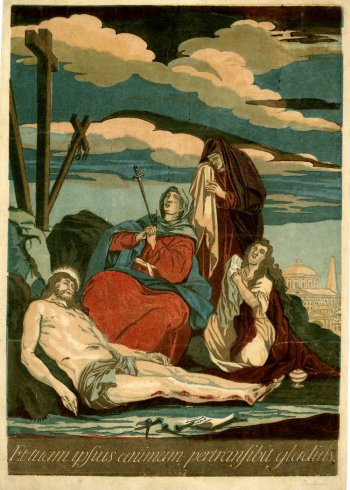
John Baptist Jackson, Lamentation over the Body of Christ, ca. 1740–44, woodcut with embossing (London: The British Museum).
Print Quarterly 34.3 (September 2017)
A R T I C L E S
• Evelyn Wöldicke, “John Baptist Jackson’s Woodcuts and the Question of Embossing,” pp. 298–310.
• Freyda Spira, “Micrographic Allegories by Johann Michael Püchler and Matthias Buchinger,” pp. 310–16.
R E V I E W S
• Adriano Aymonino, Review of the exhibition catalogue, Maria Rosaria Nappi, ed., Immagini per il Grand Tour: L’attività della Stamperia Reale Borbonica (Edizioni Scientifiche Italiane, 2015), pp. 328–31.
• Rolf Reichardt, Review of Philippe de Carbonnières, La Grande Aarmée de papier: Caricatures napoléoniennes (Presses Universitaires de Rouen et du Havre, 2015), pp. 331–33.
• Perrin Stein, Review of Kristel Smentek, Mariette and the Science of the Connoisseur in Eighteenth-Century Europe (Ashgate, 2014), pp. 340–44.
Exhibition | In Her Majesty’s Hands: Medals of Maria Theresa
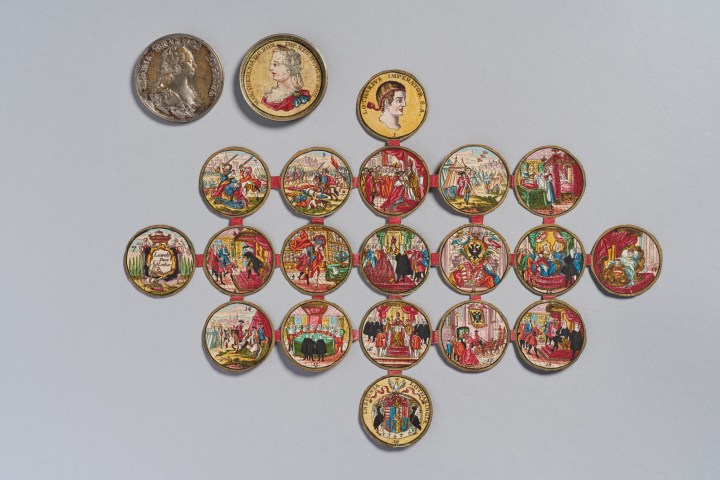
Matthäus Donner / Andreas Vestner, Maria Theresa Box Medal (Schraubmedaille) containing hand-coloured drawings; silver, hand-coloured drawing on paper inside the medal (Vienna, Kunsthistorisches Museum, Coin Collection, inv.no. 5955/1914B).
◊ ◊ ◊ ◊ ◊
Press release (via Art Daily) for the exhibition now on view at the KHM:
In Her Majesty’s Hands: Medals of Maria Theresa
Kunsthistorisches Museum, Vienna, 28 March 2017 — 18 February 2018
Curated by Anna Fabiankowitsch and Heinz Winter
The Kunsthistorisches Museum’s Coin Collection holds both the largest and by far the most important collection of coins minted under Maria Theresa; it is the best place, and now is the best time, to host an exhibition that presents the monarch’s life in medals to celebrate what would have been her 300th birthday.
 The exhibition focuses on the most important topoi in Maria Theresa’s private and public life. It presents her in the company of her large family, running the gamut of events from dynastic marriages to heart-breaking calamities. It showcases her role as a ruler forced to fight several wars for her inheritance and, together with her son and co-regent Joseph II, as a pioneering social reformer. The artefacts on show also illustrate the extent of Maria Theresa’s realm, which comprised many different ethnicities and cultures.
All these topoi are reflected in medals that emblematise historical events with the help of allegories. Maria Theresa was already widely glorified and celebrated during her lifetime, but the exhibition also documents how she was portrayed by her enemies. So-called satirical medals, which were passed around in private, turned Maria Theresa into an object of derision.
The exhibition focuses, too, on the historical background of medal production to illustrate the requisite technical skills, expenditure, and effort; introduce the most important protagonists; and document the range, purview, and media-value of Maria Theresa’s medals.
Maria Theresa (1717–1780) became a legend during her lifetime, and few female rulers were depicted more frequently or diversely. Her many likenesses—among them portraits, engravings, medals, and medallions—were designed to preserve her memory for posterity, turning her into an 18th-century media-star.
Medals played a central role in this propaganda effort controlled by the imperial court. Among the period’s foremost artistic mass media, medals were minted under the aegis of the court, and they continue to reflect the ruler’s political aims and the way she saw herself. Over three hundred different medals were produced during Maria Theresa’s reign to commemorate or celebrate either members of the imperial family or political events, both national and international.
Medals functioned as a way to commemorate important events of her reign, and as they were minted in large numbers, the material is noted for its longevity and their handy format made it easy to disseminate them, they were regarded as a historical record that would last forever. Contemporaries called these miniature memorials show- or commemorative coins, and they evolved into much sought-after and frequently exchanged collectors’ pieces. The monarch presented them as signs of imperial favour, in recognition of the recipient’s merits or achievements, or to strengthen diplomatic ties, and the majority of the medals produced in Vienna were destined for the court—ending up in Her Majesty’s hands.
Zuhanden Ihrer Majestät: Medaillen Maria Theresias (Vienna: Kunst Historisches Museum, 2017), 100 pages, 15€.

Curator Anna Fabiankowitsch during preparations for the exhibition
Photo by Lukas Beck










 Enfilade
leave a comment