New Book | Body Narratives: Motion and Emotion
This collection of essays grew out of the 2015 conference; from Brepols:
Susanna Caviglia, ed., Body Narratives: Motion and Emotion in the French Enlightenment (Turnhout: Brepols, 2017), 291 pages, ISBN: 978 2503 574745, 100€ / $125.
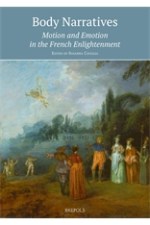 The first art historical interrogation of the body as an object and discursive ensemble that questions the power and limits of visual representation, this book explores, in broad terms, the representations and understandings of the body’s physical and psychological movement’s meanings during the French Enlightenment in its many guises—artistic, esthetic, social, and erotic. It is centered on the fundamental tension between stasis and movement, which is both constitutive of art historical reflection and embedded in the body’s existence. Stasis and movement not only correspond to the potential modalities of the body’s visual representations, but they are also the conditions which govern the relationship between the viewer and the artwork as well as that between the viewers and the spaces in which they encounter the represented body. Based on this dialectic, the present book proposes a dynamic approach of the body considered as a focus of composition, an object of interrogation, and a site of meaning during a time when the body became the focus of an increasing number of artistic, technical, scientific, and philosophical inquiries directly connected to larger historical forces and discourses. During this time, the body’s stasis and movement became the vehicles for recording cultural and social transformations but also the producers of new meanings inherent to the body itself and unveiled by the development of the new scientific and philosophical approaches of it.
C O N T E N T S
Susanna Caviglia (University of Chicago), Introduction
I Body Language: Narrative Stasis
• Dorothy Johnson (University of Iowa), The Body Speaks: Anatomical Narratives in French Enlightenment Sculptures
• Étienne Jollet (Université Paris 1 Panthéon-Sorbonne), Anti-Pygmalion: Jean-Baptiste Restout’s Diogenes and Materiality as Truth
II The Mobile Body: Social Identity and Visual Dynamics
• Mimi Hellman (Skidmore College), Engaging Tapestries at the Hôtel de Soubise: Attention, Mobility, Intercorporeality
• Melissa Hyde (University of Florida), Watching Her Step: Women and the Art of Walking after Marie-Antoinette
III Body Temporality: Aesthetics of Walking
• Mary Sheriff (University of North Carolina at Chapel Hill), Movement and Stasis: Mapping Cythera
• Ewa Lajer-Burcharth (Harvard University), Strolling Time
Exhibition | British Art: Ancient Landscapes
Opening next month at The Salisbury Museum:
British Art: Ancient Landscapes
The Salisbury Museum, 8 April — 3 September 2017
Curated by Sam Smiles
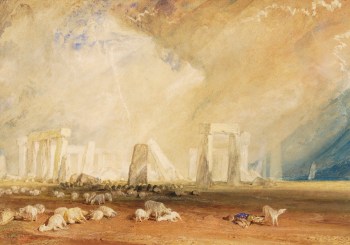
J.M.W. Turner, Stonehenge, ca. 1827–28, watercolour (The Salisbury Museum).
The British landscape has been a continual inspiration to artists across the centuries and particularly the landscapes shaped and marked by our distant ancestors. The megaliths, stone circles, and chalk-cut hill figures that survive from Neolithic and Bronze Age times have stimulated many artists to make a response. In this major new exhibition curated by Professor Sam Smiles, these unique artistic responses have been brought together to create a new discussion. Featuring the work of some of the greatest names in British art from the last 250 years—including John Constable, J.M.W. Turner, Eric Ravilious, John Piper, Barbara Hepworth, Henry Moore, Paul Nash, Richard Long, and Derek Jarman—the exhibition explores how this work records and reflects on some of Britain’s most treasured ancient landscapes.
The catalogue is published by Paul Holberton:
Sam Smiles, British Art: Ancient Landscapes (London: Paul Holberton Publishing, 2017), 120 pages, ISBN: 978 19113 00144, £25.
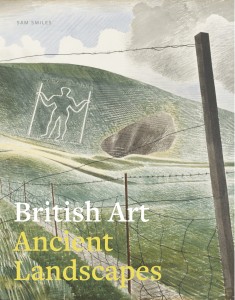 Published to accompany an exhibition at The Salisbury Museum and Art Gallery, this volume explores the most significant works of art engaged with prehistoric moments across Britain from the 18th century to the 21st. While some of the works in the earlier period may be familiar to readers—especially Turner and Constable’s famous watercolours of Stonehenge—the varied responses to British Antiquity since 1900 are much less well known and have never been grouped together.
The author aims to show the significance of antiquity for 20th-century artists, demonstrating how they responded to the observable features of prehistoric Britain and exploited their potential for imaginative re-interpretation. The classic phase of modernist interest in these sites and monuments was the 1930s, but a number of artists working after WWII developed this legacy or were stimulated to explore that landscape in new ways. Indeed, it continues to stimulate responses and the book concludes with an examination of works made within the last few years.
An introductory essay looks at the changing artistic approach to British prehistoric remains over the last 250 years, emphasizing the artistic significance of this body of work and examining the very different contexts that brought it into being. The cultural intersections between the prehistoric landscape, its representation by fine artists and the emergence of its most famous sites as familiar locations in public consciousness will also be examined. For example, engraved topographical illustrations from the 18th and 19th centuries and Shell advertising posters from the 20th century will be considered.
Artists represented include: J.M.W. Turner, John Constable, Thomas Hearne, William Blake, Samuel Prout, William Geller, Richard Tongue, Thomas Guest, John William Inchbold, George Shepherd, William Andrews Nesfield, Copley Fielding, Yoshijiro (Mokuchu) Urushibara, Alan Sorrell, Edward McKnight Kauffer, Frank Dobson, Paul Nash, Eric Ravilious, John Piper, Henry Moore, Barbara Hepworth, Ithell Colquhoun, Gertrude Hermes, Norman Stevens, Norman Ackroyd, Bill Brandt, Derek Jarman, Richard Long, Joe Tilson, David Inshaw and Jeremy Deller.
Sam Smiles is the author of The Image of Antiquity: Ancient Britain and the Romantic Imagination (1994), Flight and the Artistic Imagination (2012), and West Country to World’s End: The South West in the Tudor Age (2013).
New Book | London: Prints and Drawings before 1800
Published by the Bodleian and distributed by The University of Chicago Press:
Bernard Nurse, London: Prints and Drawings before 1800 (Oxford: Bodleian Library, in association with The London Topographical Society, 2017), 232 pages, ISBN: 978 18512 44126, £30 / $50.
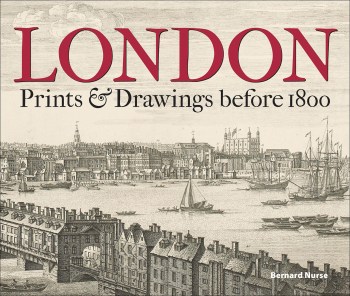 By the end of the eighteenth century London was the second largest city in the world, its relentless growth fuelled by Britain’s expanding empire. Before the age of photography, the most widely used means of creating a visual record of the changing capital was through engravings and drawings, and those that survive today are invaluable in showing us what the capital was like in the century leading up to the Industrial Revolution.
This book contains over one hundred images of the Greater London area before 1800 from maps, drawings, manuscripts, printed books, and engravings, all from the Gough Collection at the Bodleian Library. Examples are drawn from the present Greater London to contrast town and countryside at the time. Panoramas of the river Thames were popular illustrations of the day, and the extraordinarily detailed engravings made by the Buck brothers are reproduced here. The construction, and destruction, of landmark bridges across the river are also shown in contemporary engravings.
Prints made of London before and after the Great Fire show how artists and engravers responded to contemporary events such as executions, riots, fires, and even the effects of a tornado. They also recorded public spectacles, creating beautiful images of firework displays and frost fairs on the river Thames. This book presents rare material from the most extensive collection on British topography assembled in this period by a private collector, providing a fascinating insight into life in Georgian London.
Bernard Nurse is the former Librarian of the Society of Antiquaries of London.
New Book | The Print Before Photography
From Museum Bookstore:
Anthony Griffiths, The Print Before Photography: An Introduction to European Printmaking, 1550–1820 (London: The British Museum, 2016), 560 pages, ISBN: 978 07141 26951, $75.
 A landmark publication—beautifully illustrated with over 300 prints from the British Museum’s renowned collection—The Print Before Photography traces the history of printmaking from its earliest days until the arrival of photography.
Copperplate printmaking, developed alongside Gutenberg’s invention of moveable type, was a huge business employing thousands of people, and dominating image production for nearly four centuries across the whole of Europe. Its techniques and influence remained very stable until the nineteenth century, when this world was displaced by new technologies, of which photography was by far the most important. The Print Before Photography examines the unrivaled importance of printmaking in its golden age, illustrated through the British Museum’s outstanding collection of prints. This unique and significant book is destined to be a leading reference in print scholarship, and will be of interest to anyone with an interest in this era of art history.
Between 1991 and 2010, Antony Griffiths was deputy keeper, then keeper, of Prints and Drawings at The British Museum. In 1984 he co-founded the journal Print Quarterly. He was appointed a fellow of the British Academy in 2000.
New Book | The Sovereign Artist: Charles Le Brun
From Paul Holberton:
Wolf Burchard, The Sovereign Artist: Charles Le Brun and the Image of Louis XIV (London: Paul Holberton Publishing, 2017), 288 pages, ISBN: 978 19113 00052, £40.
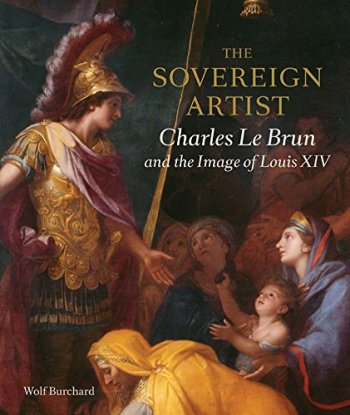 The first monograph to examine the wide artistic production of Louis XIV’s most prolific and powerful artist, Charles Le Brun (1619–1690), illustrating not only his paintings but the magnificence of the interiors and decorative works of art produced according to his designs. Revealing Le Brun’s extraordinary versatility and exploring his work at the Academy, the Gobelins and Savonnerie manufactories, and the royal building sites of the Louvre and Versailles, it is also the first book to explore in depth his artistic relationship to the Sun King.
In his joint capacities of Premier peintre du roi, director of the Gobelins manufactory and rector of the Académie royale de peinture et de sculpture, Le Brun exercised a previously unprecedented influence on the production of the visual arts—so much so that some scholars have repeatedly described him as ‘dictator’ of the arts in France. The Sovereign Artist explores how Le Brun operated in his diverse fields of activities, linking and juxtaposing his portraiture, history painting and pictorial theory with his designs for architecture, tapestries, carpets and furniture. It argues that Le Brun sought to create a repeatable and easily recognizable visual language associated with Louis XIV, in order to translate the king’s political claims for absolute power into a visual form. How he did this is discussed through a series of individual case studies ranging from Le Brun’s lost equestrian portrait of Louis XIV, and his involvement in the Querelle du coloris at the Académie, to his scheme for 93 Savonnerie carpets for the Grande Galerie at the Louvre, his Histoire du roy tapestry series, his decoration of the now destroyed Escalier des Ambassadeurs at Versailles.
One key theme is the relation between the unity of the visual arts, to which Le Brun aspired, and the strong hierarchical distinctions he made between the liberal arts and the mechanical crafts: while his lectures at the Académie advocated a visual and conceptual unity in painting and architecture, they were also a means by which he attempted to secure the newly gained status of painting as a liberal art, and therefore to distinguish it from the mechanical crafts which he oversaw the production of at the Gobelins manufactories. His artistic and architectural aspirations were comparable to those of his Roman contemporary Gianlorenzo Bernini, summoned to Paris in 1665 to design the Louvre’s East façade and to create a portrait bust of Louis XIV. Bernini’s failure to convince the king and Colbert of his architectural scheme offered new opportunities for Le Brun and his French contemporaries to prove themselves capable of solving the architectural problems of the Louvre and to transform it into a palace appropriate “to the grandeur and the magnificence of the prince who [was] to inhabit it” (Jean-Baptiste Colbert to Nicolas Poussin in 1664). The comparison between Le Brun and Bernini, made in the book, not only illustrates how France sought artistic supremacy over Italy during the second half of the 17th century, but further helps to demonstrate how Le Brun himself wanted to be perceived: beyond acting as a translator of the king’s artistic ambition, the artist appears to have sought his own sovereign authority over the visual arts.
Wolf Burchard is an art and architectural historian. He is the National Trust’s Furniture Research Curator and was formerly Curatorial Assistant at the Royal Collection Trust.
New Book | After the Fire: London Churches
From Pimpernel Press:
Angelo Hornak, After the Fire: London Churches in the Age of Wren, Hooke, Hawksmoor, and Gibbs (London: Pimpernel Press, 2016), 384 pages, ISBN: 978 191025 8088384, £50.
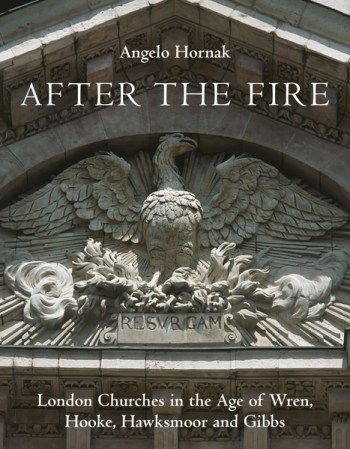 “London was but is no more!” In these words diarist John Evelyn summed up the destruction wrought by the Great Fire that swept through the City of London in 1666. The losses included St Paul’s Cathedral and eight-seven parish churches, as well as at least thirteen thousand houses.
In After the Fire, celebrated photographer and architectural historian Angelo Hornak explores, with the help of his own stunning photographs, the churches built in London during the sixty years that followed the Great Fire, as London rose from the ashes, more beautiful—and far more spectacular—than ever before. The catastrophe offered a unique opportunity to Christopher Wren and his colleagues—including Robert Hooke and Nicholas Hawksmoor—who, over the next forty years, rebuilt St Paul’s and fifty-one other London churches in a dramatic new style inspired by the European Baroque.
Forty-five years after the Fire, the Fifty New Churches Act of 1711 gave Nicholas Hawksmoor the scope to build breathtaking (and controversial) new churches including St Anne’s Limehouse, Christ Church Spitalfields and St George’s Bloomsbury. By the 1720s the pendulum was swinging away from the Baroque of Wren and Hawksmoor, and it was James Gibbs’ more restrained St Martin-in the-Fields that was to provide the prototype for churches throughout the English-speaking world—especially in North America—for the next hundred years.
Angelo Hornak is the author of Balloon over Britain (1991) and London from the Thames (1999) and has provided the photographs for many books, including histories of St Paul’s Cathedral and Westminster Abbey and the cathedrals of Canterbury, Winchester, Wells, Exeter, and Ely. He lives in London and Norfolk.
Exhibition | Canaletto and the Art of Venice
Press release (14 December 2016) from the Royal Collection Trust:
Canaletto and the Art of Venice
The Queen’s Gallery, Buckingham Palace, London, 19 May — 12 November 2017
The Queen’s Gallery, Palace of Holyroodhouse, Edinburgh, 11 May — 21 October 2018
National Gallery of Ireland, Dublin, 5 December 2018 — 24 March 2019
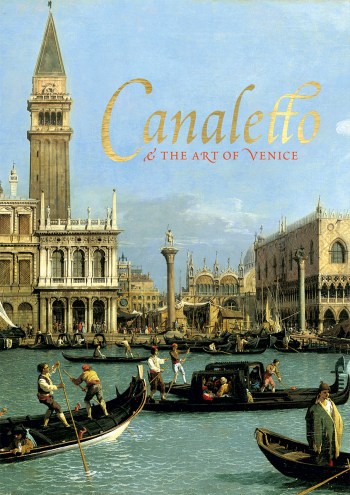 In 1762 the young monarch George III purchased virtually the entire collection of Joseph Smith, the greatest patron of art in Venice at the time. Thanks to this single acquisition, the Royal Collection contains one of the finest groups of 18th-century Venetian art in the world, including the largest collection of works by Giovanni Antonio Canal, better known as Canaletto.
Through over 200 paintings, drawings, and prints from the Royal Collection’s exceptional holdings, Canaletto and the Art of Venice presents the work of Venice’s most famous view-painter alongside that of his contemporaries, including Sebastiano and Marco Ricci, Rosalba Carriera, Francesco Zuccarelli, Giovanni Battista Piazzetta, and Pietro Longhi and explores how they captured the essence and allure of Venice for their 18th-century audience, as they still do today.
Joseph Smith (c.1674−1770) was an English merchant and later British Consul in Venice, a post dealing with Britain’s maritime, commercial, and trading interests. He had moved to Italy in around 1700 and over several decades built up an outstanding art collection, acting as both patron and dealer to many contemporary Venetian artists. Smith was Canaletto’s principal agent, selling his paintings to the wealthy Grand Tourists who were drawn to Venice’s cultural attractions. His palazzo on the Grand Canal became a meeting place for collectors, patrons, scholars, and tourists, where visitors could admire his vast collection and commission their own versions of Canaletto’s views to take home.
One of the most important of Smith’s commissions from Canaletto was the series of 12 paintings of the Grand Canal, which together create a near complete journey down the waterway. Canaletto’s sharp-eyed precision makes these views seem powerfully real; yet he rearranged and altered elements of each composition to create ideal impressions of the city. Two larger paintings are of festivals, including the ‘Sposalizio del Mar’, or ‘Wedding of the Sea’, which took place on Ascension Day and attracted crowds of British visitors. The Grand Canal was a subject frequently captured by Canaletto, including in a series of six drawings, among them Venice: The central stretch of the Grand Canal, c.1734. Intended as works of art in their own right, rather than as preparatory studies for paintings, the drawings are carefully constructed and rich in tone and detail.
Alongside the grand public entertainments, Venice boasted a thriving opera and theatre scene, especially during carnival season. The need to create stage sets within a very short period of time provided plentiful employment for Venetian artists. Both Marco Ricci and Canaletto worked for the theatre, where they learned how to manipulate perspective to heighten drama. The exhibition includes several of Ricci’s designs for the Venetian stage, such as A room with a balcony supported by Atlantes, c.1726. Marco Ricci also produced caricatures of opera singers, such as the drawing of the internationally famed castrato Farinelli, which were circulated among Joseph Smith and his fellow Venetian collectors and opera aficionados.
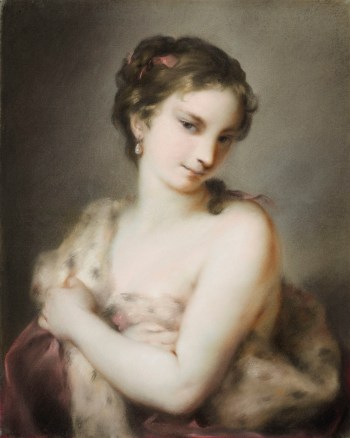
Rosalba Giovanna Carriera, A Personification of Winter, ca. 1726, pastel on paper (London: Royal Collection Trust, 400647).
On display together for the first time are personifications of the Four Seasons by Rosalba Carriera, whose pastels were highly prized by European collectors. They were intended to be hung in private domestic spaces, such as dressing rooms, bedrooms, or small antechambers. Carriera was one of the first artists to develop a commercial relationship with Joseph Smith, and her sensual pastel of Winter, c.1726, an allegorical female figure wrapped in furs, was one of the most admired works in Smith’s collection.
Canaletto, Marco Ricci, and Francesco Zuccarelli all contributed to the development of the genre known as the capriccio—scenes combining real and imaginary architecture, often set in an invented landscape, to create poetically evocative works. Ruins of ancient Rome in both Ricci’s Caprice View with Roman Ruins, c.1729, and Zuccarelli’s pastoral Landscape with Classical Ruins, Cattle and Figures, c.1741–42, convey a sense of the irrevocable loss of a great age.
There was a major revival in printmaking in Venice in the 18th century, with many publishers recruiting established artists, such as Giovanni Battista Piazzetta and Antonio Visentini, to provide designs for their publications. Joseph Smith was an enthusiastic print collector and one of the major supporters of contemporary printmaking in Venice. Smith financed and directed the Pasquali press, which contributed to the circulation of Enlightenment ideas, such as those of Isaac Newton, and imported banned foreign texts into Venice, including the work of Voltaire. Visentini was the chief draughtsman for the press, providing many hundreds of pen and ink drawings of initials and tailpieces, several of which will be on display in the exhibition.
The catalogue is distributed by The University of Chicago Press:
Lucy Whitaker and Rosie Razzall, Canaletto and the Art of Venice (London: Royal Collection Trust, 2017), 320 pages, ISBN: 978 190974 1409, $60.
Note (added 22 November 2018) — The posting was updated to include dates for Edinburgh and Dublin.
Exhibition | La Serenissima: Celebrating Venice
From the press release for the exhibition:
Sérénissime! Venise en fête, de Tiepolo à Guardi
La Serenissima: Celebrating Venice, from Tiepelo to Guardi
Musée Cognacq-Jay, Paris, 25 February — 25 June 2017
Curated by Rose-Marie Herda-Mousseaux and Benjamin Couilleaux
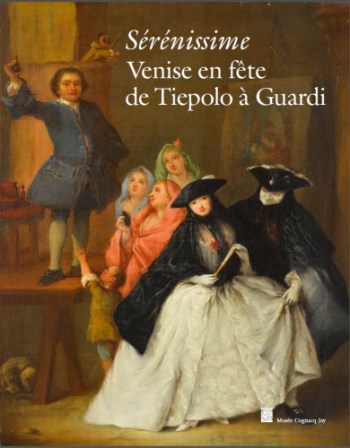 In the eighteenth century, the political and economic stability of the Serenissima Repubblica di Venezia gave rise to the last golden age of Venice, which would end with the Napoleonic conquest of 1797. This last chapter of a millenary history was marked by an unprecedented deployment of public and private events. Festivities, celebrations, regattas, and other spectacles set the tempo of city life and attracted the curious from all over Europe. Much more than simple amusements, these festivities were part of a political and religious pageant designed to promote Venice. Immortalized by some of the great names in painting—Tiepolo, Guardi, Longhi—they created a lasting impression and made known the charms of the City of the Doges throughout Europe. Over forty paintings, engravings, and drawings from prestigious French and European collections are presented to the public, bringing to life once again, for the duration of the exhibition, the opulence of the Most Serene Republic of Venice in the Age of Enlightenment.
The exhibition layout focuses on four themes related to Venetian celebrations:
Festivities Large and Small
Dance and music were highly esteemed by Venetian society, among both the aristocracy and the people.
From City to Stage
In the eighteenth century, the commedia dell’arte achieved unprecedented popularity, in particular with playwright Carlo Goldoni. Opera also benefited from majestic settings, the most famous of which is still La Fenice.
Power as Spectacle
Both secular and sacred institutions in the Most Serene Republic encouraged the crowds to attend major festivities that crystallized the image of Venice as a powerful and sumptuous city. Receptions for foreign princes, notably French, also provided an opportunity to organize extraordinary celebrations on Piazza San Marco or the Grand Canal.
At the Carnival
What would Venice be without its carnival? Dating from the Middle Ages, this colorful masked festival brought together an eighteenth-century cosmopolitan crowd that loved the open-air fairground attractions as much as it did the more discreet amusements of the Ridotto, the ancestor of the casino.
Rose-Marie Herda-Mousseaux and Benjamin Couilleaux, Sérénissime: Venise en fête, de Tiepolo à Guardi (Paris: Editions Paris Musées, 2017), 176 pages, ISBN: 978 27596 03428, 30€.
Exhibition | Gilded Interiors: French Masterpieces of Gilt Bronze

Jean-Baptiste Lepaute, Mantel clock, detail, 1781
(London: The Wallace Collection)
◊ ◊ ◊ ◊ ◊
From the press release for the exhibition:
Gilded Interiors: French Masterpieces of Gilt Bronze
The Wallace Collection, London, 4 May — 30 July 2017
Curated by Helen Jacobsen
Often designed by leading architects and modeled by important sculptors, gilt bronze was used to create beautiful yet functional objects such as clocks, candelabras, and firedogs and to decorate and embellish highly refined furniture and porcelain. This exhibition showcases luxurious artworks commissioned and owned by the wealthiest patrons and collectors, including leading figures of pre-revolutionary France like Marie-Antoinette, the duc d’Aumont, and the comte d’Artois as well international patrons such as the Prince of Wales (later George IV). Artists such as Pierre Gouthière, François Rémond, and Claude Pition, who ran the finest chasing and gilding workshops, created beautiful works, equal in expense and craftsmanship to some of the greatest paintings and sculpture of the period.
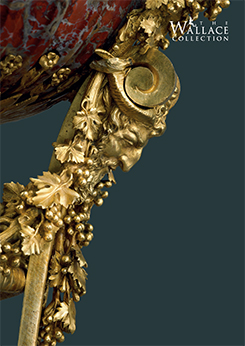 Largely drawn from The Wallace Collection, home to one of the world’s most important collections of French eighteenth-century gilt bronze, these exceptional objects include the exquisite perfume burner by Gouthière once owned by Marie-Antoinette and a pair of candlesticks made for the French Queen to celebrate the birth of her son. The Wallace Collection works will be shown alongside loans from other world-class collections including drawings from the Bibliothèque Municipale in Besançon.
The exhibition will feature drawings by Pierre-Adrien Pâris, one of the foremost architects and interior designers of the period. His highly-detailed works, never before seen in the UK, illustrate how buildings from ancient Rome were used as a fertile source of design for gilt-bronze masterpieces and reveal how the antique world provided artists with contemporary ideas for architecture and decorative art. Architects and designers who travelled to Rome took inspiration from the classical ruins with which they were surrounded and their drawings of architecture and Antique monuments provided the basis for some of the greatest gilt-bronze works ever created.
Gilded Interiors: French Masterpieces of Gilt Bronze will be an opportunity for visitors to engage more fully with these magnificent works, which will be given centre stage in the special exhibition galleries. Well-lit and with the works fully visible ‘in the round’, the exhibition will enable the viewer to experience these works of art in a different way, allowing the exquisite beauty and technical accomplishments of these pieces to be properly admired and enjoyed.
◊ ◊ ◊ ◊ ◊
From I. B. Tauris:
Helen Jacobsen, Gilded Interiors: Parisian Luxury and the Influence of Rome, 1770–1790 (London: Philip Wilson, 2017), 112 pages, ISBN: 978 178130 0589, £20 / $30.
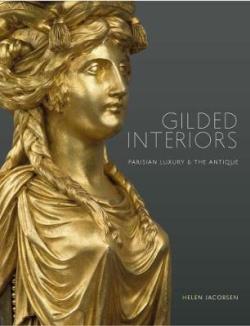 The Wallace Collection has an internationally-renowned collection of French eighteenth-century art but perhaps lesser known today is their stunning collection of gilt-bronze objects. These bronzes d’ameublement—from clocks and mounted Sevres porcelain to wall lights and candelabra—epitomise the levels of luxury achieved in Parisian interiors. Highly expensive and expertly wrought, they illustrate the heights of skilled craftsmanship achieved by French bronze workers in the eighteenth century as well as showcasing the wealth and connoisseurship of their owners. Lavishly illustrated with new photography, this publication will be a book of ‘highlights’ to include the very best of what the Wallace Collection has to offer in this field.
Helen Jacobsen is senior curator and curator of French eighteenth-century decorative arts at the Wallace Collection.
Exhibition | Poussin to David: French Drawings at the Albertina

Jacques-Louis David, The Combat of Diomedes, 1776
(Vienna: Albertina)
◊ ◊ ◊ ◊ ◊
Now on view at the Albertina:
Poussin to David: French Drawings at the Albertina
Poussin bis David: Französische Zeichnungen der Albertina
Albertina, Vienna, 25 January — 25 April 2017
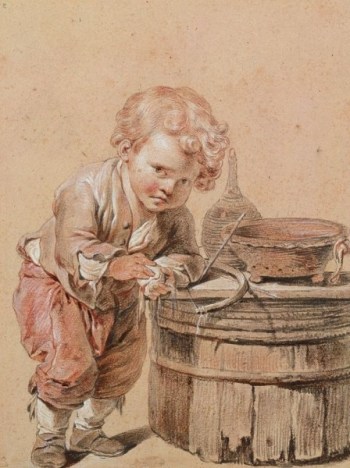
Jean-Baptiste Greuze, Boy with a Broken Egg, ca. 1756 (Vienna: Albertina).
Whether poetic love stories or mythological epics, whether atmospheric portrait studies or picturesque ruins—today, the masterpieces of French Baroque art are more enthralling than ever. 70 major works selected from the Albertina’s rich holdings of drawings sweep visitors into the dreamy and multi-layered cosmos of French art from the Baroque and Rococo periods: the works on display include Nicolas Poussin’s breath-taking free landscape studies as well as Claude Lorrain’s light-drenched depictions of nature, and playful masterpieces by François Boucher and Jean-Honoré Fragonard likewise assume their rightful places here, as do the lovely scenes of Jean-Baptiste Greuze. The crowning conclusion of this showing, which reflects two centuries of French art, is provided by the imposing creations of Jacques Louis David.
Christine Ekelhart, ed., From Poussin to David: French Drawings at the Albertina (Munich: Hirmer, 2017), 176 pages, ISBN: 978 37774 28369, $45.










 Enfilade
leave a comment