Exhibition | The Artist
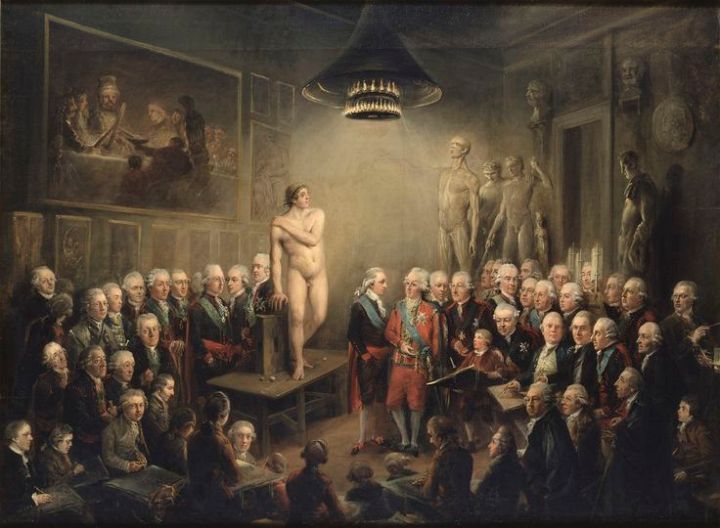
Elias Martin, King Gustav III Visits the Academy of Fine Arts in 1780, 1782, oil on canvas, 99 × 135 cm
(Stockholm: Nationalmuseum)
◊ ◊ ◊ ◊ ◊
Now on view at the Moderna Museet in Malmo:
The Artist / Konstnären
Konstakademien (Royal Academy of Fine Arts), Stockholm, 11 February — 11 September 2016
Moderna Museet, Malmö, 24 September 2016 — 19 February 2017
Throughout history, artists have played a wide variety of different roles. It’s a huge leap from the courtly painter who works on commission to the bohemian who refuses to rely on the approval of high society. This exhibition explores a number of different roles for artists, and also uncovers some of the myths that surround them.
How independent was the bohemian really? What kinds of new standards and rules have emerged within the avant-garde of modern art? And where did the idea of the free, creative, male genius come from? Women artists have often been portrayed as ‘exceptional anomalies’ in the history of art, but this exhibition shows just how numerous and how influential they have been, and how in the 1870s and 80s they shook up the preconception of the artist as a role for men.

Alexander Roslin, The Artist and His Wife Marie Suzanne Giroust Painting the Portrait of Wilhelm Peill, 1767, oil on canvas 131 × 98.5 cm (Stockholm: Nationalmuseum).
In more recent times, many artists have played the role of entrepreneur. Jeff Koons and Ernst Billgren work as modern businessmen in a commercial market economy. But the entrepreneurial artist has historical roots. Rosa Bonheur and Anders Zorn were both skilled painters as well as extremely competent when it came to building up their own personal brands, which helped them achieve great success in the international art market at the end of the nineteenth century. Entrepreneurial artists played an important role in seventeenth-century Holland as well.
During the eighteenth and nineteenth centuries, it was the values of the art academies of Europe that set the standard in the art world. Artists in these academies were trained in reproducing the classical ideals. Today the research conducted in university art schools is an example of a new form of academic work for artists.
This exhibition illuminates how artists relate to travel and to encounters with other cultures. In some cases an artist’s view of foreign cultures may be full of clichés and stereotypes. But there are also plenty of examples of artists who have worked to expose underlying power structures and standards in their encounters with other cultures.
Many artists throughout history have seen themselves as visionaries or prophets. Feminist artists such as Siri Derkert and Gittan Jönsson have worked both with criticism of contemporary society and with politically charged visions of the future. Other artists have been preoccupied with visions of a more spiritual nature, including Hilma af Klint and Vassilij Kandinskij.
This exhibition is a collaboration between Moderna Museet, the Royal Academy of Fine Arts, and the National Museum of Fine Arts. We want to show how powerful it is when we allow our collections from different eras to meet, and then complement that mix with a number of key works on loan.
Anne Dahlström, Margareta Gynning, Per Hedström, Carl-Johan Olsson, Andreas Nilsson, John Peter Nilsson, and Eva-Lena Bengtsson, Konstnären / The Artist (Stockholm: Nationalmuseum, 2016), 130 pages, ISBN: 978–9171008626, SEK149.
Exhibition | Portrait of the Artist

Press release (6 September 2016) from the Royal Collection Trust:
Portrait of the Artist
The Queen’s Gallery, Buckingham Palace, London, 4 November 2016 — 17 April 2017
The Queen’s Gallery, Palace of Holyroodhouse, Edinburgh, TBA
The first-ever exhibition of portraits of artists in the Royal Collection examines the changing image of the creative genius through more than 150 paintings, drawings, prints, photographs and decorative arts. Portrait of the Artist explores themes such as the cult of the artistic personality, the artist at work, and artists’ self-portraits.
From the 16th century, artists rose from the ranks of skilled artisans to a more elevated social status, a change in part influenced by royal patronage. The medieval tradesmen’s guilds were replaced first by workshops run by a master and subsequently by the first art academies. The lives of the most successful artists were recorded for posterity in the new literary genre of artists’ biographies. One of the most important collections of biographies from this period was Giorgio Vasari’s Delle vite de’ piu eccellenti pittori, scultori et architettori (1568), which described the lives of over 150 artists including that of the author. As artists became more prominent in society, a market developed for images of those deemed to be exceptional by virtue of their artistic talent. At the same time, artists increasingly saw self-portraiture as a way of demonstrating their skills to potential collectors and asserting their new standing in the world.
Images of artists became a valuable commodity, keenly acquired by monarchs and other influential patrons. The inventory compiled by Charles I’s Surveyor of Pictures in the late 1630s shows that three of the most important artists’ portraits owned by the monarch, including self-portraits by Daniel Mytens (c.1630) and Sir Peter Paul Rubens (1623), hung outside the King’s Withdrawing Room at Whitehall Palace. The 1666 inventory of Charles II’s collection lists 24 portraits of artists in “the Pafsage betweene ye Greene Roome and ye Clofet.” In this most intimate part of the royal apartments, accessible only to the King’s closest acquaintances and family, were Artemisia Gentileschi’s Self-portrait as the Allegory of Painting (La Pittura) (c.1638–39), Rubens’s self-portrait (1623) and portrait of his former assistant Anthony van Dyck (c.1627–28).
During the 17th century, general advancements in optics and practical developments in the production of mirrors enabled artists to be increasingly experimental and ambitious in their self-portraits. Artemisia Gentileschi used two mirrors to capture herself from an unusual angle for her powerful self-portrait as the personification of Painting, a remarkably unorthodox representation of a woman at this early date.
Artists frequently incorporated their own image into their works, as major players in historical and mythological narratives or through more subtle means. In Judith with the Head of Holofernes (1613), the painter Cristofano Allori appears as the decapitated Holofernes, his former lover Maria di Giovanni Mazzafiri is the murderous Judith, and her mother is Judith’s maidservant. Jan de Bray’s The Banquet of Cleopatra (1652) is a thinly disguised family portrait in which the artist casts his father Salomon de Bray, also a successful painter, in the role of Mark Antony.

Jean-Étienne Liotard, Self-Portrait, ca. 1753, enamel (London: Royal Collection Trust, RCIN 421436).
Through the choice of costume, gesture, props and setting, a self-portrait enabled an artist to take on a variety of roles. After visiting the Levant in 1738–43, the painter Jean-Étienne Liotard adopted a style of clothing for which he was to become known as ‘Le Peintre Turc’. His unconventional appearance—the Moldavian fur headdress and long beard seen in his self-portrait miniature of 1753—was thought by some to have contributed to his commercial success.
For young artists without the funds to pay a professional model, self-portraiture was a convenient way to practice their drawing skills. Annibale and Agostino Carracci’s self-portraits of c.1575–80 were probably produced by the teenage artists to hone their talents in this way. Some self-portraits appear to have been produced solely for the purpose of self-scrutiny. In a chalk drawing, possibly executed at the age of 80 in the final year of his life, Gianlorenzo Bernini records his hooded eyes and sunken cheeks with unflinching honesty.
The relationship between contemporaries in the art world is explored in the exhibition through representations of artists by their friends, admirers and pupils. Francesco Melzi’s chalk drawing of the aged Leonardo da Vinci (c.1515) is thought to be the most reliable surviving likeness of his teacher. Rubens’s portrait of his former assistant and lifelong friend Van Dyck shows the artist in three-quarter profile, his gaze averted to make him appear reflective, in contrast to the confident figure presented in Van Dyck’s self-portraits. The friendship between the engraver Francesco Bartolozzi and the painter Giovanni Battista Cipriani, Italian artists working in London, is recorded in charming pencil sketches that the pair made of each other in 1770—one painting, the other dozing in a chair.
In the 19th century, romanticised episodes from the lives of famous artists from the past were popular subject-matter. Johann Michael Wittmer’s Raphael’s First Sketch of the ‘Madonna della Sedia’ (c.1853) depicts the fable of how the Renaissance master came to create one of his best-known works on the base of a wine barrel. Frederick Leighton’s monumental work Cimabue’s Madonna Carried in Procession (1855) encapsulates the Victorian artist’s belief that, during the Renaissance, great art was appreciated at all levels of society and artists were held in high esteem, their genius widely acknowledged.
◊ ◊ ◊ ◊ ◊
In the US and Canada, the catalogue is distributed by The University of Chicago Press:
Anna Reynolds, Lucy Peter, and Martin Clayton, Portrait of the Artist (London: Royal Collection Trust, 2016), 240 pages, ISBN: 978-1909741324, $48.
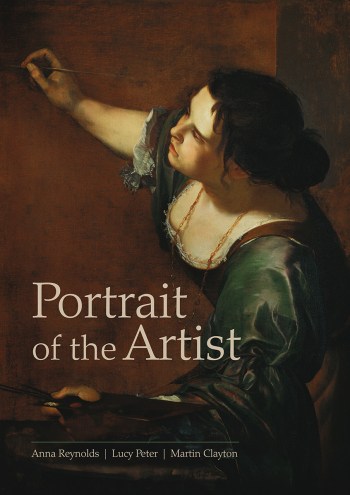 Dürer’s Self-Portrait at Age Twenty-Eight. Hockney’s Self-Portrait with Cigarette. Melzi’s drawing of Leonardo da Vinci, widely regarded as the most reliable surviving likeness of this most famous Old Master. Throughout history, many of the world’s most renowned artists have made portraits to represent themselves and others.
The first book to focus on images of artists from within the Royal Collection, Portrait of the Artist brings together paintings, drawings, prints, and photographs by artists from across the centuries, including works by Rembrandt van Rijn, Peter Paul Rubens, David Hockney, and Lucian Freud. While some of the portraits included in this book were created to showcase the artist’s talent, others were motivated by more personal reasons, to preserve the images of cherished friends. Anna Reynolds, Lucy Peter, and Martin Clayton explore the miscellany of themes running throughout the discipline of portraiture, from the rich symbolism found in images of the artist’s studio to the transformation of styles with which artists depicted themselves, changing their portrayals to align with their changing status. They also explore the relationships between artists and patrons, including the important role of the monarchy in commissioning and collecting portraits of artists.
New Book | Chinese and Japanese Works of Art in the Royal Collection
Published by the Royal Collection Trust and distributed in the U.S. and Canada by Chicago:
John Ayers, Chinese and Japanese Works of Art in the Collection of Her Majesty The Queen, 3 volumes (London: Royal Collection Trust, 2016), 1296 pages, ISBN: 978-1905686490, £150 / $250.
 The Royal Collection includes some of the most important examples of Eastern applied art in the Western world, reflecting the West’s long-standing appetite for rarities from distant lands. With more than 2,000 objects distributed across the royal residences in England and Scotland, the collection represents a rich cross-section of Chinese and Japanese porcelains, jades, lacquers, and other works of art.
This three-volume catalogue raisonné covers this substantial and important collection in comprehensive detail. It includes for the first time the many eighteenth- and nineteenth-century bronze mounts that are such a striking feature of the collection. Made in French and British workshops to enhance the objects they display, the mounts themselves are often of superb quality and of great historical importance.
More than 2,400 colour images are used to illustrate the collection, including intricate decorative details and makers’ marks. Introductory essays cover the history and development of the collection and the ways in which these works of art have been displayed in the royal palaces and adapted according to the fashions of the day.
Volume One presents the Chinese ceramics of the Ming and Qing dynasties in chronological order (continued in Volume Two). In addition, due to their unique historical significance, the contents of the collection at Hampton Court Palace are presented here separately. Volume Two continues the works of the Qing dynasty, and ends with the Japanese works; the volume also contains a special focus on the European mounts that were added to works of Chinese and Japanese porcelain during the eighteenth and early nineteenth centuries. Volume Three contains non-porcelain works, namely lacquer, jade and other hardstones, carved ivories, textiles and metalwork. Many of these works came into the Royal Collection as Imperial gifts, to George III, Queen Victoria, King Edward VII, and Queen Alexandra, with the exception of the Japanese lacquer wares, which were acquired for George IV to furnish the Royal Pavilion at Brighton. Although not much studied, these pieces were admired by the royal family, and Chinese rooms were created at Windsor and Sandringham House, decorated with an eclectic mixture of European chinoiserie and authentic works of Asian art.
New Book | The Learned Draftsman: Edme Bouchardon
From The Getty:
Édouard Kopp, The Learned Draftsman: Edme Bouchardon (Los Angeles: J. Paul Getty Museum, 2017), 336 pages, ISBN: 978-1606065044 , $65.
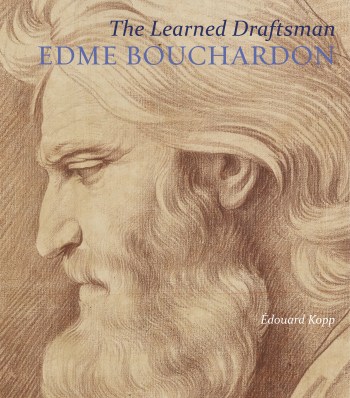 The celebrated French artist Edme Bouchardon (1698–1762) is primarily known as a sculptor today, but his contemporaries widely lauded him as a draftsman as well. Talented, highly innovative, and deeply invested in the medium, Bouchardon made an important contribution to the European art and culture of his time, and in particular to the history of drawing. Around two thousand of his drawings survive—most of which bear no relation, conceptual or practical, to his sculpture—yet, remarkably, little scholarly attention has been paid to this aspect of his oeuvre. This is the first book-length work devoted to the artist’s draftsmanship since 1910.
Ambitious in scope, this volume offers a compelling narrative that effectively covers four decades of Bouchardon’s activity as a draftsman—from his departure for Rome in 1723 as an aspiring student to his death in Paris in 1762, by which time he was one of the most renowned artists in Europe. His accomplished and dynamic style is analyzed and copiously illustrated in a series of five interrelated chapters that serve as case studies, each of which focuses on a coherent group of drawings from a particular period of Bouchardon’s career.
Edouard Kopp is the Maida and George Abrams Associate Curator of Drawings, Harvard Art Museums. He is the coauthor, with Scott Allan, of Unruly Nature: The Landscapes of Théodore Rousseau (Getty Publications, 2016) and the author of Capturing Nature’s Beauty: Three Centuries of French Landscapes (Getty Publications, 2009).
New Book | Les Rothschild: Une Dynastie de Mécènes en France
From Somogy:
Pauline Prévost-Marcilhacy, ed., Les Rothschild: Une Dynastie de Mécènes en France, 3 volumes (Paris: Somogy éditions d’Art, 2016), 1112 pages, ISBN: 978-2757202128, 290€.
 Grands collectionneurs et mécènes d’exception selon une tradition familiale « qui veut qu’à chaque génération, nous nous efforcions d’enrichir de notre mieux le patrimoine de notre pays », les Rothschild ont joué un rôle essentiel dans le domaine culturel depuis le dernier quart du XIXe siècle. L’ampleur de leur générosité à l’égard des musées et des collections publiques françaises—près de cent vingt mille œuvres d’art données à plus de deux cents institutions—est pour la première fois l’objet d’une publication d’envergure. De l’Antiquité à nos jours, toutes les périodes de l’histoire de l’art y sont représentées, ainsi que tous les continents et les domaines de création.
Pour mener à bien cet ambitieux projet, Pauline Prevost-Marcilhacy a réuni cinquante-trois spécialistes, conservateurs et universitaires, français et étrangers, qui explorent ici tous les aspects de ce mécénat exceptionnel.
Auteurs: Sous la direction de Pauline Prevost-Marcilhacy, Historienne de l’art – avec les textes de Mathilde Avisseau-Broustet (BNF), François Avril (BNF), François Baratte (Universitaire), Marc Bascou (Louvre), Blaise Ducos (Louvre), Gwenaëlle Fellinger (Louvre), Anne Forray-Carlier (Musée des Arts décoratifs), Pascale Gorguet-Ballesteros (Musée Galliéra), Dominique Hollard (BNF), Philippe Malgouyres (Louvre), Julie Olivier (BNF), Alain Pasquier (Louvre), Evelyne Possémé (Musée des Arts décoratifs), Marie-Hélène Tesnière (BNF), Dominique Thiébaut (Louvre), Dimitrios Zikos (Universitaire).
◊ ◊ ◊ ◊ ◊
V O L U M E 1 : 1 8 7 3 – 1 9 2 2
Les Rothschild: Une Dynastie de Mécènes en France
Edmond James de Rothschild (1845–1934)
• Edmond James de Rothschild
• Edmond James et Gustave de Rothschild, mécènes de l’archéologue et donateurs au musée du Louvre, 1873
• Le trésor de Boscoreale au musée du Louvre, 1895
• Dons de la baronne James Édouard et du baron Edmond James de Rothschild au département des Manuscrits de la Bibliothèque nationale, 1902–08
• Dons de costumes rares du baron et de la baronne Edmond James de Rothschild au musée Carnavalet et au musée des Arts décoratifs, 1906–08
• Le mécénat envers les artistes vivants, 1906–20
• Un ensemble de moucharabiehs au musée du Louvre et au musée des Arts décoratifs, 1920
Alphonse de Rothschild (1827–1905)
• Alphonse de Rothschild
• Le mécénat envers les artistes vivants en faveur des musées de région, 1895–1905
Charlotte de Rothschild (1825–1899) et Nathaniel de Rothschild (1812–1870)
• Charlotte et Nathaniel de Rothschild
• Dons et legs de la baronne Nathaniel de Rothschild, 1885–99
• Le goût pour la Renaissance italienne, musée du Louvre, 1899
• Un ensemble de coffrets en cuir au musée des Arts décoratifs, 1899
• Une collection de bijoux au musée des Arts décoratifs, 1899
Adolphe de Rothschild (1823–1900) et Julie de Rothschild (1830–1907)
• Adolphe et Julie de Rothschild
• L’art médiéval au musée du Louvre et au musée de Cluny, 1901
• Les objets de la Renaissance, musée du Louvre, 1901
James Édouard de Rothschild (1844–1881) et Thérèse de Rothschild (1847–1931)
• James Édouard et Thérèse de Rothschild
• Les manuscrits de la première rédaction des œuvres de Brantôme à la Bibliothèque nationale, 1903
• Monnaies et pierres gravées au Cabinet des médailles de la Bibliothèque nationale, 1903–04
Arthur de Rothschild (1851–1903)
• Arthur de Rothschild
• Une collection de bagues au musée de Cluny, 1904
• Peintures flamandes, hollandaises et françaises au musée du Louvre, 1904
V O L U M E 2 : 1 9 2 2 – 1 9 3 5
Salomon de Rothschild (1838–1864) et Adèle de Rothschild Pauline (1843–1922)
• Salomon et Adèle de Rothschild Pauline
• Peintures, dessins et sculpture, 1922
• Un ensemble exceptionnel d’orfèvrerie et de bijoux, 1922
• Ivoires et Bronzes, 1922
• Arts du feu de la Renaissance, 1922
• Armes occidentales, 1922
• Objets d’art islamique, 1922
• Porcelaines du XVIIIe siècle, 1922
• Tabatières du XVIIIe siècle, 1922
• Montres et écailles piquées, 1922
• Meubles et tapisseries du XVIIIe siècle, 1922
• Objets d’art d’Extrême-Orient, 1922
• Manuscrits, 1922
• Livres et estampes, 1922
• Albums de photographies, 1922
• Monnaies, 1922
Robert de Rothschild (1880–1946)
• Robert de Rothschild
• Dons au musée des Arts décoratifs
Henri de Rothschild (1872–1946)
• Henri de Rothschild
• Le mécénat envers les artistes vivants en faveur des musées de régions, 1906–194
• Têtes de mort au musée des Arts décoratifs, 1926
• Autographes à la Bibliothèque nationale, 1933
Alice de Rothschild (1847–1922)
• Pipes et boîtes d’allumettes
• Don d’Alice de Rothschild à la bibliothèque de Grasse, 1927
Béatrice Ephrussi de Rothschild (1864–1934)
• Béatrice Ephrussi de Rothschild
• Sculptures, 1933
• Peintures italiennes et espagnoles, 1933
• Le XVIIIe siècle à la villa Ephrussi de Rothschild, 1933
• Porcelaines françaises, 1933
• Porcelaines étrangères, 1933
• Biscuits, 1933
• Textiles, 1933
• Arts d’Extrême-Orient, 1933
• Peintures et dessins du XIXe siècle, 1933
V O L U M E 3 : 1 9 3 5 – 2 0 1 6
La Donation Edmond de Rothschild au Département des Arts Graphiques du Musée du Louvre, 1935
• Histoire de la constitution d’un « Musée de la gravure »
• Les nielles
• Les débuts de la gravure en Allemagne, dans les anciens Pays-Bas et en Italie
• Dürer et Rembrandt
• Les estampes allemandes du XVIe siècle
• La gravure flamande au XVIe siècle
• Les estampes italiennes du XVIe siècle
• Les estampes françaises du XVIe siècle
• Les estampes du XVIIe siècle
• Les estampes du XVIIIe siècle
• Les gravures d’architecture, d’ornements et d’arts décoratifs du XVIIIe siècle
• Les dessins du XVe siècle au XVIIIe siècle
• Les livres illustrés
• La fortune critique
• Historique et installation au musée du Louvre
Dons de la Baronne Edmond James et de James Armand de Rothschild, 1934–36
• La collection de dentelles de la baronne Edmond James de Rothschild au musée des Arts décoratifs, 1935
• Monnaies et médailles à la Bibliothèque nationale, 1935
• Objets de fouilles en Palestine, 1936
Les Rothschild et La Bibliothèque Nationale Après-Guerre
Le Legs Henri de Rothschild en 1947
• La bibliothèque de James Édouard de Rothschild (1844–1881)
• Les manuscrits enluminés de la collection de James Édouard, Thérèse et Henri de Rothschild
• Théâtre et poésie entre Moyen Âge et Renaissance
• La collection théâtrale d’Henri de Rothschild
Deux Manuscrits d’Edmond James et Adolphe de Rothschild
• Deux livres d’heures royaux : les Heures de Jeanne de Navarre, 1972; et les Très Belles Heures de Jean de Berry, 1956
Les Rothschild et les Musées Après-Guerre: Dons et Dations
• La récupération et la restitution des collections spoliées, 1945–53
• Les héritiers du baron Édouard de Rothschild
• Le château de Ferrières
• Les héritiers du baron Robert de Rothschild
• Mobilier Art déco au musée des Arts décoratifs
• Dons de Maurice et Miriam Alexandrine de Rothschild, 1935–37
• Dons d’Edmond de Rothschild à Versailles, 1966–88
• Don d’Edmond de Rothschild au musée du Louvre, 1990
• Objets antiques, peintures, dessins et objets d’art du XVIIIe siècle. Dation de 1990
Donations et Mécénat, 1955–2016
• Alix de Rothschild (1911–1987)
• Dons d’Alix de Rothschild au musée national des Arts et Traditions populaires et au musée de l’Homme
• Dons d’Alix de Rothschild au musée de l’Homme
• Dons de la baronne Élie de Rothschild aux musées français
• Dons du baron Élie de Rothschild au Centre Pompidou – Musée national d’Art moderne
• Dons de Béatrice Rosenberg au musée d’Orsay et au musée des Arts décoratifs, 2005–06
Mécénat au Bénéfice des Musées, 1963–2016
• Mécénat au bénéfice des musées
Annexes
• Historique et installation au musée du Louvre, 1935 ; textes cités en annexes
• Le don de la baronne Edmond James de Rothschild au Cabinet des médailles de la Bibliothèque nationale
• Liste des livres légués par le baron James de Rothschild (1792–1868) à son petit-fils James (1844–1881)
• Bibliographie
• Index des lieux de conservation
• Index des noms de personnes
Exhibition | Meta-painting: A Journey to the Idea of Art
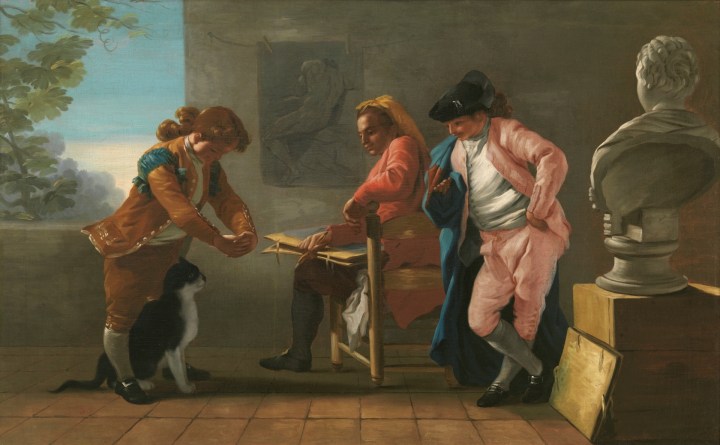
José del Castillo, The Study of Drawing, 1780, oil on canvas, 105 × 160 cm
(Madrid: Prado).
◊ ◊ ◊ ◊ ◊
Now on view at the Prado:
Meta-painting: A Journey to the Idea of Art / Metapintura: Un viaje a la idea del arte
Museo Nacional del Prado, Madrid, 15 November 2016 — 19 February 2017
Curated by Javier Portús
With Meta-painting, the Museo del Prado is offering a new approach to its collection in the latest in a series of exhibitions that began in 2010 with Rubens and continued with Captive Beauty (2013) and Goya in Madrid (2014). This series has aimed to offer visitors the chance to reflect on the Museum’s own collections and to look at its works in a new context which encourages different interpretations. Meta-painting proposes a journey that begins with mythological and religious narratives on the origins of artistic activity at the dawn of the modern age and concludes in 1819, the year of the Prado’s foundation. The exhibition thus also celebrates the 197th anniversary of the Museum’s founding as a temple of the arts, signifying their full acceptance as disciplines of social utility.
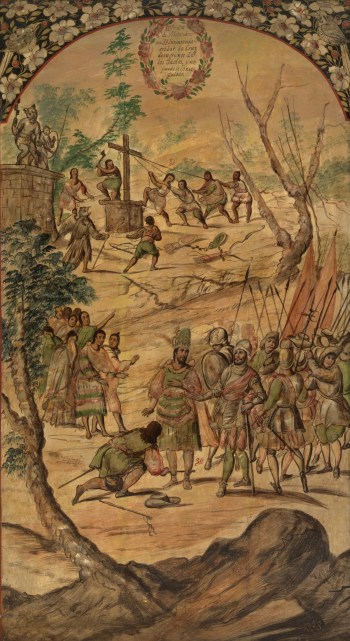
Juan González / Miguel González, Conquista de México por Hernán Cortés (30 y 31), 1698. Enconchado, Óleo sobre lienzo sobre tabla, 97 × 53 cm.
Two aspects central to the Prado—the Spanish royal collections and Spanish art—provide the context for the exhibition’s structure. Furthermore, these are two inseparable terms, given that the evolution of Spanish art was determined by the existence of the royal collections. The survey offered by the exhibition is a wide-ranging and varied one, including paintings, drawings, prints, books, medals, examples of the decorative arts and sculptures. Twenty-two of these works have been loaned by eighteen museums and collections, including the Fundación Casa de Alba, the National Gallery in London, the Museo de Bellas Artes in Seville, the Banco de España, and the Museo de la Real Academia de Bellas Arts de San Fernando in Madrid.
All the 137 works in the exhibition refer to art or to images, either as self-portraits of creators such as Titian, Murillo, Bernini and Goya; or because they include other paintings and sculptures, such as Saint Benedict destroying Idols by Ricci and Arachne by Rubens; or because they analyse issues relating to the definition of art and its history, such as José García Hidalgo’s book Principles for studying the very noble and royal art of painting […] and Goya’s Portrait of Jovellanos.
The exhibition’s ‘journey’ is divided into different phases. Fifteen sections focus on the relationship between art, the artist and society, each one of which looks at a specific issue, among them: the powers attributed to religious images; the role played by the ‘painting within the painting’; artists’ attempts to break through the pictorial space and continue it towards the viewer; the origins and practice of the idea of artistic tradition; portraits and self-portraits of artists; places for the creation and collecting of art; the origin of the modern concept of art history; the subjectivity that emerged in self-portraits from the Enlightenment onwards; and the importance of the concepts of love, death and fame in the modern artistic discourse.
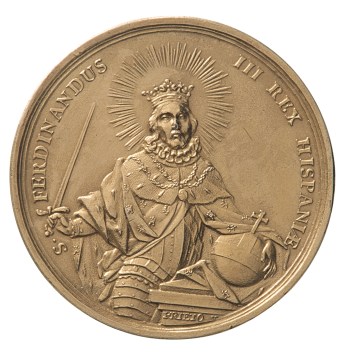
Francisco Tomás Prieto, Segundo premio de primera clase de la Academia de San Fernando, 1753, Silver-gilt, 44,5 mm diameter (Madrid: Prado)
The exhibition also represents a tribute by the Museo del Prado to Cervantes on the 400th anniversary of his death as it includes a section on Don Quixote as one of the great examples of self-referential literature, juxtaposed with Las Meninas. Thus, just as Cervantes’ text is a ‘novel within a novel’ so Velázquez’s painting is a ‘painting on painting’ in which the artist not only depicts himself painting but which involves various important issues regarding the potential of the art of painting and the role of the painter.
Las Meninas will remain in Room 12 of the Villanueva Building where it is habitually displayed but it is present in the exhibition through a modern facsimile of part of Laurent’s graphoscope which is displayed alongside editions of the two parts of Don Quixote, reminding visitors that these two masterpieces of the Spanish Golden Age are both reference points in the history of meta-fiction.
Javier Portús, Metapintura: Un viaje a la idea del arte (Madrid: Museo Nacional del Prado, 2016), 304 pages, ISBN: 978-8484803270.
New Book | Painting and Narrative in France
From Routledge:
Peter Cooke and Nina Lübbren, eds., Painting and Narrative in France, from Poussin to Gauguin (New York: Routledge, 2016), 218 pages, ISBN: 978-1472440105, $150.
 Before Modernism, narrative painting was one of the most acclaimed and challenging modes of picture-making in Western art; yet, by the early twentieth century storytelling had all but disappeared from ambitious art. France was a key player in both the dramatic rise and the controversial demise of narrative art. This is the first book to analyse French painting in relation to narrative, from Poussin in the early seventeenth to Gauguin in the late nineteenth century. Thirteen original essays shed light on key moments and aspects of narrative and French painting through the study of artists such as Nicolas Poussin, Charles Le Brun, Jacques-Louis David, Paul Delaroche, Gustave Moreau, and Paul Gauguin. Using a range of theoretical perspectives, the authors study key issues such as temporality, theatricality, word-and-image relations, the narrative function of inanimate objects, the role played by viewers, and the ways in which visual narrative has been bound up with history painting. The book offers a fresh look at familiar material, as well as studying some little-known works of art, and reveals the centrality and complexity of narrative in French painting over three centuries.
Peter Cooke is Senior Lecturer in French Studies at the University of Manchester. His most recent book is Gustave Moreau: History Painting, Spirituality and Symbolism.
Nina Lübbren is Art Historian and Principal Lecturer in Film Studies, and Deputy Head of Department of English, Communication, Film and Media, Anglia Ruskin University.
◊ ◊ ◊ ◊ ◊
C O N T E N T S
List of Figures
Notes on Contributors
Acknowledgements
Introduction: Narrativity and (French) Painting, Peter Cooke and Nina Lübbren
I. Ancien Régime
1 Units of Vision and Narrative Structures: Upon Reading Poussin’s Manna, Claudine Mitchell
2 Figures of Narration in the Context of a Painted Cycle: The North Bays of the Grande Galerie at Versailles, Marianne Cojannot-Le Blanc
3 The Crisis of Narration in Eighteenth-Century French History Painting, Susanna Caviglia
4 Obscure, Capricious, and Bizarre: Neoclassical Painting and the Choice of Subject, Mark Ledbury
II. Restoration and July Monarchy
5 Delacroix and ‘The Work of the Reader’, Beth S. Wright
6 Narrative and History in Léopold Robert’s Arrival of the Harvesters in the Pontine Marshes, Richard Wrigley
7 Narrative Strategies in Paul Delaroche’s Assassination of the Duc de Guise, Patricia Smyth
III. Second Empire and Third Republic
8 Eloquent Objects: Gérôme, Laurens, and the Art of Inanimate Narration, Nina Lubbren
9 Tyrannical Inopportunity: Gustave Moreau’s Anti-narrative Strategies, Scott C. Allan
10 Theatricality versus Anti-Theatricality: Narrative Techniques in French History Painting (1850−1900), Pierre Sérié
11 The Conflicted Status of Narrative in the Art of Paul Gauguin, Belinda Thomson
IV. Key Issues of Pictorial Narrative
12 Narrativity, Temporality and Allegorisation, from Poussin to Moreau, Peter Cooke
13 Towards a Study of Narration in Painting: The Early Modern Period, Étienne Jollet
Index
Exhibition | Bitter Sweet: Coffee, Tea, and Chocolate
Overlapping, at least partially, with The Edible Monument, this DIA exhibition explores luxury drinks:
Bitter|Sweet: Coffee, Tea, and Chocolate
Detroit Institute of Arts, 20 November 2016 — 5 March 2017
Curated by Yao-Fen You
The Detroit Institute of Arts presents Bitter|Sweet: Coffee, Tea & Chocolate, on view from November 20, 2016 to March 5, 2017. The introduction of coffee, tea, and chocolate to Europe, beginning in the late 16th century, profoundly changed drinking habits, tastes, and social customs, and spurred an insatiable demand for specialized vessels such as tea canisters, coffee cups, sugar bowls, and chocolate pots. The exhibition is organized by the Detroit Institute of Arts with support from the National Endowment for the Arts.

Pineapple Coffeepot, ca. 1750, creamware with colored glazes, Staffordshire, England (Detroit Institute of Arts).
The 68 works of art in Bitter|Sweet are mostly from the museum’s comprehensive holdings in pre-1850 European silver and ceramics. Highlights include three exquisitely decorated beverage services: a rare 24-piece set made by Germany’s Fürstenberg Porcelain Manufactory; a set once owned by Prince Louis, Duke of Nemours that illustrates the refinement of early 19th-century French Sèvres porcelain; and a Vienna Porcelain ensemble for two associated with Archduke Joseph of Austria. DIA paintings, prints, and sculpture related to the arrival and impact of the beverages in Europe help create new contexts and connections for objects from the permanent collection.
Other key works include Madame de Pompadour’s coffee grinder from the Musée du Louvre; a 1684 handwritten Spanish manuscript satirizing the vogue for chocolate from the Hispanic Society, New York; and an 18th-century German breakfast set containing chocolate beakers from the Clark Art Institute, Williamstown, Massachusetts. Diego Velázquez’s painting Infanta Maria Theresa from the Museum of Fine Arts Boston helps tell the story of the cocoa bean’s migration from the New World to the French royal court of Louis XIV via Spain.
Bitter|Sweet will be the first DIA exhibition to engage all five senses. In addition to the artworks, there will be videos about the preparation of coffee, tea, and chocolate as well as opportunities to touch, to hear, to smell, and even to taste. Such interactive components demonstrate the DIA’s commitment to engaging visitors in meaningful experiences with art.
“The exhibition is a very exciting venture for the DIA, with regards to the rich, complex story we’re telling and the innovative visitor-centered ways in which we are presenting it,” said Salvador Salort-Pons, DIA director. “While European art will be at center stage, the exhibition examines global interconnections from centuries ago that we hope will resonate with all visitors today. Just about everyone—regardless of culture or background—has a personal relationship with one or more of these beverages. I’m also excited about the ways the exhibition engages the permanent collection. Of course, I love that several of the loans in Bittersweet comment on Spain’s relationship to chocolate.”
Bitter|Sweet also touches on the human cost of procuring the raw materials to produce coffee, tea, and chocolate as well as the sugar used to alter the beverages’ bitter taste. Coffee was imported from Africa through the Middle East, tea from Asia, chocolate from the Americas, and sugar harvested by slaves on colonial plantations. To meet demand and keep prices down for the European market, merchants—such as the Dutch East India Company and the British East India Company—eventually found ways to cultivate tea and coffee bushes on foreign lands colonized under their rule.
◊ ◊ ◊ ◊ ◊
From Yale UP:
Yao-Fen You, with essays by Mimi Hellman and Hope Saska, Coffee, Tea, and Chocolate: Consuming the World (New Haven: Yale University Press, 2016), 142 pages, ISBN: 978-0300222500, $25.
 Coffee, tea, and chocolate were all the rage in Enlightenment Europe. These fashionable beverages profoundly shaped modes of sociability and patterns of consumption, yet none of the plants required for their preparation was native to the continent: coffee was imported from the Levant, tea from Asia, and chocolate from Mesoamerica. Their introduction to 17th-century Europe revolutionized drinking habits and social customs. It also spurred an insatiable demand for specialized vessels such as hot beverage services and tea canisters, coffee cups, and chocolate pots.
This beautiful book demonstrates how the paraphernalia associated with coffee, tea, and chocolate can eloquently evoke the culture of these new beverages and the material pleasures that surrounded them. Contributors address such topics as the politics of coffee consumption in 18th-century Germany; 18th-century visual satires on the European consumption of tea, coffee, and chocolate; and the design history of coffee pots in the United States between the colonial period and the present.
Yao-Fen You is associate curator of European sculpture and decorative arts at the Detroit Institute of Arts.
New Books | American History and the Enlightenment
As these six books underscore, America has always been a complicated place. All the best for a Happy Election Day! –CH
From the University of Georgia Press:
Jennifer Goloboy, Charleston and the Emergence of Middle-Class Culture in the Revolutionary Era (Athens: University of Georgia Press, 2016), 208 pages, ISBN: 978-0820349961, $55.
 Too often, says Jennifer Goloboy, we equate being middle class with ‘niceness’—a set of values frozen in the antebellum period and centered on long-term economic and social progress and a close, nurturing family life. Goloboy’s case study of merchants in Charleston, South Carolina, looks to an earlier time to establish the roots of middle-class culture in America. She argues for a definition more applicable to the ruthless pursuit of profit in the early republic. To be middle class then was to be skilled at survival in the market economy.
What prompted cultural shifts in the early middle class, Goloboy shows, were market conditions. In Charleston, deference and restraint were the bywords of the colonial business climate, while rowdy ambition defined the post-Revolutionary era, which in turn gave way to institution building and professionalism in antebellum times. Goloboy’s research also supports a view of the Old South as neither precapitalist nor isolated from the rest of American culture, and it challenges the idea that post-Revolutionary Charleston was a port in decline by reminding us of a forgotten economic boom based on slave trading, cotton exporting, and trading as a neutral entity amid warring European states. This fresh look at Charleston’s merchants lets us rethink the middle class in light of the new history of capitalism and its commitment to reintegrating the Old South into the world economy.
Jennifer L. Goloboy is an independent scholar based in Minneapolis, specializing in the history of the early American middle class. She is the editor of Industrial Revolution: People and Perspectives. Goloboy earned her PhD in the history of American civilization from Harvard University.
◊ ◊ ◊ ◊ ◊
From Basic Books:
Nicholas Nicholas Guyatt, Bind Us Apart: How Enlightened Americans Invented Racial Segregation (New York: Basic Books, 2016), 416 pages, ISBN: 978-0465018413, $30.
 Why did the founding fathers fail to include blacks and Indians in their cherished proposition that “all men are created equal”? The usual answer is racism, but the reality is more complex and unsettling. In Bind Us Apart, historian Nicholas Guyatt argues that, from the Revolution through the Civil War, most white liberals believed in the unity of all human beings. But their philosophy faltered when it came to the practical work of forging a color-blind society. Unable to convince others—and themselves—that racial mixing was viable, white reformers began instead to claim that people of color could only thrive in separate republics: in Native states in the American West or in the West African colony of Liberia. Herein lie the origins of “separate but equal.” Decades before Reconstruction, America’s liberal elite was unable to imagine how people of color could become citizens of the United States. Throughout the nineteenth century, Native Americans were pushed farther and farther westward, while four million slaves freed after the Civil War found themselves among a white population that had spent decades imagining that they would live somewhere else. Essential reading for anyone disturbed by America’s ongoing failure to achieve true racial integration, Bind Us Apart shows conclusively that “separate but equal” represented far more than a southern backlash against emancipation—it was a founding principle of our nation.
Nicholas Guyatt is a university lecturer in history at the University of Cambridge. He is a regular contributor to The Nation, London Review of Books, and The Guardian. Guyatt lives in Cambridge, England.
◊ ◊ ◊ ◊ ◊
From The University of North Carolina Press:
Robert Parkinson, The Common Cause: Creating Race and Nation in the American Revolution (Chapel Hill: The University of North Carolina Press, for the Omohundro Institute of Early American History and Culture, Williamsburg, 2016), 768 pages, ISBN: 978-1469626635, $45.
 When the Revolutionary War began, the odds of a united, continental effort to resist the British seemed nearly impossible. Few on either side of the Atlantic expected thirteen colonies to stick together in a war against their cultural cousins. In this pathbreaking book, Robert Parkinson argues that to unify the patriot side, political and communications leaders linked British tyranny to colonial prejudices, stereotypes, and fears about insurrectionary slaves and violent Indians. Manipulating newspaper networks, Washington, Jefferson, Adams, Franklin, and their fellow agitators broadcast stories of British agents inciting African Americans and Indians to take up arms against the American rebellion. Using rhetoric like “domestic insurrectionists” and “merciless savages,” the founding fathers rallied the people around a common enemy and made racial prejudice a cornerstone of the new Republic. In a fresh reading of the founding moment, Parkinson demonstrates the dual projection of the “common cause.” Patriots, through both an ideological appeal to popular rights and a wartime movement against a host of British-recruited slaves and Indians, forged a racialized, exclusionary model of American citizenship.
Robert G. Parkinson is assistant professor of history at Binghamton University.
◊ ◊ ◊ ◊ ◊
From Yale UP:
Steve Pincus, The Heart of the Declaration: The Founders’ Case for an Activist Government (New Haven: Yale University Press, 2016), 224 pages, ISBN: 978-0300216189, $26.
 From one election cycle to the next, a defining question continues to divide the country’s political parties: Should the government play a major or a minor role in the lives of American citizens? The Declaration of Independence has long been invoked as a philosophical treatise in favor of limited government. Yet the bulk of the document is a discussion of policy, in which the Founders outlined the failures of the British imperial government. Above all, they declared, the British state since 1760 had done too little to promote the prosperity of its American subjects. Looking beyond the Declaration’s frequently cited opening paragraphs, Steve Pincus reveals how the document is actually a blueprint for a government with extensive powers to promote and protect the people’s welfare. By examining the Declaration in the context of British imperial debates, Pincus offers a nuanced portrait of the Founders’ intentions with profound political implications for today.
Steve Pincus is the Bradford Durfee Professor of History at Yale University. He is the author of several books on seventeenth- and eighteenth-century British history.
◊ ◊ ◊ ◊ ◊
From Johns Hopkins UP:
Richard Alan Ryerson, John Adams’s Republic: The One, the Few, and the Many (Baltimore: Johns Hopkins University Press, 2016), 576 pages, ISBN: 978-1421419220, $60.
 Scholars have examined John Adams’s writings and beliefs for generations, but no one has brought such impressive credentials to the task as Richard Alan Ryerson in John Adams’s Republic. The editor-in-chief of the Massachusetts Historical Society’s Adams Papers project for nearly two decades, Ryerson offers readers of this magisterial book a fresh, firmly grounded account of Adams’s political thought and its development.
Of all the founding fathers, Ryerson argues, John Adams may have worried the most about the problem of social jealousy and political conflict in the new republic. Ryerson explains how these concerns, coupled with Adams’s concept of executive authority and his fear of aristocracy, deeply influenced his political mindset. He weaves together a close analysis of Adams’s public writings, a comprehensive chronological narrative beginning in the 1760s, and an exploration of the second president’s private diary, manuscript autobiography, and personal and family letters, revealing Adams’s most intimate political thoughts across six decades. How, Adams asked, could a self-governing country counter the natural power and influence of wealthy elites and their friends in government? Ryerson argues that he came to believe a strong executive could hold at bay the aristocratic forces that posed the most serious dangers to a republican society. The first study ever published to closely examine all of Adams’s political writings, from his youth to his long retirement, John Adams’s Republic should appeal to everyone who seeks to know more about America’s first major political theorist.
Richard Alan Ryerson, the former academic director and historian of the David Library of the American Revolution, was the editor-in-chief of the Adams Papers from 1983 to 2001.
◊ ◊ ◊ ◊ ◊
From Yale UP:
Caroline Winterer, American Enlightenments: Pursuing Happiness in the Age of Reason (New Haven: Yale University Press, 2016), 368 pages, ISBN: 978-0300192575, $35.
 The accepted myth of the ‘American Enlightenment’ suggests that the rejection of monarchy and establishment of a new republic in the United States in the eighteenth century was the realization of utopian philosophies born in the intellectual salons of Europe and radiating outward to the New World. In this revelatory work, Stanford historian Caroline Winterer argues that a national mythology of a unitary, patriotic era of enlightenment in America was created during the Cold War to act as a shield against the threat of totalitarianism and that Americans followed many paths toward political, religious, scientific, and artistic enlightenment in the 1700s that were influenced by European models in more complex ways than commonly thought. Winterer’s book strips away our modern inventions of the American national past, exploring which of our ideas and ideals are truly rooted in the eighteenth century and which are inventions and mystifications of more recent times.
Caroline Winterer is Anthony P. Meier Family Professor in the Humanities at Stanford University and director of the Stanford Humanities Center. The author of three previous books, she received an American Ingenuity Award from the Smithsonian Institution.
New Book | The American School: Artists and Status
From Yale UP:
Susan Rather, The American School: Artists and Status in the Late-Colonial and Early National Era (New Haven: Yale University Press, 2016), 316 pages, ISBN: 978-0300214611, $75.
 An in-depth look at the changing status of American artists in the 18th and early 19th century This fascinating book is the first comprehensive art-historical study of what it meant to be an American artist in the 18th- and early 19th-century transatlantic world. Susan Rather examines the status of artists from different geographical, professional, and material perspectives, and delves into topics such as portrait painting in Boston and London; the trade of art in Philadelphia and New York; the negotiability and usefulness of colonial American identity in Italy and London; and the shifting representation of artists in and from the former British colonies after the Revolutionary War, when London remained the most important cultural touchstone. The book interweaves nuanced analysis of well-known artists—John Singleton Copley, Benjamin West, and Gilbert Stuart, among others—with accounts of non-elite painters and ephemeral texts and images such as painted signs and advertisements. Throughout, Rather questions the validity of the term ‘American’, which she sees as provisional-the product of an evolving, multifaceted cultural construction.
Susan Rather is a professor in the Department of Art and Art History at the University of Texas, Austin.










leave a comment