New Book | The Villa Laurentina of Pliny the Younger
From L’Erma di Bretschneider:
Jerzy Miziolek, The Villa Laurentina of Pliny the Younger in an 18th-Century Vision (Rome: L’Erma di Bretschneider, 2016), 250 pages, ISBN: 978-8891308443, €75 / $94.

The book deals with a paper reconstruction of Pliny the Younger’s (c. AD 61–112) villa near Ostia, some twenty kilometres from Rome. This unique work was created in Rome in the years 1777–78 by a young Pole, Count Stanisław K. Potocki (1755–1821) in cooperation with Giuseppe Manocchi and other outstanding artists of the time. The work, originally in the Potocki collection in Wilanów, is today housed in the iconographic collection of the National Library, Warsaw. It contains over thirty large-format, color drawings. In the late 18th century, probably during his last sojourn in Italy (1795–97), Count Potocki wrote a 24-page-long commentary to his work, entitled Notes et Idées sur la Villa de Pline. This hitherto unpublished manuscript commentary and reconstruction drawings of the villa are now published together with a virtual visualisation of the villa produced in 3D Studio Max 2014.
Jerzy Miziolek is professor of the visual arts and the classical tradition at the University of Warsaw (Institute of Archaeology). He is the author of seven books and more than 150 papers and reviews. He has delivered more than forty papers and lectures at foreign universities and international symposia concerning Early Christian, Renaissance, and neoclassical art.
◊ ◊ ◊ ◊ ◊
C O N T E N T S
Introduction
I. Stanislaw Kostka Potocki: Archaeology and Artistic Culture in the 2nd Half of the Eighteenth Century
1 The Fascination with Antiquity and Its Influence in the 2nd Half of the Eighteenth Century
2 Stanisław Kostka Potocki in the Memoirs of Eyewitness
3 Stanisław Kostka Potocki’s Studies at the Royal Academy in Turin
4 Stanisław Kostka Potocki’s Travels around Italy in 1774–82
5 In the Company of Princess Izabela Lubomirska: Stanisław Kostka Potocki’s Sojourn in Italy in 1785–86
II. The Laurentina: Pliny the Younger’s Seaside Villa and Its Reconstruction in the Pure Taste of the Century of Trajan
1 A Literary Portrait of the Laurentina: The Dwelling-Place of the Muses
2 The Owner of the Laurentina
3 The Search for the Remnants of the Laurentina in the Eighteenth Century and Later
4 Pliny ‘s Letter on the Laurentina in European Culture from the Renaissance to Neoclassicism
5 Artists Employed by Stanisław Kostka Potocki and Their Drawings
6 Reconstruction Drawings of the Laurentina and Remarks on the Notes et Idées sur la Villa de Pline
7 Reconstruction of Pliny ‘s Villa, Decoration of the Main Rooms, Patterns, and Inspirations
8 The Cryptoportico with Adjacent Pavilions and the Heliocaminus
9 Some notes on the Ideas Guiding the Plan for Pliny ‘s Villa by Potocki
III. The Third Dimension of Pliny the Younger ‘s villa: Virtual Reconstruction of the Laurentina
Instead of an Epilogue: The Laurentina of Potocki ‘s Vision and the Artistic Cultures of Neoclassical Warsaw
Appendices
Pliny the Younger, Letter to Gallus (2, 17)
Stanisław Kostka Potocki, Notes and Ideas on Pliny ‘s Villa
Notes and Explanations in the Portfolios Containing the Drawings
Bibliography
New Book | Klassizismus in Aktion: Goethes ‘Propyläen’
Published by Böhlau with details from De Gruyter:
Daniel Ehrmann and Norbert Christian Wolf, eds., Klassizismus in Aktion: Goethes ‘Propyläen’ und das Kunstprogramm der Weimarer Klassik (Vienna: Böhlau Verlag, 2015), 458 pages, ISBN: 978-3205201540, 59€ / $83 / £45.
 Der Band setzt sich mit der von Johann Wolfgang Goethe von 1798 bis 1800 herausgegebenen Kunstzeitschrift Propyläen auseinander und nimmt dabei nicht nur bekannte Essays des Herausgebers, sondern auch Beiträge Friedrich Schillers, Johann Heinrich Meyers und Wilhelm von Humboldts in den Blick. Erstmalig wird so eine zentrale Programmschrift des deutschen Klassizismus in ihrem inneren Zusammenhang gemustert und in ihren zeitgenössischen Kontexten interdisziplinär untersucht. Dadurch kann die literaturhistorische und ästhetikgeschichtliche Bedeutung des publizistischen Projekts neu ermessen werden. Der Forschung soll so ein vertiefender Einblick in das innere Gefüge und die spannungsreiche Beschaffenheit des klassizistischen Weimarer Kunstprogramms eröffnet werden.
◊ ◊ ◊ ◊ ◊
I N H A L T S V E R Z E I C H N I S
EINLEITUNG
• Daniel Ehrmann / Norbert Christian Wolf, Klassizismus in Aktion. Zum spannungsreichen Kunstprogramm der Propyläen
KULTUR UND AUTONOMIE
• Sabine Schneider, »Ein Unendliches in Bewegung«. Positionierungen der Kunst inderKultur
• Hans-Jürgen Schings, Laokoon und La Mort de Marat oder Weimarische Kunstfreunde und Französische Revolution
• Daniel Ehrmann, Bildverlust oder Die Fallstricke der Operativität. Autonomie und Kulturalität der Kunst in den Propyläen
NATUR UND DIE KÜNSTE
• Elisabeth Décultot, Kunsttheorie als Übersetzung. Goethes Auseinandersetzung mit Diderots Versuch über die Mahlerey
• Dieter Borchmeyer, Weimarer Opernästhetik. Goethes Essay Ueber Wahrheit und Wahrscheinlichkeit der Kunstwerke
• Ernst Osterkamp, Das Drama und die Kunst des Klassizismus in den Propyläen
NORMATIVITÄT UND VIELSTIMMIGKEIT
• Johannes Grave Natur und Kunst, Illusion und Bildbewusstsein. Zu einigen Bildern in Goethes Beiträgen für die Propyläen
• Norbert Christian Wolf, Vielstimmigkeit im Kontext. Goethes ›kleiner KunstRoman‹
Der Sammler und die Seinigen in entstehungsgeschichtlicher und gattungstheoretischer Perspektive
• Martin Dönike, »Antike Kunstwerke«. Johann Heinrich Meyers altertumskundliche Beiträge zu den Propyläen
KLASSIZISTISCHE UND ANTIKLASSIZISTISCHE KUNSTPRAXIS
• Frank Büttner, Die Weimarischen Kunstfreunde und die Krise der Kunstakademien um 1800
• Johannes Rössler, Über das Helldunkel. Re exionen zu Druckgraphik und Reproduktionsmedien in den Propyläen
• York-Gothart Mix, ›Das Unendliche und das Endliche‹. Die Propyläen und die kunstphilosophische Debatte über die Arabeske als romantisches Erkenntnisbild
VOR UND NACH DEN »PROPYLÄEN«
• Gerrit Brüning, Glückliches Ereignis im Zeichen der Kunst. Die Propyläen als Frucht der Zusammenarbeit Goethes und Schillers
• Claudia Keller, Die ungeschriebenen Propyläen – Klassizismus im Experiment
• Peter Sprengel, Goethe-Nachfolge als Architekturphantasie. Zum Motiv der Propyläen im Werk Gerhart Hauptmanns
Abbildungen
Siglenverzeichnis
Verzeichnis der Beiträgerinnen und Beiträger
Personenregister
Exhibition | Versailles: Treasures from the Palace

Hall of Mirrors (Galerie des Glaces), 1678–84
(Château de Versailles)
◊ ◊ ◊ ◊ ◊
Press release (18 July 2016) from the NGA:
Versailles: Treasures from the Palace
National Gallery of Australia, Canberra, 9 December 2016 — 17 April 2017
The NGA has revealed details of the sumptuous treasures from the Palace of Versailles, which will be on show in Canberra this December. Versailles: Treasures from the Palace is a once-in-a-lifetime chance to see and experience a mesmerising period in French history in Australia. For the first time ever, the treasures will travel from France to entice visitors into a world of power, passion and luxury through this epic exhibition. More than 130 paintings, intricate tapestries, gilded furniture, monumental statues and other objects from the Royal gardens, and personal items from Louis XIV to Marie-Antoinette, will bring to life the reigns of three kings, their queens and mistresses in a fascinating and tumultuous period of French history. The exhibition will celebrate the lives, loves, and passions of the people of Versailles through a full program of activities including music performances, children’s programs, and public events.

François Hubert Drouais, The Sourches Family (‘Le Concert Champêtre’), 1756, oil on canvas (Château de Versailles, Dist. RMN-Grand Palais / Christophe Fouin)
“We are delighted to bring the grandeur of the culture of Versailles exclusively to Canberra and make it possible for all Australians to access and appreciate the social, political and cultural aspects of this unique phenomenon. If ever absolute power can be expressed through unbridled opulence, this is it,” said Gerard Vaughan, NGA Director.
“Along with astonishing treasures, like the marble bust of Louis XIV, or the glamorous formal portrait of Marie- Antoinette, we are bringing to Australia the entire 1.5 tonne statue of Latona and Her Children from one of the main fountains of the Palace of Versailles,” said Dr Vaughan. “The authenticity of this cultural experience will leave a lasting imprint on all our visitors.”
The exhibition contrasts small personal items, such as the precious golden reliquary which belonged to Louis XIV’s mother, or Marie-Antoinette’s hand-crafted chair and harp, with huge works including six-metre tapestries from the most important Gobelins series ever produced for Louis XIV, and a monumental conversation piece of the Sourches family which requires individual freight.
“Versailles is at the heart of French cultural expression as much as the NGA is the heart of Australian visual expression and we are very excited to bring this historic exhibition to Australia,” said Catherine Pégard, President of the Public Establishment of the Palace, Museum and National Estate of Versailles.
“The opportunity to send such important French treasures has been made possible because of the major restoration program at Versailles, and we are thrilled to see that the outcome of the work will be the enjoyment of thousands of Australians,” said Christophe Lecourtier, Ambassador of France to Australia.
“The NGA is bringing to Canberra yet another spectacular show, which will attract people from all over the country and the world this summer,” said Andrew Barr, ACT Chief Minister. “These shows are important to the local tourism sector and I’m confident that this show will be another success for the Gallery.”
New Book | Hogarth’s Legacy
Distributed by Yale UP:
Cynthia Roman, ed., Hogarth’s Legacy (New Haven: Yale University Press, 2016), 272 pages, ISBN: 978-0300215618, $80.
 The legacy of graphic artist William Hogarth (1697–1764) remains so emphatic that even his last name has evolved into a common vernacular term referring to his characteristically scathing form of satire. Featuring rarely seen images and written contributions from leading scholars, this book showcases a collection of the artist’s works gathered from the Lewis Walpole Library at Yale University and other repositories. It attests to the idiosyncratic nature of his style and its international influence, which continues to incite aesthetic and moral debate among critics. The eight essays by eminent Hogarth experts help to further contextualize the artist’s unique narrative strategies, embedding the work within German philosophical debates and the moral confusion of the Victorian period and emphasizing the social and political dimensions that are part and parcel of its profound impact. Endlessly parodied and emulated, Hogarth’s distinctive satire persists in its influence throughout the centuries and this publication provides the necessary lens through which to view it.
Cynthia Roman is curator of prints, drawings, and paintings at the Lewis Walpole Library.
New Book | Artistes, savants et amateurs: Art et sociabilité
A collection of essays that emerged from the conference Art et Sociabilité au XVIIIe siècle
(Paris, 23–25 June 2011) is now available from Mare et Martin:
Jessica Fripp, Amandine Gorse, Nathalie Manceau, and Nina Struckmeyer, eds., Artistes, savants et amateurs: Art et sociabilité au XVIIIe siècle (1715–1815) (Paris: Les Éditions Mare et Martin, 2016), 296 pages, ISBN: 979-1092054422, 35€.
 La notion de sociabilité a fait l’objet, depuis quelques années, d’un renouvellement historiographique important. La complexité de cette notion impose pour son étude une approche pluridisciplinaire qui fasse appel aussi bien à la sociologie qu’à la philosophie, à l’anthropologie qu’à l’histoire de l’art.
Ce volume rassemble des études de spécialistes internationaux et explore la diversité des échanges sociaux dans le monde artistique du XVIIIe siècle. En examinant la sociabilité des divers acteurs de la création artistique, ces textes analysent les réseaux formés par le commerce des objets matériels, à travers l’étude des collections, du marché de l’art ou des expositions, et par le commerce des idées, à travers l’étude des écrits sur l’art et de l’art de la conversation. Le rôle des pratiques sociales au sein de la sphère publique dans l’évolution de la production artistique et des échanges matériels, économiques et intellectuels constitue donc l’objet de cet ouvrage collectif.
◊ ◊ ◊ ◊ ◊
T A B L E D E S M A T I È R E S
Préface, Étienne Jollet
Introduction: La sociabilité, une notion équivoque, Jessica L. Fripp, Amandine Gorse, Nathalie Manceau et Nina Struckmeyer
I. LA SOCIÉTÉ DES ARTISTES
• Le peintre-gentleman : un modèle de sociabilité et ses variations dans l’Angleterre du dix-huitième siècle, Elisabeth Martichou
• Entre hommage et parodie : une conversation graphique entre Watteau et Oppenord, Jean-François Bédard
• Behind Closed Doors: Charles-Antoine Coypel and le théâtre de société, Esther Bell
II. LA COMMUNAUTÉ PROFESSIONNELLE
• A case study in sociabilité: Bachelier’s École royale gratuite de dessin, Reed Benhamou
• La sociabilité à l’Académie de France à Rome sous le directorat de Charles-Joseph Natoire (1752–1775), Susanna Caviglia
• Les cercles des artistes allemands à Paris autour de 1800, Frauke Josenhans / Nina Struckmeyer
• Painters and Parish Life in Eighteenth-Century Paris: Art, Religion, and Sociability, Hannah Williams
III. LES REPRÉSENTATIONS DE LA SOCIABILITÉ
• Friendship at the Salon, Jessica L. Fripp
• Fêting the Hunt in Eighteenth-Century Painting, Julie Anne Plax
• Le tableau de mode et Hogarth – la peinture de genre dans la première moitié du XVIIIe siècle : entre autodérision et critique sociale, Jörg Ebeling
IV. LES LIEUX DE LA SOCIABILITÉ
• Les chimères de la République des Arts. Fonction et expérimentation du fac-similé scientifique dans la première moitié du XVIIIe siècle, Valérie Kobi
• Les dictionnaires des Beaux-Arts au XVIIIe siècle : pour qui et pourquoi ?, Gaëtane Maës
• Le commerce de la peinture dans les Salons de Diderot, Stéphane Lojkine
• L’œil du spectateur : incarnation d’une nouvelle sociabilité, Isabelle Pichet
• Des hommes et des œuvres : sociabilités et associations dans le musée parisien autour de 1800, Noémie Étienne
V. LES MODÈLES DE LA SOCIABILITÉ
• Paris/Provinces : une sociabilité savante et artistique au XVIIIe siècle vue au travers des correspondances privées, ou les échanges épistolaires comme instruments de la sociabilité, Patrick Michel
• Les classiques de Weimar en dialogue avec la culture parisienne, Boris Roman Gibhardt
• Les Souvenirs d’Élisabeth Vigée Le Brun : distinction et sociabilité dans une Vie d’artiste, Bernadette Fort
Illustrations
Bibliographie générale
Auteurs Remerciements
Index
Exhibition | In the Light of Naples: The Art of Francesco de Mura

Francesco de Mura, The Visitation, ca. 1750, oil on canvas, 37 × 46 1/2 inches
(Winter Park: Cornell Fine Arts Museum, Rollins College)
◊ ◊ ◊ ◊ ◊
Opening in September at the Cornell Fine Arts Museum:
In the Light of Naples: The Art of Francesco de Mura
Cornell Fine Arts Museum, Rollins College, Winter Park, Florida, 17 September — 18 December 2016
Chazen Museum, University of Wisconsin-Madison, 20 January — 2 April 2017
The Frances Lehman Loeb Art Center, Vassar College, Poughkeepsie, New York, 21 April — 2 July 2017
Curated by Arthur Blumenthal
In the Light of Naples: The Art of Francesco de Mura will be the first-ever exhibition of the art of Francesco de Mura (1696–1782), arguably the greatest painter of the Golden Age of Naples. The Cornell Museum owns a major painting by De Mura, The Visitation, which is the impetus for this show.
Francesco de Mura, the indisputable leader in his day of the Neapolitan School and the favorite of the reigning Bourbon King Charles VII, was the chief painter of decorative cycles to emerge from the studio of Francesco Solimena (1657–1747), the celebrated Baroque artist. De Mura’s refined and elegant compositions, with their exquisite, light, and airy colors, heralded the rococo in Naples, and his later classicistic style led to Neo-Classicism. De Mura’s ceiling frescoes rivaled those of his celebrated Venetian contemporary, Giambattista Tiepolo (1696–1770). Yet, today, he lacks his proper place in the history of art. This show seeks to answer why this is so: If he was so celebrated and admired in his lifetime, why is De Mura so little known today?
The exhibition—which, in 2017, will travel to the Chazen Museum at the University of Wisconsin-Madison and the Loeb Art Center at Vassar College—will feature more than 40 works by De Mura from such collections as Boston’s Museum of Fine Arts, the Metropolitan Museum in New York, the Art Institute of Chicago, the Minneapolis Art Institute, the National Gallery of Art in Washington, and other public and private collections. In addition, there will be loans from Naples, Paris, and London.
Included will be the Cornell Museum’s recently acquired Solimena painting, as well as the Cornell’s newly identified oil by a follower of Solimena. Dr. Arthur Blumenthal, Director Emeritus of the Cornell, is the Guest Curator of the show, which will have a scholarly catalogue with essays by such art historians as Nicola Spinosa, former Superintendent of the National Museums in Naples and foremost expert on De Mura. Through De Mura’s original creations in the exhibition, the Cornell will finally be giving this richly deserving Neapolitan artist—the last Baroque artist—his due.
◊ ◊ ◊ ◊ ◊
Catalogue available in September from Artbooks.com:
Arthur Blumenthal, ed., In the Light of Naples: The Art of Francesco de Mura, (London: Giles, 2016), 208 pages, ISBN: 978-1907804854, $50.
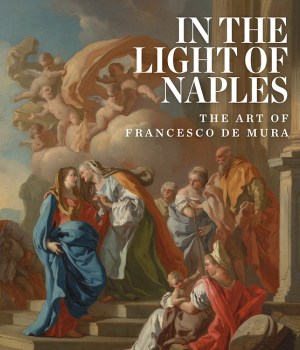 Francesco de Mura (1696–1782), one of the greatest painters of the Golden Age of Naples, at last gains the attention he deserves in this first-ever scholarly publication. De Mura’s refined and elegant compositions, with their exquisite light and color, heralded the Rococo in Naples, while his later classicistic style led to the simplicity and sculptural quality of Neoclassicism. In the Light of Naples: The Art of Francesco de Mura reveals the power of his work through more than 200 colour illustrations, including details from his great frescoes, as well as images of many of his key paintings—published here for the first time. The indisputable leader in his day of the Neapolitan School and the favorite of the reigning Bourbon King Charles VII (1735–59), Francesco de Mura was the chief painter of decorative cycles to emerge from the studio of Francesco Solimena (1657–1747), the great Baroque artist. Outstanding works in Naples include the enormous oil painting of The Adoration of the Magi (ca.1728) for the church of Santa Maria Donnaromita, and the stunning frescoes of The Adoration of the Magi (1732) in the apsidal dome of the church of the Nunziatella and, on the ceiling of the nave of the same church, The Assumption of the Virgin (1751). Nearly a third of De Mura’s works were destroyed in the American and British bombing of Naples during World War II, including, most tragically, his series of frescoes at the abbey of Monte Cassino.
Arthur Blumenthal is Director Emeritus of Cornell Fine Arts Museum at Rollins College.
◊ ◊ ◊ ◊ ◊
Note (added 21 December 2016) — Malcolm Bull reviews the exhibition for The Burlington Magazine 158 (December 2016), pp. 1006–07:
In the mid-eighteenth century, Francesco de Mura (1696–1782) was universally acknowledged to be the leading artist in Naples . . . But his fortune since then has been less favourable . . . Most of De Mura’s work remains in situ, making it hard to mount a representative exhibition. In these circumstances it is not surprising that this, the first-ever exhibition of the artist’s work, In the Light of Naples: The Art of Francesco de Mura at Cornell Fine Arts Museum, Rollins College, Winter Park, FL (to 18th December), where this reviewer saw the show, required a decade of planning by its curator, Arthur Blumenthal. The result is, however, a triumph. . . Although this is a small exhibition, there is enough to convince even the most skeptical viewer that De Mura is an artist of the first rank (1006).
New Book | A Potted History
From ACC Distribution:
Stella Beddoe, A Potted History: Henry Willett’s Ceramic Chronicle of Britain (Woodbridge: Antique Collectors Club, 2015), 352 pages, ISBN: 978-1851498116, £45 / $90.
 The Willett Collection at the Brighton Museum & Art Gallery is the only collection formed to illustrate what 19th-century businessman Henry Willett called ‘popular British history’. The collection of nearly 2,000 items is arranged here in chapters corresponding to Willett’s own cataloguing system. Many of the groupings commemorate historical events and personalities, such as ‘Royalty and Loyalty’, its content running from the Tudors through to Queen Victoria, and ‘Statesmen’, with its ceramic representations of Disraeli and Gladstone. Other chapters focus on social history, from the grisly murder in the Red Barn to bull baiting, pugilism, animal husbandry and teetotalism.
Stella Beddoe’s engaging, informative text places each item in context, exploring the maker and the subject matter depicted. The introduction on Henry Willett the man reveals the life that spawned such a diverse, irreplaceable collection of ceramics. The items, depicted in more than 800 colour illustrations, comprise hollow ware and flat ware, ornamental busts and figures, dating from the late sixteenth to the late nineteenth centuries. They represent a complete range of ceramic bodies and manufacturing technology.
Stella Beddoe worked at Brighton Royal Pavilion & Museums as Keeper of Decorative Art (including the Willett Collection) and, later, Senior Keeper, from 1978 to 2012.
◊ ◊ ◊ ◊ ◊
C O N T E N T S
1 Henry Willett, The Man and The Collection
2 Royalty and Loyalty
3 Military Heroes
4 Naval Heroes
5 Soldiers and Sailors
6 England and France
7 England and America
8 Statesmen
9 Clubs and Societies, and Professions and Trades
10 Philanthropy
11 Crime
12 Architecture
13 Scripture History and Religion
14 Music and Drama
15 Poetry Science and Literature
16 Sporting and Field Sports
17 Pastimes and Amusements
18 Agriculture
19 Conviviality and Teetotalism
20 Domestic Incidents
New Book | Paper Peepshows
From ACC Distribution:
Ralph Hyde, Paper Peepshows: The Jacqueline and Jonathan Gestetner Collection (Woodbridge: Antique Collectors’ Club, 2015), 272 pages, ISBN: 978-1851498000, $90.
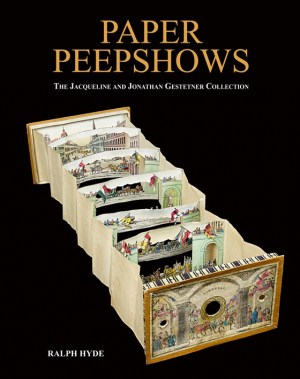 Peepshows were introduced in the mid-eighteenth century by Martin Engelbrecht in Augsburg. They called for a long wooden cabinet designed for purpose incorporating a viewing lens and sometimes a mirror. In the 1820s peepshows made entirely of paper appeared on the scene more or less at the same moment in Vienna, London and Paris. The clumsy cabinet was no longer called for. The new peepshow was equipped with paper bellows so it could be expanded or contracted in a trice. Paper peepshows were light; they were comparatively cheap. They fitted neatly into the pocket. Viewing a Paper Peepshow is an intimate, individual experience that, in the age of television and hand-held computers, gives a real sense of personal discovery. The viewer engages by peeping through a tiny hole and thereby discovers inside layers of images, like a pocket-sized stage set.
The format lent itself to a wide variety of subjects: to coronations and to state visits and funerals, to pleasure gardens, to trips up rivers and to the ceremonial openings of new railways, to distant views of cities and to tourist landmarks, to military engagements in exotic places, and to the July Revolution and the fall of the Bourbons in France in 1830. The Crystal Palace, erected in Hyde Park 1851 for the Great Exhibition, inspired the production of very large numbers of peepshows, mostly made overseas and imported. Peepshows made possible visits to sites existing in the imagination, to plunge down Alice’s rabbit hole, for example, and to wander through the Garden of Eden in Paradise.
The main center of peepshow manufacture in the nineteenth century was toy-making Nuremburg. Briefly in the 1950s it was Britain. Nowadays it is the United States. Paper peepshows are no longer intended essentially for children but for bibliophiles and art-appreciating adults.
This stunning book charts the history of these charming collectables. The illustrated catalogue section includes the following data where known: country of origin, publisher, date, method of printing (e.g. chromolithograph), shape and dimensions, and number of scenes. As well as a full description of each piece, the author gives fascinating historical and cultural context for these items—ranging from depictions of the July Revolution (Paris, 1830), to the opening of the Thames Tunnel, to the nursery tale of Puss in Boots.
C O N T E N T S
Foreword by Erkki Huhtamo
• The Gestetner Paper Peeshow Collection at the V&A
• The Story of Paper Peepshows
• What We Peep With
Catalogue: Austria, Canada, China, Denmark, France, Germany, Great Britain, Italy, Russia, The Netherlands, United States of America, Unknown Origin
Appendix 1: Peepshow View Boxes
Appendix 2: Table-top Tableaux in the Gestetner Collection
Appendix 3: Boîtes d’optique in the the Gestetner Collection
Bibliography
Acknowledgments
General Index
Title Index
New Book | Italian Watermarks, 1750–1860
From Brill:
Theo Laurentius and Frans Laurentius, Italian Watermarks, 1750–1860 (Leidin: Brill, 2016), 175 pages, ISBN: 978-9004310612, €175 / $210.
 The knowledge of papermaking spread slowly over Italy from the start of the 13th century. Scholarly interest in the history of Italian paper manufacture has concentrated especially on the earliest period. Research into Italian paper from the 17th, 18th, and 19th centuries has lagged somewhat behind.
Watermarks are extremely important for investigating the origins of paper. Until quite recently watermarks were copied and reproduced by placing them on a light source and then tracing them over onto some kind of transparency. It should be clear, however, that in many instances this technique could never achieve reproductions that were one hundred per cent accurate. Italian Watermarks, 1750–1860 offers x-rays and descriptions of approximately three hundred Italian watermarks. A selection of paper produced in different areas of Italy is presented with an identification.
Theo Laurentius has been active as a paper researcher for over fifty years. He has published several studies on watermarks and paper, including two important catalogues: Watermarks 1600–1650 Found in the Zeeland Archives (Hes & De Graaf, 2007) and Watermarks 1650–1700 Found in the Zeeland Archives (Hes & De Graaf, 2008).
Frans Laurentius, Ph.D., is an art historian. He has published several studies on graphic arts, Dutch pottery, and watermarks, as well as a monograph on the Dutch print dealer Clement de Jonghe: Clement de Jonghe (ca. 1624–1677): Kunstverkoper in de Gouden Eeuw (Hes & De Graaf, 2010).
New Book | Silver in Georgian Dublin
From Routledge:
Alison FitzGerald, Silver in Georgian Dublin: Making, Selling, Consuming (New York: Routledge, 2016), 256 pages, ISBN: 978-1472427878, $150.
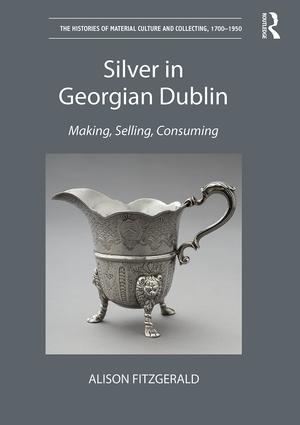 Georgian Dublin is synonymous with a period of unprecedented expansion in the market for luxury goods. At a time when new commodities, novel technologies, and fashionable imports seduced elite society, silver enjoyed an established association with gentility and prestige. Earlier studies have focused predominantly on the issue of style. This book considers the demand for silver goods in Georgian Ireland from the perspectives of makers, retailers, and consumers. It discusses the practical and symbolic uses of silverware, interpreted through contemporary guild accounts, inventories, trade ephemera, and culinary manuscripts. For the first time the activities of Dublin’s goldsmiths and their customers are considered in the context of the British Isles, acknowledging Dublin’s ‘second city’ status in relation to London. How did the availability of new products like English porcelain and Sheffield Plate affect the demand for silver in Dublin, and how did silver imports from London affect the Dublin trade? To what extent do the practices of Dublin goldsmiths mirror their North American counterparts seeking to infer associations with the fashionable metropolis of London? Drawing on an extensive range of documentary and object evidence this wide-ranging analysis considers the context in which silver goods were made, used, valued, and displayed in Georgian Ireland.
Alison FitzGerald is a Lecturer in the Department of History at Maynooth University, Ireland.
◊ ◊ ◊ ◊ ◊
C O N T E N T S
Introduction
1 The Business of Becoming a Goldsmith in Eighteenth-Century Dublin
2 Goldsmiths and Market Forces in Eighteenth-Century Ireland
3 Shopping for Plate in Dublin and London
4 Silver and Its Meaning in Georgian Ireland
5 The Silver Trade in Post-Union Ireland
Conclusion










 Enfilade
leave a comment