New Book | Court, Country, City: British Art and Architecture, 1660–1735
Distributed by Yale UP:
Mark Hallett, Nigel Llewellyn, and Martin Myrone, eds., Court, Country, City: British Art and Architecture, 1660–1735 (New Haven: Yale Center for British Art, 2016), 544 pages, ISBN: 978-0300214802, £55 / $85.
 The late 17th and early 18th centuries saw profound changes in Britain and in its visual arts. This volume provides fresh perspectives on the art of the late Stuart and early Georgian periods, focusing on the concepts, spaces, and audiences of court, country, and city as reflected in an array of objects, materials, and places.
The essays discuss the revolutionary political and economic circumstances of the period, which not only forged a new nation-state but also provided a structural setting for artistic production and reception. Contributions from nineteen authors and the three editors cover such diverse topics as tapestry in the age of Charles II and painting in the court of Queen Anne; male friendship portraits; mezzotint and the exchange between painting and print; the interpretation of genres such as still life and marine painting; the concept of remembered places; courtly fashion and furnishing; the codification of rules for painting; and the development of aesthetic theory.
Mark Hallett is director of studies at the Paul Mellon Centre for Studies in British Art. Nigel Llewellyn is former head of research, and Martin Myrone is lead curator, pre-1800 British art, at Tate Britain.
◊ ◊ ◊ ◊ ◊
C O N T E N T S
Acknowledgments
Introduction
• Mark Hallett, Through Vertue’s Eyes: Looking Again at British Art and Architecture, 1660–1735
Spaces, Stages, Arenas
• Richard Stephens, The Palace of Westminster and the London Market for Pictures
• Christine Stevenson, Making Empire Visible at the Second Royal Exchange, London
• Anya Matthews, Honour, Ornament, and Frugality: The Reconstruction of London’s Livery Halls after the Great Fire
• Sebastian Edwards, Fashioning and Furnishing for Performance: The Rise and Fall of the State Bedchamber in the English Royal Palace
• Anthony Geraghty, Castle Howard and the Interpretation of English Baroque Architecture
Kings, Queens, Commanders
• Richard Johns, Antonio Verrio and the Triumph of Painting at the Restoration Court
• Matthew Hargraves, The Public Image of John Churchill, First Duke of Marlborough, 1702–1708
• Lydia Hamlett, Rupture through Realism: Sarah Churchill and Louis Laguerre’s Murals at Marlborough House
• Tabitha Barber, ‘All the World is ambitious of seeing the Picture of so Great a Queen’: Kneller’s State Portraits of Queen Anne and the Pictorial Currency of Friendship
• Claudine van Hensbergen, Public Sculpture of Queen Anne: The Minehead Commission (1715)
• David Solkin, The English Revolution and the Revolution of History Painting: The Bowles Brothers’ Life of
Charles I
Networks, Shared Practices, Communities
• Diana Dethloff, Lely, Drawing, and the Training of Artists
• Helen Pierce, ‘This Ingenious young Gent and excellent artist’: William Lodge (1649–1689) and the York Virtuosi
• Tim Batchelor, ‘Deceives in an acceptable, amusing, and praiseworthy fashion’: Still Life, Illusion, and Deception
• Jacqueline Riding, ‘As Session of Painters’: Legacy, Succession, and the Prospects for British Portraiture after Kneller
Prospects, Print, Empire
• John Bonehill, The View from the Gentleman’s Seat
• Emily Mann, Thirty Different Drafts of Guinea: A Printed Prospectus of Trade and Territory in West Africa
• Peter Moore, Dialogues in Paint and Print: Mezzotint Portraiture and Intermedial Exchange
Theory, Artwords, Periodization
• Caroline Good, A Royal Subject: William Sanderson’s Guide to Painting on the Eve of the Restoration
• Martin Myrone, Engraving’s Third Dimension
• Nigel Llewellyn, A Taxonomy for the Invisible: Categories for English Funeral Monuments
Notes on Contributors
Credits
Index
New Book | Life in the Country House in Georgian Ireland
From Yale UP:
Patricia McCarthy, Life in the Country House in Georgian Ireland (London: The Paul Mellon Centre for Studies in British Art, 2016), 272 pages, ISBN: 978-0300218862, £45 / $75.
 For aristocrats and gentry in 18th-century Ireland, the townhouses and country estates they resided in were carefully constructed to accommodate their cultivated lifestyles. Based on new research from Irish national collections and correspondence culled from papers in private keeping, this publication provides a vivid and engaging look at the various ways in which families tailored their homes to their personal needs and preferences. Halls were designed in order to simultaneously support a variety of activities, including dining, music, and games, while closed porches allowed visitors to arrive fully protected from the country’s harsh weather. These grand houses were arranged in accordance with their residents’ daily procedures, demonstrating a distinction between public and private spaces, and even keeping in mind the roles and arrangements of the servants in their purposeful layouts. With careful consideration given to both the practicality of everyday routine and the occasional special event, this book illustrates how the lives and residential structures of these aristocrats were inextricably woven together.
Patricia McCarthy is an independent architectural historian based in Dublin.
◊ ◊ ◊ ◊ ◊
C O N T E N T S
Introduction
1 Approaching and Arriving
2 Crossing the Threshold
3 Dining
4 Public Rooms
5 Family Spaces
6 Servants and Privacy
Notes
List of Inventories
Glossary
Index
Acknowledgments
New Book | Agents of Space
This collection of essays grew out of HECAA-sponsored panels at conferences of the Universities Art Association of Canada. From Cambridge Scholars Publishing:
Christina Smylitopoulos, ed., Agents of Space: Eighteenth-Century Art, Architecture, and Visual Culture (Newcastle upon Tyne: Cambridge Scholars Publishing, 2016), 238 pages, ISBN: 978-1443888837, £48.
 In the last twenty-five years, the concept of space has emerged as a productive lens through which historians of the long eighteenth century can examine the varied and mutable issues at play in the creation and reception of objects, images, spectacles, and the built environment. This collection of essays investigates the potentialities afforded by space in eighteenth-century art and visual culture. Rather than being defined by a particular school of art or the type of space invoked, it invites global difference and reflects scholarly engagement in the eighteenth-century artistic phenomena of Italy, Mexico, and India, as well as Britain and France in immediate, imperial, and transnational contexts. The contributions here share an emphasis on agency, which in this context means the way in which objects, artists, architects, and patrons (in their many guises) have attempted to negotiate various artistic, political, philosophical, and socio-economic values through creating, reflecting, appropriating, denying, or reimagining space.
Divided into two sections, the chapters in the first part, “Memory,” examine specific episodes of eighteenth-century art and visual culture that are acts of remembering, or a result of such action, or objects used to persuade through reminding. In these essays, space’s agency—whether understood as real, theoretical, or imagined—is harnessed by recalling past cultures so as to assert and reassert identities that are also bound by limiting factors, including class, religion, artistic methodology, and materiality. The chapters in the second section, “Reform,” demonstrate memory’s perseverance in eighteenth-century attempts to strike off in new directions, and consider more concrete and purposeful cases of reaching toward the future. In this section, the capacity of space to inform the development, growth, and even transformation of this period is emphasized, revealing an interest in the incremental or radical reform of politics, psychological states, artistic eminence, and colonial/imperial identities.
This book invites a broader geographical scope to studies of space and underscores the ways in which agency can be productive to multifarious lines of artistic, cultural, and historical inquiry.
Christina Smylitopoulos is Assistant Professor of Art History in the School of Fine Art and Music at the University of Guelph. Prior to her position at Guelph, Smylitopoulos was a Postdoctoral Research Associate at the Yale Center for British Art, a Social Science and Humanities Research Council of Canada Doctoral Fellow and a Paul Mellon Centre for Studies in British Art Junior Fellow.
◊ ◊ ◊ ◊ ◊
C O N T E N T S
List of Illustrations
Acknowledgements
Michael Yonan, Preface
Christina Smylitopoulos, Introduction—Discursivity: Space, Agency, and Eighteenth-Century Art, Architecture, and Visual Culture
Part I: Memory
1 Joan Coutu, On Being There: The Significance of Place and the Grand Tour for Britons in the Eighteenth Century
2 Elizabeth Nogan Ranieri, Sacred Space and Imagery: The Basilica of San Domenico Maggiore’s Eighteenth-Century Sacristy
3 Barbara Tetti, The Space Between the Banks of the Tevere River: Carlo Marchionni’s Drawings of Three Roman Bridges
4 Kristin Campbell, “The Proprietor exerts his utmost Care…”: The Commercial and Commemorative Fates and Fortunes of John Boydell’s Houghton Gallery Project
Part II: Reform
5 Paul Holmquist, Tying the Seductive Powers of Art to the Innate Rights of Man: The Architect as Legislator in the Ideal City of Chaux
6 Ji Eun You, Draping the Republic: Fabric Furnishings in Interior Spaces during the French Revolution
7 Diana Cheng, Lord Chesterfield’s Boudoir: A Room Without the Sulks
8 Alena Robin, Voices from the Archives: Phelipe Chacón, José de Ibarra, Nicolás Enríquez, and The Painter’s Profession in Mexico City in 1735
9 Sutapa Dutta, Agents of an Epistemological Space: Education and the Civilizing Mission in Early Colonial Bengal
Contributors
Index
Exhibition | Spreading Canvas

Charles Brooking, Shipping in the English Channel, ca. 1755, oil on canvas (New Haven: Yale Center for British Art, Paul Mellon Collection)
◊ ◊ ◊ ◊ ◊
From the YCBA:
Spreading Canvas: Eighteenth-Century British Marine Painting
Yale Center for British Art, New Haven, 15 September — 4 December 2016
Curated by Eleanor Hughes
This is the first major exhibition to survey the tradition of marine painting that was inextricably linked to Britain’s rise to prominence as a maritime and imperial power, and to position the genre at the heart of the burgeoning British art world of the eighteenth century. The demand for marine paintings—and the prints made after them—in the eighteenth century, from ship launches to shipwrecks, naval battles to serene coastal views, reflects Britain’s absolute dependence on the sea. In an age when Britain claimed to rule the waves, marine paintings found a new importance and helped the island nation tell its stories of triumph and disaster. This exhibition will reconstruct the full array of representational modes—pictorial, planimetric, narrative, and plastic—that were deployed throughout the century to represent the maritime exploits of the nation. Drawn primarily from the collections of the Yale Center for British Art and augmented by spectacular loans, Spreading Canvas will demonstrate that marine painting was both ubiquitous and fundamental to eighteenth-century British culture.
Spreading Canvas: Eighteenth-Century British Marine Painting has been organized by the Center and will be curated by Eleanor Hughes, Deputy Director for Art & Program at the Walters Art Museum. The organizing curator at the Center is Matthew Hargraves, Chief Curator of Art Collections and Head of Collections Information and Access.
◊ ◊ ◊ ◊ ◊
From Yale UP:
Eleanor Hughes, ed., with essays by Eleanor Hughes, Richard Johns, Geoff Quilley, Christine Riding, and Catherine Roach and contributions by Sophie Lynford, John McAleer, and Pieter van der Merwe, Spreading Canvas: Eighteenth-Century British Marine Painting (New Haven: Yale Center for British Art, 2016), 312 pages, ISBN 978-0300221572, $75.
 Spreading Canvas takes a close look at the tradition of marine painting that flourished in 18th-century Britain. Drawing primarily on the extensive collections of the Yale Center for British Art and the National Maritime Museum in Greenwich, London, this publication shows how the genre corresponded with Britain’s growing imperial power and celebrated its increasing military presence on the seas, representing the subject matter in a way that was both documentary and sublime. Works by leading purveyors of the style, including Peter Monamy, Samuel Scott, Dominic Serres, and Nicholas Pocock, are featured alongside sketches, letters, and other ephemera that help frame the political and geographic significance of these inspiring views, while also establishing the painters’ relationships to concurrent metropolitan art cultures. This survey, featuring a wealth of beautifully reproduced images, demonstrates marine painting’s overarching relevance to British culture of the era.
Exhibition | A Third Gender: Beautiful Youths in Japanese Prints
Press release (via Art Daily) for the exhibition now on view at ROM:
A Third Gender: Beautiful Youths in Japanese Prints
Royal Ontario Museum, Toronto, 7 May — 27 November 2016
Japan Society, New York, 10 March — 11 June 2017
Curated by Asato Ikeda

Suzuki Harunobu, Mitate-e of a Poem by Saigyō Hōshi. 1767/68 (Ontario: ROM, Sir Edmund Walker Collection 926.18.113)
The ground-breaking A Third Gender: Beautiful Youths in Japanese Prints opened at the Royal Ontario Museum on Saturday, May 7, 2016. Featuring stunning woodblock prints, samurai armor, a kimono, screen paintings, lacquerwork, and illustrated books, the exhibition explores issues of gender and tells a pivotal story of sexuality in Japan’s Edo period (1603–1868).
A Third Gender is the first North American display on wakashu. Four hundred years ago in Japan, a complex social structure existed in which gender involved more than a person’s biological sex. Age, position in the sexual hierarchy, and appearance were also considered. Fundamental to this structure were youths termed wakashu. Neither ‘adult man’ nor ‘woman’—each a separate gender—wakashu were objects of desire for both, playing distinct social and sexual roles. Constituting a third gender, they are visually represented in these Edo period woodblock prints.
The exhibition features approximately 60 woodblock prints (ukiyo-e), visually representing wakashu. Many never before displayed, they are from the ROM’s Japanese art collection—the largest in Canada. Produced since the 8th century in Japan, woodblock prints, created collaboratively by a designer, engraver, printer, and publisher, became popular in the 17th century. The exhibition’s prints were created in early 18th to mid-19th centuries by major ukiyo-e masters including Okumura Masanobu, Suzuki Harunobu, and Kitagawa Utamaro.
A Third Gender is curated by Dr. Asato Ikeda, Assistant Professor of Art History at Fordham University, New York and the ROM’s 2014–16 Bishop White Postdoctoral Fellow of Japanese Art and Culture. In Ikeda’s words, “A Third Gender invites ROM visitors to think differently about gender and sexuality and we anticipate the exhibition will be of interest to a diverse audience.”
◊ ◊ ◊ ◊ ◊
From Brill:
Joshua Mostow, Asato Ikeda, and Ryoko Matsuba, A Third Gender: Beautiful Youth in Japanese Edo-period Prints, 1600–1868 (Leiden: Hotei, 2016), 215 pages, ISBN 978-0888545145, $50.
 For the first time outside Japan, A Third Gender examines the fascination with wakashu in Edo-period culture and their visual representation in art, demonstrating how they destabilize the conventionally held model of gender binarism. The volume will reproduce, in color, over a hundred works, mostly woodblock prints and illustrated books from the eighteenth and nineteenth centuries produced by a number of designers ranging from such well-known artists as Okumura Masanobu, Suzuki Harunobu, Kitagawa Utamaro, and Utagawa Kunisada, to lesser known artists such as Shigemasa, Eishi, and Eiri. A Third Gender is based on the collection of the Royal Ontario Museum, which houses the largest collection of Japanese art in Canada, including more than 2500 woodblock prints.
Joshua S. Mostow is Professor of Asian Studies at the University of British Columbia, Vancouver. Asato Ikeda is Assistant Professor of Art History at Fordham University, New York and the ROM’s 2014–16 Bishop White Postdoctoral Fellow of Japanese Art and Culture.
◊ ◊ ◊ ◊ ◊
P R O G R A M S E R I E S
Elements of Sake
3 May 2016
Join Michael Tremblay for an introduction and guided tasting of sake, designed to demystify and engage. This special evening will explore the basics of sake, its production and history, and the culture that created it.
Japanese Visual Culture: Gender and Sexual Diversity
12 May 2016
Asato Ikeda, the curator of A Third Gender, will examine the role of male youths in Edo-period Japan and how this gender and sexuality system can be understood from a contemporary North American perspective.
It’s Complicated: Gender Ambiguity in Early-Mondern Japan
7 June 2016
Explore the roles of gender, sexuality, and erotic art in Japanese culture with internationally renowned scholar Joshua Mostow. Please note this lecture will contain explicit images and discussions of a sexual nature, and is not recommended for those under the age of 18.
Lost in Translation? Gender and Sexuality Across Time and Cultures
21 June 2016
How do we understand representations of sexuality, including same sex sexuality, across different historical and cultural moments without imposing contemporary norms? Join our panel as they explore concepts surrounding our exhibition A Third Gender.
The Art of Japan
16 October 2016
Experience the fundamentals of Japanese art in this in-depth workshop lead by ROM Educator George Hewson. This full day workshop includes a guided visit of the exhibition A Third Gender and lunch.
◊ ◊ ◊ ◊ ◊
Note (added 14 March 2017) — The original posting did not include the Japan Society as a venue.
New Book | Marie-Antoinette
From The Getty:
Hélène Delalex, Alexandre Maral, and Nicolas Milovanovic, Marie-Antoinette (Los Angeles: J. Paul Getty Museum, 2016), 216 pages, ISBN 978-1606064832, $50.
 Marie-Antoinette (1755–1793) continues to fascinate historians, writers, and filmmakers more than two centuries after her death. She became a symbol of the excesses of France’s aristocracy in the eighteenth century that helped pave the way to dissolution of the country’s monarchy. The great material privileges she enjoyed and her glamorous role as an arbiter of fashion and a patron of the arts in the French court, set against her tragic death on the scaffold, still spark the popular imagination.
In this gorgeously illustrated volume, the authors find a fresh and nuanced approach to Marie-Antoinette’s much-told story through the objects and locations that made up the fabric of her world. They trace the major events of her life, from her upbringing in Vienna as the archduchess of Austria, to her ascension to the French throne, to her execution at the hands of the revolutionary tribunal. The exquisite objects that populated Marie-Antoinette’s rarefied surroundings—beautiful gowns, gilt-mounted furniture, chinoiserie porcelains, and opulent tableware—are depicted. But so too are possessions representing her personal pursuits and private world, including her sewing kit, her harp, her children’s toys, and even the simple cotton chemise she wore as a condemned prisoner. The narrative is sprinkled with excerpts from her correspondence, which offer a glimpse into her personality and daily life.
Hélène Delalex is curator attaché at the Palace of Versailles, where Alexandre Maral is curator. Nicolas Milovanovic is curator at the Louvre Museum.
New Book | Carl Gustaf Pilo
Available from Nyt Nordisk Forlag (New Nordic Publishing) . . .
Charlotte Christensen, Drømmebilleder: Carl Gustaf Pilos Portrætkunst (Copenhagen: Nyt Nordisk Forlag, 2016), 448 pages, ISBN 978-8717044999, 400KR.
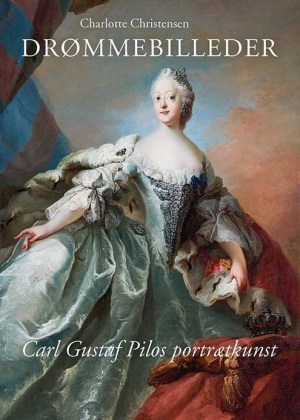 Carl Gustaf Pilo (1711–1793), der var rokokoens fremmeste hofmaler i Norden, fødtes i Sverige, men levede i Danmark i størstedelen af sin tid som kunstner. Skæbnen bragte ham fra en periode som adelens portrættør i Skåne til hofmalerposten i Danmark, hvor han særligt kom til at definere den gyldne tid for de danske riger under Frederik V til de turbulente år med Christian VII og Struensee. Han blev i 1772 udvist af Danmark, og skabte sig derefter i Gustaf IIIs Sverige sin alderdoms fremragende og helt særegne mesterværk, maleriet af den svenske konges kroning.
Som kongernes kunstner var Pilos liv afhængigt af de skiftende magtkonstellationer i Danmark, og han var med til at forme kunstakademiet i København. Bogen sætter Pilos kunstnergerning ind i den kulturhistoriske ramme, den hører til i, foruden at den redegør for de politiske og idehistoriske omvæltninger i de nordiske lande, der var med til at forme hans til tider dramatiske livsløb.
Bogen præsenterer et rigt udvalg af Carl Gustav Pilos kunstværker, der i dag er spredt på herregårde og slotte, i privatsamlinger og museer, med nyoptagelser af de ofte kolossal store malerier og detaljer, der er karakteristiske for hans malemåde.
Charlotte Christensen har været vidt omkring i det danske kunstliv. Samtidens billedkunst og teaterliv har haft en vigtig plads i hendes arbejde inden for museumsverdenen og som direktør for Kunstforeningen i København. Hun har undervist på universiteterne i Aarhus og København og på Statens Teaterskole. Formidlingen af ældre kunst har haft lige så stor prioritet, og 1600-tallet var i centrum, da hun var generalsekretær for Christian IV-året 1988. Christensen har skrevet monografier om Jens Juel og Nicolai Abildgaard og bidraget med artikler om Vigilius Eriksen og Laurits Tuxen til kataloget for Frederiksborgmuseets udstilling Danmark og zarernes Rusland, 1600–1900. Hun er også kendt som forfatter til Gyldendals bog om engle. Seneste har Christensen været tilknyttet Designmuseum Danmark og publiceret museets art nouveau-samling og udgivet … At give af et godt Hjerte og et glad Sind: Kunstindustrimuseets Venner, 1910–2010.
Exhibition | William Hogarth: A Harlot’s Progress and Other Stories
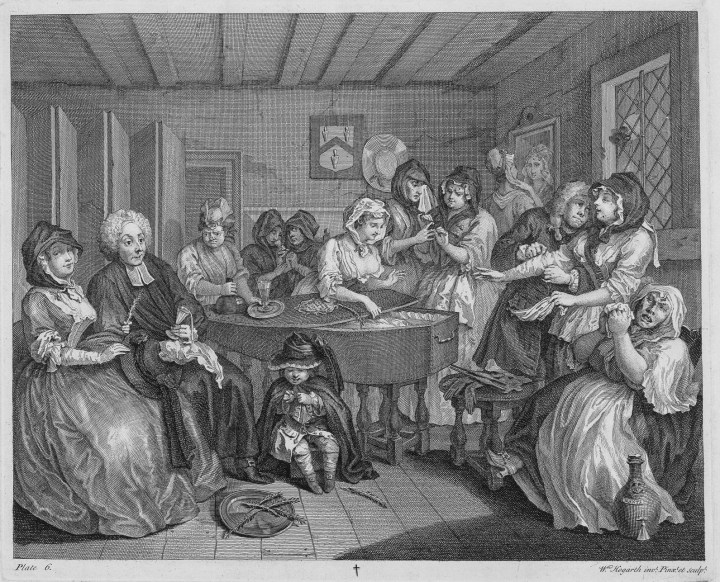
William Hogarth, A Harlot’s Progress, Plate 6, 1732, 364 × 440 mm
(Copenhagen: SMK – The National Gallery of Denmark)
◊ ◊ ◊ ◊ ◊
Press release (22 February 2016) from the National Gallery of Denmark:
William Hogarth: A Harlot’s Progress and Other Stories
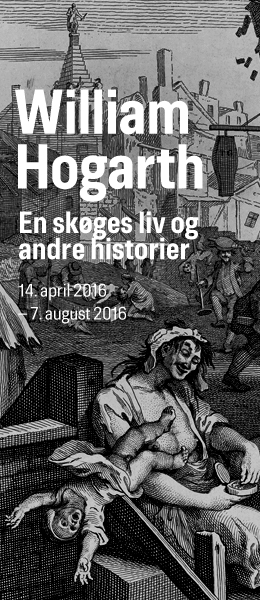
William Hogarth: En skøges liv og andre historier
Statens Museum for Kunst, Copenhagen, 14 April — 7 August 2016
Curated by Vibeke Vibolt Knudsen
A young country girl arrives in London in search of work. Instead she ends up a prostitute, and her life spirals steadily downwards, bringing stints in prison and venereal disease. With the exhibition William Hogarth: A Harlot’s Progress and Other Stories, the SMK turns back time to visit eighteenth-century city life in London. The exhibition presents work by the British artist and satirist William Hogarth (1697–1764), who invented a new kind of narrative picture series that served up satirical and moral points with acerbic wit. His style of social critique was unique for the time, focusing on many highly topical subjects: Prostitution, poverty, violence, drunkenness, deceit, self-aggrandisement and desire.
 Three series hold a particularly prominent position in Hogarth’s oeuvre: A Harlot’s Progress (1732), A Rake’s Progress (1735), and Marriage à-la-mode (1745). Each series describes a main protagonist who strives to climb the rungs of the class ladder, but loses their way in debauchery, heading directly for self-destruction and death.
In his autobiographical notes Hogarth states that his pictures are scenes from a play and his subjects are actors strutting soundlessly on the stage. His stories became highly successful, attracting a large audience that included the lower echelons of society as well as the elite. Hogarth insisted that a picture must capture the viewer’s attention by entertaining and pleasing the eye, thereby allowing the serious aspects of its subject to gradually sink in as the narrative progresses towards its tragic climax.
Hogarth’s art is closely linked to London and city life. Around the year 1700 the city had swelled to a population of 600,000, making it the largest city in Europe. He made daily records of the chaotic urban crowds, of all the many and varied forms of life unfolding in the city’s streets and houses; he had a particularly keen eye for the contrasts between different social strata and how they met and clashed.
William Hogarth: A Harlot’s Progress and Other Stories is an exhibition of works from The Royal Collection of Graphic Arts, which is one of the oldest collections of prints and drawings in the world. Housing more than 240,000 works, the collection has roots that date back to the sixteenth century. In 1843 the collection was opened to the public, and in 1896 it was relocated to the new National Gallery of Denmark alongside The Royal Collection of Paintings and The Royal Cast Collection.
The catalogue is available from Arnold Busck:
Vibeke Vibolt Knudsen, William Hogarth: En skøges liv og andre historier (Odder: Narayana Press, 2016), 96 pages, ISBN 978-8792023971, 128KR.
New Book | The Shining Inheritance: Italian Painters at the Qing Court
From The Getty:
Marco Musillo, The Shining Inheritance: Italian Painters at the Qing Court, 1699–1812 (Los Angeles: Getty Research Institute, 2016), 192 pages, ISBN 978-1606064740, $60.
 During Qing dynasty China, Italian artists were hired through Jesuit missionaries by the imperial workshops in Beijing. In The Shining Inheritance: Italian Painters at the Qing Court, 1699–1812, Marco Musillo considers the professional adaptations and pictorial modifications to Chinese traditions that allowed three of these Italian painters—Giovanni Gherardini (1655– ca. 1729), Giuseppe Castiglione (1688–1766), and Giuseppe Panzi (1734–1812)—to work within the Chinese cultural sphere from 1699, when Gherardini arrived in China, to 1812, the year of Panzi’s death. Musillo focuses especially on the long career and influence of Castiglione (whose Chinese name was Lang Shining), who worked in Beijing for more than fifty years. Serving three Qing emperors, he was actively engaged in the pictorial discussions at court.
The Shining Inheritance perceptively explores how each painter’s level of professional artistic training affected his understanding, selection, and translation of the Chinese pictorial traditions. Musillo further demonstrates how this East-West artistic exchange challenged the dogma of European universality through a professional dialogue that became part of established workshop routines. The cultural elements, procedures, and artistic languages of both China and Italy were strategically played against each other in negotiating the successes and failures of the Italian painters in Beijing. Musillo’s subtle analysis offers a compelling methodological model for an increasingly global field of art history.
Marco Musillo is a research fellow at the Kunsthistorisches Institut in Florence.
New Book | Exuberant Apotheoses
From Brill:
Daniel Fulco, Exuberant Apotheoses—Italian Frescoes in the Holy Roman Empire: Visual Culture and Princely Power in the Age of Enlightenment (Leiden: Brill, 2016), 600 pages, ISBN: 978-9004308046, €181 / $234.
 From the late seventeenth through the mid-eighteenth centuries, large-scale Italian frescoes soared in popularity as nobles in the German principalities of the Holy Roman Empire constructed new palaces at an unprecedented rate. They competed with one another to produce lavish decorative schemes that expressed their claim to princely power and political authority. Whereas previous art historians have primarily focused on iconographic and stylistic issues and generally treated these programs as individual commissions of regional courts, this book places the works of art within their broad cultural and historical contexts during the Enlightenment. This monograph explains how rulers gradually shifted from emphasizing military heroism to stressing their cultivation of the arts and sciences, and addresses how expressing membership in a specifically European civilization emerged as an integral visual theme and a key ambition of the German nobility.
Daniel Fulco, Ph.D. (2014), University of Illinois at Urbana-Champaign, is an independent scholar of 17th- and 18th-century European art. His research also engages with 19th-century painting and the exhibition of Islamic art in fin-de-siècle Europe.
◊ ◊ ◊ ◊ ◊
C O N T E N T S
Acknowledgements
List of Illustrations
Abbreviations
Introduction
1 The Aftermath of Military Conflict: A Rise in Princely Visual Culture (1648–1710)
2 War and International Politics: The Staircase Frescoes of Schloss Bensberg (1710–1714)
3 Dynasticism and Cultural Philanthropy: The Pictorial Program of Schloss Bensberg’s State Rooms (1710–1714)
4 The Blue Elector’s Aeneas: Jacopo Amigoni’s Images of War and Triumph at Schloss Schleissheim (1724–1726)
5 Ducal Power and Munificence: Carlo Innocenzo Carlone’s Frescoes in Schloss Ludwigsburg (1731–1733)
6 Prince-Episcopal Patronage and World Civilization: Giovanni Battista Tiepolo’s Apollo and the Four Continents in the Würzburg Residenz (1751–1753)
Excursus: Italo-Germanic Artistic Exchange and Collaboration
Epilogue
Bibliography
Index










 Enfilade
leave a comment