New Book | Framing Majismo: Art and Royal Identity in Spain
From Penn State UP:
Tara Zanardi, Framing Majismo: Art and Royal Identity in Eighteenth-Century Spain (University Park: Penn State University Press, 2016), 264 pages, ISBN: 978-0271067247, $95.
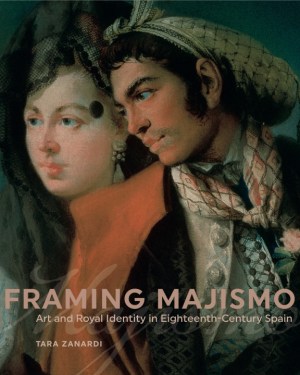 Majismo, a cultural phenomenon that embodied the popular aesthetic in Spain from the second half of the eighteenth century, served as a vehicle to ‘regain’ Spanish heritage. As expressed in visual representations of popular types participating in traditional customs and wearing garments viewed as historically Spanish, majismo conferred on Spanish ‘citizens’ the pictorial ideal of a shared national character.
In Framing Majismo, Tara Zanardi explores nobles’ fascination with and appropriation of the practices and types associated with majismo, as well as how this connection cultivated the formation of an elite Spanish identity in the late 1700s and aided the Bourbons’ objective to fashion themselves as the legitimate rulers of Spain. In particular, the book considers artistic and literary representations of the majo and the maja, purportedly native types who embodied and performed uniquely Spanish characteristics. Such visual examples of majismo emerge as critical and contentious sites for navigating eighteenth-century conceptions of gender, national character, and noble identity. Zanardi also examines how these bodies were contrasted with those regarded as ‘foreign’, finding that ‘foreign’ and ‘national’ bodies were frequently described and depicted in similar ways. She isolates and uncovers the nuances of bodily representation, ultimately showing how the body and the emergent nation were mutually constructed at a critical historical moment for both.
Tara Zanardi is Assistant Professor of Art History at Hunter College.
◊ ◊ ◊ ◊ ◊
C O N T E N T S
List of Illustrations
Acknowledgments
Introduction
1 Majismo, the Spanish National Character, and the Elite Cultivation of Cultural Patrimony
2 Swaggering Majos: Performing the Masculine Ideal
3 Performing the Bullfight: Spanish Bodies as Noble Spectacle
4 Majas, Elites, and Female Agency
5 Majismo and Elite Identity
Conclusion
Notes
Bibliography
Index
New Book | Thirty-Six Views: The Kangxi Emperor’s Mountain Estate
From Dumbarton Oaks Research Library:
Kangxi Emperor, translated by Richard Strassberg, with an introduction by Stephen Whiteman, Thirty-Six Views: The Kangxi Emperor’s Mountain Estate in Poetry and Prints (Washington, D.C.: Dumbarton Oaks Research Library, 2016), 316 pages, ISBN: 978-0884024095, $50.

In 1712, the Kangxi emperor published Imperial Poems on the Mountain Estate for Escaping the Heat (Yuzhi Bishu shanzhuang shi) to commemorate his recently completed summer palace. Through his perceptions of thirty-six of its most scenic views, his poems and descriptions present an unusually intimate self-portrait of the emperor at the age of sixty that reflected the pleasures of his life there as well as his ideals as the ruler of the Qing Empire. Kangxi was closely involved in the production of the book and ordered several of his outstanding court artists—the painter Shen Yu and the engravers Zhu Gui and Mei Yufeng—to produce woodblock prints of the thirty-six views, which set a new standard for topographical illustration. He also ordered Matteo Ripa, an Italian missionary serving as a court-artist, to translate these images into the medium of copperplate engraving, which introduced this technique to China. Ripa’s hybridized interpretations soon began to circulate in Europe and influenced contemporary aesthetic debates about the nature and virtues of the Chinese garden. This artistic collaboration between a Chinese emperor and a western missionary-artist thus marked a significant moment in intercultural imagination, production, and transmission during an earlier phase of globalization.
New Book | Frederick the Great: King of Prussia
From Random House:
Tim Blanning, Frederick the Great: King of Prussia (London: Allen Lane, 2015), 688 pages, ISBN: 978-1400068128, $35.
 Few figures loom as large in European history as Frederick the Great. When he inherited the Prussian crown in 1740, he ruled over a kingdom of scattered territories, a minor Germanic backwater. By the end of his reign, the much larger and consolidated Prussia ranked among the continent’s great powers. In this magisterial biography, award-winning historian Tim Blanning gives us an intimate, in-depth portrait of a king who dominated the political, military, and cultural life of Europe half a century before Napoleon.
A brilliant, ambitious, sometimes ruthless monarch, Frederick was a man of immense contradictions. This consummate conqueror was also an ardent patron of the arts who attracted painters, architects, musicians, playwrights, and intellectuals to his court. Like his fellow autocrat Catherine the Great of Russia, Frederick was captivated by the ideals of the Enlightenment—for many years he kept up lively correspondence with Voltaire and other leading thinkers of the age. Yet, like Catherine, Frederick drew the line when it came to implementing Enlightenment principles that might curtail his royal authority.
Frederick’s terrifying father instilled in him a stern military discipline that would make the future king one of the most fearsome battlefield commanders of his day, while deriding as effeminate his son’s passion for modern ideas and fine art. Frederick, driven to surpass his father’s legacy, challenged the dominant German-speaking powers, including Saxony, Bavaria, and the Habsburg Monarchy. It was an audacious foreign policy gambit, one at which Frederick, against the expectations of his rivals, succeeded.
In examining Frederick’s private life, Blanning also carefully considers the long-debated question of Frederick’s sexuality, finding evidence that Frederick lavished gifts on his male friends and maintained homosexual relationships throughout his life, while limiting contact with his estranged, unloved queen to visits that were few and far between.
The story of one man’s life and the complete political and cultural transformation of a nation, Tim Blanning’s sweeping biography takes readers inside the mind of the monarch, giving us a fresh understanding of Frederick the Great’s remarkable reign.
Until his retirement in 2009, Tim Blanning was a professor of modern European history at the University of Cambridge, and he remains a fellow of Sidney Sussex College and of the British Academy. He is the general editor of The Oxford History of Modern Europe and The Short Oxford History of Europe. He is also the author of The Culture of Power and the Power of Culture, which won a prestigious German prize and was short-listed for the British Academy Book Prize; The New York Times bestseller The Pursuit of Glory; The Triumph of Music; and The Romantic Revolution. In 2000 he was awarded a Pilkington Prize for teaching by the University of Cambridge.
New Book | The Philadelphia Country House
From Johns Hopkins UP:
Mark Reinberger and Elizabeth McLean, The Philadelphia Country House: Architecture and Landscape in Colonial America (Baltimore: Johns Hopkins University Press, 2015), 464 pages, ISBN: 9781421411637, $70.
 Colonial Americans, if they could afford it, liked to emulate the fashions of London and the style and manners of English country society while at the same time thinking of themselves as distinctly American. The houses they built reflected this ongoing cultural tension. By the mid-eighteenth century, Americans had developed their own version of the bourgeois English countryseat, a class of estate equally distinct in social function and form from townhouses, rural plantations, and farms. The metropolis of Philadelphia was surrounded by a particularly extraordinary collection of country houses and landscapes. Taken together, these estates make up one of the most significant groups of homes in colonial America.
In this masterly volume, Mark Reinberger, a senior architectural historian, and Elizabeth McLean, an accomplished scholar of landscape history, examine the country houses that the urban gentry built on the outskirts of Philadelphia in response to both local and international economic forces, social imperatives, and fashion. What do these structures and their gardens say about the taste of the people who conceived and executed them? How did their evolving forms demonstrate the persistence of European templates while embodying the spirit of American adaptation?
The Philadelphia Country House explores the myriad ways in which these estates—which were located in the country but responded to the ideas and manners of the city—straddled the cultural divide between urban and rural. Moving from general trends and building principles to architectural interiors and landscape design, Reinberger and McLean take readers on an intimate tour of the fine, fashionable elements found in upstairs parlors and formal gardens. They also reveal the intricate working world of servants, cellars, and kitchen gardens. Highlighting an important aspect of American historic architecture, this handsome volume is illustrated with nearly 150 photographs, more than 60 line drawings, and two color galleries.
Mark Reinberger is a professor of architecture at the University of Georgia. He is the author of Utility and Beauty: Robert Wellford and Composition Ornament in America. Elizabeth McLean is a research associate in botany at the Academy of Natural Sciences of Drexel University. She is the coauthor of Peter Collinson and the Eighteenth-Century Natural History Exchange.
Exhibition | Princely Splendour: The Power of Pomp
From the Belvedere:
Princely Splendour: The Power of Pomp / Fürstenglanz: Die Macht der Pracht
Winter Palace, Vienna, 18 March — 26 June 2016

Anton von Maron, Emperor Joseph II with the Statue of Mars, 1775 (Vienna: KHM-Museumsverband)
The exhibition Princely Splendour: The Power of Pomp explores collecting in the Baroque period and uses the transformation of Prince Eugene’s Winter Palace into a modern museum as an opportunity to look back to princely splendor, Baroque galleries, and the art of order. At the heart of the exhibition are the lavish catalogues of the major European Baroque galleries, proclaiming the prestige of their creators and also marking the origins of modern exhibition and art catalogues. They document princely ideals of beautiful interiors, provide glimpses behind concepts of Baroque (re)presentation and reflect classification systems, ‘public’ accessibility, and display practices typical of the period. These original collection catalogues are combined with portraits of the princes and a selection of paintings from their collections. The exhibition is the first to explore this phenomenon from a pan-European perspective and compare the most important princely collectors from the Baroque period.
Princely Splendour demonstrates the importance that Europe’s former ruling dynasties attached to their art collections. For centuries, owning art was used as a way of flaunting power. This development was accompanied by the increasing status of artists, particularly painters, in the emerging Baroque period. Talented artists became the favourites of princes and securing their services for the court, and the exclusive rights to their work this entailed, were further ‘puzzle pieces’ in the power structure. At the height of the Baroque period outstanding talents, such as Peter Paul Rubens, could even be promoted to diplomats and enjoyed the status of ‘painter princes’.
The exhibits include Theatrum Pictorium (Theatre of Painting), published by court painter David Teniers the Younger in 1660. This lavishly illustrated work is a testimony to the Habsburg Archduke Leopold Wilhelm’s passion for collecting and represents the birth of these elaborately designed books with printed reproductions of the artworks. Also featuring in the exhibition are Jean-Baptiste Colbert’s Tableaux du Cabinet du Roi created under France’s King Louis XIV; the Dresden Galeriewerk under August III, elector of Saxony and king of Poland; as well as a Prodromus, a type of preview compiled under the Austrian Emperor Charles VI in Baroque Vienna around 1720–30 with over one thousand planned painting reproductions grouped into miniature tableaus. This pan-European show features outstanding loans from the Louvre and other museums, with the state portrait of the French Sun King from the Palace of Versailles as the exhibition’s highlight.
The Imperial Picture Gallery’s move from Vienna’s Stallburg to the Upper Belvedere presented an ideal opportunity to compile a new guide to the collection. This small-scale publication provides an insight into the concept and organization of the new hanging which, when compared with other European galleries, reveals a completely new, rationalized order. Increasingly, large albums were being replaced by more reasonably priced shorter catalogues, reflecting the public’s wishes to enjoy the collection in the form of handy guides. In the spirit of the Enlightenment, the opening of aristocratic collections to a new, wider public went hand in hand with the evolution of these gallery catalogues.
Agnes Husslein-Arco and Tobias G. Natter, ed., Fürstenglanz: Die Macht der Pracht (2016), 224 pages, ISBN: 978-3902805973, 39€.
New Harley Gallery Showcases The Portland Collection
A new building at The Harley Gallery (Welbeck, Nottinghamshire) opens on Sunday to showcase The Portland Collection. . .
The Harley Gallery and Foundation is delighted to announce a new building which will display historic works from The Portland Collection, the historic fine and decorative arts collections of the Cavendish-Bentinck family. The family, currently headed by William Parente, grandson of the 7th Duke of Portland, have lived at Welbeck for over 400 years and through the generations have developed a beautiful and intriguing collection. The Portland Collection includes examples from some of the most highly regarded artists of each era.

George Stubbs, 3rd Duke of Portland, Welbeck Abbey, 1766 (The Portland Collection)
Hugh Broughton Architects were appointed to design the new building after a tightly fought architectural competition. The new building will consist of a glazed entrance pavilion and two gallery spaces, with a fresh new look for the courtyard itself. The main gallery spaces will be housed in a new structure, nestled between the Victorian walls. A top lit, barrel vaulted roof will filter light into the long gallery. A broad variety of pieces from the beautiful Portland Collection will be on show in a large gallery space.
The new building will be situated next to the existing Harley Gallery, within the walls of the Victorian Tan Gallop. Recently, this area has been used for storage. It was originally built as a covered area where the Welbeck Estate’s race horses could be trained in winter or poor weather. The name ‘Tan Gallop’ comes from the oak chippings that were used to cover the floor. By-products of the tanning process, these chippings were soft and provided a good surface for the horses to run on. A portion of the Tan Gallop, further away from The Harley Gallery, was converted into artists studios by the Harley Foundation in 1980.
Curatorial Advisory Panel
Karen Hearn, Honorary Professor, UCL
Alex Farquharson, Director, Nottingham Contemporary
Tim Knox, Director, The Fitzwilliam Museum
Hannah Obee, Curator, Chatsworth House Trust
Michael Hall, Architectural Historian and Journalist
New Book | Swedish Desire: Centuries of Luxury Consumption
From the Centre for Fashion Studies at Stockholm University:
Paula von Wachenfeldt and Klas Nyberg, eds., Det svenska begäret: sekler av lyxkonsumtion (Stockholm: Carlsson Bokförlag, 2015), 315 pages, ISBN: 978-9173316712, 255kr.
 With essays by Paula von Wachenfledt, Klas Nyberg, Marjatta Rahikainen, Kirsi Vainio-Korhonen, Håkan Jakobsson, Carolina Brown, Leif Runelfelt, Helena Kåberg, Louise Wallenberg, and Ulrika Berglund, this collection of essays The Swedish Desire: Centuries of Luxury Consumption is the first academic Swedish book on luxury history and development between the seventeenth and the first half of the twentieth century. There are few things that can create so much debate and resentment as the topic of luxury. As much as it creates well-being and comfort for its owner, luxury can also be a needle in the eye of the viewer. And as much as it can be an aesthetic expression, it remains a bitter reminder of social ills. As in most Western societies, Sweden has been an interesting arena for all kind of luxury parades and consumption and, not least, resistance. This book illustrates different historical examples of luxury use, human desire, and bitterness.
The editors of the book are senior lecturer Paula von Wachenfeldt and Professor Klas Nyberg at the Centre for Fashion Studies, Stockholm University.
◊ ◊ ◊ ◊ ◊
Beteckningen Det svenska begäret avser att visa att fenomenet lyx vinner på att betraktas som ett dynamiskt element i sitt historiska, kulturella och samhälleliga sammanhang. 1600-, 1700- resp. 1800-talen har haft olika välbeställda grupperingar som skilt ut sig genom olika typer av lyx: slottsbyggen, lyxig klädsel och heminredning; stora egendomar och nybyggnation. I boken utforskas lyxens svenska historia från nya infallsvinklar med utgångspunkt i aktuell forskning av historiker, konst- och modevetare. Här skrivs om manlig resp. kvinnlig lyx i förordningar och modeartiklar; hur svensk aristokrati beställde lyxartiklar som kalescher och karosser; hur spetsar – den vita lyxen – demonstrerade välstånd; hur indigoblått markerade god ekonomi; hur borgerliga värderingar och ideal tar sig uttryck i lyxens tjänst. Hur lyx och begär demonstrerades i svensk film på 1910–1940-talen; hur medelvägens lyx i form av franska hantverkstraditioner passade in i det svenska folkhemmet etc.
Paula von Wachenfeldt, docent, modevetare, litteraturvetare universitetslektor vid Centrum för modevetenskap, Stockholms universitet, redaktör och författare i boken.
Klas Nyberg, modevetare och professor i nationalekonomi vid Södertörns Högskola. Professor i ekonomisk historia vid Uppsala universitet och professor vid Centrum för modevetenskap, Stockholms universitet. redaktör och författare i boken.
Exhibition | The Empress and the Gardener
Press release from Hampton Court:
The Empress and the Gardener
Hampton Court Palace, London, 28 April — 4 September 2016
Curated by Sebastian Edwards
 A remarkable collection of watercolour paintings and drawings once owned by the Empress Catherine the Great of Russia will go on show at Hampton Court Palace this spring, as part of the nationwide commemorations marking the 300th anniversary of Lancelot ‘Capability’ Brown’s birth. Never displayed before, the exhibition of almost 60 intricately detailed views of the palace, park and gardens vividly captures Hampton Court during the time when Capability Brown served there as Chief Gardener to King George III. The intriguing history of this collection, which lay forgotten in the stores of the State Hermitage Museum in St Petersburg, Russia for over two centuries, will be explored in The Empress and the Gardener.
Arguably Britain’s most famous landscape gardener, Capability Brown served as Chief Gardener to King George III at Hampton Court Palace from 1764 to 1783. The job came with a handsome salary and residence at the palace, but Brown, who famously transformed landscapes across the country, actually did very little to change the palace’s Baroque formal gardens, choosing instead to preserve them out of respect for his predecessors. Nevertheless, by the time he moved into royal service, he was already operating a busy landscaping business, and winning international acclaim as one of the most famous proponents of the ‘English Style’ of landscape design.
Famously a voracious consumer of foreign culture, Catherine the Great was a great admirer of all things English, declaring to the philosopher Voltaire that “Anglo-mania rules my plantmania.” She built herself an ‘English Palace’ and ‘English Park’ at her palace at Peterhof, with the help of British designers but was unable to find a Capability Brown of her own. Seizing a lucrative opportunity, a figure in the shadows, John Spyers, assistant to Brown, sold two albums of his detailed drawings from Brown’s home and workplace, Hampton Court Palace, to the Empress for the huge sum of 1,000 roubles.
Quite how Spyers managed to achieve this extraordinary coup remains a mystery, but ironically the Empress found herself the possessor of an album of drawings of a palace landscape which Brown himself had barely touched. The albums, which alone had cost Catherine a tenth the price of creating her new gardens, disappeared in her collection at the Hermitage (now the State Hermitage Museum) and lay forgotten for over two centuries before being rediscovered by Hermitage curator Mikhail Dedinkin in 2002.
Today, the Spyers views are a unique survival: the richest and most revealing record of how Hampton Court gardens looked when Brown was in charge. Together they are considered one of the most complete visual records of any historic landscape ever captured before the dawn of photography. From rare glimpses of the ordinary people who lived in or visited the palace and its gardens, to evocative details of Hampton Court’s celebrated courtyards, passageways and picturesque corners, they explore an almost-forgotten period in the palace’s history in vivid detail.
The Empress and the Gardener will see these rare works go on public display for the first time, in the very setting that inspired their creation. The exhibition will also feature contemporary portraits of Capability Brown and the Empress Catherine, previously unseen drawings of Catherine’s ‘English Palace’ in the grounds of Peterhof near St. Petersburg and several pieces of the famous ‘Green Frog’ dinner service, a triumph of British design created for the Empress by Wedgwood, featuring images of some of the celebrated landscapes where Brown worked across England.
Sebastian Edwards, exhibition curator, said, “We are thrilled to be able to present this remarkable window into a forgotten Georgian era in the palace’s past, in the year when garden lovers up and down the country are celebrating the 300th anniversary of Capability Brown’s birth. We hope that after enjoying The Empress and the Gardener our visitors will follow in John Spyers’s footsteps, out into Hampton Court’s magnificent gardens and discover how they have changed over the centuries.”
◊ ◊ ◊ ◊ ◊
From Artbooks.com:
Mikhail Dedinkin and David Jacques, The Hampton Court Albums of Catherine the Great, (London: Fontanka 2016), 160 pages, ISBN: 978-1906257224, £32 / $45.
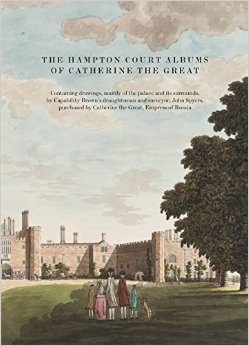
This album publishes, for the very first time, 100 hitherto unknown watercolours/drawings of Capability Brown’s designs for Hampton Court Palace gardens. These were purchased by Empress Catherine the Great of Russia through her own gardener James Meader, a disciple of Capability Brown, and then forgotten in the Hermitage stores. John Spyers, the artist to whom the albums have been attributed by Hermitage curator Mikhail Dedinkin, was Brown’s surveyor. Catherine the Great paid the huge sum of 1,000 roubles for them in the early 1780s and they were clearly bought as Capability Brown drawings. Almost no other visual material about Hampton Court and its gardens and park at the period when Lancelot ‘Capability’ Brown was the resident Royal Gardener has survived, so the importance of these views, which have never been published or on exhibition before, cannot be overstated.
New Book | The Philip Johnson Glass House: An Architect in the Garden
From Rizzoli (for anyone thinking about where Capability Brown’s ideas lead in the twentieth century) . . .
Maureen Cassidy-Geiger, with a foreword by Charles A. Birnbaum and photography by Peter Aaron, The Philip Johnson Glass House: An Architect in the Garden (New York: Skira Rizzoli, 2016), 224 pages, ISBN: 978-0847848362, $55.
 The first authoritative book on the history of the Glass House property—Philip Johnson’s fifty-year project of iconic modernist design, encompassing the remarkable buildings, landscape, and follies. From its completion in 1949 to the present day, Philip Johnson’s Glass House has drawn cognoscenti and the curious from around the world to New Canaan, Connecticut, to experience what might be the most photographed modernist residence in America. The property—an architectural playground on forty-seven acres with eleven Johnsonian follies dating from 1949 to 1995—is an icon of twentieth-century architectural and landscape design. The book chronicles how Philip Johnson and David Whitney, the architect and the plantsman, lived on the property for decades and used the landscape as an ever-changing canvas for their designs—the result of a unique synthesis of influences and ideas from across history and geography. New research reveals Johnson’s and Whitney’s interaction with the landscape and the evolution of the site from a five-acre parcel to a world-renowned gentlemanly estate for modern times. The Philip Johnson Glass House—beautifully illustrated with vintage and commissioned photography—will be a must-have for connoisseurs of architecture, landscape design, photography, and social history.
Maureen Cassidy-Geiger is an internationally recognized curator, scholar, and educator with expertise in European decorative arts, gardens, photography, and the history of architecture.
Charles A. Birnbaum, FASLA FAAR, is president and CEO of the Cultural Landscape Foundation in Washington, D.C.
New Book | The Secret Life of the Georgian Garden
Forthcoming from I. B. Tauris:
Kate Felus, with a foreword by Roy Strong, The Secret Life of the Georgian Garden: Beautiful Objects and Agreeable Retreats (London: I. B. Tauris, 2016), 240 pages, ISBN: 978-1784535728, $28 / £18.
 Georgian landscape gardens are among the most visited and enjoyed of the UK’s historical treasures. The Georgian garden has also been hailed as the greatest British contribution to European Art, seen as a beautiful composition created from grass, trees and water—a landscape for contemplation. But scratch below the surface and history reveals these gardens were a lot less serene and, in places, a great deal more scandalous. Beautifully illustrated in colour and black and white, this book is about the daily life of the Georgian garden. It reveals its previously untold secrets from early morning rides through to evening amorous liaisons. It explains how by the eighteenth century there was a desire to escape the busy country house where privacy was at a premium and how these gardens evolved aesthetically, with modestly-sized, far-flung temples and other eye-catchers, to cater for escape and solitude as well as food, drink, music and fireworks. Its publication coincides with the 2016 tercentenary of the birth of Lancelot ‘Capability’ Brown, arguably Britain’s greatest ever landscape gardener, and the book is uniquely positioned to put Brown’s work into its social context.
Kate Felus is a garden historian and historic landscape consultant. She researches designed landscapes of all periods, specializing particularly in eighteenth- and early nineteenth-century parks and gardens.










 Enfilade
leave a comment