Exhibition | Jannis Kounellis at Monnaie de Paris
From the Monnaie de Paris:
Jannis Kounellis
Monnaie de Paris, 11 March — 30 April 2016
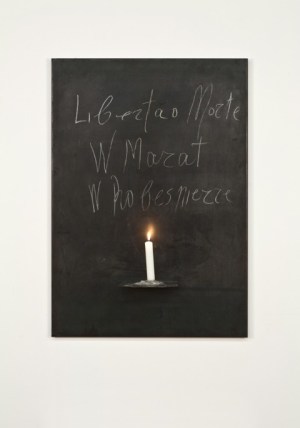
Jannis Kounellis, Libertà o Morte. W Marat W Robespierre, 1969.
At Monnaie de Paris (the Paris Mint), Jannis Kounellis has composed a dramatic sculpture throughout the thousand square metres of the 18th-century exhibition rooms of this Palace beside the Seine. Eminently present, concrete, irreducible, the new exhibition by Kounellis imposes a direct experience on visitors, without intermediaries.
“I come to Paris empty-handed, like an old painter.” This is what Kounellis said a few months ago in response to the invitation by Monnaie de Paris, which hosts this figure of contemporary art, at the origin of the Arte povera movement. As a painter, Kounellis designed his exhibition at Monnaie de Paris as a fresco. He had already, in 1972, crossed the boundaries of painting with Da inventare sul posto, a work accompanied by a dancer and a violinist.
In the 18th-century Monnaie de Paris salons, the paintings are staged through an installation of metal trestles. This army of cold metal will captivate visitors with its size and the contrast with the architecture and décor of the Palace: columns, marble, ornaments, gilt…
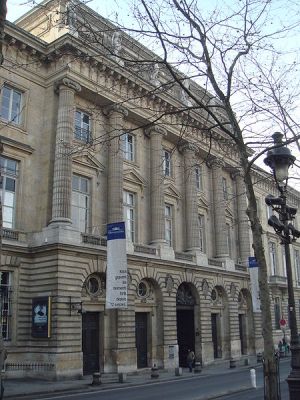
Jacques-Denis Antoine, Hôtel de la Monnaie, 1767–75
(Photo: Wikimedia Commons)
Jannis Kounellis offers a true experience to visitors. He had already positioned living energy alive, animal or human, at the centre of his work with the incomparable 12 live horses in 1969. But also in Nabucco in 1970 or quarters of hanging meat, or the Stommeln Pullheim Synagogue exhibition where fish evolved into a plate threatened with a knife in 1991.
Kounellis is inspired by Monnaie de Paris, the oldest company in the world and part of the heart of the last factory in Paris where know-how and industry intermingle to create his ‘new project’. The artist appeals to the visitor and raises the question of how a work is produced. It is in the technique, in the craft of the workshops, in the intuitive use of shapes and at the modelling stage that the artist’s project for Monnaie de Paris is born. The work Libertà o Morte. W Marat W Robespierre, 1969 will be presented in the exhibition as well as Da inventare sul posto which will echo the beating heart of the coin presses of Monnaie de Paris, embodying the strength, the rhythm, the orchestration.
A special public program will be performed by Etel Adnan with poetry and musical sessions on 17 March and 28 April at 7pm. Transmitted live on RAM Radioartemobile and broadcast on the Monnaie de Paris website, these rendez-vous will form part of a unique selection of radio archives.
Christophe Beaux, Jannis Kounellis, and Chiara Parisi, Jannis Kounellis (Berlin: Hatje Cantz, 2016), 64 pages, ISBN 978-3775741590, 30€. In French and English.
New Book | The Empress of Art: Catherine the Great
From Pegasus Books:
Susan Jaques, The Empress of Art: Catherine the Great and the Transformation of Russia (New York: Pegasus Books, 2016), 384 pages, ISBN: 978-1605989723, $21.
 Ruthless and passionate, Catherine the Great is singularly responsible for amassing one of the most awe-inspiring collections of art in the world and turning St. Petersburg in to a world wonder. The Empress of Art brings to life the creation of this captivating woman’s greatest legacy.
An art-oriented biography of the mighty Catherine the Great, who rose from seemingly innocuous beginnings to become one of the most powerful people in the world. A German princess who married a decadent and lazy Russian prince, Catherine mobilized support amongst the Russian nobles, playing off of her husband’s increasing corruption and abuse of power. She then staged a coup that ended with him being strangled with his own scarf in the halls of the palace, and she being crowned the Empress of Russia.
Intelligent and determined, Catherine modeled herself off of her grandfather in-law, Peter the Great, and sought to further modernize and westernize Russia. She believed that the best way to do this was through a ravenous acquisition of art, which Catherine often used as a form of diplomacy with other powers throughout Europe. She was a self-proclaimed “glutton for art” and she would be responsible for the creation of the Hermitage, one of the largest museums in the world, second only to the Louvre. Catherine also spearheaded the further expansion of St. Petersburg, and the magnificent architectural wonder the city became is largely her doing. There are few women in history more fascinating than Catherine the Great, and for the first time, Susan Jaques brings her to life through the prism of art.
Susan Jaques is a journalist specializing in art. She holds a BA in history from Stanford University and an MBA from UCLA. She is the author of A Love for the Beautiful: Discovering America’s Hidden Art Museums and lives in Los Angeles, where she’s a gallery docent at the J. Paul Getty Museum.
New Book | The Global Lives of Things
Published in December by Routledge:
Anne Gerritsen and Giorgio Riello, eds., The Global Lives of Things: The Material Culture of Connections in the Early Modern World (New York: Routledge, 2015), 266 pages, paperback ISBN: 978-1138776753, $50 / hardback ISBN: 978-1138776661, $160.
 The Global Lives of Things considers the ways in which ‘things’, ranging from commodities to works of art and precious materials, participated in the shaping of global connections in the period 1400–1800. By focusing on the material exchange between Asia, Europe, the Americas and Australia, this volume traces the movements of objects through human networks of commerce, colonialism and consumption. It argues that material objects mediated between the forces of global economic exchange and the constantly changing identities of individuals, as they were drawn into global circuits. It proposes a reconceptualization of early modern global history in the light of its material culture by asking the question: what can we learn about the early modern world by studying its objects?
This exciting new collection draws together the latest scholarship in the study of material culture and offers students a critique and explanation of the notion of commodity and a reinterpretation of the meaning of exchange. It engages with the concepts of ‘proto-globalization’, ‘the first global age’ and ‘commodities/consumption’. Divided into three parts, the volume considers in Part One, Objects of Global Knowledge, in Part Two, Objects of Global Connections, and finally, in Part Three, Objects of Global Consumption. The collection concludes with afterwords from three of the leading historians in the field, Maxine Berg, Suraiya Faroqhi and Paula Findlen, who offer their critical view of the methodologies and themes considered in the book and place its arguments within the wider field of scholarship. Extensively illustrated, and with chapters examining case studies from Northern Europe to China and Australia, this book will be essential reading for students of global history.
Anne Gerritsen is Associate Professor in the Department of History at the University of Warwick. Her previous publications include Ji’an Literati and the Local in Song-Yuan-Ming China (2007).
Giorgio Riello is Professor in the Department of History at the University of Warwick. In addition to several edited collections, he is the author of A Foot in the Past (2006) and Cotton: The Fabric that Made the Modern World (2013).
◊ ◊ ◊ ◊ ◊
C O N T E N T S
Introduction The Global Lives of Things: Material Culture in the First Global Age, Anne Gerritsen and Giorgio Riello
Part I: Objects of Global Knowledge
1 Itineraries of Matter and Knowledge in the Early Modern World, Pamela Smith
2 Towards a Global History of Shagreen, Christine Guth
3 The Coral Network: The Trade of Red Coral to the Qing Imperial Court in the Eighteenth Century, Pippa Lacey
Part II: Objects of Global Connections
4 Beyond the Kunstkammer: Brazilian Featherwork and the Northern European Court Festivals, Mariana Françozo
5 The Empire in the Duke’s Palace: Global Material Culture in Sixteenth-century Portugal, Nuno Senos
6 Dishes, Coins and Pipes: The Epistemological and Emotional Power of VOC Material Culture in Australia, Susan Broomhall
7 Encounters around the Material Object: French and Indian Consumers in Eighteenth-Century Pondicherry, Kévin Le Doudic
Part III: Objects of Global Consumption
8 Customs and Consumption: Russia’s Global Tobacco Habits in the Seventeenth and Eighteenth Centuries, Matthew P. Romaniello
9 Sugar Revisited: Sweetness and the Environment in the Early Modern World, Urmi Engineer
10 Coffee, Mind and Body: Global Material Culture and the Eighteenth-Century Hamburg Import Trade, Christine Fertig and Ulrich Pfister
Afterwords
Paula Findlen
Suraiya Faroqhi
Maxine Berg
Exhibition | Jefferson and Palladio: Constructing a New World
◊ ◊ ◊ ◊ ◊
From the Palladio Museum:
Jefferson and Palladio: Constructing a New World / Come costruire un mondo nuovo
Palladio Museum, Vicenza, 23 September 2015 — 28 March 2016
Curated by Guido Beltramini and Fulvio Lenzo
Visitors are introduced to the exhibition by a mirror reflecting the busts of Palladio and Thomas Jefferson. This raises the initial question in the show: how are forms and ideas ‘reflected’? Why, in this case, was an architect from a province in Northern Italy adopted as a model for the construction of the architecture of the New World?

Thomas Jefferson, Plan of the Rotunda of the University of Virginia (Charlottesville: Special Collections, University of Virginia Library)
The answer is linked to another fundamental question: what is Thomas Jefferson (1743–1826), the man who drafted the Declaration of Independence and was the third president of the United States, doing in a museum of architecture? The reason is that he more than any other American shaped the face of the new nation through art, architecture and regional planning. Visionary but also pragmatic, he was both a man of action and an intellectual who knew Latin and Greek. And he was convinced that the New World could only be built through reason and beauty.
Jefferson and Palladio: Constructing a New World is the first-ever exhibition dedicated to the great American Palladian in Europe. It will enable visitors to explore Jefferson’s world, his art collections, architectural designs, dreams, and also his contradictions, through drawings, sculptures, precious books, architectural models, films and multimedia. The exhibition also features 36 photographs by Filippo Romano, the result of a photographic survey specifically conducted in Virginia in Spring 2014. There are also three precious original bozzetti (models) by Antonio Canova for a statue of George Washington, commissioned by Thomas Jefferson. Visitors can enhance their experience of the exhibition by downloading a free smartphone app with descriptions by the curators and so move through the rooms accompanied by their words.
The exhibition is dedicated to the memory of Mario Valmarana, the still greatly cherished professor at the University of Virginia who devoted his life to creating bridges between Palladio’s Veneto and Jefferson’s Virginia. Sponsored by Roberto Coin, the exhibition has been made possible thanks to the support of the Regione del Veneto, the Fondazione Cariverona and Dainese, and is the result of collaboration with the Fondazione Canova di Possagno and the Stiftung Bibliothek Werner Oechslin, Einsiedeln, Switzerland. The exhibition is also part of a joint project developed with the Canadian Centre for Architecture, Montreal, which in October 2014 staged the photographic exhibition Found in Translation: Palladio-Jefferson, A narrative by Filippo Romano.
The exhibition has been curated by Guido Beltramini and Fulvio Lenzo, with the support of an Advisory Committee, chaired by Howard Burns (Scuola Normale Superiore, Pisa), and composed of James Ackerman (Harvard University), Bruce Boucher (University of Virginia), Travis C. McDonald (Corporation for Jefferson’s Poplar Forest), Damiana Paternò (IUAV, Venice), Mario Piana (IUAV, Venice), and Craig Reynolds (University of Virginia). The catalogue (available in English or Italian) is published by Officina Libraria. The exhibition layout has been designed by Alessandro Scandurra.
◊ ◊ ◊ ◊ ◊
◊ ◊ ◊ ◊ ◊
The catalogue is available from Artbooks.com:
Guido Beltramini and Fulvio Lenzo, eds., Jefferson and Palladio: Constructing a New World (Milan: Officina Libraria, 2016), 176 pages, ISBN: 9788897737780, $30.
 The catalogue offers an opportunity to acquire a deeper understanding of Jefferson’s architecture and, at the same time, leads to a clearer understanding of Palladio himself. Jefferson looked to Palladio because he was the architect of one of Europe’s few republics in which administrative power was in the hands of landed gentlemen who avoided the ostentation of princely manners and spent long periods of time in the countryside.
Thomas Jefferson (1743–1826), a cosmopolitan figure with rural roots, was a master of the knowledge of his time. He drafted The Declaration of Independence (1776), and thus founded a new view of the proper relation between governed and government. Jefferson was the architect of the new America, not just in a political sense, but in a literal sense as well. Architecture had an important place in his personal and public agenda. A self-taught architect, Jefferson buildings are among America’s most famous: Monticello, the Virginia State Capitol, and the University of Virginia are the starting points of American classical architecture. Jefferson was guided by his admiration for Palladio’s Four Books on Architecture, which provided him with key architectural forms and ideas. Palladio showed him how the admired building types of the ancient Romans could be adapted to modern purposes and provide a rational, harmonious framework for living and for building a new society.
Guido Beltramini is Director of the Centro Internazionale di Studi di Architettura Andrea Palladio, Vicenza. Fulvio Lenzo is Associate Professor in the history of architecture at the Universita IUAV di Venezia, Venice.
◊ ◊ ◊ ◊ ◊
C O N T E N T S
Palladio in America, James Ackerman
Jefferson and Palladio, Guido Beltramini
Jefferson: Architecture and Democracy, Fulvio Lenzo
Photographing Jefferson, Filippo Romano
Palladianism in America Before Jefferson, Bruce Boucher
The National Survey Grid and the American Democracy, Catherine Maumi
Jefferson’s Creation of American Classical Architecture, Richard Guy Wilson
Jefferson and the First Public Statues in the United States, Giovanna Capitelli
Canova and the Monument to George Washington, Mario Guderzo
Palladio: Materials and Building Techniques Damiana, Lucia Paterno
Jefferson Builder, Travis McDonald
Enrtries for Monticello, Virginia State Capitol, President’s House, Poplar Forest, Bremo, Barboursville, University of Virginia
Bibliography
Exhibition Checklist
New Appointment for Isabella Vitti
In January 2016, Isabella Vitti began her new position as Editor of Art History & Visual Studies at Routledge Taylor & Francis Group. She comes to the position after four years at Cambridge University Press, where she worked mainly on archaeology and Renaissance studies books—highly-illustrated projects that provided a lot of experience with image permissions, color plate sections, and high-resolution image files. Before Cambridge, Vitti worked at the Museum of Modern Art in the membership department—in her words, “an art historian’s dream!” She studied art history as an undergraduate at Wesleyan University.
Vitti stresses that most of Ashgate’s series covering the eighteenth century will continue. These include:
• The Histories of Material Culture and Collecting, 1700–1950
• Science and the Arts since 1750
• Visual Culture in Early Modernity
Routledge’s proposal guidelines are available here: Vitti’s email address is isabella.vitti@taylorandfrancis.com. She welcomes proposals for research monographs or edited collections.
New Book | Benjamin West and the Struggle to be Modern
From Merrell:
Loyd Grossman, Benjamin West and the Struggle to be Modern (London, Merrell, 2015), 256 pages, ISBN: 978-1858946412, £35 / $60.
 At the time of his death in 1820, Benjamin West was the most famous artist in the English-speaking world and celebrated throughout Europe. From humble beginnings in Pennsylvania, he had become the first American artist to study in Italy, and within a few short years of his arrival in London had been instrumental in the foundation of the Royal Academy of Arts and been appointed history painter to King George III. However, West’s posthumous reputation took a critical mauling, and today he remains one of the most neglected and misunderstood of Britain’s great 18th-century artists. As Loyd Grossman asserts in his new book, West was in the vanguard that created neoclassicism and romanticism, and among the first painters to represent the exciting and inspirational qualities of contemporary events, as opposed to events from the biblical, classical or mythological past. Most significantly, his best-known painting, The Death of General Wolfe, was a thrilling, revolutionary work that played a role in changing the course of art. In a lively, immersing text that situates West in the midst of Enlightenment thinking about history and progress, Grossman explores both why Wolfe has exercised such a magnetic grip on our imaginations for almost 250 years, and how, with this artwork, West helped to lay the foundations of a modern attitude that has affected the way we live and think ever since.
Loyd Grossman is a broadcaster, historian and journalist. He has presented a wide range of TV programmes, from Through the Keyhole and MasterChef to Loyd on Location and History of British Sculpture. Born in Massachusetts, Grossman has been based in the UK since 1975. He is involved with many charities supporting the arts, heritage and education in the UK. He is Chairman of the Heritage Alliance, Chairman of the Churches Conservation Trust and President of the National Association of Decorative and Fine Arts Societies (NADFAS). He was appointed OBE in 2003 and was awarded a Doctor of Letters degree in 2007 by the University of Chester in recognition of his heritage work. In January 2011 the University of Lincoln awarded him an honorary Doctor of Arts degree in recognition of his contribution to the cultural heritage sector. Grossman has a particular interest in eighteenth-century British art and architecture.
Exhibition | Faces of Terror: Violence and Fantasy
The exhibition closes in Paris this weekend:
Faces of Terror: Violence and Fantasy from David to Delacroix
Visages de l’effroi: Violence et Fantastique de David à Delacroix
Musée de la Vie Romantique, Paris, 3 November 2015 — 28 February 2016
Musée Municipal, La Roche-sur-Yon, 19 March — 19 June 2016
 With a collection of more than 100 paintings, drawings and sculptures by David, Girodet, Gericault, Ingres and Delacroix, Faces of Terror presents French forms of fantastical Romanticism. This darker part of 19th-century art reveals a certain strength of spirit and provides a fascinating perspective on imagination during the romantic period.
Romanticism, although often reduced to a feeling of discontentment among the people of the 18th century that was generated by the upheavals of the time, without a doubt expresses the feeling of disenchantment of a whole generation, built on the ruins of the Ancien Régime and the tumult of the French Revolution. In the overflow of extreme emotions these artists skilfully found subjects for a new kind of aesthetic, exploring the dark side of the human soul, at a time when dreams and the irrational were emerging from the latency of Reason and the spirit of the Enlightenment period.
From the end of the 18th century, the form of Neoclassicism adopted by the greatest artists depicted the death of heroes and portrayed the violence of tragedies from ancient history, simultaneously justified by both moral values and academic proprieties. Terror, political upheaval and Napoleonic war generated a much more blatant perspective of horror that was no longer the prerogative of historical paintings. During the period of the Restoration of the monarchy, the development of the mainstream press led to broadcasts of reports of bloody violence across the country, which became topical issues for artists.
The Romantic period focuses on the supernatural and sometimes morbid, and depicts—thanks to an abundant but often unknown production of works of art—a crude reality as well as the strange, dusky figures of spectres and devils from the literature and poetry of the time. This dialogue with the supernatural is notably depicted in representations of the myth of Ossian, or in the success of Dante’s work with the torment of the condemned.
Jérôme Farigoule and Hélène Jagot, eds., Visages de l’effroi: Violence et fantastique de David à Delacroix (Liénart, 2015), 288 pages, ISBN: 978-2359061475, 26€.
Exhibition | Catwalk: Fashion at the Rijksmuseum, 1625–1960

Mantua purportedly worn by Helena Slicher for her marriage to Aelbrecht baron van Slingelandt on 4 September 1759
(Amsterdam: Rijksmuseum)
◊ ◊ ◊ ◊ ◊
Now on view at the Rijksmuseum:
Catwalk, 1625–1960
Rijksmuseum, Amsterdam, 20 February — 16 May 2016
Curated by Bianca du Mortier; designed by Erwin Olaf
For the first time, the Rijksmuseum presents a large selection of its diverse fashion collection in an exhibition designed by world-renowned Dutch photographer Erwin Olaf.
From February 20 through May 16 2016, six galleries of the Philips Wing will be dedicated to fashion of the Dutch from 1625 to 1960. Starting with garments worn by members of the Frisian branch of the house of Nassau in the Golden Age, the exhibits will feature vibrantly coloured French silk gowns and luxurious velvet gentlemen’s suits of the eighteenth century, classically-inspired Empire dresses, and bustles of the Fin de Siècle—culminating in twentieth-century French haute couture by Dior and Yves Saint Laurent.

Wedding dress, 1759; photo by Erwin Olaf, model is Ymre Stiekema.
As Rijksmuseum Curator of Costumes Bianca du Mortier explains, “The garments presented in this exhibition reflect the stories of the people who wore them. In fashion, the choices of the wearer count—they make him or her a trendsetter or a follower. Even today the clothes of the very rich and powerful always convey a conscious or unconscious message. In that respect, nothing has changed over the last 330 years. These choices are restricted by such factors as budget, opportunity, age, social status, climate, personal likes and dislikes and so forth. And when presented in a museum, there is a final selection: the selection of the Rijksmuseum.”
The exhibition is designed by world-renowned Dutch photographer Erwin Olaf. He states, “The challenge and honour of designing this exhibition . . . for the most extraordinary museum in the Netherlands came at exactly the right moment for me. For several years now I’ve been exploring alternative ways to present my photographic work and to integrate it in installations, sound, video and films as means to immerse viewers in a world that fires and challenges their personal imaginations and, ultimately, sparks a stimulating dialogue between the viewer and the work on view.
Highlights include
• A pair of underpants belonging to Hendrik Casimir I, Count of Nassau Dietz (1612–1640)
• The widest dress in the Netherlands: Helena Slicher’s (1737–1776) wedding gown or mantua, which she supposedly wore at her marriage to Aelbrecht baron van Slingelandt (1732–1801) on 4 September 1759
• An exceptionally precious and fragile dress of blonde silk bobbin lace (1815–1820)
• A silk taffeta cocktail dress by Cristóbal Balenciaga (1951–1952)
The Rijksmuseum’s fashion collection totals some 10,000 items , with men’s, women’s and children’s attire and accessories spanning the period from 1700 until 1960. In addition, the History Department owns the earliest Dutch costumes, worn in the seventeenth century by the Frisian branch of the Nassau family and by the Stadtholder and King William III. Being the oldest costumes collection in the country, having begun in 1870, acquisitions initially emphasized on the eighteenth and nineteenth centuries, but over time gradually expanded to include the first half of the twentieth century. All of the garments comes from the wardrobes of upper-class Dutch men and women, but they were not necessarily made in the Netherlands. Foreign fashion houses and fabrics from all the leading textile-manufacturing countries around the world are amply represented. Acquisitions for the collection are based on historical significance, such as a post-war dress made of silk RAF pilots maps; design relevance, such as Yves Saint Laurent’s 1965 ‘Mondrian dress’; and costume-historical importance, such as a silk taffeta cocktail gown by Cristóbal Balenciaga (1951–1952). Most items were donated or bequeathed, supplemented with purchases.
To coincide with the exhibition, the Rijksmuseum is publishing a richly illustrated ‘Collection Book’ – Costume & Fashion, authored by Curator of Costumes Bianca du Mortier, with contributions from the museum’s textile restorers, fellow conservators, and a specialized colour analyst. The photography is by Rijksmuseum photographer Carola Van Wijk in collaboration with Frans Pegt. Various activities will be organized in conjunction with the exhibition, including a series of lectures by the catalogue’s authors and external experts.
◊ ◊ ◊ ◊ ◊
Symposium | Fashion in Museums: Past, Present, and Future
Rijksmuseum, Amsterdam, 21–22 April 2016
Not only the curator’s and conservator’s point of view will be presented, but also the administrator’s—who is often unfamiliar with costume and fashion’s different requirements and has to be convinced of the steep costs of a fashion exhibit. Experts from leading national and international institutions will present their insights: a conference not to be missed!
Over the past two decades most of the blockbuster fashion exhibitions around the world have centered around present day fashion designers and were more or less offered to the respective institutions as a complete package including the extensive marketing and publicity apparatus of the fashion brand. This is a far cry from Diana Vreeland’s original concept (1983–84) of a museum celebrating a contemporary designer—in her case Yves Saint Laurent—by presenting a retrospective curated by the museum and presented by them.
In a speech delivered by renowned fashion journalist Suzy Menkes (International Vogue Editor) at the Rijksmuseum in June 2015 she called for a return to museum curated exhibitions based on in-depth research of their own collections which hold so many amazing yet unexplored treasures. With the exhibition Catwalk, Fashion at the Rijksmuseum, the museum puts a renewed step in this direction by presenting a cross-section of its costume collection—the oldest in the country—in a setting designed by renowned Dutch photographer, Erwin Olaf.
Speakers
• Gieneke Arnolli (Fries Museum, Leeuwarden)
• Ninke Bloemberg (Centraal Museum, Utrecht)
• Bianca du Mortier (Rijksmuseum)
• Johanna Hashagen (Bowes Museum, UK)
• Johannes Pietsch (Bayerisches Nationalmuseum, Munich)
• Ellinoor Bergvelt and Christine Delhaye (University of Amsterdam)
• Angelika Riley (Museum für Kunst und Gewerbe Hamburg)
• Alexandra Bosc (Palais Galliera, Musée de la mode de la Ville de Paris)
• Mila Ernst (Digitaal platform Modemuze)
• Sue-an van der Zijpp (Groninger Museum)
Details are available here»
New Book | Benjamin Franklin in London
From Yale UP:
George Goodwin, Benjamin Franklin in London: The British Life of America’s Founding Father (New Haven: Yale University Press, 2016), 400 pages, ISBN: 978-0300220247, $32.50.
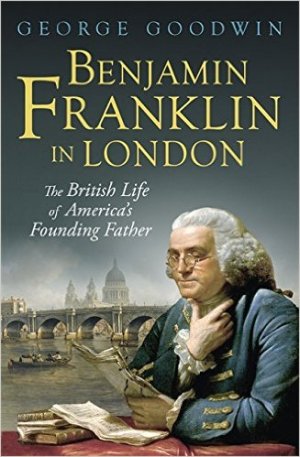 For more than one-fifth of his life, Benjamin Franklin lived in London. He dined with prime ministers, members of parliament, even kings, as well as with Britain’s most esteemed intellectuals—including David Hume, Joseph Priestley, and Erasmus Darwin—and with more notorious individuals, such as Francis Dashwood and James Boswell. Having spent eighteen formative months in England as a young man, Franklin returned in 1757 as a colonial representative during the Seven Years’ War, and left abruptly just prior to the outbreak of America’s War of Independence, barely escaping his impending arrest.
In this fascinating history, George Goodwin gives a colorful account of Franklin’s British years. The author offers a rich and revealing portrait of one of the most remarkable figures in U.S. history, effectively disputing the commonly held perception of Franklin as an outsider in British politics. It is an enthralling study of an American patriot who was a fiercely loyal British citizen for most of his life—until forces he had sought and failed to control finally made him a reluctant revolutionary at the age of sixty-nine.
George Goodwin is the author of numerous articles and two previous histories, Fatal Colours: Towton 1461 and Fatal Rivalry: Henry VIII, James IV, and the Battle for Renaissance Britain. He is currently Author in Residence at the Benjamin Franklin House in London and was a 2014 International Fellow at the Robert H. Smith International Center for Jefferson Studies, Monticello. He lives close to London’s Kew Gardens.
◊ ◊ ◊ ◊ ◊
C O N T E N T S
Prologue
Life Before London
A Young Man in London
Foundations
Conductor
Return to London
A London Life
Benjamin Franklins British Family
Moves and Countermoves
Intermission
The Stamp Act
Pivotal Years
12 Home Comforts and Discomforts
Seeking Balance
Movements
Drawn to the Cockpit
The Last Year in London
A Little Revenge
Selected Places to Visit and Related Organizations
Bibliography
Notes
Acknowledgements
Index
New Book | Parsonages
From Bloomsbury:
Kate Tiller, Parsonages (New York: Bloomsbury Shire Publications, 2016), 88 pages, ISBN: 978-1784421373, $15.
 From the Middle Ages to the present day, parsonages—vicarages, rectories, and later manses, presbyteries, and chapel houses—have been among the most significant dwellings in every kind of British community. Their roles have been wide and varied. Architecturally important, and ranging from medieval vernacular buildings to the bespoke house designs of leading architects of the nineteenth and twentieth centuries, to the more modest homes of today’s clergy, parsonages are important not only as buildings but for the part they—and their occupants—have played in the life of local communities, and in their links with the wider world. The parsonage, a hub of activity and connection, a place of change and continuity, provides fascinating historical insights both general and local. This study draws on the evidence of architecture, official documents, private records, literary accounts, and contemporary and modern images to build a picture of parsonages and their occupants. It includes a section on tracing the history of a parsonage.
C O N T E N T S
Parsonage Histories: Houses, Priests and People
Setting the Pattern: Medieval Priests’ Houses
The Post-Reformation Parsonage
Georgian Parsonages: A Golden Age?
Victorian and Edwardian Heyday
Vicarages and Rectories: The Recent Past
Further Reading
Tracing the History of a Parsonage: A Checklist of Sources
Index










 Enfilade
leave a comment