New Book | Giambattista Bodoni: His Life and His World
On the occasion of the publication of Valerie Lester’s Giambattista Bodoni: His Life and His World, the first English biography of the great typographer, PRPH Rare Books and David R. Godine, Publisher invite you to an exhibit of selected Bodoni masterworks at our New York Gallery, a five-minute walk from The Grolier Club, Wednesday, January 27, 2016, 7.30–10.00pm. Light refreshments will be served. Please RSVP to news@prphbooks.com. PRPH Rare Books, 26 East 64th Street, 3rd Floor , New York, NY 10065.
A brief catalogue of nineteen items related to Bodoni is available as a PDF file here»
◊ ◊ ◊ ◊ ◊
From David R. Godine:
Valerie Lester, Giambattista Bodoni: His Life and His World (Boston: David R. Godine, 2015), 280 pages, ISBN: 978-1567925289, $40.
 A lively, lavishly illustrated biography of the great printer Bodoni, vividly describing his work, life, and times while justifying his reputation as the ‘prince of typographers’.
This is the first English-language biography of the relentlessly ambitious and incomparably talented printer Giambattista Bodoni (1740–1813). Born to a printing family in the small foothill town of Saluzzo, he left his comfortable life to travel to Rome in 1758 where he served as an apprentice of Cardinal Spinelli at the Propaganda Fide press. There, under the sponsorship of Ruggieri, his close friend, mentor, and protector, he learned all aspects of the printing craft. Even then, his real talent, indeed his genius, lay in type design and punchcutting, especially of the exotic foreign alphabets needed by the papal office to spread the faith.
His life changed when in 1768 at age 28 he was invited by the young Duke of Parma to abandon Rome for that very French city to establish and direct the ducal press. He remained in Parma, overseeing a vast variety of printing, some of it pedestrian, but much of it glorious. And all of it making use of the typefaces he personally designed and engraved.
This fine book goes beyond Bodoni’s capacity as a printer; it examines the life and times in which he lived, the turbulent and always fragile political climate, the fascinating cast of characters that enlivened the ducal court, the impressive list of visitors making the pilgrim- age to Parma, and the unique position Parma occupied, politically Italian but very much French in terms of taste and culture. Even the food gets its due (and in savory detail). The illustrations—of the city, of the press, of the types and matrices—are compelling enough, but most striking are the pages from the books he designed. And especially, pages from his typographic masterpiece, the Manuale Tipografico, painstakingly prepared by his wife Ghitta, posthumously published in two volumes, and displaying the myriad typefaces in multiple sizes that Bodoni had designed and engraved over a long and prolific career.
Intriguing, scholarly, visually arresting, and designed and printed to Bodoni’s standards, this title belongs on the shelf of any self-respecting bibliophile. It not only makes for compelling reading, it will be considered the biography of record of a great printer for years to come.
Valerie Browne Lester is an independent scholar, writer, and translator living in Boston. She is the author of Phiz: The Man Who Drew Dickens (2004), a biography of Hablot Knight Browne, Dickens’s principal illustrator who was also her great-great-grandfather. She translated Alain-Fournier’s Le Grand Meaulnes (The Magnificent Meaulnes, 2009), and has written poetry, plays, and articles.
New Book | Jacques-François Blondel
From Librairie Droz:
Aurélien Davrius, ed., Jacques-François Blondel, un architecte dans la « République des Arts » (Geneva: Librairie Droz, 2016), 752 pages, ISBN: 978-2600019514, 89€.
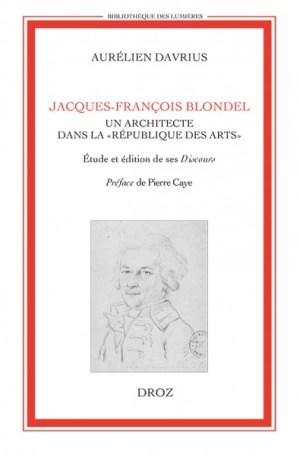 Au XVIIIe siècle, de nombreux architectes ont publié des traités ou des « Cours » sur leur art. L’un d’eux se distingue par la quantité et la qualité des livres qu’il publie : Jacques-François Blondel (1708/9–1774). Auteur majeur de la théorie architecturale, Blondel a su, au cœur des Lumières, redonner une actualité à l’architecture classique, en s’opposant à l’art rocaille qui domine alors. Pour Blondel, l’architecture possède une dimension encyclopédique – il mobilise à la fois les savoirs techniques et les différents arts –, mais aussi sociale – chacun est appelé à y participer. Les écrits de Blondel sont par ailleurs indissociables de son action pédagogique : avec la fondation de son Ecole des Arts, qui se propose de centraliser la diversité des compétences, il opère une véritable révolution pédagogique. Cet ouvrage rassemble les discours, mémoires, articles pour L’Encyclopédie et autres textes de Blondel, dans lesquels le professeur développe ses idées sur le « bon goût » en architecture. Pour la majeure partie inédits, ou jamais réédités depuis le XVIIIe siècle, ces documents renseignent sur les enjeux de l’art de bâtir au siècle des Lumières, ainsi que sur la transmission de la tradition nationale.
◊ ◊ ◊ ◊ ◊
Table des matières (more…)
New Book | The Country House: Material Culture and Consumption
Published by Historic England and distributed by The University of Chicago Press:
Jon Stobart and Andrew Hann, eds., The Country House: Material Culture and Consumption (Swindon: English Heritage, 2016), 224 pages, ISBN: 978-1848022331, £70 / $140.
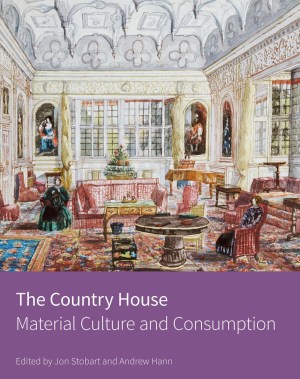 The country house has long been recognised as symbol of elite power—a showpiece demonstrating the wealth and ambition of its owner, but also their taste and discernment. Ownership of a country house distinguished the landed classes from the rest of society and signalled an individual’s arrival amongst a privileged elite. Yet, as the contributions to this book amply demonstrate, the country house in Britain and elsewhere in Europe was much more than this: it was a lived and living space, populated by family, visitors and servants. This formed the context in which decisions were made about what to buy, what to keep and what could be discarded; about what taste comprised and how it would be balanced against financial constraints or the imperatives of pedigree and heritance.
In this collection, consumption is thus explored as an active and ongoing process that involved the mundane as well as the magnificent. It drew the country house into complex and overlapping networks of supply that stretched from the local to the international. Material culture and elite identity were shaped by a cosmopolitan mixture of the everyday, the European and the exotic, thus food from the kitchen garden was served a la francaise from Chinese porcelain.
Jon Stobart is Professor of History at Manchester Metropolitan University.
Andrew Hann is Properties Historians’ Team Leader at English Heritage.
◊ ◊ ◊ ◊ ◊
C O N T E N T S
Introduction, Jon Stobart: The Country House and Cultures of Consumption
Section 1 | Elites, consumption and the country house
1. Yme Kuiper: The rise of the country house in the Dutch Republic: Beyond Johan Huizinga’s narrative of Dutch civilisation in the 17th century
2. Jane Whittle: The gentry as consumers in early 17th-century England
3. Johanna Ilmakunnas: To build according to one’s status: A country house in late 18th-century Sweden
4. Mark Rothery and Jon Stobart: Geographies of supply: Stoneleigh Abbey and Arbury Hall in the 18th century
5. Shelley Garland: The use of French architectural design books in De Grey’s choice of style at Wrest Park
Section 2 | Continuity, heritage and the country house
6. Hannah Chavasse: Fashion and ‘affectionate recollection’: Material culture at Audley End, 1762–1773
7. Hanneke Ronnes: A sense of heritage: Renewal versus preservation in the English and Dutch palaces of William III in the 18th century
8. Victor Hugo López Borges: An Anglo-Irish country house in Spain: The Palacio de Castrelos
Section 3 | Eastern connections, adoptions and imitations
9. Emile de Bruijn: Consuming East Asia: Continuity and change in the development of chinoiserie
10. Kate Smith: Imperial objects? Country house interiors in 18th-century Britain
11. Patricia F Ferguson: ‘Japan China’ taste and elite ceramic consumption in 18th-century England: Revising the narrative
12. Helen Clifford: ‘Conquests from North to South’: The Dundas property empire. New wealth, constructing status and the role of ‘India’ goods in the British country house.
Section 4 | Country house interiors as lived spaces
13. Rosie MacArthur: Settling into the country house: The Hanburys at Kelmarsh Hall
14. Susan Jenkins: Fashion and function: The decoration of the library at Kenwood in context
15. Karol Mullaney-Dignam: Useless and extravagant? The consumption of music in the Irish country house
16. Annie Gray: Broccoli, bunnies and beef: Supplying the edible wants of the Victorian country house
Section 5 | Presenting the country house
17. Nicola Pickering: Mayer Amschel de Rothschild and Mentmore Towers: Displaying ‘le goût Rothschild’
18. Anna McEvoy: Following in the footsteps of 18th-century tourists: The visitor experience at Stowe over 300 years
19. Karen Fielder: X marks the spot: Narratives of a lost country house
Exhibition | Meant to Be Shared: Prints from the Arthur Ross Collection

Giovanni Battista Piranesi, Veduta della Piazza di Monte Cavallo (View of the Piazza di Monte Cavallo [now the Piazza del Quirinale with the Quirinal Palace]), from Vedute di Roma (Views of Rome), 1750, etching (New Haven: Yale University Art Gallery, The Arthur Ross Collection).
◊ ◊ ◊ ◊ ◊
Press release (11 December 2015) from the Yale University Art Gallery:
Meant to Be Shared: Selections from the Arthur Ross
Collection of European Prints at the Yale University Art Gallery
Yale University Art Gallery, New Haven, 18 December 2015 — 24 April 2016
Samuel P. Harn Museum of Art, University of Florida, Gainesville, 29 January — 8 May 2017
Syracuse University Art Galleries, Syracuse University, 17 August — 19 November 2017
Curated by Suzanne Boorsch
The Yale University Art Gallery is delighted to announce Meant to Be Shared: Selections from the Arthur Ross Collection of European Prints at the Yale University Art Gallery, an exhibition presenting highlights of the more than 1,200 prints donated to the Gallery in 2012 by the Arthur Ross Foundation. Beginning in the late 1970s, philanthropist Arthur Ross (1910–2007) avidly collected works of art by some of the most renowned Italian, Spanish, and French printmakers of the last several centuries for his eponymous foundation. Highlights of the Arthur Ross Collection include works by Francisco Goya, the first artist whom Ross collected; Giovanni Battista Piranesi’s images of ancient and 18th-century Rome, which reflect Ross’s love of classicism and the Eternal City; and Édouard Manet’s illustrations for Edgar Allan Poe’s famous poem The Raven.
The Arthur Ross Collection comprises three major segments. The largest is a group of some 800 18th-century Italian works by Giovanni Battista Piranesi, Giovanni Antonio Canal (called Canaletto), Giovanni Battista Tiepolo and his sons, and others. A group of close to 200 prints by the Spaniard Francisco Goya includes the three intriguing and enigmatic series of etchings he made in the second decade of the 19th century, during which Spain suffered, first, Napoleon Bonaparte’s invasion, and then, with the restoration of the Bourbon monarchy, the repressive rule of King Ferdinand VII. The third segment consists of about 200 French prints by some of the greatest artists of the 19th and 20th centuries: Eugène Delacroix, Honoré Daumier, Camille Pissarro, Édouard Manet, Edgar Degas, Paul Gauguin, Henri Matisse, and Pablo Picasso.
This inaugural exhibition features 19 of Goya’s profoundly mysterious Disparates (Los proverbios) (Follies [Proverbs]) series, made around 1816 to 1819 but not published in Goya’s lifetime, for fear of the Inquisition. Ten images from the Tauromaquia (The Art of Bullfighting; 1815, published 1816) series and nine of the Desastres de la guerra (Disasters of War; ca. 1810–11, published 1863) are on display as well. The installation also highlights illustrations of great works of literature—one of the salient themes of the French work—including Delacroix’s 13 lithographs illustrating William Shakespeare’s Hamlet (1834–43) and some of his illustrations for Johann Wolfgang von Goethe’s Faust (1827, published 1828), and Manet’s truly revolutionary illustrations for Edgar Allan Poe’s The Raven (1875).
An entire gallery is devoted to views of places that might have been visited on the Italian segment of the Grand Tour, the cultural tour of Europe that was deemed an essential cap to the classical education of young gentlemen, especially those from Britain. Sparkling views of the Venetian region by Canaletto set the stage. The largest section is devoted to Rome; this part of the exhibition features a spectacular six-by-seven-foot map of the Eternal City, published in 1748, designed by the surveyor Giovanni Battista Nolli, and 20 of Piranesi’s Vedute (Views; ca. 1748–60) of Rome. The final area focuses on images of Pompeii and Paestum, in southern Italy, where in the mid-18th century rediscoveries of ancient sites excited the intelligentsia across Europe.
The title of the exhibition, Meant to Be Shared, reflects the raison d’être of the collection. Arthur Ross collected these prints for his foundation with the express purpose, in the words of his widow, Janet C. Ross, “to lend first-class prints … to educational institutions in the United States and abroad that would not otherwise have access to such objects for study and enjoyment.” In this spirit, the inaugural exhibition travels to the Samuel P. Harn Museum of Art at the University of Florida, Gainesville, in early 2017, and to the Syracuse University Art Galleries, New York, later that year. Gallery staff members have partnered with Harn Museum Director Rebecca M. Nagy and Syracuse University Art Galleries Director Domenic Iacono to plan ways to use the prints as teaching tools at each institution—including related university courses, public programs, and close-looking sessions—throughout the run of the exhibition. Suzanne Boorsch, the Gallery’s Robert L. Solley Curator of Prints and Drawings and curator of the exhibition, explains, “Far and away the most difficult aspect of preparing this exhibition was to make a selection from the abundance of riches that constitute this extraordinary donation. The possibilities that the Arthur Ross Collection offers for exhibition, research, and teaching are virtually endless, and, indeed, this inaugural exhibition and the collection catalogue are just the beginning of the rewards to be reaped by the study and enjoyment of this gift.”
The Gallery’s mission of sharing its collections broadly honors both the legacy of Arthur Ross and the value of the work he collected. Jock Reynolds, the Gallery’s Henry J. Heinz II Director, states, “We are grateful that the Arthur Ross Foundation has chosen the Gallery to be the steward of this remarkable collection, ensuring its proper care and always sharing it generously with active learners of all ages.”
◊ ◊ ◊ ◊ ◊
P R O G R A M M I N G
Gallery Talks
Wednesday, December 9, 12:30 pm
“Piranesi’s Rome: The Vision of an 18th-Century Architect and Printmaker,” Jakub Koguciuk, Ph.D. candidate in the History of Art and Renaissance Studies, Yale University
Wednesday, February 24, 12:30 pm
“Bullfighting: Audience and Perspective in Prints by Antonio Carnicero, Francisco Goya, and Pablo Picasso,” Ian Althouse, Ph.D. candidate in the Department of Spanish and Portuguese, Yale University
Wednesday, February 24, 1:30 pm
“Las corridas de toros: Audiencia y mirada en el arte de Antonio Carnicero, Francisco Goya y Pablo Picasso” (in Spanish), Ian Althouse
Wednesday, April 13, 12:30 pm
“Intensité, Obscurité, Frivolité: The Proliferation of Print Media in 19th-Century France,” Lisa Hodermarsky, the Sutphin Family Senior Associate Curator of Prints and Drawings, Yale University Art Gallery
Ryerson Lectures
Thursday, January 21, 5:30 pm
“Goya’s Prints in Context,” Janis A. Tomlinson, Director of University Museums, University of Delaware, Newark
Friday, February 5, 1:30 pm
“The Marriage of Venice and Rome, or What Makes Piranesi Great?,” Andrew Robison, the Andrew W. Mellon Senior Curator of Prints and Drawings, National Gallery of Art, Washington, D.C.
Friday, April 1, 1:30 pm
“From Paris to Tahiti: Paul Gauguin’s Innovative Prints,” Elizabeth C. Childs, the Etta and Mark Steinberg Professor of Art History and Chair of the Department of Art History and Archaeology, Washington University in Saint Louis
Performance
Thursday, March 31, 5:30 pm
Chamber Music of the 18th Century, Tiny Baroque Orchestra
Studio Programs
Friday, February 12, 1:30 and 3:00 pm
Printmaking Workshops
Inspired by the over 1,200 prints in the Arthur Ross Collection, Mauricio Cortes Ortega, M.F.A. candidate, and Caroline Sydney, SM ’16, both of Yale University, invite visitors to explore the art of printmaking. In this hands-on workshop, participants learn the basic techniques of intaglio printing and create a unique print of their own. Space is limited. Registration required; please call 203.432.9525.
◊ ◊ ◊ ◊ ◊
The catalogue is distributed by Yale UP:
Suzanne Boorsch, Douglas Cushing, Alexa Greist, Elisabeth Hodermarsky, Sinclaire Marber, John Moore, and Heather Nolin, with a foreword by Janet Ross, Meant to Be Shared: The Arthur Ross Collection of European Prints (New Haven: Yale University Press, 2016), 196 pages, ISBN: 978-0300214390, $60.
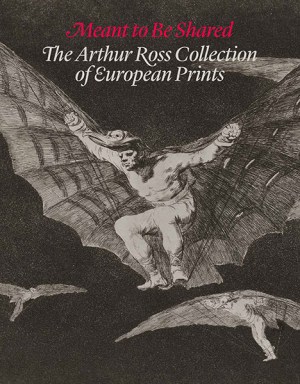 This important volume offers the first comprehensive look at the Arthur Ross Collection—more than 1,200 17th- to 20th-century Italian, French, and Spanish prints—and is published to mark the inaugural exhibition of the collection in its new home at the Yale University Art Gallery. Highlights include superb etchings by Canaletto and Tiepolo; the four volumes of Piranesi’s Antiquities of Rome, as well as his famous Vedute (Views) and Carceri (Prisons); Goya’s Tauromaquia in its first edition of 1816; an extremely rare etching by Edgar Degas; and numerous other 19th-century French prints, by Eugène Delacroix, Honoré Daumier, Édouard Manet, Paul Gauguin, Paul Cézanne, and others. The accompanying essays discuss the life of Arthur Ross, a significant philanthropist who funded several arts institutions; the formation of the collection and the art-historical significance of the works; and several thematic approaches to studying the collection, reinforcing its legacy as an important teaching resource.
New Book | An Anthology of Decorated Papers: A Sourcebook
From Thames & Hudson:
P. J. M. Marks, An Anthology of Decorated Papers: A Sourcebook for Designers (London: Thames & Hudson, 2016), 256 pages, ISBN: 978-0500518120, $60 / £38.
 Rich in ornamentation, decorated papers have been in use for centuries—as wrappers and endpapers for books, as the backing for playing cards, and even as linings for chests and cases. Yet despite the many contexts in which they can be found, they often go unnoticed. This remarkable new book not only showcases several hundred of the best and most exquisite examples of decorated paper but also provides a fascinating introduction to its history, traditions, and techniques. Drawing on the Olga Hirsch collection at the British Library, one of the largest and most diverse collections of decorated papers in the world, this beautifully produced anthology will both delight and inspire designers, bibliophiles, and anyone with a love of pattern and decoration.
P. J. M. Marks is curator of bookbindings at the British Library. Her previous books include The British Library Guide to Bookbinding, Treasures in Focus: Decorated Papers, and Beautiful Bookbindings. Her most recent publication is a chapter on selected European decorated bookbindings in The Arcadian Library: Bindings and Provenance.
◊ ◊ ◊ ◊ ◊
From the BL:
The Olga Hirsch collection of decorated papers, bequeathed in 1968, comprises over 3,500 sheets of paper and around 130 books in paper wrappers or with decorated end-leaves. There are hand-made papers from the 16th century onwards, and also later, machine-made papers. Various techniques of decorating paper are represented: there are brush-coated, sprinkled, sprayed, flock, marbled, block-printed, embossed, and metallic-varnish papers, as well as book jackets and 20th-century artists’ papers.
Mirjam Foot, “The Olga Hirsch Collection of Decorated Papers,” British Library Journal 7 (Spring 1981): 12–38, available as a PDF file here.
Exhibition | Ships, Clocks & Stars: The Quest for Longitude

Working replicas of John Harrison’s three remarkable timekeepers (H1, H2, H3) are highlights of the Ships, Clocks & Stars exhibition at Mystic Seaport; pictured is a detail of H3. Photo by Andy Price/Mystic Seaport.
◊ ◊ ◊ ◊ ◊
Press release (20 August 2015) for the exhibition, which was earlier on display at the National Maritime Museum in Greenwich:
Ships, Clocks, and Stars: The Quest for Longitude
National Maritime Museum, Greenwich, 11 July 2014 — 4 January 2015
Mystic Seaport, Mystic, Connecticut, 19 September 2015 — 28 March 2016
Mystic Seaport proudly presents Ships, Clocks & Stars: The Quest for Longitude, on tour from England for a limited time only. The award-winning exhibition, produced by the National Maritime Museum in London and sponsored by United Technologies Corp., reveals the race to determine longitude at sea. Spurred on by the promise of rich rewards, astronomers, philosophers, and artisans—including John Harrison and his innovative timekeepers—finally solved one of the greatest technical challenges of the 18th century.
For centuries, longitude (east-west position) was a matter of life and death at sea. Ships that went off course had no way to rediscover their longitude. With no known location, they might smash into underwater obstacles or be forever lost at sea. For a maritime nation such as Britain, growing investment in long distance trade, outposts and settlements overseas made the ability to accurately determine a ship’s longitude increasingly important.
Ships, Clocks & Stars celebrates the 300th anniversary of the British Longitude Act of 1714, which offered a huge prize for any practical way to determine longitude at sea. The longitude problem was so difficult that—despite that incentive—it took five decades to solve it. Through the latest research and extraordinary, historic artifacts—many from the collection of the National Maritime Museum and never before displayed outside the UK—the exhibition tells the story of the clockmakers, astronomers, naval officers, and others who pursued the long ‘quest for longitude’ to ultimate success.
In recent years, John Harrison has been cast as the hero of the story, not least in Dava Sobel’s bestselling book Longitude: The True Story of a Lone Genius Who Solved the Greatest Scientific Problem of His Time. Ships, Clocks & Stars provides a new perspective on this famous tale. While John Harrison makes a good story and his marine sea-watch was vital to finally solving the problem of longitude, this was against a backdrop of almost unprecedented collaboration and investment. Famous names such as Galileo, Isaac Newton, James Cook, and William Bligh all feature in this fascinating and complex history. Crucially, it was Astronomer Royal Nevil Maskelyne’s observations and work on the Nautical Almanac at the Royal Observatory in Greenwich that demonstrated the complementary nature of astronomical and timekeeper methods. Combined, the two methods lead to the successful determination of longitude at sea and changed our understanding of the world.
“Mystic Seaport is very proud to bring Ships, Clocks & Stars to New England to tell this important story of scientific discovery, innovation, creativity, perseverance, and even adventure as different parties raced to find a solution,” said Steve White, president of Mystic Seaport. “This exhibit is more than the story of longitude: it is the story of human problem-solving, and it is as relevant today as it was in the eighteenth century.”
2015 Berger Prize for British Art History: James Barry’s Murals
Congratulations to Bill Pressly!
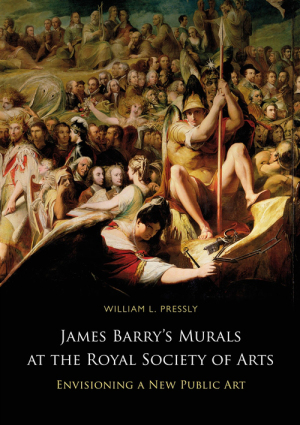 On December 7, William Pressly was awarded the 2015 William M. B. Berger Prize for British Art History for his book James Barry’s Murals at the Royal Society of Arts: Envisioning a New Public Art (Cork University Press). The book demonstrates that Barry’s RSA paintings contain a hidden meaning that has gone undetected for 230 years. The pictures offer in the heart of the London establishment a glorification of the Roman Catholic Church. The artist’s creation of a complex, mythic narrative establishes him as the mentor of William Blake, whose approach to art owes a profound debt to the Irishman’s example.
Other titles relevant to the eighteenth century on the short list included:
• Ruth Guilding, Owning the Past: Why the English collected Antique Sculpture, 1640–1840 (Yale University Press for the Paul Mellon Centre for Studies in British Art)
• Jane Munro, Silent Partners: Artist and Mannequin from Function to Fetish (Yale University Press in Association with the Fitzwilliam Museum, Cambridge)
• Malcolm Baker, The Marble Index: Roubiliac and Sculptural Portraiture in Eighteenth-Century Britain (Yale University Press for the Paul Mellon Centre for Studies in British Art)
The complete list, including the long list is available here»
Exhibition | Portals to the Past: British Ceramics, 1675–1825

William Greatbatch, Tea Canister, Soup Plate, Teapot; Fenton, Staffordshire, England, 1765–1770, cream-colored earthenware, lead glaze (Charlotte: The Mint Museum)
◊ ◊ ◊ ◊ ◊
From The Mint Museum:
Portals to the Past: British Ceramics, 1675–1825
The Mint Museum, Charlotte, North Carolina, opening 16 January 2015 (running for two years)
The Mint Museum’s collection of eighteenth-century British pottery and porcelain is widely respected for its scope and quality. The collection numbers over 2,000 objects and includes important examples of both salt-glazed and dry-bodied stoneware from Staffordshire; tin-glazed earthenware from Bristol, Liverpool, and London; and cream-colored earthenware from Derbyshire, Staffordshire, and Yorkshire. Notable eighteenth-century porcelain factories represented include Chelsea, Bow, and Vauxhall in London, Longton Hall in Staffordshire, Worcester, Bristol, and others. Individual works in the collection are exceptional because of their rarity, craftsmanship, provenance, or as representative examples of particular types or methods of production or decoration.

William Littler, Sweetmeat Stand; West Pans, East Lothian, Scotland, 1765–70, earthenware, lead glaze (Charlotte: The Mint Museum)
British Ceramics 1675–1825 presents more than 200 highlights of this collection in a new installation in the Alexander, Spangler, and Harris Galleries at Mint Museum Randolph. The objects are interpreted through a variety of thematic lenses—function, style, manufacturing technique, maker—to encourage visitors to engage with the objects in ways they find personally meaningful and interesting. The exhibition includes many objects that have never before been on view, as well as contemporaneous works of art in from the Mint’s holdings in other media, including paintings, furniture, fashion, and silver.
The exhibition’s opening follows the December release of a 270-page, illustrated catalogue, British Ceramics 1675–1825: The Mint Museum, produced by the museum in collaboration with D. Giles Limited, London. Both the catalogue and the exhibition honor the fiftieth anniversary of the museum’s purchase of the Delhom Collection of British and European ceramics.
Portals to the Past: British Ceramics 1675–1825 is presented by the Delhom Service League, ceramics affiliate of The Mint Museum, with additional support provided by Moore & Van Allen.
◊ ◊ ◊ ◊ ◊
From Giles:
Brian Gallagher, Barbara Stone Perry, Letitia Roberts, Diana Edwards, Pat Halfpenny, Maurice Hillis, and Margaret Ferris Zimmerman, British Ceramics 1675–1825: The Mint Museum (London: D. Giles Limited, 2015), 272 pages, ISBN: 978-1907804366, £50 / $80.
 British Ceramics 1675–1825 is an important and visually stunning new publication which highlights 200 of the best pieces from the The Mint Museum’s collection, selected on account of their rarity, craftsmanship, notable provenance, or as important examples of particular types, or methods of production, or decoration. Each object is illustrated in colour, and is accompanied by a catalogue entry including title, manufacturer, date, medium, marks, dimensions, description of other unique physical aspects (inscriptions or quote on the body of the vessel), provenance, previous publication history and exhibition history. Descriptive text for each piece covers unusual and pertinent aspects of its manufacture and history.
Brian Gallagher is the curator of Decorative Arts, The Mint Museum. Barbara Stone Perry is the former curator of Decorative Arts, The Mint Museum. Letitia Roberts is an independent scholar and consultant, and the former senior international specialist for European Ceramics and Chinese Export Porcelain at Sotheby’s, New York. Diana Edwards is a prolific writer and lecturer on seventeenth- and eighteenth-century British ceramics, and advises numerous ceramics organizations. Pat Halfpenny is a highly respected expert on Staffordshire pottery, and is curator emerita of Ceramics and Glass and retired Director of Museum Collections at Winterthur Museum, Delaware. Maurice Hillis has published extensively on eighteenth-century English pottery and porcelain, and is the former chairman and current president of the Northern Ceramic Society, United Kingdom. Margaret Ferris Zimmermann lectured on ceramics for the Delhom Service League’s orientation program at The Mint Museum for many years and is the former editor of the American Ceramic Circle Journal.
New Book | Furniture-Makers and Consumers in England, 1754–1851
From Ashgate:
Akiko Shimbo, Furniture-Makers and Consumers in England, 1754–1851: Design as Interaction (Farnham: Ashgate Publishings, 2015), 280 pages, ISBN: 978-0754669289, $125.
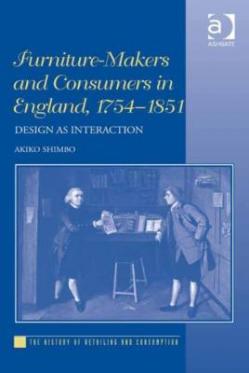 Covering the period from the publication of Thomas Chippendale’s The Gentleman and Cabinet-Makers’ Director (1754) to the Great Exhibition (1851), this book analyses the relationships between producer retailers and consumers of furniture and interior design, and explores what effect dialogues surrounding these transactions had on the standardisation of furniture production during this period. This was an era, before mass production, when domestic furniture was made both to order and from standard patterns and negotiations between producers and consumers formed a crucial part of the design and production process. This study narrows in on three main areas of this process: the role of pattern books and their readers; the construction of taste and style through negotiation; and daily interactions through showrooms and other services, to reveal the complexities of English material culture in a period of industrialisation.
Akiko Shimbo is Professor in the Department of Architecture and Environment Systems, School of Systems Engineering and Science,
Shibaura Institute of Technology, Japan.
◊ ◊ ◊ ◊ ◊
C O N T E N T S
List of Tables
List of Figures
List of Illustrations
General Editor’s Preface
Acknowledgments
1 Introduction
2 Furniture Design: Sharing Knowledge among Craftspeople
3 Pattern Books: Communicating between Producers and Consumers
4 Forming Taste and Style: Consumers’ Needs and Participation
5 The Showroom as Mediator
6 Furniture Repairs and Services: Building a Clientele
7 Taste, State and the Market: Changing Relationships between Producers and Consumers
8 Conclusion
Appendix: Pattern Books and Trade Guides (1750–1853) Consulted in this Study
Bibliography
Index
Exhibition | Light, Time, Legacy: Francis Towne’s Watercolours of Rome
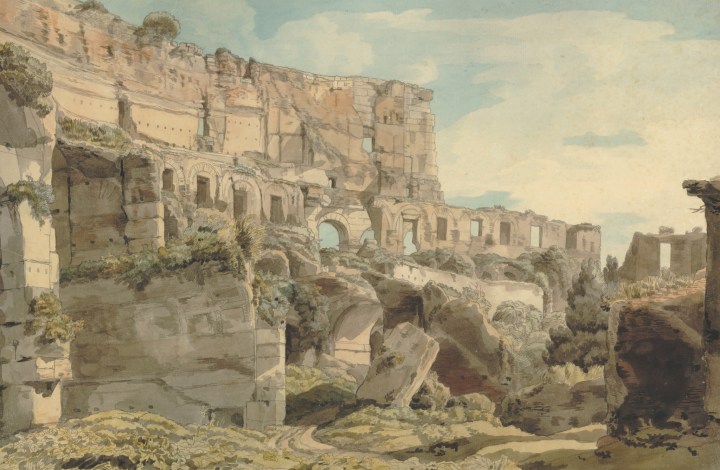
Francis Towne, Inside the Colosseum, 1780
(London: The British Museum)
◊ ◊ ◊ ◊ ◊
Press release for the upcoming exhibition:
Light, Time, Legacy: Francis Towne’s Watercolours of Rome
The British Museum, London, 21 January — 14 August 2016
Curated by Richard Stephens
2016 is the bicentenary of Francis Towne’s death and his historic bequest to the British Museum of 75 uniquely beautiful watercolours made on his visit to Italy in 1780–81. To celebrate this generous gift the watercolours are all on display here—at their heart are 52 views of Rome that have not been shown together since 1805. Towne’s decision to give the Museum such a major group of his drawings, so that they could be seen in the wider context of a collection that charted the history of the graphic arts from its Renaissance beginnings, was both strategic and pioneering as it set a pattern for artists to donate their work that endures to this day, as seen in the recent gift of 200 prints made by the American artist Jim Dine.

Francis Towne, Near the Arco Scuro, 1780, watercolour with pen and ink and some gum arabic, 320 x 467 mm (London: The British Museum)
Towne was born in London in 1739 where he later trained and then moved to Exeter. He tried unsuccessfully to gain recognition in the London art world, and failed to be elected to the Royal Academy on eleven separate occasions. Towne gained artistic recognition in his posthumous legacy at the British Museum. At the start of the 20th century, through these watercolours, Towne became the poster boy for the ‘new Georgian’ revival of interest in 18th-century art. The clarity and abstracted economy of Towne’s watercolours were not only admired by the public but also by early 20th-century modernists, and he is today recognised as one of Britain’s greatest watercolour artists.
Through Towne’s vision, the exhibition will explore Enlightenment Britain’s relationship with the classical past and Ancient Rome. Towne travelled to Rome in 1780–81 during a period of political crisis in England when America was in revolt, a French invasion of England was anticipated and a highly divisive general election had just concluded. Towne, and his social circle, viewed ancient Rome as a catastrophic precedent for what they perceived as a corrupt ruling power in England. The ruins that Towne depicted in his landscapes signified a warning to contemporary society not to suffer the same fate as the fallen Roman Empire.
Italy had a transformational effect on Towne’s work. When Towne first arrived in Rome he started making excursions north of city, making rural sketches instead of focusing on the ancient monuments. Towne’s delicate early studies were eventually replaced with large scale bolder work when Towne depicted such subjects as the Colosseum and other iconic Roman ruins. The experience of Rome was much different in the 18th century, few ruins had been excavated and tourists were free to explore them.
When Towne returned to England in 1781, these watercolours played a central role in his subsequent career. Although he was never accepted by the London art establishment, he organised an exhibition of his life’s work in 1805 with the Museum’s watercolours at its centre. Towne bequeathed the watercolours of Rome and others to the British Museum in 1816, with a further selection by his executors arriving in 1818.
A new open access catalogue raisonné of Francis Towne’s work by the guest curator of this exhibition, Dr Richard Stephens, will be published online in early 2016 by the Paul Mellon Centre for Studies in British Art.
The illustrated leaflet for the exhibition is available as a PDF file here»
◊ ◊ ◊ ◊ ◊
P R O G R A M M I N G
All events are free
Decline and Fall: Francis Towne and the Ruins of Rome
Tuesday, 26 January, 13.15–14.00, Room 90. Just drop in.
A gallery talk by exhibition curator Richard Stephens.
Light, Time, Legacy: Francis Towne’s Watercolours of Rome
Friday, 5 February, 13.30–14.15, BP Lecture Theatre. Booking essential.
Exhibition curator Richard Stephens gives a 45-minute illustrated introduction to the exhibition.
Theory and Practice in Towne’s Watercolours of Rome
Friday, 19 February, 13.15–14.00, Room 90. Just drop in.
A gallery talk by Timothy Wilcox, independent scholar.
The Selective Eye: Francis Towne’s Watercolours of Rome
Thursday, 21 April, 13.15–14.00, Room 90. Just drop in.
A gallery talk by art historian and curator Anne Lyles, independent speaker.
Magick Land? Francis Towne and His Response to Rome
Friday, 6 May, 13.15–14.00, Room 90. Just drop in.
A gallery talk by Jonny Yarker, Director of Lowell Libson Ltd.
Decline and Fall: Francis Towne and the Ruins of Rome
Wednesday, 15 June, 13.15–14.00, Room 90. Just drop in.
A gallery talk by exhibition curator Richard Stephens.










 Enfilade
leave a comment