Exhibition | De Versailles à La Motte Tilly: L’abbé Terray
Press release for the exhibition now on view at the Château de La Motte Tilly:
De Versailles à La Motte Tilly: L’abbé Terray, Ministre de Louis XV
Château de La Motte Tilly, 29 May — 20 September 2015
Curated by Gwenola Firmin and Vincent Bastien
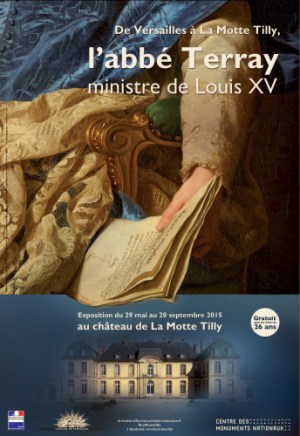 Après Sacres Royaux, de Louis XIII à Charles X au palais du Tau à Reims et Le salon de George Sand à Nohant, en 2014, la troisième exposition du partenariat entre le Centre des monuments nationaux et le château de Versailles se tiendra au château de La Motte Tilly (Aube) du 29 mai au 20 septembre 2015. Cette nouvelle exposition conjointe est consacrée à l’abbé Joseph Marie Terray (1715–1778), ministre des finances de Louis XV, à l’occasion du tricentenaire de sa naissance.
L’abbé Terray et La Motte Tilly
Joseph Marie Terray bénéficie, à ses début, de l’héritage financier de son oncle, premier médecin de la princesse Palatine, belle-sœur de Louis XIV. Nommé abbé de Notre-Dame de Molesme, au diocèse de Langres, en octobre 1764, il devient, le 23 décembre 1769, contrôleur général des Finances de Louis XV. Après le renvoi du duc de Choiseul en 1770, il est l’un des hommes forts du ministère dit du Triumvirat. Incarnation de l’ascension sociale du XVIIIe siècle, talentueux réformateur, grand homme de l’histoire économique et politique du règne de Louis XV, l’abbé Terray, malgré l’appui constant de Madame de Pompadour puis de Madame Du Barry, est très impopulaire. Il mène en effet une politique financière, certes efficace et progressiste, mais aussi brutale et autoritaire. Le ministre occupe finalement la prestigieuse charge de directeur des Bâtiments du Roi en août 1773. Mais, un an plus tard, il démissionne avec l’avènement de Louis XVI et se retire à La Motte Tilly, tout en rêvant secrètement d’être rappelé au gouvernement.
Son domaine de La Motte Tilly, parfait exemple de l’architecture du XVIIIe siècle, est sa résidence de 1748 à son décès en 1778. La demeure et son parc, comprenant aujourd’hui près de 1080 hectares, témoignent d’un certain art de vivre au Siècle des Lumières. L’actuel château, élevé à partir de 1755, est l’œuvre de l’architecte parisien François-Nicolas Lancret (1717–1789), le neveu du célèbre peintre de scènes galantes, Nicolas Lancret. L’implication de l’abbé Terray dans les différents chantiers de sa demeure de plaisance s’amplifie à mesure que sa carrière politique prend de l’importance.
L’exposition
Présentée dans les anciens appartements du ministre, l’exposition De Versailles à La Motte Tilly. L’abbé Terray, ministre de Louis XV retrace l’ascension et la vie du maître des lieux, personnage historique parmi les plus influents de la fin du règne de Louis XV mais aussi parmi les plus controversés du XVIIIe siècle. Réunis pour la première fois, des documents d’archives, des objets d’art précieux, des dessins et des tableaux contribuent également à mettre en lumière le domaine de La Motte Tilly, chef-d’œuvre architectural trop longtemps ignoré. L’exposition est enfin l’occasion unique de présenter un somptueux portrait conservé dans les collections versaillaises : l’effigie officielle du ministre tout puissant peinte par Alexandre Roslin à la demande de Terray en 1773. Ce dernier y est figuré au sommet de sa gloire.
L’exposition est rendue possible grâce au prêt d’œuvres des collections du musée national de Versailles et de Trianon, ainsi qu’aux concours généreux du musée du Louvre, de l’abbaye de Chaalis, de la Bibliothèque nationale de France, de la Bibliothèque municipale de Versailles, des Archives nationales, des Archives départementales de l’Aube et de plusieurs collections particulières.
Ce parcours historique est conçu par Gwenola Firmin, conservateur, en charge des peintures du XVIIIe siècle au château de Versailles, assistée de Vincent Bastien, docteur en Histoire de l’art, chargé de mission.
Le partenariat entre le CMN et le château de Versailles
Le partenariat établie en 2013 entre le CMN et le château de Versailles instaure un dialogue entre des collections trop souvent méconnues et des hauts lieux du patrimoine national. Des expositions temporaires conjointes permettent aux deux institutions d’unir leurs ressources afin de donner au plus grand nombre la possibilité de découvrir ou de redécouvrir quelques pages de l’Histoire de France. En 2014, les expositions Sacres royaux, de Louis XIII à Charles X au palais du Tau à Reims et Le salon de George Sand au domaine de Nohant ont attiré au total près de 76 000 visiteurs.
Gwenola Firmin and Vincent Bastien, De Versailles à la Motte Tilly: L’abbé Terray, Ministre de Louis XV (éditions du Patrimoine / Centre des Monuments Nationaux, 2015), 48 pages, ISBN: 978-2757704714, 12€.
The full dossier de presse is available as a PDF file here»
Galleries Reopen at the Bayerisches Nationalmuseum

◊ ◊ ◊ ◊ ◊
From the Bavarian National Museum:
Barock und Rokoko
Bayerisches Nationalmuseum, Munich, open from 9 July 2015
Seit dem 9. Juli 2015 ist der zum Englischen Garten gelegene Westflügel des Bayerischen Nationalmuseums nach mehrjähriger Sanierung wieder für den Besucher zugänglich. Auf rund 1500 m² werden mehr als 600 einzigartige kunst- und kulturhistorische Glanzstücke des 17. und 18. Jahrhunderts in neuem Licht präsentiert. Skulpturen, Möbel, Gemälde, Uhren, Porzellan, Goldschmiedewerke, Prunkwaffen und Tapisserien künden von Vorlieben, Alltag und Entwicklungen jener Epoche.
 Im Hauptgeschoss des Museums wird damit der kunst- und kulturhistorische Rundgang fortgesetzt, der sich in erster Linie an bayerischen Kurfürsten Maximilian I., Ferdinand Maria, Max Emanuel und Karl Albrecht und ihren Kunstvorlieben orientiert. Erstmals präsentiert sind große Teile der Kunstsammlung des Kurfürsten Johann Wilhelm von der Pfalz, dessen Kunstschätze aus Düsseldorf und Mannheim um 1800 nach München kamen. Bei den nun neu ausgestellten Werken handelt es sich um einen Großteil der Objekte, die das Haus Wittelsbach dem Museum kurz nach dessen Gründung 1855 übergeben hat.
Ein eigener Saal widmet sich Facetten des barocken Gartens und dem von der Natur inspirierten Kunsthandwerk. Ein weiterer Raum, das sogenannte Landshuter Zimmer aus dem Stadtpalais der Freiherren von Stromer in Landshut, veranschaulicht die Wohnwelt des Adels im 18. Jahrhundert. Einen weiteren Schwerpunkt der Sammlung bilden schließlich die Skulpturen des Barock und Rokoko, allen voran die Werke von Johann Baptist Straub und Ignaz Günther.
In der Vermittlung beschreitet das Museum neue Wege. Medienstationen mit Touchscreens ermöglichen den Besuchern spannende Blicke hinter verschlossene Schranktüren oder auf tickende Uhrwerke.
Additional images are available here»

◊ ◊ ◊ ◊ ◊
The catalogue, published by Sieveking Verlag, is available from Artbooks.com:
Renate Eikelmannn, Barock und Rokoko: Meisterwerke des 17. und 18. Jahrhunderts (München: Sieveking Verlag, 2015), 248 pages, ISBN: 978-3944874364, 25€ / $45.
The collections of Baroque and Rococo art at the Bayerisches Nationalmuseum are among the most important in Europe. Many of the works created by the international artists and craftsmen represented at the museum are outstanding achievements. Sculptures, furniture, paintings, clocks, porcelain objects, goldsmith work, sumptuously decorated weapons, and tapestries bear witness to the tastes and trends of the era. The succession of rulers who had a profound impact on Bavaria between the Thirty Years’ War and the French Revolution provides the chronological focus for this catalogue of selected works: Bavarian electors Maximilian I, Ferdinand Maria, Max Emanuel, and Karl Albrecht, as well as Elector Palatine Johann Wilhelm, whose art collection arrived in Munich by way of family succession. The publication also includes a look at the domestic environments of the nobility and the eighteenth-century passion for gardens. Baroque and Rococo sculptures constitute a cornerstone of the museum’s collections, especially works by Munich sculptors Johann Baptist Straub and Ignaz Günther. Their masterpieces, produced for churches and monasteries as well as for aristocratic patrons, are now considered quintessential examples of southern German Rococo.
Call for Nominations | Eldredge Book Prize
Call for Nominations: 2016 Charles C. Eldredge Prize
The Smithsonian American Art Museum is now accepting nominations for the 2016 Charles C. Eldredge Prize. The prize is awarded annually by the Museum for outstanding scholarship in the field of American art. A cash award of $3,000 is made to the author of a recent book-length publication that provides new insight into works of art, the artists who made them, or aspects of history and theory that enrich our understanding of the artistic heritage of the United States. The Eldredge Prize seeks to recognize originality and thoroughness of research, excellence of writing, clarity of method, and significance for professional or public audiences. It is especially meant to honor those authors who deepen or focus debates in the field, or who broaden the discipline by reaching beyond traditional boundaries.
Single-author books devoted to any aspect of the visual arts of the United States and published in the three previous calendar years (2013, 2014, 2015) are eligible. To nominate a book, send a one-page letter explaining the work’s significance to the field of American art history and discussing the quality of the author’s scholarship and methodology. Nominations by authors or publishers for their own books will not be considered. The deadline for nominations is December 1, 2015. Please send them to: The Charles C. Eldredge Prize, Research and Scholars Center, Smithsonian American Art Museum, P.O. Box 37012, MRC 970, Washington, D.C. 20013-7012. Nominations will also be accepted by email: eldredge@si.edu or fax: (202) 633-8373.
Further information about the prize may be found here»
New Book | Concepts of Value in European Material Culture, 1500–1900
From Ashgate:
Bert De Munck and Dries Lyna, eds., Concepts of Value in European Material Culture, 1500–1900 (Farnham: Ashgate, 2015), 304 pages, ISBN: 9781472451965, $135.
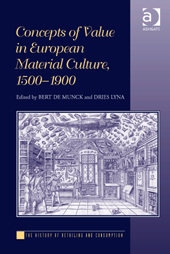 In contemporary society it would seem self-evident that people allow the market to determine the values of products and services. For everything from a loaf of bread to a work of art to a simple haircut, value is expressed in monetary terms and seen as determined primarily by the ‘objective’ interplay between supply and demand. Yet this ‘price-mechanism’ is itself embedded in conventions and frames of reference which differed according to time, place and product type. Moreover, the dominance of the conventions of utility maximising and calculative homo economicus is a relatively new phenomenon, and one which directly correlates to the steady advent of capitalism in early modern Europe. This volume brings together scholars with expertise in a variety of related fields, including economic history, the history of consumption and material culture, art history, and the history of collecting, to explore changing concepts of value from the early modern period to the nineteenth century and present a new view on the advent of modern economic practices. Jointly, they fundamentally challenge traditional historical narratives about the rise of our contemporary market economy and consumer society.
Bert De Munck is a Professor in the Department of History at the University of Antwerp, Belgium. He is a member of the Centre for Urban History at the same university and Director of both the interdisciplinary Urban Studies Institute and the Scientific Research Community (WOG) ‘Urban Agency. Setting the Research Agenda of Urban History’. His publications include Innovation and Creativity in Late Medieval and Early Modern European Cities (2014, co-edited with Karel Davids); Gated Communities? Regulating Migration in Early Modern Cities (2012, co-edited with Anne Winter); Technologies of Learning: Apprenticeship in Antwerp from the 15th Century to the End of the Ancien Régime (2007); and Learning on the Shop Floor: Historical Perspectives on Apprenticeship (2007, co-edited with Hugo Soly and Steven L. Kaplan).
Dries Lyna is an Assistant Professor of History at the Radboud University Nijmegen, The Netherlands. His areas of interest include the history of urban economies, material culture and art markets of the Low Countries, from the late seventeenth to nineteenth centuries. He has received fellowships and awards from the Fulbright Commission, the Getty Research Institute, the International Economic History Association and the Belgian American Educational Foundation. His publications include Art Auctions and Dealers: The Dissemination of Netherlandish Art during the Ancien Régime (2009, co-edited with Filip Vermeylen and Hans Vlieghe) and Art Crossing Borders: The International Art Market in the Age of Nation States, 1760–1914 (forthcoming, co-edited with Jan Baetens).
◊ ◊ ◊ ◊ ◊
C O N T E N T S
1 Locating and Dislocating Value: A Pragmatic Approach to Early Modern and Nineteenth-Century Economic Practices, Bert de Munck and Dries Lyna
Part I Expanding Markets and Market Devices
2 Labelling with Numbers? Weavers, Merchants and the Valuation of Linen in Seventeenth-Century Münster, Christof Jeggle
3 Words of Value? Art Auctions and Semiotic Socialization in the Austrian Netherlands (1750–1794), Dries Lyna
4 From a ‘Knowledgeable’ Salesman towards a ‘Recognizable’ Product? Questioning Branding Strategies before Industrialization (Antwerp, Seventeenth to Nineteenth Centuries), Ilja Van Damme
5 Golden Touchstones? The Culture of Auctions of Paintings in Brussels, 1830–1900, Anneleen Arnout
Part II Conventions, Material Culture, and Institutions
6 The Justness of Aestimatio and the Justice of Transactions: Defining Real Estate Values in Early Modern Milan, Michela Barbot
7 Vehicles of Disinterested Pleasure: French Painting and Non-Remunerative Value in the Eighteenth Century, Tomas Macsotay
8 Usefulness, Ornamental Function, and Novelty: Debates on Quality in Button and Buckle Manufacturing in Northern Italy (Eighteenth to Nineteenth Centuries), Barbara Bettoni
Part III The Old and the New
9 Façon de Venise: Determining the Value of Glass in Early Modern Europe, Corine Maitte
10 The Veneer of Age: Valuing the Patina of Silver in Eighteenth-Century Britain, Helen Clifford
11 The Value of a Collection: Collecting Practices in Early Modern Europe, Adriana Turpin
Index
Exhibition | Élisabeth Louise Vigée Le Brun (1755–1842)
Opening next month in Paris at the Grand Palais:
Élisabeth Louise Vigée Le Brun (1755–1842)
Grand Palais, Paris, 23 September 2015 — 11 January 2016
The Metropolitan Museum of Art, New York, 9 February — 15 May 2016
National Gallery of Canada, Ottawa, 10 June — 12 September 2016
Curated by Joseph Baillio and Xavier Salmon
This first retrospective devoted to the works of Elisabeth Louise Vigée Le Brun presents an artist whose life stretched from the reign of Louis XV to that of Louis-Philippe—one of the most eventful and turbulent periods in European and above all French history of modern times.
 Self-portraits by Vigée Le Brun abound: paintings, pastels and drawings that elegantly associate feminine grace and pride. With the Ancien Régime and its School of Fine Arts coming to an end, she supplanted most of her rival portrait artists. Vigee Le Brun used self-portraits to assert her status, circulate her image and show people the mother she had become despite the constraints of a career.
She made her greatest coup de force at the 1787 Exhibition where she presented two paintings that cannot be dissociated. First, a Portrait of Queen Marie-Antoinette posing for a portrait surrounded by her children in an attempt to rectify the image of an extravagant libertine; secondly, the portrait of a female artist hugging her daughter Julie to her chest in an effusive Raphael-like manner. The latter is one of the finest and most popular of the many works by this painter owned by the Louvre and has remained the emblem of «maternal tenderness» since it was first exhibited to the public. The culture of the Enlightenment and the influence of Rousseau obliged the artist to take on this role, which she did happily and with resounding success. As a counterpoint, she painted the Portrait of Hubert Robert. These paintings are absolute icons illustrating the joy of life and creative genius, complementing and communicating with each other.
What is even more remarkable was her determination to overcome obstacles hindering her career. Born in Paris in 1755, she came from a relatively modest background, her mother a hairdresser and her father a talented portrait artist. Her father died when she was a young adolescent. Drawing inspiration from his example, the brilliant young artist was accepted as a master painter at the Academy of Saint-Luc. In 1776, she married the most important art dealer of her generation, Jean Baptiste Pierre Le Brun (1748–1813), but this prevented her from being accepted at the Royal Academy of Painting and Sculpture because its regulations formally forbid any contact with mercantile professions. However, this union had a beneficial effect on her career. When the price of Flemish paintings soared, she learnt how to master the magic of colours and the fine craftsmanship of Rubens and Van Dyck. Her clientèle had mainly been the bourgeoisie but in 1777, she started working for the aristocracy, descendants of royal blood and finally Queen Marie-Antoinette. However, it was not until 1783 and the intervention of the Queen’s husband, Louis XVI, that the portrait artist was able to join the Royal Academy of Painting after much polemic.
Organized by the Réunion des musées nationaux/Grand Palais in Paris, The Metropolitan Museum of Art in New York, and the National Gallery of Canada in Ottawa.
The exhibition booklet is available here»
Details on the catalogue to follow later.
New Book | Then and Now: Collecting and Classicism
From McGill-Queen’s University Press:
Jean Coutu, Then and Now: Collecting and Classicism in Eighteenth-Century England (Montreal: McGill-Queen’s University Press, 2015), 340 pages, ISBN: 978-0773545434, $100.
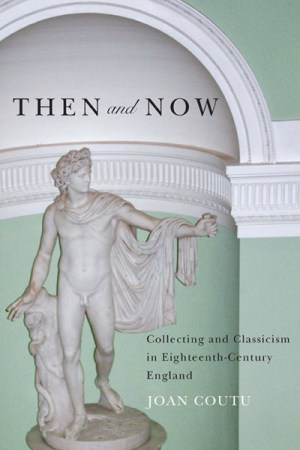 In the mid-eighteenth century, English gentlemen filled their houses with copies and casts of classical statuary while the following generation preferred authentic antique originals. By charting this changing preference within a broader study of material culture, Joan Coutu examines the evolving articulation of the English gentleman.
Then and Now consists of four case studies of mid-century collections. Three were amassed by young aristocrats—the Marquis of Rockingham, the Duke of Richmond, and the Earl of Huntingdon—who, consistent with their social standing, were touted as natural political leaders. Their collections evoke the concept of gentlemanly virtue through example, offering archetypes to encourage men toward acts of public virtue. As the aristocrats matured in the politically fractious realm of the 1760s, such virtue could become politicized. A fourth study focuses on Thomas Hollis, who used his collection to proselytize his own unique political ideology.
Framed by studies of collecting practices earlier and later in the century, Coutu also explores the fluid temporal relationship with the classical past as the century progressed, firmly situating the discussion within the contemporaneous emerging field of aesthetics. Broadening the focus beyond published texts to include aesthetic conversations among the artists and the aristocracy in Italy and England, Then and Now shows how an aesthetic canon emerged—embodied in the Apollo Belvedere, the Venus de’ Medici, and the like—which shaped the Grand Manner of art.
Joan Coutu is associate professor of art history and visual culture at the University of Waterloo, and author of Persuasion and Propaganda: Monuments and the Eighteenth-Century British Empire.
◊ ◊ ◊ ◊ ◊
C O N T E N T S
Figures
Acknowledgments
Introduction
1 Temporal Elision and Sculpture Collections in the First Half of the Eighteenth Century
2 An “Old Whig”: The 2nd Marquis of Rockingham and His Collections
3 The 3rd Duke of Richmond and His Sculpture Gallery in Whitehall: Munificence Worthy of a Prince
4 The 10th Earl of Huntingdon and the Arcadian Plains of Leicestershire
5 Thomas Hollis and His Life Plan
6 Conclusion: The Nuances of the Classical Archetype
Notes
Bibliography
Index
New Book | From Invention to Perfection
Published by Arnoldsche and available from Artbooks.com:
Sarah-Katharina Andres-Acevedo and Hans Ottomeyer, eds., From Invention to Perfection: Masterpieces of Eighteenth-Century Decorative Art (Stuttgart: Arnoldsche, 2015), 352 pages, ISBN: 978-3897904422, 78€.
 One hundred masterpieces of European art and arts and crafts of the eighteenth century form a panorama of innovation, design and expert realisation. In their sumptuous design, the porcelain, furniture, bronzes and silver objects are all miracles of the luxury craftsmanship found in court art. Such sophisticated design was the driving force behind the quickly successive styles of classicism, naturalism and the exotic design of the Rococo period. André-Charles Boulle, Jakob Philipp Hackert, Johann Joachim Kaendler, Alexandre-Jean Oppenordt und Jean-Baptiste François Pater are just some of the renowned artists featured in this catalogue. The artworks are opulently presented, interpreted in detail and arranged according to context. Thus the colourful image of a great era in art emerges, one that relied on creative energy and the power of the imagination.
With contributions by Sarah-K. Andres-Acevedo, Christine Cornet, Melitta Kunze-Köllensperger, Georg Lechner, Claudia Lehner-Jobst, Claudia Nordhoff, Hans Ottomeyer, Ulrich Pietsch, Christina Pucher, David Ranftl, Michael Röbbig-Reyes, Max Tillmann and Alfred Ziffer.
New Book | William Hunter’s World
From Ashgate:
E. Geoffrey Hancock, Nick Pearce, and Mungo Campbell, eds., William Hunter’s World: The Art and Science of Eighteenth-Century Collecting (Farnham: Ashgate Publishing, 2015), 424 pages, ISBN: 978-1409447740, $140.
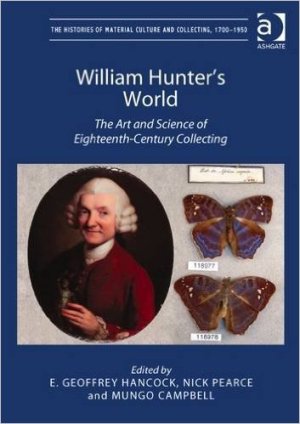 Despite William Hunter’s stature as one of the most important collectors and men of science of the eighteenth century, and the fact that his collection is the foundation of Scotland’s oldest public museum, The Hunterian, until now there has been no comprehensive examination in a single volume of all his collections in their diversity. This volume restores Hunter to a rightful position of prominence among the medical men whose research and amassing of specimens transformed our understanding of the natural world and man’s position within it.
This volume comprises essays by international specialists and are as diverse as Hunter’s collections themselves, dealing as they do with material that ranges from medical and scientific specimens, to painting, prints, books and manuscripts. The first sections focus upon Hunter’s own collection and his response to it, while the final section contextualises Hunter within the wider sphere. The volume includes references to The Hunterian’s web pages and on-line databases, enabling searches for items from Hunter’s collections, both from his museum and library.
Locating Hunter’s collecting within the broader context of his age and environment, this book provides an original approach to a man and collection whose importance has yet to be comprehensively assessed.
E. Geoffrey Hancock, an entomologist with a career in various British museums, is currently Honorary Curator of Entomology and a Research Fellow in The Hunterian Museum. His interests include the history of museums and their collections.
Nick Pearce holds the Sir John Richmond Chair of Fine Art at the University of Glasgow, where he specialises in the arts of China. His career has spanned both museums and universities, including the Victoria & Albert Museum, The Burrell Collection in Glasgow and the universities of Durham and Edinburgh.
Mungo Campbell worked at the National Galleries of Scotland until 1997 and is now Deputy Director of The Hunterian. Curating several major loan exhibitions culminated recently in Allan Ramsay: Portraits of the Enlightenment (2013), and he edited the accompanying publication.
◊ ◊ ◊ ◊ ◊
C O N T E N T S
Foreword, David Gaimster
Introduction, Mungo Campbell
Part I—William Hunter: Developing His Museum
1 The Great Windmill Street Anatomy School and Museum, Helen McCormack
2 Anatomy and the ‘museum oeconomy’: William and John Hunter as collectors, Simon Chaplin
Part II—William Hunter: Anatomy in Practice
3 William Hunter’s sources of pathological and anatomical specimens, with particular reference to obstetric subjects, Stuart W. McDonald and John W. Faithfull
4 ‘An universal language’: William Hunter and the production of The Anatomy of the Human Gravid Uterus, Caroline Grigson
5 The anatomist and the artists: Hunter’s involvement, Anne Dulau Beveridge
6 William Hunter’s anatomical and pathological specimens, Stuart W. McDonald
Part III—William Hunter: Collector
7 Animal specimens in William Hunter’s anatomical collection, Stuart W. McDonald and Margaret Reilly
8 William Hunter’s zoological collections, Margaret Reilly
9 The shaping role of Johann Christian Fabricius: William Hunter’s insect collection and entomology in 18th-century London, E. Geoffrey Hancock
10 Dr John Fothergill: Significant donor, Starr Douglas
11 The mineral collection of William Hunter: Assembly and function, John W. Faithfull
12 A collection without a catalogue: Captain John Laskey and the missing vertebrate fossils from the collection of William Hunter, Jeff Liston
13 Archaeological objects in William Hunter’s collection, Sally-Anne Coupar
14 William Hunter’s parade shield: A memento of Leonardo’s Milan?, Martin Kemp
15 Ethnographic treasures in the Hunterian from Cook’s voyages, Adrienne L. Kaeppler
16 ‘At last in Dr Hunter’s library’: William Hunter’s Chinese collections, Nick Pearce
17 William Hunter’s numismatic books, Donal Bateson
18 The ‘Hunterian orchard’: William Hunter’s library, David Weston
Part IV—William Hunter: The Wider World
19 On the way to the museum: Frederich The Great’s Bildergalerie in the park of Sanssouci in the context of other painting collections in 18th-century Germany, Heiner Krellig
20 Dr Black goes down to town: The 1788 tour to Ireland and England, Robert G. W. Anderson
21 For ‘instruction and delight’: The enfilade of nature at Sir Ashton Lever’s museum, Leicester House, London, 1775–86, Clare Haynes
22 David Ure (1749–98): The enlightened fossil collector, Neil D. L. Clark
Index
New Book | Indian Cotton Textiles from the Karun Thkar Collection
From ACC Distribution:
John Guy, Indian Cotton Textiles: Chintz from the 14th to the Early 20th Centuries in Karun Thkar Collection (New York: ACC Art Books, 2015), 172 pages, ISBN: 978-1851498093, $70.
 India has been at the heart of the global trade in textiles since ancient times, and cotton has been at the heart of the Subcontinent’s economy for millennia. Indian dyed and painted cottons were admired in and traded to the Far East and the Mediterranean world for many generations before European interest in chintz created a new market. The trade in Indian cloth flourished due to the ability of its craftsmen to create a multitude of detailed and expressive patterns with strong and fast colors. Such textiles gained high esteem among the elite at home and abroad, ultimately acquiring heirloom status.
Karun Thakar has been collecting textile art for more than 30 years, and has one of the world’s leading private collections from the Indian Subcontinent, with costume and fabrics from the 14th century through to the early 20th. Aspects of the Thakar Collection have been exhibited in the Victoria & Albert Museum in London and at the Metropolitan Museum of Art in New York.
The Indian dyed and painted cotton cloths in the Thakar Collection are perhaps the best in private hands. Many have never previously been published. Dating from the 15th century onwards, the collection illustrates the trade in textiles across the Indian Ocean with the Malay-Indonesian world, with Sri Lanka, Armenia and Europe, as well as within the Indian domestic market.
John Guy is the Florence and Herbert Irving Curator of the Arts of South and Southeast Asia, Department of Asia Art, The Metropolitan Museum of Art, New York, and an elected Fellow of the Society of Antiquaries, London. His major publications include: Woven Cargoes: Indian Textiles in the East (1998), Indian Temple Sculpture (2007), Wonder of the Age: Master Painters of India, 1100–1900, and Lost Kingdoms: Hindu-Buddhist Sculpture of Early Southeast Asia (2014).
New Book | Carlo Marchionni: Caricaturista
From Campisano:
Simonetta Prosperi Valenti Rodino, Carlo Marchionni: Caricaturista tra Roma, Montefranco, Civitavecchia e Ancona (Rome: Campisano, 2015), 464 pages, ISBN: 978-8898229482, $90.
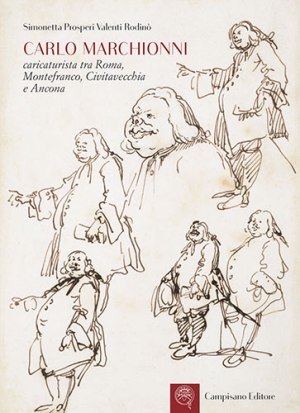 Carlo Marchionni (1702–1786) è assai noto per la sua attività di architetto e decoratore nel Settecento a Roma, città dove lavorò nelle imprese più significative del tempo: la Fabbrica e la Sacrestia di San Pietro, anche se la sua fama è legata alla celebre Villa Albani sulla via Salaria, da lui progettata per raccogliere la collezione di antichità del cardinal Alessandro Albani. Accanto a questa attività, Marchionni si dedicò anche alla caricatura, realizzando per suo divertimento un’ampia serie di divertenti studi caricaturali dedicati a personaggi d’ogni ambiente sociale del suo tempo: da gentiluomini ed ‘offiziali’, prelati e personaggi di Curia, artisti suoi colleghi incontrati all’Accademia di San Luca, quali l’architetto Barigioni, i pittori Benefial, Batoni e Monosilio, senza dimenticare servi, mendicanti, gobbi ed appartenenti alla più bassa categoria sociale, che ci offrono nel loro insieme uno spaccato interessantissimo della società romana del Settecento. Se le strade di Roma, fornirono il materiale umano più interessante all’occhio curioso dell’architetto, la sua vena satirica lo accompagnò anche nei suoi viaggi di lavoro a Civitavecchia ed Ancona, luoghi dove si soffermò a ritrarre figure di turchi, levantini e lavoranti portuali incontrati per caso. Una pausa serena gliela offrì la cittadina umbra di Montefranco, nei pressi di Terni, dove soggiornò con la sua famiglia in una tranquilla vacanza ospitato dall’amico Lorenzo Sinibaldi: lì ebbe modo di fissare in divertentissime vignette i personaggi più in vista del piccolo centro agricolo, dal Segretario comunale, ai villici, al barbiere, sino a fabbri, contadini e i caratteristici gobbi, da lui presi bonariamente in giro. Tre di questi tomi, ed indubbiamente i più significativi, sono confluiti nelle raccolte del Museo di Roma a Palazzo Braschi: insieme agli analoghi volumi, oggi conservati uno nella Biblioteca Palatina di Parma, l’altro nella Biblioteca Apostolica Vaticana, ed infine l’ultimo nel Département des Arts Graphiques del Louvre di Parigi, essi costituiscono il documento della produzione di caricature, davvero non secondaria, del più noto architetto attivo a Roma nel Settecento. Questo libro illustra tale attività, offrendo il catalogo completo delle ben 294 caricature conservate nei tre volumi del Museo di Roma.
Simonetta Prosperi Valenti Rodinò è professore ordinario di Storia dell’arte moderna all’Università di Roma Tor Vergata. Èspecialista del disegno italiano ed in particolare romano dal XVI al XVIII secolo, soggetto ai cui ha dedicato molti saggi in riviste italiane e straniere ed in cataloghi di mostre. Da anni approfondisce lo storia del collezionismo ed il mercato del disegno in Italia dei secoli XVII e XVIII. Le sue più recenti e significative pubblicazioni su questi soggetti sono i volumi Il Codice Resta di Palermo (2007), I disegni del Codice Capponiano 237 della Biblioteca Apostolica Vaticana (2010), Dilettanti del disegno nell’Italia del Seicento: padre Resta tra Malvasia e Magnavacca (2013). È uno dei curatori ed autori del volume di Atti del Convegno Maratti e l’Europa (Roma, 11–12 novembre 2013), di prossima pubblicazione.










 Enfilade
leave a comment