New Book | Mariette and the Science of the Connoisseur
From Ashgate:
Kristel Smentek, Mariette and the Science of the Connoisseur in Eighteenth-Century Europe (Aldershot: Asghate, 2014), 342 pages, ISBN: 978-1472438027, £70 / $120.
 Celebrated connoisseur, drawings collector, print dealer, book publisher, and authority on the art of antiquity, Pierre-Jean Mariette (1694–1774) was a pivotal figure in the eighteenth-century European art world. Focusing on the trajectory of Mariette’s career, this book examines the material practices and social networks through which connoisseurs forged the idea of art as an object of empirical and historical analysis. Drawing on significant unpublished archival material as well as on histories of science, publishing, collecting, and display, this book shows how Mariette and his colleagues’ practices of classification and interpretation of the graphic arts gave rise to new conceptions of artistic authorship and to a history of art that transcended the biographies of individual artists. To follow Mariette’s career through the eighteenth century is to see that art was consolidated as a specialized category of intellectual inquiry—and that style emerged as its structuring analytic device—in the overlapping spaces of the collector’s cabinet, the connoisseur’s portfolio, and the dealer’s shop.
Kristel Smentek is Associate Professor of Art History in the Department of Architecture at MIT.
◊ ◊ ◊ ◊ ◊
C O N T E N T S
Introduction: Art History and the 18th-Century Connoisseur
Knowledge Economies of the Print Trade
The Making of a Drawings Connoisseur
The Collector’s Cut
Origins: Of Antiquarianism, Aesthetics, and History
Conclusion: The Mariette Sales
Select Bibliography
Index
Exhibition | Treasures from India: Jewels from the Al-Thani Collection
Press release (21 October 2014) from The Met:
Treasures from India: Jewels from the Al-Thani Collection
The Metropolitan Museum of Art, New York, 28 October 2014 — 25 January 2015
Curated by Navina Haidar

Flask, 1650–1700, North India, Rock crystal, inlaid with gold wire, rubies, and emeralds, with gold collar, stopper, and foot, 9.2 x 5.5 cm (The Al-Thani Collection).
Some 60 jeweled objects from the private collection formed by Sheikh Hamad bin Abdullah Al-Thani will be presented at The Metropolitan Museum of Art in the exhibition Treasures from India: Jewels from the Al-Thani Collection, opening October 28. The presentation will provide a glimpse into the evolving styles of the jeweled arts in India from the Mughal period until the early 20th century, with emphasis on later exchanges with the West. The exhibition will be shown within the Metropolitan Museum’s Islamic art galleries, adjacent to the Museum’s own collection of Mughal-period art.
“It is with great delight that we present to the public this selection of works representing several centuries of tradition and craftsmanship in the jeweled arts—from India’s Mughal workshops to the ateliers of Paris,” Thomas P. Campbell , Director and CEO of the Metropolitan Museum, said when announcing the exhibition.
Sheikh Hamad stated: “The jeweled arts of India have fascinated me from an early age and I have been fortunate to be able to assemble a meaningful collection that spans from the Mughal period to the present day. I am delighted that The Metropolitan Museum of Art will be exhibiting highlights from the collection, making the subject known to a wider audience.”

Box (dibbi), 1740–80, North India; Jade, inlaid with gold wire, rubies, emeralds, and crystal, 4.2 x 10.8 x 10.2 cm (The Al-Thani Collection)
The display will include historical works from the Mughal period in the 17th century and from various courts and centers of the 18th and 19th centuries, including Hyderabad; a group of late 19th- and 20th-century jewels made for India’s Maharajas by Cartier and other Western firms; and contemporary commissions inspired by traditional Indian forms. On view will be several antique gems that were incorporated into modern settings by Maison Cartier, jewelry designer Paul Iribe, and others. Contextual information will be provided through historical photographs and portraits of Indian royalty wearing works similar to those on view.
India has been a vibrant center for the jeweled arts for many centuries, with its own mines yielding gold, diamonds, and many other precious and semiprecious stones. India’s Mughal rulers and their successors appreciated ceremonial and functional objects made of luxury materials. Among the Mughal works will be an elegant jade dagger originally owned by two emperors—the hilt was made for Jahangir and it was re-bladed for his son Shah Jahan, builder of the Taj Mahal. In the 19th century, the dagger was in the collection Samuel F. B. Morse, inventor of the Morse code. The hilt features a miniature sculpture—a European-style head.
Historically, the gem form favored throughout India has been the cabochon. In the traditional kundan technique, a gem is set within a bed of gold, and often backed in foil to enhance its color. Another highlight of the exhibition will be a gem-set tiger head finial originally from the throne of Tipu Sultan (1750–1799), which incorporated numerous cabochon diamonds, rubies, and emeralds in a kundan setting.

Huqqa Mouthpiece, 1750–1800, North India, Jade, inlaid with gold, rubies, and emeralds; 7.1 x 1.9 cm (The Al-Thani Collection)
Also on view will be several examples of North Indian sarpesh and jigha (turban ornaments) from 1875–1900, brought together in a display that traces their evolution from traditional plume-inspired forms and techniques toward more Western shapes and construction. Silver foil backing was used; however, the diamonds were set using a Western-style claw or coronet, rather than the kundan setting. And a work designed by the artist Paul Iribe and made by goldsmith Robert Linzeler in 1910 in Paris recalls the kind of aigrette (decorative pin) that would have ornamented the turban of a Maharaja or Nizam. At the center is a large emerald, carved in India between 1850 and 1900.
The exhibition is organized by Navina Haidar, Curator, Islamic Art Department. Exhibition design is by Michael Batista, Exhibition Design Manager; graphics are by Sophia Geronimus, Graphic Design Manager; and lighting is by Clint Ross Coller and Richard Lichte, Graphic Design Managers, all of the Museum’s Design Department. The exhibition is made possible by Cartier.
The exhibition will be accompanied by a catalogue published by the Metropolitan Museum and distributed by Yale University Press. Written by Navina Haidar, with a foreword by Sheila Canby, the Patti Cadby Birch Curator in Charge of the Department of Islamic Art, and contributions from Courtney Stewart, Senior Research Assistant, it draws on a study of the collection called Beyond Extravagance, edited by Amin Jaffer, that was printed by Assouline Publishing in 2013.
◊ ◊ ◊ ◊ ◊
From Yale UP:
Navina Najat Haidar and Courtney Ann Stewart, Treasures from India: Jewels from the Al-Thani Collection (New York: The Metropolitan Museum of Art, 2014), 144 pages, ISBN: 978-0300208870, $40.
 India’s rich tradition of jeweled arts has produced extravagant and opulent creations that range from ornaments for every part of the body to ceremonial court objects such as boxes, daggers, and thrones. Starting with the Mughal rulers of India (1526–1858) and continuing to the present day, this artistic practice is characterized by an abundance of costly materials such as gold, ivory, jade, and precious stones of astounding size and quality, which artists have used to create unique and valuable works.
Treasures from India presents 60 iconic works from the world-renowned Al-Thani collection, accompanied by a text that introduces readers to their significance within the history of Indian jeweled arts. Included are some of the earliest pieces created for the imperial Mughals in the 16th century, others made for Maharajahs of the 18th through 20th centuries, and later Indian-inspired works created by Cartier in the 20th century. These examples represent the range and scope of the finest expression of the jeweled arts in India, and stand among the highest expressions of Indian culture and artistry.
Navina Najat Haidar is curator and administrator, and Courtney Ann Stewart is senior research assistant, both in the Department of Islamic Art at The Metropolitan Museum of Art.
New Book | James Barry’s Murals at the Royal Society of Arts
James Barry’s Murals at the Royal Society of Arts: Envisioning a New Public Art will be launched at the Royal Society of Arts in London on December 9th and at the Crawford Art Gallery in Cork on December 3rd. From Cork UP:
William L. Pressly, James Barry’s Murals at the Royal Society of Arts: Envisioning a New Public Art (Cork: Cork University Press, 2014), 384 pages, ISBN: 978-1782051084, €49 / $66.
 Between 1777 and 1784, the Irish artist James Barry (1741–1806) executed six murals for the Great Room of the Society of Arts in London. Although his works form the most impressive series of history paintings in Great Britain, they remain one of the British art world’s best kept secrets, having attracted little attention from critics or the general public. James Barry’s Murals at the Royal Society of Arts is the first to offer an in-depth analysis of these remarkable paintings and the first to demonstrate that the artist was pioneering a new approach to public art in terms of the novelty of the patronage and the highly personal nature of his content. Barry insisted on, and received, complete control over his subject matter, the first time in the history of Western art that the patron of a large, impressive interior agreed to such a demand. The artist required autonomy in order to present his personal vision, which encompasses a complex surface narrative as well as a hidden meaning that has gone unperceived for 230 years. The artist disguised his deeper message due to its inflammatory nature. Were his meaning readily apparent, the Society would have thrown out him and his murals.
Ultimately, as this book seeks to show, the artist intended his paintings to engage the public in a dialogue that would utterly transform British society in terms of its culture, politics, and religion. In making this case, the book brings this neglected series into the mainstream of discussions of British art of the Romantic period, revealing the intellectual profundity invested in the genre of history painting and re-evaluating the role Christianity played in Enlightenment thought.
William L Pressly is Emeritus Professor of Eighteenth- and Nineteenth-Century European Art at the University of Maryland. He is the author of James Barry: The Life and Art of James Barry (Yale University Press, 1981) and James Barry: the Artist as Hero (Tate Gallery, 1983).
Exhibition | Ornements: Chefs-d’oeuvre de la Collection Jacques Doucet
From INHA:
Ornements, XVe-XVIIIe Siècles: Chefs-d’oeuvre de la Collection Jacques Doucet
Institut national d’histoire de l’art, Galerie Colbert, Paris, 2 October — 31 December 2014
 La Bibliothèque de l’Institut national d’histoire de l’art, héritière de la Bibliothèque d’art et d’archéologie créée par le couturier Jacques Doucet (1853–1929) à partir de 1908, est aujourd’hui riche de plus de 25 000 estampes d’ornement, réunies en près de 700 volumes. Son fonds d’estampes couvre la production, tant française qu’italienne ou allemande, du XVIe au XVIIIe siècle. Sources importantes pour les historiens des arts décoratifs, de l’architecture, de l’estampe, ces œuvres ont fait l’objet d’un catalogage informatisé et d’une numérisation, dans le cadre du programme « Histoire de l’ornement » de l’INHA. L’exposition, organisée dans la salle Roberto Longhi de la Galerie Colbert, correspond à l’achèvement de ce programme et à la parution d’un livre consacré à la collection d’estampes d’ornement de l’INHA, publié en coédition par Mare et Martin et l’INHA.
À travers la présentation d’une cinquantaine d’estampes, où se déploie une multiplicité de motifs (rinceaux, frises, fleurs, volutes, grotesques, trophées, cuirs…), l’exposition permet d’éclairer les fonctions de l’estampe d’ornement, mais aussi le contexte de sa production et de sa diffusion, et enfin, son statut d’objet d’étude et de collection. Sont particulièrement mis en valeur les points forts de la collection Doucet, telles les estampes allemandes des XVIe–XVIIe siècles (Martin Schongauer, Virgil Solis, Albrecht Dürer), les gravures d’orfèvres « cosses de pois » du premier XVIIe siècle (Jean Toutin), mais aussi les estampes françaises du XVIIIe siècle représentant rocailles et chinoiseries (Pillement, Huquier), ainsi que leurs copies européennes. Des objets d’art permettent de resituer la place de l’estampe au sein du processus de création. Enfin, reliures remarquables, états rares, épreuves coloriées, illustrent l’histoire des praticiens, amateurs ou collectionneurs de ces estampes, tel Edmond Foulc, dont la collection fut acquise par Jacques Doucet en 1914.
Commissariat
Michaël Decrossas, Lucie Fléjou
Remerciement
Jérémie Cerman, Rose-Marie Chapalain, Sophie Derrot, Elli Doulkaridou, Ludovic Jouvet, Léonie Marquaille, Étienne Tornier, Céline Ventura-Teixeira, qui par leur travail de catalogage des recueils d’ornement des collections Jacques Doucet de la Bibliothèque de l’INHA permettent aujourd’hui cette exposition. Ainsi que la Cité de la céramique, Sèvres & Limoges, musée national de Sèvres et Les Arts Décoratifs pour leurs prêts.
◊ ◊ ◊ ◊ ◊
From INHA:
Michaël Decrossas and Lucie Fléjou, eds, Ornements, XVe–XIXe Siècles: Chefs-d’œuvre de la Bibliothèque de l’INHA, Collections Jacques Doucet (Paris: INHA-Mare & Martin, 2014), 384 pages, ISBN: 979-1092054378, 37€.
 Marquant l’aboutissement d’un programme de recherche porté par l’Institut national d’histoire de l’art depuis 2010, cet ouvrage réunit vingt-six essais abordant quelques-unes des questions les plus intéressantes posées par l’ornement entre le XVIe et le XIXe siècle, et sa place dans l’histoire de l’art, qu’il s’agisse des estampes d’ornement ou des styles d’ornement (rococo, rocaille, « à l’antique »), ou encore d’artistes comme Jean Lemoyne, Gabriel Huquier, Charles Percier et Pierre-François-Léonard Fontaine. Un chapitre de l’ouvrage est consacré à Jacques Doucet, le grand couturier collectionneur qui est à l’origine de la Bibliothèque de l’INHA, laquelle conserve un fonds exceptionnel d’environ 25 000 estampes d’ornement.
Avec la collaboration de Jean-François Bédard (Syracuse University, New York), Michèle Bimbenet-Privat (musée du Louvre), Jean-Gérald Castex (Cité de la céramique – Sèvres & Limoges), Jérémie Cerman (université Paris-Sorbonne), Catherine Chédeau (université de Franche-Comté), Michaël Decrossas (INHA), Marzia Faietti (Galleria degli Uffizi), Lucie Fléjou (INHA), Rossella Froissart (université de Provence), Jean-Philippe Garric (université Paris 1 Panthéon-Sorbonne), Marianne Grivel (université Paris-Sorbonne), Caroline Heering (université catholique de Louvain), Rémi Labrusse (université Paris Ouest Nanterre La Défense), Corinne Le Bitouzé (Bibliothèque nationale de France), Guy-Michel Leproux (École pratique des hautes études), Estelle Leutrat (université de Rennes 2), Marie-Pauline Martin (université de Provence), Véronique Meyer (université de Poitiers), Christian Michel (université de Lausanne), Odile Nouvel-Kammerer (musée des Arts décoratifs), Anne Perrin-Khelissa (université de Toulouse II – Le Mirail), Antoine Picon (Harvard University), Sébastien Quéquet (musée des Arts décoratifs), Kristel Smentek (MIT, Massachusetts), Carsten-Peter Warncke (Georg-August-Universität Göttingen)
New Book | The Manufacture des Gobelins under Louis XIV
From ArtBooks.com:
Florian Knothe, The Manufacture des meubles de la couronne aux Gobelins under Louis XIV: A Social, Political, and Cultural History (Turnhout: Brepols, 2014), 350 pages, ISBN: 978-2503553207, $150 / 100€.
 The cultural importance, dependencies and mechanics of manufacture in Europe prior to the Industrial Revolution are understudied areas of research. In the case of French royal manufacture during the ancien régime, art-historical interest first awakened in the latter half of the nineteenth century with the publication of several descriptive texts that made archival sources available to a wider public. This volume on the Manufacture royale des meubles de la couronne aux Gobelins examines the current state of research on the royal workshops and indicates the manner by which this research can both extend and challenge the prevailing trends in the historiography of the Gobelins (Studies in Western Tapestry 8).
Florian Knothe is Director of the University Museum and Art Gallery at the University of Hong Kong, where he also occupies a part-time appointment as Honorary Associate Professor.
New Book | Scottish Pewter, 1600–1850
From Birlinn Limited:
Peter Spencer Davies, Scottish Pewter, 1600–1850 (Edinburgh: John Donald, 2014), 304 pages, ISBN: 978-1906566722, £55.
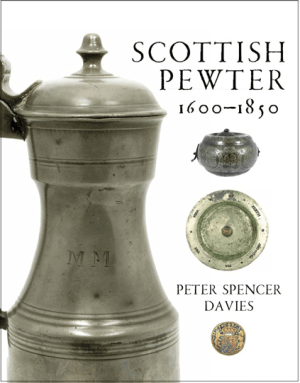 Pewter was in common use in most households, churches and places of commerce in Europe for hundreds of years before it gradually fell out of favour as more modern materials became available. Scottish pewter wares have an intrinsic interest, being quite different from those of England. In particular, they have a simple beauty arising from the plain functionality of form, reflective of the Protestant culture of Scotland at the time. However, despite its historical importance Scottish pewter has remained one of the least understood areas of the country’s material heritage.
Now, expert Peter Spencer Davies has produced what will be the definitive guide to the subject. This engaging book takes the reader through the development of the craft from its sixteenth-century beginnings, and making extensive use of otherwise inaccessible archival material, brings to life the role of the pewterers and their wares in the socio-economic history of the country. Lavishly illustrated throughout, the book offers a comprehensive guide to the metal, the manufacturing procedures of the pewterers, and provides examples of all known types of object that they made. One of the objectives has been to facilitate the identification of any item, together with the name of the maker, date, and place of manufacture. To this end, the book has detailed appendices, which include illustrations of all known makers’ marks.
Peter Spencer Davies, PhD, FSA Scot, had a professional life as an academic (biologist) at the University of Glasgow. Now retired, he pursues a lifelong interest in English and Scottish pewter. He is a Past-President of the Pewter Society, and has had articles published in the Proceedings of the Society of Antiquities of Scotland, Journal of the Pewter Society, and Connoisseur magazine. He is an expert in the conservation and restoration of old pewter.
New Book | The Scottish Town in the Age of the Enlightenment
From Edinburgh UP:
Bob Harris and Charles McKean, The Scottish Town in the Age of the Enlightenment, 1740–1820 (Edinburgh: Edinburgh University Press, 2014), 640 pages, (hardcover) ISBN: 978-0748692569, $165 / (softcover) ISBN: 978-0748692576, $50.
 This heavily illustrated and innovative study is founded upon personal documents, town council minutes, legal cases, inventories, travellers’ tales, plans and drawings relating to some 30 Scots burghs of the Georgian period. It establishes a distinctive history for the development of Scots burghs, their living patterns and legislative controls, and shows that the Scottish urban experience was quite different from other parts of Britain.
With population expansion, and economic and social improvement, Scots of the time experienced immense change both in terms of urban behaviour and the decay of ancient privileges and restrictions. This volume shows how the Scots Georgian burgh developed to become a powerfully controlled urban community, with disturbance deliberately designed out.
This is a collaborative history, melding together political, social, economic, urban and architectural histories, to achieve a comprehensive perspective on the nature of the Scottish Georgian town. Not so much a history by growth and numbers, this pioneering study of Scottish urbanization explores the type
of change and the quality of result.
Bob Harris is a lecturer in British History at the University of Oxford. He is a prolific historian who has written on many aspects of British politics and social and cultural history in the eighteenth and early nineteenth centuries. His publications include: A Patriot Press (Oxford, 1993); Politics and the Nation: Britain in the Mid-Eighteenth Century (Oxford, 2002); and Scotland in the Age of the French Revolution (Edinburgh, 2005).
The late Charles McKean was Professor of Scottish Architectural History at the University of Dundee and considered the pre-eminent historian of Scottish buildings and towns. He is author of: The Scottish Thirties: An Architectural Introduction (Scottish Academic Press, Edinburgh, 1987); For a Wee Country: Architectural Contributions to Scotland since 1840 (RIAS, Edinburgh, 1990); Edinburgh Portrait of a City (Century, London, 1993); and The Making of the Museum of Scotland (NMS, Edinburgh, 2000).
◊ ◊ ◊ ◊ ◊
C O N T E N T S
Introduction
Part I: Towns and Improvement
1 Scottish towns in context
2 Urban improvement
3 Urban embellishment and public buildings
4 A tale of five towns
Part II: Society and Culture
5 Middling ranks, homes and possessions
6 Cultural life: transformation and adaptation
7 ‘Community’, order, and the stability of the burgh
Conclusion
Appendix: Improvement Profiles
Bibliography
Index
New Book | Paintings in the Collection of the Society of Antiquaries
Forthcoming from Brepols:
Jill Franklin, Bernard Nurse, and Pamela Tudor-Craig, Catalogue of Paintings in the Collection of the Society of Antiquaries of London (Turnhout: Harvey Miller, 2014), 520 pages, ISBN: 978-1909400191, $285 / 200€.
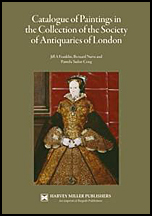 The paintings owned by the Society of Antiquaries of London are important for the quality of some of the individual paintings and for the collection as a whole. Before England’s National Portrait Gallery was founded, the Society pioneered the study of royal portraiture, seeking to establish the true likenesses of the Tudor and Plantagent monarchs and some of their continental counterparts. In the words of Sir Roy Strong, the Society’s early portraits are “of the utmost national importance … next to the Royal Collection, the most important series of early sixteenth-century royal portraits to survive as a group.” They are joined in this scholarly catalogue raisonée by works that have been exhibited in Europe’s major museums: among them are Hans Eworth’s portrait of Mary I, Simone dei Crocifissi’s Dream of the Virgin, an outstanding example of fourteenth-century Bolognese Gothic art now on long-term loan to the National Gallery, and portraits of Daniel and Rebecca Minet by Thomas Gainsborough. This fully illustrated catalogue, wedded to meticulous scholarship and the results of the latest scientific dating techniques, ensures that the art historical world now has access to art that will be studied and discussed for many years to come.
New Book | Moving Pictures: Intra-European Trade in Images
Available from ArtBooks.com:
Neil De Marchi and Sophie Raux, eds., Moving Pictures: Intra-European Trade in Images, 16th–18th Centuries (Turnhout: Brepols, 2014), 340 pages, ISBN: 978-2503548081, $135 / 91€.
 This collection examines the volume, contexts, and mechanisms of trade in visual images in Early Modern Europe. Focusing overtly on the internal dynamics and links between art markets in the Early Modern period, it presupposes that art objects—here visual images—are objects of desire. During this period, however, desire changed; a great deal more of these objects came to be made for ordinary domestic consumption, including devotional purposes, than as tokens of the magnificence, piety, cultivation, or learning of individual commissioners. Probably most still were commissioned, but to satisfy tastes that, though differentiated internationally, were widely shared within one country or region. Most too were commissioned at a distance, by agents, and were moved between maker and end-point distributor by specialised traders, many of whom—though far from all—were large-scale operators. The dominant focus of contributors here is therefore on the agents of this distance trade, its mechanisms, and its impacts in terms of both satisfying and subtly shaping tastes at a range of prices. Measurement and mappings are aspects of this traffic. Focus was sharpened by concentrating on three questions: what is currently known about the number of images, whether in the form of paintings, prints, small sculptures or woven textiles, that circulated in early modern Europe? Through what channels and networks were they distributed? And what were the economic, social and institutional contexts?
Neil De Marchi is Professor of Economics at Duke University. His recent writing has been on the circumstances in which key players in contemporary art markets operate and the behaviours that stem from these constraints.
Sophie Raux is Associate Professor of Early Modern Art History at the University of Lille (France). Her research focuses mostly on the circulation and consumption of images and art objects in the Southern Low Countries and France.
◊ ◊ ◊ ◊ ◊
C O N T E N T S
• K. Brosens, Quality, Risk and Uncertainty and the Market for Brussels Tapestry, 1450–1750
• N. De Marchi (et al), Supply-Demand Imbalance in the Antwerp Painting Market, 1630–1680
• M. Szanto, The Pont Notre-Dame, Heart of the Picture Trade in France, 16th–18th Centuries
• S. Raux, Circulation, Distribution and Consumption of Antwerp Paintings in the Markets of the Southern Netherlands and Northern France, 1570–1680
• C. Rasterhoff, The Zeeland Connection: The Art Trade between the Northern and Southern Netherlands during the Seventeenth Century
• N. Gozzano, From Flanders to Sicily: The Network of Flemish Dealers in Italy and the International Art Market in the Seventeenth Century
• I. Cecchini, Going South: The Space for Flemish Art Dealers in Seventeenth-Century Northern Italy
• P. Michel, Paris, Market of Europe: Russian and English Buyers on the Paris Market in the Second Half of the Eighteenth Century
• C. Guichard, Small Worlds: The Auction Economy in the Late Eighteenth-Century Paris Art Market
• B. Miyamoto, Bidding as a Guide to British Visual Preference: A Late Eighteenth-Century Case Study
• D. Lyna, Towards an Integrated Market? The Austrian Netherlands and the Western European Trade in Pre-Owned Paintings, 1750–1800
New Book | Delicious Decadence
From Ashgate:
Christoph Vogtherr, Monica Preti, and Guillaume Faroult, eds., Delicious Decadence: The Rediscovery of French Eighteenth-Century Painting in the Nineteenth Century (Aldershot: Ashgate, 2014), 210 pages, ISBN: 978-1472449214, £55 / $100.
 The history of collecting is a topic of central importance to many academic disciplines, and shows no sign of abating in popularity. As such, scholars will welcome this collection of essays by internationally recognised experts that gathers together for the first time varied and stimulating perspectives on the nineteenth-century collector and art market for French eighteenth-century art, and ultimately the formation of collections that form part of such august institutions as the Louvre and the National Gallery in London. The book is the culmination of a successful conference organised jointly between the Wallace Collection and the Louvre, on the occasion of the acclaimed exhibition Masterpieces from the Louvre: The Collection of Louis La Caze. Exploring themes relating to collectors, critics, markets and museums from France, England and Germany, the volume will appeal to academics and students alike, and become essential reading on any course that deals with the history of collecting, the history of taste and the nineteenth-century craze for the perceived douceur de vivre of eighteenth-century France. It also provides valuable insight into the history of the art markets and the formation of museums.
Christoph Martin Vogtherr has been Director of the Wallace Collection since 2011 and was previously Curator of Pictures pre-1800. Before joining the Collection he was Paintings Curator at the Foundation of Prussian Palaces and Gardens, Potsdam, Germany (1998–2007). In 2010 he published the catalogue raisonné of paintings by Watteau, Pater and Lancret in Berlin and Potsdam and, more recently, on Antoine Watteau, French eighteenth-century collecting and the Fête galante.
Monica Preti is an art historian who received her PhD in History and Civilization at the European University Institute (Fiesole, Florence). She is a former Research fellow at the Institut national d’histoire de l’art (Paris), and since 2006 she is Head of Academic Programs (History of Art and Archeology) at the Louvre’s Auditorium. Her research focuses on the history of taste, collections and museums in the eighteenth and nineteenth centuries.
Guillaume Faroult is Senior Curator at the Musée du Louvre in charge of French Paintings of the Eighteenth Century and British Paintings. He has curated many major exhibitions in these fields and in 2007 edited a catalogue raisonné of the paintings (mostly French of the eighteenth century) from the collection of Louis La Caze, now at the Louvre. He has published extensively about David, Fragonard and French eighteenth- and nineteenth-century collecting.
◊ ◊ ◊ ◊ ◊
C O N T E N T S
• Introduction, Christoph Martin Vogtherr
• The ‘rediscovery’ of 18th-century French painting before La Caze: Introductory notes, Monica Preti
• The taste for 18th-century painting and art market between 1830 and 1860 as regards the La Caze collection, Marie-Martine Dubreuil
• Watteau and Chardin, ‘the two most truly painters of the entire French School’: The rediscovery of Watteau and Chardin in France between 1820 and 1860, Guillaume Faroult
• Collectors of 18th-century French art in London: 1800–1850, Jon Whiteley
• ‘Elegant depravity and irresponsible gaiety’: The Murray of Henderland Collection and the Scottish taste for French 18th-century art, Frances Fowle
• ‘Ah! Que c’est francais!’: Thoré-Bürger and 18th-century French art, Frances Suzman Jowell
• Aesthetic, economic and political issues of the 1860 exhibition: Paintings of the French School from private collections, Pauline Prévost-Marcilhacy
• Early exhibitions of French 18th-century art in Berlin and the birth of Watteau research, Christoph Martin Vogtherr
• The National Gallery in the 19th century and French 18th-century painting, Humphrey Wine
• French 18th-century painting in England and the opening of the Wallace Collection, Stephen Duffy










 Enfilade
leave a comment