New Book | The Country House: Material Culture and Consumption
From English Heritage:
Andrew Hann and Jon Stobart, eds., The Country House: Material Culture and Consumption (Swindon: English Heritage, 2014), 256 pages, ISBN: 978-1848022331, £70.
 This book presents a series of conference papers exploring the material culture of the country house and its presentation to the public. There is an academic interest in the consumption practices of the elite as well as in the country house as a lived and living space that was consciously transformed according to fashion and personal taste. Importantly there is also a concern amongst curators to present a coherent narrative of historic properties and their contents to the modern visitor.
The proceeding address a number of current academic debates about elite consumption practices and the role of landed society as arbiters of taste. By looking at the country house as lived space, many of the papers throw up interesting questions about the accumulation and arrangement of objects, the way in which rooms were used and experienced by both owners and visitors, and how this sense of ‘living history’ can be presented meaningfully to the public.
Andrew Hann is Properties Historians’ Team Leader at English Heritage; Jon Stobart is Professor of History at the University of Northampton.
New Book | Style and Satire: Fashion in Print, 1777–1927
From Artbooks.com:
Catherine Flood and Sarah Grant, Style and Satire: Fashion in Print, 1777–1927 (London: V&A Publishing, 2014), 80 pages, ISBN: 978-1851778034, £13 / $20.
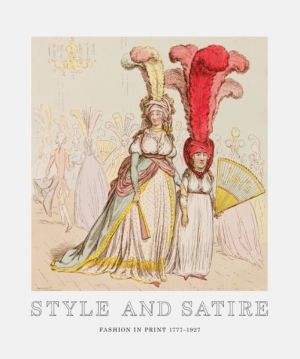 From the sky-high coiffures of Marie Antoinette to Victorian hoop skirts, from the sheer gowns of Pride and Prejudice era to the flat-chested 1920s flapper, Style and Satire tells the story of European fashion and its most extreme trends through lavish fashion plates and the glorious satirical prints they inspired.
Beautifully printed, hand-colored fashion plates first appeared in magazines and for sale individually in the late 18th century. At the same time (and often by the same artists), satirical prints gloried in the absurdities of fashion, presenting an alternative, often humorously exaggerated, vision of the fashionable ideal. Both forms were a product of the same print market, and both documented modern life. Lavishly illustrated, Style and Satire presents a witty and original history of fashion trends.
Catherine Flood is a prints curator, and Sarah Grant is a curator in the Word and Image Department of the V&A.
A digital preview is available here»
New Book | Wallpaper in Ireland, 1700–1900
As noted in Wallpaper News, Issue #5 (September 2014), an occasional newsletter edited by Robert Kelly, Churchill House Press has recently published this book by David Skinner, with proceeds benefitting the Irish Georgian Society:
David Skinner, Wallpaper in Ireland, 1700–1900 (Churchill House Press, 2014), 216 pages, ISBN: 978-0955024672, €45 / £35.
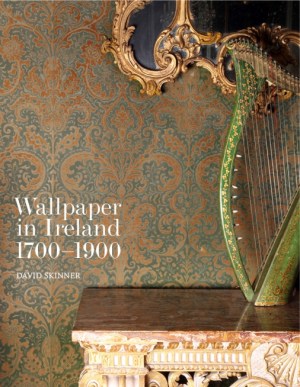 This lavishly illustrated book is the first devoted to the subject of the manufacture and use of wallpaper in Ireland. Drawing on his extensive experience both as a maker and a researcher of historic wallpapers, David Skinner has compiled a detailed survey of the patterns used to decorate Irish houses from the early eighteenth century until the demise of the Irish ‘paper-staining’ trade at the close of the nineteenth century. Journals, letters, invoices and newspaper advertisements are among the sources explored to chart the history of wallpaper in Ireland, the role of emigrant Irish artisans in developing wallpaper manufacture in France and North America, the tax on wallpaper, and the trade in smuggled wallpaper between Ireland and Victorian England.
The book will provide an invaluable guide to researchers, architects and those involved in the study of historic interiors. Many of the rooms illustrated are published here for the first time, and include little-known examples of the sumptuous wallpapers imported from China and France, set alongside the
products of native ‘paper-stainers’.
Robert O’Byrne provides a brief review in The Irish Times
(5 July 2014).
New Book | Material Goods, Moving Hands
From Manchester University Press:
Kate Smith, Material Goods, Moving Hands: Perceiving Production in England, 1700–1830 (Manchester: Manchester University Press, 2014), 208 pages, ISBN: 978-0719090677, £70 / $105.
 In eighteenth-century Britain, greater numbers of people entered the marketplace and bought objects in ever-greater quantities. As consumers rather than producers, how did their understandings of manufacturing processes and the material world change?
Material Goods, Moving Hands combines material culture and visual culture approaches to explore the different ways in which manufacturers and retailers presented production to consumers during the eighteenth century. It shows how new relationships with production processes encouraged consumers, retailers, designers, manufacturers and workers to develop conflicting understandings of production. Objects then were not just markers of fashion and taste, they acted as important conduits through which people living in Georgian Britain could examine and discuss their material world and the processes and knowledge that rendered it.
Kate Smith was a Research Fellow on The East India Company at Home, 1757–1857, a 3-year Leverhulme Trust-funded research project based in the Department of History at the University of Warwick (2011–12) and University College London (2012–14).
She is now Lecturer in Eighteenth-Century History at the
University of Birmingham.
◊ ◊ ◊ ◊ ◊
C O N T E N T S
Introduction
1. New ways of looking
2. Visual access to production
3. Listening in to the manufacturing world
4. Picturing production and embodying knowledge
Conclusion
Bibliography
Index
New Book | Art, Artisans, and Apprentices
From Oxbow Books:
James Ayres, Art, Artisans, and Apprentices: Apprentice Painters and Sculptors in the Early Modern British Tradition (Oxford: Oxbow Books, 2014), 536 pages, ISBN: 978-1782977421, £35.
 Before the foundation of academies of art in London in 1768 and Philadelphia in 1805, most individuals who were to emerge as artists trained in workshops of varying degrees of relevance. Easel painters began their careers apprenticed to carriage, house, sign, or ship painters, whilst a few were placed with those who made pictures. Sculptors emerged from a training as ornamental plasterers or carvers. Of the many other trades in a position to offer an appropriate background were ‘limning’, staining, engraving, surveying, chasing, and die-sinking. In addition, plumbers gained the right to use oil painting and, for plasterers, the application of distemper was an extension of their trade. Central to the theme of this book is the notion that, for those who were to become either painters or sculptors, a training in a trade met their practical needs. This ‘training’ was of an altogether different nature to an ‘education’ in an art school. In the past, prospective artists were offered, by means of apprenticeships, an empirical rather than a theoretical understanding of their ultimate vocation.
James Ayres provides a lively account of the inter-relationship between art and trade in the late 17th to early 19th centuries, in both Britain and North America. He demonstrates with numerous, illustrated examples, the many cross-overs in the ‘art and mystery’ of artistic training, and, to modern eyes, the sometimes incongruous relationships between the various trades that contributed to the blossoming of many artistic careers, including some of the most illustrious names of the ‘long 18th century’.
More information is available here»
◊ ◊ ◊ ◊ ◊
C O N T E N T S
Acknowledgements
Introduction
I. Crafts, Trades, Artisans, and Guilds
1. Art and mystery
2. The guilds and livery companies
3. Guild regulation and training
4. Indentured apprenticeships
5. The craft trades and the visual arts
II. Painters
6. The art of picture craft
7. The materials of painters
8. Painter stainers
9. The painters: mechanic and liberal
10. Easel painting
11. The trade of painting in oil: House and decorative painting, Sign painting and making, Coach painting, Marine painting
12. Size painting: Stained hangings, Stained transparencies, Scene painting for the theatre, The plasterers
13. Limning and watercolour painting
III. Sculptors, Carvers, and Related Trades
14. Sculpture
15. Modelling and casting in plaster: Modelling in clay, Casting in plaster
16. The pointing machine
17. Carving: Woodcarving, Stone and marble carving
18. Metalwork and related trades: The foundry, Chasers and chasing, Die-sinking and seal-cutting
IV. Academies of Art and the Foundations of Artistic Professions
19. The origin and function of academies of art
20. Conclusion
Appendices
I. Indenture of 1788: Isaac Dell
II. Advertisement for a Stationer and Picture Dealer, c. 1750–1759
III. Samuel Wale (?–d. 1786) as sign painter
IV. Charles Catton (1728–1798) ‘The Prince of Coach Painters’
V. John Baker RA (1736–1771), coach painter
VI. Luke (Marmaduke) Cradock (1660–1717) the ‘Ornamental Painter’
VII. Sign painting in Colonial and early Federal America
VIII. Prices of house painters’ work of 1799
IX. Stained hangings: early seventeenth and eighteenth century
X. A sampling of individual painters or sculptors who left the English Provinces for Apprenticeships in London, Westminster, or Southwark
XI. Some of the many woodcarvers who later worked in stone and marble
XII. The construction of an armature in John Flaxman’s studio
XIII. Prices in 1797 for ship-carving on Royal Navy vessels in relationship to tonnage
XIV. Price list for lead statuary
XV. Some members of the St Martin’s Lane Academy
XVI. Proposed accommodation and prospectus for the Royal Academy Schools
XVII. Part of Gustav Waagen’S (1794–1868) evidence before the Select Committee of the House of Commons in 1834, on the value of Academies of Art
Glossary
Bibliography
Index
New Book | Art and Migration: Netherlandish Artists on the Move
From Brill:
Frits Scholten, Joanna Woodall and Dulcia Meijers, eds., Art and Migration: Netherlandish Artists on the Move, 1400–1750 (Brill, 2014), 384 pages, ISBN: 978-9004270534, €120 / $154. [Netherlands Yearbook for History of Art / Nederlands Kunsthistorisch Jaarboek 63 (2013)]
 Since the Middle Ages artists from the Low Countries were known to be fond of travelling, as Guicciardini in his Descrittione di tutti i Paesi Bassi (Antwerp, 1567) and Karel van Mander in his 1604 Schilderboeck, already noticed. Much more mobile than their colleagues from other European countries, many Netherlandish artists spread all over Europe; a remarkable number among them achieved great fame as court artists, as the careers of Claus Sluter in Burgundy, Anthonis Mor in Spain, Bartholomeus Spranger or Adriaen de Vries in Prague, Giambologna and Jacob Bijlevelt in Florence demonstrate. Moreover, they exerted considerable influence on the artistic production of their time. Nevertheless, most of them sank into oblivion soon after they died. Dutch art history neglected them for a long time as they did not fit into the traditional canon of the Low Countries; nor were they adopted by the art histories of their new homelands. This new NKJ volume is an
attempt to change this.
C O N T E N T S
1. Frits Scholten and Joanna Woodall, Introduction
2. Filip Vermeylen, Greener pastures? Capturing artists’ migrations during the Dutch Revolt
3. Hope Walker, Netherlandish immigrant painters and the Dutch reformed church of London, Austin Friars, 1560–1580
4. Arjan de Koomen, ‘Una cosa non meno maravigliosa che honorata’: The expansion of Netherlandish sculptors in sixteenth-century Europe
5. Franciszek Skibiński, Early-modern Netherlandish sculptors in Danzig and East-Central Europe: A study in dissemination through interrelation and workshop practice
6. Aleksandra Lipińska, Eastern outpost: The sculptors Herman Van Hutte and Hendrik Horst in Lviv, c. 1560–1610
7. Gert Jan van der Sman and Bouk Wierda, Wisselend succes: De loopbanen van Nederlandse en Vlaamse kunstenaars in Florence, 1450–1600
8. Marije Osnabrugge , From itinerant to immigrant artist: Aert Mytens in Naples
9. Abigail D. Newman, Juan de la Corte in Madrid: ‘branding’ Flanders abroad
10. Judith Noorman, A fugitive’s success story: Jacob van Loo in Paris, 1661–1670
11. Isabella di Lenardo, Carlo Helman, merchant, patron and collector, and the role of family ties in the Antwerp–Venice migrant network
12. Saskia Cohen-Willner, Between painter and painter stands a tall mountain: Van Mander’s Italian Lives as a source for instructing artists in the ‘deelen der consten’
Exhibition | Habsburg Splendor
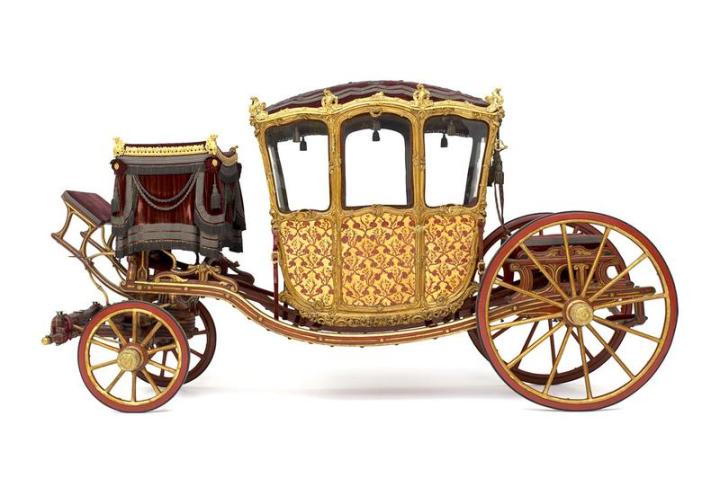
The Prince’s Dress Carriage, ca. 1750–55
(Vienna: Kunsthistorisches Museum)
◊ ◊ ◊ ◊ ◊
It’s still too early to get a good sense of what’s included from the eighteenth century, but we’re sure to hear lots more about the exhibition in the coming months, particularly if you live anywhere near Minneapolis, Houston, or Atlanta. It really should be an extraordinary show. –CH
Press release (18 April 2014) from the MFAH:
Habsburg Splendor: Masterpieces from Vienna’s Imperial Collections
Minneapolis Institute of Arts, 15 February — 10 May 2015
Museum of Fine Arts, Houston, 14 June — 13 September 2015
High Museum of Art, Atlanta, 18 October 2015 — 17 January 2016
Curated by Monica Kurzel-Runtscheiner
In 2015, a major American collaboration will bring masterworks amassed by one of the longest-reigning European dynasties to the United States. Habsburg Splendor: Masterpieces from Vienna’s Imperial Collections showcases masterpieces and rare objects from the collection of the Habsburg Dynasty—the emperors of the Holy Roman Empire and other powerful rulers who commissioned extraordinary artworks now in the collection of the Kunsthistorisches Museum in Vienna. The exhibition, largely composed of works that have never traveled outside of Austria, will be on view at the Minneapolis Institute of Arts (MIA); the Museum of Fine Arts, Houston (MFAH); and the High Museum of Art, Atlanta.
Debuting in Minneapolis in February 2015 before traveling to Houston and Atlanta, Habsburg Splendor: Masterpieces from Vienna’s Imperial Collections explores the dramatic rise and fall of the Habsburgs’ global empire, from their political ascendance in the late Middle Ages to the height of their power in the 16th and 17th centuries, the expansion of the dynasty in the 18th and 19th centuries to its end in 1918 with the conclusion of World War I. The 93 artworks and artifacts that tell the story include arms and armor, sculpture, Greek and Roman antiquities, court costumes, carriages, decorative-art objects, and paintings by such masters as Correggio, Giorgione, Rubens, Tintoretto, Titian, and Velázquez. Key masterpieces that have never before traveled to the United States include:
• The Crowning with Thorns (c. 1602/04) by Caravaggio
• A portrait of Jane Seymour (1536), Queen of England and third wife to Henry VIII, by Hans Holbein the Younger
• Jupiter and Io (c. 1530/32) by Correggio . . . .
Habsburg Splendor: Masterpieces from Vienna’s Imperial Collections chronicles the Habsburgs’ story in three chapters, each featuring a three-dimensional “tableau”—a display of objects from the Habsburgs’ opulent court ceremonies—as context for the other works on view.
D A W N O F T H E D Y N A S T Y
The first section features objects commissioned or collected by the Habsburgs from the 13th through the 16th centuries. In this late medieval/early Renaissance period, Habsburg rulers staged elaborate commemorative celebrations to demonstrate power and to establish their legitimacy to rule, a tradition that flourished during the reigns of Maximilian I and his heirs. Works from this era—including sabres and armor, tapestries, Roman cameos and large-scale paintings—illustrate the significance of war and patronage in expanding Habsburg influence and prestige.
Tableau: Suits of armor displayed on horseback, and jousting weapons from a royal tournament.
Highlights include:
• Armor of Emperor Maximilian I (c. 1492) made by Lorenz Helmschmid
• Bronze bust of Emperor Charles V (c. 1555) by Leone Leoni
• A rock crystal goblet made for Emperor Frederick III (1400–1450)
G O L D E N A G E
The second and largest section of the exhibition highlights the apex of Habsburg rule, the Baroque Age of the 17th and 18th centuries. The dynasty used religion, works of art and court festivities to propagate its self-image and claim to rule during this politically tumultuous time. Paintings by Europe’s leading artists demonstrate the wealth and taste of the Habsburg rulers, while crucifixes wrought in precious metals and gems, as well as sumptuous ecclesiastical vestments, reflect the emperor’s role as defender of the Catholic faith.
Tableau: A procession featuring a Baroque ceremonial carriage and sleigh, with carvings by master craftsman Balthasar Ferdinand Moll.
Highlights include:
• An ivory tankard (1642) by Hans Jacob Bachmann
• Infanta Maria Teresa (1652–53), a portrait of the daughter of Philip IV of Spain and eventual wife of Louis XIV of France, by Velázquez
• An alchemical medal (1677), illustrated with portraits in relief of the Habsburgs, by Johann Permann
T W I L I G H T O F T H E E M P I R E
The exhibition concludes with works from the early 19th century, when the fall of the Holy Roman Empire gave rise to the hereditary Austrian Empire—a transition from the ancien régime to a modern state in which merit determined distinction and advancement. Franz Joseph, who would reign longer than any previous Habsburg, saw the growth of nationalism and ultimately ruled over a dual monarchy of Austria-Hungary. As heir to the Habsburg legacy—and in the spirit of public education and enrichment—he founded the Kunsthistorisches Museum in 1891. Reflecting the modernization of the Habsburg administration, the exhibition ends with a spectacular display of official court uniforms and dresses.
Tableau: Uniforms and women’s gowns from the court of Franz Joseph.
Highlights include:
• Campaign uniform of Franz Joseph (1907)
• A velvet dress made for Empress Elisabeth (c. 1860/65)
• An evening gown made for Princess Kinsky (c. 1905)
• Ceremonial dress of Crown Prince Otto for the Hungarian Coronation (1916)
The exhibition is curated by Dr. Monica Kurzel-Runtscheiner, director of the Imperial Carriage Museum, Vienna. The hosting curator at the Minneapolis Institute of Arts is Kaywin Feldman, director. At the Museum of Fine Arts, Houston, the lead hosting curator is Dr. David Bomford, director of conservation; his curatorial team comprises Dr. Helga Aurisch, curator, European art, and Christine Gervais, associate curator, decorative arts and Rienzi. At the High Museum of Art, the hosting curator is Dr. David A. Brenneman, director of collections and exhibitions and Frances B. Bunzl Family Curator of European art.
A full-color catalogue is being published by the Museum of Fine Arts, Houston, with essays by Dr. Monica Kurzel-Runtscheiner, director of the Imperial Carriage Museum, Vienna; Dr. Franz Pichorner, deputy director, Kunsthistorisches Museum, Vienna; and Dr. Stefan Krause, curator of arms and armor, Kunsthistorisches Museum. Additionally, a virtual exhibition of additional pieces will be viewable online, deepening the visitor experience and providing further opportunities for the public to engage with the art and its history.
A Brief History of the Habsburgs
The noble House of Habsburg rose to prominence in the late Middle Ages through strategic marriages, political alliances and conquest. In 1273, count Rudolph IV gained control of Germany as King of the Romans, and Habsburg domains continued to grow leading up to Pope Nicholas V’s coronation of Frederick III as Holy Roman Emperor in 1452. Under Frederick’s son Maximilian I and his successor, Charles V, the Habsburgs achieved world-power status, assuming the title of emperor without papal consent and enfolding Spain and Burgundy into the Habsburg-controlled territories. The dynasty split into Spanish and Austrian branches shortly thereafter, and in the 17th and 18th centuries the male lines died out, resulting in the loss of Spain.
In 1740, Maria Theresa—the sole female Habsburg ruler, who reigned for a remarkable 40 years—seized control of the Austrian line to become the final ruler of the House of Habsburg. The early 19th century witnessed the final demise of the Holy Roman Empire and the establishment of the main Habsburg line’s successors: the House of Habsburg-Lorraine. A hundred years later, in 1916, Emperor Charles I inherited a dual Austro-Hungarian monarchy upon the death of longtime Emperor Franz Joseph. More than 600 years of Habsburg sovereignty came to an end in 1918 with the close of World War I.
◊ ◊ ◊ ◊ ◊
Scheduled for February publication with distribution by Yale UP:
Monica Kurzel-Runtscheiner, Franz Pichorner, and Stefan Krause, Habsburg Splendor: Masterpieces from Vienna’s Imperial Collections (New Haven: Yale University Press, 2015), 296 pages, ISBN: 978-0300210866, $60.
This beautiful book tells the fascinating story of the Habsburg dynasty, which ruled most of central Europe, Spain, Belgium, and parts of Italy for nearly six hundred years, from the 15th through the 20th century. Charles V (1500–1558) once remarked that the sun never set on the Habsburg Empire, and for most of its history, Vienna served as its capital. The Habsburgs were acclaimed collectors and generous patrons of the arts. Franz Joseph I (1830–1916), the penultimate emperor of the dynasty, created the Kunsthistorisches Museum in Vienna to house the artistic treasures of the empire. Today, this museum possesses one of the most renowned collections in the world of Western art. An extraordinarily wide-ranging survey of the Habsburgs’ collections, this volume features classical Greek and Roman works, medieval arms and armor, tapestries, early modern painting and craftwork, ceremonial gilded carriages, and opulent costumes. Together, they reveal the splendor and the spectacle of the Habsburg court.
Copyright © artdaily.org
Copyright © artdaily.org
Copyright © artdaily.org
“Habsburg Splendor: Masterpieces from Vienna’s Imperial Collections” showcases masterpieces and rare object
Exhibition | Pehr Hilleström: The 18th Century Observed

Pehr Hilleström, Three Women Telling Fortune in Coffee, 1780s, 80 x 110cm
(Stockholms universitets konstsamling, J. A. Berg Collection #158)
◊ ◊ ◊ ◊ ◊
From The Sinebrychoff Art Museum:
Pehr Hilleström: The 18th Century Observed / Välähdyksiä 1700-luvun elämästä
The Sinebrychoff Art Museum, Helsinki, 4 September 2014 — 11 January 2015
Curated by Mikael Ahlund
The life of the bourgeoisie in Stockholm in the Age of Enlightenment will be on display in the Sinebrychoff Art Museum. The paintings of the Swedish artist Pehr Hilleström (1732−1816) give us a unique view directly of ordinary life in the 18th century, of how the bourgeoisie lived in Stockholm. Hilleström portrayed the whole strata of life in the Gustavian period: the life and ceremonies of the court, idle young ladies in elegant drawing rooms, servant girls carrying on with their domestic tasks, theatre, peasant culture, foundries and mines. Fifty paintings representing his most important topics will be on display. Pehr Hilleström’s work has never been exhibited this widely in Finland. The exhibition has been created in cooperation with the Nationalmuseum of Stockholm.
Exhibition publication: Mikael Ahlund, Pehr Hilleström – Välähdyksiä 1700-luvun elämästä | 1700-talet i blickpunkten (editors Kirsi Eskelinen, Reetta Kuojärvi-Närhi).
A selection of high-resolution images are available here»
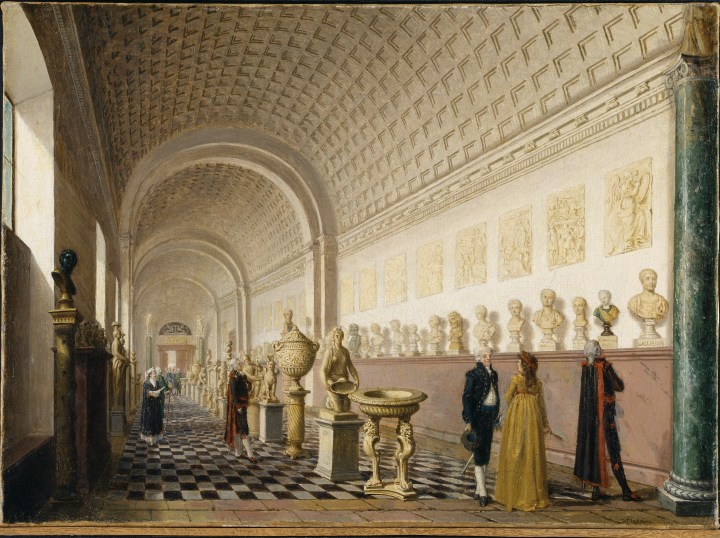
Pehr Hilleström, The Inner Gallery of the Royal Museum at the
Royal Palace, Stockholm, 1796 (Nationalmuseum, Stockholm)
◊ ◊ ◊ ◊ ◊
Press release (1 September 2014) from Stockholm’s Nationalmuseum:
Nationalmuseum has made a major loan of works to the Pehr Hilleström exhibition at the Sinebrychoff Art Museum in Helsinki. The loan comprises some twenty works by this artist best known for his documentary paintings of 18th-century Stockholm.

Pehr Hilleström, Self-Portrait, 1771 (Stockholm: Nationalmuseum; photo by Erik Cornelius)
This is the first time that a Finnish gallery has mounted a comprehensive exhibition of works by the Swedish artist Pehr Hilleström (1732–1816). Nationalmuseum in Stockholm has contributed some twenty paintings by Hillestrom, one of Sweden’s most highly regarded artists of the 18th century. The works on loan include Testing Eggs, Kitchen Scene, Card Game at the Home of Elis Schröderheim, Public Banquet at Stockholm Castle New Year’s Eve 1779, plus two self-portraits and an enigmatic portrait of Carl Michael Bellman. In all, fifty of Hilleström’s best-known paintings are on display. The exhibition was planned by Nationalmuseum’s Mikael Ahlund, who also wrote the commentary for the accompanying book.
Pehr Hilleström portrayed the entire spectrum of life in the Gustavian era, from idle young ladies in elegant drawing rooms to industrious working-class wives going about their domestic chores. He is famous for his almost documentary depictions of city fires and official ceremonies in 18th-century Stockholm. His wide range of motifs includes industry, landscapes and scenes from the theatre. In his later years, he
also turned to historical and religious motifs.
New Book | The Arts of Living: Europe, 1600–1815
Among the V&A’s New Books for the fall:
Elizabeth Miller and Hilary Young, eds., The Arts of Living: Europe, 1600–1815 (London: V&A Publishing, 2014), 208 pages, ISBN: 978-1851778072, £25 / $40.
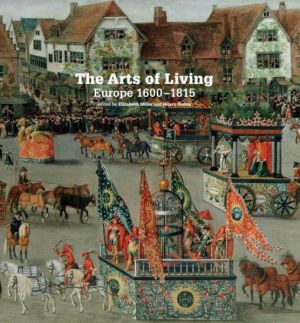 Published to accompany the landmark opening of the V&A’s new Europe 1600–1800 galleries, The Arts of Living explores the breadth, depth and beauty of the V&A’s seventeenth- and eighteenth-century collections. Written by a team of experts, this book provides an overview of more than two centuries of cultural development and artistic endeavour. Masterpieces such as the Serilly Cabinet and Gian Lorenzo Bernini’s terracotta for his funeral monument the Blessed Ludovica Albertoni are contextualized alongside discussions of Louis XIV’s patronage and the seventeenth-century Dutch interior. Many works are shown for the first time, including Count Brühl’s Meissen fountain and actor David Garrick’s tea service.
Elizabeth Miller is senior curator of prints, and Hilary Young is senior curator of ceramics at the V&A.
A preview of the book is available here»
Exhibition | Constable: The Making of a Master

◊ ◊ ◊ ◊ ◊
Press release for the upcoming exhibition:
Constable: The Making of a Master
Victoria & Albert Museum, London, 20 September 2014 — 11 January 2015
Curated by Mark Evans
“We see nothing till we truly understand it.” Constable, 1821
The V&A’s major autumn exhibition will re-examine the work of John Constable (1776–1837), Britain’s best-loved artist. It will explore his sources, techniques and legacy and reveal the hidden stories behind the creation of some of his most well-known paintings. Constable: The Making of a Master will juxtapose Constable’s work for the first time with the art of 17th-century masters of classical landscape such as Ruisdael, Rubens and Claude, whose compositional ideas and formal values Constable revered. On display will be such celebrated works as The Hay Wain (1821), The Cornfield (1826) and Salisbury Cathedral from the Meadows (1831), together with oil sketches Constable painted outdoors directly from nature, which are unequalled at capturing transient effects of light and atmosphere. The exhibition will bring together over 150 works of art including oil sketches, drawings, watercolours and engravings.
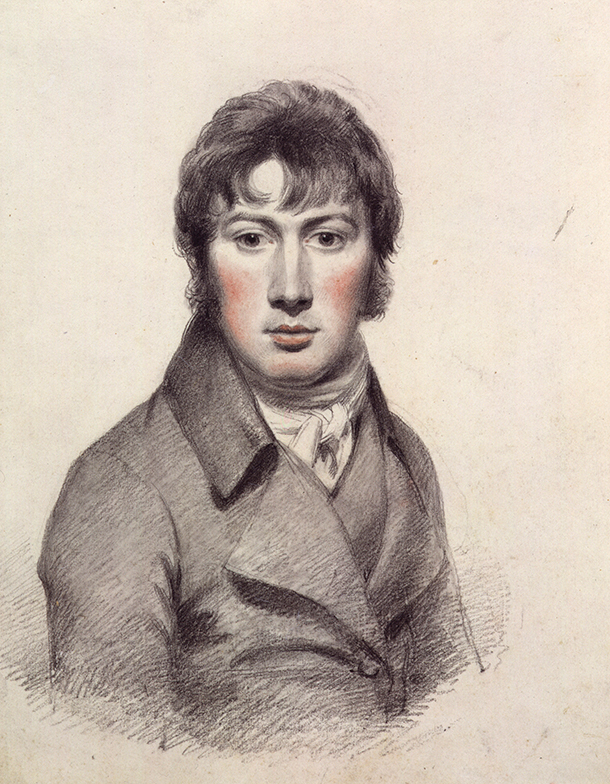
John Constable, Self-Portrait, ca. 1799-1804, pencil and black chalk heightened with white and red chalk (London: National Portrait Gallery)
Martin Roth, V&A Director, said: “The V&A has been one of the leading centres for Constable research since the 19th century, following a significant gift of paintings, oil sketches and drawings from Constable’s daughter Isabel in 1888. This exhibition refreshes our understanding of his work and creative influence. It shows that Constable’s art, so well-loved and familiar to many of us, still delivers surprises.”
Born in East Bergholt, Suffolk on 11 June 1776, John Constable was the second son of a gentleman farmer and mill owner. Whilst working in the family business he became intimately familiar with the countryside around the River Stour and sketched observations of nature and the scenery and motifs of the Suffolk countryside. Given permission by his father to pursue art, he travelled to London in 1799 where he studied at the Royal Academy of Arts. He was schooled in the old masters, meticulously copying their work and reflecting on their compositions in his individual style. On display will be paintings including Moonlight Landscape (1635–1640) by Rubens and Landscape with a Pool (1746–47) by Gainsborough, which inspired Constable’s early practice.
Constable made a number of close copies of the old masters which he referred to as a “facsimile…a more lasting remembrance.” Paintings including Claude’s Landscape with a Goatherd and Goats (c.1636–37) and Ruisdael’s Windmills near Haarlem (c.1650–52), as well as etchings and drawings by Herman van Swanevelt and Alexander Cozens, will be displayed alongside Constable’s own direct copies, many of which will be brought together for the first time since they were produced almost 200 years ago. Constable also owned an extensive art collection that included 5000 etchings principally by 17th-century Dutch, Flemish, and French landscape painters, which became a vital resource for his own image making.
Outdoor sketching was central to Constable’s working method. The 1810s saw the beginning of a series of expressive oil sketches and drawings in the open air, capturing the changes of weather and light in his native countryside. His naturalistic representation of the landscape and use of broad brushstrokes and impasto technique challenged conventions and brought the genre of outdoor oil sketching to a new level of refinement. Examples of his cloud studies, including sketches of Hampstead Heath and Brighton Beach will demonstrate Constable’s innovative and poetic evocations of land, sea and sky.
The exhibition will also investigate Constable’s methods for transferring the freshness of his sketches into his exhibition paintings. From 1818–19 Constable produced full-scale oil sketches to resolve the compositions, colours, and light values of his ‘six-footers’ such as The Hay Wain (1821) and The Leaping Horse (1825) which are amongst the best-known images in British art.
In the last decade of his life Constable and the engraver David Lucas collaborated on a series of mezzotints after the artist’s paintings. The final section of the exhibition will present a major group of these prints together with the exemplary original oil sketches on which they were based. Through these prints Constable sought to secure his artistic legacy and ensure the continued study of his groundbreaking paintings, which remain hugely influential to the present day.
◊ ◊ ◊ ◊ ◊
Constable: The Making of a Master Study Day
Victoria & Albert Museum, London, 4 October 2014
This study day will bring together scholars from a range of disciplines to explore the man, the artist, his ambitions, interests and techniques. Speakers will include Mark Evans, Annie Lyles, Sarah Cove, John Thornes, and Jonathan Clarkson. Saturday, 4 October, 10.30–17.15, Seminar Room Three. £45, £35 concessions, £15 students.
◊ ◊ ◊ ◊ ◊
Mark Evans, with Susan Owens and Stephen Calloway, John Constable: The Making of a Master (London: V&A Publishing, 2014), 192 pages, ISBN: 978-1851778003, £30.
 The remarkable naturalism of John Constable’s paintings has always been acknowledged, and his ‘vivid and timeless’ (as he called them) oil sketches have been celebrated since the 1890s as precursors of Impressionism, modernism and photographic composition. He remains a powerful influence on contemporary artists, and was famously Lucian Freud’s favourite painter. He was also hailed in 1866 as the first painter whose ‘art is purely and thoroughly English’, and his studio oil paintings have helped to define our idea of the English countryside. Published to accompany a major V&A exhibition, this book evaluates these aspects of Constable’s work, placing the artist’s naturalism and studio work in the context of his wider practice—in particular his talent for copying, and extensive print collection. A companion volume to John Constable: Oil Sketches from the Victoria and Albert Museum (V&A Publishing, 2011), this book shows how the artist’s reverence for the Old Masters is not incompatible with his revolutionary handling of paint: where others competed with the Masters, Constable assimilated their ideas and values to imbue his own naturalistic vision with dynamism..
Mark Evans is senior curator of Paintings at the V&A.
◊ ◊ ◊ ◊ ◊
Map: Constable’s England
 In conjunction with the exhibition, the V&A has created a Pinterest map to help visitors explore Constable’s England. As is usually the case with Pinterest, there are drawbacks, but I found the map useful for visualizing big points and connecting pictures to places. Given how technologically easy it is to produce this sort of page, it could work well as a teaching assignment. It also provides an excuse for me to remind readers that Enfilade maintains a handful of Pinterest boards, too. –CH










 Enfilade
leave a comment