New Book | Support for the Fleet

The former home for injured seamen established
at Greenwich by Queen Mary
◊ ◊ ◊ ◊ ◊
From English Heritage:
Jonathan Coad, Support for the Fleet: Architecture and Engineering of the Royal Navy’s Bases, 1700–1914 (Swindon: English Heritage, 2013), 464 pages, ISBN: 978-1848020559, £100.
Joint winner of the Association for Industrial Archaeology’s Peter Neaverson Award for Outstanding Scholarship in Industrial Archaeology (2014)
 This major new book traces for the first time the architectural and engineering works in the Royal Navy’s shore bases at home and overseas and the political imperatives and technologies that helped shape them up to the First World War. Based on detailed archival research, it concentrates on the remarkable legacy of surviving structures. The varied requirements of the sailing navy and its steam-driven successor are reflected in successive dockyard remodellings and expansions. The book reveals the close links that developed with a rapidly industrialising Britain at the end of the eighteenth century, showing contributions of figures such as Samuel Bentham, Thomas Telford, Henry Maudslay, the Rennies, the Jessops and James Watt.
The influence of the Royal Engineers is traced from early beginnings in the 1700s to their major role in the dockyard expansions from the late 1830s into the twentieth century. The architectural development of victualling and ordnance yards, naval hospitals, schools and coaling stations are all described, together with their key contributions to Great Britain’s long naval supremacy. Copiously illustrated with maps, plans and photographs, this important and lively work will appeal to naval historians, industrial archaeologists and students of British history.
Jonathan Coad is a former Inspector of Ancient Monuments. He is a Vice-President of the Society for Nautical Research and a former President of the Royal Archaeological Institute of Great Britain and Ireland.
◊ ◊ ◊ ◊ ◊
C O N T E N T S
1. The Royal Dockyards in Great Britain, 1700–1835
2. The Royal Dockyards in Great Britain, 1835–1914
3. Planning and Building the Royal Dockyards to 1795
4. Planning and Building the Royal Dockyards, 1795–1914
5. Engineering Works of the Sailing Navy, 1700–1835
6. Buildings of the Sailing Navy
7. Dockyard Housing, Offices and Chapels
8. Buildings and Engineering Works of the Steam Navy, 1835–1914
9. Growth of Empire: The Overseas Bases of the Sailing Navy, 1700–1835
10. Heyday of Empire: The Overseas Bases, 1835–1914
11. The Mediterranean Bases: Buildings and Engineering Works, 1700–1914
12. The West Indies and North American Bases: Buildings and Engineering Works, 1700–1914
13. South Atlantic and Australian Bases: Buildings and Engineering Works, 1700–1914
14. Feeding the Fleet: The Royal Victualling Yards
15. Naval Ordnance Yards
16. Care of the Sick and Wounded: Naval Hospitals
17. Barracks and Training Establishments
Exhibition | Caroline Watson and Female Printmaking
Opening next month at The Fitzwilliam:
Caroline Watson and Female Printmaking in Late Georgian England
The Fitzwilliam Museum, Cambridge, 23 September 2014 — 4 January 2015
Curated by David Alexander
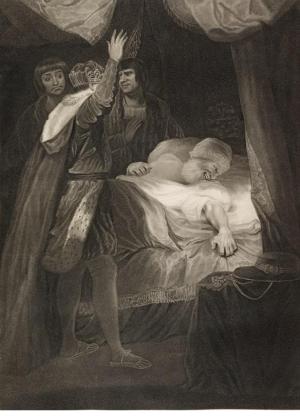
Caroline Watson, The Death of Cardinal Beaufort, stipple and etching after Sir Joshua Reynolds, 1792.
Caroline Watson (1760/61–1814) can be seen as the first British woman professional engraver. Many women in Britain had made prints before her day, but she was the first to make an extended career as an independent engraver. Nearly all those who had earlier made prints were either amateurs, making prints for amusement, or members of printmakers’ families, playing their part in family enterprises. The interest of her career is increased because she was working at a time when women were becoming more important as print buyers; some of her output reflected this change and the accompanying popularity of prints catering to feminine taste. She received support from other women, including recognition from Queen Charlotte, who appointed her ‘Engraver to the Queen’ in 1785, after she had been working for only five years. Later she was encouraged by the wealthy Bute family, particularly by the 4th Earl’s second wife, whose guest she was on several occasions at Luton Park, where Lord Bute, had one of the finest picture collections in England.
At the same time as finding support from other women Caroline Watson was encouraged by several influential men who saw advantage in using her skills; at the start of her career there were the painters Robert Edge Pine, Sir Joshua Reynolds and Ozias Humphry, as well as the printseller John Boydell, all of whom must have known her father; at the end of her career there was William Hayley, a poet and man of letters who befriended many artists. He both admired her as an ailing woman working on her own, and saw her as a reliable and talented collaborator. Having previously employed William Blake to engrave book illustrations he instead employed Caroline Watson on his Life of Romney, 1809. She did not owe her success to patronage, but to her great skill and dedication as an engraver; however the accidents of patronage were an important element in any artist’s career, especially for a woman who was of a retiring nature and not particularly robust in health.
The 200th anniversary of Watson’s death and the fact that the Fitzwilliam and the Folger Library own a number of unpublished letters by her to Hayley, which throw much light on her situation and way of life, provide a suitable opportunity not just to look at her career but to examine printmaking by women in the Britain of her time.
◊ ◊ ◊ ◊ ◊
Caroline Watson and Female Printmaking in Late Georgian England
The Fitzwilliam Museum, Cambridge, 24 September 2014
David Alexander, Honorary Keeper of British Prints and curator of the exhibition, will give a lunchtime talk at 1:15 on Wednesday, 24 September in the Seminar Room. Free admission is by token, 1 per person, available at the Courtyard Entrance desk from 12.45 on the day of the talk.
◊ ◊ ◊ ◊ ◊
Note (added 28 September 2014) — The catalogue is available from the Fitzwilliam:
David Alexander, Caroline Watson and Female Printmaking in Late Georgian England (Cambridge: Fitzwilliam Museum, 2014), 126 pages, ISBN 978-0957443464, £15.
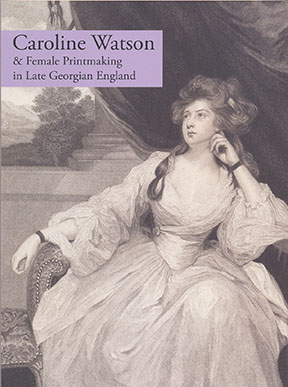 Caroline Watson, who died in 1814, can be seen as the first professional woman engraver, in the sense that she worked independently rather than as a member of a family of engravers. Over a career of thirty years she engraved more than a hundred very delicate prints in the stipple, or dotted manner, which was particularly suited for reproducing miniature portraits. The catalogue, which contains a chronological list of her prints, puts her in the context of the female printmaking of her time, and shows how exceptional was her achievement in working in a male dominated profession. The catalogue carries a transcription of sixteen letters written to her last major employer, William Hayley, which throw much light on the working methods of engravers in general.
Exhibition | Silent Partners: Artist and Mannequin
Press release (4 August) from The Fitzwilliam:
Silent Partners: Artist and Mannequin from Function to Fetish
The Fitzwilliam Museum, Cambridge, 14 October 2014 — 25 January 2015
Musée Bourdelle, Paris, 31 March — 12 July 2015
Curated by Jane Munro
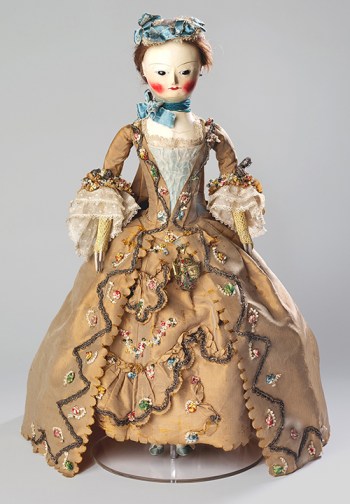
Fashion doll with costume and accessories, 1755–60; wood, gesso, paint, glass, human hair, knitted cotton, satin, silk, gilt braid, wire, silk gauze, linen, cotton, and silk satin, 60 x 42 x 43 cm (London: V&A Museum)
Every picture tells a story … but it does not always give away its secrets. For much of its existence, the artist’s mannequin, or lay figure, was one of art’s best-kept.
Now, for the first time, Silent Partners will unveil the mannequin’s secret life to show how, from being an inconspicuous studio tool, a piece of equipment as necessary as easel, pigments and brushes, the lay figure became the fetishised subject of the artist’s painting, and eventually, in the twentieth century, a work of art in its own right.
A common figure in the studios of painters and sculptors from the Renaissance onwards, this ‘artful implement’ was used to study perspective, arrange compositions, ‘rehearse’ the fall of light and shade and, especially, to paint drapery and clothing. But, while even the very greatest artists condoned its use, the mannequin best served its purpose by remaining ‘silent’: too present or visible in the finished picture, the mannequin could make figures appear stiff and unnatural, and so betray the tricks of the artist’s trade.
The nineteenth century was a turning point. Mannequin-making became a profession in its own right and Paris, especially, became a leading centre of production. Competition was fierce to create and perfect the ‘naturalistic’ mannequin, one that was life-size with an articulated skeleton that could move in realistic ways and an exterior finish that was painted and padded to look—sometimes eerily—human.
And as the mannequins became an increasingly sophisticated human replica, so they emerged from the anonymity of the studio to take their place, centre stage, on the canvas. At first the mannequin featured humorously, in witty visual games of ‘hide and seek’ and double entendre. However, throughout the course of the nineteenth century, painters such as Degas began to represent it in more troubling ways, playing on the unnerving psychological presence of a figure that was realistic, yet unreal, lifelike, yet lifeless. Others—photographers especially—explored in more voyeuristic terms how the relationship between male painter and female mannequin played out behind closed doors, revealing the studio as a place of potent erotic encounter.

Paul Huot, Female Mannequin, ca. 1816; wood, metal, horsehair, wax, silk, cotton and painted papier-mâché head, 163 x 65 cm, (Museumslandschaft Hessen Kassel, Sammlung Angewandte Kunst)
By the end of the century, innovations in the manufacture of mannequins shifted to the shop window dummy, the lay figure’s closest kin. Again, Paris led the way, and the fashion mannequin was transformed by firms such as Pierre Imans and Siégel from a schematic approximation of the human form into an uncannily realistic surrogate that inspired both consumerist longing and sexual fantasy.
This distinctively modern mannequin—one that reflected the life and elegance of its era—set a new challenge for twentieth-century painters and photographers. Featureless and expressionless, they haunted the paintings of the Italian metaphysical painters Giorgio de Chirico and Carlo Carrà, while the Surrealists celebrated the ‘modern’ mannequin as a manifestation of the ‘marvellous’, an object that could reveal the artist’s—and our—secret unconscious desires.
One of the most wide-ranging and ambitious shows ever hosted at the Fitzwilliam, the exhibition will feature over 180 paintings, drawings, books and photographs as well as fashion dolls, trade catalogues, a series of extraordinary patent documents and videos that will surprise and at times disturb. There will be paintings and drawings by Fra Bartolommeo, Cézanne, Poussin, Gainsborough, Millais, Ford Madox Brown, Courbet, Wilhelm Trübner, Kokoschka and Degas as well as photographs by and of Surrealist artists such as Bellmer, Raoul Ubac, Dalì and Man Ray; two works by Jake and Dinos Chapman will form a twenty-first-century coda. But among the most striking and fascinating exhibits will be the mannequins themselves: from beautifully carved sixteenth-century figures to haunting wooden effigies once belonging to Sickert (and maybe Hogarth) and painted dolls of full human height, top-of-the range models that were highly sought after by artists throughout Europe.
◊ ◊ ◊ ◊ ◊
From Yale UP:
Jane Munro, Silent Partners: Artist and Mannequin from Function to Fetish (New Haven: Yale University Press, 2014), 280 pages, ISBN: 978-0300208221, $65.
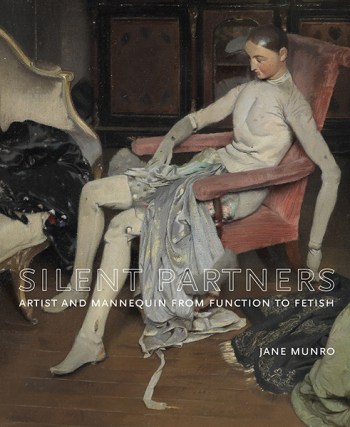 The articulated human figure made of wax or wood has been a common tool in artistic practice since the 16th century. Its mobile limbs enable the artist to study anatomical proportion, fix a pose at will, and perfect the depiction of drapery and clothing. Over the course of the 19th century, the mannequin gradually emerged from the studio to become the artist’s subject, at first humorously, then in more complicated ways, playing on the unnerving psychological presence of a figure that was realistic, yet unreal—lifelike, yet lifeless.
Silent Partners locates the artist’s mannequin within the context of an expanding universe of effigies, avatars, dolls, and shop window dummies. Generously illustrated, this book features works by such artists as Poussin, Gainsborough, Degas, Courbet, Cézanne, Kokoschka, Dalí, Man Ray, and others; the astute, perceptive text examines their range of responses to the uncanny and highly suggestive potential of the mannequin.
Jane Munro is a curator in the Department of Paintings, Drawings and Prints at the Fitzwilliam Museum and director of studies in history of art at Christ’s College at the University of Cambridge.
New Book | Art at the Origin
From the publisher:
Hans Christian Hönes, Kunst am Ursprung. Das Nachleben der Bilder und die Souveränität des Antiquars (Bielefeld: Transcript Verlag, 2014), 330 pages, ISBN 978-3837627503, 38€.
 The book provides a systematic study of the spectacular and often highly speculative art theories and art-historical narratives of such renowned antiquaries as Pierre d’Hancarville, Richard Payne Knight, and James Christie. Hans Christian Hönes analyses their theories on the origins of art and interprets the theory of history resulting from these hypotheses on the beginnings of art as a narrative of »survival«, bearing a surprisingly close resemblance to ideas culminating around 1900 in the writings of Aby Warburg.
Die spektakulären und höchst spekulativen Geschichtsentwürfe und Bildtheorien bedeutender Antiquare wie Pierre d’Hancarville und Richard Payne Knight stehen in diesem Buch erstmals im Fokus der Analyse. Hans Christian Hönes beleuchtet deren Theorien über den Ursprung der Kunst und das, so die These, daraus resultierende Narrativ eines bis in die eigene Gegenwart virulenten »Nachlebens« dieser Ursprünge. So offenbart sich ein Geschichtsentwurf, der überraschende Parallelen zu Theorien aufweist, wie sie um 1900 im Werk Aby Warburgs kulminieren. Die Studie zeigt: Das Anliegen der Protagonisten ist weniger die Suche nach historistischer Wahrheit—sondern vielmehr die
Konstruktion einer souverän entworfenen, polemischen und
romanhaften Kunstübung.
Hans Christian Hönes is Research Associate of the international research group Bilderfahrzeuge: Warburg’s Legacy and the Future of Iconology at the Warburg-Institute London.
Exhibition | Picturing Mary: Woman, Mother, Idea
From the NMWA:
Picturing Mary: Woman, Mother, Idea
National Museum of Women in the Arts, Washington, D.C., 5 December 2014 — 12 April 2015
Curated by Timothy Verdon
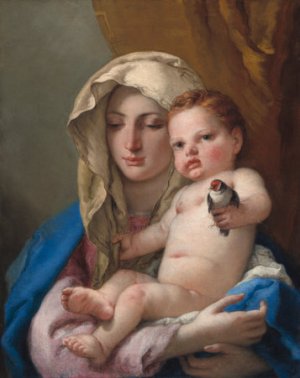
Giovanni Battista Tiepolo, Madonna of the Goldfinch, ca. 1767–70 (National Gallery of Art, Washington, D.C., Samuel H. Kress Collection #1943.4.40)
Appearing throughout the entire world, her image is immediately recognizable. In the history of Western art, she was one of the most popular subjects for centuries. Picturing Mary: Woman, Mother, Idea is a landmark exhibition at the National Museum of Women in the Arts (NMWA), bringing together masterworks from major museums, churches and private collections in Europe and the United States. Iconic and devotional, but also laden with social and political meaning, the image of the Virgin Mary has influenced Western sensibility since the sixth century.
Picturing Mary examines how the image of Mary was portrayed by well-known Renaissance and Baroque artists, including Botticelli, Dürer, Michelangelo, Pontormo, Gentileschi and Sirani. More than 60 paintings, sculptures and textiles are on loan from the Vatican Museums, Musée du Louvre, Galleria degli Uffizi, Palazzo Pitti and other public and private collections—many exhibited for the first time in the United States.
“Among the most important subjects in Western art for more than a millennium was a young woman: Mary, the mother of Jesus. Her name was given to cathedrals, her face imagined by painters and her feelings explored by poets,” said exhibition curator and Marian scholar Monsignor Timothy Verdon, director, Museo dell’Opera del Duomo, Florence, Italy. “This exhibition will explore the concept of womanhood as represented by the Virgin Mary, and the power her image has exerted through time, serving both sacred and social functions during the Renaissance and Baroque periods.”
Picturing Mary is the newest project in an ongoing program of major historical loan exhibitions organized by NMWA, including An Imperial Collection: Women Artists from the State Hermitage Museum (2003) and Royalists to Romantics: Women Artists from the Louvre, Versailles, and other French National Collections (2012). In addition to illustrating the work of women artists, NMWA also presents exhibitions and programs about feminine identity and women’s broader contributions to culture. Picturing Mary extends, in particular, the humanist focus of Divine and Human: Women in Ancient Mexico and Peru, a large-scale exhibition organized by NMWA in 2006.
The full press release (16 July 2014) is available as a PDF file here»
◊ ◊ ◊ ◊ ◊
From ACC Distrbution:
Timothy Verdon, Melissa R. Katz, Amy Remensnyder, Miri Rubin, Kathryn Wat, Picturing Mary Woman, Mother, Idea (New York: Scala Arts Publishers, 2014), 160 pages, ISBN: 978-1857598957, $45 / £30.
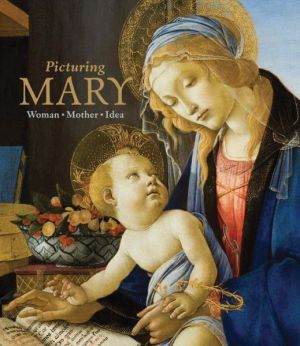 Iconic and devotional, but also fraught with social and political significance, the image of the Virgin Mary has shaped Western art since the sixth century. Depictions of the Virgin Mary in art through the ages are examined from a unique combination of Christian, Jewish, Muslim and contemporary art-historical perspectives. The thought-provoking texts examine Mary’s image as an enthroned queen, a tender young mother and a pious woman, demonstrating how her personification of womanhood has resonated throughout history to the present day.
Timothy Verdon is director of Museo dell Opera di Santa Maria del Fiore. Melissa R. Katz is Luther Gregg Sullivan Fellow in Art History, Wesleyan University. Amy Remensnyder is associate professor, Department of History at Brown University. Miri Rubin is Professor of Medieval and Early Modern History, Queen Mary University of London. Kathryn Wat is Chief Curator,
National Museum of Women in the Arts.
New Book | Italian Master Drawings from the Princeton Art Museum
From Yale UP:
Laura M. Giles, Lia Markey, and Claire Van Cleave, Italian Master Drawings from the Princeton University Art Museum (New Haven: Yale University Press, 2014), 334 pages, ISBN: 978-0300149326, $65.
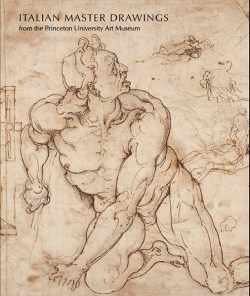 This richly illustrated volume offers a new look at the exceptional collection of Italian drawings at the Princeton University Art Museum. An introductory essay by Laura M. Giles chronicles the history and significance of the collection, and nearly one hundred of the collection’s masterworks are treated with essay-length entries and full-page images. The first scholarly examination of the collection since Felton Gibbons’s comprehensive publication of 1977, the catalogue includes an appendix of more than 150 drawings that have entered the collection since—many previously unpublished, and all fully documented with short entries. Highlights include works by celebrated masters, including Carpaccio and Modigliani, from the early Renaissance through the early Modern periods, with an emphasis on the collection’s renowned holdings of works by Luca Cambiaso, Guercino, and the two Tiepolos.
Laura M. Giles is the Heather and Paul G. Haaga Jr., Class of 1970, Curator of Prints and Drawings at the Princeton University Art Museum. Lia Markey is a lecturer in the department of art and archaeology at Princeton University, specializing in Italian Renaissance art. Claire Van Cleave is the author of Master Drawings of the Italian Renaissance (2007).
New Book | Warm Flesh, Cold Marble
From Yale UP:
David Bindman, Warm Flesh, Cold Marble: Canova, Thorvaldsen, and Their Critics (New Haven: Yale University Press, 2014), 220 pages, ISBN: 978-0300197891, $55.
 This brilliant book focuses on the aesthetic concerns of the two most important sculptors of the early 19th century, the great Italian sculptor Antonio Canova (1757–1822) and his illustrious Danish rival Bertel Thorvaldsen (1770–1844). Rather than comparing their artistic output, the distinguished art historian David Bindman addresses the possible impact of Kantian aesthetics on their work. Both artists had elevated reputations, and their sculptures attracted interest from philosophically minded critics. Despite the sculptors’ own apparent disdain for theory, Bindman argues that they were in dialogue with and greatly influenced by philosophical and critical debates, and made many decisions in creating their sculptures specifically in response to those debates.
Warm Flesh, Cold Marble considers such intriguing topics as the aesthetic autonomy of works of art, the gender of the subject, the efficacy of marble as an imitative medium, the question of color and texture in relation to ideas and practices of antiquity, and the relationship between the whiteness of marble and ideas of race.
David Bindman is Emeritus Durning-Lawrence Professor of the History of Art, University College London, and visiting professor, history of art, Harvard University.
Exhibition | Body and Soul: Munich Rococo from Asam to Günther
◊ ◊ ◊ ◊ ◊
the Kunsthalle Munich:
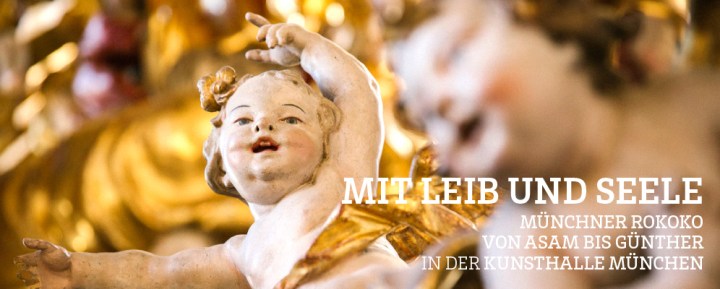
Body and Soul: Munich Rococo from Asam to Günther
Mit Leib und Seele: Münchner Rokoko von Asam bis Günther
Kunsthalle der Hypo-Kulturstiftung, Munich, 12 December 2014 – 12 April 2015
The Kunsthalle Munich and the Diocesan Museum Freising are organising a joint exhibition on Munich rococo—a golden age of Bavarian art, unparalleled even by international standards.
The exhibition presents numerous outstanding artists who lived in Munich between 1720 and 1770, like the Asam brothers, Cosmas Damian (1686–1739) and Egid Quirin (1692–1750), along with Johann Baptist Straub (1704–1784), Anton Bustelli (1723–1763) and Ignaz Günther (1725–1775). On the one hand, their exceptionally aesthetic language is characterised by an almost unprecedented jocular vitality, then again it is pervaded with a refined elegance. Visitors will be treated to a unique exhibition experience as numerous significant works from Bavaria and Germany’s wealth of churches, museums and castles come together in a fascinating journey. Thanks to the cooperation with the diocesan, many of the works have been loaned by churches and monasteries for the very first time and are being presented in the rooms of the Kunsthalle in this unique exhibition. Rarely in the past have visitors been given the opportunity to behold these otherwise almost inaccessible works in such proximity, allowing their artistic and technical qualities to be unveiled.
The Many Faces of Rococo
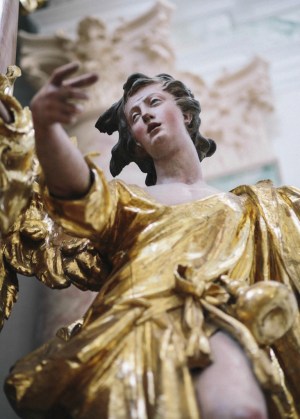
Johann Baptist Straub, Raphael the Archangel from the high altar, 1767, gilt and polyhcrome wood, 200 cm (Munich: Parish Church of St. Michael, © Thomas Dashuber).
The exhibition is showing approximately 160 rococo masterpieces, particularly sculptures in wood and other materials like stucco, clay, porcelain and silver, together with paintings, drawings and graphic prints. The starting point of the exhibition is the baroque artwork combining architecture, painting, stucco and sculpture, which reached its final, particularly impressive culmination in the hands of the Asam brothers. Contextualised by Bozzetti (sculptural designs) and drawings, the sculptures of Johann Baptist Straub and Ignaz Günther are at the very heart of the exhibition. Straub is considered to be the founding father of rococo sculpture, while Günther marks the pinnacle, and yet also the grand finale, of the epoch. Christian Jorhan the Elder (1727–1804) and Franz Xaver Schmädl (1705–1777) represent the generation of students who propagated Munich’s rococo beyond the city walls and out into the surrounding areas. Anton Bustelli introduces a mundane aspect: the effortless sophistication and playfulness of his renowned porcelain figures, which were popular table decorations at court, symbolise the entire era. The final chapter of the exhibition is dedicated to the sculptor Roman Anton Boos (1733–1810). Although his works are clearly rooted in the tradition of his predecessors, at the same
time they presage the emerging art of classicism.
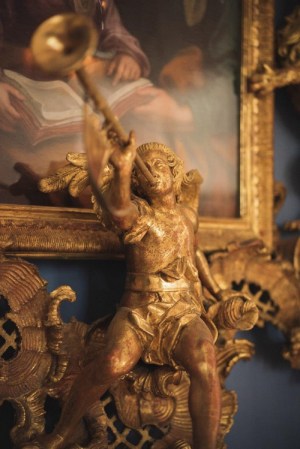
François Cuvilliés, detail of the decorative frame from the St Anne Altar, 1742–44 (Munich: Wallfahrts-kirche St. Anna, © Thomas Dashuber)
Between Play and Earnest
The exhibition aims to offer fresh insight with an unadulterated look at the epoch and, in so doing, not merely showcase the high artistic quality of the works but also to integrate them in the zeitgeist and the spiritual world. In the process, rococo art is taken literally in its specificity and its characteristics—the playful, delicate elements—turn out to be its inherent strengths. Far-reaching issues, relating to the mounting of the sculptures, their architectural integration or workshop practice for example, are also addressed.
The art of Munich rococo interfuses sacrality and profanity, the ecclesiastical and courtly worlds, but also play and earnest. Thus, an aesthetic language emerges that is unique in Europe, yet entirely its own.
A lavishly illustrated catalogue with further essays and detailed information on all the exhibits has been published by Sieveking Verlag to accompany the exhibition.
◊ ◊ ◊ ◊ ◊
From the publisher:
Christoph Kürzeder, Ariane Mensger, Peter Volk, et al. Mit Leib und Seele: Münchner Rokoko von Asam bis Günther (Sieveking Verlag, 2014), 384 pages, ISBN 978-3944874159, 50€.
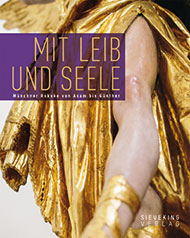 The exhibition Mit Leib und Seele (Body and Soul) aims to shed new light on the astounding stylistic diversity of the Munich Rococo between the years 1720 and 1770. The accompanying publication illustrates how a fresh consideration of the era provides illuminating insights into works by a range of artists, including the Asam brothers, Johann Baptist Straub, Franz Anton Bustelli, and Ignaz Günther. While the focus is on sculpture, the exhibition also features porcelain, silverwork, paintings, and drawings. The high art of the Rococo is presented in the context of its zeitgeist and religious milieu and appears more vibrant and more spectacular than ever: with their elegant, refined physicality and profound spirituality the artworks of this important period enter into a dialogue with viewers—and engage both body and soul.
The Kunsthalle of the Hypo Cultural Foundation in Munich is exhibiting these epochal works in partnership with the Diözesanmuseum Freising. The result of this collaboration is a unique exhibition in which the Munich Rococo will be seen in a presentation unprecedented in its magnitude and quality.
New Book | The Rise of Heritage: Preserving the Past
From Cambridge UP:
Astrid Swenson, The Rise of Heritage: Preserving the Past in France, Germany and England, 1789–1914 (New York: Cambridge University Press, 2013), 432 pages, ISBN: 978-0521117623, $99.
 Where does our fascination for ‘heritage’ originate? This groundbreaking comparative study of preservation in France, Germany and England looks beyond national borders to reveal how the idea of heritage emerged from intense competition and collaboration in a global context. Astrid Swenson follows the ‘heritage-makers’ from the French Revolution to the First World War, revealing the importance of global networks driving developments in each country. Drawing on documentary, literary and visual sources, the book connects high politics and daily life and uncovers how, through travel, correspondence, world fairs and international congresses, the preservationists exchanged ideas, helped each other campaign and dreamed of establishing international institutions for the protection of heritage. Yet, these heritage-makers were also animated by fierce rivalry as international tension grew. This mixture of international collaboration and competition created the European culture of heritage, which defined preservation as integral to modernity, and still shapes current institutions and debates.
Astrid Swenson is Lecturer in European History at Brunel University, London. Her previous publications include From Plunder to Preservation: Britain and the Heritage of Empire, c.1800–1940 (co-edited with Peter Mandler, 2013).
◊ ◊ ◊ ◊ ◊
C O N T E N T S
Introduction
Part I. National Heritage Movements
1. In search of origins
2. The heritage-makers
Part II. International Meeting-Points
3. Exhibition mania
4. ‘Peace and goodwill among nations’
Part III. Transnational Campaigns
5. ‘A Morris dance ’round St Mark’s’
6. ‘A yardstick for a people’s cultural attainment’
Conclusion
Bibliography
New Book | Bluestockings Displayed
From Cambridge UP:
Elizabeth Eger, ed., Bluestockings Displayed: Portraiture, Performance and Patronage, 1730–1830 (New York: Cambridge University Press, 2013), 323 pages, ISBN: 978-0521768801, £60.
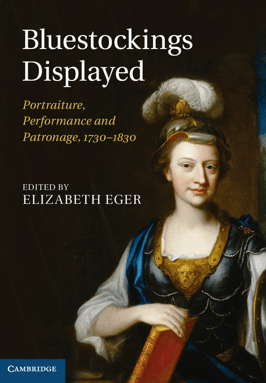 The conversation parties of the bluestockings, held to debate contemporary ideas in eighteenth-century Britain, were vital in encouraging female artistic achievement. The bluestockings promoted links between learning and virtue in the public imagination, inventing a new kind of informal sociability that combined the life of the senses with that of the mind. This collection of essays, by leading scholars in the fields of literature, history and art history, provides an interdisciplinary treatment of bluestocking culture in eighteenth-century Britain. It is the first academic volume to concentrate on the rich visual and material culture that surrounded and supported the bluestocking project, from formal portraits and sculptures to commercially reproduced prints. By the early twentieth century, the term ‘bluestocking’ came to signify a dull and dowdy intellectual woman, but the original bluestockings inhabited a world in which brilliance was valued at every level and women were encouraged to shine and even dazzle.
Elizabeth Eger is Reader in Eighteenth-Century Literature at King’s
College London.
◊ ◊ ◊ ◊ ◊
C O N T E N T S
Introduction, Elizabeth Eger
I. Portraits
1. Romantic bluestockings: From muses to matrons, Anne Mellor
2. ‘To dazzle let the vain design’: Alexander Pope’s portrait gallery, or, the impossibility of brilliant women, Emma Clery
3. Virtue, patriotism and female scholarship in bluestocking portraiture, Clare Barlow
4. Anne Seymour Damer: A sculptor of ‘republican perfection’, Alison Yarrington
5. The blues gone grey: Portraits of bluestocking women in old age, Devoney Looser
II. Performance
6. Sacred love: Eliza Linley’s voice Joseph Roach
7. The learned female soprano Susan Staves
8. Roles and role models: Montagu, Siddons, Lady Macbeth Shearer West
9. Hester Thrale: ‘What trace of the wit?’ Felicity A. Nussbaum
III. Patronage and Networks
10. Reading practices in Elizabeth Montagu’s epistolary network of the 1750s, Markman Ellis
11. The queen of the blues, the bluestocking queen, and bluestocking masculinity, Clarissa Campbell Orr
12. Luck be a lady: Patronage and professionalism for women writers in the 1790s, Harriet Guest










 Enfilade
leave a comment