New Book | Shoes and the Georgian Man
From Bloomsbury:
Matthew McCormack, Shoes and the Georgian Man (London: Bloomsbury Visual Arts, 2025), 208 pages, ISBN: 978-1350358676 (hardback), £85, $100 / ISBN: 978-1350358669 (paperback), £29, $40.
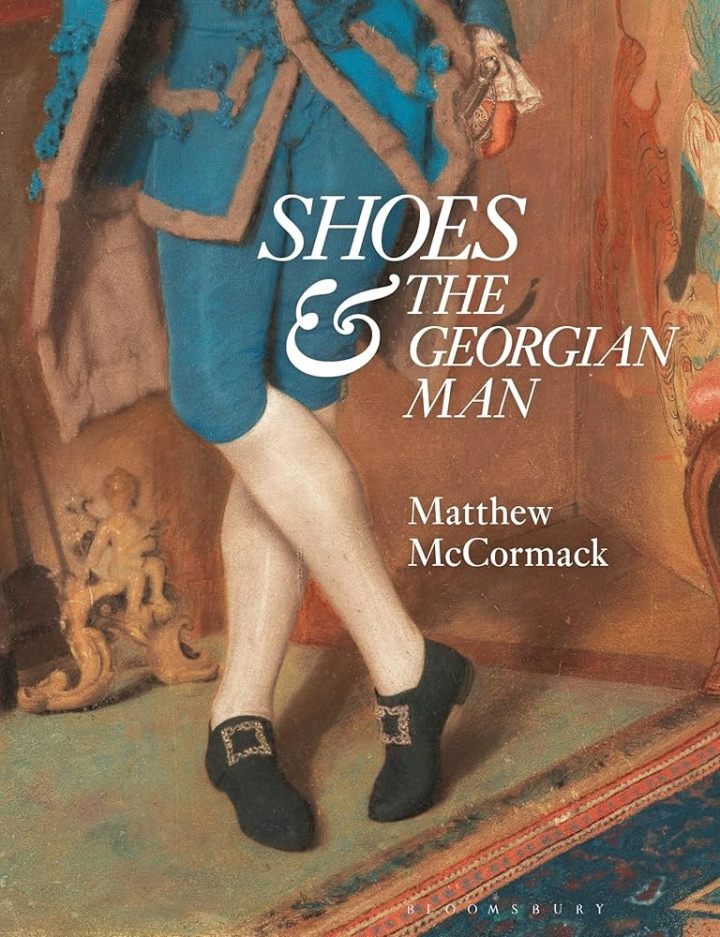 Shoes are everyday objects, but they are loaded with meaning. This book reveals how shoes played a powerful role in the wider story of shifts in gender relations in 18th-century Britain. It focuses on the relationship of shoes with the body and its movements, and therefore how what we wear on our feet relates closely to social, occupational, and gender roles. It also uses footwear to explore topics such as politics, war, dance, and disability. Thinking about shoes as material objects, McCormack studied historic shoes first-hand in museums, in order to ascertain their physical properties and what they would have been like to wear. Worn shoes preserve traces of the wearer’s body in their indentations, stretches and scuffs, providing a unique primary source about their wearer. This approach forges new connections between the histories or material culture, gender, and the body, and sheds new light on what it meant to be a man in the 18th century.
Matthew McCormack is Professor of History at the University of Northampton, course leader for MA History, and a Fellow of the Royal Historical Society and of the Higher Education Academy. His previous books include The Independent Man: Citizenship and Gender Politics in Georgian England, Embodying the Militia in Georgian England, and Citizenship and Gender in Britain, 1688–1928. He edited the Journal for Eighteenth-Century Studies (2015–20).
c o n t e n t s
List of Figures
Acknowledgements
Introduction
1 Georgian Men and Their Shoes
2 Shoes and the Body
3 Shoes and Politics
4 Boots and Masculinity
5 Gout Shoes and Disability
6 Dancing Feet
7 The Soldier’s Shoe
Conclusion: Wearing Georgian Shoes
Select Bibliography
Index
Registration for an online conversation about the book is available via Eventbrite:
Online Conversation: Shoes and the Georgian Man
Tuesday, 11 March 2025, 2pm EDT
Serena Dyer talks with Matthew McCormack about his new book, Shoes and the Georgian Man, published by Bloomsbury in January 2025. By Leicester Branch of the Historical Assn.
New Book | The Turban
From Reaktion Books with distribution by The University of Chicago Press:
Chris Filstrup and Jane Merrill, The Turban: A History from East to West (London: Reaktion Books, 2025), 264 pages, ISBN: 978-1836390749, £20 / $30.
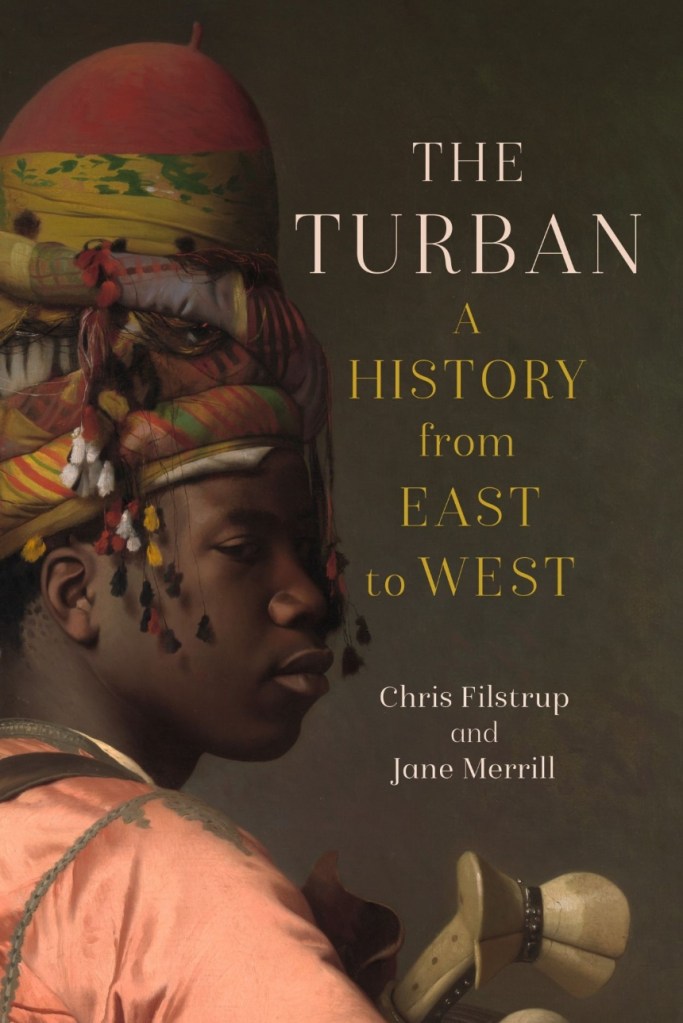 A superbly illustrated history of the turban, from Arabian origins to global cultural icon.
A turban is a strip of cloth folded and wrapped around the head; however, this description includes multifarious forms across space and time. This book follows the turban as it moves from the Arabian Peninsula through the Ottoman Empire to Europe and the Americas. It directs the reader’s gaze from traditional and religious uses of the turban into the realms of international trade, Renaissance art and contemporary fashions. Turbans, as this book shows, have moved in and out of Western culture, at times considered archaic and forgotten, then noticed and reinstated as major accessories. Today Sikh men are recognized by their distinctive headwraps, and the turban remains an important part of Black culture. This book explores the turban’s many adaptations worldwide.
Chris Filstrup was Chief of the Oriental Division at the New York Public Library and Dean of Libraries at Stony Brook University. He is co-author with Jane Merrill of The Wedding Night (2011) among other titles. He lives in Alexandria, Virginia.
Jane Merrill has written for many national U.S. magazines and is the author of The Showgirl Costume (2018) and other cultural histories. She lives in Saint George, Maine.
c o n t e n t s
Introduction
1 A Path into Western Iconography
2 Trade, Diplomacy and Depiction
3 Nabobs, Adventurers and Travellers
4 Masques and Turquerie
5 Riding the Magic Carpet
6 A Neoclassical Accessory
7 Individual Expressions: Africa and the Caribbean
8 Cultural Tourism and Authenticity since 1900
References
Bibliography
Acknowledgements
Photo Acknowledgements
Index
New Book | The Virtues of Underwear
From Reaktion Books, with distribution by The University of Chicago Press:
Nina Edwards, The Virtues of Underwear: Modesty, Flamboyance and Filth (London: Reaktion Books, 2024), 224 pages, ISBN: 978-1789149562, £20 / $28.
 Unravels the intimate narratives woven into the fabric of our most personal garments.
Stories are woven into the fabric of our most personal garments. From the first loincloths to the intricate layers of shapewear, the concealed world of underwear is capable of expressing individual desire and also aspects of society at large. An indicator of the vagaries of fashion, underwear can be simple or elaborate. It both safeguards and exposes, reflecting our hopes and experiences. Underwear can embarrass and excite, amuse and shame us. This book illuminates the sometimes profound significance of the garments we wear beneath our outer clothing. It discusses the history of both women’s and men’s underwear, and global cultures of dress.
Nina Edwards is a freelance writer based in London. Her books include Darkness: A Cultural History (2018) and Pazazz: The Impact and Resonance of White Clothing (2023), both published by Reaktion Books.
c o n t e n t s
Introduction
1 What Is Underwear For?
2 Codpiece and Corset
3 Modesty and the Immodest Torso
4 Outer to Under and Back Again
5 Fabric and Fit
6 Medical and Other Practical Matters
7 Economic and Religious Concerns
8 The Underwear Drawer
Glossary
References
Bibliography
Acknowledgements
Photo Acknowledgements
Index
The Burlington Magazine, January 2025
.
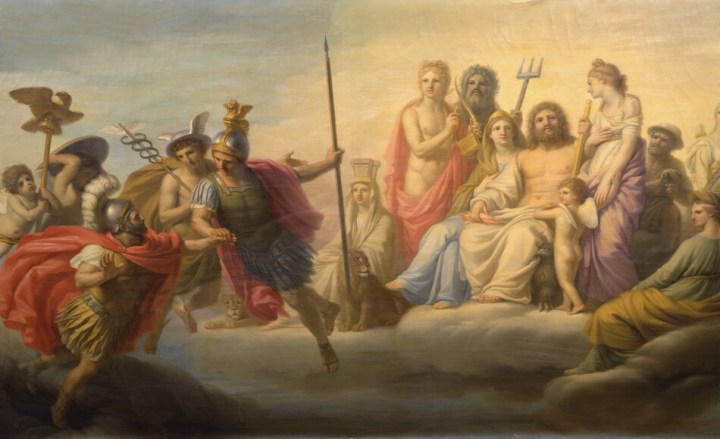
Stefano Tofanelli, Apotheosis of Romulus before the Gods of Olympus, 1790, oil on canvas, 208 × 318 cm
(Rome: Palazzo Altieri)
◊ ◊ ◊ ◊ ◊
The long 18th century in the January issue of The Burlington:
The Burlington Magazine 167 (January 2025)
e d i t o r i a l
• “A One Billion Pound Gift,” p. 3.
“Now you can gasp,” said the Chairman of the Trustees of the British Museum to guests at a recent fundraising dinner. He had just revealed the valuation of £1billion for the magnificent collection of Chinese ceramics that has been given to the museum by the Sir Percival David Foundation. Munificence on this scale is normally only associated with the richest of American museums, so a new record seems to have been set in the European context by this extraordinary gesture.
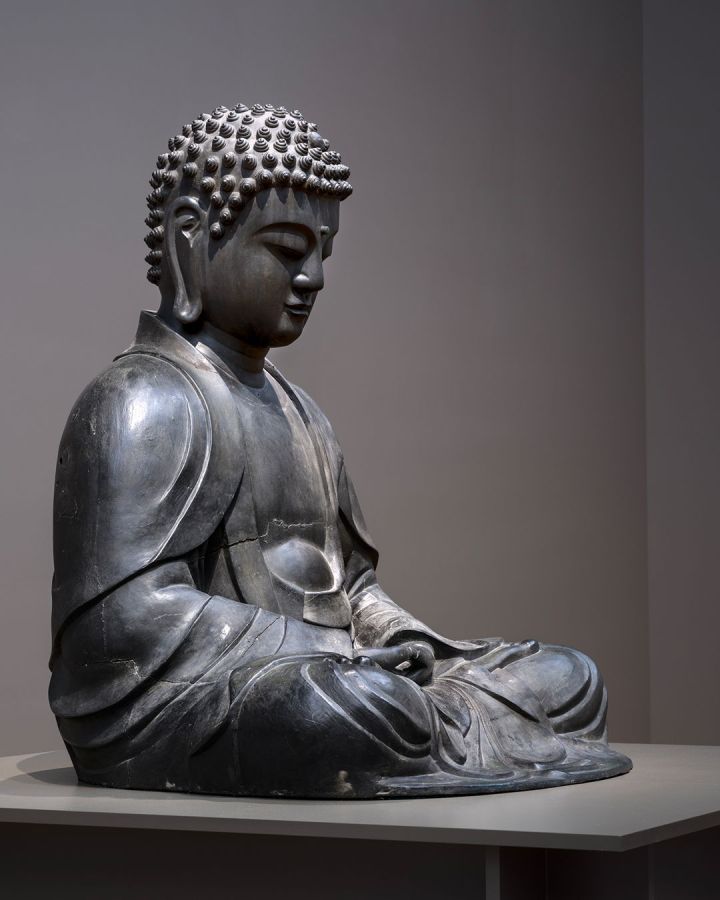
Buddha Amida (Amitabha), Japan, 1716 (Collection Wereldmuseum). Included in the exhibition Asian Bronze: 4,000 Years of Beauty.
s h o r t e r n o t i c e s
• Pilar Diez del Corral Corredoira, “A Project for the Church of Menino Deus, Lisbon, by Vieira Lusitano,” pp. 26–29.
• Alessio Cerchi, “Stefano Tofanelli’s Deification of Aeneas by Venus Rediscovered,” pp. 29–31.
r e v i e w s
• Lori Wong and Sujatha Arundathi Meegama, Review of the exhibition Asian Bronze: 4,000 Years of Beauty (Rijksmuseum, 2024–25), pp. 35–37.
• Delphine Bastet, Review of Grands décors restaurés de Notre-Dame de Paris, edited by Caroline Piel and Emmanuel Pénicaut (Silvana Editoriale, 2024), pp. 62–63.
• Peter Humfrey, Review of Anne Nellis Richter, The Gallery at Cleveland House: Displaying Art and Society in Late Georgian London (Bloomsbury, 2024), pp. 71–72.
New Book | Reading the World, British Practices of Natural History
Coming in March from the University of Pittsburgh Press:
Edwin Rose, Reading the World: British Practices of Natural History, 1760–1820 (Pittsburgh: University of Pittsburgh Press, 2025), 408 pages, ISBN: 978-0822948513, $65.
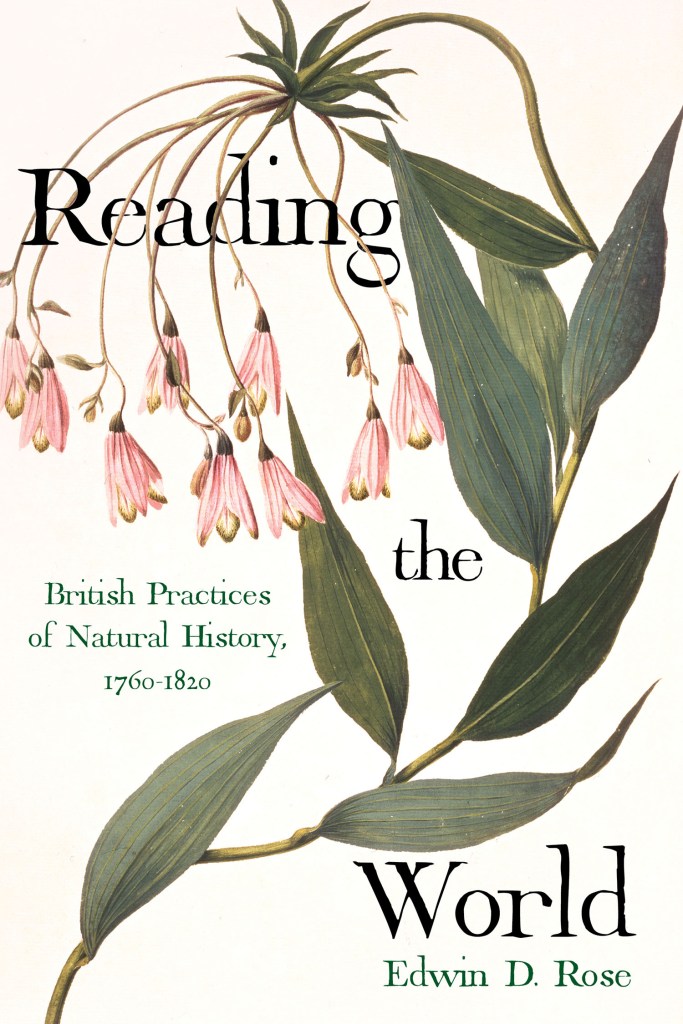 In the eighteenth and nineteenth centuries—a period that marked the emergence of a global modernity—educated landowners, or ‘gentlemen’, dominated the development of British natural history, utilizing networks of trade and empire to inventory nature and understand events across the world. Specimens, ranging from a Welsh bittern to the plants of Botany Bay, were collected, recorded, and classified, while books were produced in London and copies distributed and used across Britain, Continental Europe, the Pacific, Asia, and the Americas. Natural history connected a diverse range of individuals, from European landowners to Polynesian priests, incorporating, distributing, synthesizing, and appropriating information collected on a global scale. In Reading the World, Edwin D. Rose positions books, natural history specimens, and people in a close cycle of literary production and consumption. His book reveals new aspects of scientific practice and the specific roles of individuals employed to collect, synthesize, and distribute knowledge—reevaluating Joseph Banks’s and Daniel Solander’s investigations during James Cook’s Endeavour voyage to the Pacific. Uncovering the range of skills involved in knowledge production, Rose expands our understanding of natural history as a cyclical process, from the initial collection and identification of specimens to the formal publication of descriptions to the eventual printing of sources.
Edwin D. Rose is currently AHRC Research Fellow in the Department of History and Philosophy of Science at the University of Cambridge and Advanced Research Fellow at Darwin College, Cambridge. From May 2025 he will be a Leverhulme Trust Early Career Research Fellow in the School of Philosophy, Religion, and History of Science at the University of Leeds.
Research Seminar | Artists and the East India Company, 1760–1830
Upcoming at the Mellon Centre:
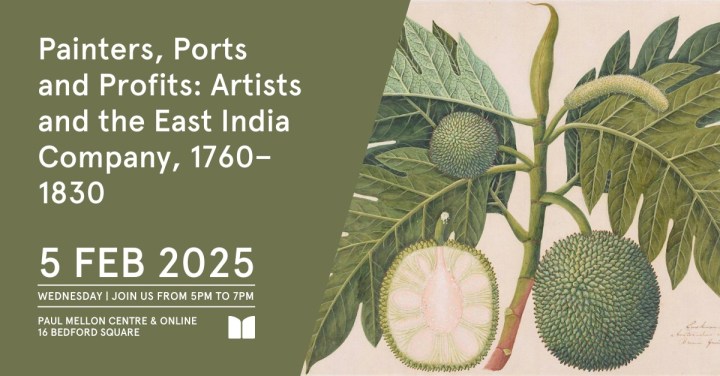
Holly Shaffer and Laurel Peterson | Painters, Ports, and Profits: Artists and the East India Company, 1760–1830
Online and in-person, Paul Mellon Centre, London, 5 February 2025, 5pm
In January 2026, the Yale Center for British Art (YCBA) will open Painters, Ports, and Profits: Artists and the East India Company, 1760–1830. This exhibition explores the interactions between artists trained in India, China, and Britain amid the relentless commercial ambitions of the East India Company at key ports and centres of trade in Asia. Featuring over a hundred objects drawn from the YCBA collection in various media—including architectural drafts, opaque watercolours, hand-coloured aquatints and small- and large-scale portraits—the exhibition highlights works by artists who are no longer well known alongside those of well-established ones. Brought together for the first time, these works tell a story of artists compelled by new subjects, styles and materials in expanding markets, profoundly affecting art within and beyond Asia.
As the power of the British empire waned in the twentieth century, ‘Company painting’ became a prevalent umbrella term to describe works made for Company officials, specifically by Indian artists, and ‘Export art’ became a descriptor for works created by Chinese artists for a European market. Painters, Ports, and Profits challenges and critically rethinks these terms while also putting the arts into dialogue. It presents an expanded conception of arts made under the auspices of the Company by focusing on artists trained in different ways who worked for Company patrons as well as commercial markets in India, China, and Britain; the types of subjects in which they specialised; and the artistic materials with which they experimented. By examining the range of arts and relationships developed during the Company’s relentless pursuit of profits, the exhibition sheds light on aesthetic and colonial discourses that were formed in the eighteenth and nineteenth centuries and persist today. Co-curators Laurel Peterson and Holly Shaffer will preview the themes and objects explored in the exhibition and the related catalogue.
Book tickets here»
Holly Shaffer is Robert Gale Noyes Assistant Professor of Humanities in the department of history of art and architecture at Brown University. Her research focuses on eighteenth- and nineteenth-century arts in Britain and South Asia, and their intersections. Her first book, Grafted Arts: Art Making and Taking in the Struggle for Western India, 1760–1910 (London and New Haven: Paul Mellon Centre with Yale University Press, 2022), was awarded the Edward C. Dimock Jr. Prize in the Indian Humanities and an Historians of British Art Book Award. In 2011, she curated Adapting the Eye: An Archive of the British in India, 1770–1830 at the YCBA, and in 2013, Strange and Wondrous: Prints of India from the Robert J. Del Bontà Collection at the National Museum of Asian Art. She has published essays in Archives of Asian Art, The Art Bulletin, Art History, Journal 18, Modern Philology, and Third Text, and recently edited volume 51 of Ars Orientalis on the movement of graphic arts across Asia and Europe.
Laurel O. Peterson is the Assistant Curator of Prints and Drawings at the Yale Center for British Art. She specialises in British works on paper produced during the long eighteenth century. She served as the organising curator of John Singer Sargent: Portraits in Charcoal in 2019 and as co-curator of Architecture, Theater, and Fantasy: Bibiena Drawings from the Jules Fisher Collection in 2021, both at the Morgan Library and Museum. She received her PhD in the history of art from Yale and her research has been supported by the Sir John Soane’s Museum Foundation, the Paul Mellon Centre for Studies in British Art, and the Lewis Walpole Library. She has held positions at the British Museum and the Morgan Library.
Image: Unknown artist (Company style), Breadnut (Artocarpus camansi), ca. 1825, watercolor, gouache, and graphite (New Haven: Yale Center for British Art, Paul Mellon Fund, B2022.5).
New Book | Time Machines
Just published by MIT Press, with plenty of 18th-century material:
Richard Taws, Time Machines: Telegraphic Images in Nineteenth-Century France (Cambridge: MIT Press, 2025), 400 pages, ISBN: 978-0262049184, $50.
 A riveting exploration of the relationship between art and telegraphy, and its implications for understanding time and history in nineteenth-century France.
In Time Machines Richard Taws examines the relationship between art and telegraphy in the decades following the French Revolution. The optical telegraph was a novel form of visual communication developed in the 1790s that remained in use until the mid-1850s. This pre-electric telegraph, based on a semaphore code, irrevocably changed the media landscape of nineteenth-century France. Although now largely forgotten, in its day it covered vast distances and changed the way people thought about time. It also shaped, and was shaped by, a proliferating world of images. What happens, Taws asks, if we think about art telegraphically?
Placed on prominent buildings across France—for several years there was one on top of the Louvre—the telegraph’s waving limbs were a ubiquitous sight, shifting how public space was experienced and represented. The system was depicted by a wide range of artists, who were variously amused, appalled, irritated, or seduced by the telegraph’s intractable coded messages and the uncanny environmental and perceptual disruption it caused. Clouds, architecture, landscapes, and gestures: all signified differently in the era of telegraphy, and the telegraph became a powerful means to comprehend France’s technological and political past. While Paris’s famous arcades began to crisscross the city at ground level, a more enigmatic network was operating above. Shifting attention from the streets to the skies, this book shows how modern France took shape quite literally under the telegraph’s sign.
Richard Taws is Professor of History of Art and Visual Culture at University College London. He is the author of The Politics of the Provisional as well as coeditor, with Iris Moon, of Time, Media, and Visuality in Post-Revolutionary France and, with Genevieve Warwick, Art and Technology in Early Modern Europe.
New Book | Reading Typographically
From Stanford UP:
Geoffrey Turnovsky, Reading Typographically: Immersed in Print in Early Modern France (Stanford: Stanford University Press, 2024), 328 pages, ISBN: 978-1503637214, $70.
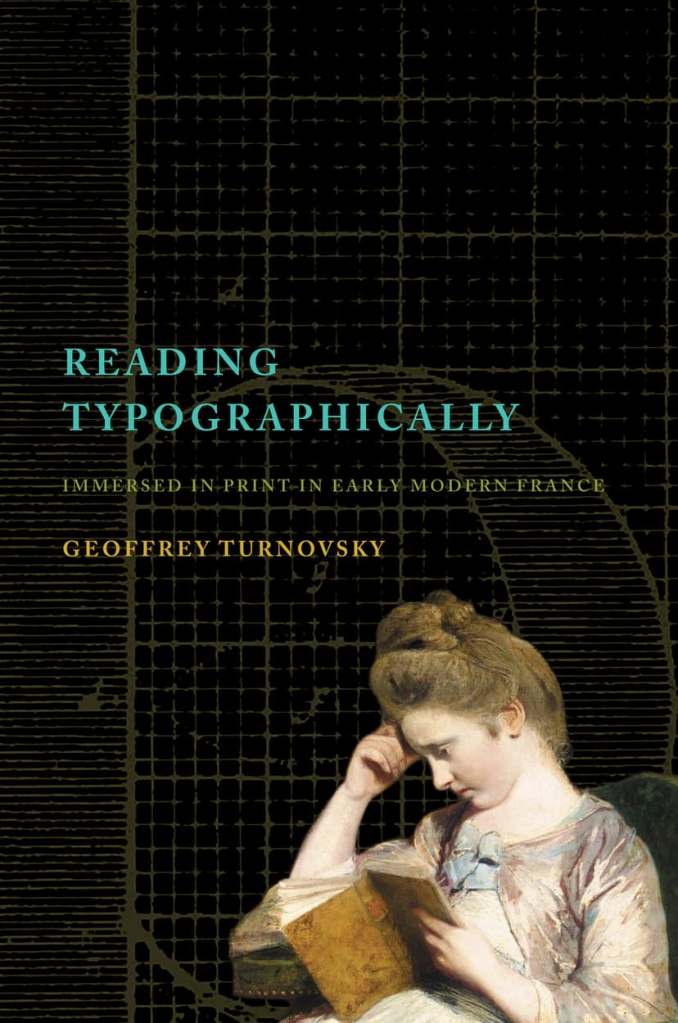 Anxieties about the fate of reading in the digital age reveal how deeply our views of the moral and intellectual benefits of reading are tied to print. These views take root in a conception of reading as an immersive activity, exemplified by the experience of ‘losing oneself in a book’. Against the backdrop of digital distraction and fragmentation, such immersion leads readers to become more focused, collected, and empathetic.
How did we come to see the printed book as especially suited to deliver this experience? Print-based reading practices have historically included a wide range of modes, not least the disjointed scanning we associate today with electronic text. In the context of religious practice, literacy’s benefits were presumed to lie in such random-access retrieval, facilitated by indexical tools like the numbering of Biblical chapters and verses. It was this didactic, hunt-and-peck reading that bound readers to communities.
Exploring key evolutions in print in 17th- and 18th-century France, from typeface, print runs, and format to punctuation and the editorial adaptation of manuscript and oral forms in print, this book argues that typographic developments upholding the transparency of the printed medium were decisive for the ascendancy of immersive reading as a dominant paradigm that shaped modern perspectives on reading and literacy.
Geoffrey Turnovsky is Associate Professor of French at the University of Washington, Seattle. He is the author of The Literary Market: Authorship and Modernity in the Old Regime (2011).
c o n t e n t s
Acknowledgments
Introduction: The Benefits of Reading
1 Typeface: Disappearing Letters from the Romain du Roi to Didot
2 Print Runs: Tender Maps in the Marketplace
3 Format: Appropriations of the Book
4 Editorial Labors: The Typography of Intimate Texts
5 Punctuation Marks: Bringing Speech to Life on the Printed Page
Conclusion: Hybridity and Text Technologies
Notes
Selected Bibliography
Index
New Book | Freedom’s Currency
From Penn Press:
Julia Wallace Bernier, Freedom’s Currency: Slavery, Capitalism, and Self-Purchase in the United States (Philadelphia: University of Pennsylvania Press, 2024), 224 pages, ISBN: 978-1512826470, $50.
 The first comprehensive study of self-purchase in the United States from the American Revolution to the Civil War
Enslaved people lived in a world in which everything had a price. Even freedom. Freedom’s Currency follows enslaved people’s efforts to buy themselves out of slavery across the United States from the American Revolution to the Civil War. In the first comprehensive study of self-purchase in the nation, Julia Wallace Bernier reveals how enslaved people raised money, fostered connections, and made use of slavery’s systems of value and exchange to wrest control of their lives from those who owned them. She chronicles the stories of famous fugitives like Frederick Douglass, who, with the help of friends and supporters, purchased his freedom to protect himself against the continued legal claims of his enslavers and the possibility of recapture. She also shows how enslaved fathers like Lunsford Lane and mothers like Elizabeth Keckley tried to secure lives for their families outside of slavery. Freedom’s Currency argues that freedom played a central role in the social and economic lives of the enslaved and in the ways that these aspects of their lives overlapped. This intimate portrait of community illuminates the complexity of enslaved people’s ideas about their place at the intersection of slavery and American capitalism and their attempts to value freedom above all. Given the stakes—liberation or remaining enslaved—it is an account of both triumph and devastating failure.
Julia Wallace Bernier is Assistant Professor of History at Washington & Jefferson College.
Exhibition | Monstrous Beauty: A Feminist Revision of Chinoiserie
Opening in March at The Met:
Monstrous Beauty: A Feminist Revision of Chinoiserie
The Metropolitan Museum of Art, New York, 25 March — 17 August 2025

Monstrous Beauty: A Feminist Revision of Chinoiserie radically reimagines the story of European porcelain through a feminist lens. When porcelain arrived in early modern Europe from China, it led to the rise of chinoiserie, a decorative style that encompassed Europe’s fantasies of the East and fixations on the exotic, along with new ideas about women, sexuality, and race. This exhibition explores how this fragile material shaped both European women’s identities and racial and cultural stereotypes around Asian women. Shattering the illusion of chinoiserie as a neutral, harmless fantasy, Monstrous Beauty adopts a critical glance at the historical style and its afterlives, recasting negative terms through a lens of female empowerment.
Bringing together nearly 200 historical and contemporary works spanning from 16th-century Europe to contemporary installations by Asian and Asian American women artists, Monstrous Beauty illuminates chinoiserie through a conceptual framework that brings the past into active dialog with the present. In demand during the 1700s as the embodiment of Europe’s fantasy of the East, porcelain accumulated strong associations with female taste over its complex history. Fragile, delicate, and sharp when broken, it became a resonant metaphor for women, who became the protagonists of new narratives around cultural exchange, consumption, and desire.
The catalogue is distributed by Yale University Press:
Iris Moon, ed., Monstrous Beauty: A Feminist Revision of Chinoiserie (New York: The Metroplitan Museum of Art, 2025), 256 pages, ISBN: 978-1588397928, $35. With additional contributions by Marlise Brown, Patty Chang, Anne Anlin Cheng, Elizabeth Cleland, Patricia Ferguson, Eleanor Hyun, Cindy Kang, Ronda Kasl, Joan Kee, Pengliang Lu, Lesley Ma, David Porter, Joseph Scheier-Dolberg, Elizabeth Kowaleski Wallace, Chi-ming Yang, and Yao-Fen You.










 Enfilade
leave a comment