Book Discussion | Basile Baudez on Architecture et tradition académique
From the École Nationale des Chartes:
Basile Baudez on Architecture et tradition académique, with Katie Scott
École Nationale des Chartes, Paris, 29 March 2014
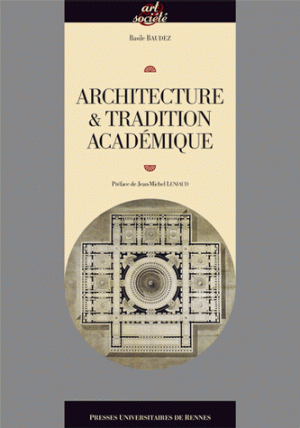 Basile Baudez, Architecture & tradition académique au temps des Lumières (Presses Universitaires de Rennes, 2013), 390 pages, ISBN: 978-2753521223, 24€.
Issu d’une thèse de doctorat soutenue à l’Éphé sous la direction de Jean-Michel Leniaud, cet ouvrage, constitue la première synthèse jamais publiée traitant des rapports entre l’architecture, les architectes et l’institution académique au XVIIIe siècle en Europe.
Adoptant une méthode comparatiste, ce livre permet d’interroger la pertinence d’un modèle élaboré dans l’Italie humaniste et transformé au XVIIe siècle pour servir la politique culturelle de Louis XIV. Le succès considérable de cette forme institutionnelle dans l’Europe des Lumières s’explique en grande partie par sa souplesse, à l’opposé de son évolution au XIXe siècle et sa capacité à organiser de manière efficace les rapports entre certains artistes, le pouvoir et le public.
Étudier l’histoire de l’architecture sous l’angle de la tradition académique, c’est mettre au jour la naissance de la profession architecturale telle qu’on la connait aujourd’hui. L’appartenance à une académie sanctionnée par le pouvoir politique permet en effet de définir les critères au nom desquels l’exercice de la profession était possible, d’une part, et la relation du milieu de l’architecture au pouvoir, d’autre part, la soif de reconnaissance et de protection à la fois.
L’auteur
Archiviste paléographe (prom. 2000), Basile Baudez est agrégé d’histoire, maître de conférences en histoire du patrimoine moderne et contemporain à l’Université Paris-Sorbonne et travaille sur l’histoire de l’architecture européenne au XVIIIe siècle ainsi que sur l’histoire des institutions artistiques.
Le discutant
Katie Scott travaille au Courtauld Institute of Art with et s’est spécialisée dans les représentations du quotidien en particulier à travers les arts éphémères. Sa récente étude est dédiée à ce sujet, plus particulièrement dans le Paris du XVIIIe siècle : Trade and the Ephemeral Everyday in Eighteenth-century Paris.
La conférence se déroulera à 17 h, en grande salle de cours de l’École nationale des chartes, au 19, rue de la Sorbonne (Paris Ve).

New Book | Sweden in the Eighteenth-Century World
From Ashgate:
Göran Rydén, ed., Sweden in the Eighteenth-Century World: Provincial Cosmopolitans (Aldershot: Ashgate, 2013), 386 pages, ISBN: 978-1409465881, £75 / $135.
 Eighteenth-century Sweden was deeply involved in the process of globalisation: ships leaving Sweden’s central ports exported bar iron that would drive the Industrial Revolution, whilst arriving ships would bring not only exotic goods and commodities to Swedish consumers, but also new ideas and cultural practices with them. At the same time, Sweden was an agricultural country to a large extent governed by self-subsistence, and—for most—wealth was created within this structure. This volume brings together a group of scholars from a range of disciplinary backgrounds who seek to present a more nuanced and elaborated picture of the Swedish cosmopolitan eighteenth century. Together they paint a picture of Sweden that is more like the one eighteenth-century intellectuals imagined, and help to situate Sweden in histories of cosmopolitanism of the wider world.
Göran Rydén is Professor of Economic History at the Institute for Housing and Urban Research at Uppsala University, Sweden.
◊ ◊ ◊ ◊ ◊
C O N T E N T S
1. Provincial cosmopolitanism: An introduction, Göran Rydén
2. Where in the world was Sweden? A brief guide for foreigners, Chris Evans
3. The language of cosmos: The cosmopolitan endeavour of universal languages, David Dunér
4. Swedish agriculture in the cosmopolitan eighteenth century, Mats Morell
5. Travelling and the formation of taste: The European journey of Bengt Ferrner and Jean Lefebure, 1758–1763, Lars Berglund
6. Eskiltuna Fristad: The beginnings of an urban experiment, Göran Rydén
7. Prints and attraction in eighteenth-century Stockholm, Sonya Petersson
8. In defence of freedom: Christianity and the pursuit of human happiness in Anders Chydenius’ world, Carola Nordbäck
9. Sweden’s neutrality and the eighteenth-century inter-state system, Leos Müller
10. Runaway colours: Recognisability and categorization in Sweden and early America, 1750–1820, Karin Sennefelt
11. When Sweden harboured idlers: Gender and luxury in public debates, c. 1760–1830, Karin Hassan Jansson
12. A divided space: Subjects and others in the Swedish West Indies during the late eighteenth century, Holger Weiss
13. A world of fiction: Bengt Lidner and global compassion in eighteenth-century Sweden, Anna Cullhed
14. Sveaborg and the end of the Swedish cosmopolitan eighteenth century: An epilogue, Göran Rydén and Holger Weiss
Select bibliography
Index
New Book | Adam von Bartsch (1757–1821): Life and Work
Published by Imhof and available from Artbooks.com:
Rudolf Rieger, Adam von Bartsch (1757–1821): Leben und Werk des Wiener Kunsthistorikers und Kupferstechers unter besonderer Berücksichtigung seiner Graphik nach Handzeichnungen (St Petersburg: Imhof, 2013), 1264 pages, 2 volumes with DVD, ISBN: 978-3865687012, 199€ / $325.
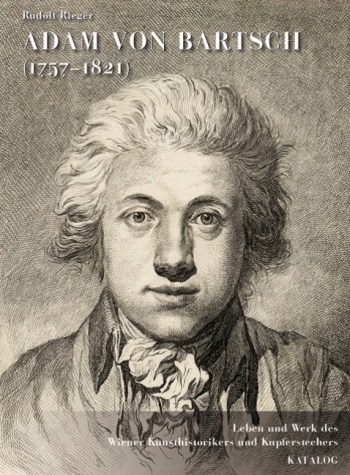 Adam von Bartsch gilt als ‘Ahnvater’ der modernen Graphikforschung, formulierte er doch nicht nur grundlegende Überlegungen zur Systematisierung von Druckgraphik, sondern schuf mit seinem 21-bändigen ‘Le Peintre Graveur’ (1803–1821) ein fundamentales Korpuswerk, das bis heute den Ausgangspunkt für die Beschäftigung mit graphischer Kunst von den Anfangen bis ins 18. Jahrhundert darstellt. Kaum bekannt ist hingegen, dass Bartsch auch künstlerisch tätig war und mit einem OEuvre von fast 600 Blatt zu den innovativsten Graphikern seiner Zeit gehörte, dessen herausragende Stellung in der Graphik um 1800 noch nicht dargestellt wurde. Neben Porträts und Illustrationsgraphik widmete er sich vor allem der Reproduktion von Handzeichnungen alter Meister und schuf auf diesem Gebiet zahlreiche Blatter, die teils einzeln, teils als Folgen verlegt wurden.
Der Werkkatalog unterzieht erstmalig alle Arbeiten Bartschs einer Sichtung und Beurteilung. Begleitet wird er von einer biographischen Studie und einer Analyse des graphischen Schaffens sowie einer nach Ländern gegliederten, in dieser Form noch nicht unternommenen Darstellung zur Reproduktionsgraphik nach Zeichnungen im 18. und 19. Jahrhundert, vor deren Hintergrund Bartschs Stellung erst deutlich konturiert werden kann. Neben der Würdigung Bartschs als herausragendem Vertreter eines durch die Aufklärung geprägten neuen Wissenschaftler- und Künstlertypus liefert die Publikation somit einen grundlegenden Beitrag zur Graphikgeschichte jener Zeit im europäischen Kontext.
◊ ◊ ◊ ◊ ◊
Note (added 1 March 2015) — The book is reviewed by F. Carlo Schmid in The Burlington Magazine 157 (February 2015): 108–09.
Exhibition | Pierre-Antoine Demachy (1723–1807)
Adapted from the Office of Tourism of Versailles:
Le Témoin Méconnu: Pierre-Antoine Demachy (1723–1807)
Musée Lambinet, Versailles, 15 February — 18 May 2014
 The Musée Lambinet in Versailles dedicates a unique exhibition to Pierre Antoine Demachy. This little-known artist of the eighteenth century, whose work has never before been showcased in a single exhibition, is a fabulous witness of his time. Strongly influenced by Italian art, Demachy applied to Paris cityscape types practiced by Canaletto and Guardi. He was among the artists whom the Empress Catherine II of Russia in 1768 placed an order through its ambassador to France, and the Count of Angivillers purchased for Louis XVI a view of the Seine at the Salon of 1783.
The work of Demachy will be presented through the following seven themes:
• Architectural whims and fantasy views
• Views related to the Louvre
• Demolition of churches and fire the Foire Saint-Germain
• Church interiors
• Other views in and around Paris
• Historic Events
• Views of the Seine and cityscapes
The press release, which includes a checklist of the major works exhibited, is available here»
◊ ◊ ◊ ◊ ◊
The catalogue is available from Artbooks.com:
Françoise Roussel-Leriche and Marie Petkowska Le Roux, Le Témoin Méconnu: Pierre-Antoine Demachy, 1723–1807 (Paris: Magellan, 2014), 216 pages, ISBN: 978-2350742809, $55.
New Book | The Architectural Capriccio
From Ashgate:
Lucien Steil, ed., The Architectural Capriccio: Memory, Fantasy and Invention (Aldershot: Ashgate, 2014), 548 pages, ISBN: 978-1409431916, £90 / $125.
 Bringing together leading writers and practicing architects including Jean Dethier, David Mayernik, Massimo Scolari, Robert Adam, David Watkin and Leon Krier, this volume provides a kaleidoscopic, multilayered exploration of the architectural capriccio. It not only explains the phenomena within a historical context, but moreover, demonstrates its contemporary validity and appropriateness as a holistic design methodology, an inspiring pictorial strategy, an efficient rendering technique and an optimal didactic tool. The book shows and comments on a wide range of historic masterworks and highlights contemporary artists and architects excelling in a modern updated, refreshed and original tradition of the capriccio. The capacity of the capriccio to create an imaginary, imagined or ‘analogue’ reality by combining and relocating existing or invented buildings and places in uniquely suggestive drawings and paintings offers unprecedented insights in the ‘Architectural Mind’.
Unlike what the word capriccio might suggest, it is not ‘capricious’ but indeed follows complex rules of realism and figuration, as well as coherent narratives and semantics. It is a playful reflection of the dialectics of the real and the ideal. The capriccio does not challenge the mechanism of reality, but questions the mechanic and linear reading of the real, of life and of art and offers a large palette of threads, figures, tones and nuances to illustrate and contribute creatively to the complexity of a sustainable built and living architectural environment.
Lucien Steil is an Associate Professor in Architecture at the University of Notre Dame, Indiana and Rome.
◊ ◊ ◊ ◊ ◊
C O N T E N T S
• Foreword: Capriccio: The efficacy of spatial narrative, Michael Graves
• Preface: The Architectual Capriccio: Memory, fantasy, invention, Lucien Steil
• Introduction, Alireza Sagharchi
• ‘Il Capriccio’, Definition of the capriccio (caprice) in the French Larousse Dictionary, trans. Julie Kleinman
• Meaning and purpose of the Capriccio, David Mayernik
• The poietic image, Samir Younés
• The Capricci of Giovanni Paolo Panini, David Mayernik
• Patronage in the golden age of the Capriccio, Selena Anders
• The grand tour, Lucien Steil
• Capriccio: The leap of the goat or the unexpected, Jose Cornelio da Silva
• Metaphors for a political urban landscape: Schinkel’s Capricci of a ‘new Athens-on-the-Spree’, Jean-François Lejeune
• J.M. Gandy’s composite views for John Soane, William Palin
• American Capriccio: Imaginary architecture in nineteenth-century painting, Gail Leggio
• The Capricci of Carl Laubin, David Watkin
• Symmetria and ethics: The didactic Capriccio, David Ligare
• Settings: Emily Allchurch and the old masters, Xavier Bray and Minna Moore Ede
• Massimo Scolari, Leon Krier
• Drawing, Leon Krier
• Capriccio, Leon Krier
• ‘Imago Luxemburgi’, Leon Krier
• The Capriccio and poetical realism, Lucien Steil
• Urban chiaroscuro (after Piranesi): Behind the scenes, Emily Allchurch
• Sublime architecture: Capricci in sketchbook and paintings, Lucien Steil
• Le Corbusier’s eye and the vanishing point of modernity, David Brain
• The architectural project: An homage to Rob Krier, Lucien Steil
• ‘La citta analoga’: Thoughts on the urban Capriccio for the design of real cities, Pier Carlo Bontempi
• Magical realism in Miami, Javier Cenicaceleya
• A very British Capriccio, Alireza Sagharchi
• Building the Capriccio, Robert Adam
• Capricci capricciosi, Ettore Maria Mazzola
• The double nature of the architectural Capriccio: From pictorial fiction to urban reality, Jean Dethier
• Postface: ‘techne’ and technology, Lucien Steil
• The aura of the computer generated image: Or virtuosity and the cult of the artifact, Dialog between Alireza Sagharchi and Gil Gorski
• Index
New Book | Globes: 400 Years of Exploration, Navigation, and Power
From The University of Chicago Press:
Sylvia Sumira, Globes: 400 Years of Exploration, Navigation, and Power (Chicago: The University of Chicago Press, 2014), 224 pages, ISBN: 978-0226139005, $45.
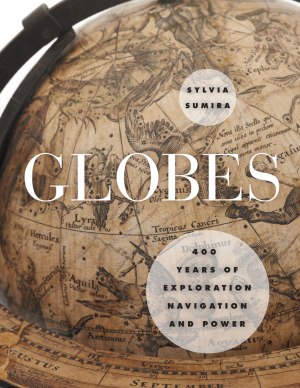 The concept of the earth as a sphere has been around for centuries, emerging around the time of Pythagoras in the sixth century BC, and eventually becoming dominant as other thinkers of the ancient world, including Plato and Aristotle, accepted the idea. The first record of an actual globe being made is found in verse, written by the poet Aratus of Soli, who describes a celestial sphere of the stars by Greek astronomer Eudoxus of Cnidus (ca. 408–355 BC). The oldest surviving globe—a celestial globe held up by Atlas’s shoulders—dates back to 150 AD, but in the West, globes were not made again for about a thousand years. It was not until the fifteenth century that terrestrial globes gained importance, culminating when German geographer Martin Behaim created what is thought to be the oldest surviving terrestrial globe. In Globes: 400 Years of Exploration, Navigation, and Power, Sylvia Sumira, beginning with Behaim’s globe, offers a authoritative and striking illustrated history of the subsequent four hundred years of globe making.
Showcasing the impressive collection of globes held by the British Library, Sumira traces the inception and progression of globes during the period in which they were most widely used—from the late fifteenth century to the late nineteenth century—shedding light on their purpose, function, influence, and manufacture, as well as the cartographers, printers, and instrument makers who created them. She takes readers on a chronological journey around the world to examine a wide variety of globes, from those of the Renaissance that demonstrated a renewed interest in classical thinkers; to those of James Wilson, the first successful commercial globe maker in America; to those mass-produced in Boston and New York beginning in the 1800s. Along the way, Sumira not only details the historical significance of each globe, but also pays special attention to their materials and methods of manufacture and how these evolved over the centuries.
Sylvia Sumira is a leading authority on historic globes and one of few conservators in the world to specialize in printed globes. She worked at the National Maritime Museum, Greenwich before setting up her own studio, where she carries out conservation work for museums, libraries, and other institutions, as well as for private owners. She lives in London.
New Book | Mimesis Across Empires
From Duke UP:
Natasha Eaton, Mimesis across Empires: Artworks and Networks in India, 1765–1860 (Durham: Duke University Press, 2013), 352 pages, ISBN: 978-0822354802, $30.
 In Mimesis Across Empires, Natasha Eaton examines the interactions, attachments, and crossings between the visual cultures of the Mughal and British Empires during the formative period of British imperial rule in India. Eaton explores how the aesthetics of Mughal ‘vernacular’ art and British ‘realist’ art mutually informed one another to create a hybrid visual economy. By tracing the exchange of objects and ideas—between Mughal artists and British collectors, British artists and Indian subjects, and Indian elites and British artists—she shows how Mughal artists influenced British conceptions of their art, their empire, and themselves, even as European art gave Indian painters a new visual vocabulary with which to critique colonial politics and aesthetics. By placing her analysis of visual culture in relation to other cultural encounters—ethnographic, legislative, diplomatic—Eaton uncovers deeper intimacies and hostilities between
the colonizer and the colonized, linking artistic mimesis to the larger colonial
project in India.
Natasha Eaton is a Lecturer in the History of Art at University College London.
◊ ◊ ◊ ◊ ◊
C O N T E N T S
List of Illustrations
Acknowledgments
Introduction
1. Colonizing the Exotic: Indian and Colonial Art in London
2. The Mirroring of Mirrors: Nostalgia, Sovereignty, and Unhomely Images in Calcutta
3. Mimicking Kingship: Sovereign Genealogies, Vernacular Landscape, and the Work of William Hodges
4. Art and Gift in India: Mimesis and Inalienability
5. Sacrifice and the Double: Physiognomy, Divination, and Ethnographic Art in India
Conclusion
Notes
Works Cited
Index
New Book | Colour, Art, and Empire
From Macmillan:
Natasha Eaton, Colour, Art, and Empire: Visual Culture and the Nomadism of Representation (London: I. B. Tauris, 2013), 416 pages, ISBN: 978-1780765198, $105.
 Colour, Art and Empire explores the entanglements of visual culture, enchanted technologies, waste, revolution, resistance and otherness. The materiality of color offers a critical and timely force-field for approaching afresh debates on colonialism. Located at the thresholds of nomenclature, imitation, mimesis and affect, this book analyses the formation of color and politics as qualitative overspill. Here color can be viewed both as central and supplemental to early photography, the totem, alchemy, tantra and mysticism. From the 18th-century Austrian empress Maria Theresa, to Rabindranath Tagore and Gandhi, to 1970s Bollywood, color makes us adjust our take on the politics of the human sensorium as defamiliarizing and disorienting.
Color wreaks havoc with western expectations of biological determinism, objectivity and eugenics. Beyond the cracks of such discursive practice, color becomes a sentient and nomadic retort to be pitted against a perceived colonial hegemony. Its alter materiality’s and ideological reinvention as a resource for independence struggles, makes color fundamental to multivalent genealogies of artistic and political action and their relevance to the present.
Natasha Eaton is a Lecturer in the History of Art at University College London.
◊ ◊ ◊ ◊ ◊
C O N T E N T S
1. Introduction: Chromo Zones and the Nomadism of Colour
2. Alchemy, Painting and Revolution in India, 1750–1860
3. Supplement, Subaltern Art, Design and Dyeing in Britain and South Asia, 1851–1905
4. Part 1: Still Dreaming of the Blue Flower? Race, Anthropology and the Colour Sense
5. Part 2: Creole Laboratory: Anthropology and Affect in the Torres Strait
6. Swadeshi Colour Throughout the Philtre/Filter of Indian Nationalism, 1905–1947
Exhibition | Andreas Schlüter and Baroque Berlin
To mark the 300th anniversary of Andreas Schlüter’s death, the Bode-Museum mounts this exhibition:
Schloss Bau Meister: Andreas Schlüter and Baroque Berlin
Bode-Museum, Berlin, 4 April — 13 July 2014
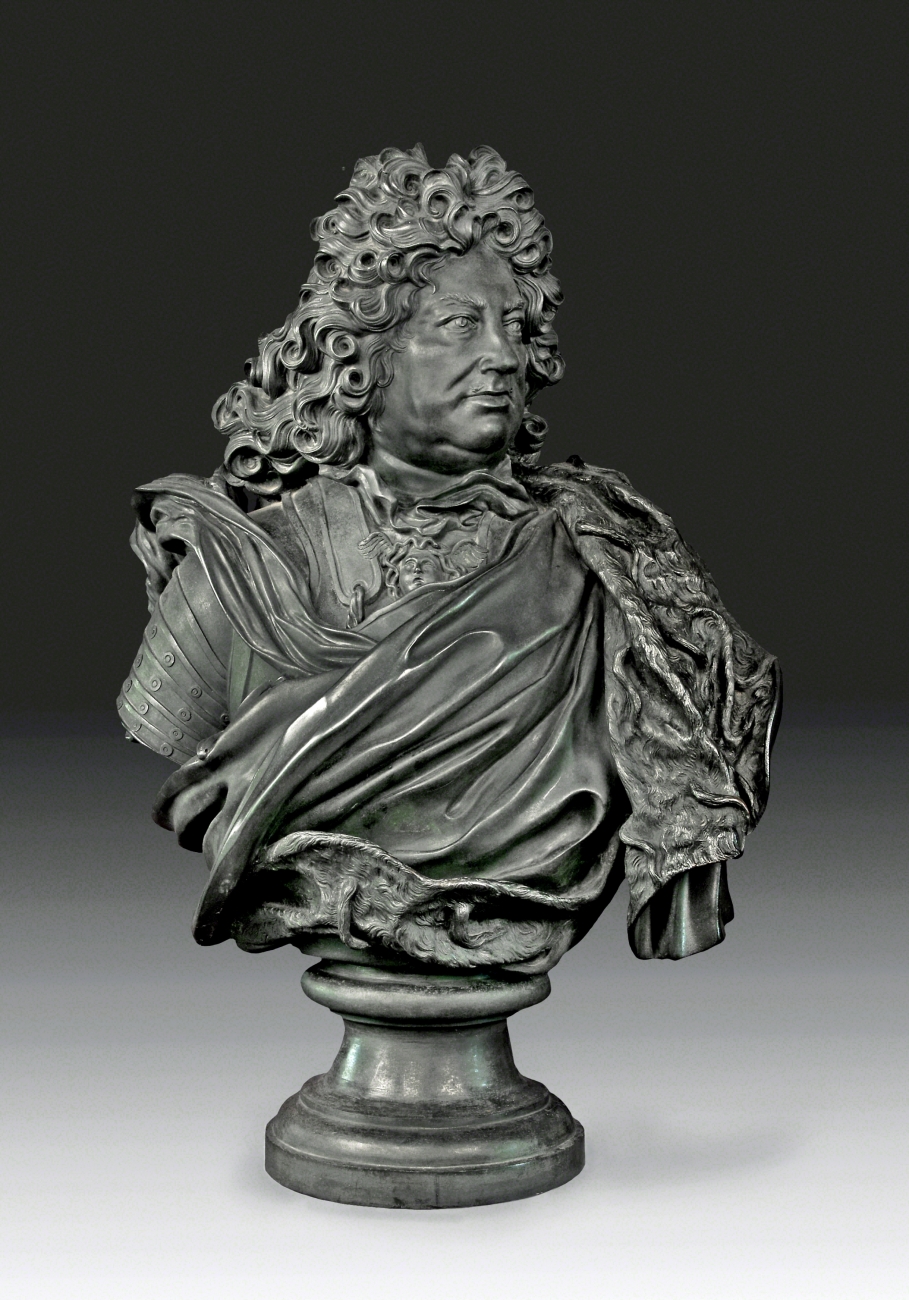
Bust of Landgrave Frederick II of Hesse Homburg, Berlin, 1701, bronze © Bad Homburg v. d. Höhe, Palace, Photo: Renate Deckers-Matzko
Andreas Schlüter (1659/60–1714) was a Baroque artist par excellence. Celebrated by his contemporaries as the ‘Michelangelo of the North’, Schlüter was not only a sculptor, but also an architect, town planner, and designer of magnificent interiors which were created to give lustre, for the first time, to the ambitious and emerging royal capital of Berlin. To commemorate the 300th anniversary of his death, the Bode-Museum is now holding the first ever major exhibition to be devoted to this important Berlin artist.
During the reign of Elector Friedrich III (from 1701 Friedrich I, ‘King in Prussia’), Schlüter was appointed official court sculptor and was entrusted with a variety of artistic roles in the Prussian capital, during a time when Prussia was emerging as a nascent new power.
This retrospective takes in all aspects of his multifaceted work and, enriched by numerous outstanding loans, recreates the opulent world that this creator of Baroque Berlin fashioned and inhabited. The exhibition in the Bode-Museum runs from 4 April until 13 July 2014 and is spread over a total of 16 galleries and side rooms. On display are not only Schlüter’s own works, but also those of the greatest role models of his time, including sculptures by such distinguished artists as Gian Lorenzo Bernini, Francesco Mochi, Francois Girardon, and Antoine Coysevox.
More information is available at the exhibition website.
◊ ◊ ◊ ◊ ◊
Published by Hirmer, the catalogue is available from Artbooks.com:
Hans-Ulrich Kessler, ed., Andreas Schlüter: Schöpfer des Barocken Berlin (Munich: Hirmer Verlag, 2014), 540 pages, ISBN: 978-3777421995, 50€ / $95.
 Andreas Schlüter (1659/60–1714), der bedeutendste Architekt und Bildhauer der Barockzeit nördlich der Alpen, verwandelte um 1700 Berlin in eine moderne, barocke Residenzstadt. Anlässlich seines 300. Todestages erzählt das opulente Katalogbuch die spannende Geschichte von Schlüters künstlerischem Werdegang und bietet einen fundierten Überblick über sein Œuvre.
Zunächst am Hof des polnischen Königs tätig, wurde Schlüter 1694 von Kurfürst Friedrich III. von Brandenburg, ab 1701 König Friedrich I. von Preußen, nach Berlin berufen. Fortan war er als Hofkünstler maßgeblich an der Umsetzung der Repräsentationsstrategien seines königlichen Auftraggebers beteiligt, wobei er sich an so glanzvollen Kunstzentren wie Rom und Paris orientierte. In 25 Beiträgen stellen namhafte Kenner Schlüters Werk umfassend vor, beginnend mit den Jahren in Danzig und Polen über seine Berliner Blütezeit mit Hauptwerken wie dem Reiterstandbild des Großen Kurfürsten,
dem Zeughaus und dem Berliner Schloss bis hin zu seinem
Spätwerk, der Berliner Villa Kameke.
New Book | The Material Culture of the Jacobites
From Cambridge UP:
Neil Guthrie, The Material Culture of the Jacobites (New York: Cambridge University Press, 2014), 284 pages, ISBN: 978-1107041332, $95.
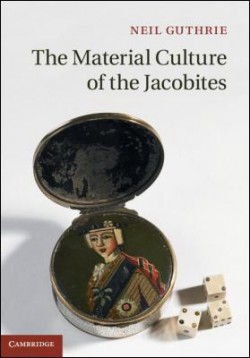 The Jacobites, adherents of the exiled King James II of England and VII of Scotland and his descendants, continue to command attention long after the end of realistic Jacobite hopes down to the present. Extraordinarily, the promotion of the Jacobite cause and adherence to it were recorded in a rich and highly miscellaneous store of objects, including medals, portraits, pin-cushions, glassware and dice-boxes. Interdisciplinary and highly illustrated, this book combines legal and art history to survey the extensive material culture associated with Jacobites and Jacobitism. Neil Guthrie considers the attractions and the risks of making, distributing and possessing ‘things of danger’; their imagery and inscriptions; and their place in a variety of contexts in the seventeenth and eighteenth centuries. Finally, he explores the many complex reasons underlying the long-lasting fascination with the Jacobites.
Neil Guthrie is a lawyer by profession and has published articles on Jacobite material culture, law, and literary history, including “Johnson’s Touch-piece and the ‘Charge of Fame’: Personal and Public Aspects of the Medal in Eighteenth-Century Britain,” in The Politics of Samuel Johnson (edited by H. Erskine-Hill and J. C. D. Clark, 2012).
C O N T E N T S
Introduction
1. ‘By things themselves’: the danger of Jacobite material culture
2. ‘Many emblems of sedition and treason’: patterns of Jacobite visual symbolism
3. ‘Their disloyal and wicked inscriptions’: the uses of texts on Jacobite objects
4. ‘Tempora mutantur et nos mutamur in illis’: phases and varieties of Jacobite material culture
5. ‘Those who are fortunate enough to possess pictures and relics’: later uses of Jacobite material culture
Bibliography










 Enfilade
leave a comment