New Books | Beastly London / Gorgeous Beasts
Along with these two books (the second of which I should have posted months ago), readers interested in animals may find useful the review essay by Simona Cohen, “Animal Imagery in Renaissance Art,” in Renaissance Quarterly 67 (March 2014): 164–80. -CH
From Reaktion:
Hannah Velten, Beastly London: A History of Animals in the City (London: Reaktion Books, 2013), 288 pags, ISBN: 978-1780231679, £29 / $50.
 Horse-drawn cabs rattling through the streets, terrified cattle being herded along congested thoroughfares to Smithfield market, pigs squealing and grunting in back yards—London was once filled with a cacophony of animal noises (and smells). But over the last thirty years, the city seems to have finally banished animals from its streets, apart from a few well-loved beasts such as the ravens at the Tower of London and the shire horses that pull the Lord Mayor’s golden coach.
Londoners once shared their homes with all kinds of animals—pets, livestock and vermin—and the streets were full of horses, cattle and the animal entertainers that performed to passers-by. Animals from all corners of the globe were imported through London’s docks and exotic beasts became popular attractions at venues such as the Zoological Gardens or lived in the private menageries of kings and naturalists. The city’s residents were entertained by performing fleas, mathematically gifted horses and dancing bears, as well as more bloodthirsty pursuits such as shooting and dog- and cockfights. In the Victorian age the city, not before time, became the birthplace of animal welfare societies and animal rights campaigns. Yet just as conditions gradually improved for the beasts of London, markets, slaughterhouses and dairies began to be moved to the suburbs, and the automobile eventually replaced the horse. The number of resident animals fell, and they are no longer a large part of everyday life in the capital—apart from a stalwart few, such as pets, pigeons and pests. Beastly London explores the complex and changing relationship between Londoners of all backgrounds and their animal neighbours, and reveals how animals helped to shape the city’s economic, social and cultural history.
Hannah Velten is a freelance writer based in Fletching, Sussex, and the author of Cow (Reaktion, 2007) and Milk (Reaktion, 2010).
C O N T E N T S
Introduction: Revealing the Beasts
1. Livestock: Londoners’ Nuisance Neighbours
2. Working Animals: Straining Every Muscle
3. Sporting Animals: Natural Instincts Exploited
4. Animals as Entertainers: Performance, Peculiarity and Pressure
5. Exotic Animals: The Allure of the Foreign and the Wild
6. Pampered Pets and Sad Strays
7. London Wildlife: The Persecuted and the Celebrated
Final Thoughts: An Apology and a Pardon
References
Acknowledgements
Photo Acknowledgements
Index
◊ ◊ ◊ ◊ ◊
From Penn State UP:
Joan B. Landes, Paula Young Lee, and Paul Youngquist, eds., Gorgeous Beasts: Animal Bodies in Historical Perspective (University Park: Pennsylvania State University Press, 2012), 258 pages, ISBN: 978-0271054018, $50.
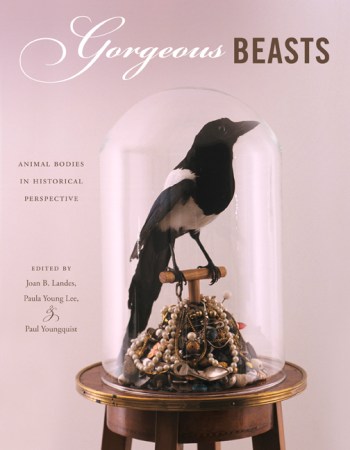 Gorgeous Beasts takes a fresh look at the place of animals in history and art. Refusing the traditional subordination of animals to humans, the essays gathered here examine a rich variety of ways animals contribute to culture: as living things, as scientific specimens, as food, weapons, tropes, and occasions for thought and creativity. History and culture set the terms for this inquiry. As history changes, so do the ways animals participate in culture. Gorgeous Beasts offers a series of discontinuous but probing studies of the forms their participation takes.
This collection presents the work of a wide range of scholars, critics, and thinkers from diverse disciplines: philosophy, literature, history, geography, economics, art history, cultural studies, and the visual arts. By approaching animals from such different perspectives, these essays broaden the scope of animal studies to include specialists and nonspecialists alike, inviting readers from all backgrounds to consider the place of animals in history and art. Combining provocative critical insights with arresting visual imagery, Gorgeous Beasts advances a challenging new appreciation of animals as co-inhabitants and co-creators of culture.
Joan B. Landes is Walter L. and Helen Ferree Professor of Early Modern History and Women’s Studies at The Pennsylvania State University. Paula Young Lee is an independent scholar and the editor of Meat, Modernity, and the Rise of the Slaughterhouse (2008). Paul Youngquist is Professor of English at the University of Colorado.
C O N T E N T S
List of Illustrations
Acknowledgments
Introduction, Joan B. Landes, Paula Young Lee, and Paul Youngquist
1. Animal Subjects: Between Nature and Invention in Buffon’s Natural History Illustrations, Joan B. Landes
2. Renaissance Animal Things, Erica Fudge
3. The Cujo Effect, Paul Youngquist
4. On Vulnerability: Studies from Life That Ought Not to Be Copied, Ron Broglio
5. The Rights of Man and the Rights of Animality at the End of the Eighteenth Century, Pierre Serna, Translated by Vito Caiati and Joan B. Landes
6. Calling the Wild, Harriet Ritvo
7. Trophies and Taxidermy, Nigel Rothfels
8. Fishing for Biomass, Sajay Samuel and Dean Bavington
9. Daniel Spoerri’s Carnival of Animals, Cecilia Novero
A Conversation with the Artist Mark Dion, Joan B. Landes, Paula Young Lee, and Paul Youngquist
Bibliography
About the Contributors
Index
Exhibition | From Watteau to Fragonard: Les Fêtes Galantes
The exhibition opens today at the Jacquemart-André. In addition to the remarkably comprehensive 30-page press kit, the exhibition website, available in both French and English, is outstanding. -CH
From Watteau to Fragonard: Les Fêtes Galantes
Musée Jacquemart-André, Paris, 14 March — 21 July 2014
Curated by Christoph Vogtherr and Mary Tavener Holmes

Antoine Watteau, An Embarrassing Proposal, oil on canvas, ca. 1715–20
(Saint-Petersburg, Hermitage Museum)
◊ ◊ ◊ ◊ ◊
The Musée Jacquemart-André is delighted to be holding the exhibition From Watteau to Fragonard, les fêtes galantes. There will be approximately sixty works on display, mostly paintings lent for the occasion by major collections, predominantly public, from countries including France, Germany, the UK and the USA.
The poetical term fête galante refers to a new genre of paintings and drawings that blossomed in the early 18th century during the Regency period (1715–1723) and whose central figure was Jean-Antoine Watteau (1684–1721). Inspired by images of bucolic merrymaking in the Flemish tradition, Watteau and his followers created a new form, with a certain timelessness, characterised by greater subtlety and nuance. These depict amorous scenes in settings garlanded with luxuriant vegetation, real or imaginary: idealised dancers, women and shepherds are shown engaged in frivolous pursuits or exchanging confidences. The poetical and fantastical atmospheres that are a mark of his work are accompanied by a quest for elegance and sophistication characteristic of the Rococo movement, which flourished during the Age of Enlightenment, evidenced in his flair for curved lines and light colours.

Jean-Honoré Fragonard, A Game of Hot Cockles, oil on canvas, ca. 1775–80 (Washington, D.C., National Gallery of Art)
The exhibition offers a chance to rediscover the pioneering nature of Watteau’s output. These are works of great creativity, depictions of life outdoors in some of his finest paintings and most accomplished drawings. Nicolas Lancret (1690–1743) and Jean-Baptiste Pater (1695–1725) were greatly influenced by the master, their works revisiting and refining the codes of the fêtes galantes. Their imaginary scenes are anchored in reality, featuring locations, works of art and multiple details that would have been easily recognisable to their contemporaries.
The flexibility of the fête galante theme proved to be an invitation to experimentation and innovation, and the genre was to inspire several generations of artists, occupying a central place in French art throughout the 18th century. Works by other highly creative painters, such as François Boucher (1703–1770) and Jean-Honoré Fragonard (1732–1806), illustrate their very personal visions of the joys of the fête galante as first imagined by Watteau.
The Musée Jacquemart-André, with its marvellous collection of 18th-century French paintings, is the perfect setting for an exhibition looking at fêtes galantes. We are particularly pleased that several of the finest drawings from the period, from the collection created by Nélie Jacquemart and Édouard André, will also be on display as part of the exhibition.
The Curators
 Currently director of London’s Wallace Collection, Christoph Vogtherr is a specialist in 18th-century French painting. He is the author of an authoritative work on the subject, the catalogue raisonné of paintings by Jean-Antoine Watteau, Jean-Baptiste Pater, and Nicolas Lancret in Berlin and Potsdam, published in 2010. During 2011, he curated two successful exhibitions of works by Watteau at the Wallace Collection.
Mary Tavener Holmes holds a doctorate from the Institute of Fine Arts at New York University. A specialist in 18th-century French paintings and drawings, she has over thirty years’ experience as a curator, author and professor of European art. She has produced numerous publications, including A Magic Mirror: The Portrait in France, 1700–1900 (1986) and Nicolas Lancret: Dance before a Fountain (2006).
◊ ◊ ◊ ◊ ◊
The catalogue is available from Artbooks.com:
Christoph Vogtherr and Mary Tavener Holmes, De Watteau à Fragonard. Les Fêtes Galantes (Antwerp: Mercator, 2014), 224 pages, ISBN: 978-9462300453, €39.
New Book | A Companion to British Art: 1600 to the Present
From Wiley:
Dana Arnold and David Peters Corbett, eds., A Companion to British Art: 1600 to the Present (Hoboken, NJ: Wiley-Blackwell, 2013), 588 pages, ISBN: 978-1405136297, $195.
 This companion is a collection of newly-commissioned essays written by leading scholars in the field, providing a comprehensive introduction to British art history.
• A generously-illustrated collection of newly-commissioned essays which provides a comprehensive introduction to the history of British arts
• Combines original research with a survey of existing scholarship and the state of the field
• Touches on the whole of the history of British art, from 800-2000, with increasing attention paid to the periods after 1500
• Provides the first comprehensive introduction to British art of the eighteenth, nineteenth, and twentieth centuries, one of the most lively and innovative areas of art-historical study
• Presents in depth the major preoccupations that have emerged from recent scholarship, including aesthetics, gender, British art’s relationship to Modernity, nationhood and nationality, and the institutions of the British art world
Dana Arnold is Professor of Architectural History and Theory at Middlesex University, UK. She has published several books on British architecture and visual culture and is author of the best selling Art History: A Very Short Introduction (2004). She is series editor of New Interventions in Art History, Wiley-Blackwell Companions to Art History, and Blackwell Anthologies in Art History.
David Peters Corbett is Professor of History of Art at the University of East Anglia. He has published a number of books, and has received prizes from the Historians of British Art, College Art Association USA, and a Guardian book of the year award. He is the editor of the journal Art History.
C O N T E N T S
Table of Contents
List of Illustrations viii
Acknowledgements xiii
Notes on Contributors xiv
Editors’ Introduction 1
Part 2 | General
1 The ‘Englishness’ of English Art Theory 13
Mark A. Cheetham
2 Modernity and the British 38
Andrew Ballantyne
3 English Art and Principled Aesthetics 60
Janet Wolff
Part 3 | Institutions
4 “Those Wilder Sorts of Painting”: the Painted Interior in the Age of Antonio Verrio 79
Richard Johns
5 Nineteenth-Century Art Institutions and Academies 105
Colin Trodd
6 Crossing the Boundary: British Art across Victorianism and Modernism 131
David Peters Corbett
7 British Pop Art and the High/Low Divide 156
Simon Faulkner
8 When Attitudes Became Formless: Art and Antagonism in the 1960s 180
Jo Applin
Part 4 | Nationhood
9 Art and Nation in Eighteenth-Century Britain 201
Cynthia Roman
10 International Exhibitions: Linking Culture, Commerce, and Nation 220
Julie F. Codell
11 Itinerant Surrealism: British Surrealism either side of the Second World War 241
Ben Highmore
12 55° North 3° West: a Panorama from Scotland 265
Tom Normand
13 Retrieving, Remapping, and Rewriting Histories of British Art: Lubaina Humid’s “Revenge” 289
Dorothy Rowe
Part 5 | Landscape
14 Defining, Shaping, and Picturing Landscape in the Nineteenth Century 317
Anne Helmreich
15 Theories of the Picturesque 351
Michael Charlesworth
16 Landscape into Art: Painting and Place-Making in England, c.1760–1830 373
Tom Williamson
17 Landscape Painting, c.1770–1840 397
Sam Smiles
18 Landscape and National Identity: the Phoenix Park Dublin 422
Dana Arnold
Part 6 | Men and Women
19 The Elizabethan Miniature 451
Dympna Callaghan
20 “The Crown and Glory of a Woman”: Female Chastity in Eighteenth-Century British Art 473
Kate Retford
21 Serial Portraiture and the Death of Man in Late-Eighteenth-Century Britain 502
Whitney Davis
22 Virtue, Vice, Gossip, and Sex: Narratives of Gender in Victorian and Edwardian Painting 532
Pamela M. Fletcher
New Book | Winckelmann on Art, Architecture, and Archaeology
From Boydell & Brewer:
Johann Joachim Winckelmann on Art, Architecture, and Archaeology, translated by David Carter (Rochester, NY: Boydell & Brewer, 2013), 280 pages, ISBN: 978-1571135209, $90.
 Johann Joachim Winckelmann (1717–68) has long been recognized as one of the founders of modern art history and a major force in the development of archaeology and the study of ancient Greek architecture. He also exerted an influence on the Weimar Classicism of Goethe and Schiller, for whom his description of Greek sculpture as evoking “edle Einfalt und stille Grösse” (noble simplicity and a calm greatness) became a watchword. He contributed to modern scientific archaeology through his application of empirically derived categories of style to the analysis of classical works of art and architecture, and was one of the first to undertake detailed empirical examinations of artifacts and describe them precisely in a way that enabled reasoned conclusions to be drawn about ancient societies and their cultures. Yet several of his important essays are not available in modern English translation. The present volume remedies this situation by collecting four of Winckelmann’s most seminal essays on art along with several shorter pieces on the topic, two major if brief essays on architecture, and one longer essay on archaeology. Paired with this is an introduction covering Winckelmann’s life and work.
David Carter is retired as Professor of Communicative English at Yonsei University, Seoul, Korea, and is former Lecturer in German Studies at the University of Southampton, UK. Among his recently published translations from German are Klaus Mann’s novel Alexander (2008) and On Cocaine (2011), a collection of Sigmund Freud’s writings on the topic.
C O N T E N T S
1 Translator’s Acknowledgments
2 Introduction
3 Thoughts on the Imitation of Greek Works in Painting and the Art of Sculpture
4 Open Letter on Thoughts on the Imitation of Greek Works in Painting and the Art of Sculpture
5 Explanation of Thoughts on the Imitation of Greek Works in Painting and the Art of Sculpture and Response to the Open Letter on These Thoughts
6 More Mature Thoughts on the Imitation of the Ancients with Respect to Drawing and the Art of Sculpture
7 Description of the Most Excellent Paintings in the Dresden Gallery
8 Reflections on Art
9 Recalling the Observation of Works of Art
10 On Grace in Works of Art
11 Description of the Torso in the Belvedere in Rome
12 Treatise on the Capacity for Sensitivity to the Beautiful in Art and the Method of Teaching It
13 Remarks on the Architecture of the Old Temples at Agrigento in Sicily
14 Preliminary Report on Remarks on the Architecture of the Ancients
15 Open Letter on the Herculanean Excavations
16 Notes
17 Select Bibliography
Exhibition | Ruin Lust
For anyone with Richard Wilson on the mind, he turns up in Tate Britain’s ruin exhibition, too.
Ruin Lust
Tate Britain, London, 4 March — 18 May 2014
Curated by Brian Dillon, Emma Chambers, and Amy Concannon
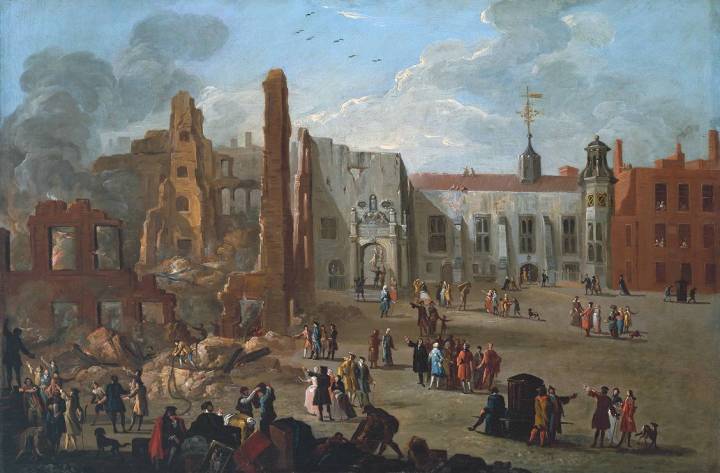
Richard Wilson, The Inner Temple after the Fire of 4 January 1737, oil on canvas, 1737 (Tate Britain). The picture records the devastation caused by a fire that destroyed Crown-Office Row in the Inner Temple. The group in the centre includes Frederick, Prince of Wales (in blue, wearing the Garter star), who had sent fifty soldiers to help the firemen and later came to inspect the scene himself. More information is available here»
◊ ◊ ◊ ◊ ◊
Ruin Lust, an exhibition at Tate Britain from 4 March 2014, offers a guide to the mournful, thrilling, comic and perverse uses of ruins in art from the eighteenth century to the present day. The exhibition is the widest-ranging on the subject to date and includes over 100 works by artists such as J.M.W. Turner, John Constable, John Martin, Eduardo Paolozzi, Rachel Whiteread, and Tacita Dean.
The exhibition begins in the midst of the craze for ruins that overtook artists, writers and architects in the eighteenth century. J.M.W. Turner and John Constable were among those who toured Britain in search of ruins and picturesque landscapes, producing works such as Turner’s Tintern Abbey: The Crossing and Chancel, Looking towards the East Window 1794 and Constable’s Sketch for ‘Hadleigh Castle’ c.1828–29.
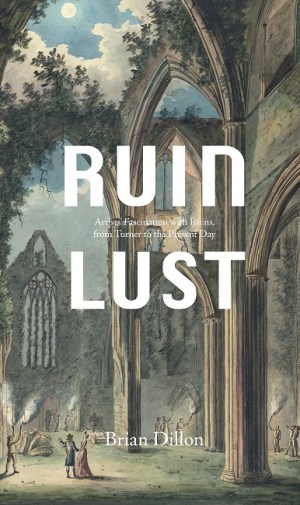 This ruinous heritage has been revisited—and sometimes mocked—by later artists such as Keith Arnatt, who photographed the juxtaposition of historic and modern elements at picturesque sites for his deadpan series A.O.N.B. (Areas of Outstanding Natural Beauty) 1982–84 and John Latham whose sculpture Five Sisters Bing 1976, which was part of a project to turn post-industrial shale heaps in Scotland into monuments. Classical ruins have a continued presence in the work of Eduardo Paolozzi, Ian Hamilton Finlay, and John Stezaker. In works such as Keith Coventry’s Heygate Estate 1995 and Rachel Whiteread’s Demolished—B: Clapton Park Estate 1996, which shows the demolition of Hackney tower blocks, we see Modernist architectural dreams destroyed.
The exhibition explores ruination through both the slow picturesque decay and abrupt apocalypse. John Martin’s The Destruction of Pompeii and Herculaneum 1822 recreates historical disaster while Gustave Doré’s engraving The New Zealander 1872 shows a ruined London. The cracked dome of St Paul’s Cathedral in the distance was a scene partly realised during the Blitz.
Ruin Lust will include work provoked by the wars of the twentieth century, including Graham Sutherland’s Devastation series 1940–41, which depicts the aftermath of the Blitz and Jane and Louise Wilson’s 2006 photographs of the Nazis’ defensive Atlantic Wall. Paul Nash’s photographs of surreal fragments in the 1930s and 40s, or Jon Savage’s images of a desolate London in the late 1970s show how artists also view ruins as zones of pure potential, where the world must be rebuilt or reimagined.
The exhibition will include rooms devoted to Tacita Dean and Gerard Byrne. Dean’s nostalgic film installation Kodak 2006 explores the ruin of the image, as the technology of 16 mm film becomes obsolescent. In 1984 and Beyond 2005–07, Byrne reimagines a future that might have been. The installation presents a re-enactment of a discussion, published in Playboy in 1963, in which science fiction writers—including Isaac Asimov, Ray Bradbury, and Arthur C. Clarke—speculate about what the world might be like in 1984.
This transhistorical exhibition is curated by writer and critic Brian Dillon; Emma Chambers, Curator of Modern British Art; and Amy Concannon, Assistant Curator of British Art, 1790–1850. It will be accompanied by a book and a programme of talks and events in the gallery.
◊ ◊ ◊ ◊ ◊
From Tate Britain’s bookshop:
Brian Dillon, Ruin Lust: Artists’ Fascination with Ruins from Turner to the Present Day (London: Tate Publishing, 2014), 64 pages, ISBN: 978-1849763011, £10 / $22.
Why are we fascinated by ruins? They recall the glory of dead civilisations and the certain end of our own. They stand as monuments to historic disasters, but also provoke dreams about futures born from destruction and decay. Ruins are bleak but alluring reminders of our vulnerable place in time and space. For centuries, ruins have attracted artists: among them J.M.W. Turner, Gustave Doré, Paul Nash, Graham Sutherland, Patrick Caulf eld, Tacita Dean, and Jane and Louise Wilson. Ruin Lust explores the history of this obsession, from the art of the picturesque in the eighteenth century, through the wreckage of two world wars, to contemporary artists complex attitudes to the ruins of the recent past.
Brian Dillon is a novelist, critic, and curator who has explored many ancient and modern ruins and written widely on the history of ruination in art and culture. His books include: Objects in this Mirror: Essays; Sanctuary; In the Dark Room; and Ruins, an anthology of artists and critics reflections on ruination. He is UK editor of Cabinet magazine and reader in critical writing at the Royal College of Art.
New Book | The Golden Age of Botanical Art
Published by The University of Chicago Press in September 2013 (having first appeared in Europe in 2012). . .
Martyn Rix, The Golden Age of Botanical Art (Chicago: The University of Chicago Press, 2013), 256 pages, ISBN: 978-0226093598, $35.
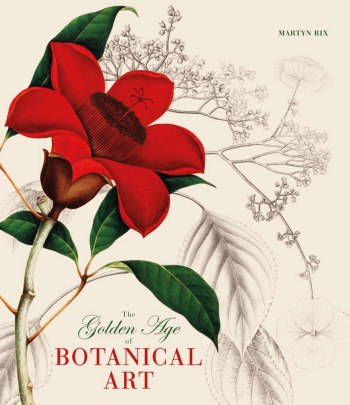 The seventeenth century heralded a golden age of exploration, as intrepid travelers sailed around the world to gain firsthand knowledge of previously unknown continents. These explorers also collected the world’s most beautiful flora, and often their findings were recorded for posterity by talented professional artists. The Golden Age of Botanical Art tells the story of these exciting plant-hunting journeys and marries it with full-color reproductions of the stunning artwork they produced. Covering work through the nineteenth century, this lavishly illustrated book offers readers a look at 250 rare or unpublished images by some of the world’s most important botanical artists.
Truly global in its scope, The Golden Age of Botanical Art features work by artists from Europe, China, and India, recording plants from places as disparate as Africa and South America. Martyn Rix has compiled the stories and art not only of well-known figures—such as Leonardo da Vinci and the artists of Empress Josephine Bonaparte—but also of those adventurous botanists and painters whose names and work have been forgotten. A celebration of both extraordinarily beautiful plant life and the globe-trotting men and women who found and recorded it, The Golden Age of Botanical Art will enchant gardeners and art lovers alike.
Martyn Rix is a botanist and the Editor of Curtis’s Botanical Magazine, and as such has an unrivalled knowledge of botanical art. With a PhD in Botany from the University of Cambridge, he has worked at the University Botanic Garden in Zurich and at the RHS Garden, Wisley and has made many expeditions to different parts of the world, to collect new plants for gardens. He is the author or co-author of a number of books, including the highly acclaimed The Botanical Garden.
C O N T E N T S
Introduction
1 The Origins of Botanical Art / Leonardo da Vinci
2 Early Works of the Sixteenth Century / Jacopo Ligozzi
3 Seventeenth-Century Florilegia / Dutch Flower Paintings
4 North American Plants / Linnaeus and Plant Classification
5 Travellers to the Levant / Maria Sybilla Merian
6 The Exploration of Russia and Japan / Les Vélins du Muséum
7 Botany Bay and Beyond / Sir Joseph Banks
8 The Golden Age in England / Mrs. Delany and Her Paper Mosaicks
9 South American Adventures / Thornton’s The Temple of Flora, or Garden of Nature
10 The Golden Age in France / Empress Joséphine
11 Botanical and Horticultural Illustrated Journals / Henry C. Andrews
12 Early Chinese Plant Drawings / Père David and the French Missionaries
13 The Company School in India / The Story of Flora Danica 1761–1883
14 A New Era at Kew / George Maw
15 Victorian Travellers / Elwes and the Genus Lilium
16 Bringing China to Europe / Modern Florilegia
17 The Flowers of War and Beyond / Exhibiting Botanical Watercolours
18 Carrying on the Tradition
Index
Bibliography
Publishers’ Credits
Exhibition | Le Bivouac de Napoléon: Luxe impérial en campagne
From the Palais Fesch:
Le Bivouac de Napoléon: Luxe impérial en campagne
Palais Fesch, Musée des Beaux Arts, Ajaccio, 13 February — 12 May 2014
 Napoléon Ier passe une grande partie de son existence en campagne ou en voyage. Il possède pour ses déplacements et ses bivouacs, une organisation particulière reproduisant pour partie l’étiquette impériale. Ses tentes de campagne sont de véritables palais tissés mobiles, ses bagages, – lit, table, fauteuil, écritoire, nécessaire ou encore chaise d’affaires – constituent un ameublement pliant et luxueux en boite. Les nombreuses voitures qui transportent les effets de l’empereur en campagne, escortées et conduites par un personnel de service nombreux, forment un véritable convoi.
Cet ouvrage, sous la direction de Jehanne Lazaj, conservatrice au Mobilier national, entend montrer l’ingéniosité d’objets prestigieux tout comme la somptuosité de l’artisanat d’Empire à travers l’étude de plus de 70 œuvres qui sont autant d’éléments de campements, de contexte ou de documents iconographiques. Le lecteur s’installe, ainsi, sous le tente de Napoléon pour appréhender une vision la plus
complète possible de la vie des bivouacs, les soirs de
victoire comme de défaite.
Exhibition | Richard Wilson
To mark the opening of Richard Wilson and the Transformation of European Landscape Painting, curators Robin Simon and Martin Postle will be in New Haven this evening (5:30, Wednesday, 5 March 2014) for a session entitled “Putting Wilson on the Spot: Landscape, Art, and Location.” Exhibition press release from the YCBA:
Richard Wilson and the Transformation of European Landscape Painting
Yale Center for British Art, New Haven, 6 March — 1 June 2014
National Museum Cardiff, 5 July — 26 October 2014
Curated by Robin Simon and Martin Postle
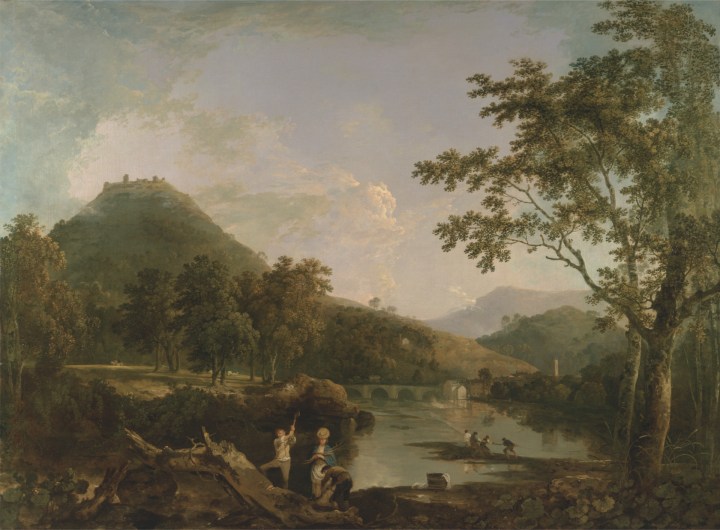
Richard Wilson, Dinas Bran from Llangollen, 1770–71, oil on canvas,
Yale Center for British Art, Paul Mellon Collection
◊ ◊ ◊ ◊ ◊
This spring, the Yale Center for British Art presents the first major exhibition in more than thirty years devoted to Welsh painter Richard Wilson (1714–1782), considered by many to be the father of British landscape painting. Richard Wilson and the Transformation of European Landscape Painting, opening on March 6, 2014, will demonstrate the extent of Wilson’s influence throughout Europe and explore his work in its international context. The exhibition will focus on the nearly seven years he spent working in Rome in the 1750s, a transformational period for Wilson and for European landscape art.
The exhibition will feature many of Wilson’s greatest paintings and drawings alongside works by European masters who preceded Wilson, contemporaries whose practice directly influenced his, and artists who were in turn taught or influenced by him. Other artists in the exhibition will include the old masters Claude Lorrain and Gaspard Dughet, as well as many of Wilson’s contemporaries such as Claude-Joseph Vernet, Pompeo Batoni, and Anton Raphael Mengs. Also presented will be works by many of Wilson’s pupils and followers, including the little-known artists Robert Crone and Adolf Friedrich Harper—both of whom studied with Wilson in Italy, as well as major figures such as John Constable and J. M. W. Turner.
As part of a cosmopolitan group of artists in Rome, Wilson pioneered a serious and powerfully original approach to landscape that reflected the nascent neoclassicism being advanced by his friends Anton Raphael Mengs and Johann Winckelmann. Wilson’s pupils in Rome transmitted his style across northern Europe. Setting up in London after his Italian sojourn, he established a large and successful studio and gained a European reputation with grand historical landscapes—such as The Destruction of the Children of Niobe (1760)—which were featured at the new public art exhibitions in London and widely disseminated through popular engravings. His treatment of British landscapes, particularly of his native Wales, borrowed their conceptual framework from the paintings of the seventeenth-century masters Claude Lorrain and Gaspard Dughet, but with a specificity of lighting conditions and weather that was an enduring legacy to the British landscape school.
Wilson’s great success during the 1760s slipped away in the following decade, as there was less demand for his work and his health deteriorated. By the time of his death he was largely forgotten. However, within a few years his critical reputation began to revive, and by the early nineteenth century he was celebrated as a pioneering figure of the British school. His innovations in landscape painting were crucial to the development of the genre during the romantic period, which saw its greatest expression in the work of J. M. W. Turner and John Constable, both profound admirers of Wilson.
This is the first exhibition the Center has co-organized with Amgueddfa Cymru– National Museum Wales. The exhibition has been co-curated by Robin Simon, Honorary Professor of English, University College London, and Editor, The British Art Journal, and Martin Postle, Deputy Director of Studies, The Paul Mellon Centre for Studies in British Art, London. The organizing curator at the Center is Scott Wilcox, Chief Curator of Art Collections and Senior Curator of Prints and Drawings; and, at Amgueddfa Cymru–National Museum Wales, Oliver Fairclough, Keeper of Art.
◊ ◊ ◊ ◊ ◊
From Yale UP:
Martin Postle and Robin Simon, eds., with contributions by Steffen Eggle, Oliver Fairclough, Jason Kelly, Ana María Suárez Huerta, Lars Kokkonen, Kate Lowry, Paul Spencer-Longhurst, Jonathan Yarker, Scott Wilcox, and Rosie Ibbotson. Richard Wilson and the Transformation of European Landscape Painting (New Haven: Yale University Press, 2014), 416 pages, ISBN: 978-0300203851 $80.
 Long known as the father of British landscape painting, Richard Wilson (1713–1782) was in fact at the heart of a profound conceptual shift in European landscape art. This magnificently illustrated volume not only situates Wilson’s art at the beginning of a native tradition that would lead to John Constable and J. M. W. Turner, but compellingly argues that in Rome during the 1750s Wilson was part of an international group of artists who reshaped the art of Europe. Rooted in the work of great seventeenth-century masters such as Claude Lorrain but responding to the early stirrings of neoclassicism, Wilson forged a highly original landscape vision that through the example of his own works and the tutelage of his pupils in Rome and later in London would establish itself throughout northern Europe.
Martin Postle is assistant director of the Paul Mellon Centre for Studies in British Art. Robin Simon is honorary professor of English at University College
London, and editor of The British Art Journal.
New Book | Antique Sealed Bottles, 1640–1900
Happy Mardi Gras!
David Burton, Antique Sealed Bottles 1640–1900 and the Families that Owned Them (Antique Collectors’ Club, 2014), 1800 pages (3 volumes), ISBN: 978-1851497553, £250.
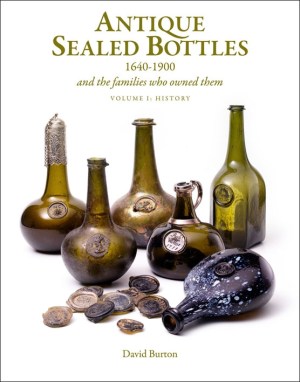 Time in a bottle; this is a collection that explores the unlocking of history through the identification of its unique seals, using crests and coats-of-arms as the ‘keys’ towards identifying the original owner. This three-volume collection examines the evolution of the sealed bottle from the 1640s to the late 1800s and provides a detailed description to accompany each entry, supported by numerous photographs, including the number of examples known, their condition, and the collections where the bottles and detached seals are held.
The laying down of wine to improve its quality and longevity related to the social history of the day, the design of the bottles, their evolution and manufacture, are a reflection of the individuals who ordered and used the bottles at home or in the private gentlemen’s clubs, much influenced by the historic events of the 17th through to the 20th centuries.
Wine consumption has a place in cultural history; these collected bottles existed at times of incredible upheaval and social change. From the early colonial settlements of the New World, into the slave markets of Richmond, VA, New Orleans, Charleston, SC, and Philadelphia, and with the plantation owners who amassed vast wealth and prestige as a result of this trade. In the taverns and coffee houses of London, alongside the bear baiting and cock fighting to be found across the River Thames in Southwark, in the cellars of the Oxford colleges and Inns of Court, these sealed bottles give much information on the early drinking habits of the aspiring and upwardly mobile, and the established aristocracy.
C O N T E N T S
Volume One
Dated Sealed Bottles, 1650–1900
Volume Two
Undated Sealed Bottles, Seventeenth Century; Undated Sealed Bottles, 1700–1900; Crests and Coats of Arms, pre-1700 identified; Crests and Coats of Arms, pre-1700 unidentified; Crests and Coats of Arms, post-1700 identified; Crests and Coats of Arms, post-1700 unidentified
Volume Three
Chapter One: What is a Sealed Bottle? Chapter Two: Sealed Bottles from the Seventeenth Century; Chapter Three: Sealed Bottles from the Eighteenth and Nineteenth Centuries; Chapter Four: Heraldry and Sealed Bottles; Chapter Five: Sealed Bottles from the West Country; Chapter Six: Sealed Bottles from Wales; Chapter Seven: Sealed Bottles associated with the American Colonies; Chapter Eight: Sealed Bottles in Major Public Collections; Chapter Nine: Building a Collection; Chapter Ten: Price Guide and Price Trends

Exhibition | Art and Appetite: American Painting
In comparison to the nineteenth century, the eighteenth-century offerings are slim, but it’s still hard to tell this story without the latter. Press release (11 December 2014) from the Amon Carter:
Art and Appetite: American Painting, Culture, and Cuisine
The Art Institute of Chicago, 12 November 2013 — 27 January 2014
Amon Carter Museum of American Art, Fort Worth, Texas, 22 February — 18 May 2014
Curated by Judith A. Barter

John Greenwood, Sea Captains Carousing in Surinam, ca.1752–58
(Saint Louis Art Museum)
◊ ◊ ◊ ◊ ◊
This spring, the Amon Carter Museum of American Art invites visitors to feast their eyes on the rich tradition of food in American art with the opening of the exhibition Art and Appetite: American Painting, Culture, and Cuisine. Exploring the many meanings and interpretations of eating in America, Art and Appetite brings together 65 paintings from the 18th through the 20th centuries to demonstrate how depictions of food have allowed American artists to both celebrate and critique everything from trends in the national diet to the broader issues of society and politics. Featuring many iconic works by such noted artists as Edward Hopper, Norman Rockwell and Andy Warhol, the exhibition is on view from February 22 through May 18, 2014. Art and Appetite is organized by the Art Institute of Chicago; admission is free.
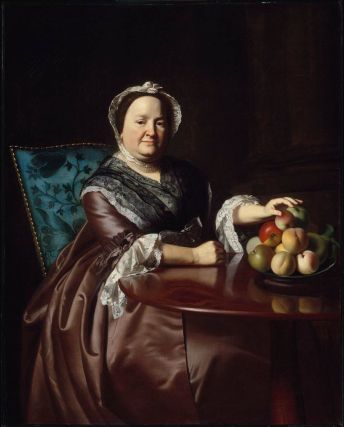
John Singleton Copley, Portrait of Mrs. Ezekiel Goldthwait (Elizabeth Lewis), 1771 (Boston: Museum of Fine Arts)
Art and Appetite takes a different approach to the subject of food in American art, contextualizing works to rediscover the meanings they held for their makers and their audiences. Despite the prevalence of works about food, research has rarely focused on the cultural significance of the objects depicted in these paintings, nor has it addressed how these images embodied changing ideals throughout the nation’s history. Thematically and chronologically organized, Art and Appetite breaks with the traditional histories of the genre to explore how these works illuminate American attitudes about patriotism and politics, identity and gender, progress and history, and production and consumption. The exhibition examines 250 years of American art, from the agricultural bounty of the “new world” to Victorian-era excess, debates over temperance, the rise of restaurants and café culture, the changes wrought by 20th-century mass production, and much more.
From the earliest years of the newly established United States, American artists such as Raphaelle Peale used still-life painting to express cultural, political and social values, elevating the genre to a significant aesthetic language. Later, in the antebellum era, depictions of food highlighted abundance, increasing wealth and changing social roles, while elegant decanters of wine and spirits in still-life paintings by John F. Francis reflect the prevalence of drinking and the mid-century debates over temperance. During the Gilded Age, despite the implications of the term, American artists moved away from excess and eschewed high Victorian opulence in favor of painting the simple meal. Many artists, such as William Harnett and De Scott Evans, also used images of food to serve up biting political commentary that addressed the social and economic transformations of the 1880s and 1890s.
In the 20th century new ways of eating and socializing began to change depictions of food in art. Restaurant dining—still novel in the United States in the late 19th century—became a common subject in the works of William Glackens, John Sloan and others. Café and cocktail culture, described in the work of Stuart Davis and Gerald Murphy, became increasingly important even as Prohibition banned the consumption of alcohol. Modern artists employed food in their radically new explorations of pictorial form, all the while challenging national ideals of family and home. Finally, during the 1950s and 1960s, Pop artists, among them Andy Warhol and Roy Lichtenstein, addressed the ways in which mass production and consumption dramatically altered the American experience of food. Hamburgers, fries and cakes were depicted as objects of mass-produced foodstuffs without human referent. Artists employed new means to explore the visual power of advertising, the standardization of factory-produced meals and the commercialization of American appetites.
Today, as professional and home chefs increasingly turn toward local, organic food and American society ponders its history as a fast-food nation, this exhibition offers visitors the chance to look at depictions of American food and culture with new meaning and fresh eyes.
Art and Appetite: American Painting, Culture, and Cuisine was organized by the Art Institute of Chicago. It is supported in part by generous contributions from Central Market, the Fort Worth Promotion and Development Fund, and the Ben E. Keith Foundation.
Also, see the online cookbook from The Art Institute of Chicago.
◊ ◊ ◊ ◊ ◊
From Yale UP:
Judith A. Barter, ed., with essays by Judith A. Barter, Annelise K. Madsen, Sarah Kelly Oehler, and Ellen E. Roberts, Art and Appetite: American Painting, Culture, and Cuisine (New Haven: Yale University Press, 2013), 248 pages, ISBN: 978-0300196238, $50.
 Food has always been an important source of knowledge about culture and society. Art and Appetite takes a fascinating new look at depictions of food in American art, demonstrating that artistic representations of edibles offer thoughtful reflection on the cultural, political, economic, and social moments in which they were created. Artists used food as prism through which they could celebrate and critique their society, expressing ideas relating to politics, race, class, and gender. With a focus that ranges from Colonial still lifes of the 18th century through the Pop artists of the 20th century, this lively publication investigates the many interpretations of eating in America.
Art and Appetite features still-life and trompe l’oeil painting, sculpture, and other works by such celebrated artists as John Singleton Copley, Raphaelle Peale, Lilly Martin Spencer, William Michael Harnett, William Merritt Chase, Elizabeth Paxton, Norman Bel Geddes, Stuart Davis, Edward Hopper, Alice Neel, Wayne Thiebaud, and Roy Lichtenstein, among others. Essays by leading experts address topics including the horticultural and botanical underpinnings of still-life painting, the history of alcohol consumption in the United States, the cultural history of Thanksgiving, and the commercialization of food in the world of Pop art. In addition to the images and essays, this book includes a selection of vintage recipes for all-American dishes.
Judith A. Barter is the Field-McCormick Chair and Curator, Department of American Art, at the Art Institute of Chicago.










 Enfilade
leave a comment