New Book | Looking Smart: Chardin’s Genre Subjects
From the University of Delaware Press:
Paula Radisich, Pastiche, Fashion, and Galanterie in Chardin’s Genre Subjects: Looking Smart (Newark: University of Delaware Press, 2013), 206 pages, ISBN: 978-1611494242, $75.
 Pastiche, Fashion, and Galanterie in Chardin’s Genre Subjects seeks to understand how Chardin’s genre subjects were composed and constructed to communicate certain things to the elites of Paris in the 1730s and 1740s. The book argues against the conventional view of Chardin as the transparent imitator of bourgeois life and values so ingrained in art history since the nineteenth century. Instead, it makes the case that these pictures were crafted to demonstrate the artist’s wit (esprit) and taste, traits linked to conventions of seventeenth-century galanterie.
Early eighteenth-century Moderns like Jean-Siméon Chardin (1699–1779) embraced an aesthetic grounded upon a notion of beauty that could not be put into words—the je ne sais quoi. Despite its vagueness, this model of beauty was drawn from the present, departed from standards of formal beauty, and could only be known through the critical exercise of taste. Though selecting subjects from the present appears to be a simple matter, it was complicated by the fact that the modernizers expressed themselves through the vehicles of older, established forms. In Chardin’s case, he usually adapted the forms of seventeenth-century Dutch and Flemish genre painting in his genre subjects. This gambit required an audience familiar enough with the conventions of Lowlands art to grasp the play involved in a knowing imitation, or pastiche. Chardin’s first group of enthusiasts accordingly were collectors who bought works of living French artists as well as Dutch and Flemish masters from the previous century, notably aristocratic connoisseurs like the chevalier Antoine de la Roque and Count Carl-Gustaf Tessin.
Paula Radisich is professor of art history at Whittier College.
New Book | Les Ruines: Entre Destruction et Construction
Published by Campisano and available from ArtBooks.com:
Karolina Kaderka, ed., Les Ruines: Entre destruction et construction de l’Antiquité à nos jours (Rome: Campisano Editore, 2013), 284 pages, ISBN: 978-8898229123, €40.
 Aucune époque n’échappe aux ruines et toutes les ruines ont une histoire. Elles sont vouées à perdurer ou disparaître, fasciner ou déranger. L’intérêt pour les ruines s’explique de façon naturelle par leur omniprésence et ne date pas d’aujourd’hui: différentes époques et cultures témoignent de leur façon propre de les appréhender. Si le goût des ruines antiques émerge en Europe avec la Renaissance et suscite un véritable culte au siècle des Lumières, toutes les époques de l’histoire sont amenées à affronter des ruines de genres divers, parfois conceptualisées mentalement. Au cours du siècle dernier, dans un contexte où surgissent de nouvelles formes de destructions, massives et violentes, se font jour une nouvelle sensibilité aux ruines et un désir d’étudier, de manière plus complexe, leur impact et leur signification pour les sociétés : celles auxquelles elles appartenaient à l’origine, comme celles auxquelles elles seront confrontées par la suite. S’inscrivant dans la continuité des recherches actuelles sur le sujet, ce volume interdisciplinaire souhaite présenter et discuter l’existence et la perception de ruines en Europe, dans des contextes culturels et historiques variés, qu’elles soient considérées in situ, représentées ou ressenties, qu’elles soient décrites ou abordées par d’autres moyens que les mots. Des archéologues, historiens, historiens de l’art et de l’architecture, esthéticiens, spécialistes des langues, de la littérature et des nouvelles technologies de conservation des traces du passé, croisent leurs regards dans des études qui portent sur les constructions détruites, tout comme sur les destructions construites, en montrant diverses façons de les concevoir depuis l’Antiquité jusqu’à aujourd’hui.
Karolina Kaderka est archéologue et historienne de l’art antique. Chercheuse associée dans l’équipe d’accueil Histara (EA 4115) de l’École pratique des hautes études (EPHE Paris) et lauréate du prix «Jeune chercheur» de la Fondation des Treilles pour 2013, elle est actuellement post-doctorante Fernand Braudel-IFER à l’Université
de Constance. Après des études universitaires à l’Université Charles de Prague et à l’Université Louis-et-Maximilien de Munich, elle a obtenu en 2012 un doctorat (co-tutelle EPHE Paris/Université de Dresde), avec une thèse consacrée au décor tympanal des temples de Rome. Ses travaux portent notamment sur la sculpture romaine, sur l’art romain dans son contexte (spatial, socioculturel et historique, avec un intérêt particulier pour les programmes décoratifs), sur les transferts culturels entre la Grèce, le monde étrusco-italique et Rome et sur la photographie archéologique. Dernièrement elle a collaboré au catalogue d’exposition Éclats d’antiques. Sculptures et photographies : Gustave Mendel à Constantinople (Paris, 2013).
C O N T E N T S
• Préface – Une lecture des ruines, François Queyrel
• Introduction. Les Ruines. Entre destruction et construction, Karolina Kaderka
• La conservazione delle rovine di guerra nella Grecia antica e il giuramento di Platea (vero o falso?), Massimiliano Papini
• Les ruines de Cicéron. Temples et mœurs à la fin de la République romaine, Karolina Kaderka
• Paysage de ruines dans la peinture romaine (Ier siècle av. J.-C. – Ier siècle ap. J.-C.), Isabella Colpo
• Abandonner ou restaurer: la peur des ruines dans l’Antiquité tardive, Éric Morvillez
• L’esthétique paysanne des spolia dans les églises médiévales du Hat¸eg (Roumanie, xiiie-xve siècle), Vladimir Agrigoroaei
• Le «Antichità greche» di Giuliano da Sangallo. Erudizione e rovinismo nel Libro dei Disegni, Codice Barberiniano Latino 4424, Dario Donetti
• Tradition religieuse contre invention à l’antique: ruines dans la peinture de la deuxième moitié du Quattrocento, Sabine Frommel
• Spazio, Tempo e rovine nel giardino del Rinascimento, Claudia Conforti
• Symbolique et réemploi des ruines: réflexions à partir du cas de la Lorraine après la guerre de Trente Ans, Raphaël Tassin
• La tourelle de l’abbatiale de Royaumont: un débris devenu monument, Jean-François Belhoste
• Ruines et Lumières : Français et Anglais aux prises autour de la Rome antique aux xviiie et début xixe siècles, Odile Boubakeur
• Ruines et pensée de l’Histoire. Le paradigme catastrophique de Walter Benjamin, Sabine Forero Mendoza
• Ruines de la modernité ou modernité de la ruine ?, Audrey Norcia
• Poétiques des ruines ou comment écrire dans les décombres de la Seconde Guerre mondiale, Pierre Hyppolite
• L’expression interlinguistique des ruines et sa poétique, Anne Szulmajster-Celnikier
• Réplique virtuelle et réplique réelle de la tablette d’Idalion – bronze chypriote conservé à la BnF, Patrick Callet
• Ruines, permanence de l’impermanence: un essai de conclusion, Alain Schnapp
New Book | The Life and Times of Quatremère de Quincy
From Palgrave Macmillan:
Louis A. Ruprecht, Classics at the Dawn of the Museum Era: The Life and Times of Antoine Chrysostome Quatremère de Quincy (1755–1849) (New York: Palgrave Macmillan, 2014), 300 pages, ISBN: 978-1137384072, $95.
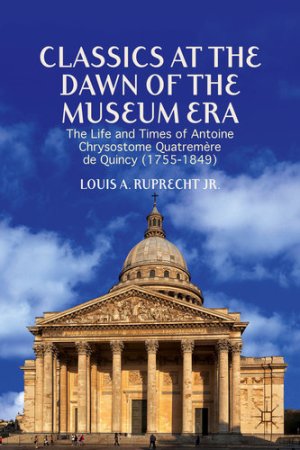 Antoine Chrysostome Quatremere de Quincy (1759–1849), arguably the foremost French classicist and art historian of the nineteenth century, is relatively little-known in English language scholarship. Three of his books were translated in the early nineteenth century, none in the twentieth century, and an important collection of two sets of open letters concerning museums, looting and repatriation was just published in 2012.
Quatremère has been unfairly called ‘the French Winckelmann,’ a charge that sticks primarily because so little of his work has ever been translated. In fact, he shows us, not what apish imitation of Wincklemann’s Neoclassicism looked like in the nineteenth century, but rather what these two overlapping disciplines had become in the generation after Winckelmann. Quatremère was formed by three crucial developments that Winckelmann did not and could not know: the French Revolution and its aftermath; Hegelian aesthetics; and the establishment of the museum era in Europe. Quatremère also remained committed to his Roman Catholicism and to the secular values of the early Revolution; in this he is very different than Winckelmann, who converted to Catholicism just before moving to Rome, and who was, according to many who claimed to understand him best, really a ‘closeted pagan’ if he were anything at all. Quatremère wrote eloquently and with deep insight concerning his understanding of the compatibilities between the Classical and Christian vision, an issue that does not figure in Winckelmann’s more intentionally ‘profane’ musings. Ruprecht hopes to show that Quatremère’s true importance emerges only if we situate him in his own times, one generation after Winckelmann, in a very different, and a far more revolutionary and secularizing cultural moment.
Louis A. Ruprecht is William M. Suttles Chair of Religious Studies at Georgia State University.
New Book | The Pathos of the Cross
According the the foreword, the book focuses on the period from 1600 to 1750. From Oxford UP:
Richard Viladesau, The Pathos of the Cross: The Passion of Christ in Theology and the Arts-The Baroque Era (New York: Oxford University Press, 2014), 368 pages, ISBN: 978-0199352685, £36 / $55.
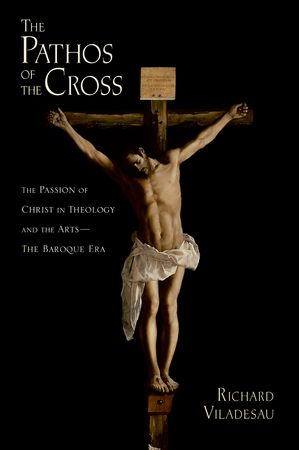 The Baroque period was in some senses the beginning of modern Western scientific and intellectual culture, the early budding of the Enlightenment. In the light of a new scientific and historical consciousness, it saw the rise of deism and the critique of traditional forms of Christianity. Secular values and institutions were openly or surreptitiously replacing the structures of traditional Christian society. At the same time, it was a time of religious renewal and of the reaffirmation of tradition. In sacred art, it was the age of of Bernini, Rubens, Van Dyck, Velazquez, and Rembrandt; in church music, the period of Monteverdi, Scarlatti, Handel, Telemann, and Bach. The pathos of Christ’s crucifixion—its power to evoke strong emotions of pity and compassion—was a central element in Baroque theology and spirituality. The sacred arts of the period reflect the centrality of this theme. Many of the works of the period retain their ability to move us emotionally and spiritually centuries later—even though the theology they represent has been challenged and frequently rejected. This volume traces the ways in which Roman Catholic and Protestant theologies of the period continued to proclaim the centrality of cross of Christ to human salvation. In a parallel movement, it illustrates how musical and artistic works of the period were both inspired and informed by these theologies, and how they moved beyond them in an aesthetic mediation of faith.
• Continues the historical theological/aesthetic survey of the first two volumes of this series
• Systematically examines the presence of theological themes in individual works of art and music of the Baroque period
• Is unique in its overview of the interrelationships of art and theology during a significant period of religious development
• Proposes the notion of ‘pathos’ as a means of summarizing the Baroque sensibility with regard to Christ’s passion
Richard Viladesau was ordained in 1969 in Rome for the Diocese of Rockville Centre. He is Professor of Theology at Fordham University, since 1988, and Administrator of Our Lady Star of the Sea Church, Saltaire, New York.
◊ ◊ ◊ ◊ ◊
C O N T E N T S
Foreword
Abbreviations
List of Illustrations
Introduction—The Social Context of the Baroque Period: The Beginnings of Modernity
Part I: The Survival of the Classical Paradigm of the Cross in Roman Catholicism
1 The Theoretical Mediation: The Cross in Baroque Tridentine Orthodoxy
2 The Aesthetic Mediation: The Cross in Baroque Catholic Art
3 The Aesthetic Mediation: The Passion in Catholic Music
Part II: The Cross in Protestant Orthodoxy
4 The Theological Mediation: Baroque Lutheran and Reformed Theology of the Cross
5 The Aesthetic Mediation: The Cross in Protestant Art
6 The Aesthetic Mediation: Protestant Passion Music
Part III: The Challenge to the Orthodox Doctrine of Redemption: The Enlightenment Paradigm
7 Challenges to the Classical Paradigm of the Cross and the Emergence of a New Paradigm of Salvation
Envoi
Appendix 1: Virtual Museum
Appendix 2: Discography—Music of the Passion of the Baroque Era
Bibliography
Index
Notes
Exhibition | The Fortunes of the Italian Primitives, ca. 1800
From the exhibition website:
La Fortuna dei Primitivi: Tesori d’Arte dalle Collezioni Italiane fra Sette e Ottocento
The Fortunes of the Primitives: Art Treasures from Italian Collections
between the Late Eighteenth and Nineteenth Centuries
Galleria dell’Accademia, Florence, 24 June — 8 December 2014

Libro d’Ore di Lorenzo de’ Medici, Annunciazione (Firenze, Biblioteca Medicea Laurenziana, Ms. Ashb. 1874, c. 13v)
This exhibition is the first ever dedicated to the topic as a whole. It proposes to offer a critical-bibliographic picture of this very important cultural phenomenon concerning the history of taste and collecting in Italy between the late XVIII century and early XIX century. Among other things, this phenomenon exerted a considerable and direct influence on the formation of the major public art collections in the most important European countries.
The exhibition begins with the fundamental contribution of Giovanni Previtali (La fortuna dei primitivi. Dal Vasari ai Neoclassici, Turin, 1964), published exactly fifty years ago. With a scientific committee made up of art historians, historians of collecting and art critics, the exhibition intends to delve into this theme that to date has been relatively neglected. Significant progress has been made since the pioneering studies of Venturi, Previtali, Haskell and Pomian. The time is therefore ripe to reflect on this phenomenon and, especially, on the people who collected works by the primitives, to some extent systematically (and therefore not occasionally), and on those who strove to lay hands on these panel paintings with precious gold grounds (merchants, agents, procurers and restorers). Singling out Florence as the privileged site for an exhibition like this one is practically a foregone conclusion, given the wealth the Tuscan-Florentine area has had historically in the production of artworks in the fourteenth and fifteenth centuries. Almost all the collections of primitives indeed boasted works from this geographic area.
The exhibition will review the principal personalities who were in the forefront of this recovery, exponents of the church (from simple abbots to powerful cardinals), as well as noblemen and scholars who could not resist the attraction of these fragile and precious artistic representations. The rooms will therefore exhibit works of art (paintings, sculptures, objects of sumptuary art and illuminated codices) that were once in the collections of Francesco Raimondo Adami, Stefano Borgia, Angelo Maria Bandini, Alexis-François Artaud de Montor, Joseph Fesch, Teodoro Correr, Girolamo Ascanio Molin, Alfonso Tacoli Canacci, Sebastiano Zucchetti, Anton Francesco Gori, Agostino Mariotti, Matteo Luigi Canonici, Giuseppe Ciaccheri, Tommaso degli Obizzi, Gabriello Riccardi, Giovan Francesco De Rossi and Guglielmo Libri, to cite only the best-known names.
An animated dialogue will accompany visitors along a sort of ideal stroll through the Italy of collectors from the late XVIII century to the early XIX century. Visitors will be encouraged to make quick visual comparisons aimed at grasping the taste, the eye and the aesthetic sensitivity of the various collectors whose collections will be compared for the first time. Alongside paintings that at that time constituted the principal interest of collectors, there are other, equally important sections tied to illuminations and sculpture. The intention is to show the circularity of interests of collectors who with a pioneering approach sought to preserve these historical-scholarly representations, every day threatened by the risk of destruction or abandon.
The very numerous visitors of the Galleria dell’Accademia will thus be able to appreciate a selection of works of art of high and, in many cases, of the highest level, based on a serious scientific project, which will offer yet another confirmation of the heights of quality Italian art attained from the XIII to the XV century. The artists whose work will be on display in this exhibition include, among others, the Master of Magdalene, Arnolfo di Cambio, Bernardo Daddi, Taddeo Gaddi, Nardo di Cione, Lippo Memmi, Ambrogio Lorenzetti, Pietro da Rimini, Beato Angelico, Filippo Lippi, Andrea Mantegna, Cosmè Tura, Piermatteo d’Amelia and Giovanni Bellini. The exhibition catalogue is expected to constitute the till-now inexistent text of reference dedicated to this specific theme taken as a whole.
The catalogue will be available from ArtBooks.com:
Angelo Tartuferi and Gianluca Tormen, eds., La Fortuna dei Primitivi: Tesori d’Arte dalle Collezioni Italiane fra Sette e Ottocento (Firenze: Giunti, 2014), $78.
Exhibition | Art and Politics: The Electress Palatine

From the Museo delle Cappelle Medicee:
Art and Politics: The Electress Palatine and the Final Season of Medici Patronage in San Lorenzo
Museum of the Medici Chapels (Cappelle Medicee) Florence, 8 April — 2 November 2014
Curated by Monica Bietti
There are many reasons for paying due tribute to the Electress Palatine, Anna Maria Luisa de’ Medici (1667–1743), the last descendent of the Grand-ducal branch of the Medici dynasty. Indeed the last years of her life—following the death of her brother the last Medici Grand Duke Gian Gastone—were intimately bound up with the present and future life of her State, for the safeguarding of which she drafted the “Family Pact,” the fundamental document that guaranteed the protection and conservation of the heritage of the Medici within their city and their State.
The idea for the exhibition stemmed from a 2012 project organised in collaboration between the REM museums of Mannheim—which wished to honour the memory of the Electress who lived and reigned in Germany following her marriage to the Elector Palatine Johann Wilhelm von Pfalz Neuburg, from 1691 to 1716—the Museum of the Medici Chapels, the Faculty of Medical Surgery of the University of Florence and the Superintendencies for the Archaeological Heritage of Tuscany, for the Architectural, Landscape, Historic, Artistic and Ethno-Anthropological Heritage of the Province of Florence and the Opificio delle Pietre Dure. This project led, between the 8th and 22nd October of 2012, to the control of the state of conservation of the mortal remains of the Electress and the rehabilitation of the tomb as well as the restoration of part of the important collection of grave goods. The Museum of the Medici Chapels decided to illustrate to the public the results of this research and restoration by organising this exhibition, centred in particular on the last years of life of the Electress.
Among the outcomes of the control of the tomb and the remains of the last descendent of the Medici, the show displays to the public for the first time two gold medals, two coins and the dedicatory plaque. In addition, the exhibition is also intended to cast light on what Anna Maria Luisa did for art and politics in Florence from 1737, when her brother Gian Gastone died up to the year of her own death in 1743. It presents novelties and authentic rarities emerging from the new studies and researches that followed in the wake of the monographic show devoted to the Electress in 2006, curated by Stefano Casciu (The Wise Princess: The Legacy of Anna Maria Luisa de’ Medici, Electress Palatine).

Bartolomäus van Douven, Allegoria degli Elettori Palatini come protettori delle Arti, 1722 (Firenze, Galleria degli Uffizi)
The show is divided into four sections designed to introduce the heterogeneous public of the Museum of the Medici Chapels to the personality of the Princess. The first, Childhood and the Adolescent Years at Poggio Imperiale, briefly illustrates her education and the years of her early youth that she spent at the Medici Villa of Poggio Imperiale with her brothers Ferdinando and Gian Gastone, her uncle Francesco Maria and her grandmother Vittoria della Rovere.
The second section, Youth and Marriage, opens with the fine portrait of Anna Maria Luisa as Flora by Antonio Franchi and deals with the period of her marriage to the Elector Palatine of the Rhine, Johann Wilhelm, celebrated in 1691, and her long sojourn in Germany where the couple were intensely engaged in artistic patronage, well-represented by the works commissioned from Bartolomeo Van Douven, whose famous Allegory of the Electors Palatine as Patrons of the Arts can be admired at the exhibition.
The third section, The Return to Florence and the Commitment to the Family Church, constitutes the core of the exhibition, illustrating the years immediately following the return to Florence of the Electress after the death of her husband in 1716. The events of these years significantly affected the complex of San Lorenzo, which was enhanced by important commissions made by Anna Maria Luisa, presented here in the light of new “political” documents. Following the “Family Pact” of 1737, the Princess indeed launched the final season of Medici patronage in the great complex of San Lorenzo: “Anna Maria set in motion a wide-ranging series of commission initiatives which were focused on San Lorenzo, comprising the construction of the bell-tower, the painting of the cupola of the basilica, the project for the decoration of the ceiling of the Chapel of the Princes (never carried through): it was clearly an attempt on her part to conclude the extensive cycle of operations begun by her distant ancestor Giovanni di Bicci three centuries earlier, in the service of the famous basilica and the public magnificence of the family” (Cristina Acidini).
The show ends with the fifth section, Death, which took place on 18 February 1743, where period engravings and publications illustrate the ceremonies connected with the event. Also displayed in this section are the three-dimensional cast of the head of the Electress, the medals and the other objects found in her tomb.
◊ ◊ ◊ ◊ ◊
From Sillabe:
Monica Bietti, Arte e Politica: L’Elettrice Palatina e l’ultima stagione della committenza medicea a San Lorenzo (Livorno, Sillabe, 2014), 280 pages, ISBN: 978-8883477324, €30.
 La campagna di restauro e indagine che ha avuto per oggetto il monumentale complesso delle Cappelle dei Principi presso la basilica di San Lorenzo a Firenze ha dato esiti a dir poco straordinari, non ultima la riesumazione e la delicatissima ricognizione sulle spoglie mortali della principessa Anna Maria Luisa, evento eccezionale di altissimo profilo scientifico, documentato dal National Geographic, e in questo 2014 il Museo vuole renderne partecipe il pubblico.
Già nel 2006 Firenze ha reso omaggio all’ultima dei Medici con un’altra importante mostra La principessa saggia. L’eredità di Anna Maria Luisa de’ Medici Elettrice Palatina, edito da Sillabe; in questo nuovo evento saranno affrontati temi che approfondiscono la vita di Anna Maria Luisa, moglie dell’Elettore Palatino Johann Wilhelm von Pfalz-Neuburg, e la sua politica dopo il rientro a Firenze, in seguito della morte del fratello Giangastone.
La mostra delle 77 opere di vario genere, alcune delle quali mai esposte al pubblico, offriranno una panoramica aggiornata e approfondita della vita della principessa, le sue committenze artistiche, le sue scelte politiche e di famiglia.
New Book | Ways of Making and Knowing
From the University of Michigan Press (with an excerpt and more information available at the website for the series, The Bard Graduate Center Cultural Histories of the Material World) . . .
Pamela H. Smith, Amy R. W. Meyers, and Harold J. Cook, eds., Ways of Making and Knowing: The Material Culture of Empirical Knowledge (Ann Arbor: University of Michigan Press, 2014), 448 pages, ISBN: 978-0472119271, $60.
 “Making” and “knowing” have generally been viewed as belonging to different types and orders of knowledge. “Craft” and “making” have been associated with how-to information, oriented to a particular situation or product, often informal and tacit, while “knowing” has been related to theoretical, propositional, and abstract knowledge including natural science. Although craftspeople and artists have worked with natural materials and sometimes have been viewed as experts in the behavior of matter, the notion that making art can constitute a means of knowing nature is a novel one.
This volume, with contributions from historians of science, medicine, art, and material culture, shows that the histories of science and art are not simply histories of concepts or styles, or at least not that alone, but histories of the making and using of objects to understand the world. The common view of craftspeople more or less mindlessly following a collection of recipes or rules—which are said to be fundamentally different from “science” and “art”—has greatly distorted our understanding of the growth of natural knowledge in the early modern period. More intensive examination of material practices makes it clear that the methods of the artisan represent a process of knowledge-making that involved extensive experimentation and observation, in addition to generalizations about matter and nature. As increasing numbers of people came to be immersed in such activities, whether as craftspeople, medical practitioners, merchants, nobles, magistrates, reformers, collectors, or even scholars, the attributes of “nature” were not only articulated in a variety of ways, and not only seen as a resource for human use, but came to be identified with a variety of “goods.” Knowing nature could of course lead to material betterment but for many, living according to nature’s dictates also led to the development of personal ethics and the public good. As natural knowledge became increasingly important in society in these various ways, it forged new connections among groups, helped create new identities, brought about new kinds of claims to authority and intellectual legitimacy, and gave rise to new ways of thinking about the senses, certainty, and epistemology. None of this could have happened without the conversations and controversies that enabled the assessment of objects in novel ways.
◊ ◊ ◊ ◊ ◊
C O N T E N T S
Introduction: Making and Knowing
Harold J. Cook, Pamela H. Smith, and Amy R.W. Meyers
1. Making as Knowing: Craft as Natural Philosophy
Pamela H. Smith
2. From Skills to Wisdom: Making, Knowing and the Arts
Suzanne B. Butters
3. Between Trade and Science: Dyeing and Knowing in the Long Eighteenth Century
Alicia Weisberg-Roberts
4. How to Cure the Golden Vein: Medical Remedies as Wissenschaft in Renaissance Germany
Alisha Rankin
5. Evidence, Artisan Experience and Authority in Early Modern England
Patrick Wallis and Catherine Wright
6. American Roots: Technologies of Plant Transportation and Cultivation in the Early Atlantic World
Mark Laird and Karen Bridgman
7. Inside the Box: John Bartram and the Science and Commerce of the Transatlantic Plant Trade
Joel Fry
8. From Plant to Page: Aesthetics and Objectivity in a Nineteenth-Century Book of Trees
Lisa Ford
9. The Labor of Division: Cabinetmaking and the Production of Knowledge
Glenn Adamson
10. Making Lists: Social and Material Technologies in the Making of Seventeenth-Century British Natural History
Elizabeth Yale
11. The Preservation of Specimens and the Take-Off in Anatomical Knowledge in the Early Modern Period
Harold J. Cook
12. Conrad Gessner on an ‘ad vivum’ image
Sachiko Kusukawa
13. Corals versus Trees: Charles Darwin’s Early Sketches of Evolution
Horst Bredekamp
14. Decaying Objects and the Making of Meaning in Museums
Mary M. Brooks
Epilogue
Malcolm Baker
Study Day | Fame and Friendship: Pope, Roubiliac and the Portrait Bust
The exhibition Fame and Friendship: Pope, Roubiliac and the Portrait Bust (recently closed at YCBA) opens June 18 at Waddesdon Manor in Buckinghamshire (where it will be on display until 26 October 2014). In connection, Malcolm Baker will lead a special interest day on Thursday, 10 July.
From Waddesdon Manor:
Study Day | Fame and Friendship: Pope, Roubiliac and the Portrait Bust
Waddesdon Manor and Stowe Landscape Gardens, 10 July 2014
 Led by Professor Malcolm Baker, the curator of the exhibition, this day will begin with an in-depth look at Fame and Friendship: Pope, Roubiliac and the Portrait Bust, followed by lunch in the Manor Restaurant. In the afternoon, participants will travel to nearby Stowe Landscape Gardens to see the famous Temple of British Worthies and to explore the central role of the sculpture portrait bust in the creation and celebration of fame and friendship. The day will end with tea at Stowe. The price of your ticket (£70) includes coach travel from Waddesdon to Stowe and return to your car at Waddesdon; normal admissions charges apply to both Waddesdon and Stowe.
Malcolm Baker is Distinguished Professor of the History of Art, University of California, Riverside, and Honorary Senior Research Fellow at the Victoria and Albert Museum.
◊ ◊ ◊ ◊ ◊
In addition to The Marble Index: Roubiliac and Sculptural Portraiture in Eighteenth-Century Britain, Malcolm Baker’s major publication related to the exhibition and due out later this year from Yale University Press, a more tightly focused catalogue will be published by Paul Holberton:
Malcolm Baker, Fame and Friendship: Pope, Roubiliac and the Portrait Bust (London: Paul Holberton Publishing, 2014), 128 pages, ISBN: 978-0954731052, £15 / $25.
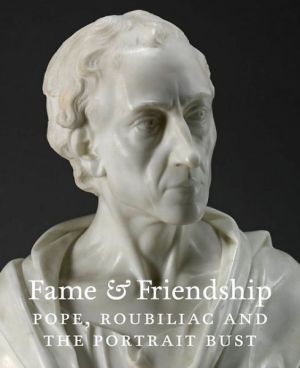 No literary figure of the eighteenth century was more esteemed than the poet Alexander Pope, and his sculpted portraits exemplify the celebration of literary fame at a period when authorship was being newly conceived and the portrait bust was enjoying new popularity. Accompanying an exhibition at Waddesdon Manor (The Rothschild Collection), this publication explores the convergence between authorship, portraiture, and the sculpted image in particular, by bringing together a wide range of works that foreground Pope’s celebrity status.
Pope took great pains over how he was represented and carefully fashioned his public persona through images, published letters and the printed editions of his works. Alongside some of the most celebrated painted portraits of the poet will be a selection of the printed texts which Pope planned with meticulous care. The publication focuses on eight versions of the same portrait bust by the leading sculptor of the period, Louis François Roubiliac.
The marble bust had long been seen as a form appropriate for the celebration of literary fame and Pope’s bust in part imitates those of classical authors whose works he both translated and consciously imitated in his own poems. More than any other sculptor, Roubiliac reworked the conventions of the bust, transforming it into a genre that was considered worthy of close and sustained attention. Nowhere is this seen more tellingly than in his compelling and intense portraits of Pope. Based on a vividly modelled clay original, the variant marble versions were carved with arresting virtuosity, recalling Pope’s own phrase, “Marble, soften’d into Life.” At the same time, the image was reproduced by both the sculptor himself and by others, in a variety of materials.
Multiplied and reproduced throughout the eighteenth century, Pope’s bust was the most familiar and visible sign of his authorial fame. At the same time, it was also used as a way of articulating friendship—a constant theme in Pope’s verse—and all the early versions of Roubiliac’s bust were probably executed for Pope’s closest friends. By bringing together the eight versions thought to have been executed by Roubiliac and his studio, and a number of other copies in marble, plaster and ceramic, this publication will offer the opportunity to explore not only the complex relationship between these various versions but the hitherto little understood processes of sculptural production and replication in eighteenth-century Britain.
Exhibition | Royal Spectacle at the French Court

C.-N. Cochin père, after C.-N. Cochin fils, Décoration du Bal Masqué donné par le Roy, plate 7 of Recueil des Festes, Feux d’Artifice, et Pompes Funèbres (Paris: Ballard, 1756). National Trust / Waddesdon Manor, 3176. Photo by Mike Fear. Depiction of the ball given by Louis XV in February 1745, on the occasion of the marriage of the Dauphin to Marie Thérèse Raphaëlle of Spain. Click here for a higher resolution image.
◊ ◊ ◊ ◊ ◊
From Waddesdon Manor:
Royal Spectacle: Ceremonial and Festivities at the French Court
Waddesdon Manor, Buckinghamshire, 26 March — 26 October 2014
Curated by Selma Schwartz and Rachel Jacobs
This exhibition marks the publication of the Catalogue of Printed Books and Bookbinding: The James A. de Rothschild Bequest at Waddesdon Manor (2013), highlighting illustrated books published on the occasion of court festivities, celebrations and spectacles. Lavishly illustrated books, with engravings of the largest format, document the many extravagant festivities and ceremonies staged for the French court during the 17th and 18th centuries to mark the life cycle of births, marriages and deaths. Fanciful theatrical stage settings are the backdrop for richly costumed processions, equestrian tournaments, theatre performances, church ceremonies and spectacular firework displays. The books themselves are often bound in exquisite bindings intended for the royal family and aristocracy. While focusing on France, the exhibition also includes some comparative material from other European courts.
Tours of the exhibition with one of the curators will take place on Friday 30 May, 11 July and 26 September. For more information on how to book, please click here.
◊ ◊ ◊ ◊ ◊
Note (added 18 June 2014) — A 45-page, illustrated checklist with details on the 58 exhibited works is available for download as a PDF file at the Waddesdon website.
Exhibition | China at Versailles: Art and Diplomacy in the 18th Century
From the Château de Versailles:
China at Versailles: Art and Diplomacy in the 18th Century
Château de Versailles, 27 May — 26 October 2014

Audience granted to the King of Siam’s ambassadors, 1 September 1686, at the Palace of Versailles, Etching on copper in black and burin At Pie. Landry rue St. Jacques at St. François de Sales, Almanac for the year 1687 (Paris, Bibliothèque nationale de France)
The Palace of Versailles presents China at Versailles: Art and Diplomacy in the 18th Century, organised for the 50th anniversary of the establishment of diplomatic relations between France and China. The exhibition follows the history of political and artistic exchanges between China and France during the 18th century. The paintings, furniture, lacquerware, porcelains and tapestries exhibited bear testimony to the extreme luxury of their time and are very rare today. The approximately 150 works gathered together for the exhibition illustrate France’s taste for Chinese artistic productions and reveal the interest among Europeans for descriptions of China throughout the 18th century.
A Political and Cultural Dialogue
In 1688, Louis XIV undertook a diplomatic policy that was to lead to high-level scientific and intellectual exchanges between France and China. By sending French Jesuits to the court in Beijing, the Sun King developed privileged, lasting relations with the Kangxi Emperor, his contemporary. Correspondence and exchanges intensified under the reigns of Louis XV and Louis XVI. The two countries developed unique diplomatic relations. The political and intellectual ties that were forged between France and China led to a veritable golden age of diplomatic relations between the two countries up to the French Revolution.

Claude-Louis Châtelet, View of the Chinese Ring Game; drawing in black chalk, watercolour and gouache; excerpt from Recueil des vues et plans du Petit Trianon à Versailles, under the direction of Richard Miquet, 1786.
Chinese Art at Versailles
Porcelains, wallpaper, lacquerware, fabrics and silks: Chinese artistic productions aroused a great deal of interest in France starting in the 18th century. Under the reign of Louis XIV, France’s taste for ‘lachine’ or ‘lachinage’ was attributed to the gifts brought from the Far East by the King of Siam’s ambassadors in 1686. This appetite for Chinese art can also be seen in what was later to be called ‘la chinoiserie’, a trend in tastes that took on various forms:
• imitations of Chinese art,
• influence of Chinese art on French art,
• adaptation of oriental materials to French tastes,
• but also the creation of an imaginary, peaceful China.
Although the French sovereigns, protectors of the arts, could not openly display their taste for China in the royal apartments, many pieces of Chinese artwork decorated their private apartments at Versailles and Trianon.
◊ ◊ ◊ ◊ ◊
Published by Somogy, the catalogue as described at the Château de Versailles:
Marie-Laure de Rochebrune, Anne-Cécile Sourisseau, and Vincent Bastien, eds., La Chine à Versailles: Art et Diplomatie au XVIIIe Siècle (Paris: Somogy éditions d’Art, 2014), 280 pages, ISBN: 978-2757208137, 39€.
 L’exposition La Chine à Versailles: Art et diplomatie au XVIIIe siècle retrace l’histoire des échanges politiques, scientifiques et artistiques entre la France et la Chine au siècle des Lumières.
Peintures, meubles, laques, gravures, porcelaines, livres précieux, tapisseries… les chefs-d’oeuvre exposés au château de Versailles témoignent du luxe raffiné de leur époque. Ils illustrent, dès le règne de Louis XIV, le goût français pour les productions artistiques chinoises. Ils révèlent aussi l’intérêt de la cour de Versailles pour l’Extrême-Orient, suscité par les descriptions que les jésuites envoyés en Chine rédigèrent dès la fin du XVIIe siècle.
Les cent cinquante oeuvres rassemblées dans cette exposition ‘évènement’ proviennent des plus grandes institutions françaises (musée du Louvre, musée Guimet, Bibliothèque nationale, etc.) et étrangères (collections royales anglaises, musée de l’Ermitage à Saint-Pétersbourg, etc.) ainsi que de collections particulières.
More information about the catalogue (in French) is available as PDF file here»










leave a comment