Renovation and Conservation at the YCBA and the Beinecke
For those of you thinking ahead in terms of fellowships at Yale, bear in mind these planned closures for 2014 and 2015. 2016, however, seems like a fine time to be in New Haven!
◊ ◊ ◊ ◊ ◊
From the Beinecke:
The Beinecke Rare Book & Manuscript Library will undergo a major renovation beginning at the end of May 2015. The renovation will replace the library’s mechanical systems and expand its research, teaching, storage, and exhibition capabilities. The library will reopen in September 2016.
A temporary reading room in the Sterling Memorial Library will provide researchers access to the library’s collections while work is under way. Beginning in April 2014, access to various collections will be limited as we prepare the library for closure. Please consult our closed collections schedule for information about when specific collections will be unavailable.
We invite you to learn more about the project, and follow our progress as we prepare the library for another 50 years as a world-class center of research and scholarship.
◊ ◊ ◊ ◊ ◊
From the YCBA:
. . . Planning is well underway for the second phase of the project, which will take place in 2015. The focus of this next phase will be the renewal of the public galleries on the second, third, and fourth floors, as well as the refurbishment of the Lecture Hall. The project will also address improvements related to life safety and accessibility, and extensive building-wide mechanical and electrical upgrades will be made. Visitors will have limited access to the building and no special exhibitions will be mounted or visiting fellowships awarded. When the Center reopens in January 2016, its collections will be completely reinstalled in the elegant, sky-lit galleries of the fourth floor, and three focused exhibitions, featuring specific aspects of the Center’s collection, will be on view in the second- and third-floor galleries.
◊ ◊ ◊ ◊ ◊
From Yale UP
Peter Inskip and Stephen Gee in association with Constance Clement, Louis I. Kahn and the Yale Center for British Art: A Conservation Plan (New Haven: Yale University Press, 2012), 200 pages, ISBN 978-0300171648, $50.
 The standing of the Yale Center for British Art as one of the world’s great museums and study centers finds expression in its remarkable building, designed by Louis I. Kahn (1901–1974). In this important and innovative volume, two architects offer a plan to ensure the proper stewardship of the building in order to preserve its essence as a great architectural structure. Peter Inskip and Stephen Gee describe the design, construction, and subsequent renovation of the building; assess its cultural significance; analyze the materials that comprise it (steel, concrete, glass, white oak, and travertine); and shed light on its evolution over the four decades since it was built. Drawing on their extensive experience developing conservation plans for both historic sites and modern buildings, they propse a series of policies for the Center’s conservation into the future.
Peter Inskip and Stephen Gee are with the London-based firm Peter Inskip + Peter Jenkins Architects. Constance Clement is Deputy Director of the Yale Center for British Art.
New Book | The Profession of Sculpture in the Paris ‘Académie’
SVEC 2014.02 from the Voltaire Foundation:
Tomas Macsotay, The Profession of Sculpture in the Paris ‘Académie’, SVEC (Oxford: Oxford University Studies in the Enlightenment, 2014), 360 pages, ISBN-13: 978-0729410793, £70 / €84 / $116.
 The profession of sculpture was transformed during the eighteenth century as the creation and appreciation of art became increasingly associated with social interaction. Central to this transformation was the esteemed yet controversial body, the Académie royale de peinture et de sculpture. In this richly illustrated book, Tomas Macsotay focuses on the sculptor’s life at the Académie, analysing the protocols that dictated the production of academic art. Arguing that these procedures were modelled on the artist’s study journey to Rome, Macsotay discusses the close links between working practices introduced at the Académie and new notions of academic community and personal sensibility. He explores the bodily form of the morceau de réception on which the election of new members depended, and how this shaped the development of academic ideas and practices. Macsotay also reconsiders the early revolutionary years, where outside events exacerbated tensions between personal autonomy and institutional authority.
The Profession of Sculpture in the Paris Académie underscores the moral and aesthetic divide separating modern interpretations of sculpture based on notions of the individual artistic persona, and eighteenth-century notions of sociable production. The result is a book which takes sculpture outside the national arena, and re-focuses attention on its more subjective role, a narrative of intimate life in a modern world.
Tomas Macsotay is a research fellow at the Universitat Autònoma, Barcelona. He is currently researching the visual culture of Spanish academies and sculpture in transnational Rome, and has previously published articles on the history of eighteenth-century French, Dutch, and British art. Macsotay’s 2008 thesis The Human Figure as Method: Study, Sculpture and Sculptors in the Académie Royale de Peinture et de Sculpture (1720–1765) was awarded the 2009 Prix Marianne Roland Michel.
C O N T E N T S
Introduction
1. The impossible originality of Falconet’s Milon
2. Sculptors’ morceaux between style and method
3. From shop floor to academic gallery
4. Guidance and autonomy: the role of Rome
5. Vleughels’s drawing sculptors
6. The order of figures: inert and moving
Epilogue. Of lions and cats: sociability and sculpture
Bibliography
Index
Macsotay offers a peak at the book’s argument with this posting at the Voltaire Foundation’s blog, “Sculptors in the Paris Académie’s mould, and how to (mis)understand them,” (17 February 2014).
New Book | Transporting Visions
From the University of California Press:
Jennifer L. Roberts, Transporting Visions: The Movement of Images in Early America (Los Angeles: University of California Press, 2014), 240 pages, ISBN: 978-0520251847, $60 / £42.
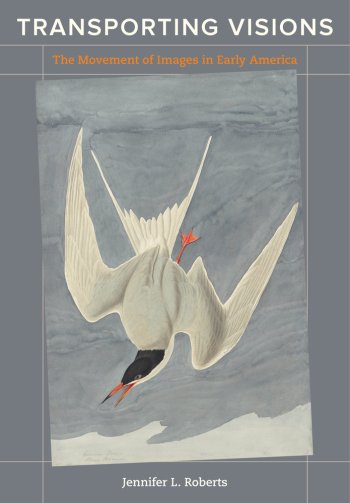 Transporting Visions follows pictures as they traveled through and over the swamps, forests, towns, oceans, and rivers of British America and the United States between 1760 and 1860. Taking seriously the complications involved in moving pictures through the physical world—the sheer bulk and weight of canvases, the delays inherent in long-distance reception, the perpetual threat to the stability and mnemonic capacity of images, the uneasy mingling of artworks with other kinds of things in transit–Jennifer L. Roberts forges a model for a material history of visual communication in early America. Focusing on paintings and prints by John Singleton Copley, John James Audubon, and Asher B. Durand—which were designed with mobility in mind—Roberts shows how an analysis of such imagery opens new perspectives on the most fundamental problems of early American commodity circulation, geographic expansion, and social cohesion.
Jennifer L. Roberts is Elizabeth Cary Agassiz Professor of the Humanities at Harvard University. She teaches American art from the colonial period to the present, with particular focus on issues of landscape, expedition, material culture theory, and the history of science. Her book Mirror-Travels: Robert Smithson and History was published in 2004 by Yale University Press.
C O N T E N T S
Acknowledgments
Introduction: Long-Distance Pictures
1. Dilemmas of Delivery in Copley’s Atlantic
2. Audubon’s Burden: Materiality and Transmission in The Birds of America
3. Gathering Moss: Asher B. Durand and the Deceleration of Landscape
Epilogue: Material Visual Culture
Notes
Selected Bibliography
List of Illustrations
Index
New Book | Androids in the Enlightenment
From The University of Chicago Press:
Adelheid Voskuhl, Androids in the Enlightenment: Mechanics, Artisans, and Cultures of the Self (Chicago: University of Chicago Press, 2013), 296 pages, ISBN: 978-0226034027, $45.
 The eighteenth century saw the creation of a number of remarkable mechanical androids: at least ten prominent automata were built between 1735 and 1810 by clockmakers, court mechanics, and other artisans from France, Switzerland, Austria, and the German lands. Designed to perform sophisticated activities such as writing, drawing, or music making, these ‘Enlightenment automata’ have attracted continuous critical attention from the time they were made to the present, often as harbingers of the modern industrial age, an era during which human bodies and souls supposedly became mechanized.
In Androids in the Enlightenment, Adelheid Voskuhl investigates two such automata—both depicting piano-playing women. These automata not only play music, but also move their heads, eyes, and torsos to mimic a sentimental body technique of the eighteenth century: musicians were expected to generate sentiments in themselves while playing, then communicate them to the audience through bodily motions. Voskuhl argues, contrary to much of the subsequent scholarly conversation, that these automata were unique masterpieces that illustrated the sentimental culture of a civil society rather than expressions of anxiety about the mechanization of humans by industrial technology. She demonstrates that only in a later age of industrial factory production did mechanical androids instill the fear that modern selves and societies had become indistinguishable from machines.
Adelheid Voskuhl is associate professor in the Department of the History of Science at Harvard University.
C O N T E N T S
List of Illustrations
Acknowledgments
1 Introduction: Androids, Enlightenment, and the Human-Machine Boundary
2 The Harpsichord-Playing Android; or, Clock-Making in Switzerland
3 The Dulcimer-Playing Android; or, Furniture-Making in the Rhineland
4 The Design of the Mechanics; or, Sentiments Replicated in Clockwork
5 Poetic Engagement with Piano-Playing Women Automata
6 The ‘Enlightenment Automaton’ in the Modern Industrial Age
Conclusion
Bibliography
Index
New Book | Credit, Fashion, Sex in Old Regime France
From Duke UP:
Clare Haru Crowston, Credit, Fashion, Sex: Economies of Regard in Old Regime France (Duke University Press, 2013), 448 pages, ISBN: 978-0822355137 (hardcover), $100 / ISBN: 978-0822355281 (paperback), $28.
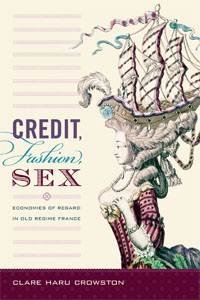 In Old Regime France credit was both a central part of economic exchange and a crucial concept for explaining dynamics of influence and power in all spheres of life. Contemporaries used the term credit to describe reputation and the currency it provided in court politics, literary production, religion, and commerce. Moving beyond Pierre Bourdieu’s theorization of capital, this book establishes credit as a key matrix through which French men and women perceived their world. As Clare Haru Crowston demonstrates, credit unveils the personal character of market transactions, the unequal yet reciprocal ties binding society, and the hidden mechanisms of political power.
Credit economies constituted ‘economies of regard’ in which reputation depended on embodied performances of credibility. Crowston explores the role of fashionable appearances and sexual desire in leveraging credit and reconstructs women’s vigorous participation in its gray markets. The scandalous relationship between Queen Marie Antoinette and fashion merchant Rose Bertin epitomizes the vertical loyalties and deep social divides of the credit regime and its increasingly urgent political stakes.
Clare Haru Crowston is Associate Professor of History at the University of Illinois, Urbana-Champaign. She is the author of Fabricating Women: The Seamstresses of Old Regime France, 1675–1791, also published by Duke University Press.
C O N T E N T S
Illustrations and Tables ix
Money and Measurements xi
Acknowledgments xiii
Introduction 1
1. Credit and Old Regime Economies of Regard 21
2. Critiques and Crises of the Credit System 56
3. Incredible Style: Intertwined Circuits of Credit, Fashion, and Sex 96
4. Credit in the Fashion Trades of Eighteenth-Century Paris 139
5. Fashion Merchants: Managing Credit, Narrating Collapse 195
6. Madame Déficit and Her Minister of Fashion: Self-Fashioning and the Politics of Credit 246
7. Family Affairs: Consumption, Credit, and the Marriage Bond 283
Conclusion. Credit is Dead. Long Live Credit! 316
Notes 329
Bibliography 383
Index 407
New Book | A Deadly Art: European Crossbows, 1250–1850
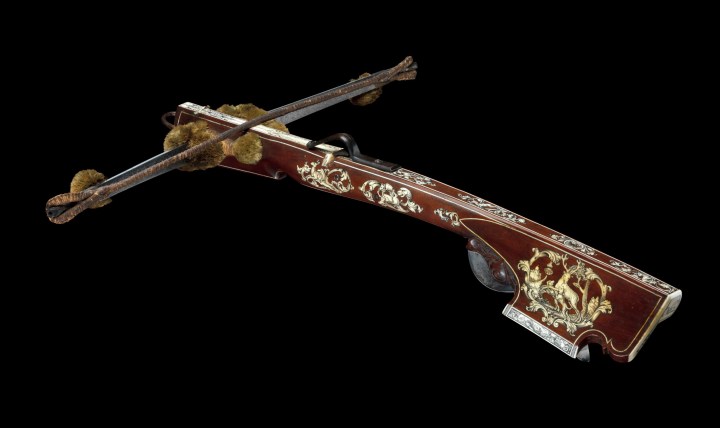
Johann Gottfried Hänisch the Elder (German, Dresden, 1696–1778), Small Crossbow (Bolzenschnepper), probably for a Woman or a Child, 1738 (Metropolitan Museum of Art, 2011.429), catalogue entry #15. Read more here»
◊ ◊ ◊ ◊ ◊
Distributed by Yale UP:
Dirk Breiding, A Deadly Art: European Crossbows, 1250–1850 (New York: The Metropolitan Museum of Art, 2014), 160 pages, ISBN: 978-0300197044, $25.
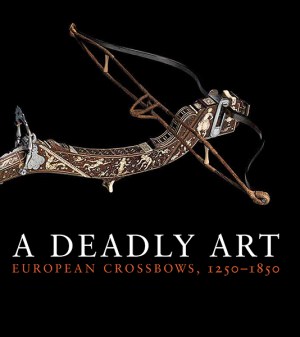 The advent of the crossbow more than 2,500 years ago effected dramatic changes for hunters and warriors. For centuries, it was among the most powerful and widely used handheld weapons, and its popularity endures to this day. A Deadly Art presents a lively, accessible survey of the crossbow’s “golden age,” along with detailed descriptions of twenty-four remarkable examples.
Beginning in the middle ages, the European aristocracy’s enthusiasm for the crossbow heralded shooting competitions and pageants that featured elaborately decorated weapons bearing elegant embellishments of rare materials and prized artistry. In addition to being highly functional, these weapons were magnificent works of art.
Dirk Breiding is J. J. Medveckis Curator of Arms and Armor at the Philadelphia Museum of Art.
New Book | Paris au XVIIIe siècle
Published by Parigramme and available from Artbooks.com:
Nicolas Courtin, Paris au XVIIIe siècle : entre fantaisie rocaille et renouveau classique (Paris: Parigramme, 2013), 192 pages, ISBN: 978-2840967934, 45€ / $88.
 La première ambition du XVIIIe siècle aurait-elle été de ne plus «périr en symétrie», comme s’en plaignait Mme de Maintenon en pensant aux courants d’air de Versailles ? En l’occurrence, c’est la sévérité du Grand Siècle qui est en cause, plus que les belles ordonnances, encore promises à de beaux jours. L’architecture privée illustre l’esprit nouveau en composant dans un Paris où l’espace devient rare et les parcelles irrégulières ; à cette contrainte s’ajoute l’aspiration à des espaces intimes et aimables. «Nos petits appartements sont tournés comme des coquilles rondes et polies», note Louis-Sébastien Mercier. Les sinuosités rocaille des intérieurs gagnent parfois les façades avant que les bâtisseurs ne puisent dans l’Antiquité l’inspiration d’une renaissance néoclassique. Celle-ci demeurera un témoin sûr du goût français, partout imité, tandis que les embellissements publics portent la marque pédagogique et moralisatrice des Lumières. Et pour cette ville de chair et de pierre, combien de Paris de papier ? Le siècle n’est avare ni de
projets ni de plans… qu’il reviendra au suivant de mettre
en oeuvre.
Nicolas Courtin est historien de l’art, chargé de mission auprès de la Commission du Vieux Paris et enseignant. Il a notamment publié Paris Grand siècle (Parigramme, 2008) et L’Art d’habiter à Paris au XVIIe siècle (Faton, 2011).
Sample pages are available here»
Exhibition | Wedding Dresses, 1775–2014
Press release for the upcoming exhibition at the V&A (also see the exhibition blog). . .
Wedding Dresses, 1775–2014
Victoria & Albert Museum, London, 3 May 2014 — 15 March 2015
Curated by Edwina Ehrman
◊ ◊ ◊ ◊ ◊
The V&A’s spring 2014 exhibition will trace the development of the fashionable white wedding dress and its interpretation by leading couturiers and designers, offering a panorama of fashion over the last two centuries. Wedding Dresses 1775–2014 will feature over 80 of the most romantic, glamorous and extravagant wedding outfits from the V&A’s collection. It will include important new acquisitions as well as loans such as the embroidered silk coat design by Anna Valentine and worn by The Duchess of Cornwall for the blessing after her marriage to HRH The Prince of Wales (2005), the purple Vivienne Westwood dress chosen by Dita Von Teese (2005), and the Dior outfits worn by Gwen Stefani and Gavin Rossdale on their wedding day (2002).
Displayed chronologically over two floors, the exhibition will focus on bridal wear. Most of the outfits were worn in Britain, by brides of many faiths. Alongside the dresses will be accessories including jewellery, shoes, garters, veils, wreaths, hats and corsetry as well as fashion sketches and personal photographs. Garments worn by bridegrooms and attendants will also be on display. The exhibition will investigate the histories of the garments, revealing fascinating and personal details about the lives of the wearers, giving an intimate insight into their occupations, circumstances and fashion choices.

Silk brocade gown, hat, and shoes, 1780. Olive Matthews Collection, Chertsey Museum. Photo by John Chase.
The opening section of the exhibition will feature some of the earliest examples of wedding fashion including a silk satin court dress (1775) and a ‘polonaise’ style brocade gown with straw bergère hat (1780) lent by the Chertsey Museum. The preference for white in the 19th century will be demonstrated by a white muslin wedding dress decorated with flowers, leaves and berries (1807) recently acquired by the V&A, and a wedding outfit embellished with pearl beads design by Charles Frederick Worth (1880). As the 19th century drew to a close historical costume influenced fashion. A fine example will be a copy of a Paris model designed by Paquin Lalanne et Cie made by Stern Brothers of New York (1890) for an American bride.
Designs from the 1920s and 1930s will illustrate the glamour of bridal wear which was now influenced by evening fashions, dresses were slim-hipped and made from richly beaded textured fabrics and slinky bias-cut satin. During the Second World War when clothing restrictions were introduced, brides needed to make imaginative and practical fashion choices. They used non-rationed fabrics such as upholstery materials, net curtaining and parachute silk, or married in a smart day dress or service uniform. On display will be a buttercup patterned dress made in light-weight upholstery fabric by London dressmaker Ella Dolling (1941).
Wedding Dresses 1775–2014 will also explore the growth of the wedding industry and the effect of increasing media focus on wedding fashions. Improvements in photography in the early 20th century encouraged photojournalism and society weddings were reported in detail in the national press and gossip columns. Two of the most spectacular wedding dresses on show will be the Norman Hartnell dress made for Margaret Whigham (later Duchess of Argyll) for her marriage to Charles Sweeny (1933), and the Charles James ivory silk satin dress worn by Barbara ‘Baba’ Beaton for her marriage to Alec Hambro (1934). These dramatic dresses will be seen alongside archive film and news clippings of the occasions as examples of society ‘celebrity’ weddings.
The mezzanine level will feature wedding garments from 1960 to 2014, taking the exhibition right up to date with Spring/Summer 2014 designs by Jenny Packham and Temperley Bridal. Emphasising the glamour and spectacle of weddings today, key designers will include Vivienne Westwood, John Galliano, Christian Lacroix, Lanvin, Vera Wang, Jasper Conran, Bruce Oldfield, Osman, Hardy Amies, Bellville Sassoon, Mr.Fish, John Bates and Jean Muir, with millinery by Philip Treacy and Stephen Jones. This section will explore the changing social and cultural attitudes to the wedding ceremony and marriage in the late 20th century and will feature examples of innovative and unconventional wedding outfits including dresses designed by Gareth Pugh and Pam Hogg for the weddings of Katie Shillingford (2011) and Mary Charteris (2012).
A version of the exhibition previously toured to Bendigo Art Gallery, Victoria, Australia (2011), Museum of New Zealand Te Papa Tongarewa (2011–12), National Museum of Singapore (2012), and Western Australian Museum, Perth, Australia (2012–13).
◊ ◊ ◊ ◊ ◊
From the V&A:
Edwina Ehrman, The Wedding Dress: 300 Years of Bridal Fashions, 2nd edition (London: V&A Publishing, 2014), 208 pages, ISBN 978-1851778133, £30 / $50.
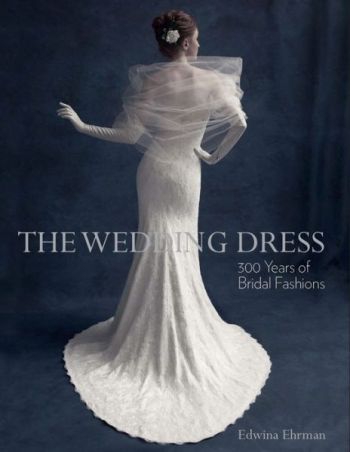 This sumptuous book draws on wedding garments in the V&A’s collection, photographs, letters, memoirs, newspaper accounts and genealogical research to explore the history of the wedding dress and the traditions that have developed around it since 1700. It focuses on the white wedding dress, which became fashionable in the early nineteenth century and is now chosen by women across the world. The book considers the way couturiers and designers have challenged and refreshed the traditional white dress and the influence of the wedding industry, whose antecedents lie in the commercialization of the wedding in Victorian Britain. The Wedding Dress is not only about costume, but also about the cultivation of the image of the bride. This book is a glorious tribute to an exquisite, stylish, glamorous gown, the romance of its evolution and the splendour of its design.
Edwina Ehrman is a curator of Textiles and Fashion at the V&A and of the exhibition The Wedding Dress: 300 Years of Bridal Fashions. She is co-author of The London Look: Fashion from Street to Catwalk and a contributor
to The Englishness of English Dress.
Exhibition | The Coast and the Sea
Press release (4 October 2013) from D. Giles:
Linda S. Ferber, The Coast and the Sea: Marine and Maritime Art in America (London: D. Giles Limited, 2013), 104 pages, ISBN 978-1907804311, $30 / £20.
The Society of the Four Arts, Palm Beach, Florida, 25 January — 9 March 2014
The Baker Museum of Art, Naples, Florida, 19 April — 6 July 2014
Portland Museum of Art, Portland, Maine, January — May 2015
The Mattatuck Museum, Waterbury, Connecticut, 6 June — 13 September 2015
The New York State Museum, Albany, New York, 24 October 2015 — 22 February 2016

A Southeast Prospect of the City of New York, ca. 1756–61. Oil on canvas. 38 x 72 1/2 in. (96.5 x 184.2 cm). Collection of the New-York Historical Society.
◊ ◊ ◊ ◊ ◊
The Coast and the Sea: Marine and Maritime Art in America will be published by D Giles Limited, in association with the New-York Historical Society, in December 2013. It is an appealing and colourful volume which presents over 50 of the best marine paintings and artifacts from the New-York Historical Society’s impressive maritime art collection.
 The works range in date from 1750 to 1940, and are by eminent marine artists like Thomas Birch, John Frederick Kensett, and Charlton T. Chapman. Highlights include large format canvasses of famous sea battles, ships at work, portraits of heroic sea captains, dashing naval officers like James Gordon Bennett Jr. and pioneering merchants, such as the aptly named Preserved Fish of New York, prominent in shipping in the early 19th century. There are also maritime themed objects such as an engraved whale’s tooth from the late 19th century, and a silver presentation urn commemorating acts of bravery from the War of 1812. An essay by curator Linda S. Ferber places the works within their wider historical and cultural narrative.
The works are then arranged thematically rather than by artist or period; there is for example a chapter on the Anglo-Dutch tradition in American marine art: the War of 1812 with its great sea battles and heroes and romantic and idealized visions of the sea. A section on the merchant marine and maritime trade features paintings of major trading posts in and around the Pearl River Delta, including Hong Kong; some of these paintings were by a group of Chinese artists working in the European style specifically for the export market. There are views of the Hudson River and the great Port of New York, as well as Gilded Age nostalgia for the great age of sail, with its clipper ships and majestic wind-jammers.
Linda S. Ferber is Senior Art Historian, the New-York Historical Society.
◊ ◊ ◊ ◊ ◊
Note (added 1 August 2014) — The original version of this posting included only the first two exhibition venues.
New Books | Beastly London / Gorgeous Beasts
Along with these two books (the second of which I should have posted months ago), readers interested in animals may find useful the review essay by Simona Cohen, “Animal Imagery in Renaissance Art,” in Renaissance Quarterly 67 (March 2014): 164–80. -CH
From Reaktion:
Hannah Velten, Beastly London: A History of Animals in the City (London: Reaktion Books, 2013), 288 pags, ISBN: 978-1780231679, £29 / $50.
 Horse-drawn cabs rattling through the streets, terrified cattle being herded along congested thoroughfares to Smithfield market, pigs squealing and grunting in back yards—London was once filled with a cacophony of animal noises (and smells). But over the last thirty years, the city seems to have finally banished animals from its streets, apart from a few well-loved beasts such as the ravens at the Tower of London and the shire horses that pull the Lord Mayor’s golden coach.
Londoners once shared their homes with all kinds of animals—pets, livestock and vermin—and the streets were full of horses, cattle and the animal entertainers that performed to passers-by. Animals from all corners of the globe were imported through London’s docks and exotic beasts became popular attractions at venues such as the Zoological Gardens or lived in the private menageries of kings and naturalists. The city’s residents were entertained by performing fleas, mathematically gifted horses and dancing bears, as well as more bloodthirsty pursuits such as shooting and dog- and cockfights. In the Victorian age the city, not before time, became the birthplace of animal welfare societies and animal rights campaigns. Yet just as conditions gradually improved for the beasts of London, markets, slaughterhouses and dairies began to be moved to the suburbs, and the automobile eventually replaced the horse. The number of resident animals fell, and they are no longer a large part of everyday life in the capital—apart from a stalwart few, such as pets, pigeons and pests. Beastly London explores the complex and changing relationship between Londoners of all backgrounds and their animal neighbours, and reveals how animals helped to shape the city’s economic, social and cultural history.
Hannah Velten is a freelance writer based in Fletching, Sussex, and the author of Cow (Reaktion, 2007) and Milk (Reaktion, 2010).
C O N T E N T S
Introduction: Revealing the Beasts
1. Livestock: Londoners’ Nuisance Neighbours
2. Working Animals: Straining Every Muscle
3. Sporting Animals: Natural Instincts Exploited
4. Animals as Entertainers: Performance, Peculiarity and Pressure
5. Exotic Animals: The Allure of the Foreign and the Wild
6. Pampered Pets and Sad Strays
7. London Wildlife: The Persecuted and the Celebrated
Final Thoughts: An Apology and a Pardon
References
Acknowledgements
Photo Acknowledgements
Index
◊ ◊ ◊ ◊ ◊
From Penn State UP:
Joan B. Landes, Paula Young Lee, and Paul Youngquist, eds., Gorgeous Beasts: Animal Bodies in Historical Perspective (University Park: Pennsylvania State University Press, 2012), 258 pages, ISBN: 978-0271054018, $50.
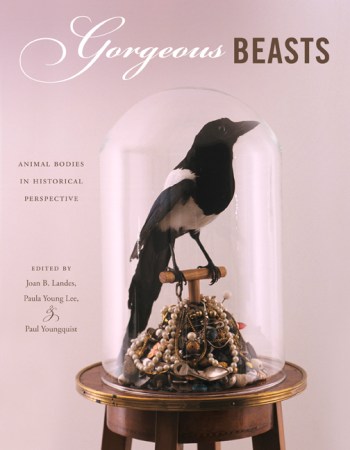 Gorgeous Beasts takes a fresh look at the place of animals in history and art. Refusing the traditional subordination of animals to humans, the essays gathered here examine a rich variety of ways animals contribute to culture: as living things, as scientific specimens, as food, weapons, tropes, and occasions for thought and creativity. History and culture set the terms for this inquiry. As history changes, so do the ways animals participate in culture. Gorgeous Beasts offers a series of discontinuous but probing studies of the forms their participation takes.
This collection presents the work of a wide range of scholars, critics, and thinkers from diverse disciplines: philosophy, literature, history, geography, economics, art history, cultural studies, and the visual arts. By approaching animals from such different perspectives, these essays broaden the scope of animal studies to include specialists and nonspecialists alike, inviting readers from all backgrounds to consider the place of animals in history and art. Combining provocative critical insights with arresting visual imagery, Gorgeous Beasts advances a challenging new appreciation of animals as co-inhabitants and co-creators of culture.
Joan B. Landes is Walter L. and Helen Ferree Professor of Early Modern History and Women’s Studies at The Pennsylvania State University. Paula Young Lee is an independent scholar and the editor of Meat, Modernity, and the Rise of the Slaughterhouse (2008). Paul Youngquist is Professor of English at the University of Colorado.
C O N T E N T S
List of Illustrations
Acknowledgments
Introduction, Joan B. Landes, Paula Young Lee, and Paul Youngquist
1. Animal Subjects: Between Nature and Invention in Buffon’s Natural History Illustrations, Joan B. Landes
2. Renaissance Animal Things, Erica Fudge
3. The Cujo Effect, Paul Youngquist
4. On Vulnerability: Studies from Life That Ought Not to Be Copied, Ron Broglio
5. The Rights of Man and the Rights of Animality at the End of the Eighteenth Century, Pierre Serna, Translated by Vito Caiati and Joan B. Landes
6. Calling the Wild, Harriet Ritvo
7. Trophies and Taxidermy, Nigel Rothfels
8. Fishing for Biomass, Sajay Samuel and Dean Bavington
9. Daniel Spoerri’s Carnival of Animals, Cecilia Novero
A Conversation with the Artist Mark Dion, Joan B. Landes, Paula Young Lee, and Paul Youngquist
Bibliography
About the Contributors
Index










leave a comment